flat NISSAN ROGUE 2022 Owners Manual
[x] Cancel search | Manufacturer: NISSAN, Model Year: 2022, Model line: ROGUE, Model: NISSAN ROGUE 2022Pages: 516, PDF Size: 2.13 MB
Page 66 of 516
WAB0046X
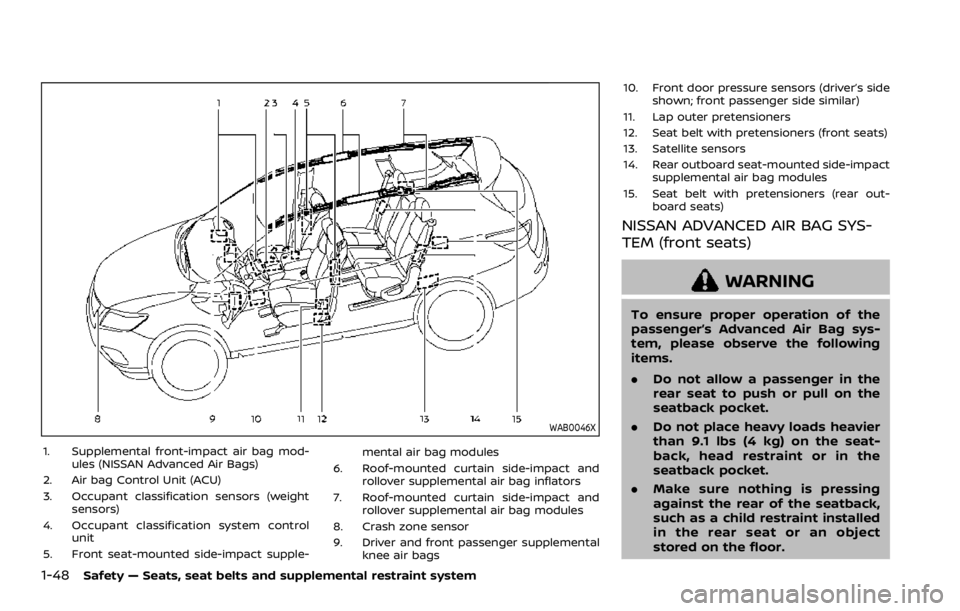
1. Supplemental front-impact air bag mod-ules (NISSAN Advanced Air Bags)
2. Air bag Control Unit (ACU)
3. Occupant classification sensors (weight sensors)
4. Occupant classification system control unit
5. Front seat-mounted side-impact supple- mental air bag modules
6. Roof-mounted curtain side-impact and rollover supplemental air bag inflators
7. Roof-mounted curtain side-impact and rollover supplemental air bag modules
8. Crash zone sensor
9. Driver and front passenger supplemental knee air bags 10. Front door pressure sensors (driver’s side
shown; front passenger side similar)
11. Lap outer pretensioners
12. Seat belt with pretensioners (front seats)
13. Satellite sensors
14. Rear outboard seat-mounted side-impact supplemental air bag modules
15. Seat belt with pretensioners (rear out- board seats)
NISSAN ADVANCED AIR BAG SYS-
TEM (front seats)
Page 81 of 516
REPAIR AND REPLACEMENT PRO-
CEDURE
The front air bags, knee air bags, side air
bags, curtain air bags and pretensioners
are designed to activate on a one-time-
only basis. As a reminder, unless it is
damaged, the supplemental air bag
warning light will remain illuminated after
inflation has occurred. These systems
should be repaired and/or replaced as
soon as possible. It is recommended you
visit a NISSAN dealer for this service.
When maintenance work is required on
the vehicle, the front air bags, knee air
bags, side air bags, curtain air bags and
pretensioners and related parts should be
pointed out to the person performing the
maintenance. The ignition switch should
always be in the LOCK position when
working under the hood or inside the
vehicle.
Page 250 of 516
TPMS with Easy Fill Tire Alert
When adding air to an under-inflated tire,
the TPMS with Easy Fill Tire Alert provides
visual and audible signals outside the
vehicle to help you inflate the tires to
the recommended COLD tire pressure.
Vehicle set-up:
1. Park the vehicle in a safe and levelplace.
2. Apply the parking brake and place the shift lever in the P (Park) position (CVT
model) or N (Neutral) position (MT
model).
3. Place the ignition switch in the ON position. Do not start the engine.
Operation:
Page 364 of 516
CAUTION
During the first 1,200 miles (2,000
km), follow these recommendations
to obtain maximum engine perfor-
mance and ensure the future relia-
bility and economy of your new
vehicle. Failure to follow these re-
commendations may result in shor-
tened engine life and reduced engine
performance.
. Avoid driving for long periods at con-
stant speed, either fast or slow. Do not
run the engine over 4,000 rpm.
. Do not accelerate at full throttle in any
gear.
. Avoid quick starts.
. Avoid hard braking as much as possi-
ble. Follow these easy-to-use Fuel Efficient
Driving Tips to help you achieve the most
fuel economy from your vehicle.
1. Use smooth accelerator and brake
pedal application.
.Avoid rapid starts and stops..Use smooth, gentle accelerator andbrake application whenever possi-
ble.
.Maintain constant speed whilecommuting and coast whenever
possible.
2. Maintain constant speed.
.Look ahead to try and anticipate and minimize stops.
.Synchronizing your speed with traf-fic lights allows you to reduce your
number of stops.
.Maintaining a steady speed canminimize red light stops and im-
prove fuel efficiency.
3. Use air conditioning (A/C) at higher vehicle speeds.
.Below 40 MPH (64 km/h), it is moreefficient to open windows to cool
the vehicle due to reduced engine
load.
.Above 40 MPH (64 km/h), it is more
efficient to use A/C to cool the
vehicle due to increased aerody-
namic drag.
.Recirculating the cool air in thecabin when the A/C is on reduces
cooling load.
4. Drive at economical speeds and dis- tances.
.Observing the speed limit and notexceeding 60 MPH (97 km/h)
(where legally allowed) can improve
fuel efficiency due to reduced aero-
dynamic drag.
.Maintaining a safe following dis-tance behind other vehicles re-
duces unnecessary braking.
.Safely monitoring traffic to antici- pate changes in speed permits
reduced braking and smooth accel-
eration changes.
.Select a gear range suitable to roadconditions.
5. Use cruise control.
.Using cruise control during highway driving helps maintain a steady
speed.
.Cruise control is particularly effec-tive in providing fuel savings when
driving on flat terrains.
6. Plan for the shortest route.
.Utilize a map or navigation system to determine the best route to save
time.
BREAK-IN SCHEDULE FUEL EFFICIENT DRIVING TIPS
Page 384 of 516
All-Wheel Drive (AWD) model
If you install snow tires, they must also be
the same size, brand, construction and
tread pattern on all four wheels.
SPECIAL WINTER EQUIPMENT
It is recommended that the following
items be carried in the vehicle during
winter:
.A scraper and stiff-bristled brush to
remove ice and snow from the win-
dows and wiper blades.
. A sturdy, flat board to be placed under
the jack to give it firm support.
. A shovel to dig the vehicle out of
snow-drifts.
. Extra window washer fluid to refill the
reservoir tank.
DRIVING ON SNOW OR ICE
Page 395 of 516
contact a NISSAN dealer about obtain-
ing these parts. See “Changing a flat tire
(models with spare tire)” (P.6-4) for
usage of jacking tools and tire replace-
ment.
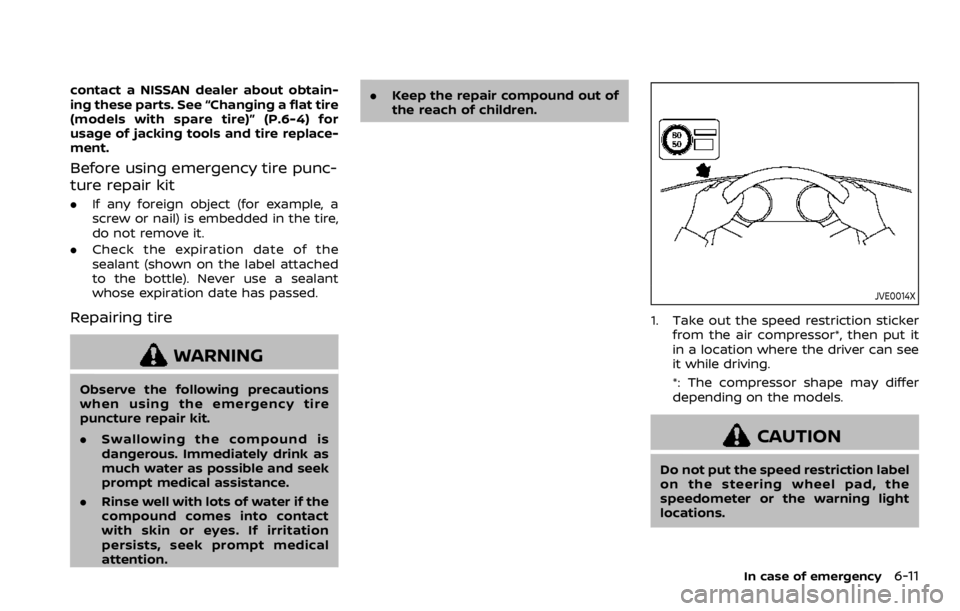
Before using emergency tire punc-
ture repair kit
.If any foreign object (for example, a
screw or nail) is embedded in the tire,
do not remove it.
. Check the expiration date of the
sealant (shown on the label attached
to the bottle). Never use a sealant
whose expiration date has passed.
Repairing tire
Page 397 of 516
SCE0871
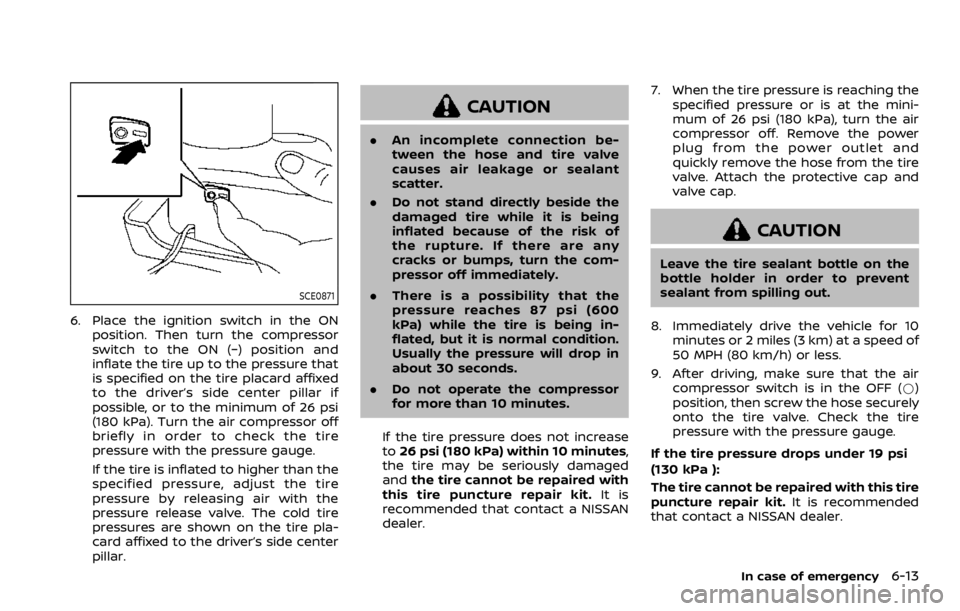
6. Place the ignition switch in the ONposition. Then turn the compressor
switch to the ON (−) position and
inflate the tire up to the pressure that
is specified on the tire placard affixed
to the driver’s side center pillar if
possible, or to the minimum of 26 psi
(180 kPa). Turn the air compressor off
briefly in order to check the tire
pressure with the pressure gauge.
If the tire is inflated to higher than the
specified pressure, adjust the tire
pressure by releasing air with the
pressure release valve. The cold tire
pressures are shown on the tire pla-
card affixed to the driver’s side center
pillar.
Page 398 of 516
If the tire pressure is 19 psi (130 kPa) or
more but less than the specified pres-
sure:
Turn the compressor switch to the ON (−)
position and inflate the tire up to the
specified pressure. Then repeat the steps
from 8.
If the pressure drops again,the tire
cannot be repaired with this tire punc-
ture repair kit. It is recommended that
contact a NISSAN dealer.
When the tire pressure is the specified
pressure:
The temporary repair is completed.
It is recommended that visit a NISSAN
dealer for tire repair/replacement as soon
as possible.
Page 403 of 516
SCE0952
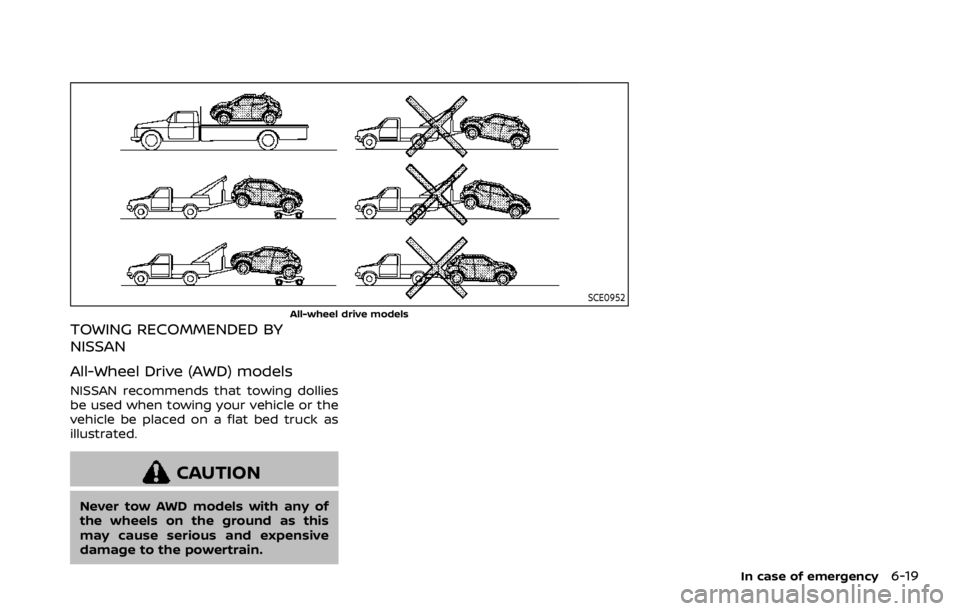
All-wheel drive models
TOWING RECOMMENDED BY
NISSAN
All-Wheel Drive (AWD) models
NISSAN recommends that towing dollies
be used when towing your vehicle or the
vehicle be placed on a flat bed truck as
illustrated.
Page 404 of 516
SCE0950
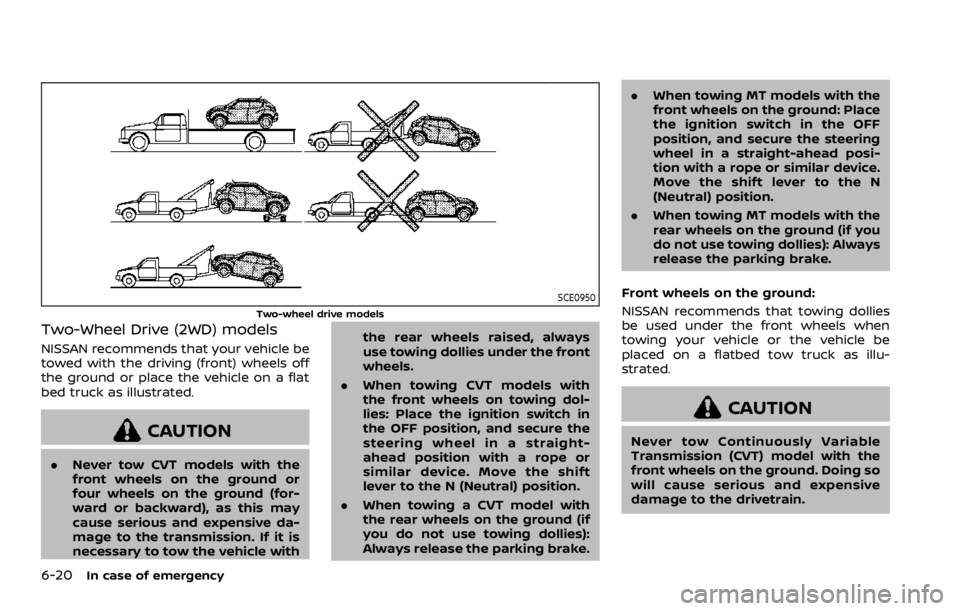
Two-wheel drive models
Two-Wheel Drive (2WD) models
NISSAN recommends that your vehicle be
towed with the driving (front) wheels off
the ground or place the vehicle on a flat
bed truck as illustrated.