Tire indicator light NISSAN ROGUE 2023 Owners Manual
[x] Cancel search | Manufacturer: NISSAN, Model Year: 2023, Model line: ROGUE, Model: NISSAN ROGUE 2023Pages: 508, PDF Size: 2.44 MB
Page 18 of 508
0-10Illustrated table of contents
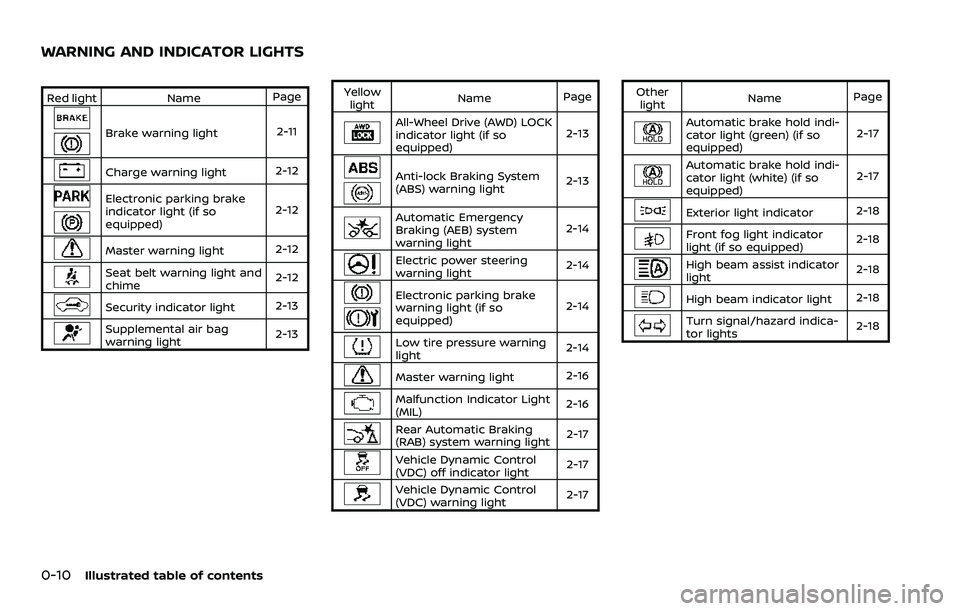
Red lightNamePage
Brake warning light 2-11
Charge warning light2-12
Electronic parking brake
indicator light (if so
equipped)2-12
Master warning light
2-12
Seat belt warning light and
chime2-12
Security indicator light
2-13
Supplemental air bag
warning light2-13Yellow
light Name
Page
All-Wheel Drive (AWD) LOCK
indicator light (if so
equipped) 2-13
Anti-lock Braking System
(ABS) warning light
2-13
Automatic Emergency
Braking (AEB) system
warning light2-14
Electric power steering
warning light
2-14
Electronic parking brake
warning light (if so
equipped)2-14
Low tire pressure warning
light
2-14
Master warning light
2-16
Malfunction Indicator Light
(MIL)2-16
Rear Automatic Braking
(RAB) system warning light
2-17
Vehicle Dynamic Control
(VDC) off indicator light2-17
Vehicle Dynamic Control
(VDC) warning light
2-17Other
light Name
Page
Automatic brake hold indi-
cator light (green) (if so
equipped) 2-17
Automatic brake hold indi-
cator light (white) (if so
equipped)2-17
Exterior light indicator
2-18
Front fog light indicator
light (if so equipped)2-18
High beam assist indicator
light
2-18
High beam indicator light
2-18
Turn signal/hazard indica-
tor lights2-18
WARNING AND INDICATOR LIGHTS
Page 92 of 508
2-10Instruments and controls
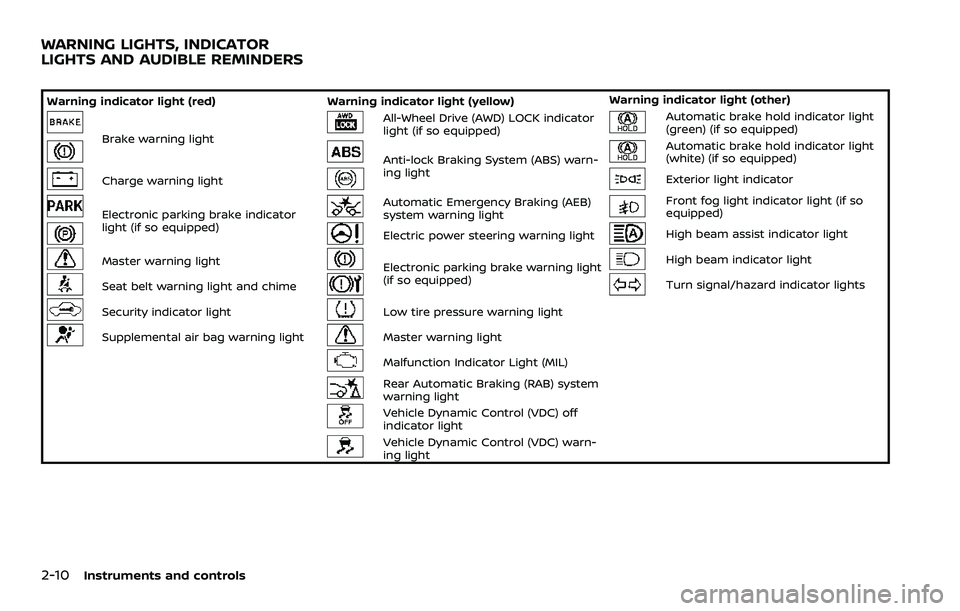
Warning indicator light (red)Warning indicator light (yellow) Warning indicator light (other)
Brake warning light
All-Wheel Drive (AWD) LOCK indicator
light (if so equipped)Automatic brake hold indicator light
(green) (if so equipped)
Anti-lock Braking System (ABS) warn-
ing lightAutomatic brake hold indicator light
(white) (if so equipped)
Charge warning lightExterior light indicator
Electronic parking brake indicator
light (if so equipped)Automatic Emergency Braking (AEB)
system warning lightFront fog light indicator light (if so
equipped)
Electric power steering warning lightHigh beam assist indicator light
Master warning lightElectronic parking brake warning light
(if so equipped)High beam indicator light
Seat belt warning light and chimeTurn signal/hazard indicator lights
Security indicator lightLow tire pressure warning light
Supplemental air bag warning lightMaster warning light
Malfunction Indicator Light (MIL)
Rear Automatic Braking (RAB) system
warning light
Vehicle Dynamic Control (VDC) off
indicator light
Vehicle Dynamic Control (VDC) warn-
ing light
WARNING LIGHTS, INDICATOR
LIGHTS AND AUDIBLE REMINDERS
Page 98 of 508
2-16Instruments and controls
CAUTION
.The TPMS is not a substitute for
the regular tire pressure check.
Be sure to check the tire pressure
regularly.
. If the vehicle is being driven at
speeds of less than 16 MPH (25
km/h), the TPMS may not operate
correctly.
. Be sure to install the specified
size of tires to the four wheels
correctly.
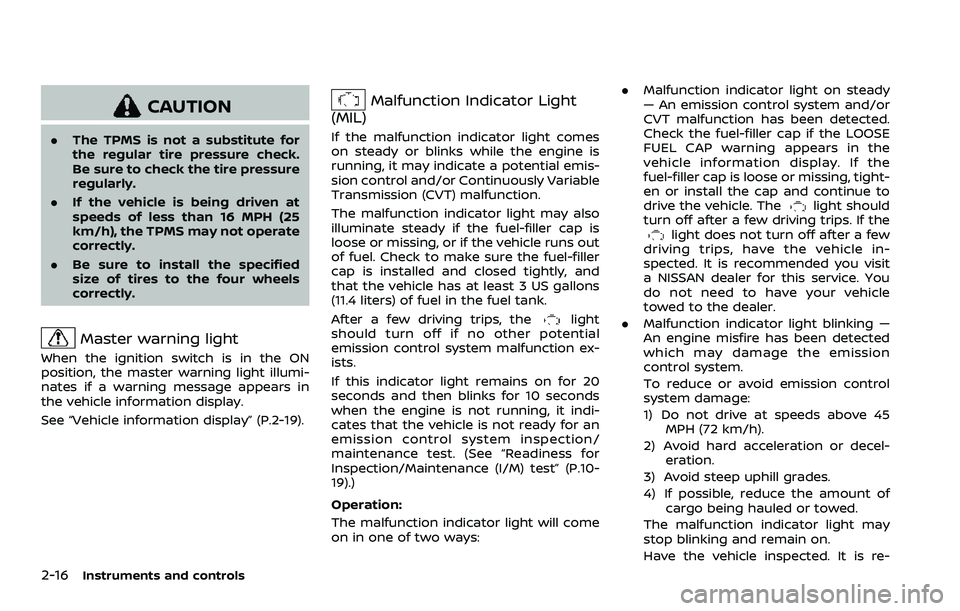
Master warning light
When the ignition switch is in the ON
position, the master warning light illumi-
nates if a warning message appears in
the vehicle information display.
See “Vehicle information display” (P.2-19).
Malfunction Indicator Light
(MIL)
If the malfunction indicator light comes
on steady or blinks while the engine is
running, it may indicate a potential emis-
sion control and/or Continuously Variable
Transmission (CVT) malfunction.
The malfunction indicator light may also
illuminate steady if the fuel-filler cap is
loose or missing, or if the vehicle runs out
of fuel. Check to make sure the fuel-filler
cap is installed and closed tightly, and
that the vehicle has at least 3 US gallons
(11.4 liters) of fuel in the fuel tank.
After a few driving trips, the
light
should turn off if no other potential
emission control system malfunction ex-
ists.
If this indicator light remains on for 20
seconds and then blinks for 10 seconds
when the engine is not running, it indi-
cates that the vehicle is not ready for an
emission control system inspection/
maintenance test. (See “Readiness for
Inspection/Maintenance (I/M) test” (P.10-
19).)
Operation:
The malfunction indicator light will come
on in one of two ways: .
Malfunction indicator light on steady
— An emission control system and/or
CVT malfunction has been detected.
Check the fuel-filler cap if the LOOSE
FUEL CAP warning appears in the
vehicle information display. If the
fuel-filler cap is loose or missing, tight-
en or install the cap and continue to
drive the vehicle. The
light should
turn off after a few driving trips. If the
light does not turn off after a few
driving trips, have the vehicle in-
spected. It is recommended you visit
a NISSAN dealer for this service. You
do not need to have your vehicle
towed to the dealer.
. Malfunction indicator light blinking —
An engine misfire has been detected
which may damage the emission
control system.
To reduce or avoid emission control
system damage:
1) Do not drive at speeds above 45
MPH (72 km/h).
2) Avoid hard acceleration or decel- eration.
3) Avoid steep uphill grades.
4) If possible, reduce the amount of cargo being hauled or towed.
The malfunction indicator light may
stop blinking and remain on.
Have the vehicle inspected. It is re-
Page 257 of 508
JVS0404X
INTELLIGENT KEY BATTERY DIS-
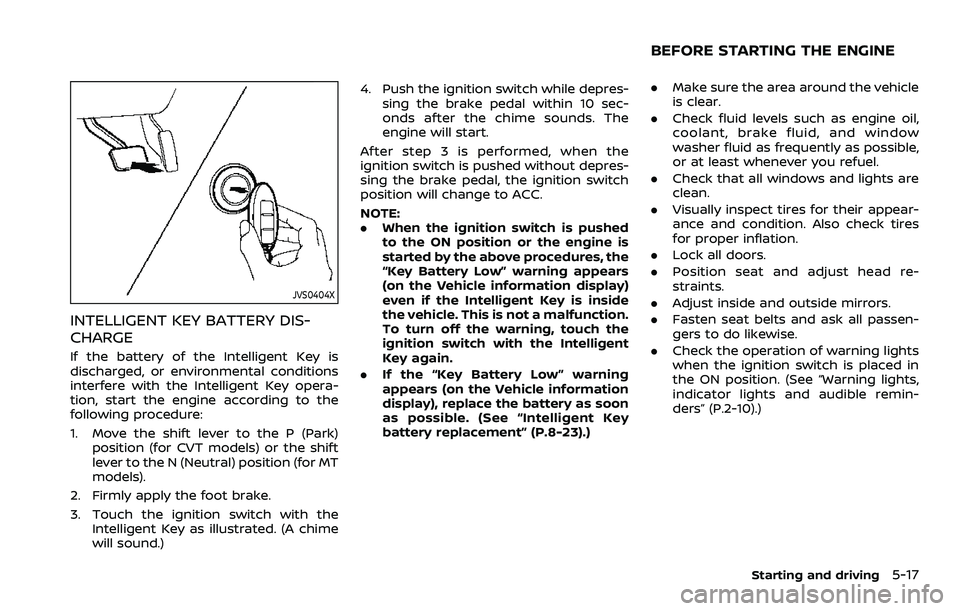
CHARGE
If the battery of the Intelligent Key is
discharged, or environmental conditions
interfere with the Intelligent Key opera-
tion, start the engine according to the
following procedure:
1. Move the shift lever to the P (Park)position (for CVT models) or the shift
lever to the N (Neutral) position (for MT
models).
2. Firmly apply the foot brake.
3. Touch the ignition switch with the Intelligent Key as illustrated. (A chime
will sound.) 4. Push the ignition switch while depres-
sing the brake pedal within 10 sec-
onds after the chime sounds. The
engine will start.
After step 3 is performed, when the
ignition switch is pushed without depres-
sing the brake pedal, the ignition switch
position will change to ACC.
NOTE:
. When the ignition switch is pushed
to the ON position or the engine is
started by the above procedures, the
“Key Battery Low” warning appears
(on the Vehicle information display)
even if the Intelligent Key is inside
the vehicle. This is not a malfunction.
To turn off the warning, touch the
ignition switch with the Intelligent
Key again.
. If the “Key Battery Low” warning
appears (on the Vehicle information
display), replace the battery as soon
as possible. (See “Intelligent Key
battery replacement” (P.8-23).)
.Make sure the area around the vehicle
is clear.
. Check fluid levels such as engine oil,
coolant, brake fluid, and window
washer fluid as frequently as possible,
or at least whenever you refuel.
. Check that all windows and lights are
clean.
. Visually inspect tires for their appear-
ance and condition. Also check tires
for proper inflation.
. Lock all doors.
. Position seat and adjust head re-
straints.
. Adjust inside and outside mirrors.
. Fasten seat belts and ask all passen-
gers to do likewise.
. Check the operation of warning lights
when the ignition switch is placed in
the ON position. (See “Warning lights,
indicator lights and audible remin-
ders” (P.2-10).)
Starting and driving5-17
BEFORE STARTING THE ENGINE
Page 278 of 508
5-38Starting and driving
.Do not use the LDW system under
the following conditions as it may
not function properly:
— During bad weather (rain, fog,
snow, etc.).
— When driving on slippery roads, such as on ice or snow.
— When driving on winding or uneven roads.
— When there is a lane closure due to road repairs.
— When driving in a makeshift or temporary lane.
— When driving on roads where the lane width is too narrow.
— When driving without normal tire conditions (for example,
tire wear, low tire pressure,
installation of spare tire (if so
equipped), tire chains, non-
standard wheels).
— When the vehicle is equipped with non-original brake parts
or suspension parts.
. The system may not function
properly under the following con-
ditions: — On roads where there are
multiple parallel lane markers;
lane markers that are faded or
not painted clearly; yellow
painted lane markers; non-
standard lane markers; or
lane markers covered with
water, dirt, snow, etc.
— On roads where discontinued lane markers are still detect-
able.
— On roads where there are sharp curves.
— On roads where there are sharply contrasting objects,
such as shadows, snow,
water, wheel ruts, seams or
lines remaining after road re-
pairs. (The LDW system could
detect these items as lane
markers.)
— On roads where the traveling lane merges or separates.
— When the vehicle’s traveling direction does not align with
the lane marker.
— When traveling close to the vehicle in front of you, which
obstructs the lane camera
unit detection range. — When rain, snow, dirt or object
adheres to the windshield in
front of the lane camera unit.
— When the headlights are not bright due to dirt on the lens
or if the aiming is not adjusted
properly.
— When strong light enters the lane camera unit. (For exam-
ple, the light directly shines on
the front of the vehicle at
sunrise or sunset.)
— When a sudden change in brightness occurs. (For exam-
ple, when the vehicle enters or
exits a tunnel or under a
bridge.)
SYSTEM TEMPORARILY UNAVAIL-
ABLE
Condition A:
If the vehicle is parked in direct sunlight
under high temperature conditions (over
approximately 104°F (40°C)) and then
started, the LDW system may be deacti-
vated automatically, the LDW indicator
will flash and the following message will
appear in the vehicle information display.
- “Unavailable: High Cabin Temperature”
When the interior temperature is reduced,
Page 329 of 508
tions (for example, tire wear,
abnormal tire pressure, instal-
lation of a spare tire (if so
equipped), tire chains, non-
standard wheels)
— When the vehicle is equipped with non-original brake or
suspension parts
— When an object such as a sticker or cargo obstructs the
camera
— When excessively heavy bag- gage is loaded in the rear seat
or luggage area of your vehi-
cle
— When the vehicle load capa- city is exceeded
. Excessive noise will interfere with
the warning chime sound, and
the beep may not be heard.
. For the ProPILOT assist system to
operate properly, the windshield
in front of the camera must be
clean. Replace worn wiper blades.
The correct size wiper blades
must be used to help make sure
the windshield is kept clean. Only
use Genuine NISSAN wiper blades,
or equivalent wiper blades, that
are specifically designed for use on your vehicle model and model
year. It is recommended that you
visit your NISSAN dealer for the
correct parts for your vehicle.
Steering Assist temporary standby
Automatic standby due to driving op-
eration:
When the driver activates the turn signal,
the Steering Assist is temporarily placed
in a standby mode. (The Steering Assist
restarts automatically when the operat-
ing conditions are met again.)
Automatic standby:
In the following cases, a warning mes-
sage is displayed along with the chime,
and the Steering Assist is placed in a
temporary standby mode. (The Steering
Assist restarts automatically when the
operating conditions are met again.)
.
When lane markers on both sides are
no longer detected
. When a vehicle ahead is no longer
detected under approximately 37 MPH
(60 km/h)
Steering assist cancel
Under the following conditions, the steer-
ing assist cancels, and the steering assist
status indicator and the steering assist
indicator turn off:
. When unusual lane markers appear in
the traveling lane or when the lane
marker cannot be correctly detected
for some time due to certain condi-
tions (for example, a snow rut, the
reflection of light on a rainy day, the
presence of several unclear lane mar-
kers)
. When the windshield wiper operates
in the high speed operation (the
steering assist is disabled when the
wiper operates for more than approxi-
mately 10 seconds)
Action to take:
Turn the ICC system off using the CANCEL
switch. When the conditions listed above
are no longer present, turn the ICC
system on again.
Steering assist malfunction
When the system malfunctions, it turns
off automatically. The steering assist
status warning (orange) illuminates. A
chime may sound depending on the
situation.
Starting and driving5-89
Page 385 of 508
To shut off the engine in an emergency
situation while driving, perform the fol-
lowing procedure:
.Rapidly push the push-button ignition
switch 3 consecutive times in less
than 1.5 seconds, or
. Push and hold the push-button igni-
tion switch for more than 2 seconds.TIRE PRESSURE MONITORING SYS-
TEM (TPMS)
This vehicle is equipped with the Tire
Pressure Monitoring System (TPMS). It
monitors tire pressure of all tires except
the spare (if so equipped). When the low
tire pressure warning light is lit, and the
“Tire Pressure Low - Add Air” warning
message is displayed in the vehicle in-
formation display, one or more of your
tires is significantly under-inflated. If the
vehicle is being driven with low tire
pressure, the TPMS will activate and warn
you of it by the low tire pressure warning
light. This system will activate only when
the vehicle is driven at speeds above 16
MPH (25 km/h). For more details, see
“Warning lights, indicator lights and audi-
ble reminders” (P.2-10) and “Tire Pressure
Monitoring System (TPMS)” (P.5-5).
WARNING
.If the low tire pressure warning
light illuminates while driving,
avoid sudden steering maneu-
vers or abrupt braking, reduce
vehicle speed, pull off the road
to a safe location and stop the
vehicle as soon as possible. Driv-
ing with under-inflated tires may
permanently damage the tires and increase the likelihood of tire
failure. Serious vehicle damage
could occur and may lead to an
accident and could result in ser-
ious personal injury. Check the
tire pressure for all four tires.
Adjust the tire pressure to the
recommended COLD tire pressure
shown on the Tire and Loading
Information label to turn the low
tire pressure warning light OFF. If
the light still illuminates while
driving after adjusting the tire
pressure, a tire may be flat. If
you have a flat tire, replace it with
a spare tire (if so equipped) or
repair it using the emergency tire
puncture repair kit (if so
equipped) as soon as possible.
. Since the spare tire (if so
equipped) is not equipped with
the TPMS, when a spare tire is
mounted or a wheel is replaced,
the TPMS will not function and
the low tire pressure warning
light will flash for approximately
1 minute. The light will remain on
after 1 minute. Have your tires
replaced and/or TPMS system
reset as soon as possible. It is
recommended you visit a NISSAN
dealer for these services.
In case of emergency6-3
EMERGENCY ENGINE SHUT OFF (models
with push-button ignition switch)FLAT TIRE
Page 450 of 508
8-38Do-it-yourself
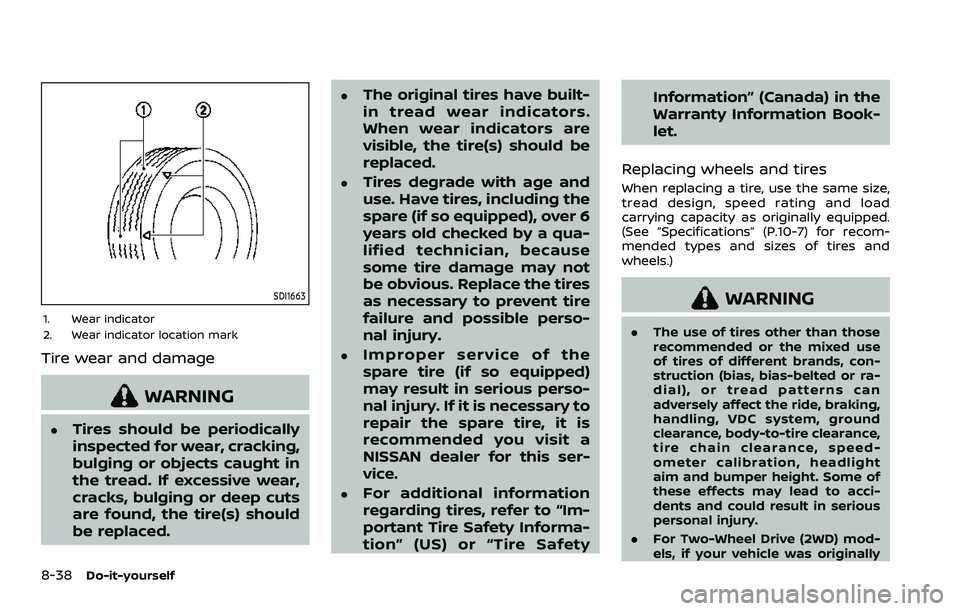
SDI1663
1. Wear indicator
2. Wear indicator location mark
Tire wear and damage
WARNING
.Tires should be periodically
inspected for wear, cracking,
bulging or objects caught in
the tread. If excessive wear,
cracks, bulging or deep cuts
are found, the tire(s) should
be replaced.
.The original tires have built-
in tread wear indicators.
When wear indicators are
visible, the tire(s) should be
replaced.
.Tires degrade with age and
use. Have tires, including the
spare (if so equipped), over 6
years old checked by a qua-
lified technician, because
some tire damage may not
be obvious. Replace the tires
as necessary to prevent tire
failure and possible perso-
nal injury.
.Improper service of the
spare tire (if so equipped)
may result in serious perso-
nal injury. If it is necessary to
repair the spare tire, it is
recommended you visit a
NISSAN dealer for this ser-
vice.
.For additional information
regarding tires, refer to “Im-
portant Tire Safety Informa-
tion” (US) or “Tire SafetyInformation” (Canada) in the
Warranty Information Book-
let.
Replacing wheels and tires
When replacing a tire, use the same size,
tread design, speed rating and load
carrying capacity as originally equipped.
(See “Specifications” (P.10-7) for recom-
mended types and sizes of tires and
wheels.)
WARNING
. The use of tires other than those
recommended or the mixed use
of tires of different brands, con-
struction (bias, bias-belted or ra-
dial), or tread patterns can
adversely affect the ride, braking,
handling, VDC system, ground
clearance, body-to-tire clearance,
tire chain clearance, speed-
ometer calibration, headlight
aim and bumper height. Some of
these effects may lead to acci-
dents and could result in serious
personal injury.
. For Two-Wheel Drive (2WD) mod-
els, if your vehicle was originally
Page 500 of 508
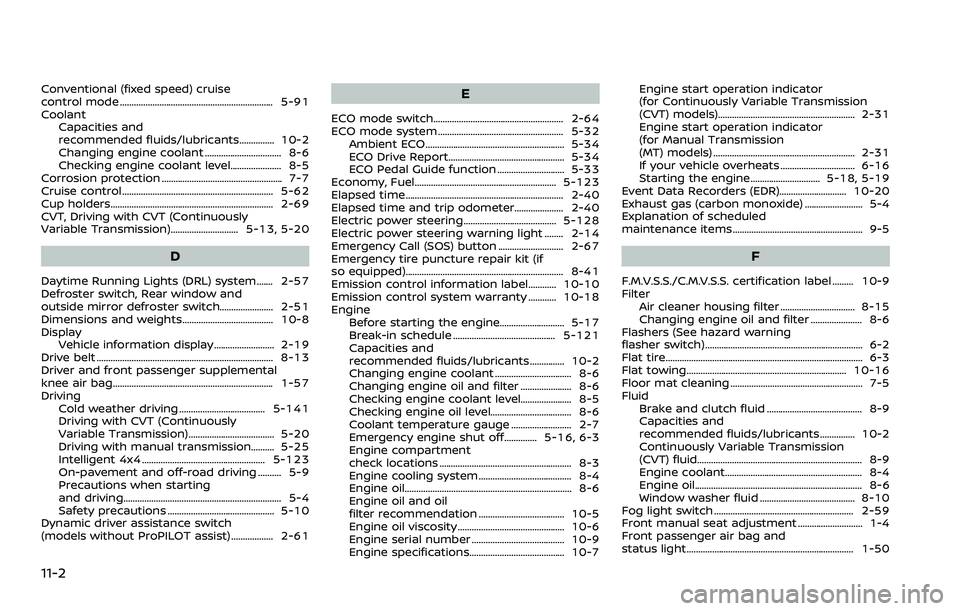
11-2
Conventional (fixed speed) cruise
control mode .................................................................. 5-91
CoolantCapacities and
recommended fluids/lubricants............... 10-2
Changing engine coolant ................................. 8-6
Checking engine coolant level...................... 8-5
Corrosion protection .................................................... 7-7
Cruise control ................................................................. 5-62
Cup holders...................................................................... 2-69
CVT, Driving with CVT (Continuously
Variable Transmission)............................. 5-13, 5-20
D
Daytime Running Lights (DRL) system....... 2-57
Defroster switch, Rear window and
outside mirror defroster switch....................... 2-51
Dimensions and weights....................................... 10-8
Display Vehicle information display.......................... 2-19
Drive belt ........................................................................\
.... 8-13
Driver and front passenger supplemental
knee air bag..................................................................... 1-57
Driving Cold weather driving ..................................... 5-141
Driving with CVT (Continuously
Variable Transmission)..................................... 5-20
Driving with manual transmission.......... 5-25
Intelligent 4x4 ..................................................... 5-123
On-pavement and off-road driving .......... 5-9
Precautions when starting
and driving.................................................................... 5-4
Safety precautions .............................................. 5-10
Dynamic driver assistance switch
(models without ProPILOT assist) .................. 2-61
E
ECO mode switch........................................................ 2-64
ECO mode system ...................................................... 5-32 Ambient ECO............................................................ 5-34
ECO Drive Report.................................................. 5-34
ECO Pedal Guide function ............................. 5-33
Economy, Fuel............................................................. 5-123
Elapsed time.................................................................... 2-40
Elapsed time and trip odometer..................... 2-40
Electric power steering........................................ 5-128
Electric power steering warning light ........ 2-14
Emergency Call (SOS) button ............................ 2-67
Emergency tire puncture repair kit (if
so equipped).................................................................... 8-41
Emission control information label............ 10-10
Emission control system warranty ............ 10-18
Engine Before starting the engine............................ 5-17
Break-in schedule ............................................ 5-121
Capacities and
recommended fluids/lubricants............... 10-2
Changing engine coolant ................................. 8-6
Changing engine oil and filter ...................... 8-6
Checking engine coolant level...................... 8-5
Checking engine oil level................................... 8-6
Coolant temperature gauge .......................... 2-7
Emergency engine shut off.............. 5-16, 6-3
Engine compartment
check locations ......................................................... 8-3
Engine cooling system ........................................ 8-4
Engine oil.....................................................................\
... 8-6
Engine oil and oil
filter recommendation ..................................... 10-5
Engine oil viscosity .............................................. 10-6
Engine serial number ........................................ 10-9
Engine specifications......................................... 10-7 Engine start operation indicator
(for Continuously Variable Transmission
(CVT) models)........................................................... 2-31
Engine start operation indicator
(for Manual Transmission
(MT) models) ............................................................. 2-31
If your vehicle overheats ................................ 6-16
Starting the engine.............................. 5-18, 5-19
Event Data Recorders (EDR)............................. 10-20
Exhaust gas (carbon monoxide) ......................... 5-4
Explanation of scheduled
maintenance items ........................................................ 9-5
F
F.M.V.S.S./C.M.V.S.S. certification label ......... 10-9
Filter Air cleaner housing filter ................................ 8-15
Changing engine oil and filter ...................... 8-6
Flashers (See hazard warning
flasher switch).................................................................... 6-2
Flat tire........................................................................\
............. 6-3
Flat towing..................................................................... 10-16
Floor mat cleaning ......................................................... 7-5
Fluid Brake and clutch fluid ......................................... 8-9
Capacities and
recommended fluids/lubricants............... 10-2
Continuously Variable Transmission
(CVT) fluid....................................................................... 8-9
Engine coolant........................................................... 8-4
Engine oil.....................................................................\
... 8-6
Window washer fluid ......................................... 8-10
Fog light switch ............................................................ 2-59
Front manual seat adjustment ............................ 1-4
Front passenger air bag and
status light........................................................................\
1-50
Page 502 of 508
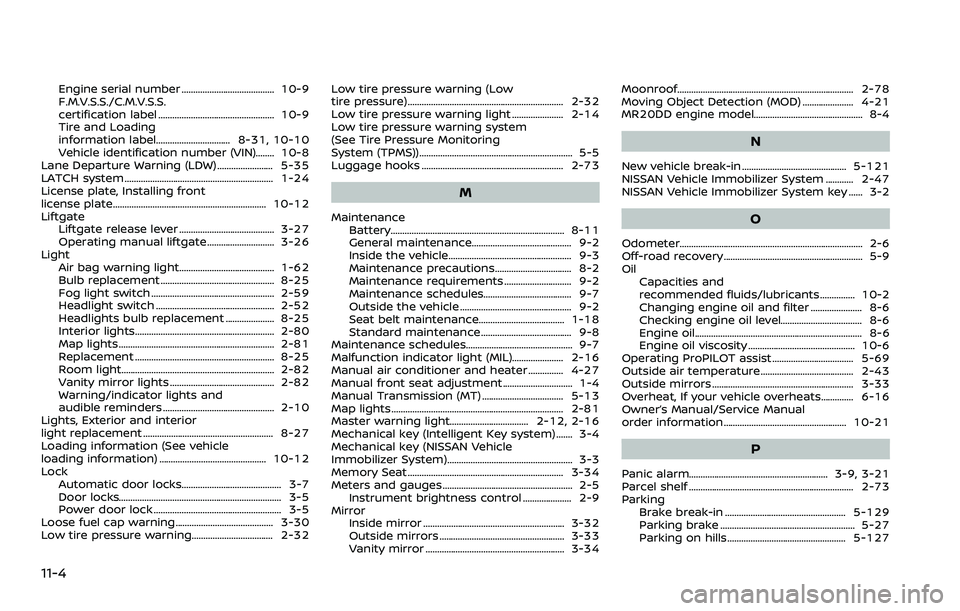
11-4
Engine serial number ........................................ 10-9
F.M.V.S.S./C.M.V.S.S.
certification label .................................................. 10-9
Tire and Loading
information label................................ 8-31, 10-10
Vehicle identification number (VIN)........ 10-8
Lane Departure Warning (LDW) ........................ 5-35
LATCH system ................................................................ 1-24
License plate, Installing front
license plate.................................................................. 10-12
Liftgate Liftgate release lever ......................................... 3-27
Operating manual liftgate............................. 3-26
Light Air bag warning light......................................... 1-62
Bulb replacement ................................................. 8-25
Fog light switch ..................................................... 2-59
Headlight switch ................................................... 2-52
Headlights bulb replacement ..................... 8-25
Interior lights............................................................ 2-80
Map lights ................................................................... 2-81
Replacement ............................................................ 8-25
Room light.................................................................. 2-82
Vanity mirror lights ............................................. 2-82
Warning/indicator lights and
audible reminders ................................................ 2-10
Lights, Exterior and interior
light replacement ........................................................ 8-27
Loading information (See vehicle
loading information) .............................................. 10-12
Lock Automatic door locks........................................... 3-7
Door locks...................................................................... 3-5
Power door lock ....................................................... 3-5
Loose fuel cap warning.......................................... 3-30
Low tire pressure warning................................... 2-32 Low tire pressure warning (Low
tire pressure) ................................................................... 2-32
Low tire pressure warning light ...................... 2-14
Low tire pressure warning system
(See Tire Pressure Monitoring
System (TPMS)).................................................................. 5-5
Luggage hooks ............................................................. 2-73
M
Maintenance
Battery........................................................................\
... 8-11
General maintenance........................................... 9-2
Inside the vehicle..................................................... 9-3
Maintenance precautions................................. 8-2
Maintenance requirements ............................. 9-2
Maintenance schedules...................................... 9-7
Outside the vehicle ................................................ 9-2
Seat belt maintenance..................................... 1-18
Standard maintenance ....................................... 9-8
Maintenance schedules.............................................. 9-7
Malfunction indicator light (MIL)...................... 2-16
Manual air conditioner and heater ............... 4-27
Manual front seat adjustment .............................. 1-4
Manual Transmission (MT) ................................... 5-13
Map lights ........................................................................\
.. 2-81
Master warning light.................................. 2-12, 2-16
Mechanical key (Intelligent Key system) ....... 3-4
Mechanical key (NISSAN Vehicle
Immobilizer System)...................................................... 3-3
Memory Seat ................................................................... 3-34
Meters and gauges ........................................................ 2-5
Instrument brightness control ..................... 2-9
Mirror Inside mirror ............................................................. 3-32
Outside mirrors ...................................................... 3-33
Vanity mirror ............................................................ 3-34 Moonroof........................................................................\
.... 2-78
Moving Object Detection (MOD) ...................... 4-21
MR20DD engine model............................................... 8-4
N
New vehicle break-in ............................................. 5-121
NISSAN Vehicle Immobilizer System ............ 2-47
NISSAN Vehicle Immobilizer System key ...... 3-2
O
Odometer........................................................................\
....... 2-6
Off-road recovery ............................................................ 5-9
Oil
Capacities and
recommended fluids/lubricants............... 10-2
Changing engine oil and filter ...................... 8-6
Checking engine oil level................................... 8-6
Engine oil.....................................................................\
... 8-6
Engine oil viscosity .............................................. 10-6
Operating ProPILOT assist ................................... 5-69
Outside air temperature ........................................ 2-43
Outside mirrors ............................................................. 3-33
Overheat, If your vehicle overheats.............. 6-16
Owner’s Manual/Service Manual
order information..................................................... 10-21
P
Panic alarm............................................................ 3-9, 3-21
Parcel shelf ....................................................................... 2-73
Parking Brake break-in .................................................... 5-129
Parking brake .......................................................... 5-27
Parking on hills................................................... 5-127