timing NISSAN ROGUE 2023 Owners Manual
[x] Cancel search | Manufacturer: NISSAN, Model Year: 2023, Model line: ROGUE, Model: NISSAN ROGUE 2023Pages: 508, PDF Size: 2.44 MB
Page 138 of 508
2-56Instruments and controls
.The timing of switching the low
beam and high beam may
change under the following situa-
tions.
— The brightness of the head-
lights of the oncoming vehicle
or leading vehicle.
— The movement and direction of the oncoming vehicle and
the leading vehicle.
— When only one light on the oncoming vehicle or the lead-
ing vehicle is illuminated.
— When the oncoming vehicle or the leading vehicle is a two-
wheeled vehicle.
— Road conditions (incline, curve, the road surface, etc.).
— The number of passengers and the amount of cargo.
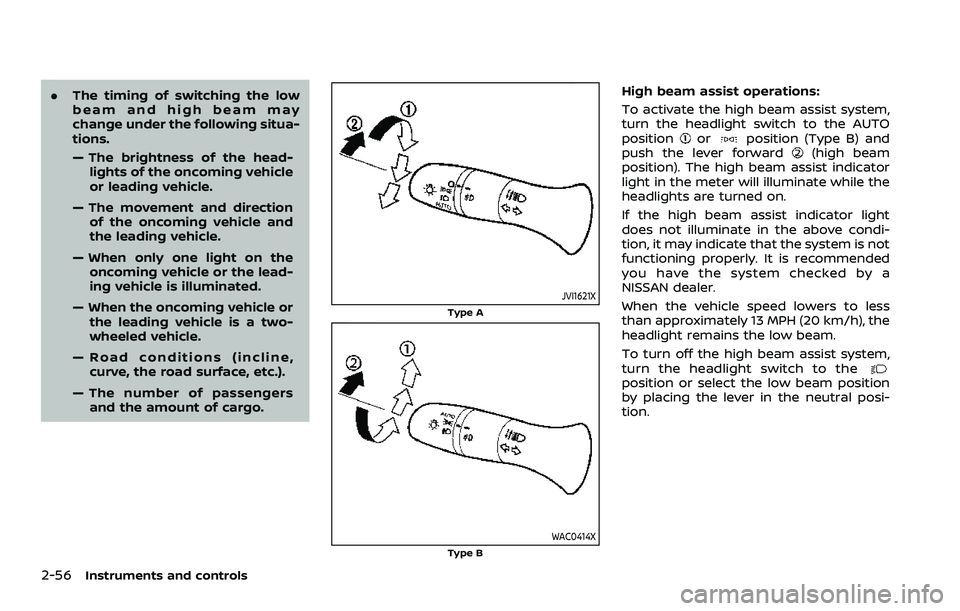
JVI1621X
Type A
WAC0414XType B
High beam assist operations:
To activate the high beam assist system,
turn the headlight switch to the AUTO
position
orposition (Type B) and
push the lever forward(high beam
position). The high beam assist indicator
light in the meter will illuminate while the
headlights are turned on.
If the high beam assist indicator light
does not illuminate in the above condi-
tion, it may indicate that the system is not
functioning properly. It is recommended
you have the system checked by a
NISSAN dealer.
When the vehicle speed lowers to less
than approximately 13 MPH (20 km/h), the
headlight remains the low beam.
To turn off the high beam assist system,
turn the headlight switch to the
position or select the low beam position
by placing the lever in the neutral posi-
tion.
Page 480 of 508
10-4Technical and consumer information
up to 15%.)
. E-15 fuel contains more than 10%
oxygenate. E-15 fuel will adversely
affect the emission control devices
and systems of the vehicle and
should not be used. Damage caused
by such fuel is not covered by the
NISSAN new vehicle limited war-
ranty.
. If a methanol blend is used, it should
contain no more than 5% methanol
(methyl alcohol, wood alcohol). It
should also contain a suitable
amount of appropriate cosolvents
and corrosion inhibitors. If not prop-
erly formulated with appropriate
cosolvents and corrosion inhibitors,
such methanol blends may cause
fuel system damage and/or vehicle
performance problems. At this time,
sufficient data is not available to
ensure that all methanol blends are
suitable for use in NISSAN vehicles.
If any driveability problems such as en-
gine stalling and difficult hot-starting are
experienced after using oxygenate-blend
fuels, immediately change to a non-oxy-
genate fuel or a fuel with a low blend of
MTBE.
Take care not to spill gasoline during
refueling. Gasoline containing oxyge-
nates can cause paint damage.E-15 fuel
E-15 fuel is a mixture of approximately
15% fuel ethanol and 85% unleaded gaso-
line. E-15 can only be used in vehicles
designed to run on E- 15 fuel. Do not use
E-15 in your vehicle. U.S. government
regulations require fuel ethanol dispen-
sing pumps to be identified with small,
square, orange and black label with the
common abbreviation or the appropriate
percentage for that region.
E-85 fuel
E-85 fuel is a mixture of approximately
85% fuel ethanol and 15% unleaded gaso-
line. E-85 can only be used in a Flexible
Fuel Vehicle (FFV). Do not use E-85 fuel in
your vehicle. U.S. government regulations
require fuel ethanol dispensing pumps to
be identified by a small, square, orange
and black label with the common abbre-
viation or the appropriate percentage for
that region.
Fuel containing MMT
MMT, or methylcyclopentadienyl manga-
nese tricarbonyl, is an octane boosting
additive. NISSAN does not recommend
the use of fuel containing MMT. Such fuel
may adversely affect vehicle perfor-
mance, including the emissions control
system. Note that while some fuel pumps label MMT content, not all do, so you may
have to consult your gasoline retailer for
more details.
Aftermarket fuel additives
NISSAN does not recommend the use of
any aftermarket fuel additives (for exam-
ple, fuel injector cleaner, octane booster,
intake valve deposit removers, etc.) which
are sold commercially. Many of these
additives intended for gum, varnish or
deposit removal may contain active sol-
vent or similar ingredients that can be
harmful to the fuel system and engine.
Octane rating tips
Using unleaded gasoline with an octane
rating lower than recommended can
cause persistent, heavy “spark knock”.
(Spark knock is a metallic rapping
noise.) If severe, this can lead to engine
damage. If you detect a persistent
heavy spark knock even when using
gasoline of the stated octane rating, or
if you hear steady spark knock while
holding a steady speed on level roads, it
is recommended you have a NISSAN
dealer correct the condition. Failure to
correct the condition is misuse of the
vehicle, for which NISSAN is not respon-
sible.
Incorrect ignition timing will result in
spark knock, after-run and/or overheat-
Page 483 of 508

ENGINE
ModelMR20DD
Type Gasoline, 4-cycle, DOHC
Cylinder arrangement 4-cylinder, in-line
Bore × Stroke in (mm)3.307 × 3.547 (84.0 × 90.1)
Displacement cu in (cm
3)121.86 (1,997)
Firing order 1-3-4-2
Idle speed rpm
No adjustment is necessary.
Ignition timing (B.T.D.C.) degree/rpm
Spark plug StandardDILKAR7D11H
Spark plug gap (Normal) in (mm)0.043 (1.1)
Camshaft operation Timing chain
This spark ignition system complies with the Canadian standard ICES-002.
WHEELS AND TIRES
Road wheel
TypeSize Offset in
(mm)
Conven-
tional 16 × 6.5JJ 1.57 (40)
17 × 7J 1.38 (35)
19 × 7J 1.57 (40)
Spare (if
so
equipped) 16 × 4T 1.18 (30)
Tire
Type
SizePressure
PSI (kPa)
[Cold]
Conven-
tional 215/65R16
98H
33 (230)
215/60R17
96H 33 (230)
225/45R19
92W 35 (240)
Spare (if
so
equipped) T145/90
D16 106M
T135/90
D16 102M
60 (420)
Depending on the models, the emergency
tire puncture repair kit is supplied.
Technical and consumer information10-7
SPECIFICATIONS