turn NISSAN ROGUE 2023 Owners Manual
[x] Cancel search | Manufacturer: NISSAN, Model Year: 2023, Model line: ROGUE, Model: NISSAN ROGUE 2023Pages: 508, PDF Size: 2.44 MB
Page 11 of 508
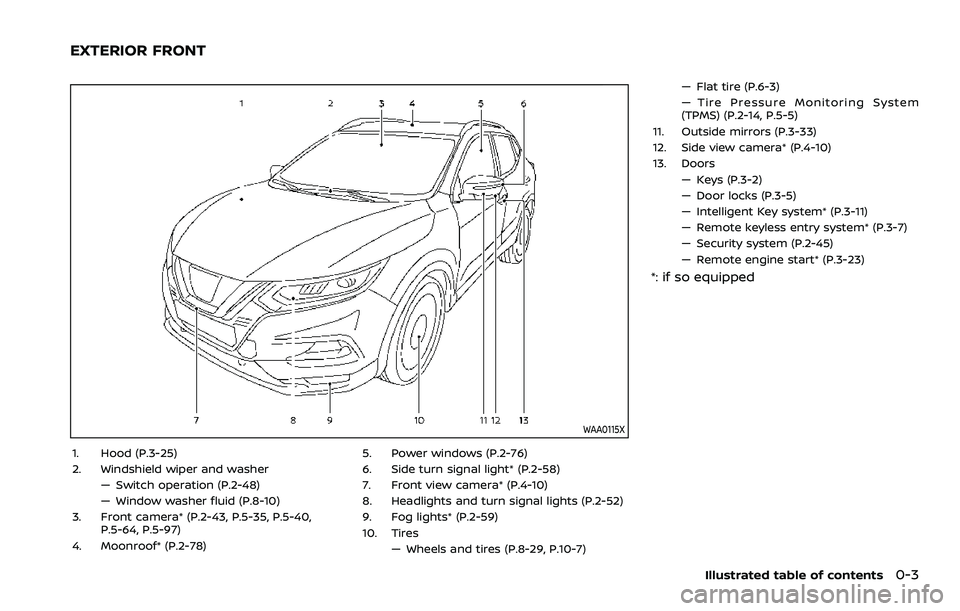
WAA0115X
1. Hood (P.3-25)
2. Windshield wiper and washer— Switch operation (P.2-48)
— Window washer fluid (P.8-10)
3. Front camera* (P.2-43, P.5-35, P.5-40, P.5-64, P.5-97)
4. Moonroof* (P.2-78) 5. Power windows (P.2-76)
6. Side turn signal light* (P.2-58)
7. Front view camera* (P.4-10)
8. Headlights and turn signal lights (P.2-52)
9. Fog lights* (P.2-59)
10. Tires
— Wheels and tires (P.8-29, P.10-7) — Flat tire (P.6-3)
— Tire Pressure Monitoring System
(TPMS) (P.2-14, P.5-5)
11. Outside mirrors (P.3-33)
12. Side view camera* (P.4-10)
13. Doors — Keys (P.3-2)
— Door locks (P.3-5)
— Intelligent Key system* (P.3-11)
— Remote keyless entry system* (P.3-7)
— Security system (P.2-45)
— Remote engine start* (P.3-23)
*: if so equipped
Illustrated table of contents0-3
EXTERIOR FRONT
Page 14 of 508
0-6Illustrated table of contents
WAA0118X
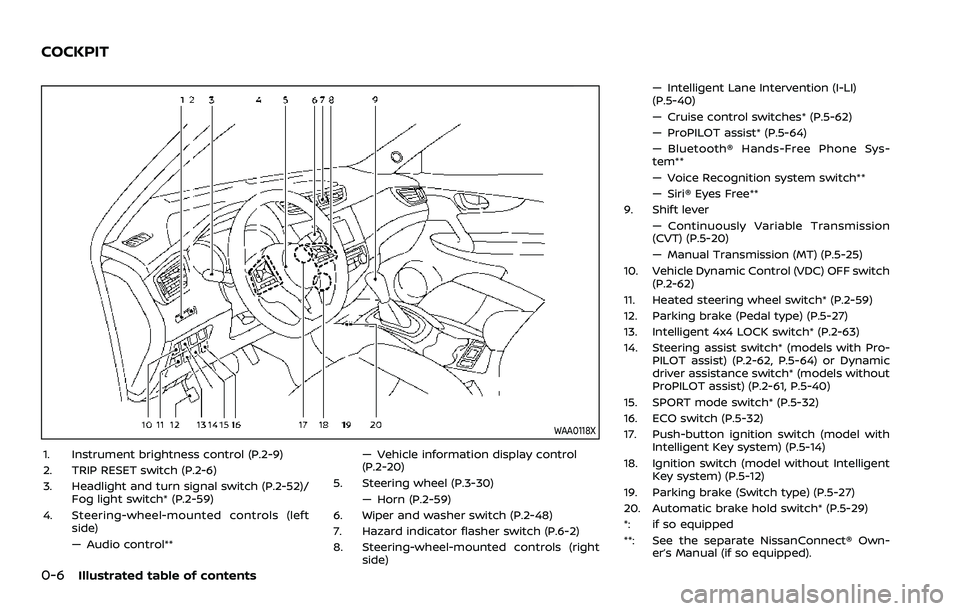
1. Instrument brightness control (P.2-9)
2. TRIP RESET switch (P.2-6)
3. Headlight and turn signal switch (P.2-52)/Fog light switch* (P.2-59)
4. Steering-wheel-mounted controls (left side)
— Audio control** — Vehicle information display control
(P.2-20)
5. Steering wheel (P.3-30) — Horn (P.2-59)
6. Wiper and washer switch (P.2-48)
7. Hazard indicator flasher switch (P.6-2)
8. Steering-wheel-mounted controls (right side) — Intelligent Lane Intervention (I-LI)
(P.5-40)
— Cruise control switches* (P.5-62)
— ProPILOT assist* (P.5-64)
— Bluetooth® Hands-Free Phone Sys-
tem**
— Voice Recognition system switch**
— Siri® Eyes Free**
9. Shift lever — Continuously Variable Transmission
(CVT) (P.5-20)
— Manual Transmission (MT) (P.5-25)
10. Vehicle Dynamic Control (VDC) OFF switch (P.2-62)
11. Heated steering wheel switch* (P.2-59)
12. Parking brake (Pedal type) (P.5-27)
13. Intelligent 4x4 LOCK switch* (P.2-63)
14. Steering assist switch* (models with Pro- PILOT assist) (P.2-62, P.5-64) or Dynamic
driver assistance switch* (models without
ProPILOT assist) (P.2-61, P.5-40)
15. SPORT mode switch* (P.5-32)
16. ECO switch (P.5-32)
17. Push-button ignition switch (model with Intelligent Key system) (P.5-14)
18. Ignition switch (model without Intelligent Key system) (P.5-12)
19. Parking brake (Switch type) (P.5-27)
20. Automatic brake hold switch* (P.5-29)
*: if so equipped
**: See the separate NissanConnect® Own- er’s Manual (if so equipped).
COCKPIT
Page 18 of 508
0-10Illustrated table of contents
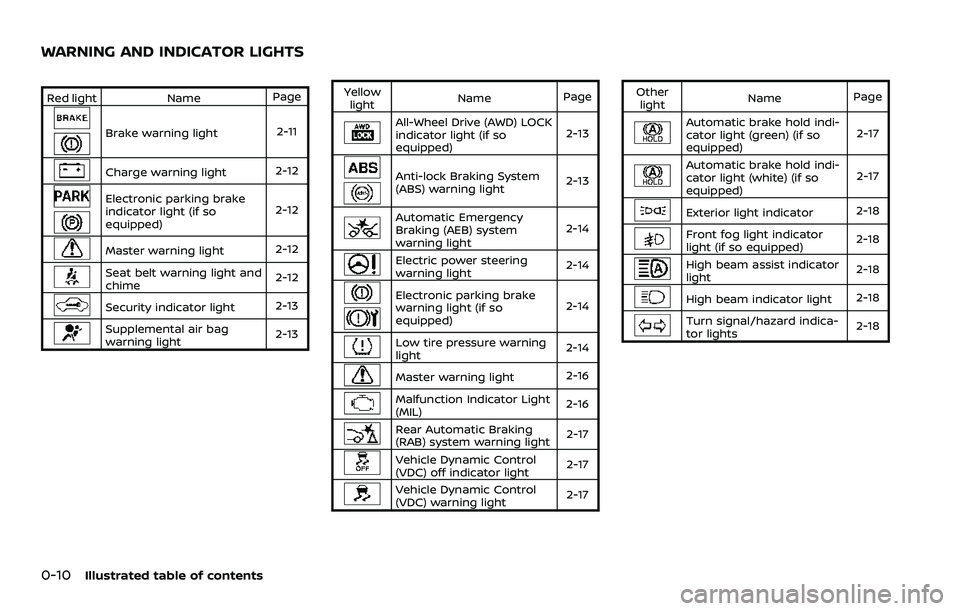
Red lightNamePage
Brake warning light 2-11
Charge warning light2-12
Electronic parking brake
indicator light (if so
equipped)2-12
Master warning light
2-12
Seat belt warning light and
chime2-12
Security indicator light
2-13
Supplemental air bag
warning light2-13Yellow
light Name
Page
All-Wheel Drive (AWD) LOCK
indicator light (if so
equipped) 2-13
Anti-lock Braking System
(ABS) warning light
2-13
Automatic Emergency
Braking (AEB) system
warning light2-14
Electric power steering
warning light
2-14
Electronic parking brake
warning light (if so
equipped)2-14
Low tire pressure warning
light
2-14
Master warning light
2-16
Malfunction Indicator Light
(MIL)2-16
Rear Automatic Braking
(RAB) system warning light
2-17
Vehicle Dynamic Control
(VDC) off indicator light2-17
Vehicle Dynamic Control
(VDC) warning light
2-17Other
light Name
Page
Automatic brake hold indi-
cator light (green) (if so
equipped) 2-17
Automatic brake hold indi-
cator light (white) (if so
equipped)2-17
Exterior light indicator
2-18
Front fog light indicator
light (if so equipped)2-18
High beam assist indicator
light
2-18
High beam indicator light
2-18
Turn signal/hazard indica-
tor lights2-18
WARNING AND INDICATOR LIGHTS
Page 25 of 508
SSS1053
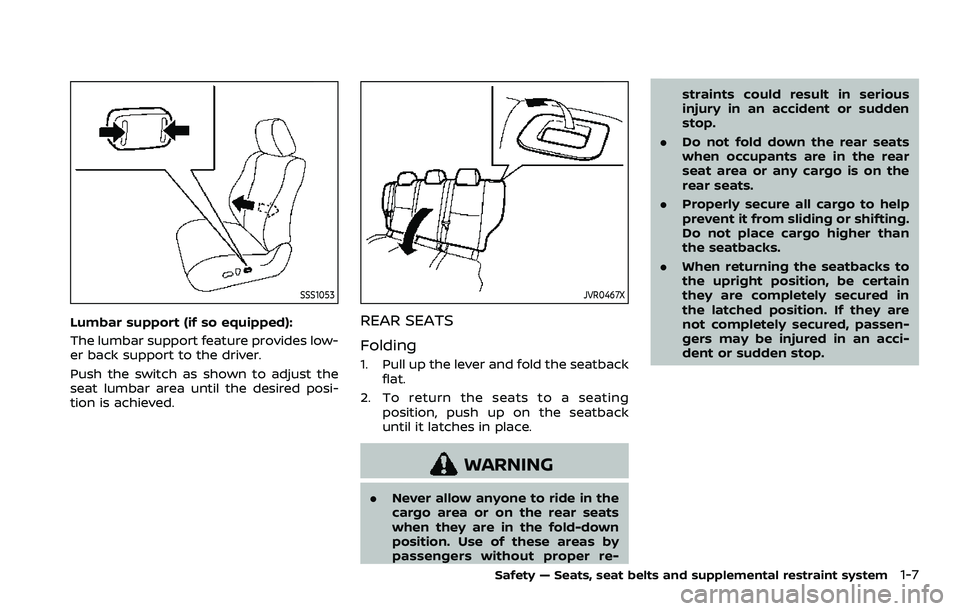
Lumbar support (if so equipped):
The lumbar support feature provides low-
er back support to the driver.
Push the switch as shown to adjust the
seat lumbar area until the desired posi-
tion is achieved.
JVR0467X
REAR SEATS
Folding
1. Pull up the lever and fold the seatbackflat.
2. To return the seats to a seating position, push up on the seatback
until it latches in place.
WARNING
. Never allow anyone to ride in the
cargo area or on the rear seats
when they are in the fold-down
position. Use of these areas by
passengers without proper re- straints could result in serious
injury in an accident or sudden
stop.
. Do not fold down the rear seats
when occupants are in the rear
seat area or any cargo is on the
rear seats.
. Properly secure all cargo to help
prevent it from sliding or shifting.
Do not place cargo higher than
the seatbacks.
. When returning the seatbacks to
the upright position, be certain
they are completely secured in
the latched position. If they are
not completely secured, passen-
gers may be injured in an acci-
dent or sudden stop.
Safety — Seats, seat belts and supplemental restraint system1-7
Page 31 of 508
SSS0016
SSS0014
WARNING
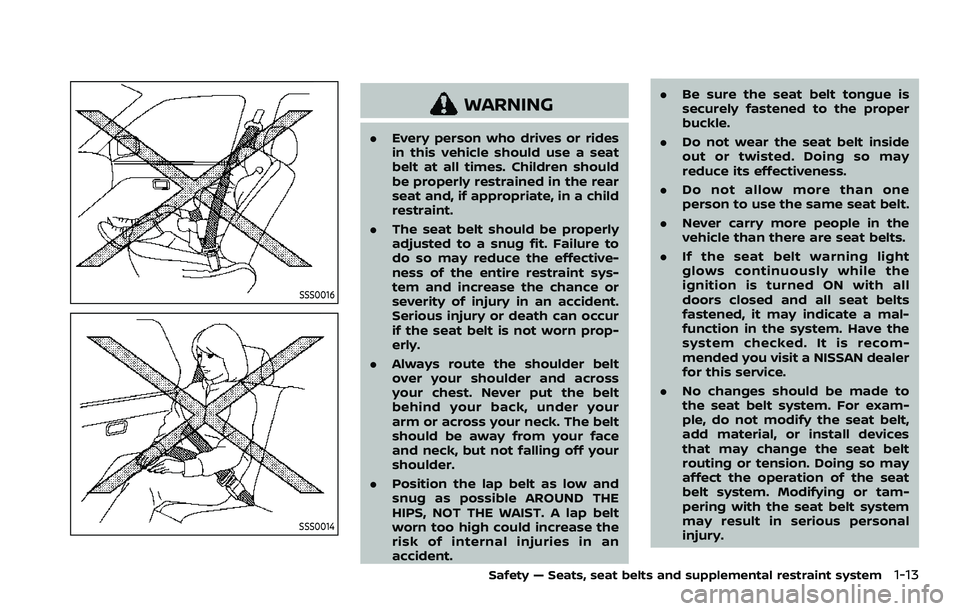
.Every person who drives or rides
in this vehicle should use a seat
belt at all times. Children should
be properly restrained in the rear
seat and, if appropriate, in a child
restraint.
. The seat belt should be properly
adjusted to a snug fit. Failure to
do so may reduce the effective-
ness of the entire restraint sys-
tem and increase the chance or
severity of injury in an accident.
Serious injury or death can occur
if the seat belt is not worn prop-
erly.
. Always route the shoulder belt
over your shoulder and across
your chest. Never put the belt
behind your back, under your
arm or across your neck. The belt
should be away from your face
and neck, but not falling off your
shoulder.
. Position the lap belt as low and
snug as possible AROUND THE
HIPS, NOT THE WAIST. A lap belt
worn too high could increase the
risk of internal injuries in an
accident. .
Be sure the seat belt tongue is
securely fastened to the proper
buckle.
. Do not wear the seat belt inside
out or twisted. Doing so may
reduce its effectiveness.
. Do not allow more than one
person to use the same seat belt.
. Never carry more people in the
vehicle than there are seat belts.
. If the seat belt warning light
glows continuously while the
ignition is turned ON with all
doors closed and all seat belts
fastened, it may indicate a mal-
function in the system. Have the
system checked. It is recom-
mended you visit a NISSAN dealer
for this service.
. No changes should be made to
the seat belt system. For exam-
ple, do not modify the seat belt,
add material, or install devices
that may change the seat belt
routing or tension. Doing so may
affect the operation of the seat
belt system. Modifying or tam-
pering with the seat belt system
may result in serious personal
injury.
Safety — Seats, seat belts and supplemental restraint system1-13
Page 32 of 508
1-14Safety — Seats, seat belts and supplemental restraint system
.Once a seat belt pretensioner has
activated, it cannot be reused and
must be replaced together with
the retractor. It is recommended
you visit a NISSAN dealer for this
service.
. All seat belt assemblies, including
retractors and attaching hard-
ware, should be inspected after
any collision. It is recommended
you visit a NISSAN dealer for this
service. NISSAN recommends that
all seat belt assemblies in use
during a collision be replaced
unless the collision was minor
and the belts show no damage
and continue to operate properly.
Seat belt assemblies not in use
during a collision should also be
inspected and replaced if either
damage or improper operation is
noted.
. All child restraints and attaching
hardware should be inspected
after any collision. Always follow
the restraint manufacturer’s in-
spection instructions and repla-
cement recommendations. The
child restraints should be re-
placed if they are damaged.
JVR0575X
SEAT BELT WARNING LIGHT AND
CHIME
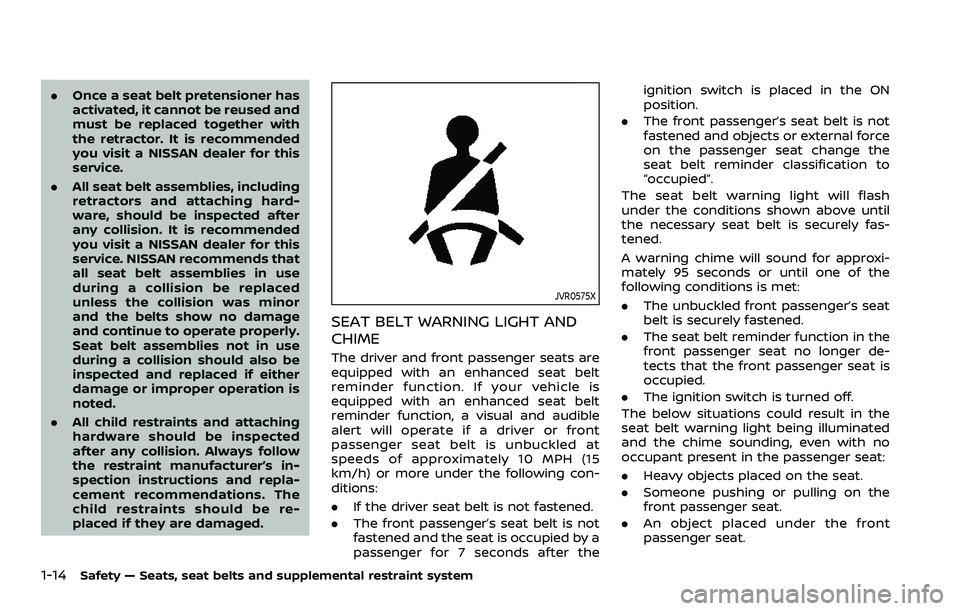
The driver and front passenger seats are
equipped with an enhanced seat belt
reminder function. If your vehicle is
equipped with an enhanced seat belt
reminder function, a visual and audible
alert will operate if a driver or front
passenger seat belt is unbuckled at
speeds of approximately 10 MPH (15
km/h) or more under the following con-
ditions:
.If the driver seat belt is not fastened.
. The front passenger’s seat belt is not
fastened and the seat is occupied by a
passenger for 7 seconds after the ignition switch is placed in the ON
position.
. The front passenger’s seat belt is not
fastened and objects or external force
on the passenger seat change the
seat belt reminder classification to
“occupied”.
The seat belt warning light will flash
under the conditions shown above until
the necessary seat belt is securely fas-
tened.
A warning chime will sound for approxi-
mately 95 seconds or until one of the
following conditions is met:
. The unbuckled front passenger’s seat
belt is securely fastened.
. The seat belt reminder function in the
front passenger seat no longer de-
tects that the front passenger seat is
occupied.
. The ignition switch is turned off.
The below situations could result in the
seat belt warning light being illuminated
and the chime sounding, even with no
occupant present in the passenger seat:
. Heavy objects placed on the seat.
. Someone pushing or pulling on the
front passenger seat.
. An object placed under the front
passenger seat.
Page 34 of 508
1-16Safety — Seats, seat belts and supplemental restraint system
JVR0572X
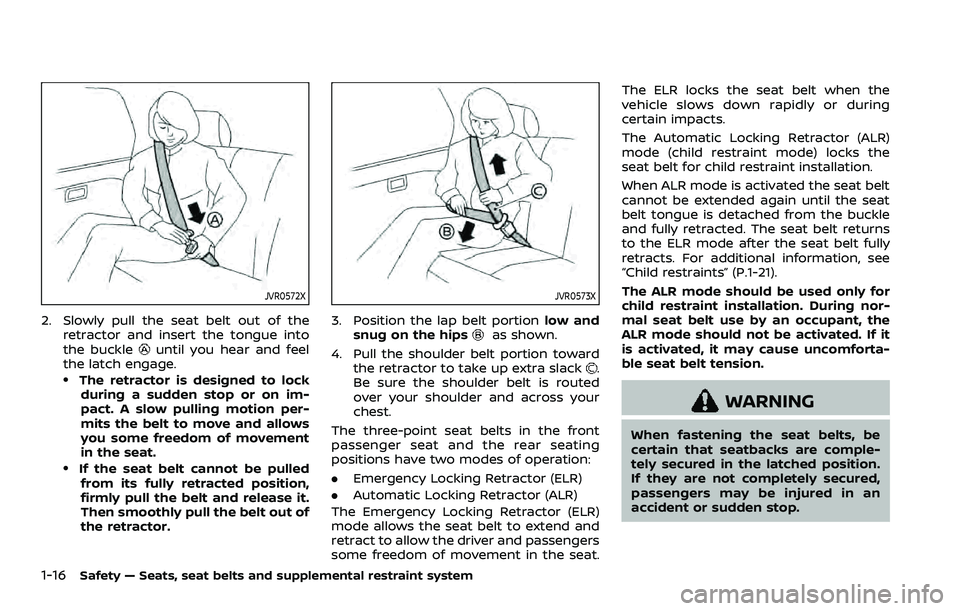
2. Slowly pull the seat belt out of theretractor and insert the tongue into
the buckle
until you hear and feel
the latch engage.
.The retractor is designed to lock
during a sudden stop or on im-
pact. A slow pulling motion per-
mits the belt to move and allows
you some freedom of movement
in the seat.
.If the seat belt cannot be pulledfrom its fully retracted position,
firmly pull the belt and release it.
Then smoothly pull the belt out of
the retractor.
JVR0573X
3. Position the lap belt portion low and
snug on the hipsas shown.
4. Pull the shoulder belt portion toward the retractor to take up extra slack
.
Be sure the shoulder belt is routed
over your shoulder and across your
chest.
The three-point seat belts in the front
passenger seat and the rear seating
positions have two modes of operation:
. Emergency Locking Retractor (ELR)
. Automatic Locking Retractor (ALR)
The Emergency Locking Retractor (ELR)
mode allows the seat belt to extend and
retract to allow the driver and passengers
some freedom of movement in the seat. The ELR locks the seat belt when the
vehicle slows down rapidly or during
certain impacts.
The Automatic Locking Retractor (ALR)
mode (child restraint mode) locks the
seat belt for child restraint installation.
When ALR mode is activated the seat belt
cannot be extended again until the seat
belt tongue is detached from the buckle
and fully retracted. The seat belt returns
to the ELR mode after the seat belt fully
retracts. For additional information, see
“Child restraints” (P.1-21).
The ALR mode should be used only for
child restraint installation. During nor-
mal seat belt use by an occupant, the
ALR mode should not be activated. If it
is activated, it may cause uncomforta-
ble seat belt tension.
WARNING
When fastening the seat belts, be
certain that seatbacks are comple-
tely secured in the latched position.
If they are not completely secured,
passengers may be injured in an
accident or sudden stop.
Page 60 of 508
1-42Safety — Seats, seat belts and supplemental restraint system
PRECAUTIONS ON SRS
This SRS section contains important in-
formation concerning the following sys-
tems:
.Driver and front passenger supple-
mental front-impact air bag (NISSAN
Advanced Air Bag System)
. Driver and front passenger supple-
mental knee air bag
. Front seat-mounted side-impact sup-
plemental air bag
. Rear outboard seat-mounted side-
impact supplemental air bag
. Roof-mounted curtain side-impact
and rollover supplemental air bag
. Seat belt with pretensioner (front and
rear outboard seats)
Supplemental front-impact air bag sys-
tem: The NISSAN Advanced Air Bag Sys-
tem can help cushion the impact force to
the head and chest of the driver and front
passenger in certain frontal collisions.
Driver and front passenger supplemen-
tal knee air bag system: This system can
help cushion the impact force to the
driver’s and front passenger’s knees in
certain collisions.
Front seat-mounted side-impact sup-
plemental air bag system: This system
can help cushion the impact force to the
chest and pelvic area of the driver and front passenger in certain side impact
collisions. The side air bag is designed to
inflate on the side where the vehicle is
impacted.
Rear outboard seat-mounted side-im-
pact supplemental air bag system:
This
system can help cushion the impact force
to the chest area of the rear outboard
seat passengers in certain side-impact
collisions. The side air bags are designed
to inflate on the side where the vehicle is
impacted.
Roof-mounted curtain side-impact and
rollover supplemental air bag system:
This system can help cushion the impact
force to the heads of occupants in front
and rear outboard seating positions in
certain side impact or rollover collisions.
In a side-impact, the curtain air bags are
designed to inflate on the side where the
vehicle is impacted. In a rollover, the
curtain air bags on both sides are de-
signed to inflate. Under both side-impact
and rollover situations, the curtain air
bags will remain inflated for a short
period of time.
These supplemental restraint systems are
designed to supplement the crash pro-
tection provided by the driver, passenger
and rear outboard seat belts and are not
a substitute for them. Seat belts should
always be correctly worn and the occu- pant seated a suitable distance away
from the steering wheel, instrument pa-
nel and door finishers. (See “Seat belts”
(P.1-12) for instructions and precautions
on seat belt usage.)
The supplemental air bags operate only
when the ignition switch is in the ON or
START position.
After the ignition is placed in the ON
position, the supplemental air bag
warning light illuminates. The supple-
mental air bag warning light will turn
off after about 7 seconds if the systems
are operational.
SUPPLEMENTAL RESTRAINT SYSTEM (SRS)
Page 62 of 508
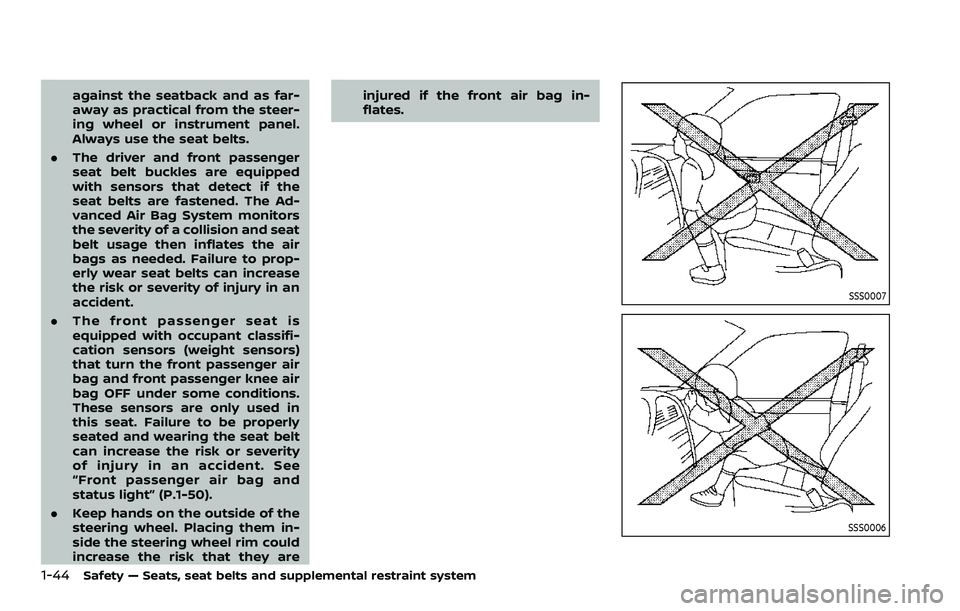
1-44Safety — Seats, seat belts and supplemental restraint system
against the seatback and as far-
away as practical from the steer-
ing wheel or instrument panel.
Always use the seat belts.
. The driver and front passenger
seat belt buckles are equipped
with sensors that detect if the
seat belts are fastened. The Ad-
vanced Air Bag System monitors
the severity of a collision and seat
belt usage then inflates the air
bags as needed. Failure to prop-
erly wear seat belts can increase
the risk or severity of injury in an
accident.
. The front passenger seat is
equipped with occupant classifi-
cation sensors (weight sensors)
that turn the front passenger air
bag and front passenger knee air
bag OFF under some conditions.
These sensors are only used in
this seat. Failure to be properly
seated and wearing the seat belt
can increase the risk or severity
of injury in an accident. See
“Front passenger air bag and
status light” (P.1-50).
. Keep hands on the outside of the
steering wheel. Placing them in-
side the steering wheel rim could
increase the risk that they are injured if the front air bag in-
flates.
SSS0007
SSS0006
Page 67 of 508
.Make sure that there is no object
placed under the front passenger
seat.
. Make sure that there is no object
placed between the seat cushion
and center console or between
the seat cushion and the door.
. Be sure that the front passenger
seat does not contact the rear
seat, instrument panel, etc., or the
head restraint does not contact
the roof.
. Do not position the front passen-
ger seat so it contacts the rear
seat. If the front seat does con-
tact the rear seat, the air bag
system may determine a sensor
malfunction has occurred and the
front passenger air bag status
light may illuminate and the sup-
plemental air bag warning light
may flash.
. If a forward facing child restraint
is installed in the front passenger
seat, do not position the front
passenger seat so the child re-
straint contacts the instrument
panel. If the child restraint does
contact the instrument panel, the
system may determine the seat is
occupied and the passenger air bag and front passenger knee air
bag may deploy in a collision.
Also the front passenger air bag
status light may not illuminate.
See “Child restraints” (P.1-21) for
information about installing and
using child restraints.
. Confirm the operating condition
with the front passenger air bag
status light.
. If you notice that the front pas-
senger air bag status light is not
operating as described in this
section, it is recommended you
visit a NISSAN dealer to check the
passenger seat Advanced Air Bag
System.
. Until you have confirmed with
your dealer that your passenger
seat Advanced Air Bag is working
properly, position the occupants
in the rear seating positions.
This vehicle is equipped with the NISSAN
Advanced Air Bag System for the driver
and front passenger seats. This system is
designed to meet certification require-
ments under U.S. regulations. It is also
permitted in Canada. All of the informa-
tion, cautions and warnings in this
manual apply and must be followed. The driver supplemental front-impact air
bag is located in the center of the
steering wheel. The passenger supple-
mental front-impact air bag is mounted in
the instrument panel above the glove
box. The front air bags are designed to
inflate in higher severity frontal collisions,
although they may inflate if the forces in
another type of collision are similar to
those of a higher severity frontal impact.
They may not inflate in certain frontal
collisions. Vehicle damage (or lack of it) is
not always an indication of proper front
air bag operation.
The NISSAN Advanced Air Bag System has
dual stage air bag inflators. The system
monitors information from the Air bag
Control Unit (ACU), seat belt buckle sen-
sors and the occupant classification sen-
sors (weight sensors). Inflator operation is
based on the severity of a collision and
seat belt usage for the driver. For the
front passenger, the occupant classifica-
tion sensors are also monitored. Based on
information from the sensors, only one
front air bag may inflate in a crash,
depending on the crash severity and
whether the front occupants are belted
or unbelted. Additionally, the front pas-
senger air bag and front passenger knee
air bag may be automatically turned OFF
under some conditions, depending on the
information provided by the occupant
Safety — Seats, seat belts and supplemental restraint system1-49