maintenance NISSAN ROGUE SELECT 2015 2.G Workshop Manual
[x] Cancel search | Manufacturer: NISSAN, Model Year: 2015, Model line: ROGUE SELECT, Model: NISSAN ROGUE SELECT 2015 2.GPages: 322, PDF Size: 2.21 MB
Page 279 of 322
8-38Maintenance and do-it-yourself
Wheel balance
Unbalanced wheels may affect vehicle handling
and tire life. Even with regular use, wheels can
get out of balance. Therefore, they should be
balanced as required.
Wheel balance service should be per-
formed with the wheels off the vehicle.
Spin balancing the wheels on the vehicle
could lead to mechanical damage.
For additional information regarding tires, refer
to “Important Tire Safety Information” in the
Warranty Information Booklet.
Care of wheels
See “Cleaning exterior” (P.7-2) for details about
care of the wheels.
Spare tire
When a spare tire is mounted (TEMPORARY
USE ONLY or conventional) , the TPMS will not
function.
Observe the following precautions if the TEM-
PORARY USE ONLY spare tire must be used,
otherwise your vehicle could be damaged or
involved in an accident.
WARNING
.The TEMPORARY USE ONLY spare
tire should be used for emergency
use. It should be replaced with the
standard tire at the first opportunity
to avoid possible tire or differential
damage.
. Drive carefully while the TEMPOR-
ARY USE ONLY spare tire is in-
stalled. Avoid sharp turns and
abrupt braking while driving.
. Periodically check spare tire infla-
tion pressure. Always keep the
pressure of the TEMPORARY USE
ONLY spare tire at 60 psi (420 kPa,
4.2 bar) . Always keep the pressure
of the full size spare tire (if so
equipped) at the recommended
pressure for standard tires, as in-
dicated on the Tire and Loading
Information label.
. With the TEMPORARY USE ONLY
spare tire installed do not drive your
vehicle at speeds faster than 50
MPH (80 km/h) .
. When driving on roads covered with
snow or ice, the TEMPORARY USE ONLY spare tire should be used on
the rear wheels and original tire
used on the front wheels (drive
wheels) . Use tire chains only on
the front (original) tires.
. Tire tread of the TEMPORARY USE
ONLY spare tire will wear at a faster
rate than the standard tire. Replace
the spare tire as soon as the tread
wear indicators appear.
. Do not use the spare tire on other
vehicles.
. Do not use more than one spare tire
at the same time.
. Do not tow a trailer while the
TEMPORARY USE ONLY spare tire
is installed.
CAUTION
.Do not use tire chains on a TEM-
PORARY USE ONLY spare tire. Tire
chains will not fit properly and may
cause damage to the vehicle.
. Because the TEMPORARY USE
ONLY spare tire is smaller than the
original tire, ground clearance is
Page 280 of 322
reduced. To avoid damage to the
vehicle, do not drive over obstacles.
Also do not drive the vehicle
through an automatic car wash
since it may get caught.
Maintenance and do-it-yourself8-39
Page 281 of 322
8-40Maintenance and do-it-yourself
MEMO
Page 282 of 322
9 Technical and consumer information
Capacities and recommended fluids/lubricants ................ 9-2Fuel information ................................................................... 9-3
Engine oil and oil filter recommendation ....................... 9-5
Air conditioning system refrigerant and
lubricant recommendations ............................................... 9-6
Specifications ........................................................................\
..... 9-7
Engine ........................................................................\
............ 9-7
Wheels and tires ................................................................. 9-7
Dimensions and weights ................................................... 9-8
When traveling or registering your vehicle in
another country ........................................................................\
.. 9-8
Vehicle identification ................................................................. 9-8 Vehicle Identification Number (VIN) plate ..................... 9-8
Vehicle identification number (chassis number) .......... 9-9
Engine serial number .......................................................... 9-9
F.M.V.S.S. certification label ............................................. 9-9
Emission control information label ............................... 9-10
Tire and loading information label ................................ 9-10
Air conditioner specification label ................................ 9-10
Installing front license plate ................................................. 9-11 Vehicle loading information ................................................. 9-12
Terms ........................................................................\
......... 9-12
Vehicle load capacity .................................................... 9-13
Securing the load .......................................................... 9-14
Loading tips ..................................................................... 9-15
Measurement of weights .............................................. 9-15
Towing a trailer ....................................................................... 9-16 Maximum load limits ...................................................... 9-16
Maximum Gross Vehicle Weight (GVW)/maximum
Gross Axle Weight (GAW) ......................................... 9-18
Towing load/specification ............................................ 9-20
Towing safety .................................................................. 9-20
Flat towing ....................................................................... 9-24
Uniform tire quality grading ................................................. 9-25 Treadwear ........................................................................\
9-25
Traction AA, A, B and C .............................................. 9-25
Temperature A, B and C .............................................. 9-25
Emission control system warranty ..................................... 9-26
Reporting safety defects ..................................................... 9-26
Readiness for Inspection/Maintenance (I/M) test ......... 9-26
Event Data Recorders (EDR) ............................................. 9-27
Owner’s Manual/Service Manual order information ..... 9-28
Page 283 of 322
9-2Technical and consumer information
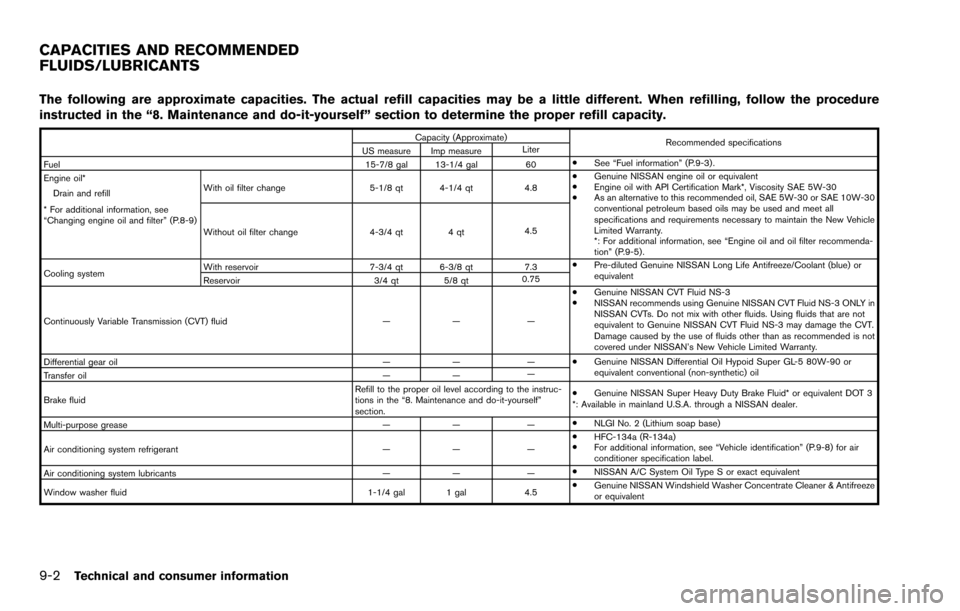
The following are approximate capacities. The actual refill capacities may be a little different. When refilling, follow the procedure
instructed in the “8. Maintenance and do-it-yourself” section to determine the proper refill capacity.
Capacity (Approximate)Recommended specifications
US measure Imp measure Liter
Fuel 15-7/8 gal 13-1/4 gal60.
See “Fuel information” (P.9-3) .
Engine oil* With oil filter change 5-1/8 qt 4-1/4 qt4.8.
Genuine NISSAN engine oil or equivalent
. Engine oil with API Certification Mark*, Viscosity SAE 5W-30
. As an alternative to this recommended oil, SAE 5W-30 or SAE 10W-30
conventional petroleum based oils may be used and meet all
specifications and requirements necessary to maintain the New Vehicle
Limited Warranty.
*: For additional information, see “Engine oil and oil filter recommenda-
tion” (P.9-5) .
Drain and refill
* For additional information, see
“Changing engine oil and filter” (P.8-9) Without oil filter change 4-3/4 qt 4 qt4.5
Cooling system With reservoir
7-3/4 qt 6-3/8 qt7.3.
Pre-diluted Genuine NISSAN Long Life Antifreeze/Coolant (blue) or
equivalent
Reservoir 3/4 qt 5/8 qt0.75
Continuously Variable Transmission (CVT) fluid —— —.
Genuine NISSAN CVT Fluid NS-3
. NISSAN recommends using Genuine NISSAN CVT Fluid NS-3 ONLY in
NISSAN CVTs. Do not mix with other fluids. Using fluids that are not
equivalent to Genuine NISSAN CVT Fluid NS-3 may damage the CVT.
Damage caused by the use of fluids other than as recommended is not
covered under NISSAN’s New Vehicle Limited Warranty.
Differential gear oil —— —.
Genuine NISSAN Differential Oil Hypoid Super GL-5 80W-90 or
equivalent conventional (non-synthetic) oil
Transfer oil ———
Brake fluid Refill to the proper oil level according to the instruc-
tions in the “8. Maintenance and do-it-yourself”
section..
Genuine NISSAN Super Heavy Duty Brake Fluid* or equivalent DOT 3
*: Available in mainland U.S.A. through a NISSAN dealer.
Multi-purpose grease —— —.
NLGI No. 2 (Lithium soap base)
Air conditioning system refrigerant —— —.
HFC-134a (R-134a)
. For additional information, see “Vehicle identification” (P.9-8) for air
conditioner specification label.
Air conditioning system lubricants —— —.
NISSAN A/C System Oil Type S or exact equivalent
Window washer fluid 1-1/4 gal 1 gal4.5.
Genuine NISSAN Windshield Washer Concentrate Cleaner & Antifreeze
or equivalent
CAPACITIES AND RECOMMENDED
FLUIDS/LUBRICANTS
Page 286 of 322
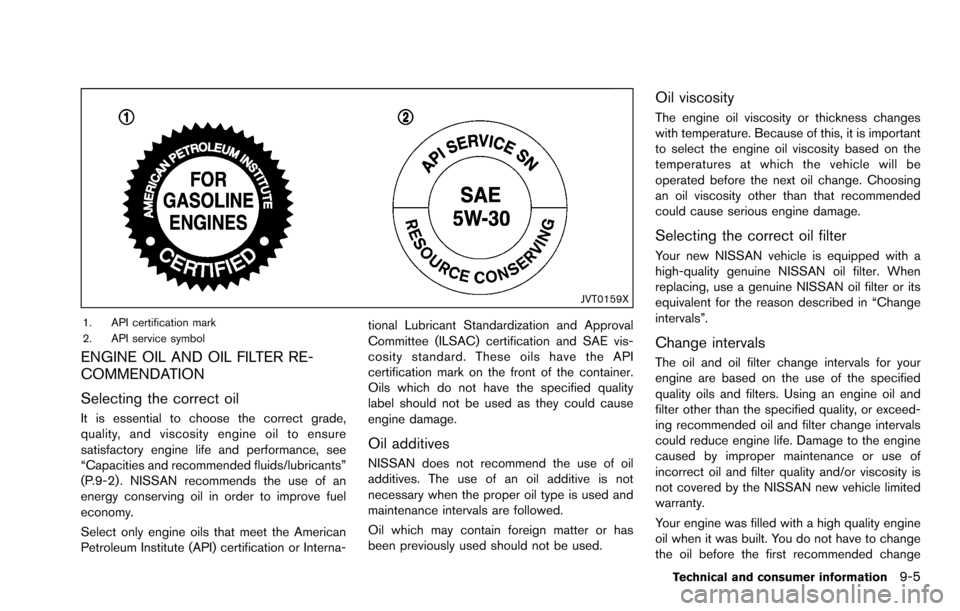
JVT0159X
1. API certification mark
2. API service symbol
ENGINE OIL AND OIL FILTER RE-
COMMENDATION
Selecting the correct oil
It is essential to choose the correct grade,
quality, and viscosity engine oil to ensure
satisfactory engine life and performance, see
“Capacities and recommended fluids/lubricants”
(P.9-2) . NISSAN recommends the use of an
energy conserving oil in order to improve fuel
economy.
Select only engine oils that meet the American
Petroleum Institute (API) certification or Interna-tional Lubricant Standardization and Approval
Committee (ILSAC) certification and SAE vis-
cosity standard. These oils have the API
certification mark on the front of the container.
Oils which do not have the specified quality
label should not be used as they could cause
engine damage.
Oil additives
NISSAN does not recommend the use of oil
additives. The use of an oil additive is not
necessary when the proper oil type is used and
maintenance intervals are followed.
Oil which may contain foreign matter or has
been previously used should not be used.
Oil viscosity
The engine oil viscosity or thickness changes
with temperature. Because of this, it is important
to select the engine oil viscosity based on the
temperatures at which the vehicle will be
operated before the next oil change. Choosing
an oil viscosity other than that recommended
could cause serious engine damage.
Selecting the correct oil filter
Your new NISSAN vehicle is equipped with a
high-quality genuine NISSAN oil filter. When
replacing, use a genuine NISSAN oil filter or its
equivalent for the reason described in “Change
intervals”.
Change intervals
The oil and oil filter change intervals for your
engine are based on the use of the specified
quality oils and filters. Using an engine oil and
filter other than the specified quality, or exceed-
ing recommended oil and filter change intervals
could reduce engine life. Damage to the engine
caused by improper maintenance or use of
incorrect oil and filter quality and/or viscosity is
not covered by the NISSAN new vehicle limited
warranty.
Your engine was filled with a high quality engine
oil when it was built. You do not have to change
the oil before the first recommended change
Technical and consumer information9-5
Page 287 of 322
9-6Technical and consumer information
interval. Oil and filter change intervals depend
upon how you use your vehicle.
Operation under the following conditions may
require more frequent oil and filter changes.
.repeated short distance driving at cold
outside temperatures
. driving in dusty conditions
. extensive idling
. towing a trailer
. stop and go commuting
Refer to the “NISSAN Service and Maintenance
Guide” for the maintenance schedule.
AIR CONDITIONING SYSTEM RE-
FRIGERANT AND LUBRICANT RE-
COMMENDATIONS
The air conditioning system in your
NISSAN vehicle must be charged with the
refrigerant HFC-134a (R-134a) and the oil,
NISSAN A/C system oil Type S or the exact
equivalents.
CAUTION
The use of any other refrigerant or oil
will cause severe damage to the air
conditioning system and will require
the replacement of all air conditioner system components.
The refrigerant HFC-134a (R-134a) in your
NISSAN vehicle will not harm the earth’s ozone
layer. Although this refrigerant does not affect
the earth’s atmosphere, certain governmental
regulations require the recovery and recycling of
any refrigerant during automotive air condition-
ing system service. A NISSAN dealer has the
trained technicians and equipment needed to
recover and recycle your air conditioning system
refrigerant.
Contact a NISSAN dealer when servicing your
air conditioning system.
Page 304 of 322
6. Turn off the engine.
To drive away:
1. Apply and hold the brake pedal.
2. Start the engine.
3. Shift the transmission into gear.
4. Release the parking brake.
5. Drive slowly until the vehicle and trailer areclear from the blocks.
6. Apply and hold the brake pedal.
7. Have someone retrieve and store the blocks.
. When going down a hill, shift into a lower
gear and use the engine braking effect.
When going up a long grade, downshift the
transmission to a lower gear and reduce
speed to reduce chances of engine over-
loading and/or overheating.
. If the engine coolant rises to an extremely
high temperature when the air conditioning
system is on, turn off the air conditioner.
Coolant heat can be additionally vented by
opening the windows, switching the fan
control to high and setting the temperature
control to the HOT position.
. Trailer towing requires more fuel than normal
circumstances.
. Avoid towing a trailer for the first 500 miles
(800 km) . .
Have your vehicle serviced more often than
at intervals specified in the recommended
maintenance schedule in the NISSAN Ser-
vice and Maintenance Guide.
. When making a turn, your trailer wheels will
be closer to the inside of the turn than your
vehicle wheels. To compensate for this,
make a larger than normal turning radius
during the turn.
. Crosswinds and rough roads will adversely
affect vehicle/trailer handling, possibly caus-
ing vehicle sway. When being passed by
larger vehicles, be prepared for possible
changes in crosswinds that could affect
vehicle handling. If swaying does occur,
firmly grip the steering wheel, steer straight
ahead, and immediately (but gradually)
reduce vehicle speed. This combination will
help stabilize the vehicle. Never increase
speed.
Do the following if the trailer begins to sway:
1. Take your foot off the accelerator pedal to allow the vehicle to coast and steer as
straight ahead as the road conditions allow.
This combination will help stabilize the
vehicle.
.Do not correct trailer sway by steering orapplying the brakes. 2. When the trailer sway stops, gently apply
the brakes and pull to the side of the road in
a safe area.
3. Try to rearrange the trailer load so it is balanced as described earlier in this section.
. Be careful when passing other vehicles.
Passing while towing a trailer requires
considerably more distance than normal
passing. Remember the length of the trailer
must also pass the other vehicle before you
can safely change lanes.
. Down shift the transmission to a lower gear
for engine braking when driving down steep
or long hills. This will help slow the vehicle
without applying the brakes.
. Avoid holding the brake pedal down too
long or too frequently. This could cause the
brakes to overheat, resulting in reduced
braking efficiency.
. Increase your following distance to allow for
greater stopping distances while towing a
trailer. Anticipate stops and brake gradually.
. Do not use cruise control (if so equipped)
while towing a trailer.
. Some states or provinces have specific
regulations and speed limits for vehicles
that are towing trailers. Obey the local
speed limits.
Technical and consumer information9-23
Page 305 of 322
9-24Technical and consumer information
.Check your hitch, trailer wiring harness
connections, and trailer wheel lug nuts after
50 miles (80 km) of travel and at every
break.
. When stopped in traffic for long periods of
time in hot weather, put the vehicle in the P
(Park) position.
. When launching a boat, don’t allow the
water level to go over the exhaust tail pipe or
rear bumper.
. Make sure you disconnect the trailer lights
before backing the trailer into the water or
the trailer lights may burn out.
When towing a trailer, the transmission
fluid should be changed more frequently.
For additional information, see the “8.
Maintenance and do-it-yourself” section
earlier in this manual.
FLAT TOWING
Towing your vehicle with all four wheels on the
ground is sometimes called flat towing. This
method is sometimes used when towing a
vehicle behind a recreational vehicle, such as a
motor home.
CAUTION
. Failure to follow these guidelines
can result in severe transmission
damage.
. Whenever flat towing your vehicle,
always tow forward, never back-
ward.
. DO NOT tow any continuously vari-
able transmission vehicle with all
four wheels on the ground (flat
towing) . Doing so WILL DAMAGE
internal transmission parts due to
lack of transmission lubrication.
. DO NOT tow an All-Wheel Drive
(AWD) vehicle with any of the
wheels on the ground. Doing so
may cause serious and expensive
damage to the powertrain.
. For emergency towing procedures
refer to “Towing recommended by
NISSAN” (P.6-13) of this manual.
Continuously Variable Transmission
(CVT)
All-Wheel Drive (AWD) models:
Do not tow an AWD vehicle with any of the
wheels on the ground.
Two-Wheel Drive (2WD) models:
To tow a vehicle equipped with a Continuously
Variable Transmission (CVT) , an appropriate
vehicle dolly MUSTbe placed under the towed
vehicle’s driving wheels. Alwaysfollow the dolly
manufacturer’s recommendations when using
their product.
Page 307 of 322
9-26Technical and consumer information
Your NISSAN is covered by the following
emission warranties.
.Emission Defects Warranty
. Emissions Performance Warranty
Details of these warranties may be found with
other vehicle warranties in your Warranty In-
formation Booklet which comes with your
NISSAN. If you did not receive a Warranty
Information Booklet, or it has become lost, you
may obtain a replacement by writing to:
. Nissan North America, Inc.
Consumer Affairs Department
P.O. Box 685003
Franklin, TN 37068-5003If you believe that your vehicle has a defect
which could cause a crash or could cause
injury or death, you should immediately
inform the National Highway Traffic Safety
Administration (NHTSA) in addition to
notifying NISSAN.
If NHTSA receives similar complaints, it
may open an investigation, and if it finds
that a safety defect exists in a group of
vehicles, it may order a recall and remedy
campaign. However, NHTSA cannot be-
come involved in individual problems be-
tween you, your dealer, or NISSAN.
To contact NHTSA, you may call the
Vehicle Safety Hotline toll-free at 1-888-
327-4236 (TTY: 1-800-424-9153); go to
http://www.safercar.gov; or write to: Ad-
ministrator, NHTSA, 400 Seventh Street,
SW., Washington, D.C. 20590. You can
also obtain other information about motor
vehicle safety from
http://www.safercar.gov.
You may notify NISSAN by contacting our
Consumer Affairs Department, toll-free, at
1-800-NISSAN-1.
WARNING
A vehicle equipped with All-Wheel Drive
(AWD) should never be tested using a
two wheel dynamometer (such as the
dynamometers used by some states for
emissions testing) , or similar equip-
ment. Make sure you inform test facility
personnel that your vehicle is equipped
with AWD before it is placed on a
dynamometer. Using the wrong test
equipment may result in transmission
damage or unexpected vehicle move-
ment which could result in serious
vehicle damage or personal injury.
Due to legal requirements in some states, your
vehicle may be required to be in what is called
the “ready condition” for an Inspection/Main-
tenance (I/M) test of the emission control
system.
The vehicle is set to the “ready condition” when
it is driven through certain driving patterns.
Usually, the “ready condition” can be obtained
by ordinary usage of the vehicle.
If a powertrain system component is repaired or
the battery is disconnected, the vehicle may be
reset to a “not ready condition”. Before taking
EMISSION CONTROL SYSTEM
WARRANTY REPORTING SAFETY DEFECTSREADINESS FOR INSPECTION/
MAINTENANCE (I/M) TEST