air condition NISSAN ROGUE SELECT 2015 Manual Online
[x] Cancel search | Manufacturer: NISSAN, Model Year: 2015, Model line: ROGUE SELECT, Model: NISSAN ROGUE SELECT 2015Pages: 322, PDF Size: 2.21 MB
Page 278 of 322

Replacing wheels and tires
When replacing a tire, use the same size, tread
design, speed rating and load carrying capacity
as originally equipped. (See “Specifications”
(P.9-7) for recommended types and sizes of
tires and wheels.)
WARNING
.The use of tires other than those
recommended or the mixed use of
tires of different brands, construc-
tion (bias, bias-belted or radial) , or
tread patterns can adversely affect
the ride, braking, handling, ground
clearance, body-to-tire clearance,
tire chain clearance, speedometer
calibration, headlight aim and bum-
per height. Some of these effects
may lead to accidents and could
result in serious personal injury.
. For 2WD models, if your vehicle was
originally equipped with 4 tires that
were the same size and you are only
replacing 2 of the 4 tires, install the
new tires on the rear axle. Placing
new tires on the front axle may
cause loss of vehicle control in
some driving conditions and cause an accident and personal injury.
. If the wheels are changed for any
reason, always replace with wheels
which have the same off-set dimen-
sion. Wheels of a different off-set
could cause premature tire wear,
degrade vehicle handling character-
istics and/or interference with the
brake discs/drums. Such interfer-
ence can lead to decreased braking
efficiency and/or early brake pad/
shoe wear. See “Wheels and tires”
(P.9-7) of this manual for wheel off-
set dimensions.
. When a spare tire is mounted or a
wheel is replaced, the TPMS will not
function and the low tire pressure
warning light will flash for approxi-
mately 1 minute. The light will
remain on after 1 minute. Contact
your NISSAN dealer as soon as
possible for tire replacement and/
or system resetting.
. Replacing tires with those not ori-
ginally specified by NISSAN could
affect the proper operation of the
TPMS.
. Do not install a damaged or de-
formed wheel or tire even if it has been repaired. Such wheels or tires
could have structural damage and
could fail without warning.
. The use of retread tire is not re-
commended.
. For additional information regard-
ing tires, refer to “Important Tire
Safety Information” in the Warranty
Information Booklet.
CAUTION
Always use tires of the same type, size,
brand, construction (bias, bias-belted
or radial) , and tread pattern on all four
wheels. Failure to do so may result in a
circumference difference between tires
on the front and rear axles which will
cause excessive tire wear and may
damage the transmission, transfer case
and differential gears (AWD models) .
Maintenance and do-it-yourself8-37
Page 282 of 322

9 Technical and consumer information
Capacities and recommended fluids/lubricants ................ 9-2Fuel information ................................................................... 9-3
Engine oil and oil filter recommendation ....................... 9-5
Air conditioning system refrigerant and
lubricant recommendations ............................................... 9-6
Specifications ........................................................................\
..... 9-7
Engine ........................................................................\
............ 9-7
Wheels and tires ................................................................. 9-7
Dimensions and weights ................................................... 9-8
When traveling or registering your vehicle in
another country ........................................................................\
.. 9-8
Vehicle identification ................................................................. 9-8 Vehicle Identification Number (VIN) plate ..................... 9-8
Vehicle identification number (chassis number) .......... 9-9
Engine serial number .......................................................... 9-9
F.M.V.S.S. certification label ............................................. 9-9
Emission control information label ............................... 9-10
Tire and loading information label ................................ 9-10
Air conditioner specification label ................................ 9-10
Installing front license plate ................................................. 9-11 Vehicle loading information ................................................. 9-12
Terms ........................................................................\
......... 9-12
Vehicle load capacity .................................................... 9-13
Securing the load .......................................................... 9-14
Loading tips ..................................................................... 9-15
Measurement of weights .............................................. 9-15
Towing a trailer ....................................................................... 9-16 Maximum load limits ...................................................... 9-16
Maximum Gross Vehicle Weight (GVW)/maximum
Gross Axle Weight (GAW) ......................................... 9-18
Towing load/specification ............................................ 9-20
Towing safety .................................................................. 9-20
Flat towing ....................................................................... 9-24
Uniform tire quality grading ................................................. 9-25 Treadwear ........................................................................\
9-25
Traction AA, A, B and C .............................................. 9-25
Temperature A, B and C .............................................. 9-25
Emission control system warranty ..................................... 9-26
Reporting safety defects ..................................................... 9-26
Readiness for Inspection/Maintenance (I/M) test ......... 9-26
Event Data Recorders (EDR) ............................................. 9-27
Owner’s Manual/Service Manual order information ..... 9-28
Page 283 of 322

9-2Technical and consumer information
The following are approximate capacities. The actual refill capacities may be a little different. When refilling, follow the procedure
instructed in the “8. Maintenance and do-it-yourself” section to determine the proper refill capacity.
Capacity (Approximate)Recommended specifications
US measure Imp measure Liter
Fuel 15-7/8 gal 13-1/4 gal60.
See “Fuel information” (P.9-3) .
Engine oil* With oil filter change 5-1/8 qt 4-1/4 qt4.8.
Genuine NISSAN engine oil or equivalent
. Engine oil with API Certification Mark*, Viscosity SAE 5W-30
. As an alternative to this recommended oil, SAE 5W-30 or SAE 10W-30
conventional petroleum based oils may be used and meet all
specifications and requirements necessary to maintain the New Vehicle
Limited Warranty.
*: For additional information, see “Engine oil and oil filter recommenda-
tion” (P.9-5) .
Drain and refill
* For additional information, see
“Changing engine oil and filter” (P.8-9) Without oil filter change 4-3/4 qt 4 qt4.5
Cooling system With reservoir
7-3/4 qt 6-3/8 qt7.3.
Pre-diluted Genuine NISSAN Long Life Antifreeze/Coolant (blue) or
equivalent
Reservoir 3/4 qt 5/8 qt0.75
Continuously Variable Transmission (CVT) fluid —— —.
Genuine NISSAN CVT Fluid NS-3
. NISSAN recommends using Genuine NISSAN CVT Fluid NS-3 ONLY in
NISSAN CVTs. Do not mix with other fluids. Using fluids that are not
equivalent to Genuine NISSAN CVT Fluid NS-3 may damage the CVT.
Damage caused by the use of fluids other than as recommended is not
covered under NISSAN’s New Vehicle Limited Warranty.
Differential gear oil —— —.
Genuine NISSAN Differential Oil Hypoid Super GL-5 80W-90 or
equivalent conventional (non-synthetic) oil
Transfer oil ———
Brake fluid Refill to the proper oil level according to the instruc-
tions in the “8. Maintenance and do-it-yourself”
section..
Genuine NISSAN Super Heavy Duty Brake Fluid* or equivalent DOT 3
*: Available in mainland U.S.A. through a NISSAN dealer.
Multi-purpose grease —— —.
NLGI No. 2 (Lithium soap base)
Air conditioning system refrigerant —— —.
HFC-134a (R-134a)
. For additional information, see “Vehicle identification” (P.9-8) for air
conditioner specification label.
Air conditioning system lubricants —— —.
NISSAN A/C System Oil Type S or exact equivalent
Window washer fluid 1-1/4 gal 1 gal4.5.
Genuine NISSAN Windshield Washer Concentrate Cleaner & Antifreeze
or equivalent
CAPACITIES AND RECOMMENDED
FLUIDS/LUBRICANTS
Page 287 of 322
9-6Technical and consumer information
interval. Oil and filter change intervals depend
upon how you use your vehicle.
Operation under the following conditions may
require more frequent oil and filter changes.
.repeated short distance driving at cold
outside temperatures
. driving in dusty conditions
. extensive idling
. towing a trailer
. stop and go commuting
Refer to the “NISSAN Service and Maintenance
Guide” for the maintenance schedule.
AIR CONDITIONING SYSTEM RE-
FRIGERANT AND LUBRICANT RE-
COMMENDATIONS
The air conditioning system in your
NISSAN vehicle must be charged with the
refrigerant HFC-134a (R-134a) and the oil,
NISSAN A/C system oil Type S or the exact
equivalents.
CAUTION
The use of any other refrigerant or oil
will cause severe damage to the air
conditioning system and will require
the replacement of all air conditioner system components.
The refrigerant HFC-134a (R-134a) in your
NISSAN vehicle will not harm the earth’s ozone
layer. Although this refrigerant does not affect
the earth’s atmosphere, certain governmental
regulations require the recovery and recycling of
any refrigerant during automotive air condition-
ing system service. A NISSAN dealer has the
trained technicians and equipment needed to
recover and recycle your air conditioning system
refrigerant.
Contact a NISSAN dealer when servicing your
air conditioning system.
Page 291 of 322
9-10Technical and consumer information
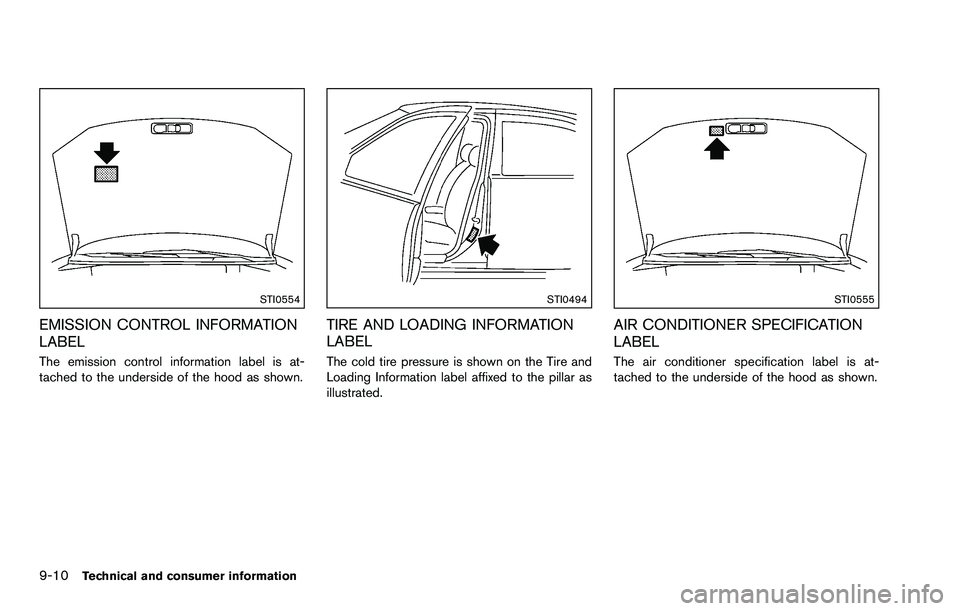
STI0554
EMISSION CONTROL INFORMATION
LABEL
The emission control information label is at-
tached to the underside of the hood as shown.
STI0494
TIRE AND LOADING INFORMATION
LABEL
The cold tire pressure is shown on the Tire and
Loading Information label affixed to the pillar as
illustrated.
STI0555
AIR CONDITIONER SPECIFICATION
LABEL
The air conditioner specification label is at-
tached to the underside of the hood as shown.
Page 304 of 322
6. Turn off the engine.
To drive away:
1. Apply and hold the brake pedal.
2. Start the engine.
3. Shift the transmission into gear.
4. Release the parking brake.
5. Drive slowly until the vehicle and trailer areclear from the blocks.
6. Apply and hold the brake pedal.
7. Have someone retrieve and store the blocks.
. When going down a hill, shift into a lower
gear and use the engine braking effect.
When going up a long grade, downshift the
transmission to a lower gear and reduce
speed to reduce chances of engine over-
loading and/or overheating.
. If the engine coolant rises to an extremely
high temperature when the air conditioning
system is on, turn off the air conditioner.
Coolant heat can be additionally vented by
opening the windows, switching the fan
control to high and setting the temperature
control to the HOT position.
. Trailer towing requires more fuel than normal
circumstances.
. Avoid towing a trailer for the first 500 miles
(800 km) . .
Have your vehicle serviced more often than
at intervals specified in the recommended
maintenance schedule in the NISSAN Ser-
vice and Maintenance Guide.
. When making a turn, your trailer wheels will
be closer to the inside of the turn than your
vehicle wheels. To compensate for this,
make a larger than normal turning radius
during the turn.
. Crosswinds and rough roads will adversely
affect vehicle/trailer handling, possibly caus-
ing vehicle sway. When being passed by
larger vehicles, be prepared for possible
changes in crosswinds that could affect
vehicle handling. If swaying does occur,
firmly grip the steering wheel, steer straight
ahead, and immediately (but gradually)
reduce vehicle speed. This combination will
help stabilize the vehicle. Never increase
speed.
Do the following if the trailer begins to sway:
1. Take your foot off the accelerator pedal to allow the vehicle to coast and steer as
straight ahead as the road conditions allow.
This combination will help stabilize the
vehicle.
.Do not correct trailer sway by steering orapplying the brakes. 2. When the trailer sway stops, gently apply
the brakes and pull to the side of the road in
a safe area.
3. Try to rearrange the trailer load so it is balanced as described earlier in this section.
. Be careful when passing other vehicles.
Passing while towing a trailer requires
considerably more distance than normal
passing. Remember the length of the trailer
must also pass the other vehicle before you
can safely change lanes.
. Down shift the transmission to a lower gear
for engine braking when driving down steep
or long hills. This will help slow the vehicle
without applying the brakes.
. Avoid holding the brake pedal down too
long or too frequently. This could cause the
brakes to overheat, resulting in reduced
braking efficiency.
. Increase your following distance to allow for
greater stopping distances while towing a
trailer. Anticipate stops and brake gradually.
. Do not use cruise control (if so equipped)
while towing a trailer.
. Some states or provinces have specific
regulations and speed limits for vehicles
that are towing trailers. Obey the local
speed limits.
Technical and consumer information9-23
Page 307 of 322
9-26Technical and consumer information
Your NISSAN is covered by the following
emission warranties.
.Emission Defects Warranty
. Emissions Performance Warranty
Details of these warranties may be found with
other vehicle warranties in your Warranty In-
formation Booklet which comes with your
NISSAN. If you did not receive a Warranty
Information Booklet, or it has become lost, you
may obtain a replacement by writing to:
. Nissan North America, Inc.
Consumer Affairs Department
P.O. Box 685003
Franklin, TN 37068-5003If you believe that your vehicle has a defect
which could cause a crash or could cause
injury or death, you should immediately
inform the National Highway Traffic Safety
Administration (NHTSA) in addition to
notifying NISSAN.
If NHTSA receives similar complaints, it
may open an investigation, and if it finds
that a safety defect exists in a group of
vehicles, it may order a recall and remedy
campaign. However, NHTSA cannot be-
come involved in individual problems be-
tween you, your dealer, or NISSAN.
To contact NHTSA, you may call the
Vehicle Safety Hotline toll-free at 1-888-
327-4236 (TTY: 1-800-424-9153); go to
http://www.safercar.gov; or write to: Ad-
ministrator, NHTSA, 400 Seventh Street,
SW., Washington, D.C. 20590. You can
also obtain other information about motor
vehicle safety from
http://www.safercar.gov.
You may notify NISSAN by contacting our
Consumer Affairs Department, toll-free, at
1-800-NISSAN-1.
WARNING
A vehicle equipped with All-Wheel Drive
(AWD) should never be tested using a
two wheel dynamometer (such as the
dynamometers used by some states for
emissions testing) , or similar equip-
ment. Make sure you inform test facility
personnel that your vehicle is equipped
with AWD before it is placed on a
dynamometer. Using the wrong test
equipment may result in transmission
damage or unexpected vehicle move-
ment which could result in serious
vehicle damage or personal injury.
Due to legal requirements in some states, your
vehicle may be required to be in what is called
the “ready condition” for an Inspection/Main-
tenance (I/M) test of the emission control
system.
The vehicle is set to the “ready condition” when
it is driven through certain driving patterns.
Usually, the “ready condition” can be obtained
by ordinary usage of the vehicle.
If a powertrain system component is repaired or
the battery is disconnected, the vehicle may be
reset to a “not ready condition”. Before taking
EMISSION CONTROL SYSTEM
WARRANTY REPORTING SAFETY DEFECTSREADINESS FOR INSPECTION/
MAINTENANCE (I/M) TEST
Page 308 of 322
the I/M test, check the vehicle’s inspection/
maintenance test readiness condition. Place the
ignition switch in the ON position without
starting the engine. If the Malfunction Indicator
Light (MIL) comes on steady for 20 seconds and
then blinks for 10 seconds, the I/M test
condition is “not ready”. If the MIL does not
blink after 20 seconds, the I/M test condition is
“ready”.
Contact a NISSAN dealer to set “ready condi-
tion” or to prepare the vehicle for testing.This vehicle is equipped with an Event Data
Recorder (EDR) . The main purpose of an EDR is
to record, in certain crash or near crash-like
situations, such as an air bag deployment or
hitting a road obstacle, data that will assist in
understanding how a vehicle’s systems per-
formed. The EDR is designed to record data
related to vehicle dynamics and safety systems
for a short period of time, typically 30 seconds
or less. The EDR in this vehicle is designed to
record such data as:
.
How various systems in your vehicle were
operating;
. Whether or not the driver and passenger
safety belts were buckled/fastened;
. How far (if at all) the driver was depressing
the accelerator and/or brake pedal; and,
. How fast the vehicle was traveling.
. Sounds are not recorded.
These data can help provide a better under-
standing of the circumstances in which crashes
and injuries occur.
NOTE: EDR data are recorded by your vehicle
only if a nontrivial crash situation occurs; no data
are recorded by the EDR under normal driving
conditions and no personal data (e.g. name,
gender, age and crash location) are recorded.
However, other parties, such as law enforce-
ment, could combine the EDR data with the type of personally identifying data routinely acquired
during a crash investigation.
To read data recorded by an EDR, special
equipment is required and access to the vehicle
or the EDR is needed. In addition to the vehicle
manufacturer and NISSAN dealer, other parties,
such as law enforcement, that have the special
equipment, can read the information if they have
access to the vehicle or the EDR. EDR data will
only be accessed with the consent of the vehicle
owner or lessee or as otherwise required or
permitted by law.
Technical and consumer information9-27
EVENT DATA RECORDERS (EDR)
Page 312 of 322
10 Index
A
ABS (Anti-lock Braking System) ............................ 5-25
Advanced air bag system ......................................... 1-47
Air bag systemAdvanced air bag system .................................. 1-47
Front passenger air bag and status light ...... 1-48
Front-seat mounted side-impact
supplemental air bag system ............................ 1-51
Roof-mounted curtain side-impact and
rollover supplemental air bag system ............. 1-51
Air bag warning labels .............................................. 1-54
Air bag warning light ..................................... 1-54, 2-14
Air cleaner housing filter ........................................... 8-16
Air conditioner Air conditioner operation ...................................... 4-8
Air conditioner service ....................................... 4-11
Air conditioner specification label ................... 9-10
Air conditioning system refrigerant and
lubricant recommendations ...................... 4-11, 9-6
Alarm, How to stop alarm (see vehicle
security system) .......................................................... 2-26
Alcohol, drugs and driving ......................................... 5-7
All-wheel drive (AWD) .............................................. 5-20
All-wheel drive (AWD) warning light ..................... 2-10
Antenna ......................................................................... 4-38
Anti-lock Braking System (ABS) ............................ 5-25
Anti-lock braking system (ABS) warning light .... 2-10
Appearance care Exterior appearance care ..................................... 7-2
Interior appearance care ....................................... 7-4
Audible reminders ...................................................... 2-16
Audio operation precautions ................................... 4-12
Audio system ............................................................... 4-12 Steering wheel audio controls ......................... 4-37 Automatic
Door locks ................................................................ 3-4
Average speed (MPH or km/h) .............................. 2-22
Avoiding collision and rollover .................................. 5-5
B
Back door (See lift gate) .......................................... 3-10
Battery ........................................................................... 8-13 Battery replacement, Key fob ........................... 8-22
Battery saver system .......................................... 2-30
Key fob battery replacement ............................ 8-22
Before starting the engine ....................................... 5-10
Belts (See drive belts) .............................................. 8-14
Bluetooth
ŠHands-Free Phone System ................ 4-40
Booster seats .............................................................. 1-37
Brake Anti-lock Braking System (ABS) ..................... 5-25
Brake fluid ............................................................. 8-11
Brake system ........................................................ 5-25
Parking brake operation ..................................... 5-16
Warning light ........................................................ 2-11
Break-in schedule ....................................................... 5-19
Brightness control Instrument panel ..................................................... 2-8
Bulb check/instrument panel ................................... 2-10
Bulb replacement ....................................................... 8-24
C
Capacities and recommended fluids/lubricants ... 9-2
Car phone or CB radio ............................................. 4-39
Cargo cover ................................................................. 2-36
Cargo light ................................................................... 2-44
Catalytic converter, Three way catalyst .................. 5-3
CD/CF/USB memory care and cleaning ............. 4-37 Ceiling light .................................................................. 2-43
Child restraints ............................................................ 1-21
Booster seats ....................................................... 1-37
LATCH system ..................................................... 1-23
Precautions on child restraints ........................ 1-21
Child safety .................................................................. 1-19
Child safety rear door lock ........................................ 3-5
Chimes, Audible reminders ...................................... 2-16
Circuit breaker, Fusible link ..................................... 8-20
Cleaning exterior and interior ........................... 7-2, 7-4
Clock ................................................................. 4-23, 4-30
Coat hooks ................................................................... 2-38
Cold weather driving ................................................. 5-28
Compact Disc (CD) player (See
audio system) .................................................. 4-24, 4-32
Console box ................................................................. 2-35
Continuously Variable Transmission
(CVT) fluid .................................................................... 8-11
Controls, Steering wheel audio controls .............. 4-37
Coolant Capacities and
recommended fluids/lubricants ........................... 9-2
Changing engine coolant ..................................... 8-8
Checking engine coolant level ............................ 8-8
Corrosion protection .................................................... 7-6
Cover, Cargo cover ................................................... 2-36
Cruise control .............................................................. 5-17
Cup holders ................................................................. 2-32
CVT, Driving with CVT (Continuously
Variable Transmission) ..................................... 5-9, 5-12D
Defroster switch, Rear window
defroster switch .......................................................... 2-29
Dimensions and weights ............................................ 9-8
Page 313 of 322
10-2
Drive belts .................................................................... 8-14
DrivingAll-wheel drive (AWD) ....................................... 5-20
Cold weather driving .......................................... 5-28
Distance (miles or km) ....................................... 2-23
Driving with CVT (Continuously
Variable Transmission) .............................. 5-9, 5-12
On-pavement and off-road driving ..................... 5-6
Precautions when starting and driving ............. 5-2
Safety precautions ................................................. 5-7
E
Economy, Fuel ............................................................. 5-20
Elapsed time ................................................................ 2-23
Electric power steering system .............................. 5-24
Electric power steering warning light .................... 2-11
Emission control information label ......................... 9-10
Emission control system warranty .......................... 9-26
EngineBefore starting the engine ................................ 5-10
Break-in schedule ................................................ 5-19
Capacities and
recommended fluids/lubricants ........................... 9-2
Changing engine coolant ..................................... 8-8
Changing engine oil and filter ............................. 8-9
Checking engine coolant level ............................ 8-8
Checking engine oil level ..................................... 8-9
Coolant temperature gauge ................................. 2-6
Engine compartment check locations ............... 8-6
Engine cooling system .......................................... 8-7
Engine oil .................................................................. 8-9
Engine oil and oil filter recommendation .......... 9-5
Engine oil viscosity ................................................. 9-5
Engine serial number ............................................. 9-9
Engine specifications ............................................. 9-7
If your vehicle overheats .................................... 6-11 Starting the engine ............................................. 5-11
Event Data Recorders (EDR) .................................. 9-27
Exhaust gas (carbon monoxide) ............................... 5-2
Extended storage fuse warning .............................. 2-19
Exterior light indicator ................................................ 2-14
F
F.M.V.S.S. certification label ...................................... 9-9
Filter Air cleaner housing filter .................................... 8-16
Changing engine oil and filter ............................. 8-9
Flashers (See hazard warning flasher switch) ...... 6-2
Flat tire ............................................................................ 6-2
Flat towing .................................................................... 9-24
Floor mat cleaning ........................................................ 7-5
Fluid Brake fluid ............................................................. 8-11
Capacities and
recommended fluids/lubricants ........................... 9-2
Continuously Variable Transmission
(CVT) fluid ............................................................. 8-11
Engine coolant ........................................................ 8-7
Engine oil .................................................................. 8-9
Window washer fluid .......................................... 8-12
FM-AM radio with Compact Disc (CD) player .... 4-22
FM-AM-SAT radio with Compact Disc
(CD) player ................................................................... 4-29
Front manual seat adjustment ................................... 1-3
Front passenger air bag and status light ............. 1-48
Front seat, Front seat adjustment ............................ 1-3
Fuel Capacities and
recommended fluids/lubricants ........................... 9-2
Fuel economy ....................................................... 5-20
Fuel information ....................................................... 9-3
Fuel octane rating .................................................. 9-3 Fuel-filler cap ........................................................ 3-11
Fuel-filler door ...................................................... 3-11
Gauge ........................................................................ 2-7
Loose fuel cap warning .......................... 2-19, 3-12
Fuel efficient driving tips ........................................... 5-19
Fuses ............................................................................. 8-19
Fusible links ................................................................. 8-20G
Gas cap ........................................................................ 3-11
Gauge .............................................................................. 2-4 Engine coolant temperature gauge ................... 2-6
Fuel gauge ............................................................... 2-7
Tachometer ............................................................... 2-6
Trip computer ....................................................... 2-21
General maintenance .................................................. 8-2
Glove box ..................................................................... 2-34
H
Hands-Free Phone System, BluetoothŠ............... 4-40
Hazard warning flasher switch .................................. 6-2
Head restraints/headrests .......................................... 1-5
Headlights Bulb replacement ................................................ 8-24
Headlight switch .................................................. 2-29
Heater Heater and air conditioner operation ................ 4-8
Hood release ................................................................. 3-9
Hook Coat hooks ............................................................ 2-38
Luggage hook ...................................................... 2-37
Utility hook ............................................................. 2-38
Horn ............................................................................... 2-31