spare tire NISSAN ROGUE SPORT 2019 Owner's Manual
[x] Cancel search | Manufacturer: NISSAN, Model Year: 2019, Model line: ROGUE SPORT, Model: NISSAN ROGUE SPORT 2019Pages: 500, PDF Size: 2.37 MB
Page 452 of 500
8-40Do-it-yourself
construction and tread pattern. The tire
pressure and wheel alignment should
also be checked and corrected as neces-
sary. It is recommended you visit a
NISSAN dealer for this service.
Wheel balance
Unbalanced wheels may affect vehicle
handling and tire life. Even with regular
use, wheels can get out of balance.
Therefore, they should be balanced as
required.
Wheel balance service should be per-
formed with the wheels off the vehicle.
Spin balancing the wheels on the vehi-
cle could lead to mechanical damage.
For additional information regarding tires,
refer to “Important Tire Safety Informa-
tion” (US) or “Tire Safety Information”
(Canada) in the Warranty Information
Booklet.
Care of wheels
See “Cleaning exterior” (P.7-2) for details
about care of the wheels.
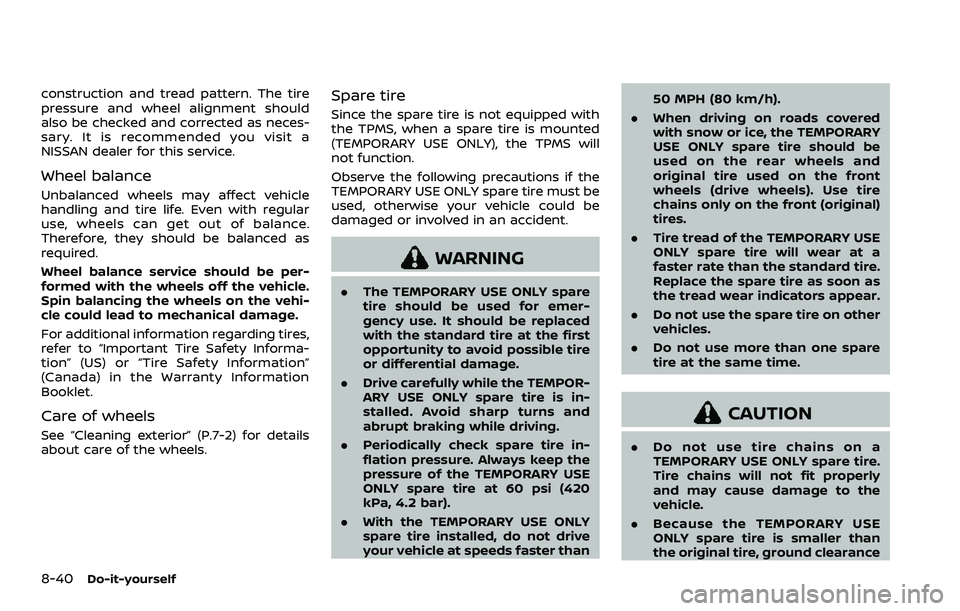
Spare tire
Since the spare tire is not equipped with
the TPMS, when a spare tire is mounted
(TEMPORARY USE ONLY), the TPMS will
not function.
Observe the following precautions if the
TEMPORARY USE ONLY spare tire must be
used, otherwise your vehicle could be
damaged or involved in an accident.
WARNING
.The TEMPORARY USE ONLY spare
tire should be used for emer-
gency use. It should be replaced
with the standard tire at the first
opportunity to avoid possible tire
or differential damage.
. Drive carefully while the TEMPOR-
ARY USE ONLY spare tire is in-
stalled. Avoid sharp turns and
abrupt braking while driving.
. Periodically check spare tire in-
flation pressure. Always keep the
pressure of the TEMPORARY USE
ONLY spare tire at 60 psi (420
kPa, 4.2 bar).
. With the TEMPORARY USE ONLY
spare tire installed, do not drive
your vehicle at speeds faster than 50 MPH (80 km/h).
. When driving on roads covered
with snow or ice, the TEMPORARY
USE ONLY spare tire should be
used on the rear wheels and
original tire used on the front
wheels (drive wheels). Use tire
chains only on the front (original)
tires.
. Tire tread of the TEMPORARY USE
ONLY spare tire will wear at a
faster rate than the standard tire.
Replace the spare tire as soon as
the tread wear indicators appear.
. Do not use the spare tire on other
vehicles.
. Do not use more than one spare
tire at the same time.
CAUTION
.Do not use tire chains on a
TEMPORARY USE ONLY spare tire.
Tire chains will not fit properly
and may cause damage to the
vehicle.
. Because the TEMPORARY USE
ONLY spare tire is smaller than
the original tire, ground clearance
Page 457 of 500
other corrosive materials, check lubrica-
tion frequently.
Lights*:Clean the headlights on a regular
basis. Make sure that the headlights, stop
lights, tail lights, turn signal lights, and
other lights are all operating properly and
installed securely. Also check headlight
aim.
Road wheel nuts (lug nuts)*: When
checking the tires, make sure no wheel
nuts are missing, and check for any loose
wheel nuts. Tighten if necessary.
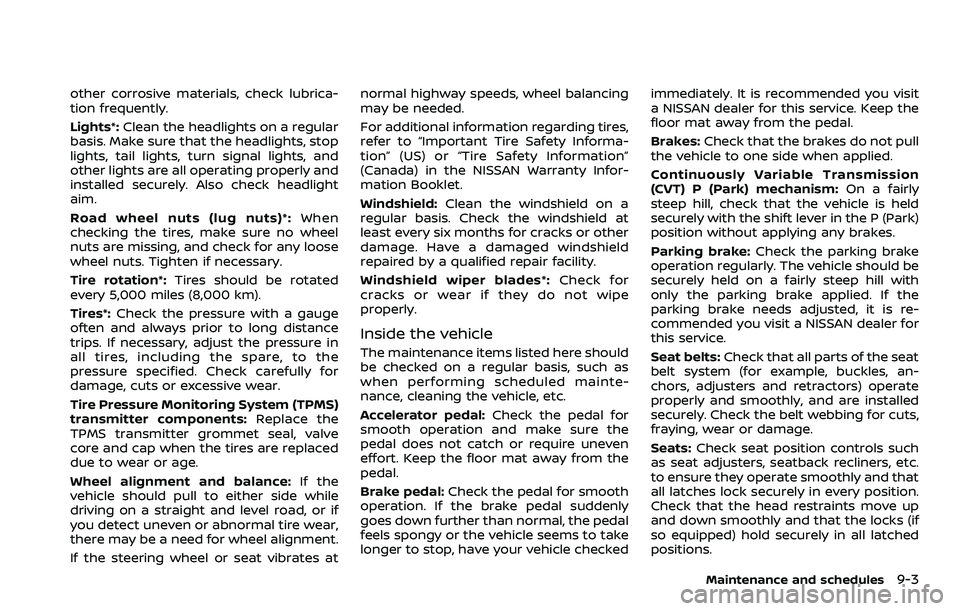
Tire rotation*: Tires should be rotated
every 5,000 miles (8,000 km).
Tires*: Check the pressure with a gauge
often and always prior to long distance
trips. If necessary, adjust the pressure in
all tires, including the spare, to the
pressure specified. Check carefully for
damage, cuts or excessive wear.
Tire Pressure Monitoring System (TPMS)
transmitter components: Replace the
TPMS transmitter grommet seal, valve
core and cap when the tires are replaced
due to wear or age.
Wheel alignment and balance: If the
vehicle should pull to either side while
driving on a straight and level road, or if
you detect uneven or abnormal tire wear,
there may be a need for wheel alignment.
If the steering wheel or seat vibrates at normal highway speeds, wheel balancing
may be needed.
For additional information regarding tires,
refer to “Important Tire Safety Informa-
tion” (US) or “Tire Safety Information”
(Canada) in the NISSAN Warranty Infor-
mation Booklet.
Windshield:
Clean the windshield on a
regular basis. Check the windshield at
least every six months for cracks or other
damage. Have a damaged windshield
repaired by a qualified repair facility.
Windshield wiper blades*: Check for
cracks or wear if they do not wipe
properly.
Inside the vehicle
The maintenance items listed here should
be checked on a regular basis, such as
when performing scheduled mainte-
nance, cleaning the vehicle, etc.
Accelerator pedal: Check the pedal for
smooth operation and make sure the
pedal does not catch or require uneven
effort. Keep the floor mat away from the
pedal.
Brake pedal: Check the pedal for smooth
operation. If the brake pedal suddenly
goes down further than normal, the pedal
feels spongy or the vehicle seems to take
longer to stop, have your vehicle checked immediately. It is recommended you visit
a NISSAN dealer for this service. Keep the
floor mat away from the pedal.
Brakes:
Check that the brakes do not pull
the vehicle to one side when applied.
Continuously Variable Transmission
(CVT) P (Park) mechanism: On a fairly
steep hill, check that the vehicle is held
securely with the shift lever in the P (Park)
position without applying any brakes.
Parking brake: Check the parking brake
operation regularly. The vehicle should be
securely held on a fairly steep hill with
only the parking brake applied. If the
parking brake needs adjusted, it is re-
commended you visit a NISSAN dealer for
this service.
Seat belts: Check that all parts of the seat
belt system (for example, buckles, an-
chors, adjusters and retractors) operate
properly and smoothly, and are installed
securely. Check the belt webbing for cuts,
fraying, wear or damage.
Seats: Check seat position controls such
as seat adjusters, seatback recliners, etc.
to ensure they operate smoothly and that
all latches lock securely in every position.
Check that the head restraints move up
and down smoothly and that the locks (if
so equipped) hold securely in all latched
positions.
Maintenance and schedules9-3
Page 477 of 500
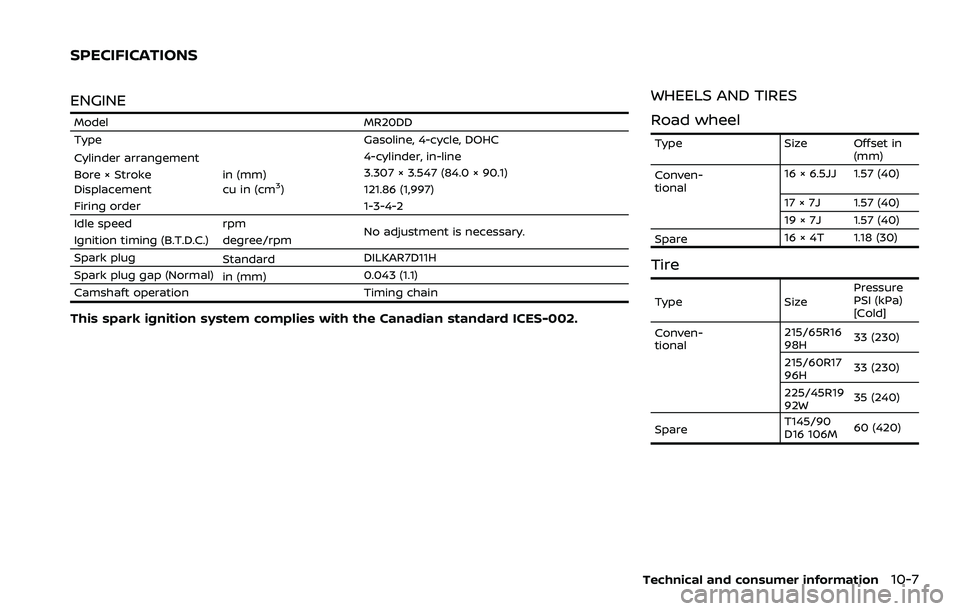
ENGINE
ModelMR20DD
Type Gasoline, 4-cycle, DOHC
Cylinder arrangement 4-cylinder, in-line
Bore × Stroke in (mm)3.307 × 3.547 (84.0 × 90.1)
Displacement cu in (cm
3)121.86 (1,997)
Firing order 1-3-4-2
Idle speed rpm
No adjustment is necessary.
Ignition timing (B.T.D.C.) degree/rpm
Spark plug StandardDILKAR7D11H
Spark plug gap (Normal) in (mm)0.043 (1.1)
Camshaft operation Timing chain
This spark ignition system complies with the Canadian standard ICES-002.
WHEELS AND TIRES
Road wheel
TypeSize Offset in
(mm)
Conven-
tional 16 × 6.5JJ 1.57 (40)
17 × 7J 1.57 (40)
19 × 7J 1.57 (40)
Spare 16 × 4T 1.18 (30)
Tire
Type
SizePressure
PSI (kPa)
[Cold]
Conven-
tional 215/65R16
98H
33 (230)
215/60R17
96H 33 (230)
225/45R19
92W 35 (240)
Spare T145/90
D16 106M
60 (420)
Technical and consumer information10-7
SPECIFICATIONS
Page 481 of 500

JVT0524X
To mount the front license plate, attach
the licence plate to the location marks
(small dimples)
of the bumper using the
two screwsprovided.
WARNING
.It is extremely dangerous to
ride in a cargo area inside
the vehicle. In a collision,
people riding in these areas
are more likely to be ser-
iously injured or killed.
.Do not allow people to ride
in any area of your vehicle
that is not equipped with
seats and seat belts.
.Be sure everyone in your
vehicle is in a seat and using
a seat belt properly.
TERMS
It is important to familiarize your-
self with the following terms before
loading your vehicle:
.Curb Weight (actual weight of
your vehicle) - vehicle weight
including: standard and optional
equipment, fluids, emergency
tools, and spare tire assembly.
This weight does notinclude passengers and cargo.
.GVW (Gross Vehicle Weight) -
curb weight plus the combined
weight of passengers and cargo.
.GVWR (Gross Vehicle Weight Rat-
ing) - maximum total combined
weight of the unloaded vehicle,
passengers, luggage, hitch, trai-
ler tongue load and any other
optional equipment. This infor-
mation is located on the F.M.V.S.
S./C.M.V.S.S. label.
.GAWR (Gross Axle Weight Rating)
- maximum weight (load) limit
specified for the front or rear
axle. This information is located
on the F.M.V.S.S./C.M.V.S.S. label.
.GCWR (Gross Combined Weight
Rating) - The maximum total
weight rating of the vehicle,
passengers, cargo, and trailer.
.Vehicle Capacity Weight, Load
limit, Total load capacity - max-
imum total weight limit specified
of the load (passengers and
cargo) for the vehicle. This is
the maximum combined weight
of occupants and cargo that can
Technical and consumer information10-11
INSTALLING FRONT LICENSE PLATE VEHICLE LOADING INFORMATION
Page 496 of 500

11-6
ShiftingCVT (Continuously
Variable Transmission)..................................... 5-20
Manual transmission ......................................... 5-25
Shoulder belt height adjustment, For
front seats........................................................................\
. 1-16
Soft bottle holders...................................................... 2-62
Spare tire............................................................. 8-40, 10-7
Spark plugs....................................................................... 8-14
Speedometer ...................................................................... 2-6
SRS Precautions on SRS ............................................ 1-40
Standard maintenance ............................................... 9-7
Starting Before starting the engine............................ 5-17
Jump starting ............................................................. 6-9
Precautions when starting
and driving.................................................................... 5-4
Push starting............................................................ 6-11
Starting the engine.............................. 5-18, 5-19
Status light, Front passenger air bag ......... 1-48
Steering Electric power steering................................ 5-144
Heated steering wheel ..................................... 2-54
Tilt/telescopic steering .................................... 3-30
Steering assist............................................................. 5-106
Steering assist switch (models with
ProPILOT assist) ............................................................ 2-57
Storage ........................................................................\
........ 2-62
Sun visors ........................................................................\
.. 3-31
Sunglasses holder....................................................... 2-64
Supplemental air bag warning labels ......... 1-58
Supplemental air bag
warning light .................................................... 1-59, 2-15
Supplemental Restraint System (SRS) ........ 1-40
Switch Fog light switch ..................................................... 2-54 Hazard warning flasher switch .................... 6-2
Headlight switch ................................................... 2-48
Ignition switch ........................................................ 5-12
Intelligent 4x4 LOCK switch ........................ 2-58
Intelligent Auto Headlight switch ............ 2-48
Power door lock switch ..................................... 3-7
Rear window and outside mirror
defroster switch .................................................... 2-47
Turn signal switch ............................................... 2-53
Vehicle dynamic control (VDC)
off switch .................................................................... 2-57
System maintenance............................................. 5-137
System malfunction ............................................... 5-136
T
Tachometer........................................................................\
.. 2-7
Temperature gauge, Engine coolant
temperature gauge ....................................................... 2-7
Theft (NISSAN Vehicle Immobilizer
System), Engine start ............................................... 2-43
Three-way catalyst......................................................... 5-4
Tilt/telescopic steering ........................................... 3-30
Tire pressure, Low tire pressure
warning light ................................................................... 2-13
Tires Flat tire........................................................................\
..... 6-3
Low tire pressure warning system ........... 5-5
Tire and Loading
information label................................ 8-31, 10-10
Tire chains.................................................................. 8-36
Tire dressing................................................................ 7-4
Tire pressure ............................................................ 8-29
Tire pressure monitoring
system (TPMS)................................................. 5-5, 6-3
Tire rotation.............................................................. 8-37
Types of tires ........................................................... 8-35 Uniform tire quality grading .................... 10-16
Wheel/tire size ........................................................ 10-7
Wheels and tires .................................................... 8-29
Towing Tow truck towing................................................. 6-13
Towing a trailer.................................................. 10-14
TPMS, Tire pressure monitoring system....... 5-5 TPMS with Easy Fill Tire Alert......................... 5-7
TPMS, Tire pressure warning system .............. 6-3
Trailer towing .............................................................. 10-14
Transceiver HomeLink® Universal Transceiver ........... 2-76
Transmission Continuously Variable Transmission ..... 5-13
Continuously Variable Transmission
(CVT) fluid....................................................................... 8-9
Driving with CVT (Continuously
Variable Transmission)..................................... 5-20
Driving with manual transmission.......... 5-25
Transmission shift lever lock release ..... 5-24
Transmitter (See remote keyless
entry system) ...................................................................... 3-8
Transmitter, With Intelligent Key system
(See Intelligent Key system) ................................ 3-19
Traveling or registering in
another country ........................................................... 10-8
Trip computer ................................................................ 2-39
Trip odometer ................................................................ 2-39
Turn signal switch ...................................................... 2-53
Turning the conventional (fixed speed)
cruise control mode ON......................................... 5-91
Turning the RAB system ON/OFF ............... 5-133
U
Underbody cleaning ...................................................... 7-3
Uniform tire quality grading ............................ 10-16