battery NISSAN SENTRA 1996 B14 / 4.G User Guide
[x] Cancel search | Manufacturer: NISSAN, Model Year: 1996, Model line: SENTRA, Model: NISSAN SENTRA 1996 B14 / 4.GPages: 191, PDF Size: 1.43 MB
Page 133 of 191

Type 2
1. To remove the caps, use a screwdriver.
2. Check the fluid level in each cell.
If it is necessary to add fluid, add only
distilled water to bring the level up to the
OK indicator in each filler opening.Do
not overfill.
JUMP STARTING
If jump starting is necessary, see the ``In
case of emergency'' section. If the engine
does not start by jump starting, the battery
may have to be replaced. Contact your
NISSAN dealer.
ADI0641
7-16
ZX
Page 142 of 191
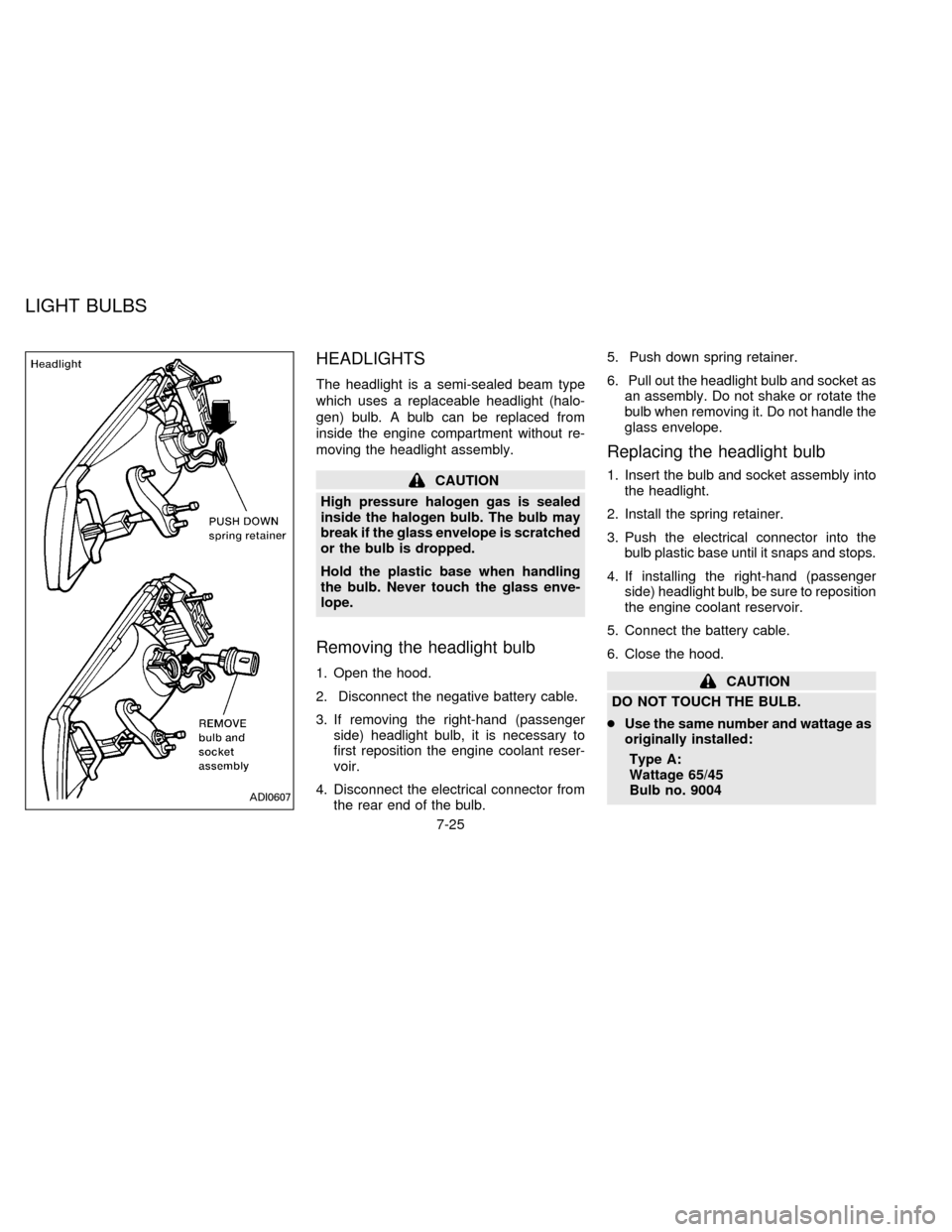
HEADLIGHTS
The headlight is a semi-sealed beam type
which uses a replaceable headlight (halo-
gen) bulb. A bulb can be replaced from
inside the engine compartment without re-
moving the headlight assembly.
CAUTION
High pressure halogen gas is sealed
inside the halogen bulb. The bulb may
break if the glass envelope is scratched
or the bulb is dropped.
Hold the plastic base when handling
the bulb. Never touch the glass enve-
lope.
Removing the headlight bulb
1. Open the hood.
2. Disconnect the negative battery cable.
3. If removing the right-hand (passenger
side) headlight bulb, it is necessary to
first reposition the engine coolant reser-
voir.
4. Disconnect the electrical connector from
the rear end of the bulb.5. Push down spring retainer.
6. Pull out the headlight bulb and socket as
an assembly. Do not shake or rotate the
bulb when removing it. Do not handle the
glass envelope.
Replacing the headlight bulb
1. Insert the bulb and socket assembly into
the headlight.
2. Install the spring retainer.
3. Push the electrical connector into the
bulb plastic base until it snaps and stops.
4. If installing the right-hand (passenger
side) headlight bulb, be sure to reposition
the engine coolant reservoir.
5. Connect the battery cable.
6. Close the hood.
CAUTION
DO NOT TOUCH THE BULB.
cUse the same number and wattage as
originally installed:
Type A:
Wattage 65/45
Bulb no. 9004
ADI0607
LIGHT BULBS
7-25
ZX
Page 157 of 191

with only the parking brake applied.
Automatic transmission ``Park'' mecha-
nismOn a fairly steep hill check that your
vehicle is held securely with the selector
lever in the P position without applying any
brakes.
UNDER THE HOOD AND
VEHICLE
The maintenance items listed here should
be checked periodically (e.g. each time you
check the engine oil or refuel).
Additional information on the following
items with ``*'' is found in the ``Do-it-
yourself operations'' section.
Windshield washer fluid*Check for ad-
equate fluid in the tank.
Engine coolant level*Check the coolant
level when the engine is cold.
Radiator and hosesCheck the front of the
radiator and clean off any dirt, insects,
leaves, etc., that may have accumulated.
Make sure the hoses have no cracks, de-
formation, rot or loose connections.
Brake fluid level*Make sure the brake and
clutch fluid level is between the ``MAX'' and``MIN'' lines on the reservoir.
Battery*Check the fluid level in each cell.
Engine drive belts*Make sure no belt is
frayed, worn, cracked or oily.
Engine oil level*Check the level after
parking the vehicle on a level spot and
turning off the engine.
Power steering fluid level* and lines
Check the level when the fluid is cold and
the engine is turned off. Check the lines for
proper attachment, leaks, cracks, etc.
Automatic transmission fluid level*
Check the level after putting the selector
lever in P with the engine idling.
Exhaust systemMake sure there are no
loose supports, cracks or holes. If the sound
of the exhaust seems unusual or there is a
smell of exhaust fumes, immediately locate
the trouble and correct it. (See the carbon
monoxide warning in the ``Starting and driv-
ing'' section.)
UnderbodyThe underbody is frequently
exposed to corrosive substances such as
those used on icy roads or to control dust. It
is very important to remove these sub-
stances, otherwise rust forms on the floorpan, frame, fuel lines and around the ex-
haust system. At the end of winter, the
underbody should be thoroughly flushed
with plain water, being careful to clean
those areas where mud and dirt may accu-
mulate. See the ``Appearance and interior
care'' section for additional information.
Fluid leaksCheck under the vehicle for
fuel, oil, water or other fluid leaks after the
vehicle has been parked for a while. Water
dripping from the air conditioner after use is
normal. If you should notice any leaks or if
gasoline fumes are evident, check for the
cause and have it corrected immediately.
8-4
ZX
Page 186 of 191
10 Index
A
Air bag (See supplemental restraint system)
Air bag warning light (If so equipped) ....... 2-20
Air cleaner housing filter ............................ 7-19
Air conditioner
Air conditioner operation ........................ 3-5
Air conditioner specification label ......... 9-13
Heater and air conditioner controls ........ 3-3
Servicing air conditioning ....................... 3-9
Air conditioning system refrigerant and
lubricant recommendations.......................... 9-8
Air flow charts .............................................. 3-6
Anchor point locations ............................... 2-32
Antenna (manual) ...................................... 3-17
Anti-lock brake system (ABS) .................. 4-16
Audio system
AM-FM radio ........................................ 3-11
AM-FM radio with cassette player ........ 3-13
Automatic
Automatic power window switch ......... 1-16
Automatic transmission fluid ................. 7-11
Driving with an automatic
transmission............................................ 4-6B
Battery........................................................ 7-15
Belts (See drive belts)
Brake
Anti-lock brake system (ABS) .............. 4-16
Brake fluid............................................. 7-13
Brake booster ....................................... 7-22
Brake wear indicators ................... 1-7, 7-22
Brake pedal .......................................... 7-21
Parking brake check ............................. 7-21
Parking brake operation ....................... 4-11
Break-in schedule ...................................... 4-13
Bulb check/instrument panel ....................... 1-5
Bulb replacement ....................................... 7-26
C
Capacities and recommended
fuel/lubricants ............................................... 9-2
Cassette player (See audio system)
CB radio or car phone ............................... 3-18
Child restraints for infants and
small children ............................................. 2-28
Child safety rear door lock .......................... 2-7
Cigarette lighter (accessory) and ashtray . 1-13
Cleaning exterior and interior ...................... 6-2
Clock-radio ................................................. 3-13Clutch pedal ............................................... 7-23
Cold weather driving cautions ................... 4-18
Controls
Audio controls ............................. 3-10, 3-13
Heater and air conditioner ...................... 3-3
Coolant
Capacities and recommended
fuel/lubricants.......................................... 9-2
Changing engine coolant........................ 7-6
Checking engine coolant level ............... 7-5
Engine coolant temperature gauge ....... 1-3
Corrosion protection .................................... 6-5
Cruise control............................................. 4-12
Cup holder ................................................. 1-14
D
Daytime running light system
(Canada only) ............................................ 1-11
Defogger switch
Rear window defogger switch .............. 1-10
Dimensions and weights............................ 9-10
Door locks .................................................... 2-2
Freeing a frozen door lock ................... 4-18
Drive belts .................................................. 7-17
Driving
Cold weather driving cautions .............. 4-18
ZX