lights NISSAN SENTRA 1996 B14 / 4.G User Guide
[x] Cancel search | Manufacturer: NISSAN, Model Year: 1996, Model line: SENTRA, Model: NISSAN SENTRA 1996 B14 / 4.GPages: 191, PDF Size: 1.43 MB
Page 86 of 191
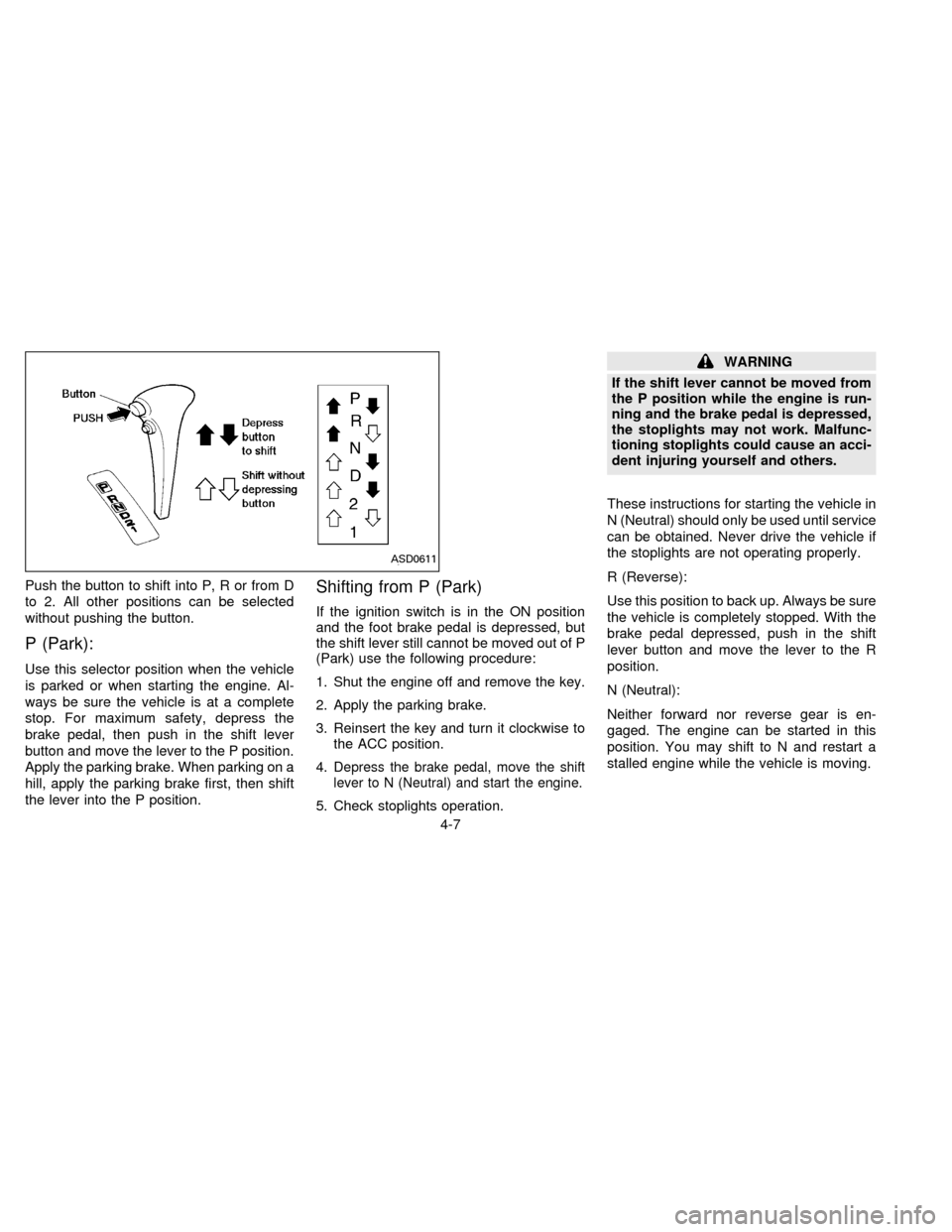
Push the button to shift into P, R or from D
to 2. All other positions can be selected
without pushing the button.
P (Park):
Use this selector position when the vehicle
is parked or when starting the engine. Al-
ways be sure the vehicle is at a complete
stop. For maximum safety, depress the
brake pedal, then push in the shift lever
button and move the lever to the P position.
Apply the parking brake. When parking on a
hill, apply the parking brake first, then shift
the lever into the P position.
Shifting from P (Park)
If the ignition switch is in the ON position
and the foot brake pedal is depressed, but
the shift lever still cannot be moved out of P
(Park) use the following procedure:
1. Shut the engine off and remove the key.
2. Apply the parking brake.
3. Reinsert the key and turn it clockwise to
the ACC position.
4.
Depress the brake pedal, move the shift
lever to N (Neutral) and start the engine.
5. Check stoplights operation.
WARNING
If the shift lever cannot be moved from
the P position while the engine is run-
ning and the brake pedal is depressed,
the stoplights may not work. Malfunc-
tioning stoplights could cause an acci-
dent injuring yourself and others.
These instructions for starting the vehicle in
N (Neutral) should only be used until service
can be obtained. Never drive the vehicle if
the stoplights are not operating properly.
R (Reverse):
Use this position to back up. Always be sure
the vehicle is completely stopped. With the
brake pedal depressed, push in the shift
lever button and move the lever to the R
position.
N (Neutral):
Neither forward nor reverse gear is en-
gaged. The engine can be started in this
position. You may shift to N and restart a
stalled engine while the vehicle is moving.
ASD0611
4-7
ZX
Page 91 of 191

The cruise control allows driving at a speed
between 30 to 90 MPH (48 to 144 km/h)
without keeping your foot on the accelerator
pedal.
To turn on the cruise control,push the
main switch. The indicator light on the
switch comes on.
To set cruising speed,accelerate your
vehicle to the desired speed, push the
COAST/SET switch and release it. The
CRUISE indicator light comes on. Take your
foot off the accelerator pedal. Your vehicle
maintains the set speed.cTo pass another vehicle,depress the
accelerator pedal. When you release the
pedal, the vehicle returns to the previ-
ously set speed.
cThe vehicle may not maintain the set
speed when going up or down steep hills.
If this happens, drive without the cruise
control.
To cancel the preset speed,use one of
the following three methods:
a) Push the CANCEL button; the CRUISE
light goes out.b) Tap the brake pedal; the CRUISE light
goes out.
c) Turn the main switch off. Both the ON
indicator and CRUISE lights go out.
The cruise control is automatically can-
celled and the CRUISE light goes out if:
cYou depress the brake pedal while push-
ing the ``ACCEL'' set switch.
cThe vehicle slows down more than 8
MPH (13 km/h) below the set speed.
cYou depress the clutch pedal (manual
transmission), or move the shift lever to
the N position (automatic transmission).
To reset at a faster cruising speed,use
one of the following three methods:
a) Depress the accelerator pedal. When the
vehicle attains the desired speed, push
and release the COAST/SET switch.
b) Push and hold the ACCEL set switch.
When the vehicle attains the speed you
desire, release the switch.
c) Push, then quickly release the ACCEL
set switch. Each time you do this, the set
speed increases by about 1 MPH (1.6
km/h).
ASD0604
CRUISE CONTROL
(If so equipped)
4-12
ZX
Page 106 of 191
tire placard affixed to the driver side
center pillar.
cRetighten the wheel nuts when the
vehicle has been run for 600 miles
(1,000 km).
5. Securely store the spare tire and jacking
equipment in the vehicle.
WARNING
cAlways make sure that the spare tire
and jacking equipment are properly
secured after use. The jack rod may
be used to securely tighten the hold-
down bolts. Such items can become
dangerous projectiles in an accident
or sudden stop.
cThe T-type spare tire and small size
spare tire are designed for emer-
gency use. See specific instructions
under the heading ``Wheels and
tires'' in the ``Do-it-yourself opera-
tions'' section.To start your engine with a booster battery,
the instructions and precautions below must
be followed.
CAUTION
cIf done incorrectly, jump starting can
be hazardous.
cExplosive hydrogen gas is always
present in the vicinity of the battery.
Keep all sparks and flames away
from the battery.
c
Do not allow battery fluid to come into
contact with eyes, skin, cloth or painted
surfaces. Battery fluid is a corrosive
sulfuric acid solution which can cause
severe burns. If the fluid should come
into contact with anything, immediately
flush the contacted area with water.
cA battery rated at above 12 volts
should not be used for a booster.
cWhenever working on or near a bat-
tery, always wear suitable eye protec-
tors (e.g., goggles or industrial safety
spectacles) and remove rings, metal
bands, or any other metal jewelry.
c
Keep battery out of the reach of chil-
dren.
Always follow the instructions below.
Failure to do so could result in damage
to the charging system and cause per-
sonal injury.
1.
If the booster battery is in another vehicle,
position the two vehicles to bring their
batteries into close proximity to each other.
Do not allow the two vehicles to touch.
2. Apply the parking brake. Move the shift
lever to Neutral (On automatic transmis-
sion models, move the lever to P). Switch
off all unnecessary electrical systems
(lights, heater, air conditioner, etc.).
3. Remove vent caps on the battery (if so
equipped). Cover the battery with an old
cloth to reduce explosion hazard.
4. Connect jumper cables in the sequence
as illustrated.
CAUTION
cAlways connect positive (+) to posi-
tive (+) and negative (þ) to body
ground (e.g., strut mounting bolt, etc.
Ðnot to the battery).
JUMP STARTING
5-7
ZX
Page 142 of 191
HEADLIGHTS
The headlight is a semi-sealed beam type
which uses a replaceable headlight (halo-
gen) bulb. A bulb can be replaced from
inside the engine compartment without re-
moving the headlight assembly.
CAUTION
High pressure halogen gas is sealed
inside the halogen bulb. The bulb may
break if the glass envelope is scratched
or the bulb is dropped.
Hold the plastic base when handling
the bulb. Never touch the glass enve-
lope.
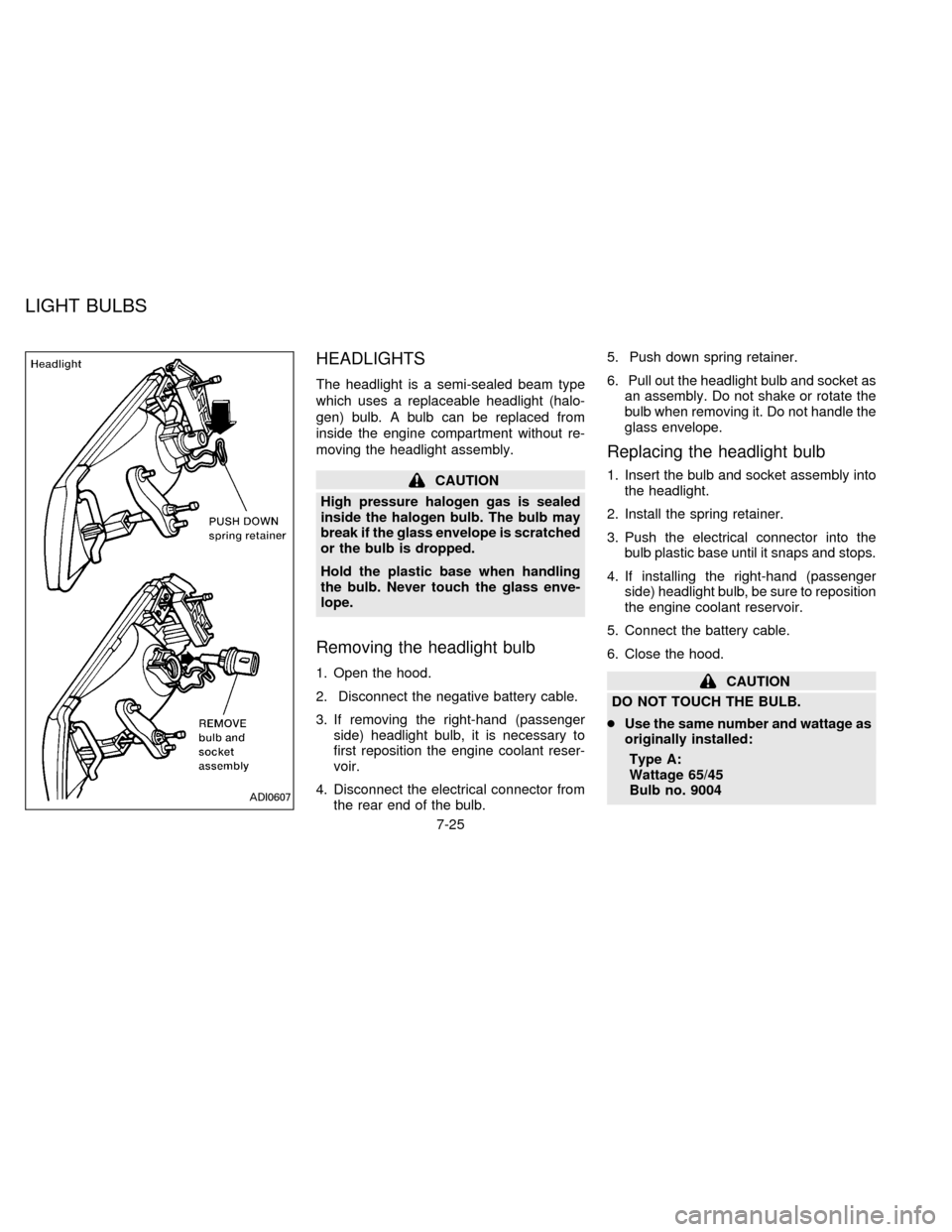
Removing the headlight bulb
1. Open the hood.
2. Disconnect the negative battery cable.
3. If removing the right-hand (passenger
side) headlight bulb, it is necessary to
first reposition the engine coolant reser-
voir.
4. Disconnect the electrical connector from
the rear end of the bulb.5. Push down spring retainer.
6. Pull out the headlight bulb and socket as
an assembly. Do not shake or rotate the
bulb when removing it. Do not handle the
glass envelope.
Replacing the headlight bulb
1. Insert the bulb and socket assembly into
the headlight.
2. Install the spring retainer.
3. Push the electrical connector into the
bulb plastic base until it snaps and stops.
4. If installing the right-hand (passenger
side) headlight bulb, be sure to reposition
the engine coolant reservoir.
5. Connect the battery cable.
6. Close the hood.
CAUTION
DO NOT TOUCH THE BULB.
cUse the same number and wattage as
originally installed:
Type A:
Wattage 65/45
Bulb no. 9004
ADI0607
LIGHT BULBS
7-25
ZX
Page 143 of 191
cAiming is not necessary after replac-
ing the bulb. When aiming adjust-
ment is necessary, contact your NIS-
SAN dealer.
cDo not leave the bulb out of the head-
light reflector for a long period of
time as dust, moisture, and smoke
may enter the headlight body and
affect the performance of the head-
light.
Before adjusting the headlights, make sure
all of the tires are properly inflated, the
vehicle is on level ground and there is no
excess weight in the vehicle that would
affect the level of the vehicle.
First, open the hood.
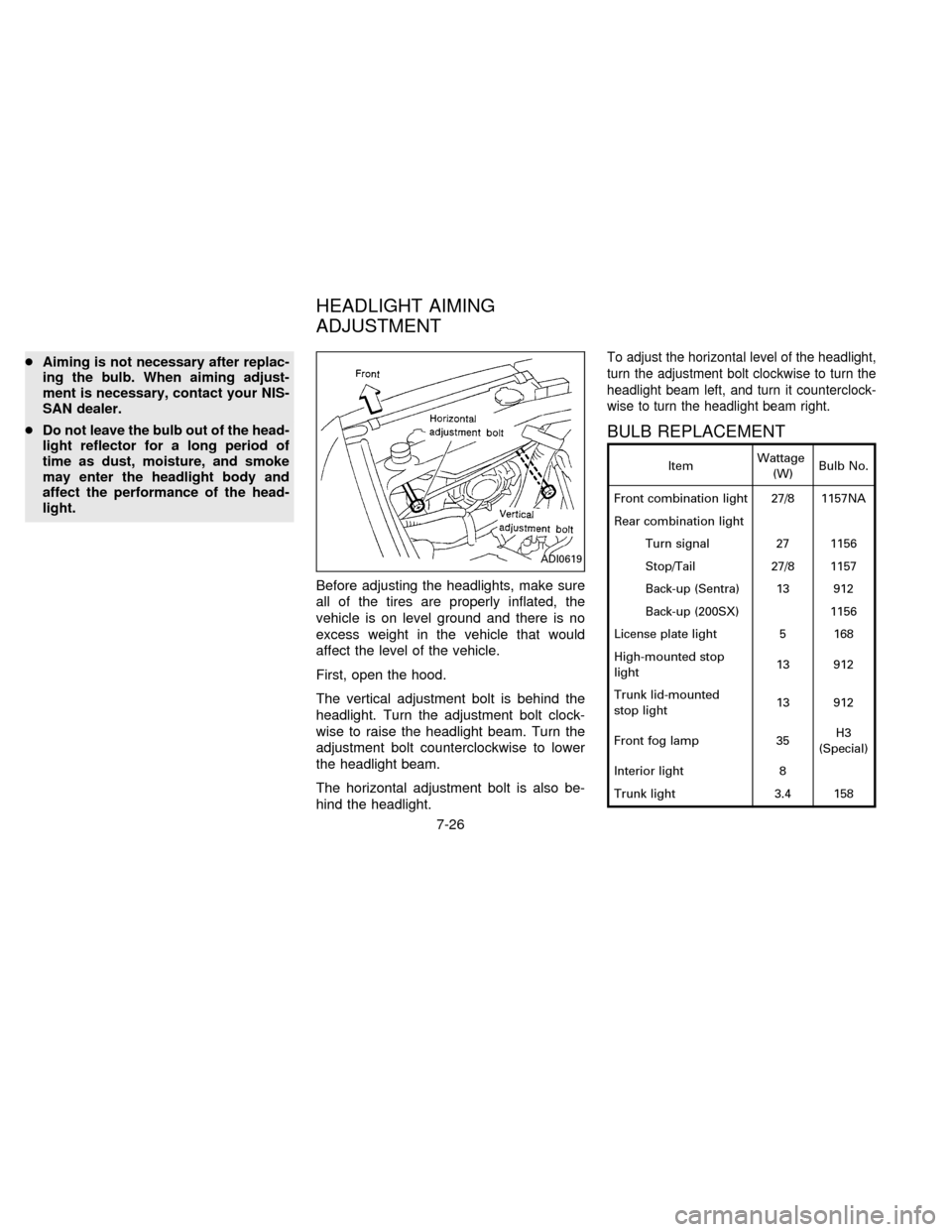
The vertical adjustment bolt is behind the
headlight. Turn the adjustment bolt clock-
wise to raise the headlight beam. Turn the
adjustment bolt counterclockwise to lower
the headlight beam.
The horizontal adjustment bolt is also be-
hind the headlight.To adjust the horizontal level of the headlight,
turn the adjustment bolt clockwise to turn the
headlight beam left, and turn it counterclock-
wise to turn the headlight beam right.
BULB REPLACEMENT
ItemWattage
(W)Bulb No.
Front combination light 27/8 1157NA
Rear combination light
Turn signal 27 1156
Stop/Tail 27/8 1157
Back-up (Sentra) 13 912
Back-up (200SX) 1156
License plate light 5 168
High-mounted stop
light13 912
Trunk lid-mounted
stop light13 912
Front fog lamp 35H3
(Special)
Interior light 8
Trunk light 3.4 158
ADI0619
HEADLIGHT AIMING
ADJUSTMENT
7-26
ZX
Page 145 of 191

Replacement procedures
All other lights are either type A, B, C or D.
When replacing a bulb, first remove the lens
and/or cover.
MDI0006
7-28
ZX
Page 156 of 191

Tire rotation*Tires should be rotated every
7,500 miles (12,000 km).
Wheel alignment and balanceIf the ve-
hicle should pull to either side while driving
on a straight and level road, or if you detect
uneven or abnormal tire wear, there may be
a need for wheel alignment.
If the steering wheel or seat vibrates at
normal highway speeds, wheel balancing
may be needed.
Windshield wiper blades*Check for
cracks or wear if they do not wipe properly.
Doors and engine hoodCheck that all
doors and the engine hood operate prop-
erly. Also ensure that all latches lock se-
curely. Lubricate hinges, latches, rollers and
links if necessary. Make sure the secondary
latch keeps the hood from opening when
the primary latch is released.
When driving in areas using road salt or
other corrosive materials, check lubrication
frequently.
Lights*Make sure the headlights, stop
lights, tail lights, turn signal lights, and other
lights are all operating properly and installed
securely. Also check headlight aim.INSIDE THE VEHICLE
The maintenance items listed here should
be checked on a regular basis, such as
when performing periodic maintenance,
cleaning the vehicle, etc.
Additional information on the following
items with ``*'' is found in the ``Do-it-
yourself operations'' section.
Warning lights and chimesMake sure all
warning lights and chimes are operating
properly.
Windshield wiper and washer*Check that
the wipers and washer operate properly and
that the wipers do not streak.
Windshield defrosterCheck that the air
comes out of the defroster outlets properly
and in sufficient quantity when operating the
heater or air conditioner.
Steering wheelCheck for changes in the
steering conditions, such as excessive free-
play, hard steering or strange noises.
SeatsCheck seat position controls such as
seat adjusters, seatback recliner, etc. to
ensure they operate smoothly and all
latches lock securely in every position.
Check that the head restraints move up anddown smoothly and the locks (if so
equipped) hold securely in all latched posi-
tions.
Seat beltsCheck that all parts of the seat
belt system (e.g. buckles, anchors, adjust-
ers and retractors) operate properly and
smoothly, and are installed securely. Check
the belt webbing for cuts, fraying, wear or
damage.
Accelerator pedalCheck the pedal for
smooth operation and make sure the pedal
does not catch or require uneven effort.
Keep the floor mats away from the pedal.
Clutch pedal*Make sure the pedal oper-
ates smoothly and check that it has the
proper free travel.
BrakesCheck that the brakes do not pull
the vehicle to one side when applied.
Brake pedal*Check the pedal for smooth
operation and make sure it has the proper
distance under it when depressed fully.
Check the brake booster function. Be cer-
tain to keep floor mats away from the pedal.
Parking brake*Check that the lever has
the proper travel and confirm that your
vehicle is held securely on a fairly steep hill
8-3
ZX
Page 182 of 191
After the hitch is removed, seal the bolt
holes to prevent exhaust fumes, water
or dust from entering the passenger
compartment.
cRegularly check that all hitch mounting
bolts are securely mounted.
Tire pressures
cWhen towing a trailer, inflate the vehicle
tires to the recommended cold tire pres-
sure indicated on the tire placard (lo-
cated on the driver side center pillar.)
cTrailer tire condition, size, load rating
and proper inflation pressure should be
in accordance with the trailer and tire
manufacturers' specifications.
Safety chain
Always use a suitable chain between your
vehicle and the trailer. The chain should be
crossed and should be attached to the hitch,
not to the vehicle bumper or axle. Be sure to
leave enough slack in the chain to permit
turning corners.
Trailer lights
Trailer lights should comply with federal
and/ or local regulations. When wiring thevehicle for towing, connect the stop and tail
light pickup into the vehicle electrical circuit.
Trailer brakes
If your trailer is equipped with a braking
system, make sure it conforms to federal
and/or local regulations and that it is prop-
erly installed.
CAUTION
Never connect a trailer brake system
directly to the vehicle brake system.
Pre-towing tips
cBe certain your vehicle maintains a level
position when a loaded and/or unloaded
trailer is hitched. Do not drive the vehicle if
it has an abnormal nose-up or nose- down
condition; check for improper tongue load,
overload, worn suspension or other pos-
sible causes of either condition.
cAlways secure items in the trailer to
prevent load shifts while driving.
cBe certain your rear view mirrors con-
form to all federal, state or local regula-
tions. If not, install any mirrors required
for towing before driving the vehicle.
Trailer towing tips
In order to gain skill and an understanding
of the vehicle's behavior, you should prac-
tice turning, stopping and backing up in an
area which is free from traffic. Steering,
stability, and braking performance are
somewhat different than under normal driv-
ing conditions.
cAlways secure items in the trailer to
prevent load shift while driving.
c
Avoid abrupt starts, acceleration or stops.
cAvoid sharp turns or lane changes.
cAlways drive your vehicle at a moderate
speed.
c
Always block the wheels on both vehicle
and trailer when parking. Parking on a
slope is not recommended; however, if
you must do so, and if your vehicle is
equipped with automatic transmission,
first block the wheels and apply the park-
ing brake, and then move the transmis-
sion shift lever into the P position. If you
move the shift lever to the P position
before blocking the wheels and applying
the parking brake, transmission damage
could occur.
9-17
ZX
Page 187 of 191

Driving with automatic
transmission............................................ 4-6
Driving with manual transmission ........... 4-9
Precautions when driving ..................... 4-16
Precautions when starting and driving ... 4-2
E
Economy-fuel ............................................. 4-14
Emission control information label............. 9-13
Emission control system warranty ............. 9-19
Engine
Before starting the engine ...................... 4-5
Capacities and recommended
fuel/lubricants.......................................... 9-2
Changing engine coolant........................ 7-6
Changing engine oil................................ 7-9
Changing engine oil filter...................... 7-10
Checking engine coolant level ............... 7-5
Checking engine oil level ....................... 7-8
Engine compartment check
locations ......................................... 7-3, 7-4
Engine coolant temperature gauge ....... 1-3
Engine cooling system ........................... 7-5
Engine oil ................................................ 7-8
Engine oil and oil filter
recommendation ..................................... 9-5
Engine oil viscosity ................................. 9-5
Engine serial number ........................... 9-12
Engine specifications .............................. 9-9
Starting the engine ............................... 4-11
Exhaust gas (Carbon monoxide) ................. 4-2F
Flashers (See hazard warning flasher switch)
Flat tire ......................................................... 5-2
Fluid (Checking)
Automatic transmission fluid ................. 7-11
Brake fluid............................................. 7-13
Engine coolant ........................................ 7-5
Engine oil ................................................ 7-8
Power steering fluid .............................. 7-13
Window washer fluid ............................ 7-14
F.M.V.S.S. certification label ..................... 9-12
Front fog light switch ................................. 1-12
Front seats ................................................. 2-13
Fuel
Capacities and recommended
fuel/lubricants.......................................... 9-2
Fuel economy ....................................... 4-14
Fuel filler cap ........................................ 2-11
Fuel filler lid lock operation .................. 2-11
Fuel gauge.............................................. 1-4
Fuel octane rating................................... 9-3
Fuel recommendation ............................. 9-3
Fuses ......................................................... 7-23
G
Gas station information............................ 10-10
Gauge
Engine coolant temperature gauge ........ 1-3
Fuel gauge.............................................. 1-4Odometer ................................................ 1-3
Speedometer .......................................... 1-3
Tachometer............................................. 1-3
Trip odometer ......................................... 1-3
Gear selection (See shifting)
General maintenance .................................. 8-2
Glove box..................................................... 2-9
H
Hazard warning flasher switch .................. 1-13
Head restraints .......................................... 2-14
Headlight aiming adjustment ..................... 7-26
Headlight and turn signal switch ............... 1-11
Headlights .................................................. 7-25
Heater and air conditioner
Heater and air conditioner controls ........ 3-3
Heater operation ..................................... 3-4
Hood release ............................................... 2-8
I
Ignition switch .............................................. 4-4
Increasing fuel economy .......................... 4-14
Indicator lights and chimes (See warning/
indicator lights and chimes)
Inside mirror ............................................... 2-35
Instrument brightness control .................... 1-12
Interior light ................................................ 1-17
10-2
ZX
Page 188 of 191

J
Jump starting ............................................... 5-7
K
Key ............................................................... 2-2
Keyless entry system (See multi-remote
control system)
L
Labels
Air conditioner specification label ......... 9-13
Emission control information label........ 9-13
Engine serial number ........................... 9-12
F.M.V.S.S. Certification label ............... 9-12
Vehicle identification number plate ...... 9-11
Warning labels (for SRS) ..................... 2-20
License plate
Installing license plate .......................... 9-14
Light
Air bag warning light............................. 2-20
Bulb check/instrument panel .................. 1-5
Bulb replacement.................................. 7-26
Front fog light switch ............................ 1-12
Headlight aiming adjustment ................ 7-26
Headlight and turn signal switch .......... 1-11
Headlights ............................................. 7-25
Interior light ........................................... 1-17
Light bulbs ............................................ 7-25Trunk light ............................................ 1-17
Warning/indicator lights and chimes ...... 1-5
Lock
Child safety rear door lock ..................... 2-7
Door locks............................................... 2-2
Fuel filler lid lock operation .................. 2-11
Power door lock...................................... 2-3
Trunk lid lock operation .......................... 2-9
M
Maintenance
General maintenance ............................. 8-2
Inside the vehicle.................................... 8-3
Outside the vehicle ................................. 8-2
Periodic maintenance schedules ............ 8-5
Seat belt maintenance.......................... 2-27
Under the hood and vehicle ................... 8-4
Manual antenna ......................................... 3-17
Meters and gauges ...................................... 1-2
Mirror
Inside mirror.......................................... 2-35
Outside mirror control ........................... 2-34
Vanity mirror ......................................... 2-35
Multi-remote control system ........................ 2-4
O
Octane rating (See fuel)
Odometer ..................................................... 1-3Oil
Capacities and recommended
fuel/lubricants.......................................... 9-2
Changing engine oil................................ 7-9
Changing engine oil filter...................... 7-10
Checking engine oil level ....................... 7-8
Engine oil ................................................ 7-8
Engine oil and oil filter
recommendation ..................................... 9-5
Opener lever for trunk lid............................. 2-9
Outside mirror control ................................ 2-34
Overdrive switch .......................................... 4-8
Overheat
If your vehicle overheats ........................ 5-9
Owner's manual order form ....................... 9-20
P
Parking
Parking brake check............................ 7-21
Parking brake operation ....................... 4-11
Parking/parking on hills ........................ 4-15
Periodic maintenance schedules ................. 8-5
Power
Power door lock...................................... 2-3
Power steering fluid .............................. 7-13
Power windows..................................... 1-15
Precautions
Maintenance precautions ....................... 7-2
Precautions on seat belt usage............ 2-22
Precautions when driving ..................... 4-16
10-3
ZX