warning light NISSAN SENTRA 1996 B14 / 4.G Owner's Manual
[x] Cancel search | Manufacturer: NISSAN, Model Year: 1996, Model line: SENTRA, Model: NISSAN SENTRA 1996 B14 / 4.GPages: 191, PDF Size: 1.43 MB
Page 106 of 191
tire placard affixed to the driver side
center pillar.
cRetighten the wheel nuts when the
vehicle has been run for 600 miles
(1,000 km).
5. Securely store the spare tire and jacking
equipment in the vehicle.
WARNING
cAlways make sure that the spare tire
and jacking equipment are properly
secured after use. The jack rod may
be used to securely tighten the hold-
down bolts. Such items can become
dangerous projectiles in an accident
or sudden stop.
cThe T-type spare tire and small size
spare tire are designed for emer-
gency use. See specific instructions
under the heading ``Wheels and
tires'' in the ``Do-it-yourself opera-
tions'' section.To start your engine with a booster battery,
the instructions and precautions below must
be followed.
CAUTION
cIf done incorrectly, jump starting can
be hazardous.
cExplosive hydrogen gas is always
present in the vicinity of the battery.
Keep all sparks and flames away
from the battery.
c
Do not allow battery fluid to come into
contact with eyes, skin, cloth or painted
surfaces. Battery fluid is a corrosive
sulfuric acid solution which can cause
severe burns. If the fluid should come
into contact with anything, immediately
flush the contacted area with water.
cA battery rated at above 12 volts
should not be used for a booster.
cWhenever working on or near a bat-
tery, always wear suitable eye protec-
tors (e.g., goggles or industrial safety
spectacles) and remove rings, metal
bands, or any other metal jewelry.
c
Keep battery out of the reach of chil-
dren.
Always follow the instructions below.
Failure to do so could result in damage
to the charging system and cause per-
sonal injury.
1.
If the booster battery is in another vehicle,
position the two vehicles to bring their
batteries into close proximity to each other.
Do not allow the two vehicles to touch.
2. Apply the parking brake. Move the shift
lever to Neutral (On automatic transmis-
sion models, move the lever to P). Switch
off all unnecessary electrical systems
(lights, heater, air conditioner, etc.).
3. Remove vent caps on the battery (if so
equipped). Cover the battery with an old
cloth to reduce explosion hazard.
4. Connect jumper cables in the sequence
as illustrated.
CAUTION
cAlways connect positive (+) to posi-
tive (+) and negative (þ) to body
ground (e.g., strut mounting bolt, etc.
Ðnot to the battery).
JUMP STARTING
5-7
ZX
Page 128 of 191
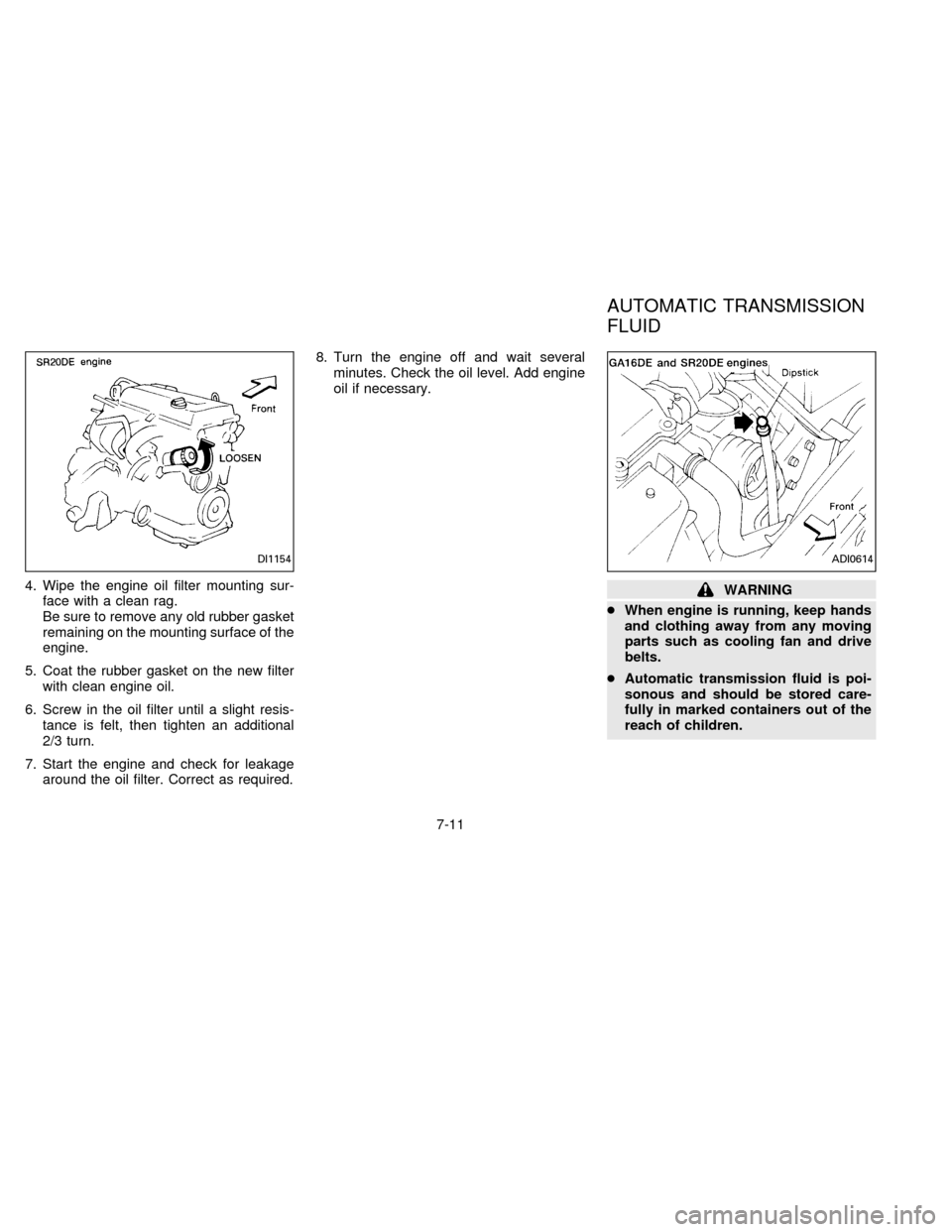
4. Wipe the engine oil filter mounting sur-
face with a clean rag.
Be sure to remove any old rubber gasket
remaining on the mounting surface of the
engine.
5. Coat the rubber gasket on the new filter
with clean engine oil.
6. Screw in the oil filter until a slight resis-
tance is felt, then tighten an additional
2/3 turn.
7. Start the engine and check for leakage
around the oil filter. Correct as required.8. Turn the engine off and wait several
minutes. Check the oil level. Add engine
oil if necessary.WARNING
cWhen engine is running, keep hands
and clothing away from any moving
parts such as cooling fan and drive
belts.
cAutomatic transmission fluid is poi-
sonous and should be stored care-
fully in marked containers out of the
reach of children.
DI1154ADI0614
AUTOMATIC TRANSMISSION
FLUID
7-11
ZX
Page 130 of 191
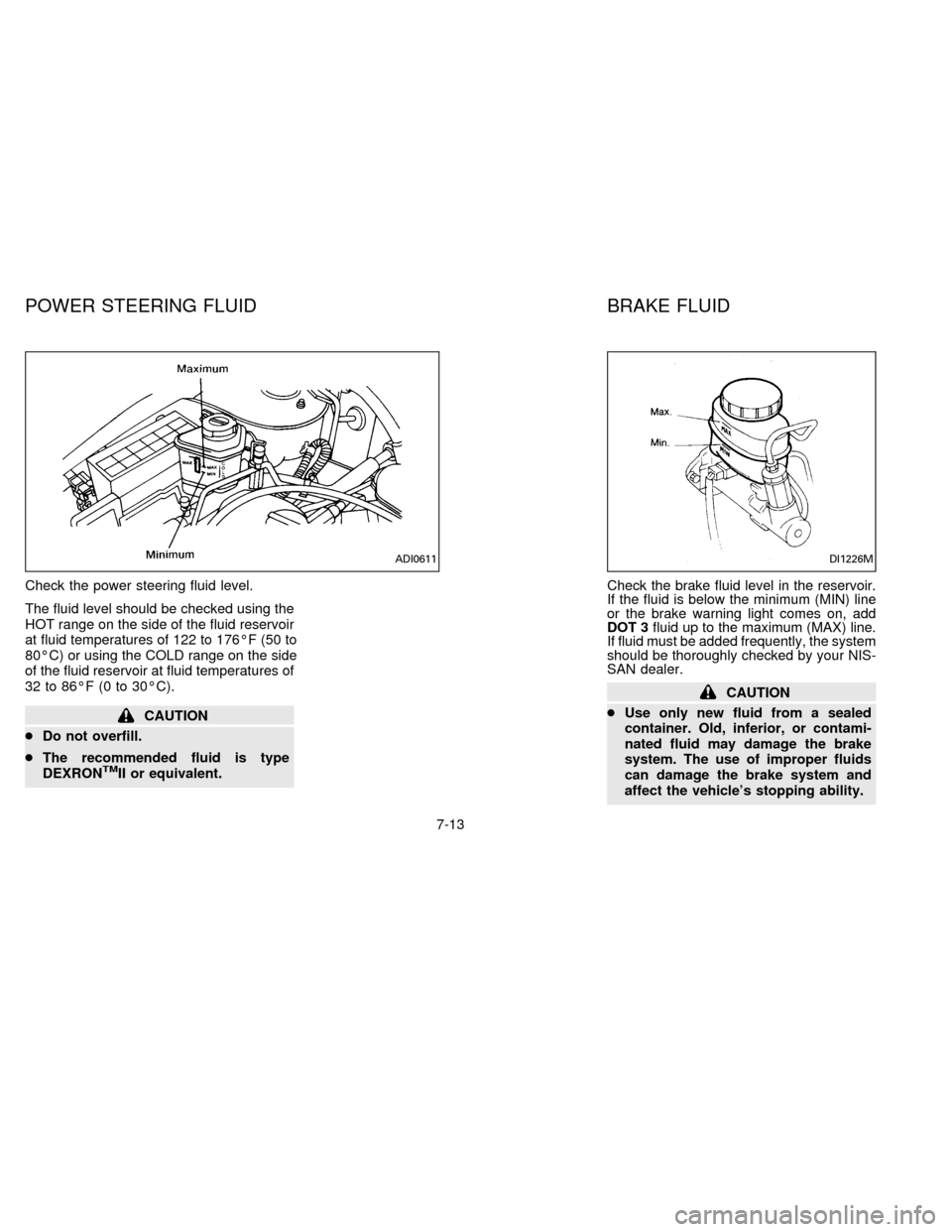
Check the power steering fluid level.
The fluid level should be checked using the
HOT range on the side of the fluid reservoir
at fluid temperatures of 122 to 176ÉF (50 to
80ÉC) or using the COLD range on the side
of the fluid reservoir at fluid temperatures of
32 to 86ÉF (0 to 30ÉC).
CAUTION
cDo not overfill.
cThe recommended fluid is type
DEXRON
TMII or equivalent.Check the brake fluid level in the reservoir.
If the fluid is below the minimum (MIN) line
or the brake warning light comes on, add
DOT 3fluid up to the maximum (MAX) line.
If fluid must be added frequently, the system
should be thoroughly checked by your NIS-
SAN dealer.
CAUTION
cUse only new fluid from a sealed
container. Old, inferior, or contami-
nated fluid may damage the brake
system. The use of improper fluids
can damage the brake system and
affect the vehicle's stopping ability.
ADI0611DI1226M
POWER STEERING FLUID BRAKE FLUID
7-13
ZX
Page 131 of 191
cDo not spill the fluid on painted sur-
faces. This will damage the paint. If
fluid is spilled, wash with water.
For USA
Fill the window washer fluid reservoir peri-
odically. Perform the refilling operation
more often under driving conditions that
require an increased amount of window
washer fluid.
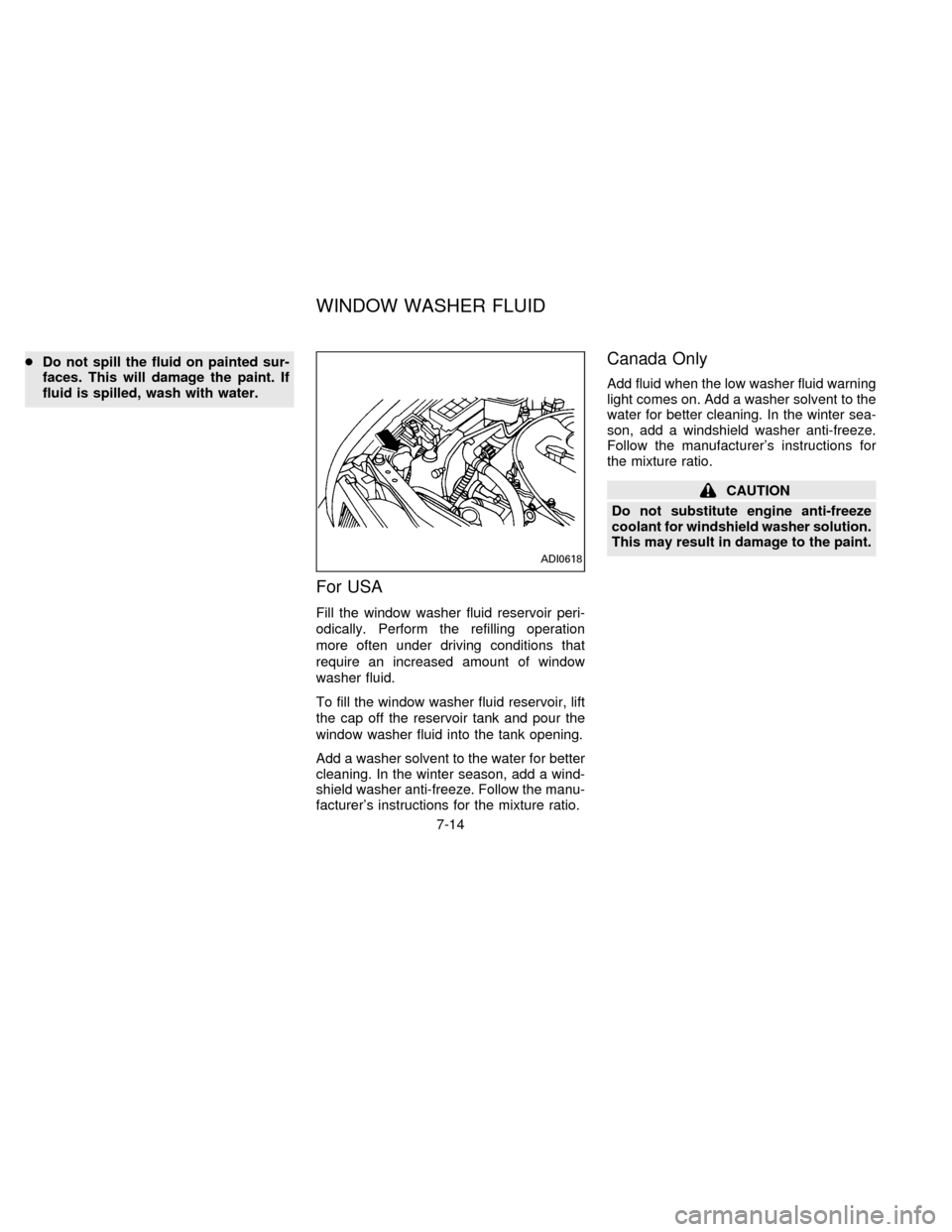
To fill the window washer fluid reservoir, lift
the cap off the reservoir tank and pour the
window washer fluid into the tank opening.
Add a washer solvent to the water for better
cleaning. In the winter season, add a wind-
shield washer anti-freeze. Follow the manu-
facturer's instructions for the mixture ratio.
Canada Only
Add fluid when the low washer fluid warning
light comes on. Add a washer solvent to the
water for better cleaning. In the winter sea-
son, add a windshield washer anti-freeze.
Follow the manufacturer's instructions for
the mixture ratio.
CAUTION
Do not substitute engine anti-freeze
coolant for windshield washer solution.
This may result in damage to the paint.
ADI0618
WINDOW WASHER FLUID
7-14
ZX
Page 139 of 191
normal, it may be due to a lack of adjust-
ment of the rear drum brakes. Apply the
parking brake several times.
WARNING
See your NISSAN dealer and have it
checked if the brake pedal height does
not return to normal.
Brake pad wear indicators
The disc brake pads on your vehicle have
audible wear indicators. When a brake pad
requires replacement, it makes a high
pitched scraping or screeching sound when
the vehicle is in motion whether or not the
brake pedal is depressed. Have the brakes
checked as soon as possible if the wear
indicator sound is heard.
Under some driving or climate conditions,
occasional brake squeak, squeal or other
noise may be heard. Occasional brake
noise during light to moderate stops is nor-
mal and does not affect the function or
performance of the brake system.
The rear drum brakes (if so equipped) do
not have audible wear indicators. Should
you ever hear an unusually loud noise fromthe rear drum brakes, have them inspected
as soon as possible by your NISSAN
dealer.
Proper brake inspection intervals should
be followed.For more information regard-
ing brake inspections, see the appropriate
maintenance schedule information in the
``Maintenance Schedule'' section of this
manual.Check the brake booster function as fol-
lows:
1. With the engine off, press and release
the brake pedal several times. When
brake pedal movement (distance of
travel) remains the same from one pedal
application to the next, continue on to the
next step.
2. While depressing the brake pedal, start
the engine. The pedal height should drop
a little.
3. With the brake pedal depressed, stop the
engine. Keeping the pedal depressed for
about 30 seconds, the pedal height
should not change.
4. Run the engine for one minute without
depressing the brake pedal, then turn it
off. Depress the brake pedal several
times. The pedal travel distance will de-
crease gradually with each depression
as the vacuum is released from the
booster.
If the brakes do not operate properly, see
your NISSAN dealer.
BRAKE BOOSTER
7-22
ZX
Page 156 of 191

Tire rotation*Tires should be rotated every
7,500 miles (12,000 km).
Wheel alignment and balanceIf the ve-
hicle should pull to either side while driving
on a straight and level road, or if you detect
uneven or abnormal tire wear, there may be
a need for wheel alignment.
If the steering wheel or seat vibrates at
normal highway speeds, wheel balancing
may be needed.
Windshield wiper blades*Check for
cracks or wear if they do not wipe properly.
Doors and engine hoodCheck that all
doors and the engine hood operate prop-
erly. Also ensure that all latches lock se-
curely. Lubricate hinges, latches, rollers and
links if necessary. Make sure the secondary
latch keeps the hood from opening when
the primary latch is released.
When driving in areas using road salt or
other corrosive materials, check lubrication
frequently.
Lights*Make sure the headlights, stop
lights, tail lights, turn signal lights, and other
lights are all operating properly and installed
securely. Also check headlight aim.INSIDE THE VEHICLE
The maintenance items listed here should
be checked on a regular basis, such as
when performing periodic maintenance,
cleaning the vehicle, etc.
Additional information on the following
items with ``*'' is found in the ``Do-it-
yourself operations'' section.
Warning lights and chimesMake sure all
warning lights and chimes are operating
properly.
Windshield wiper and washer*Check that
the wipers and washer operate properly and
that the wipers do not streak.
Windshield defrosterCheck that the air
comes out of the defroster outlets properly
and in sufficient quantity when operating the
heater or air conditioner.
Steering wheelCheck for changes in the
steering conditions, such as excessive free-
play, hard steering or strange noises.
SeatsCheck seat position controls such as
seat adjusters, seatback recliner, etc. to
ensure they operate smoothly and all
latches lock securely in every position.
Check that the head restraints move up anddown smoothly and the locks (if so
equipped) hold securely in all latched posi-
tions.
Seat beltsCheck that all parts of the seat
belt system (e.g. buckles, anchors, adjust-
ers and retractors) operate properly and
smoothly, and are installed securely. Check
the belt webbing for cuts, fraying, wear or
damage.
Accelerator pedalCheck the pedal for
smooth operation and make sure the pedal
does not catch or require uneven effort.
Keep the floor mats away from the pedal.
Clutch pedal*Make sure the pedal oper-
ates smoothly and check that it has the
proper free travel.
BrakesCheck that the brakes do not pull
the vehicle to one side when applied.
Brake pedal*Check the pedal for smooth
operation and make sure it has the proper
distance under it when depressed fully.
Check the brake booster function. Be cer-
tain to keep floor mats away from the pedal.
Parking brake*Check that the lever has
the proper travel and confirm that your
vehicle is held securely on a fairly steep hill
8-3
ZX
Page 179 of 191
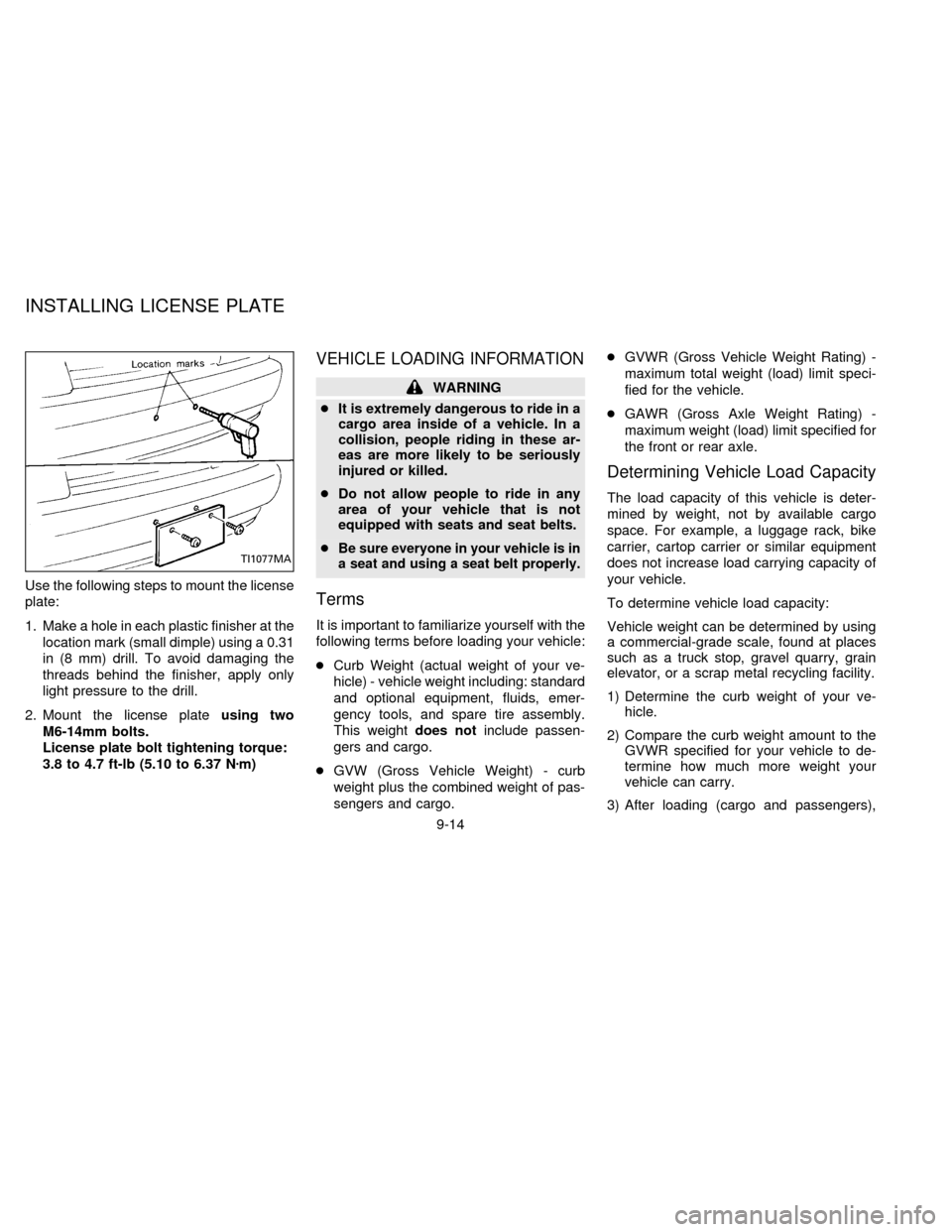
Use the following steps to mount the license
plate:
1. Make a hole in each plastic finisher at the
location mark (small dimple) using a 0.31
in (8 mm) drill. To avoid damaging the
threads behind the finisher, apply only
light pressure to the drill.
2. Mount the license plateusing two
M6-14mm bolts.
License plate bolt tightening torque:
3.8 to 4.7 ft-lb (5.10 to 6.37 Nzm)
VEHICLE LOADING INFORMATION
WARNING
cIt is extremely dangerous to ride in a
cargo area inside of a vehicle. In a
collision, people riding in these ar-
eas are more likely to be seriously
injured or killed.
cDo not allow people to ride in any
area of your vehicle that is not
equipped with seats and seat belts.
c
Be sure everyone in your vehicle is in
a seat and using a seat belt properly.
Terms
It is important to familiarize yourself with the
following terms before loading your vehicle:
cCurb Weight (actual weight of your ve-
hicle) - vehicle weight including: standard
and optional equipment, fluids, emer-
gency tools, and spare tire assembly.
This weightdoes notinclude passen-
gers and cargo.
cGVW (Gross Vehicle Weight) - curb
weight plus the combined weight of pas-
sengers and cargo.cGVWR (Gross Vehicle Weight Rating) -
maximum total weight (load) limit speci-
fied for the vehicle.
cGAWR (Gross Axle Weight Rating) -
maximum weight (load) limit specified for
the front or rear axle.
Determining Vehicle Load Capacity
The load capacity of this vehicle is deter-
mined by weight, not by available cargo
space. For example, a luggage rack, bike
carrier, cartop carrier or similar equipment
does not increase load carrying capacity of
your vehicle.
To determine vehicle load capacity:
Vehicle weight can be determined by using
a commercial-grade scale, found at places
such as a truck stop, gravel quarry, grain
elevator, or a scrap metal recycling facility.
1) Determine the curb weight of your ve-
hicle.
2) Compare the curb weight amount to the
GVWR specified for your vehicle to de-
termine how much more weight your
vehicle can carry.
3) After loading (cargo and passengers),
TI1077MA
INSTALLING LICENSE PLATE
9-14
ZX
Page 186 of 191

10 Index
A
Air bag (See supplemental restraint system)
Air bag warning light (If so equipped) ....... 2-20
Air cleaner housing filter ............................ 7-19
Air conditioner
Air conditioner operation ........................ 3-5
Air conditioner specification label ......... 9-13
Heater and air conditioner controls ........ 3-3
Servicing air conditioning ....................... 3-9
Air conditioning system refrigerant and
lubricant recommendations.......................... 9-8
Air flow charts .............................................. 3-6
Anchor point locations ............................... 2-32
Antenna (manual) ...................................... 3-17
Anti-lock brake system (ABS) .................. 4-16
Audio system
AM-FM radio ........................................ 3-11
AM-FM radio with cassette player ........ 3-13
Automatic
Automatic power window switch ......... 1-16
Automatic transmission fluid ................. 7-11
Driving with an automatic
transmission............................................ 4-6B
Battery........................................................ 7-15
Belts (See drive belts)
Brake
Anti-lock brake system (ABS) .............. 4-16
Brake fluid............................................. 7-13
Brake booster ....................................... 7-22
Brake wear indicators ................... 1-7, 7-22
Brake pedal .......................................... 7-21
Parking brake check ............................. 7-21
Parking brake operation ....................... 4-11
Break-in schedule ...................................... 4-13
Bulb check/instrument panel ....................... 1-5
Bulb replacement ....................................... 7-26
C
Capacities and recommended
fuel/lubricants ............................................... 9-2
Cassette player (See audio system)
CB radio or car phone ............................... 3-18
Child restraints for infants and
small children ............................................. 2-28
Child safety rear door lock .......................... 2-7
Cigarette lighter (accessory) and ashtray . 1-13
Cleaning exterior and interior ...................... 6-2
Clock-radio ................................................. 3-13Clutch pedal ............................................... 7-23
Cold weather driving cautions ................... 4-18
Controls
Audio controls ............................. 3-10, 3-13
Heater and air conditioner ...................... 3-3
Coolant
Capacities and recommended
fuel/lubricants.......................................... 9-2
Changing engine coolant........................ 7-6
Checking engine coolant level ............... 7-5
Engine coolant temperature gauge ....... 1-3
Corrosion protection .................................... 6-5
Cruise control............................................. 4-12
Cup holder ................................................. 1-14
D
Daytime running light system
(Canada only) ............................................ 1-11
Defogger switch
Rear window defogger switch .............. 1-10
Dimensions and weights............................ 9-10
Door locks .................................................... 2-2
Freeing a frozen door lock ................... 4-18
Drive belts .................................................. 7-17
Driving
Cold weather driving cautions .............. 4-18
ZX
Page 187 of 191

Driving with automatic
transmission............................................ 4-6
Driving with manual transmission ........... 4-9
Precautions when driving ..................... 4-16
Precautions when starting and driving ... 4-2
E
Economy-fuel ............................................. 4-14
Emission control information label............. 9-13
Emission control system warranty ............. 9-19
Engine
Before starting the engine ...................... 4-5
Capacities and recommended
fuel/lubricants.......................................... 9-2
Changing engine coolant........................ 7-6
Changing engine oil................................ 7-9
Changing engine oil filter...................... 7-10
Checking engine coolant level ............... 7-5
Checking engine oil level ....................... 7-8
Engine compartment check
locations ......................................... 7-3, 7-4
Engine coolant temperature gauge ....... 1-3
Engine cooling system ........................... 7-5
Engine oil ................................................ 7-8
Engine oil and oil filter
recommendation ..................................... 9-5
Engine oil viscosity ................................. 9-5
Engine serial number ........................... 9-12
Engine specifications .............................. 9-9
Starting the engine ............................... 4-11
Exhaust gas (Carbon monoxide) ................. 4-2F
Flashers (See hazard warning flasher switch)
Flat tire ......................................................... 5-2
Fluid (Checking)
Automatic transmission fluid ................. 7-11
Brake fluid............................................. 7-13
Engine coolant ........................................ 7-5
Engine oil ................................................ 7-8
Power steering fluid .............................. 7-13
Window washer fluid ............................ 7-14
F.M.V.S.S. certification label ..................... 9-12
Front fog light switch ................................. 1-12
Front seats ................................................. 2-13
Fuel
Capacities and recommended
fuel/lubricants.......................................... 9-2
Fuel economy ....................................... 4-14
Fuel filler cap ........................................ 2-11
Fuel filler lid lock operation .................. 2-11
Fuel gauge.............................................. 1-4
Fuel octane rating................................... 9-3
Fuel recommendation ............................. 9-3
Fuses ......................................................... 7-23
G
Gas station information............................ 10-10
Gauge
Engine coolant temperature gauge ........ 1-3
Fuel gauge.............................................. 1-4Odometer ................................................ 1-3
Speedometer .......................................... 1-3
Tachometer............................................. 1-3
Trip odometer ......................................... 1-3
Gear selection (See shifting)
General maintenance .................................. 8-2
Glove box..................................................... 2-9
H
Hazard warning flasher switch .................. 1-13
Head restraints .......................................... 2-14
Headlight aiming adjustment ..................... 7-26
Headlight and turn signal switch ............... 1-11
Headlights .................................................. 7-25
Heater and air conditioner
Heater and air conditioner controls ........ 3-3
Heater operation ..................................... 3-4
Hood release ............................................... 2-8
I
Ignition switch .............................................. 4-4
Increasing fuel economy .......................... 4-14
Indicator lights and chimes (See warning/
indicator lights and chimes)
Inside mirror ............................................... 2-35
Instrument brightness control .................... 1-12
Interior light ................................................ 1-17
10-2
ZX
Page 188 of 191

J
Jump starting ............................................... 5-7
K
Key ............................................................... 2-2
Keyless entry system (See multi-remote
control system)
L
Labels
Air conditioner specification label ......... 9-13
Emission control information label........ 9-13
Engine serial number ........................... 9-12
F.M.V.S.S. Certification label ............... 9-12
Vehicle identification number plate ...... 9-11
Warning labels (for SRS) ..................... 2-20
License plate
Installing license plate .......................... 9-14
Light
Air bag warning light............................. 2-20
Bulb check/instrument panel .................. 1-5
Bulb replacement.................................. 7-26
Front fog light switch ............................ 1-12
Headlight aiming adjustment ................ 7-26
Headlight and turn signal switch .......... 1-11
Headlights ............................................. 7-25
Interior light ........................................... 1-17
Light bulbs ............................................ 7-25Trunk light ............................................ 1-17
Warning/indicator lights and chimes ...... 1-5
Lock
Child safety rear door lock ..................... 2-7
Door locks............................................... 2-2
Fuel filler lid lock operation .................. 2-11
Power door lock...................................... 2-3
Trunk lid lock operation .......................... 2-9
M
Maintenance
General maintenance ............................. 8-2
Inside the vehicle.................................... 8-3
Outside the vehicle ................................. 8-2
Periodic maintenance schedules ............ 8-5
Seat belt maintenance.......................... 2-27
Under the hood and vehicle ................... 8-4
Manual antenna ......................................... 3-17
Meters and gauges ...................................... 1-2
Mirror
Inside mirror.......................................... 2-35
Outside mirror control ........................... 2-34
Vanity mirror ......................................... 2-35
Multi-remote control system ........................ 2-4
O
Octane rating (See fuel)
Odometer ..................................................... 1-3Oil
Capacities and recommended
fuel/lubricants.......................................... 9-2
Changing engine oil................................ 7-9
Changing engine oil filter...................... 7-10
Checking engine oil level ....................... 7-8
Engine oil ................................................ 7-8
Engine oil and oil filter
recommendation ..................................... 9-5
Opener lever for trunk lid............................. 2-9
Outside mirror control ................................ 2-34
Overdrive switch .......................................... 4-8
Overheat
If your vehicle overheats ........................ 5-9
Owner's manual order form ....................... 9-20
P
Parking
Parking brake check............................ 7-21
Parking brake operation ....................... 4-11
Parking/parking on hills ........................ 4-15
Periodic maintenance schedules ................. 8-5
Power
Power door lock...................................... 2-3
Power steering fluid .............................. 7-13
Power windows..................................... 1-15
Precautions
Maintenance precautions ....................... 7-2
Precautions on seat belt usage............ 2-22
Precautions when driving ..................... 4-16
10-3
ZX