warning NISSAN SENTRA 1996 B14 / 4.G Repair Manual
[x] Cancel search | Manufacturer: NISSAN, Model Year: 1996, Model line: SENTRA, Model: NISSAN SENTRA 1996 B14 / 4.GPages: 191, PDF Size: 1.43 MB
Page 152 of 191
CAUTION
Do not install a deformed wheel or tire
even if it has been repaired. Such
wheels or tires could have structural
damage and could fail without warning.
Wheel balance
Unbalanced wheels may affect vehicle han-
dling and tire life. Even with regular use,
wheels can get out of balance. Therefore,
they should be balanced as required.
Wheel balance service should be performed
with the wheels off the vehicle. Spin balanc-
ing the front wheels on the vehicle could
lead to transmission damage.
Care of wheels
cWash the wheels when washing the ve-
hicle to maintain their appearance.
cClean the inner side of the wheels when
the wheel is changed or the underside of
the vehicle is washed.
cDo not use abrasive cleaners when
washing the wheels.
cInspect wheel rims regularly for dents or
corrosion. Such damage may cause loss
of pressure or poor seal at the tire bead.cNISSAN recommends waxing the road
wheels to protect against road salt in
areas where it is used during winter.
Spare tire (T-type spare tire)
Observe the following precautions if the T-type
spare tire must be used, otherwise your vehicle
could be damaged or involved in an accident.
CAUTION
cThe T-type spare tire should be used
only for emergency. It should be re-
placed by the standard tire at the first
opportunity.
cDrive carefully while the T-type spare
tire is installed.
Avoid sharp turns and abrupt braking
while driving.
cPeriodically check tire inflation pres-
sure, and always keep it at 60 psi (420
kPa, 4.2 bar).
cDo not drive your vehicle at speeds
faster than 50 MPH (80 km/h).
cDo not use tire chains on a T-type
spare tire. Tire chains will not fit
properly on the T-type spare tire and
may cause damage to the vehicle.cWhen driving on roads covered with
snow or ice, the T-type spare tire
should be used on the rear wheel and
the original tire used on the front
wheels (drive wheels). Use tire chains
only on the front two original tires.
cTire tread of the T-type spare tire will
wear at a faster rate than the original
tire. Replace the T-type spare tire as
soon as the tread wear indicators
appear.
cBecause the T-type spare tire is
smaller than the original tire, ground
clearance is reduced. To avoid dam-
age to the vehicle do not drive over
obstacles. Also do not drive the ve-
hicle through an automatic car wash
since the smaller tire may get caught
in the track.
cDo not use the T-type spare tire on
other vehicles.
cDo not use more than one T-type
spare tire at the same time.
cDo not tow a trailer while the T-type
spare tire is installed.
7-35
ZX
Page 156 of 191

Tire rotation*Tires should be rotated every
7,500 miles (12,000 km).
Wheel alignment and balanceIf the ve-
hicle should pull to either side while driving
on a straight and level road, or if you detect
uneven or abnormal tire wear, there may be
a need for wheel alignment.
If the steering wheel or seat vibrates at
normal highway speeds, wheel balancing
may be needed.
Windshield wiper blades*Check for
cracks or wear if they do not wipe properly.
Doors and engine hoodCheck that all
doors and the engine hood operate prop-
erly. Also ensure that all latches lock se-
curely. Lubricate hinges, latches, rollers and
links if necessary. Make sure the secondary
latch keeps the hood from opening when
the primary latch is released.
When driving in areas using road salt or
other corrosive materials, check lubrication
frequently.
Lights*Make sure the headlights, stop
lights, tail lights, turn signal lights, and other
lights are all operating properly and installed
securely. Also check headlight aim.INSIDE THE VEHICLE
The maintenance items listed here should
be checked on a regular basis, such as
when performing periodic maintenance,
cleaning the vehicle, etc.
Additional information on the following
items with ``*'' is found in the ``Do-it-
yourself operations'' section.
Warning lights and chimesMake sure all
warning lights and chimes are operating
properly.
Windshield wiper and washer*Check that
the wipers and washer operate properly and
that the wipers do not streak.
Windshield defrosterCheck that the air
comes out of the defroster outlets properly
and in sufficient quantity when operating the
heater or air conditioner.
Steering wheelCheck for changes in the
steering conditions, such as excessive free-
play, hard steering or strange noises.
SeatsCheck seat position controls such as
seat adjusters, seatback recliner, etc. to
ensure they operate smoothly and all
latches lock securely in every position.
Check that the head restraints move up anddown smoothly and the locks (if so
equipped) hold securely in all latched posi-
tions.
Seat beltsCheck that all parts of the seat
belt system (e.g. buckles, anchors, adjust-
ers and retractors) operate properly and
smoothly, and are installed securely. Check
the belt webbing for cuts, fraying, wear or
damage.
Accelerator pedalCheck the pedal for
smooth operation and make sure the pedal
does not catch or require uneven effort.
Keep the floor mats away from the pedal.
Clutch pedal*Make sure the pedal oper-
ates smoothly and check that it has the
proper free travel.
BrakesCheck that the brakes do not pull
the vehicle to one side when applied.
Brake pedal*Check the pedal for smooth
operation and make sure it has the proper
distance under it when depressed fully.
Check the brake booster function. Be cer-
tain to keep floor mats away from the pedal.
Parking brake*Check that the lever has
the proper travel and confirm that your
vehicle is held securely on a fairly steep hill
8-3
ZX
Page 157 of 191

with only the parking brake applied.
Automatic transmission ``Park'' mecha-
nismOn a fairly steep hill check that your
vehicle is held securely with the selector
lever in the P position without applying any
brakes.
UNDER THE HOOD AND
VEHICLE
The maintenance items listed here should
be checked periodically (e.g. each time you
check the engine oil or refuel).
Additional information on the following
items with ``*'' is found in the ``Do-it-
yourself operations'' section.
Windshield washer fluid*Check for ad-
equate fluid in the tank.
Engine coolant level*Check the coolant
level when the engine is cold.
Radiator and hosesCheck the front of the
radiator and clean off any dirt, insects,
leaves, etc., that may have accumulated.
Make sure the hoses have no cracks, de-
formation, rot or loose connections.
Brake fluid level*Make sure the brake and
clutch fluid level is between the ``MAX'' and``MIN'' lines on the reservoir.
Battery*Check the fluid level in each cell.
Engine drive belts*Make sure no belt is
frayed, worn, cracked or oily.
Engine oil level*Check the level after
parking the vehicle on a level spot and
turning off the engine.
Power steering fluid level* and lines
Check the level when the fluid is cold and
the engine is turned off. Check the lines for
proper attachment, leaks, cracks, etc.
Automatic transmission fluid level*
Check the level after putting the selector
lever in P with the engine idling.
Exhaust systemMake sure there are no
loose supports, cracks or holes. If the sound
of the exhaust seems unusual or there is a
smell of exhaust fumes, immediately locate
the trouble and correct it. (See the carbon
monoxide warning in the ``Starting and driv-
ing'' section.)
UnderbodyThe underbody is frequently
exposed to corrosive substances such as
those used on icy roads or to control dust. It
is very important to remove these sub-
stances, otherwise rust forms on the floorpan, frame, fuel lines and around the ex-
haust system. At the end of winter, the
underbody should be thoroughly flushed
with plain water, being careful to clean
those areas where mud and dirt may accu-
mulate. See the ``Appearance and interior
care'' section for additional information.
Fluid leaksCheck under the vehicle for
fuel, oil, water or other fluid leaks after the
vehicle has been parked for a while. Water
dripping from the air conditioner after use is
normal. If you should notice any leaks or if
gasoline fumes are evident, check for the
cause and have it corrected immediately.
8-4
ZX
Page 179 of 191
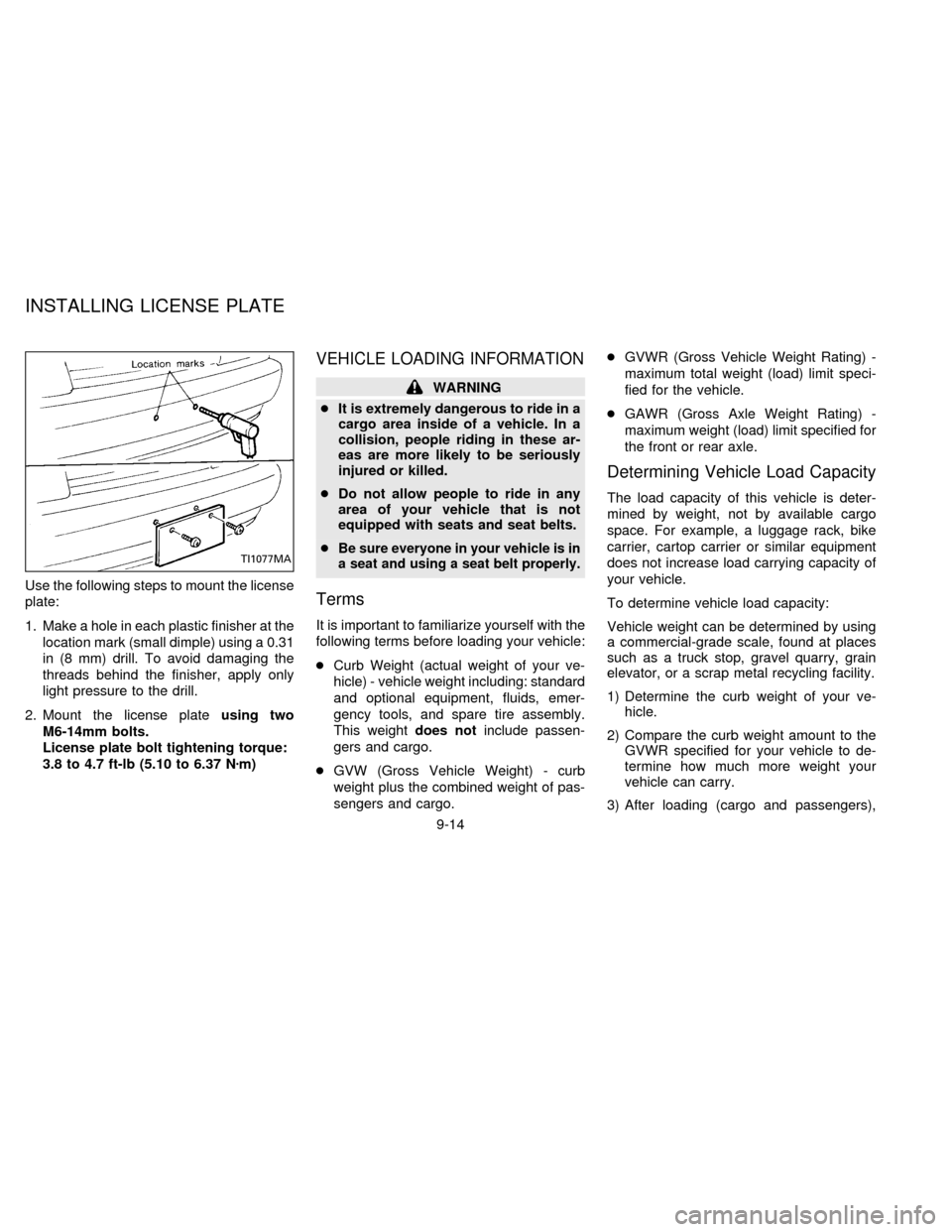
Use the following steps to mount the license
plate:
1. Make a hole in each plastic finisher at the
location mark (small dimple) using a 0.31
in (8 mm) drill. To avoid damaging the
threads behind the finisher, apply only
light pressure to the drill.
2. Mount the license plateusing two
M6-14mm bolts.
License plate bolt tightening torque:
3.8 to 4.7 ft-lb (5.10 to 6.37 Nzm)
VEHICLE LOADING INFORMATION
WARNING
cIt is extremely dangerous to ride in a
cargo area inside of a vehicle. In a
collision, people riding in these ar-
eas are more likely to be seriously
injured or killed.
cDo not allow people to ride in any
area of your vehicle that is not
equipped with seats and seat belts.
c
Be sure everyone in your vehicle is in
a seat and using a seat belt properly.
Terms
It is important to familiarize yourself with the
following terms before loading your vehicle:
cCurb Weight (actual weight of your ve-
hicle) - vehicle weight including: standard
and optional equipment, fluids, emer-
gency tools, and spare tire assembly.
This weightdoes notinclude passen-
gers and cargo.
cGVW (Gross Vehicle Weight) - curb
weight plus the combined weight of pas-
sengers and cargo.cGVWR (Gross Vehicle Weight Rating) -
maximum total weight (load) limit speci-
fied for the vehicle.
cGAWR (Gross Axle Weight Rating) -
maximum weight (load) limit specified for
the front or rear axle.
Determining Vehicle Load Capacity
The load capacity of this vehicle is deter-
mined by weight, not by available cargo
space. For example, a luggage rack, bike
carrier, cartop carrier or similar equipment
does not increase load carrying capacity of
your vehicle.
To determine vehicle load capacity:
Vehicle weight can be determined by using
a commercial-grade scale, found at places
such as a truck stop, gravel quarry, grain
elevator, or a scrap metal recycling facility.
1) Determine the curb weight of your ve-
hicle.
2) Compare the curb weight amount to the
GVWR specified for your vehicle to de-
termine how much more weight your
vehicle can carry.
3) After loading (cargo and passengers),
TI1077MA
INSTALLING LICENSE PLATE
9-14
ZX
Page 181 of 191
Maximum load limits
Maximum trailer loads
Never allow the total trailer load to exceed
1,000 lb (454 kg). The total trailer load
equals trailer weight plus its cargo weight.
Towing loads greater than 1,000 lb (454 kg)
or using improper towing equipment could
adversely affect vehicle handling, braking
and performance.
WARNING
Vehicle damage and/or personal injury
resulting from improper towing proce-
dures is not covered by NISSAN war-
ranties. Information on trailer towing
and required towing equipment should
be obtained from dealers who special-
ize in providing trailers or other towing
equipment.
Tongue load
Keep the tongue load between 9 and 11%
of the total trailer load. If the tongue load
becomes excessive, rearrange cargo to al-
low for proper tongue load.Maximum gross vehicle weight/maximum
gross axle weight
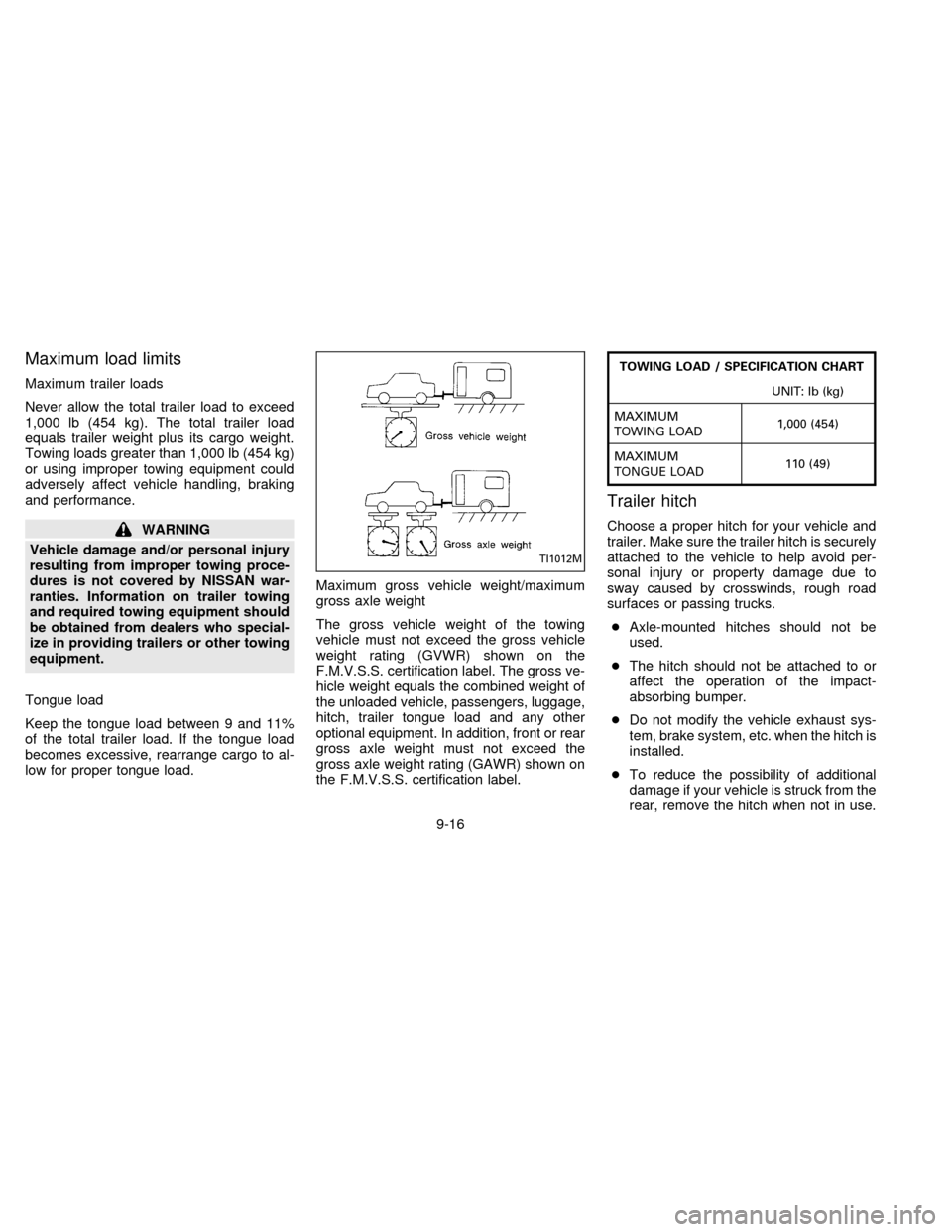
The gross vehicle weight of the towing
vehicle must not exceed the gross vehicle
weight rating (GVWR) shown on the
F.M.V.S.S. certification label. The gross ve-
hicle weight equals the combined weight of
the unloaded vehicle, passengers, luggage,
hitch, trailer tongue load and any other
optional equipment. In addition, front or rear
gross axle weight must not exceed the
gross axle weight rating (GAWR) shown on
the F.M.V.S.S. certification label.
TOWING LOAD / SPECIFICATION CHART
UNIT: lb (kg)
MAXIMUM
TOWING LOAD1,000 (454)
MAXIMUM
TONGUE LOAD110 (49)
Trailer hitch
Choose a proper hitch for your vehicle and
trailer. Make sure the trailer hitch is securely
attached to the vehicle to help avoid per-
sonal injury or property damage due to
sway caused by crosswinds, rough road
surfaces or passing trucks.
cAxle-mounted hitches should not be
used.
cThe hitch should not be attached to or
affect the operation of the impact-
absorbing bumper.
cDo not modify the vehicle exhaust sys-
tem, brake system, etc. when the hitch is
installed.
cTo reduce the possibility of additional
damage if your vehicle is struck from the
rear, remove the hitch when not in use.
TI1012M
9-16
ZX
Page 183 of 191
cWhen going down a hill, shift into a lower
gear and use the engine braking effect.
When ascending a long grade, down-
shift the transmission to a lower gear
and reduce speed to reduce chances of
engine overloading and/or overheating.
c
If the engine temperature coolant rises to
an extremely high temperature when the
air conditioning system is on, turn off the
air conditioner. Coolant heat can be addi-
tionally vented by opening the windows,
switching the fan control to high and set-
ting the temperature control to the HOT
position.
cTrailer towing requires more fuel than
normal circumstances.
cAvoid towing a trailer for your vehicle's
first 500 miles (800 km).
cHave your vehicle serviced more often
than at intervals specified in the recom-
mended Maintenance Schedule.
cWhen making a turn, your trailer wheels
will be closer to the inside of the turn
than your vehicle wheels. To compen-
sate for this, make a larger than normal
turning radius during the turn.cCrosswinds and rough roads adversely
affect vehicle/trailer handling, possibly
causing vehicle sway. When being
passed by larger vehicles, be prepared
for possible changes in crosswinds that
could affect vehicle handling. If swaying
does occur, firmly grip the steering
wheel, steer straight ahead, and imme-
diately (but gradually) reduce vehicle
speed. This combination helps to stabi-
lize the vehicle. Never increase speed.
cBe careful when passing other vehicles.
Passing while towing a trailer requires
considerably more distance than normal
passing. Remember the length of the
trailer must also pass the other vehicle
before you can safely change lanes.
cTo maintain engine braking efficiency
and electrical charging performance, do
not use fifth gear (manual transmission)
or overdrive (automatic transmission).
cAvoid holding the brake pedal down too
long or too frequently. This could cause
the brakes to overheat, resulting in re-
duced braking efficiency.
When towing a trailer, change the oil in
the transmission more frequently.
See the Maintenance Schedule.DOT Quality Grades: All passenger car tires
must conform to Federal Safety Require-
ments in addition to these grades.
Treadwear
Treadwear grade is a comparative rating
based on tire wear rate when tested under
controlled conditions on specified govern-
ment test courses. For example, a tire
graded 150 would wear one and a half
(1-1/2) times as well on the government
course as a tire graded 100. However,
relative tire performance depends on actual
driving conditions, and may vary signifi-
cantly from the norm due to variations in
driving habits, service practices and differ-
ences in road characteristics and climate.
Traction A, B and C
Traction grades are A (the highest), B and C.
They represent a tire's ability to stop on wet
pavement as measured under controlled con-
ditions, on specified government test sur-
faces of asphalt and concrete. A tire marked
with a C may have poor traction performance.
WARNING
The traction grade assigned to your
vehicle tires is based on straight line
UNIFORM TIRE QUALITY
GRADING
9-18
ZX
Page 184 of 191
braking traction tests and does not
include cornering (turning) traction.
Temperature A, B and C
Temperature grades are A (the highest), B,
and C. They represent a tire's resistance to
heat build-up, and its ability to dissipate
heat when tested under controlled condi-
tions on a specified indoor laboratory test
wheel. Sustained high temperature can
cause tire material to degenerate, reducing
tire life. Excessive temperatures can lead to
sudden tire failure. Grade C corresponds to
a performance level which all passenger car
tires must meet under the Federal Motor
Vehicle Safety Standard No. 109. Grades A
and B represent higher levels of perfor-
mance on laboratory test wheels than the
minimum required by law.
WARNING
The temperature grade for this tire is
established for a tire that is properly
inflated and not overloaded. Excessive
speed, under inflation, or excessive
loading, either separately or in combi-
nation, can cause heat build-up and
possible tire failure problems.Your NISSAN is covered by the following
emission warranties.
For USA
1) Emission Defects Warranty
2) Emissions Performance Warranty
For Canada
Emission Control System Warranty
Details of these warranties may be found
with other vehicle warranties in your war-
ranty information booklet that comes with
your NISSAN. If you did not receive a
warranty booklet, or it has become lost, you
may obtain a replacement by writing to:
cNissan Motor Corporation, in USA
Consumer Affairs Department
P.O. Box 191
Gardena, CA. 90247
cNissan Canada Inc.
P.O. Box 1709
Station ``B''
Mississauga, Ontario,
L4Y 4H6If you believe that your vehicle has a defect
which could cause a crash or could cause
injury or death, you should immediately
inform the National Highway Traffic Safety
Administration (NHTSA) in addition to noti-
fying NISSAN.
If NHTSA receives similar complaints, it
may open an investigation, and if it finds
that a safety defect exists in a group of
vehicles, it may order a recall and remedy
campaign. However, NHTSA cannot be-
come involved in individual problems be-
tween you, your dealer, or NISSAN.
To contact NHTSA, you may either call the
Auto Safety Hotline toll-free at 1- 800-424-
9393 (or 366-0123 in the Washington, D.C.
area) or write to: NHTSA, U.S. Department
of Transportation, Washington, D.C. 20590.
You can also obtain other information about
motor vehicle safety from the Hotline.
You may notify NISSAN by contacting our
Consumer Affairs Department, toll-free, at
1-800-NISSAN-1.
In Hawaii call (808) 531-0231.
EMISSION CONTROL
SYSTEM WARRANTYREPORTING SAFETY
DEFECTS ( USA)
9-19
ZX
Page 186 of 191

10 Index
A
Air bag (See supplemental restraint system)
Air bag warning light (If so equipped) ....... 2-20
Air cleaner housing filter ............................ 7-19
Air conditioner
Air conditioner operation ........................ 3-5
Air conditioner specification label ......... 9-13
Heater and air conditioner controls ........ 3-3
Servicing air conditioning ....................... 3-9
Air conditioning system refrigerant and
lubricant recommendations.......................... 9-8
Air flow charts .............................................. 3-6
Anchor point locations ............................... 2-32
Antenna (manual) ...................................... 3-17
Anti-lock brake system (ABS) .................. 4-16
Audio system
AM-FM radio ........................................ 3-11
AM-FM radio with cassette player ........ 3-13
Automatic
Automatic power window switch ......... 1-16
Automatic transmission fluid ................. 7-11
Driving with an automatic
transmission............................................ 4-6B
Battery........................................................ 7-15
Belts (See drive belts)
Brake
Anti-lock brake system (ABS) .............. 4-16
Brake fluid............................................. 7-13
Brake booster ....................................... 7-22
Brake wear indicators ................... 1-7, 7-22
Brake pedal .......................................... 7-21
Parking brake check ............................. 7-21
Parking brake operation ....................... 4-11
Break-in schedule ...................................... 4-13
Bulb check/instrument panel ....................... 1-5
Bulb replacement ....................................... 7-26
C
Capacities and recommended
fuel/lubricants ............................................... 9-2
Cassette player (See audio system)
CB radio or car phone ............................... 3-18
Child restraints for infants and
small children ............................................. 2-28
Child safety rear door lock .......................... 2-7
Cigarette lighter (accessory) and ashtray . 1-13
Cleaning exterior and interior ...................... 6-2
Clock-radio ................................................. 3-13Clutch pedal ............................................... 7-23
Cold weather driving cautions ................... 4-18
Controls
Audio controls ............................. 3-10, 3-13
Heater and air conditioner ...................... 3-3
Coolant
Capacities and recommended
fuel/lubricants.......................................... 9-2
Changing engine coolant........................ 7-6
Checking engine coolant level ............... 7-5
Engine coolant temperature gauge ....... 1-3
Corrosion protection .................................... 6-5
Cruise control............................................. 4-12
Cup holder ................................................. 1-14
D
Daytime running light system
(Canada only) ............................................ 1-11
Defogger switch
Rear window defogger switch .............. 1-10
Dimensions and weights............................ 9-10
Door locks .................................................... 2-2
Freeing a frozen door lock ................... 4-18
Drive belts .................................................. 7-17
Driving
Cold weather driving cautions .............. 4-18
ZX
Page 187 of 191

Driving with automatic
transmission............................................ 4-6
Driving with manual transmission ........... 4-9
Precautions when driving ..................... 4-16
Precautions when starting and driving ... 4-2
E
Economy-fuel ............................................. 4-14
Emission control information label............. 9-13
Emission control system warranty ............. 9-19
Engine
Before starting the engine ...................... 4-5
Capacities and recommended
fuel/lubricants.......................................... 9-2
Changing engine coolant........................ 7-6
Changing engine oil................................ 7-9
Changing engine oil filter...................... 7-10
Checking engine coolant level ............... 7-5
Checking engine oil level ....................... 7-8
Engine compartment check
locations ......................................... 7-3, 7-4
Engine coolant temperature gauge ....... 1-3
Engine cooling system ........................... 7-5
Engine oil ................................................ 7-8
Engine oil and oil filter
recommendation ..................................... 9-5
Engine oil viscosity ................................. 9-5
Engine serial number ........................... 9-12
Engine specifications .............................. 9-9
Starting the engine ............................... 4-11
Exhaust gas (Carbon monoxide) ................. 4-2F
Flashers (See hazard warning flasher switch)
Flat tire ......................................................... 5-2
Fluid (Checking)
Automatic transmission fluid ................. 7-11
Brake fluid............................................. 7-13
Engine coolant ........................................ 7-5
Engine oil ................................................ 7-8
Power steering fluid .............................. 7-13
Window washer fluid ............................ 7-14
F.M.V.S.S. certification label ..................... 9-12
Front fog light switch ................................. 1-12
Front seats ................................................. 2-13
Fuel
Capacities and recommended
fuel/lubricants.......................................... 9-2
Fuel economy ....................................... 4-14
Fuel filler cap ........................................ 2-11
Fuel filler lid lock operation .................. 2-11
Fuel gauge.............................................. 1-4
Fuel octane rating................................... 9-3
Fuel recommendation ............................. 9-3
Fuses ......................................................... 7-23
G
Gas station information............................ 10-10
Gauge
Engine coolant temperature gauge ........ 1-3
Fuel gauge.............................................. 1-4Odometer ................................................ 1-3
Speedometer .......................................... 1-3
Tachometer............................................. 1-3
Trip odometer ......................................... 1-3
Gear selection (See shifting)
General maintenance .................................. 8-2
Glove box..................................................... 2-9
H
Hazard warning flasher switch .................. 1-13
Head restraints .......................................... 2-14
Headlight aiming adjustment ..................... 7-26
Headlight and turn signal switch ............... 1-11
Headlights .................................................. 7-25
Heater and air conditioner
Heater and air conditioner controls ........ 3-3
Heater operation ..................................... 3-4
Hood release ............................................... 2-8
I
Ignition switch .............................................. 4-4
Increasing fuel economy .......................... 4-14
Indicator lights and chimes (See warning/
indicator lights and chimes)
Inside mirror ............................................... 2-35
Instrument brightness control .................... 1-12
Interior light ................................................ 1-17
10-2
ZX
Page 188 of 191

J
Jump starting ............................................... 5-7
K
Key ............................................................... 2-2
Keyless entry system (See multi-remote
control system)
L
Labels
Air conditioner specification label ......... 9-13
Emission control information label........ 9-13
Engine serial number ........................... 9-12
F.M.V.S.S. Certification label ............... 9-12
Vehicle identification number plate ...... 9-11
Warning labels (for SRS) ..................... 2-20
License plate
Installing license plate .......................... 9-14
Light
Air bag warning light............................. 2-20
Bulb check/instrument panel .................. 1-5
Bulb replacement.................................. 7-26
Front fog light switch ............................ 1-12
Headlight aiming adjustment ................ 7-26
Headlight and turn signal switch .......... 1-11
Headlights ............................................. 7-25
Interior light ........................................... 1-17
Light bulbs ............................................ 7-25Trunk light ............................................ 1-17
Warning/indicator lights and chimes ...... 1-5
Lock
Child safety rear door lock ..................... 2-7
Door locks............................................... 2-2
Fuel filler lid lock operation .................. 2-11
Power door lock...................................... 2-3
Trunk lid lock operation .......................... 2-9
M
Maintenance
General maintenance ............................. 8-2
Inside the vehicle.................................... 8-3
Outside the vehicle ................................. 8-2
Periodic maintenance schedules ............ 8-5
Seat belt maintenance.......................... 2-27
Under the hood and vehicle ................... 8-4
Manual antenna ......................................... 3-17
Meters and gauges ...................................... 1-2
Mirror
Inside mirror.......................................... 2-35
Outside mirror control ........................... 2-34
Vanity mirror ......................................... 2-35
Multi-remote control system ........................ 2-4
O
Octane rating (See fuel)
Odometer ..................................................... 1-3Oil
Capacities and recommended
fuel/lubricants.......................................... 9-2
Changing engine oil................................ 7-9
Changing engine oil filter...................... 7-10
Checking engine oil level ....................... 7-8
Engine oil ................................................ 7-8
Engine oil and oil filter
recommendation ..................................... 9-5
Opener lever for trunk lid............................. 2-9
Outside mirror control ................................ 2-34
Overdrive switch .......................................... 4-8
Overheat
If your vehicle overheats ........................ 5-9
Owner's manual order form ....................... 9-20
P
Parking
Parking brake check............................ 7-21
Parking brake operation ....................... 4-11
Parking/parking on hills ........................ 4-15
Periodic maintenance schedules ................. 8-5
Power
Power door lock...................................... 2-3
Power steering fluid .............................. 7-13
Power windows..................................... 1-15
Precautions
Maintenance precautions ....................... 7-2
Precautions on seat belt usage............ 2-22
Precautions when driving ..................... 4-16
10-3
ZX