Steering wheel NISSAN SENTRA 1997 B14 / 4.G User Guide
[x] Cancel search | Manufacturer: NISSAN, Model Year: 1997, Model line: SENTRA, Model: NISSAN SENTRA 1997 B14 / 4.GPages: 194, PDF Size: 1.62 MB
Page 101 of 194
The brake system has two separate hy-
draulic circuits. If one circuit develops a
problem, you will still have braking at
two wheels.
Vacuum assisted brakes
The brake booster aids braking by using
engine vacuum. If the engine stops, you can
stop the vehicle by depressing the brake
pedal. However, greater foot pressure on
the brake pedal will be required to stop the
vehicle and the stopping distance will be
longer.
Wet brakes
When the vehicle is washed or driven
through water, the brakes may get wet. As a
result, your braking distance will be longer
and the vehicle may pull to one side during
braking.
To dry brakes, drive the vehicle at a safe
speed while lightly pressing the brake pedal
to heat-up the brakes. Do this until the
brakes return to normal. Avoid driving the
vehicle at high speeds until the brakes
function correctly.
Using the brakes
Avoid resting your foot on the brake pedalwhile driving. This overheats the brakes,
increases wear on the brake linings and
pads, and reduces gas mileage.
To help save the brakes and to prevent the
brakes from overheating, reduce speed and
downshift to a lower gear before going down
a slope or long grade. Overheated brakes
may reduce braking performance and could
result in loss of vehicle control.
WARNING
While driving on a slippery surface, be
careful when braking, accelerating or
downshifting. Abrupt braking or accel-
erating could cause the wheels to skid
and result in an accident.The anti-lock brake system controls the
brakes at each wheel so the wheels do not
lock when braking abruptly or when braking
on slippery surfaces. The system detects
the rotation speed at each wheel and varies
the brake fluid pressure to prevent each
wheel from locking and sliding. By prevent-
ing wheel lockup, the system helps the
driver maintain steering control and helps to
minimize swerving and spinning on slippery
surfaces.
Using the System
Depress the brake pedal and hold it down.
WARNING
Do not pump the brake pedal. Doing so
may result in increased stopping dis-
tances.
Normal operation
The anti-lock brake system does not oper-
ate at speeds below 3 to 6 MPH (5 to 10
km/h) to completely stop the vehicle. (The
speeds vary according to road conditions.)
When the anti-lock system senses that one
or more wheels are close to locking up, the
actuator (under the hood) rapidly applies
BRAKE SYSTEM ANTI-LOCK BRAKE SYSTEM
(ABS) (if so equipped)
4-17
ZX
Page 104 of 194
Special winter equipment
It is recommended that the following items
be carried in the vehicle during winter:
1. A scraper and stiff-bristled brush to re-
move ice and snow from the windows
and wiper blades.
2. A sturdy, flat board to be placed under
the jack to give it firm support.
3. A shovel to dig the vehicle out of snow-
drifts.
4. Extra window washer fluid to refill the
reservoir tank.
Driving on snow or ice
WARNING
cWet ice (32ÉF, 0ÉC and freezing rain),
very cold snow or ice can be slick
and very hard to drive on. The ve-
hicle will have a lot less traction or
``grip'' under these conditions. Try to
avoid driving on wet ice until the
road is salted or sanded.cWhatever the condition, drive with
caution. Accelerate and slow down
with care. If accelerating or down-
shifting too fast, the drive wheels
will lose even more traction.
c
Allow more stopping distance under
these conditions. Braking should be
started sooner than on dry pavement.
cAllow greater following distances on
slippery roads.
cWatch for slippery spots (glare ice).
These may appear on an otherwise
clear road in shaded areas. If a patch
of ice is seen ahead, brake before
reaching it. Try not to brake while
actually on the ice, and avoid any
sudden steering maneuvers.
cDo not use cruise control on slippery
roads.
cSnow can trap dangerous exhaust
gases under your vehicle. Keep
snow clear of the exhaust pipe and
from around your vehicle.
Engine block heater/Engine heater
(if so equipped)
An engine block heater/engine heater to
assist extreme cold temperature starting is
available through your NISSAN dealer.
WARNING
Do not use your heater with an un-
grounded electrical system or two-
pronged (cheater) adapters. You can be
injured by an electrical shock if you use
an ungrounded connection.
4-20
ZX
Page 115 of 194
When towing your vehicle, all State (Provin-
cial in Canada) and local regulations for
towing must be followed. Incorrect towing
equipment could damage your vehicle. Tow-
ing instructions are available from your NIS-
SAN dealer. Local service operators are
generally familiar with the applicable laws
and procedures for towing. To assure proper
towing and to prevent accidental damage to
your vehicle, NISSAN recommends having a
service operator tow your vehicle. It is advis-
able to have the service operator carefully
read the following precautions.
WARNING
cNever ride in a vehicle that is being
towed.
cNever get under your vehicle after it
has been lifted by a tow truck.
CAUTION
cWhen towing, make sure that the
transmission, axles, steering system
and powertrain are in working con-
dition. If any unit is damaged, dollies
must be used.
cWhen towing with the front wheels
on the ground:Turn the ignition key to the OFF
position and secure the steering
wheel in a straight ahead position
with a rope or similar device. Never
place the ignition key in the LOCK
position. This will result in damage
to the steering lock mechanism.
Move the gearshift lever to the Neu-
tral (N) position.
On automatic transmission models,
to move the shift lever to the Neutral
(N) position turn the ignition key to
the ACC position.
After moving the shift lever to the
Neutral (N) position, be sure to turn
the ignition key to the OFF position.
cWhen towing with the rear wheels on
the ground, release the parking
brake.
On automatic transmission models,
to move the shift lever to the Neutral
(N) position, turn the ignition key to
the ACC position. After moving the
shift lever to the Neutral position, be
sure to turn the ignition key to the
OFF position.
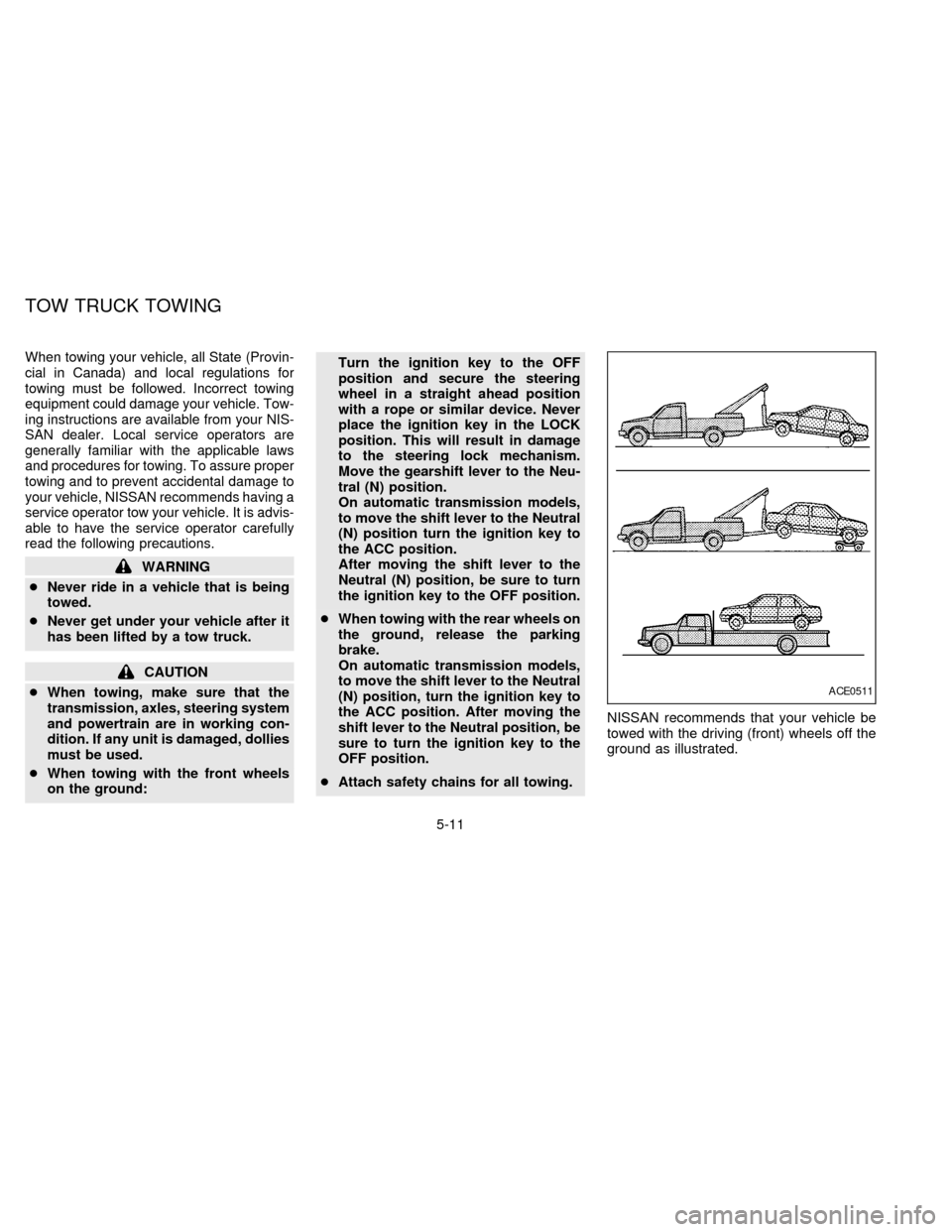
cAttach safety chains for all towing.NISSAN recommends that your vehicle be
towed with the driving (front) wheels off the
ground as illustrated.
ACE0511
TOW TRUCK TOWING
5-11
ZX
Page 116 of 194
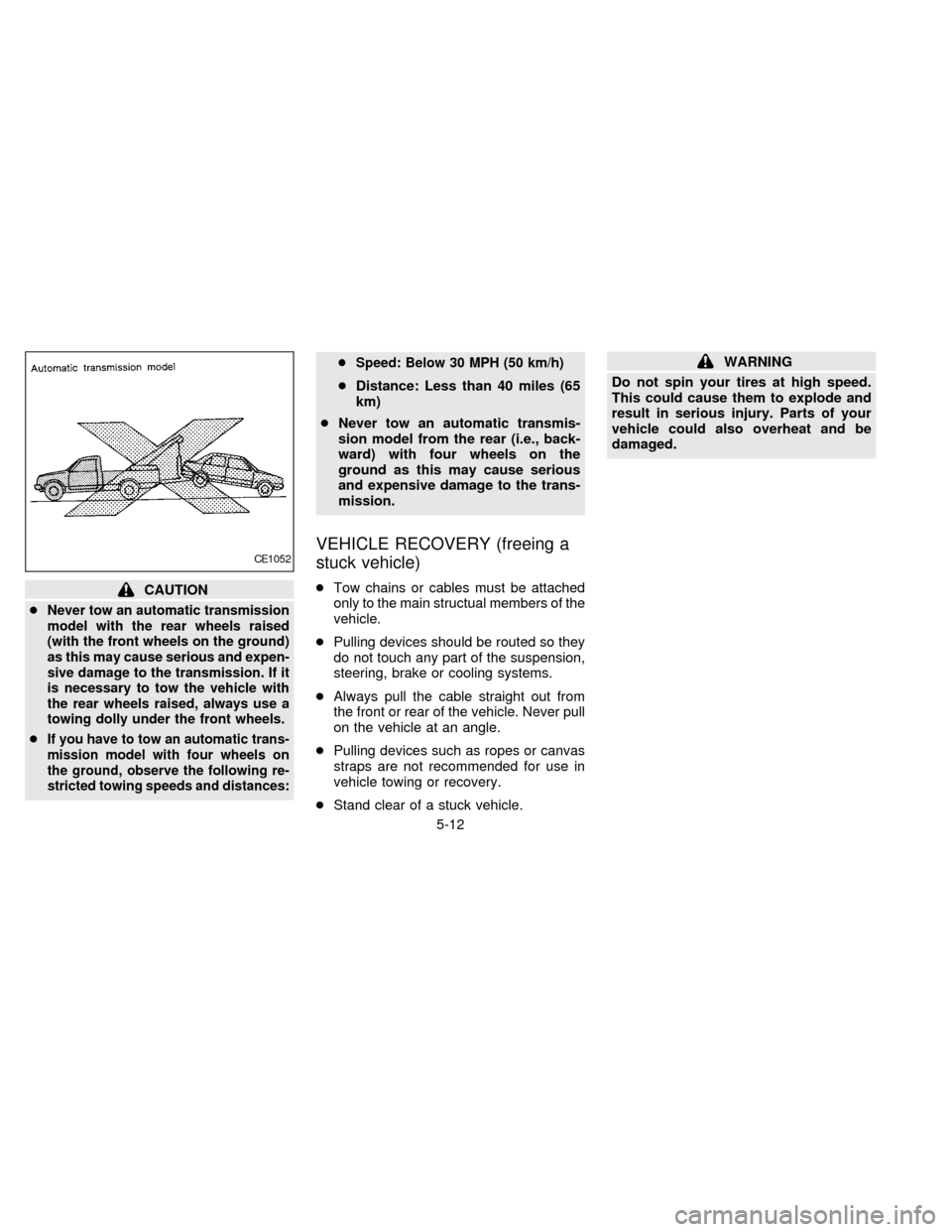
CAUTION
c
Never tow an automatic transmission
model with the rear wheels raised
(with the front wheels on the ground)
as this may cause serious and expen-
sive damage to the transmission. If it
is necessary to tow the vehicle with
the rear wheels raised, always use a
towing dolly under the front wheels.
cIf you have to tow an automatic trans-
mission model with four wheels on
the ground, observe the following re-
stricted towing speeds and distances:cSpeed: Below 30 MPH (50 km/h)
cDistance: Less than 40 miles (65
km)
cNever tow an automatic transmis-
sion model from the rear (i.e., back-
ward) with four wheels on the
ground as this may cause serious
and expensive damage to the trans-
mission.
VEHICLE RECOVERY (freeing a
stuck vehicle)
cTow chains or cables must be attached
only to the main structual members of the
vehicle.
cPulling devices should be routed so they
do not touch any part of the suspension,
steering, brake or cooling systems.
cAlways pull the cable straight out from
the front or rear of the vehicle. Never pull
on the vehicle at an angle.
cPulling devices such as ropes or canvas
straps are not recommended for use in
vehicle towing or recovery.
cStand clear of a stuck vehicle.
WARNING
Do not spin your tires at high speed.
This could cause them to explode and
result in serious injury. Parts of your
vehicle could also overheat and be
damaged.
CE1052
5-12
ZX
Page 123 of 194

7Do-it-yourself operations
Maintenance precautions .......................................7-2
Engine compartment check locations -
GA engine .............................................................7-3
Engine compartment check locations -
SR engine ..............................................................7-4
Engine cooling system ...........................................7-5
Checking engine coolant level ...............................7-5
Changing engine coolant .......................................7-6
Engine oil ...............................................................7-8
Checking engine oil level .......................................7-8
Changing engine oil ...............................................7-9
Changing engine oil filter .....................................7-10
Automatic transmission fluid (ATF) ......................7-11
Temperature conditions for checking ATF ...........7-12
Power steering fluid..............................................7-13
Brake fluid ............................................................7-14
Window washer fluid ............................................7-14
Battery ..................................................................7-15Jump starting ........................................................7-16
Drive belts ............................................................7-17
Spark plug replacement .......................................7-18
Air cleaner housing filter ......................................7-19
Wiper blades ........................................................7-20
Parking brake check.............................................7-21
Brake pedal ..........................................................7-21
Brake booster .......................................................7-22
Clutch pedal .........................................................7-23
Fuses ....................................................................7-23
Light bulbs ............................................................7-25
Headlights ............................................................7-25
Headlight aiming adjustment ................................7-26
Bulb replacement .................................................7-26
Front fog light bulb replacement (if so
equipped) .............................................................7-31
Wheels and tires ..................................................7-32
ZX
Page 161 of 194

Tire rotation* ÐTires should be rotated
every 7,500 miles (12,000 km).
Wheel alignment and balance ÐIf the
vehicle should pull to either side while driv-
ing on a straight and level road, or if you
detect uneven or abnormal tire wear, there
may be a need for wheel alignment.
If the steering wheel or seat vibrates at
normal highway speeds, wheel balancing
may be needed.
Windshield wiper blades* ÐCheck for
cracks or wear if they do not wipe properly.
Doors and engine hood ÐCheck that all
doors and the engine hood operate prop-
erly. Also ensure that all latches lock se-
curely. Lubricate hinges, latches, rollers and
links if necessary. Make sure the secondary
latch keeps the hood from opening when
the primary latch is released.
When driving in areas using road salt or
other corrosive materials, check lubrication
frequently.
Lights* ÐMake sure the headlights, stop
lights, tail lights, turn signal lights, and other
lights are all operating properly and installed
securely. Also check headlight aim.INSIDE THE VEHICLE
The maintenance items listed here should
be checked on a regular basis, such as
when performing periodic maintenance,
cleaning the vehicle, etc.
Additional information on the following
items with ``*'' is found in the ``Do-it-
yourself operations'' section.
Warning lights and chimes ÐMake sure
all warning lights and chimes are operating
properly.
Windshield wiper and washer* ÐCheck
that the wipers and washer operate properly
and that the wipers do not streak.
Windshield defroster ÐCheck that the air
comes out of the defroster outlets properly
and in sufficient quantity when operating the
heater or air conditioner.
Steering wheel ÐCheck for changes in
the steering conditions, such as excessive
freeplay, hard steering or strange noises.
Seats ÐCheck seat position controls such
as seat adjusters, seatback recliner, etc. to
ensure they operate smoothly and all
latches lock securely in every position.
Check that the head restraints move up anddown smoothly and the locks hold securely
in all latched positions.
Seat belts ÐCheck that all parts of the seat
belt system (e.g., buckles, anchors, adjust-
ers and retractors) operate properly and
smoothly, and are installed securely. Check
the belt webbing for cuts, fraying, wear or
damage.
Accelerator pedal ÐCheck the pedal for
smooth operation and make sure the pedal
does not catch or require uneven effort.
Keep the floor mats away from the pedal.
Clutch pedal* ÐMake sure the pedal
operates smoothly and check that it has the
proper free travel.
Brakes ÐCheck that the brakes do not pull
the vehicle to one side when applied.
Brake pedal* ÐCheck the pedal for
smooth operation and make sure it has the
proper distance under it when depressed
fully. Check the brake booster function. Be
certain to keep floor mats away from the
pedal.
Parking brake* ÐCheck that the lever has
the proper travel and confirm that your
vehicle is held securely on a fairly steep hill
8-3
ZX
Page 184 of 194
struck from the rear, where practical
remove the hitch when not in use.
Remove receiver when not in use.
cAfter the hitch is removed, seal the
bolt holes to prevent exhaust fumes,
water or dust from entering the pas-
senger compartment.
cRegularly check that all hitch mount-
ing bolts are securely mounted.
Tire pressures
cWhen towing a trailer, inflate the vehicle
tires to the recommended cold tire pres-
sure indicated on the tire placard (lo-
cated on the driver side center pillar).
cTrailer tire condition, size, load rating
and proper inflation pressure should be
in accordance with the trailer and tire
manufacturers' specifications.
Safety chain
Always use a suitable chain between your
vehicle and the trailer. The chain should be
crossed and should be attached to the hitch,
not to the vehicle bumper or axle. Be sure to
leave enough slack in the chain to permit
turning corners.
Trailer lights
Trailer lights should comply with federal
and/ or local regulations. When wiring the
vehicle for towing, connect the stop and tail
light pickup into the vehicle electrical circuit.
Trailer brakes
If your trailer is equipped with a braking
system, make sure it conforms to federal
and/or local regulations and that it is prop-
erly installed.
WARNING
Never connect a trailer brake system
directly to the vehicle brake system.
Pre-towing tips
cBe certain your vehicle maintains a level
position when a loaded and/or unloaded
trailer is hitched. Do not drive the vehicle if
it has an abnormal nose-up or nose- down
condition; check for improper tongue load,
overload, worn suspension or other pos-
sible causes of either condition.
cAlways secure items in the trailer to
prevent load shifts while driving.cBe certain your rear view mirrors con-
form to all federal, state or local regula-
tions. If not, install any mirrors required
for towing before driving the vehicle.
Trailer towing tips
In order to gain skill and an understanding
of the vehicle's behavior, you should prac-
tice turning, stopping and backing up in an
area which is free from traffic. Steering,
stability, and braking performance are
somewhat different than under normal driv-
ing conditions.
cAlways secure items in the trailer to
prevent load shift while driving.
c
Avoid abrupt starts, acceleration or stops.
cAvoid sharp turns or lane changes.
cAlways drive your vehicle at a moderate
speed.
c
Always block the wheels on both vehicle
and trailer when parking. Parking on a
slope is not recommended; however, if
you must do so, and if your vehicle is
equipped with automatic transmission,
first block the wheels and apply the park-
ing brake, and then move the transmis-
sion shift lever into the P position. If you
move the shift lever to the P position
before blocking the wheels and applying
9-16
ZX
Page 185 of 194
the parking brake, transmission damage
could occur.
cWhen going down a hill, shift into a lower
gear and use the engine braking effect.
When ascending a long grade, down-
shift the transmission to a lower gear
and reduce speed to reduce chances of
engine overloading and/or overheating.
cIf the engine temperature coolant rises
to an extremely high temperature when
the air conditioning system is on, turn off
the air conditioner. Coolant heat can be
additionally vented by opening the win-
dows, switching the fan control to high
and setting the temperature control to
the HOT position.
cTrailer towing requires more fuel than
normal circumstances.
cAvoid towing a trailer for your vehicle's
first 500 miles (800 km).
cHave your vehicle serviced more often
than at intervals specified in the recom-
mended Maintenance Schedule.
cWhen making a turn, your trailer wheels
will be closer to the inside of the turn
than your vehicle wheels. To compen-
sate for this, make a larger than normal
turning radius during the turn.cCrosswinds and rough roads adversely
affect vehicle/trailer handling, possibly
causing vehicle sway. When being
passed by larger vehicles, be prepared
for possible changes in crosswinds that
could affect vehicle handling. If swaying
does occur, firmly grip the steering
wheel, steer straight ahead, and imme-
diately (but gradually) reduce vehicle
speed. This combination helps to stabi-
lize the vehicle. Never increase speed.
cBe careful when passing other vehicles.
Passing while towing a trailer requires
considerably more distance than normal
passing. Remember the length of the
trailer must also pass the other vehicle
before you can safely change lanes.
cTo maintain engine braking efficiency
and electrical charging performance, do
not use fifth gear (manual transmission)
or overdrive (automatic transmission).
cAvoid holding the brake pedal down too
long or too frequently. This could cause
the brakes to overheat, resulting in re-
duced braking efficiency.
When towing a trailer, change the oil in
the transmission more frequently.
See the Maintenance Schedule.DOT Quality Grades: All passenger car tires
must conform to Federal Safety Require-
ments in addition to these grades.
Treadwear
Treadwear grade is a comparative rating
based on tire wear rate when tested under
controlled conditions on specified govern-
ment test courses. For example, a tire
graded 150 would wear one and a half
(1-1/2) times as well on the government
course as a tire graded 100. However,
relative tire performance depends on actual
driving conditions, and may vary signifi-
cantly from the norm due to variations in
driving habits, service practices and differ-
ences in road characteristics and climate.
Traction A, B and C
Traction grades are A (the highest), B and C.
They represent a tire's ability to stop on wet
pavement as measured under controlled con-
ditions, on specified government test sur-
faces of asphalt and concrete. A tire marked
with a C may have poor traction performance.
WARNING
The traction grade assigned to your
vehicle tires is based on straight line
UNIFORM TIRE QUALITY
GRADING
9-17
ZX
Page 192 of 194

Engine oil and oil filter
recommendation ..................................... 9-5
Engine oil viscosity ................................. 9-5
Opener lever for trunk lid............................. 2-8
Outside mirror control ................................ 2-38
Overdrive switch .......................................... 4-8
Overheat
If your vehicle overheats ...................... 5-10
Owner's manual order form ....................... 9-20
P
Parking
Parking brake check ............................. 7-21
Parking brake operation ....................... 4-11
Parking/parking on hills ........................ 4-15
Periodic maintenance schedules ................. 8-5
Power
Power door lock...................................... 2-3
Power steering fluid .............................. 7-13
Power windows..................................... 1-16
Rear power windows ............................ 1-17
Precautions
Maintenance precautions ....................... 7-2
Precautions on seat belt usage............ 2-24
Precautions when starting and
driving ..................................................... 4-2
Push starting ................................................ 5-9R
Radio
AM-FM radio with cassette player ....... 3-11,
3-13
CB radio or car phone .......................... 3-15
Readiness for inspection maintenance (I/M)
test ............................................................. 9-19
Rear power windows ................................. 1-17
Rear seat ................................................... 2-15
Rear window defogger switch ................... 1-11
Refrigerant recommendation ....................... 9-7
Registering your vehicle in another
country ....................................................... 9-10
Remote keyless entry system (See
multi-remote control system) ....................... 2-3
Reporting safety defects (USA) ................. 9-18
S
Safety
Child safety rear door lock ..................... 2-6
Reporting safety defects (USA) ............ 9-18
Seat adjustment ......................................... 2-12
Seat belt
2-point type without retractor (rear center
lap belt) ................................................. 2-29
3-point type with retractor..................... 2-27
Precautions on seat belt usage............ 2-24
Seat belt extenders .............................. 2-30
Seat belt maintenance.......................... 2-30
Seat belts.............................................. 2-24Shoulder belt height adjustment ........... 2-28
Seat belt warning light ................................. 1-6
Seats
Front seats............................................ 2-12
Rear seat .............................................. 2-15
Service manual order form ........................ 9-20
Servicing air conditioner .............................. 3-9
Shifting
Automatic transmission .......................... 4-7
Manual transmission............................... 4-9
Shoulder belt height adjustment ................ 2-28
Spark plug replacement............................. 7-18
Speedometer ............................................... 1-3
SRS warning label ..................................... 2-22
Starting
Before starting the engine ...................... 4-5
Jump starting .......................................... 5-7
Precautions when starting and
driving ..................................................... 4-2
Push starting........................................... 5-9
Starting the engine ............................... 4-11
Steering
Power steering fluid .............................. 7-13
Tilting steering wheel............................ 2-37
Stop light .................................................... 7-26
Sunroof ...................................................... 1-18
Supplemental restraint system (Supplemental
air bag system) .......................................... 2-16
Switch
Automatic power window switch .......... 1-17
Front fog light switch ............................ 1-13
Hazard warning flasher switch ............. 1-14
10-4
ZX
Page 193 of 194

Headlight and turn signal switch .......... 1-12
Ignition switch ......................................... 4-4
Overdrive switch ..................................... 4-8
Rear window defogger switch .............. 1-11
Windshield wiper and washer
switch .................................................... 1-10
T
Tachometer .................................................. 1-3
Theft warning ............................................... 1-9
Three way catalyst....................................... 4-2
Tilting steering wheel ................................. 2-37
Timing chain ................................................ 9-8
Tire
Flat tire.................................................... 5-2
Spare tire....................................... 5-3, 7-35
Tire chains ............................................ 7-33
Tire placard........................................... 9-12
Tire pressure ........................................ 7-32
Tire rotation .......................................... 7-33
Types of tires ........................................ 7-32
Uniform tire quality grading .................. 9-17
Wheels and tires................................... 7-32
Wheel/tire size ........................................ 9-9
Towing
Tow truck towing .................................. 5-11
Towing load/specification chart ............ 9-15
Trailer towing ........................................ 9-14
Transmission
Automatic transmission fluid (ATF) ...... 7-11
Driving with automatic transmission ....... 4-6Driving with manual transmission ........... 4-9
Travel (See registering your vehicle in
another country)......................................... 9-10
Trip odometer .............................................. 1-3
Trunk lid lock opener lever .......................... 2-8
Trunk light .................................................. 1-19
U
Uniform tire quality grading ....................... 9-17
V
Vanity mirror .............................................. 2-39
Vehicle dimensions and weights ................. 9-9
Vehicle identification number
(chassis number) ....................................... 9-10
Vehicle identification number (VIN)
plate ........................................................... 9-10
Vehicle recovery ........................................ 5-12
Ventilators .................................................... 3-2
W
Warning
Air bag warning light ..................... 1-6, 2-22
Hazard warning flasher switch ............. 1-14
Theft warning .......................................... 1-9
Warning labels (for SRS) ..................... 2-22
Warning/indicator lights and chimes ...... 1-5
Weights (See dimensions and weights) ...... 9-9Wheels and tires ........................................ 7-32
Wheel/tire size ............................................. 9-9
When traveling or registering your vehicle
in another country ...................................... 9-10
Window washer fluid.................................. 7-14
Windows
Locking passengers' windows .............. 1-16
Manual windows ................................... 1-16
Power windows..................................... 1-16
Rear power windows ............................ 1-17
Windshield wiper and washer switch ........ 1-10
Wiper
Windshield wiper and washer
switch .................................................... 1-10
Wiper blades......................................... 7-20
10-5
ZX