fuel filter NISSAN SENTRA 1997 B14 / 4.G Owners Manual
[x] Cancel search | Manufacturer: NISSAN, Model Year: 1997, Model line: SENTRA, Model: NISSAN SENTRA 1997 B14 / 4.GPages: 194, PDF Size: 1.62 MB
Page 124 of 194
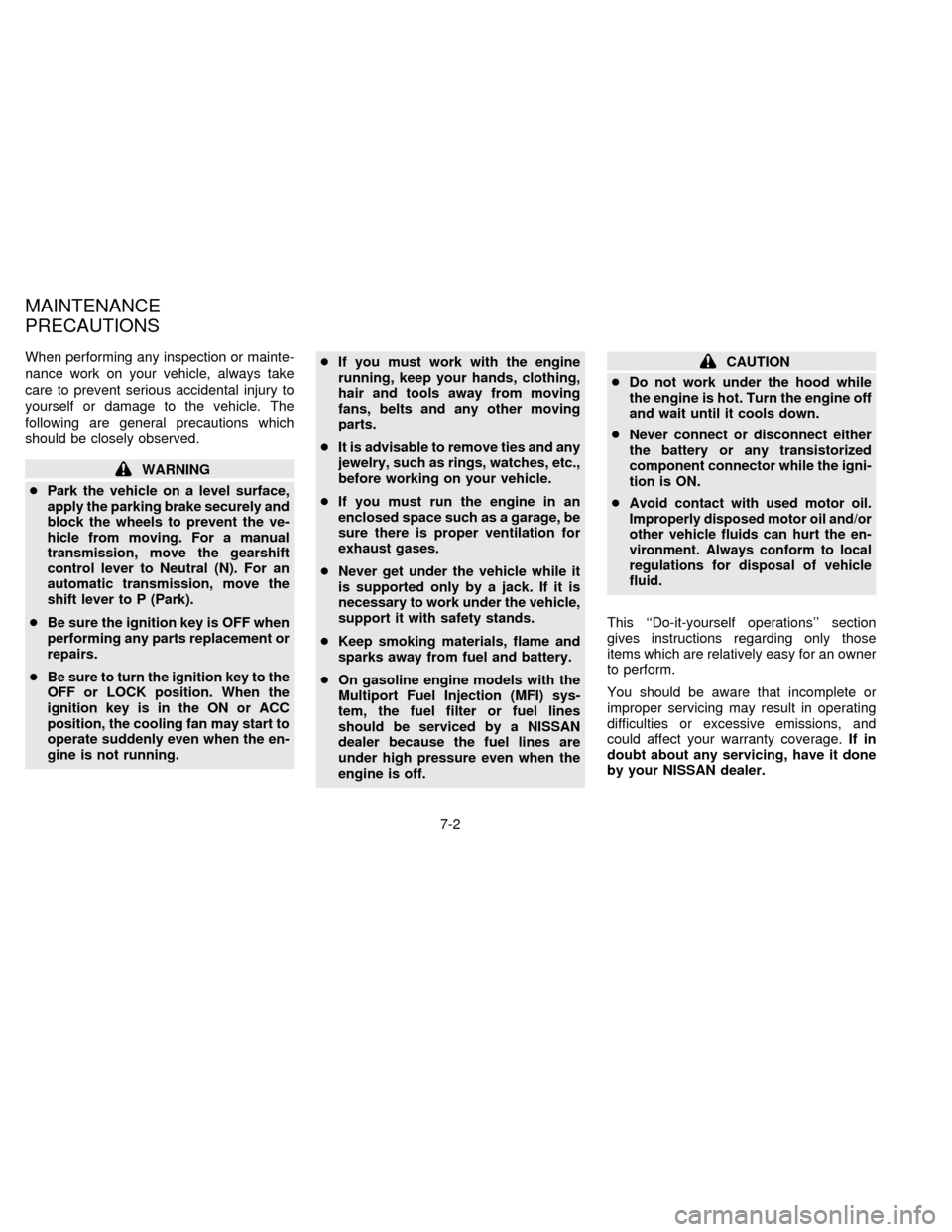
When performing any inspection or mainte-
nance work on your vehicle, always take
care to prevent serious accidental injury to
yourself or damage to the vehicle. The
following are general precautions which
should be closely observed.
WARNING
cPark the vehicle on a level surface,
apply the parking brake securely and
block the wheels to prevent the ve-
hicle from moving. For a manual
transmission, move the gearshift
control lever to Neutral (N). For an
automatic transmission, move the
shift lever to P (Park).
cBe sure the ignition key is OFF when
performing any parts replacement or
repairs.
cBe sure to turn the ignition key to the
OFF or LOCK position. When the
ignition key is in the ON or ACC
position, the cooling fan may start to
operate suddenly even when the en-
gine is not running.cIf you must work with the engine
running, keep your hands, clothing,
hair and tools away from moving
fans, belts and any other moving
parts.
cIt is advisable to remove ties and any
jewelry, such as rings, watches, etc.,
before working on your vehicle.
cIf you must run the engine in an
enclosed space such as a garage, be
sure there is proper ventilation for
exhaust gases.
cNever get under the vehicle while it
is supported only by a jack. If it is
necessary to work under the vehicle,
support it with safety stands.
cKeep smoking materials, flame and
sparks away from fuel and battery.
cOn gasoline engine models with the
Multiport Fuel Injection (MFI) sys-
tem, the fuel filter or fuel lines
should be serviced by a NISSAN
dealer because the fuel lines are
under high pressure even when the
engine is off.
CAUTION
cDo not work under the hood while
the engine is hot. Turn the engine off
and wait until it cools down.
cNever connect or disconnect either
the battery or any transistorized
component connector while the igni-
tion is ON.
c
Avoid contact with used motor oil.
Improperly disposed motor oil and/or
other vehicle fluids can hurt the en-
vironment. Always conform to local
regulations for disposal of vehicle
fluid.
This ``Do-it-yourself operations'' section
gives instructions regarding only those
items which are relatively easy for an owner
to perform.
You should be aware that incomplete or
improper servicing may result in operating
difficulties or excessive emissions, and
could affect your warranty coverage.If in
doubt about any servicing, have it done
by your NISSAN dealer.
MAINTENANCE
PRECAUTIONS
7-2
ZX
Page 164 of 194
![NISSAN SENTRA 1997 B14 / 4.G Owners Manual Schedule 1
Abbreviations: R = Replace I = Inspect. Correct or replace if necessary. [ ]: At the mileage intervals only
MAINTENANCE OPERATIONMAINTENANCE INTERVAL
Perform at number of miles,
kilometers](/img/5/605/w960_605-163.png "NISSAN SENTRA 1997 B14 / 4.G Owners Manual Schedule 1
Abbreviations: R = Replace I = Inspect. Correct or replace if necessary. [ ]: At the mileage intervals only
MAINTENANCE OPERATIONMAINTENANCE INTERVAL
Perform at number of miles,
kilometers")
Schedule 1
Abbreviations: R = Replace I = Inspect. Correct or replace if necessary. [ ]: At the mileage intervals only
MAINTENANCE OPERATIONMAINTENANCE INTERVAL
Perform at number of miles,
kilometers or months,
whichever comes first.Miles ý 1,000 3.75 7.5 11.25 15 18.75 22.5 26.25 30 33.75 37.5 41.25 45 48.75 52.5 56.25 60
(km ý 1,000) (6) (12) (18) (24) (30) (36) (42) (48) (54) (60) (66) (72) (78) (84) (90) (96)
Months 3 6 9 12 15 18 21 24 27 30 33 36 39 42 45 48
Emission control system maintenance
Drive belts See NOTE (1).I*
Air cleaner filter See NOTE (2). [R] [R]
Idle rpm (GA16DE engine)I* I*
Vapor linesI* I*
Fuel linesI* I*
Fuel filter See NOTE (3)*.
Engine coolant See NOTE (4)*.R*
Engine oilRRRRRRRRRRRRRRRR
Engine oil filter (Use Nissan PREMIUM type or equivalent)RRRRRRRRRRRRRRRR
Spark plugs (GA16DE engine)[R] [R]
(SR20DE engine) (PLATINUM-TIPPED type) See NOTE (5)*.[R]
Intake & exhaust valve clearance (GA16DE engine) See NOTE (6)*.
NOTE: (1) After 60,000 miles (96,000 km) or 48 months, inspect every 15,000 miles (24,000 km) or 12 months.
(2) If operating mainly in dusty conditions, more frequent maintenance may be required.
(3) If vehicle is operated under extremely adverse weather conditions or in areas where ambient temperatures are either extremely low or extremely
high, the filters might become clogged. In such an event, replace them immediately.
(4) After 60,000 miles (96,000 km) or 48 months, replace every 30,000 miles (48,000 km) or 24 months.
(5) Original equipment platinum-tipped plugs should be replaced at 60,000 miles (96,000 km). Conventional spark plugs can be used but should be
replaced at 30,000 miles (48,000 km) intervals. (See ``Technical and consumer Information'' section for details.)
(6) If valve noise increases, inspect valve clearance.
* Maintenance items and intervals with ``*'' are recommended by NISSAN for reliable vehicle operation. The owner need not perform such
maintenance in order to maintain the emission warranty or manufacturer recall liability. Other maintenance items and intervals are required.
8-6
ZX
Page 166 of 194
![NISSAN SENTRA 1997 B14 / 4.G Owners Manual Schedule 2
Abbreviations: R = Replace I = Inspect. Correct or replace if necessary. [ ]: At the mileage intervals only
MAINTENANCE OPERATIONMAINTENANCE INTERVAL
Perform at number of miles,
kilometers](/img/5/605/w960_605-165.png "NISSAN SENTRA 1997 B14 / 4.G Owners Manual Schedule 2
Abbreviations: R = Replace I = Inspect. Correct or replace if necessary. [ ]: At the mileage intervals only
MAINTENANCE OPERATIONMAINTENANCE INTERVAL
Perform at number of miles,
kilometers")
Schedule 2
Abbreviations: R = Replace I = Inspect. Correct or replace if necessary. [ ]: At the mileage intervals only
MAINTENANCE OPERATIONMAINTENANCE INTERVAL
Perform at number of miles,
kilometers or months, whichever comes first.Miles ý 1,000 7.5 15 22.5 30 37.5 45 52.5 60
(km ý 1,000) (12) (24) (36) (48) (60) (72) (84) (96)
Months 6 12 18 24 30 36 42 48
Emission control system maintenance
Drive belts See NOTE (1).I*
Air cleaner filter[R] [R]
Idle rpm (GA16DE engine)I* I*
Vapor linesI* I*
Fuel linesI* I*
Fuel filter See NOTE (2)*.
Engine coolant See NOTE (3)*.R*
Engine oilRRRRRRRR
Engine oil filter (Use Nissan PREMIUM type or equivalent)RRRRRRRR
Spark plugs (GA16DE engine)[R] [R]
(SR20DE engine) (PLATINUM-TIPPED type) See NOTE (4)*.[R]
Intake & exhaust valve clearance (GA16DE engine) See NOTE (5)*.
NOTE: (1) After 60,000 miles (96,000 km) or 48 months, inspect every 15,000 miles (24,000 km) or 12 months.
(2) If vehicle is operated under extremely adverse weather conditions or in areas where outside temperatures are either extremely low or extremely high, the
filters might become clogged. In such an event, replace them immediately.
(3) After 60,000 miles (96,000 km) or 48 months, replace every 30,000 miles (48,000 km) or 24 months.
(4) Original equipment platinum-tipped plugs should be replaced at 60,000 miles (96,000 km). Conventional spark plugs can be used but should be replaced
at 30,000 miles (48,000 km) intervals. (See ``Technical and consumer information'' section for details.)
(5) If valve noise increases, inspect valve clearance.
* Maintenance items and intervals with ``*'' are recommended by NISSAN for reliable vehicle operation. The owner need not perform such maintenance in
order to maintain the emission warranty or manufacturer recall liability. Other maintenance items and intervals are required.
8-8
ZX
Page 168 of 194

Additional information on the following
items with ``*'' is found in the ``Do-it-
yourself operations'' section.
Emission control system
maintenance
Drive belts* ÐCheck drive belts for wear,
fraying or cracking and also for proper tension.
Replace the drive belts if found damaged.
Air cleaner filter ÐUnder normal driving
conditions, the air cleaner filter should be
replaced in accordance with the maintenance
schedule. However, driving the vehicle in
dusty areas may cause more rapid clogging
of the element. Consequently, the element
may have to be replaced more frequently.
Vapor lines ÐCheck vapor lines and con-
nections for failure or looseness. If leaks are
found, replace them.
Fuel lines ÐCheck the fuel hoses, piping
and connections for leaks, looseness or
deterioration. Replace any parts if they are
damaged.
Fuel filter ÐIf the vehicle is operated under
extremely adverse weather conditions or in
areas where ambient temperatures are ei-
ther extremely low or extremely high, thefilter might become clogged. In such an
event, replace the filter immediately.
Engine coolant* ÐDrain and flush the
cooling system.
Engine oil & oil filter* ÐUnder normal
driving conditions, the engine oil and oil filter
should be replaced in accordance with the
maintenance schedule. However, under se-
vere driving conditions, they may have to be
replaced more frequently.
Spark plugs* ÐReplace with new plugs
having the correct heat range.
Intake & exhaust valve clearance Ð
Check and adjust the valve clearance.
Chassis and body maintenance
Brake lines & cables ÐCheck the brake
lines and hoses (including brake booster
vacuum hoses, connections & check valve)
and parking brake cables for proper attach-
ment, leaks, cracks, chafing, abrasion, de-
terioration, etc.
Brake pads, discs, drums & linings Ð
Check these and the other neighboring brake
components for wear, deterioration and
leaks. Under severe driving conditions, they
may have to be inspected more frequently.
Manual & automatic transmission fluid*
ÐCheck the fluid level and visually inspect
for signs of leakage.
Under severe driving conditions, the fluid
should be replaced at the specified interval.
Steering gear & linkage, axle & suspen-
sion parts, and drive shaft boots Ð
Check for damage, looseness and leakage
of oil or grease. Under severe driving con-
ditions, more frequent inspection should be
performed.
Steering linkage ball joints & front sus-
pension ball joints ÐCheck the ball joints
for damage, looseness and grease leakage.
Exhaust system ÐVisually check the ex-
haust pipes, muffler, and hangers for proper
attachment, leaks, cracks, chafing, abra-
sion, deterioration, etc. Under severe
driving conditions, inspection should be per-
formed more frequently.
Supplemental air bag system (if so
equipped) ÐCheck the supplemental air
bag system components for proper attach-
ment, damage, deformities, cracks, rust,
etc. Work around and on the supplemental
air bag system should be done by an autho-
rized NISSAN dealer.
EXPLANATION OF
MAINTENANCE ITEMS
8-10
ZX
Page 169 of 194

9Technical and consumer information
Capacities and recommended fuel/lubricants ........9-2
Fuel recommendation.............................................9-3
Engine oil and oil filter recommendation................9-5
Recommended SAE viscosity number...................9-7
Air conditioner system refrigerant and
lubricant recommendations ....................................9-7
Engine ....................................................................9-8
Wheel/tire size ........................................................9-9
Dimensions and weights ........................................9-9
Registering your vehicle in another country ........9-10
Vehicle identification ............................................9-10
Vehicle identification number (VIN) plate.............9-10
Vehicle identification number (chassis
number) ................................................................9-10Engine serial number ...........................................9-11
F.M.V.S.S. certification label ................................9-11
Emission control information label .......................9-12
Tire placard ..........................................................9-12
Air conditioner specification label.........................9-12
Installing license plate ..........................................9-13
Vehicle loading information ..................................9-13
Trailer towing ........................................................9-14
Uniform tire quality grading ..................................9-17
Emission control system warranty .......................9-18
Reporting safety defects (USA) ...........................9-18
Readiness for inspection/maintenance (I/M)
test ........................................................................9-19
ZX
Page 170 of 194
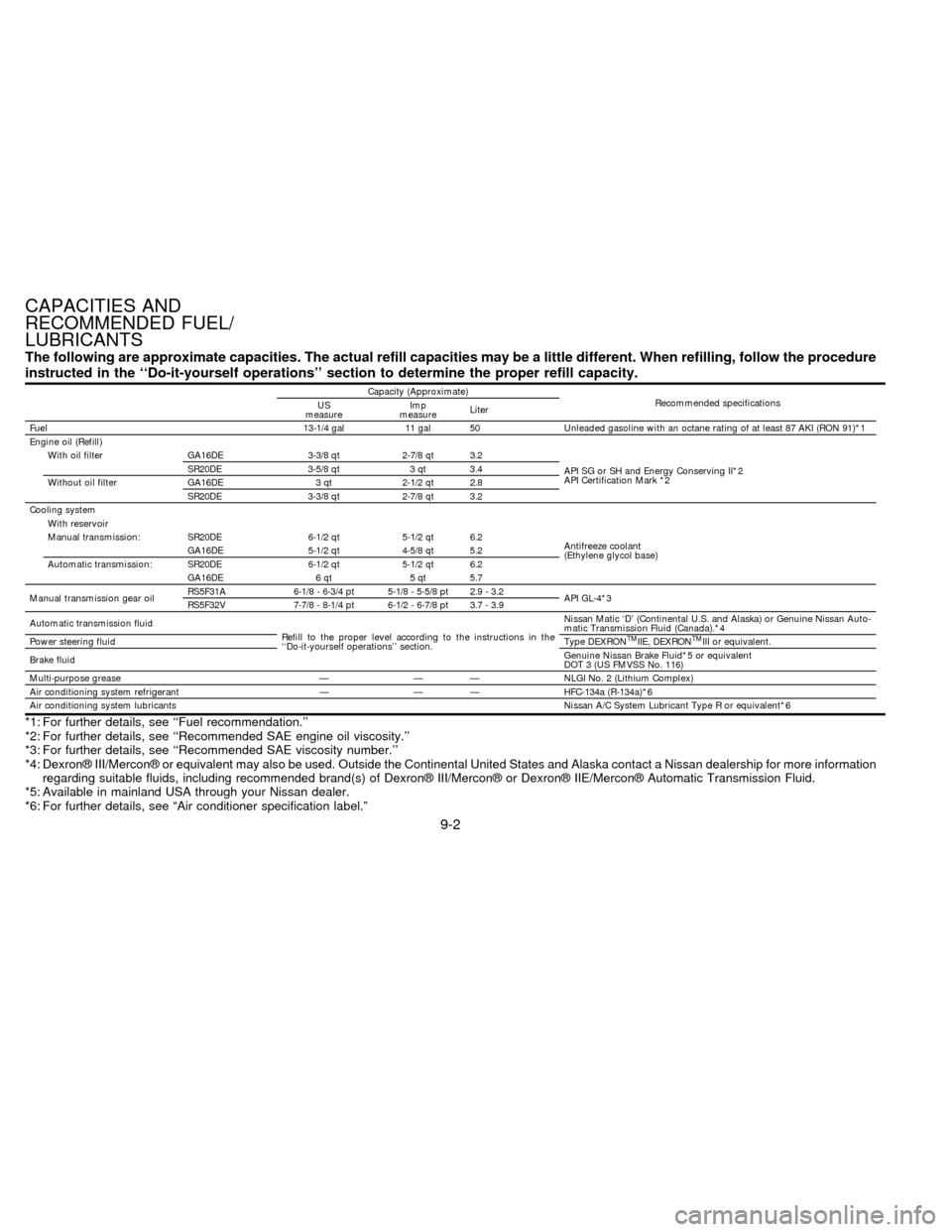
The following are approximate capacities. The actual refill capacities may be a little different. When refilling, follow the procedure
instructed in the ``Do-it-yourself operations'' section to determine the proper refill capacity.
Capacity (Approximate)
Recommended specifications
US
measureImp
measureLiter
Fuel 13-1/4 gal 11 gal 50 Unleaded gasoline with an octane rating of at least 87 AKI (RON 91)*1
Engine oil (Refill)
With oil filter GA16DE 3-3/8 qt 2-7/8 qt 3.2
API SG or SH and Energy Conserving II*2
API Certification Mark *2 SR20DE 3-5/8 qt 3 qt 3.4
Without oil filter GA16DE 3 qt 2-1/2 qt 2.8
SR20DE 3-3/8 qt 2-7/8 qt 3.2
Cooling system
With reservoir
Antifreeze coolant
(Ethylene glycol base) Manual transmission: SR20DE 6-1/2 qt 5-1/2 qt 6.2
GA16DE 5-1/2 qt 4-5/8 qt 5.2
Automatic transmission: SR20DE 6-1/2 qt 5-1/2 qt 6.2
GA16DE 6 qt 5 qt 5.7
Manual transmission gear oilRS5F31A 6-1/8 - 6-3/4 pt 5-1/8 - 5-5/8 pt 2.9 - 3.2
API GL-4*3
RS5F32V 7-7/8 - 8-1/4 pt 6-1/2 - 6-7/8 pt 3.7 - 3.9
Automatic transmission fluid
Refill to the proper level according to the instructions in the
``Do-it-yourself operations'' section.Nissan Matic `D' (Continental U.S. and Alaska) or Genuine Nissan Auto-
matic Transmission Fluid (Canada).*4
Power steering fluidType DEXRON
TMIIE, DEXRONTMIII or equivalent.
Brake fluidGenuine Nissan Brake Fluid*5 or equivalent
DOT 3 (US FMVSS No. 116)
Multi-purpose grease Ð Ð Ð NLGI No. 2 (Lithium Complex)
Air conditioning system refrigerant Ð Ð Ð HFC-134a (R-134a)*6
Air conditioning system lubricantsNissan A/C System Lubricant Type R or equivalent*6
*1: For further details, see ``Fuel recommendation.''
*2: For further details, see ``Recommended SAE engine oil viscosity.''
*3: For further details, see ``Recommended SAE viscosity number.''
*4: Dexronž III/Merconž or equivalent may also be used. Outside the Continental United States and Alaska contact a Nissan dealership for more information
regarding suitable fluids, including recommended brand(s) of Dexronž III/Merconž or Dexronž IIE/Merconž Automatic Transmission Fluid.
*5: Available in mainland USA through your Nissan dealer.
*6: For further details, see ªAir conditioner specification label.º
CAPACITIES AND
RECOMMENDED FUEL/
LUBRICANTS
9-2
ZX
Page 173 of 194

ENGINE OIL AND OIL FILTER
RECOMMENDATION
Selecting the correct oil
It is essential to choose the correct quality
and viscosity oil to ensure satisfactory en-
gine life and performance. Nissan recom-
mends the use of a low friction oil (energy
conserving oil) in order to improve fuel
economy and conserve energy. Oils which
do not have the specified quality label
should not be used as they could cause
engine damage.
Only those engine oils with the AmericanPetroleum Institute (API) CERTIFICATION
MARK on the front of the container should
be used. This type of oil supersedes the
existing API SG or SH and Energy Conserv-
ing II categories.
If you cannot find engine oil with the CER-
TIFICATION MARK, an API SG or SH and
Energy Conserving II oil with API Service
Symbol may be used. An oil with a single
designation SG or SH, or in combination
with other categories (for example, SG/CC
or SG/CD) may also be used if one with the
API CERTIFICATION MARK cannot be
found.Mineral based or synthetic type oils may be
used in your NISSAN vehicle. However,
these oils must meet the API quality and
SAE viscosity ratings specified for your ve-
hicle. Do not mix mineral based and syn-
thetic type oils in the engine at the same
time.
Oil additives
NISSAN does not recommend the use of oil
additives. The use of an oil additive is not
necessary when the proper oil type is used
and maintenance intervals are followed.
Oil which may contain foreign matter or has
been previously used should not be used.
Oil viscosity
The engine oil viscosity or thickness
changes with temperature. Because of this,
it is important to select the engine oil viscos-
ity based on the temperatures at which the
vehicle will be operated before the next oil
change. The chart ``Recommended SAE
viscosity number'' shows the recommended
oil viscosities for the expected ambient tem-
peratures. Choosing an oil viscosity other
than that recommended could cause seri-
ous engine damage.
ATI0645
9-5
ZX
Page 189 of 194

10 Index
A
Air bag (See supplemental restraint
system) ...................................................... 2-16
Air bag warning light .......................... 1-6, 2-22
Air cleaner housing filter ............................ 7-19
Air conditioner
Air conditioner operation ........................ 3-5
Air conditioner specification label ......... 9-12
Air conditioner system refrigerant and
lubrication recommendations.................. 9-7
Heater and air conditioner controls ........ 3-3
Servicing air conditioner ......................... 3-9
Air flow charts .............................................. 3-6
Alarm system (See theft warning) ............... 1-9
Anchor point locations ............................... 2-35
Antenna (manual) ...................................... 3-14
Anti-lock brake system (ABS).................... 4-17
Anti-lock brake warning light ....................... 1-7
Ashtray (See cigarette lighter and
ashtray) ...................................................... 1-14
Audio system
AM-FM radio with cassette
player........................................... 3-11, 3-13
Automatic
Automatic power window switch .......... 1-17
Automatic transmission fluid (ATF) ...... 7-11
Driving with automatic transmission ....... 4-6B
Battery........................................................ 7-15
Before starting the engine ........................... 4-5
Belts (See drive belts) ............................... 7-17
Brake
Anti-lock brake system (ABS) .............. 4-17
Brake booster ....................................... 7-22
Brake fluid............................................. 7-14
Brake light (See stop light) ................... 7-26
Brake pedal .......................................... 7-21
Brake system ........................................ 4-17
Brake warning light ................................. 1-7
Brake wear indicators ................... 1-8, 7-22
Parking brake check ............................. 7-21
Parking brake operation ....................... 4-11
Break-in schedule ...................................... 4-14
Bulb check/instrument panel ....................... 1-5
C
Capacities and recommended fuel/
lubricants...................................................... 9-2
Cargo (See vehicle loading
information) ................................................ 9-13
Cassette player (See audio
system) ............................................. 3-11, 3-13
CB radio or car phone ............................... 3-15Check engine indicator light (See
malfunction indicator light) ........................... 1-8
Child restraints for infants and small
children ...................................................... 2-31
Child safety rear door lock .......................... 2-6
Cigarette lighter (accessory)
and ashtray ................................................ 1-14
Cleaning exterior and interior ...................... 6-2
Clock-radio ................................................. 3-11
Clutch
Clutch pedal.......................................... 7-23
Cold weather driving .................................. 4-19
Controls
Audio controls ....................................... 3-11
Heater and air conditioner controls ........ 3-3
Coolant
Capacities and recommended fuel/
lubricants ................................................ 9-2
Changing engine coolant........................ 7-6
Checking engine coolant level ............... 7-5
Engine coolant temperature gauge ........ 1-3
Corrosion protection .................................... 6-5
Cruise control............................................. 4-12
Cup holder ................................................. 1-15
ZX
Page 190 of 194

D
Daytime running light system (Canada
only) ........................................................... 1-12
Defogger switch
Rear window defogger switch .............. 1-11
Dimensions and weights.............................. 9-9
Door ajar warning light ................................ 1-6
Door locks .................................................... 2-2
Drive belts .................................................. 7-17
Driving
Cold weather driving............................. 4-19
Driving with automatic transmission ....... 4-6
Driving with manual transmission ........... 4-9
Precautions when starting and
driving ..................................................... 4-2
E
Economy - fuel........................................... 4-14
Emission control information label............. 9-12
Emission control system warranty ............. 9-18
Engine
Before starting the engine ...................... 4-5
Capacities and recommended fuel/
lubricants ................................................ 9-2
Changing engine coolant........................ 7-6
Changing engine oil................................ 7-9
Changing engine oil filter...................... 7-10
Checking engine coolant level ............... 7-5
Checking engine oil level ....................... 7-8Engine compartment check
locations .......................................... 7-3, 7-4
Engine coolant temperature gauge ........ 1-3
Engine cooling system ........................... 7-5
Engine oil ................................................ 7-8
Engine oil and oil filter
recommendation ..................................... 9-5
Engine oil pressure warning light ........... 1-5
Engine oil viscosity ................................. 9-5
Engine serial number ........................... 9-11
Engine specifications .............................. 9-8
Starting the engine ............................... 4-11
Exhaust gas (Carbon monoxide) ................. 4-2
F
Flashers (See hazard warning flasher
switch) ........................................................ 1-14
Flat tire ......................................................... 5-2
Floor mat positioning aid ............................. 6-4
Fluid
Automatic transmission fluid (ATF) ...... 7-11
Brake fluid............................................. 7-14
Capacities and recommended fuel/
lubricants ................................................ 9-2
Engine coolant ........................................ 7-5
Engine oil ................................................ 7-8
Power steering fluid .............................. 7-13
Window washer fluid ............................ 7-14
F.M.V.S.S. certification label ..................... 9-11
Front fog light switch ................................. 1-13
Front seats ................................................. 2-12Fuel
Capacities and recommended fuel/
lubricants ................................................ 9-2
Fuel economy ....................................... 4-14
Fuel filler cap ........................................ 2-10
Fuel filler lid lock opener lever ............. 2-10
Fuel gauge.............................................. 1-4
Fuel octane rating................................... 9-3
Fuel recommendation ............................. 9-3
Fuses ......................................................... 7-23
Fusible links ............................................... 7-23
G
Gauge
Engine coolant temperature gauge ........ 1-3
Fuel gauge.............................................. 1-4
Speedometer .......................................... 1-3
Tachometer............................................. 1-3
Trip odometer ......................................... 1-3
General maintenance .................................. 8-2
Glove box..................................................... 2-8
H
Hazard warning flasher switch .................. 1-14
Head restraints .......................................... 2-14
Headlight aiming adjustment ..................... 7-26
Headlight and turn signal switch ............... 1-12
Headlights .................................................. 7-25
10-2
ZX
Page 191 of 194

Heater
Heater and air conditioner controls ........ 3-3
Heater operation ..................................... 3-4
Heater operation .......................................... 3-4
Hood release ............................................... 2-7
I
Ignition switch .............................................. 4-4
Increasing fuel economy............................ 4-14
Indicator lights and chimes (See warning/
indicator lights and chimes) ......................... 1-5
Inside mirror ............................................... 2-39
Instrument brightness control .................... 1-13
Interior light ................................................ 1-18
J
Jump starting ............................................... 5-7
K
Key ............................................................... 2-2
Keyless entry system (See multi-remote
control system) ............................................ 2-3L
Labels
Air conditioner specification label ......... 9-12
Emission control information label........ 9-12
Engine serial number ........................... 9-11
F.M.V.S.S. certification label ................ 9-11
Vehicle identification number (VIN)
plate ...................................................... 9-10
Warning labels (for SRS) ..................... 2-22
License plate
Installing the license plate .................... 9-13
Light
Air bag warning light ..................... 1-6, 2-22
Brake light (See stop light) ................... 7-26
Bulb check/instrument panel .................. 1-5
Front fog light switch ............................ 1-13
Headlight aiming adjustment ................ 7-26
Headlight and turn signal switch .......... 1-12
Headlights ............................................. 7-25
Interior light ........................................... 1-18
Light bulbs ............................................ 7-25
Trunk light ............................................. 1-19
Warning/indicator lights and chimes ...... 1-5
Lock
Child safety rear door lock ..................... 2-6
Door locks............................................... 2-2
Fuel filler lid lock opener lever ............. 2-10
Power door lock...................................... 2-3
Trunk lid lock opener lever ..................... 2-8
Luggage (See vehicle loading
information ................................................. 9-13M
Maintenance
General maintenance ............................. 8-2
Inside the vehicle.................................... 8-3
Maintenance precautions ....................... 7-2
Outside the vehicle ................................. 8-2
Periodic maintenance schedules ............ 8-5
Seat belt maintenance.......................... 2-30
Under the hood and vehicle ................... 8-4
Malfunction indicator light ............................ 1-8
Manual antenna ......................................... 3-14
Manual windows ........................................ 1-16
Meters and gauges ...................................... 1-2
Mirror
Inside mirror.......................................... 2-39
Outside mirror control ........................... 2-38
Vanity mirror ......................................... 2-39
Multi-remote control system ........................ 2-3
O
Octane rating (See fuel octane rating) ........ 9-3
Oil
Capacities and recommended fuel/
lubricants ................................................ 9-2
Changing engine oil................................ 7-9
Changing engine oil filter...................... 7-10
Checking engine oil level ....................... 7-8
Engine oil ................................................ 7-8
10-3
ZX