fuel pressure NISSAN SENTRA 2014 B17 / 7.G Owners Manual
[x] Cancel search | Manufacturer: NISSAN, Model Year: 2014, Model line: SENTRA, Model: NISSAN SENTRA 2014 B17 / 7.GPages: 388, PDF Size: 4.31 MB
Page 17 of 388
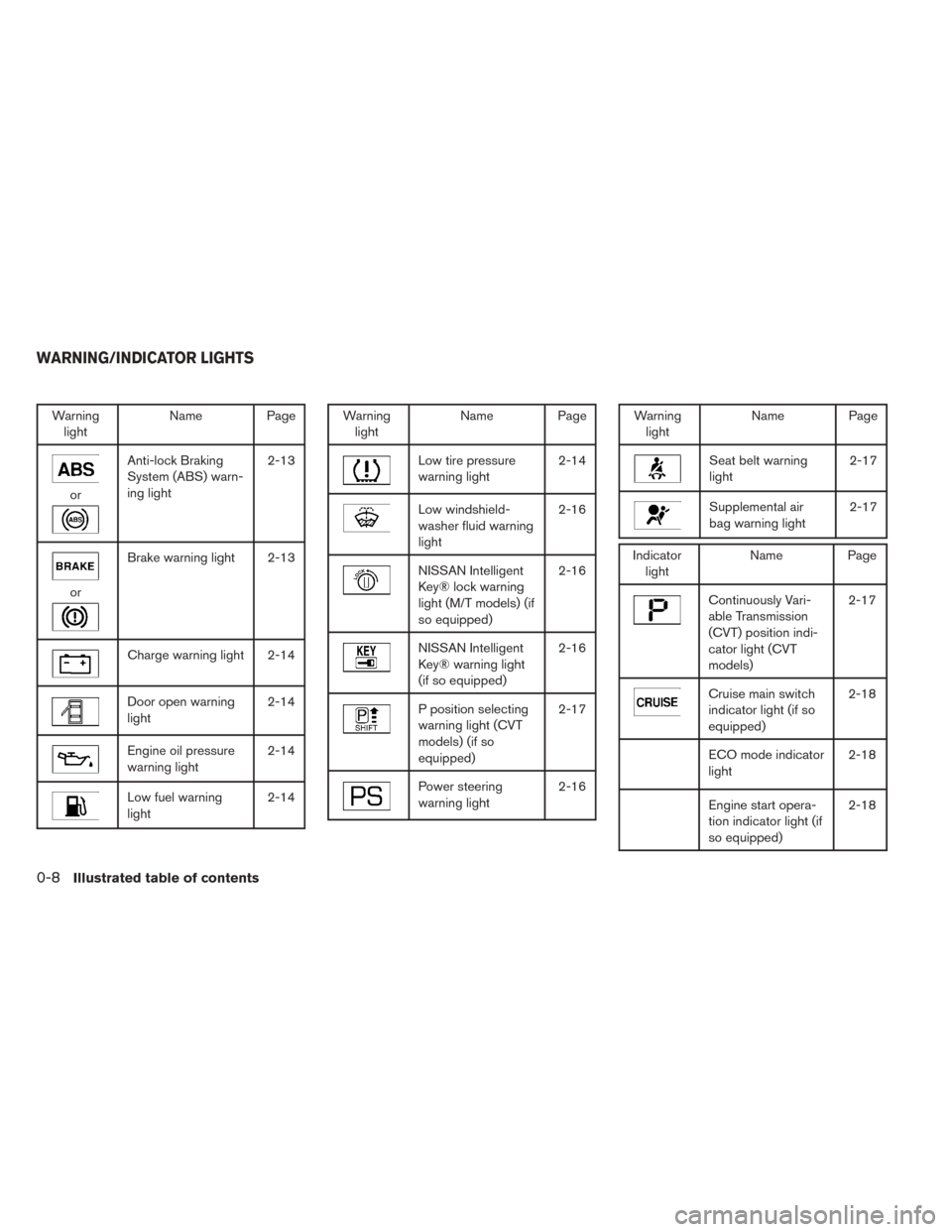
Warninglight Name Page
or
Anti-lock Braking
System (ABS) warn-
ing light 2-13
or
Brake warning light 2-13
Charge warning light 2-14
Door open warning
light
2-14
Engine oil pressure
warning light2-14
Low fuel warning
light2-14
Warning
light Name Page
Low tire pressure
warning light 2-14
Low windshield-
washer fluid warning
light2-16
NISSAN Intelligent
Key® lock warning
light (M/T models) (if
so equipped)2-16
NISSAN Intelligent
Key® warning light
(if so equipped)
2-16
P position selecting
warning light (CVT
models) (if so
equipped)2-17
Power steering
warning light
2-16
Warning
light Name Page
Seat belt warning
light 2-17
Supplemental air
bag warning light2-17
Indicator
light Name Page
Continuously Vari-
able Transmission
(CVT) position indi-
cator light (CVT
models) 2-17
Cruise main switch
indicator light (if so
equipped)
2-18
ECO mode indicator
light
2-18
Engine start opera-
tion indicator light (if
so equipped)2-18
WARNING/INDICATOR LIGHTS
0-8Illustrated table of contents
Page 85 of 388
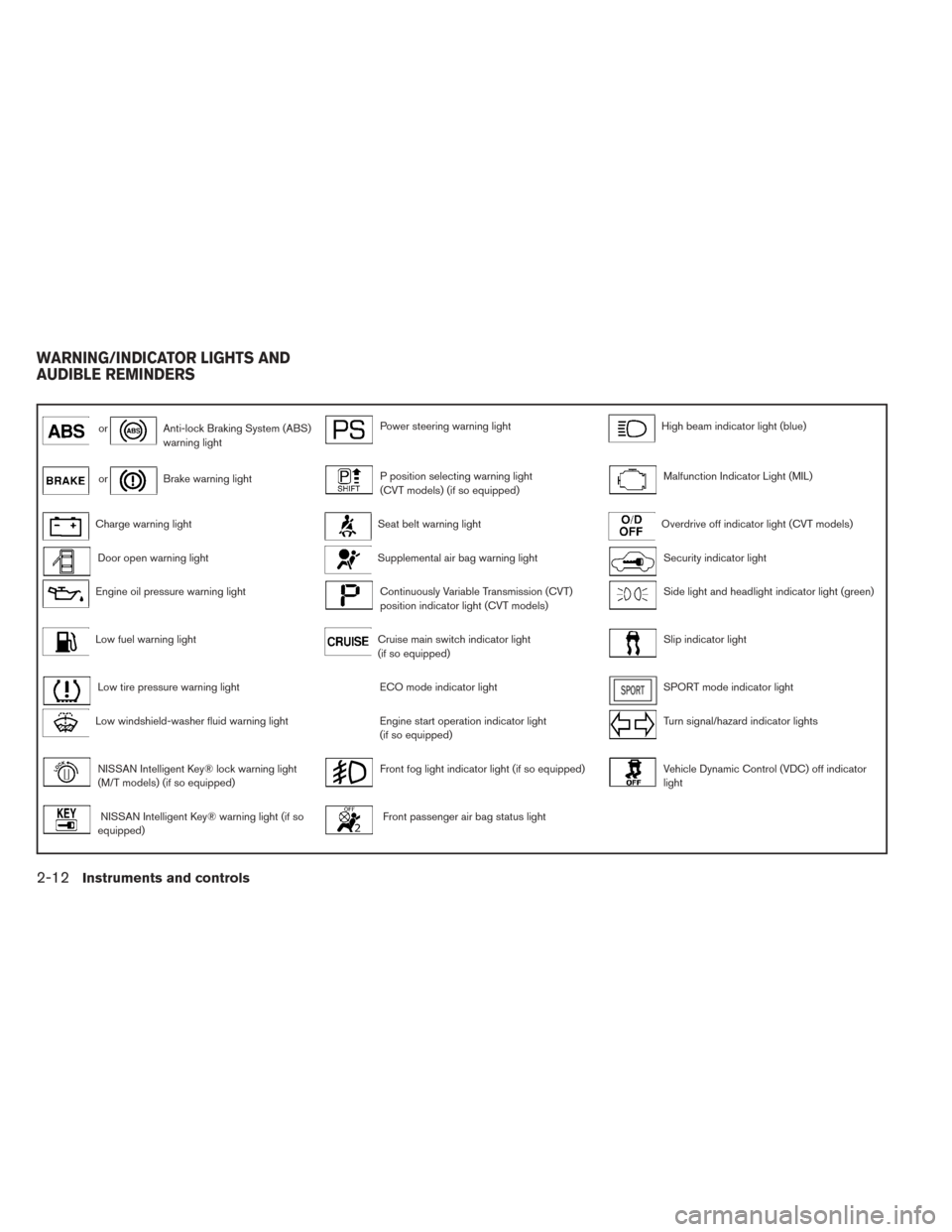
orAnti-lock Braking System (ABS)
warning lightPower steering warning lightHigh beam indicator light (blue)
orBrake warning lightP position selecting warning light
(CVT models) (if so equipped)Malfunction Indicator Light (MIL)
Charge warning lightSeat belt warning lightOverdrive off indicator light (CVT models)
Door open warning lightSupplemental air bag warning lightSecurity indicator light
Engine oil pressure warning lightContinuously Variable Transmission (CVT)
position indicator light (CVT models)Side light and headlight indicator light (green)
Low fuel warning lightCruise main switch indicator light
(if so equipped)Slip indicator light
Low tire pressure warning lightECO mode indicator lightSPORT mode indicator light
Low windshield-washer fluid warning lightEngine start operation indicator light
(if so equipped)Turn signal/hazard indicator lights
NISSAN Intelligent Key® lock warning light
(M/T models) (if so equipped)Front fog light indicator light (if so equipped)Vehicle Dynamic Control (VDC) off indicator
light
NISSAN Intelligent Key® warning light (if so
equipped)Front passenger air bag status light
WARNING/INDICATOR LIGHTS AND
AUDIBLE REMINDERS
2-12Instruments and controls
Page 87 of 388
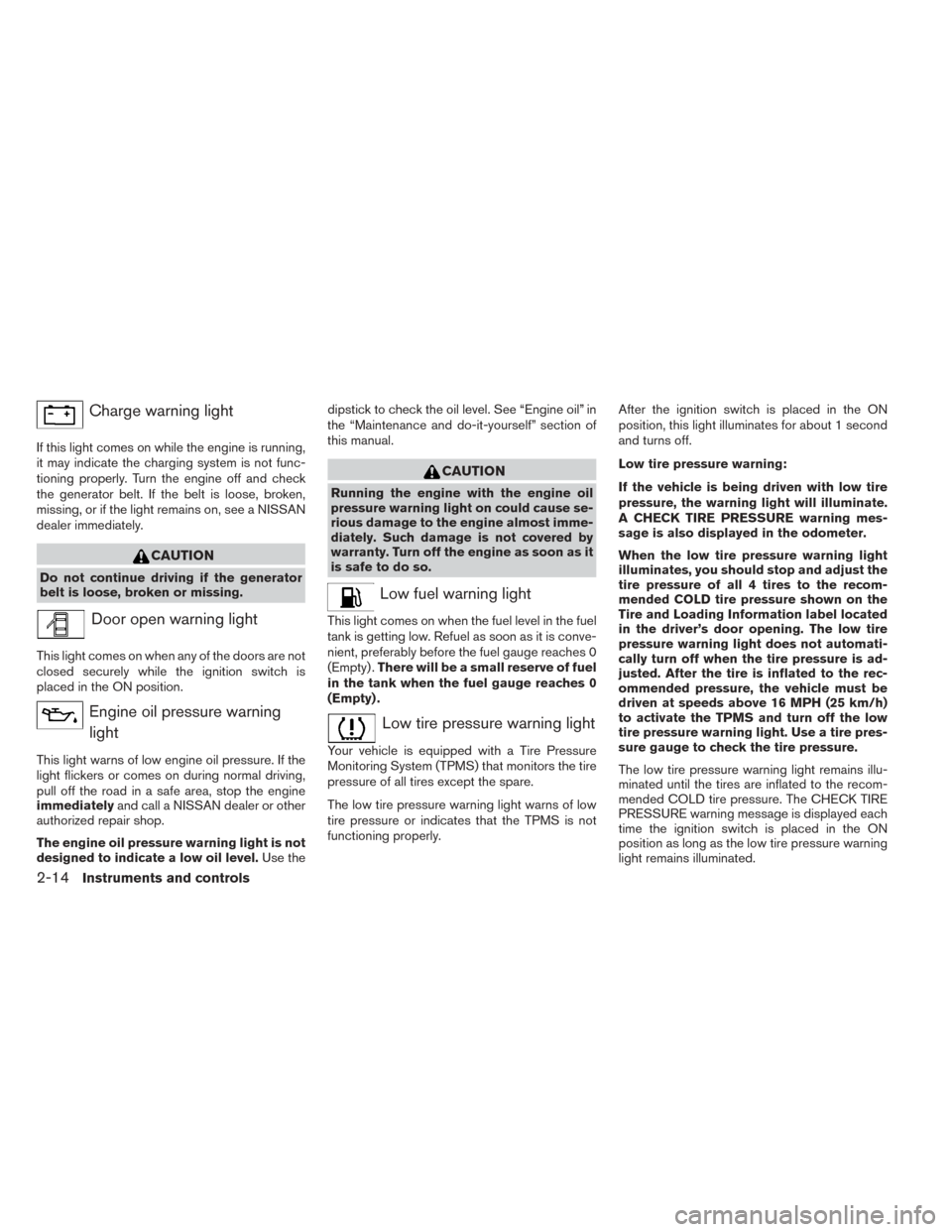
Charge warning light
If this light comes on while the engine is running,
it may indicate the charging system is not func-
tioning properly. Turn the engine off and check
the generator belt. If the belt is loose, broken,
missing, or if the light remains on, see a NISSAN
dealer immediately.
CAUTION
Do not continue driving if the generator
belt is loose, broken or missing.
Door open warning light
This light comes on when any of the doors are not
closed securely while the ignition switch is
placed in the ON position.
Engine oil pressure warninglight
This light warns of low engine oil pressure. If the
light flickers or comes on during normal driving,
pull off the road in a safe area, stop the engine
immediately and call a NISSAN dealer or other
authorized repair shop.
The engine oil pressure warning light is not
designed to indicate a low oil level. Use thedipstick to check the oil level. See “Engine oil” in
the “Maintenance and do-it-yourself” section of
this manual.
CAUTION
Running the engine with the engine oil
pressure warning light on could cause se-
rious damage to the engine almost imme-
diately. Such damage is not covered by
warranty. Turn off the engine as soon as it
is safe to do so.
Low fuel warning light
This light comes on when the fuel level in the fuel
tank is getting low. Refuel as soon as it is conve-
nient, preferably before the fuel gauge reaches 0
(Empty) .
There will be a small reserve of fuel
in the tank when the fuel gauge reaches 0
(Empty) .
Low tire pressure warning light
Your vehicle is equipped with a Tire Pressure
Monitoring System (TPMS) that monitors the tire
pressure of all tires except the spare.
The low tire pressure warning light warns of low
tire pressure or indicates that the TPMS is not
functioning properly. After the ignition switch is placed in the ON
position, this light illuminates for about 1 second
and turns off.
Low tire pressure warning:
If the vehicle is being driven with low tire
pressure, the warning light will illuminate.
A CHECK TIRE PRESSURE warning mes-
sage is also displayed in the odometer.
When the low tire pressure warning light
illuminates, you should stop and adjust the
tire pressure of all 4 tires to the recom-
mended COLD tire pressure shown on the
Tire and Loading Information label located
in the driver’s door opening. The low tire
pressure warning light does not automati-
cally turn off when the tire pressure is ad-
justed. After the tire is inflated to the rec-
ommended pressure, the vehicle must be
driven at speeds above 16 MPH (25 km/h)
to activate the TPMS and turn off the low
tire pressure warning light. Use a tire pres-
sure gauge to check the tire pressure.
The low tire pressure warning light remains illu-
minated until the tires are inflated to the recom-
mended COLD tire pressure. The CHECK TIRE
PRESSURE warning message is displayed each
time the ignition switch is placed in the ON
position as long as the low tire pressure warning
light remains illuminated.
2-14Instruments and controls
Page 257 of 388
5 Starting and driving
Precautions when starting and driving................5-2
Exhaust gas (carbon monoxide) ..................5-2
Three-way catalyst ..............................5-2
Tire Pressure Monitoring System (TPMS) ..........5-3
Avoiding collision and rollover ....................5-6
Off-road recovery ...............................5-6
Rapid air pressure loss ..........................5-7
Drinking alcohol/drugs and driving ................5-8
Ignition switch (if so equipped) ......................5-8
Continuously Variable Transmission (CVT)
(if so equipped) ................................5-8
Manual transmission (if so equipped) .............5-9
Key positions ..................................5-9
NISSAN vehicle immobilizer system .............5-10
Push-Button Ignition Switch (if so equipped) ........5-10
Operating range ............................... 5-11
Push-button ignition switch positions ............5-11
Emergency engine shut off .....................5-12
NISSAN Intelligent Key® battery discharge .......5-12
NISSAN vehicle immobilizer system .............5-13
Before starting the engine ......................... 5-13
Starting the engine ............................... 5-14Starting the engine (models with NISSAN
Intelligent Key® system)
........................... 5-15
Driving the vehicle ................................ 5-16
Continuously Variable Transmission (CVT)
(if so equipped) ............................... 5-16
Manual transmission (if so equipped) ............5-19
Parking brake .................................... 5-21
SPORT mode switch ............................. 5-22
ECO mode switch ................................ 5-22
Gear shift indicator (Manual transmission
only) (if so equipped) .......................... 5-23
Cruise control (if so equipped) .....................5-24
Precautions on cruise control ...................5-24
Cruise control operations .......................5-24
Break-in schedule ................................ 5-25
Fuel efficient driving tips ........................... 5-26
Increasing fuel economy ........................... 5-27
Parking/parking on hills ............................ 5-28
Power steering ................................... 5-29
Brake
system .................................... 5-30
Brake precautions ............................. 5-30
Anti-lock Braking System (ABS) .................5-30
Page 260 of 388
●Do not stop or park the vehicle over
flammable materials such as dry grass,
waste paper or rags. They may ignite
and cause a fire.
CAUTION
● Do not use leaded gasoline. Deposits
from leaded gasoline will seriously re-
duce the three-way catalyst’s ability to
help reduce exhaust pollutants.
● Keep your engine tuned up. Malfunc-
tions in the ignition, fuel injection, or
electrical systems can cause overrich
fuel flow into the three-way catalyst,
causing it to overheat. Do not keep driv-
ing if the engine misfires, or if notice-
able loss of performance or other un-
usual operating conditions are
detected. Have the vehicle inspected
promptly by a NISSAN dealer.
● Avoid driving with an extremely low fuel
level. Running out of fuel could cause
the engine to misfire, damaging the
three-way catalyst.
● Do not race the engine while warming it
up.
● Do not push or tow your vehicle to start
the engine.
TIRE PRESSURE MONITORING
SYSTEM (TPMS)
Each tire, including the spare (if provided) ,
should be checked monthly when cold and in-
flated to the inflation pressure recommended by
the vehicle manufacturer on the vehicle placard
or tire inflation pressure label. (If your vehicle has
tires of a different size than the size indicated on
the vehicle placard or tire inflation pressure label,
you should determine the proper tire inflation
pressure for those tires.)
As an added safety feature, your vehicle has been
equipped with a Tire Pressure Monitoring System
(TPMS) that illuminates a low tire pressure telltale
when one or more of your tires is significantly
under-inflated. Accordingly, when the low tire
pressure telltale illuminates, you should stop and
check your tires as soon as possible, and inflate
all your tires to the proper pressure. Driving on a
significantly under-inflated tire causes the tire to
overheat and can lead to tire failure. Under-
inflation also reduces fuel efficiency and tire tread
life, and may affect the vehicle’s handling and
stopping ability.
Please note that the TPMS is not a substitute for
proper tire maintenance, and it is the driver’s
responsibility to maintain correct tire pressure, even if under-inflation has not reached the level to
trigger illumination of the TPMS low tire pressure
telltale.
Your vehicle has also been equipped with a
TPMS malfunction indicator to indicate when the
system is not operating properly. The TPMS mal-
function indicator is combined with the low tire
pressure telltale. When the system detects a
malfunction, the telltale will flash for approxi-
mately one minute and then remain continuously
illuminated. This sequence will continue upon
subsequent vehicle start-ups as long as the mal-
function exists. When the malfunction indicator is
illuminated, the system may not be able to detect
or signal low tire pressure as intended. TPMS
malfunctions may occur for a variety of reasons,
including the installation of replacement or alter-
nate tires or wheels on the vehicle that prevent
the TPMS from functioning properly. Always
check the TPMS malfunction telltale after replac-
ing one or more tires or wheels on your vehicle to
ensure that the replacement or alternate tires and
wheels allow the TPMS to continue to function
properly.
Additional information:
● The TPMS does not monitor the tire
pressure of the spare tire.
Starting and driving5-3
Page 284 of 388
10.Keeping your Vehicle Cool
● Park your vehicle in a covered parking
area or in the shade whenever possible
● When entering a hot vehicle, opening the
windows will help to reduce the inside
temperature faster, resulting in reduced
demand on your A/C system
11. ECO Mode
● The ECO mode helps to enhance the fuel
economy by controlling the engine and CVT
(if so equipped) operation automatically to
avoid rapid acceleration. ●
Keep your engine tuned up.
● Follow the recommended scheduled main-
tenance.
● Keep the tires inflated to the correct pres-
sure. Low tire pressure increases tire wear
and lowers fuel economy.
● Keep the wheels in correct alignment. Im-
proper alignment increases tire wear and
lowers fuel economy.
● Use the recommended viscosity engine oil.
See “Engine oil and oil filter recommenda-
tions” in “Technical and consumer informa-
tion” in this manual.
INCREASING FUEL ECONOMY
Starting and driving5-27
Page 320 of 388
When performing any inspection or maintenance
work on your vehicle, always take care to prevent
serious accidental injury to yourself or damage to
the vehicle. The following are general precau-
tions which should be closely observed.
WARNING
●Park the vehicle on a level surface, ap-
ply the parking brake securely and
block the wheels to prevent the vehicle
from moving. For manual transmission
models, move the shift lever to N (Neu-
tral) . For CVT models, move the shift
lever to P (Park) .
● Be sure the ignition switch is in the OFF
or LOCK position when performing any
parts replacement or repairs.
● If you must work with the engine run-
ning, keep your hands, clothing, hair
and tools away from moving fans, belts
and any other moving parts.
● It is advisable to secure or remove any
loose clothing and remove any jewelry,
such as rings, watches, etc. before
working on your vehicle.
● Always wear eye protection whenever
you work on your vehicle. ●
If you must run the engine in an en-
closed space such as a garage, be sure
there is proper ventilation for exhaust
gases to escape.
● Never get under the vehicle while it is
supported only by a jack. If it is neces-
sary to work under the vehicle, support
it with safety stands.
● Keep smoking materials, flame and
sparks away from the fuel tank and
battery.
● On gasoline engine models, the fuel
filter or fuel lines should be serviced by
a NISSAN dealer because the fuel lines
are under high pressure even when the
engine is off.
●
Your vehicle is equipped with an auto-
matic engine cooling fan. It may come on
at any time without warning, even if the
ignition key is in the OFF position and the
engine is not running. To avoid injury,
always disconnect the negative battery
cable before working near the fan.
CAUTION
● Do not work under the hood while the
engine is hot. Turn the engine off and
wait until it cools down. ●
Avoid contact with used engine oil and
coolant. Improperly disposed engine
oil, engine coolant and/or other vehicle
fluids can damage the environment. Al-
ways conform to local regulations for
disposal of vehicle fluid.
● Never leave the engine or the CVT re-
lated component harness connector
disconnected while the ignition switch
is in the ON position.
● Never connect or disconnect the battery
or any transistorized component while
the ignition switch is in the ON position.
This “Maintenance and do-it-yourself” section
gives instructions regarding only those items
which are relatively easy for an owner to perform.
A genuine NISSAN service manual is also avail-
able. See “Owner’s Manual/Service Manual or-
der information” in the “Technical and consumer
information” section of this manual.
You should be aware that incomplete or improper
servicing may result in operating difficulties or
excessive emissions, and could affect warranty
coverage. If in doubt about any servicing,
have it done by a NISSAN dealer.
MAINTENANCE PRECAUTIONS
Maintenance and do-it-yourself8-5
Page 381 of 388
Chimes, audible reminders...........2-20
Cleaning exterior and interior ...........7-2
Clock.......................4-38 (models without navigation system) ....4-38
Clockset.....................4-38
C.M.V.S.S. certification label ..........9-12
Cold weather driving ...............5-33
Compact disc (CD) player ....4-39,4-44,4-50
Consolebox...................2-37
Consolelight...................2-45
Continuously Variable Transmission (CVT) . . .5-16 Continuously Variable Transmission
(CVT) fluid ..................8-11
Driving with Continuously Variable
Transmission (CVT) .............5-16
Transmission shift selector lock release . .5-18
Control panel buttons ...............4-4
Brightness/contrast button ..........4-9
Enterbutton..................4-4
Setting button .................4-7
Controls Audiocontrols(steeringwheel).......4-65
Heater and air conditioner
controls ................4-16,4-25
Coolant Capacities and recommended
fuel/lubricants .................9-2
Changing engine coolant ...........8-8
Checking engine coolant level ........8-8
Engine coolant temperature gauge .....2-6
Corrosionprotection ...............7-6
Cruisecontrol..................5-24
Cupholders................2-36,2-37
Curtain side-impact air bag system
(See supplemental side air bag and curtain
side-impact air bag system) ...........1-49 D
Daytime running light system (Canada only) . .2-28
Defroster switch Rear window defroster switch .......2-25
Dimensionsandweights ............9-10
Dimmer switch for instrument panel ......2-29
Display controls (see control panel buttons) . .4-4
Door locks .....................3-4
Door open warning light .............2-14
Drive belt .....................8-16
Driving Cold weather driving .............5-33
Driving with Continuously Variable
Transmission (CVT) .............5-16
Driving with manual transmission ......5-19
Precautions when starting and driving ....5-2
E
Economy - fuel ..................5-27
Emission control information label .......9-12
Emission control system warranty .......9-19
Engine Before starting the engine ..........5-13
Block heater .................5-35
Capacities and recommended
fuel/lubricants .................9-2
Changingenginecoolant...........8-8
Changingengineoil.............8-10
Changing engine oil filter ..........8-11
Checking engine coolant level ........8-8
Checking engine oil level ...........8-9
Engine compartment check locations ....8-6Engine coolant temperature gauge
.....2-6
Engine cooling system ............8-7
Engine oil ...................8-9
Engine oil and oil filter recommendation . . .9-6
Engine oil pressure warning light ......2-14
Engine oil viscosity ..............9-6
Engine serial number ............9-12
Engine specifications .............9-8
Starting the engine ..........5-14,5-15
Enterbutton....................4-4
Eventdatarecorders ..............9-21
E
xhaustgas(Carbonmonoxide).........5-2
Extended storage switch ............8-24
Eyeglass case ..................2-35
F
Flashers (See hazard warning flasher switch) . .6-2
Flat tire .......................6-3
Floor mat positioning aid .............7-5
Fluid Brake fluid ..................8-12
Capacities and recommended
fuel/lubricants .................9-2
Continuously Variable Transmission
(CVT) fluid ..................8-11
Engine coolant .................8-7
Engine oil ...................8-9
F.M.V.S.S. certification label ...........9-12
Foglightswitch .................2-29
Front air bag system
(See supplemental restraint system) ......1-44
Front seats .....................1-2
10-2
Page 383 of 388
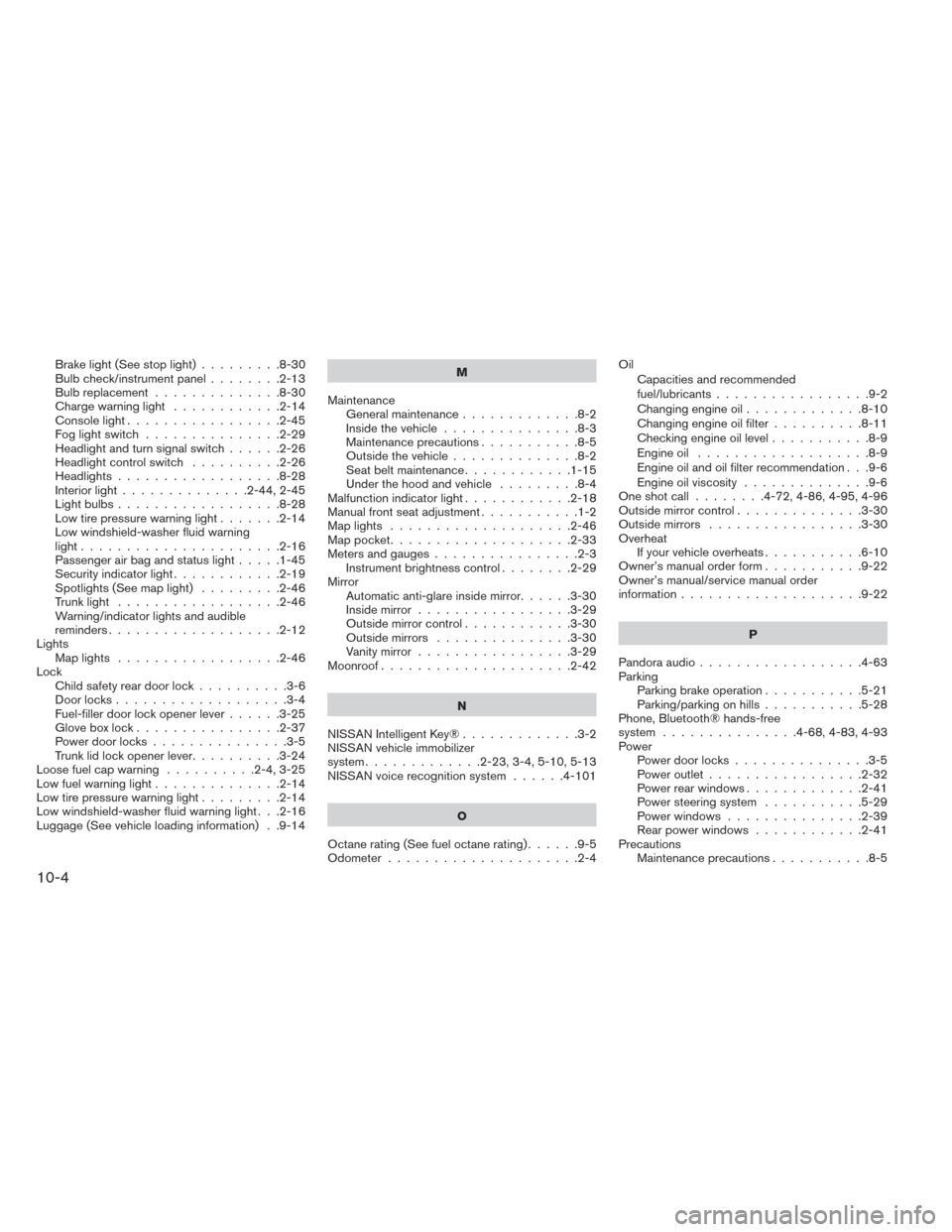
Brakelight(Seestoplight).........8-30
Bulb check/instrument panel........2-13
Bulb replacement ..............8-30
Chargewarninglight ............2-14
Console light .................2-45
Foglightswitch ...............2-29
Headlight and turn signal switch ......2-26
Headlightcontrolswitch ..........2-26
Headlights..................8-28
Interiorlight..............2-44,2-45
Lightbulbs..................8-28
Low tire pressure warning light .......2-14
Low windshield-washer fluid warning
light......................2-16
Passenger air bag and status light .....1-45
Security indicator light ............2-19
Spotlights (See map light) .........2-46
Trunklight ..................2-46
Warning/indicator lights and audible
reminders ...................2-12
Lights Maplights ..................2-46
Lock Child safety rear door lock ..........3-6
Door locks ...................3-4
Fuel-filler door lock opener lever ......3-25
Gloveboxlock................2-37
Power door locks ...............3-5
Trunk lid lock opener lever ..........3-24
Loose fuel cap warning ..........2-4,3-25
Lowfuelwarninglight..............2-14
Low tire pressure warning light .........2-14
Low windshield-washer fluid warning light . . .2-16
Luggage (See vehicle loading information) . .9-14 M
Maintenance Generalmaintenance.............8-2
Insidethevehicle...............8-3
Maintenance precautions ...........8-5
Outside the vehicle ..............8-2
Seatbeltmaintenance............1-15
Underthehoodandvehicle .........8-4
Malfunction indicator light ............2-18
Manual front seat adjustment ...........1-2
Maplights ....................2-46
Map pocket ....................2-33
Meters and gauges ................2-3
Instrument brightness control ........2-29
Mirror Automatic anti-glare inside mirror ......3-30
Inside mirror .................3-29
Outside mirror control ............3-30
Outside mirrors ...............3-30
Vanity mirror .................3-29
Moonroof .....................2-42
N
NISSAN Intelligent Key® .............3-2
NISSAN vehicle immobilizer
system .............2-23,3-4,5-10,5-13
NISSAN voice recognition system ......4-101
O
Octane rating (See fuel octane rating) ......9-5
Odometer .....................2-4 Oil
Capacities and recommended
fuel/lubricants .................9-2
Changing engine oil .............8-10
Changing engine oil filter ..........8-11
Checking engine oil level ...........8-9
Engine oil ...................8-9
Engine oil and oil filter recommendation . . .9-6
Engine oil viscosity ..............9-6
Oneshotcall........4-72,4-86,4-95,4-96
Outside mirror control ..............3-30
Outside mirrors .................3-30
Overheat If your vehicle overheats ...........6-10
Owner’s manual order form ...........9-22
Owner’s
manual/service manual order
information ....................9-22
P
Pandora audio ..................4-63
Parking Parking brake operation ...........5-21
Parking/parking on hills ...........5-28
Phone, Bluetooth® hands-free
system ...............4-68,4-83,4-93
Power Power door locks ...............3-5
Power outlet .................2-32
Power rear windows .............2-41
Power steering system ...........5-29
Power windows ...............2-39
Rear power windows ............2-41
Precautions Maintenanceprecautions...........8-5
10-4
Page 385 of 388
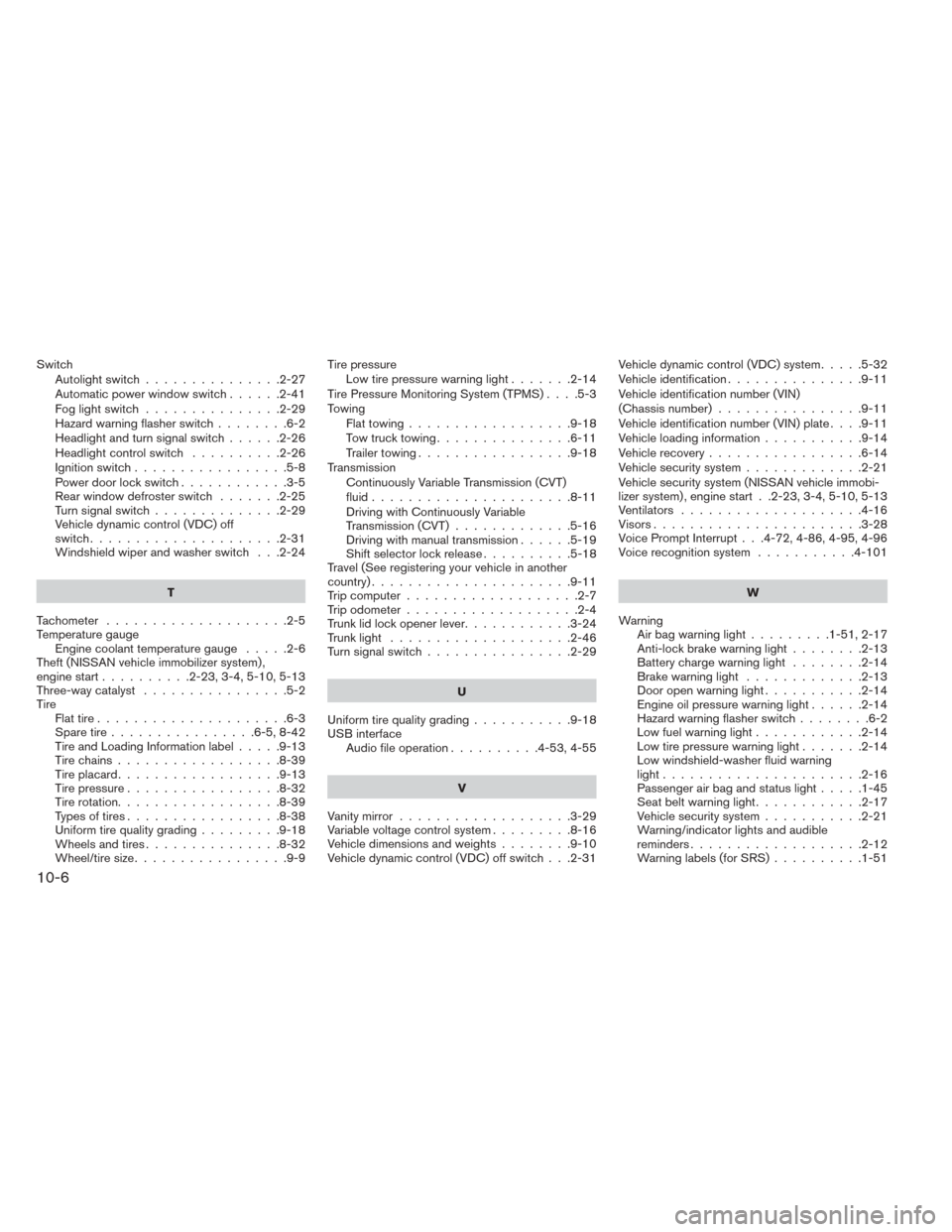
SwitchAutolightswitch...............2-27
Automatic power window switch ......2-41
Foglightswitch ...............2-29
Hazard warning flasher switch ........6-2
Headlight and turn signal switch ......2-26
Headlightcontrolswitch ..........2-26
Ignition switch .................5-8
Power door lock switch ............3-5
Rear window defroster switch .......2-25
Turnsignalswitch..............2-29
Vehicle dynamic control (VDC) off
switch.....................2-31
Windshield wiper and washer switch . . .2-24
T
Tachometer ....................2-5
Temperature gauge Engine coolant temperature gauge .....2-6
Theft (NISSAN vehicle immobilizer system) ,
engine start ..........2-23,3-4,5-10,5-13
Three-way catalyst ................5-2
Tire Flat tire .....................6-3
Spare tire ................6-5,8-42
Tire and Loading Information label .....9-13
Tire chains ..................8-39
Tireplacard..................9-13
Tirepressure.................8-32
Tire rotation..................8-39
Types of tires .................8-38
Uniform tire quality grading .........9-18
Wheels and tires ...............8-32
Wheel/tire size .................9-9 Tire pressure
Low tire pressure warning light .......2-14
Tire Pressure Monitoring System (TPMS) ....5-3
Towing Flattowing..................9-18
Towtrucktowing...............6-11
Trailer towing .................9-18
Transmission Continuously Variable Transmission (CVT)
fluid......................8-11
Driving with Continuously Variable
Transmission (CVT) .............5-16
Driving with manual transmission ......5-19
Shiftselectorlockrelease..........5-18
Travel (See registering your vehicle in another
country) ......................9-11
Trip computer ...................2-7
Trip odometer ...................2-4
Trunk lid lock opener lever ............3-24
Trunklight ....................2-46
Turn signal switch ................2-29
U
Uniform tire quality grading ...........9-18
USB interface Audio file operation ..........4-53,4-55
V
Vanity mirror ...................3-29
Variable voltage control system .........8-16
Vehicle dimensions and weights ........9-10
Vehicle dynamic control (VDC) off switch . . .2-31 Vehicle dynamic control (VDC) system
.....5-32
Vehicle identification ...............9-11
Vehicle identification number (VIN)
(Chassis number) ................9-11
Vehicle identification number (VIN) plate ....9-11
Vehicleloadinginformation...........9-14
Vehicle recovery .................6-14
Vehicle security system .............2-21
Vehicle security system (NISSAN vehicle immobi-
lizer system) , engine start . .2-23, 3-4, 5-10, 5-13
Ventilators ....................4-16
Visors.......................3-28
Voice Prompt Interrupt . . .4-72, 4-86, 4-95, 4-96
Voice recognition system ...........4-101
W
Warning Airbagwarninglight.........1-51,
2-17
Anti-lock brake warning light ........2-13
Battery charge warning light ........2-14
Brake warning light .............2-13
Door open warning light ...........2-14
Engine oil pressure warning light ......2-14
Hazard warning flasher switch ........6-2
Low fuel warning light ............2-14
Low tire pressure warning light .......2-14
Low windshield-washer fluid warning
light......................2-16
Passenger air bag and status light .....1-45
Seatbeltwarninglight............2-17
Vehicle security system ...........2-21
Warning/indicator lights and audible
reminders...................2-12
Warning labels (for SRS) ..........1-51
10-6