seats NISSAN SENTRA 2017 B17 / 7.G Service Manual
[x] Cancel search | Manufacturer: NISSAN, Model Year: 2017, Model line: SENTRA, Model: NISSAN SENTRA 2017 B17 / 7.GPages: 491
Page 58 of 491
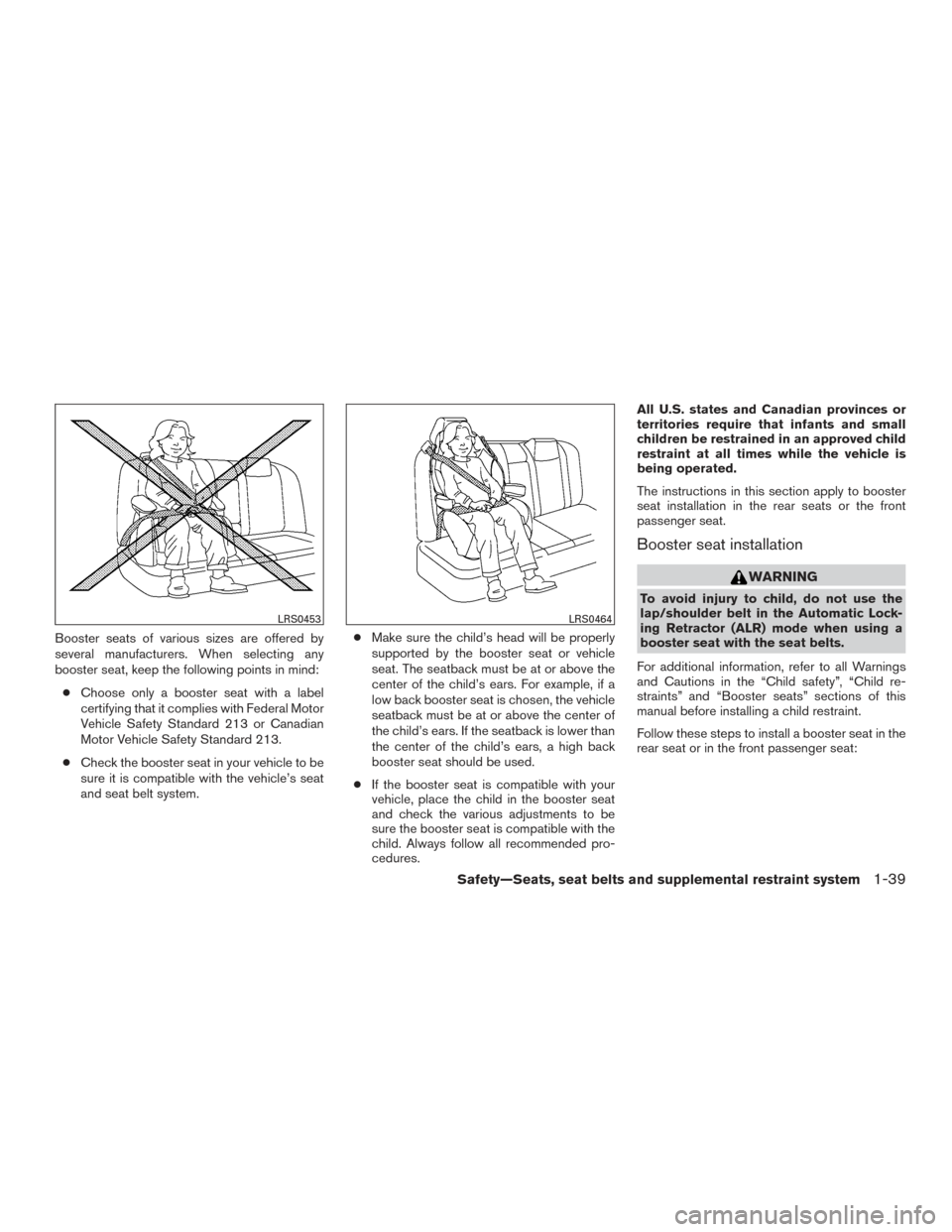
Booster seats of various sizes are offered by
several manufacturers. When selecting any
booster seat, keep the following points in mind:● Choose only a booster seat with a label
certifying that it complies with Federal Motor
Vehicle Safety Standard 213 or Canadian
Motor Vehicle Safety Standard 213.
● Check the booster seat in your vehicle to be
sure it is compatible with the vehicle’s seat
and seat belt system. ●
Make sure the child’s head will be properly
supported by the booster seat or vehicle
seat. The seatback must be at or above the
center of the child’s ears. For example, if a
low back booster seat is chosen, the vehicle
seatback must be at or above the center of
the child’s ears. If the seatback is lower than
the center of the child’s ears, a high back
booster seat should be used.
● If the booster seat is compatible with your
vehicle, place the child in the booster seat
and check the various adjustments to be
sure the booster seat is compatible with the
child. Always follow all recommended pro-
cedures. All U.S. states and Canadian provinces or
territories require that infants and small
children be restrained in an approved child
restraint at all times while the vehicle is
being operated.
The instructions in this section apply to booster
seat installation in the rear seats or the front
passenger seat.
Booster seat installation
WARNING
To avoid injury to child, do not use the
lap/shoulder belt in the Automatic Lock-
ing Retractor (ALR) mode when using a
booster seat with the seat belts.
For additional information, refer to all Warnings
and Cautions in the “Child safety”, “Child re-
straints” and “Booster seats” sections of this
manual before installing a child restraint.
Follow these steps to install a booster seat in the
rear seat or in the front passenger seat:
LRS0453LRS0464
Safety—Seats, seat belts and supplemental restraint system1-39
Page 59 of 491
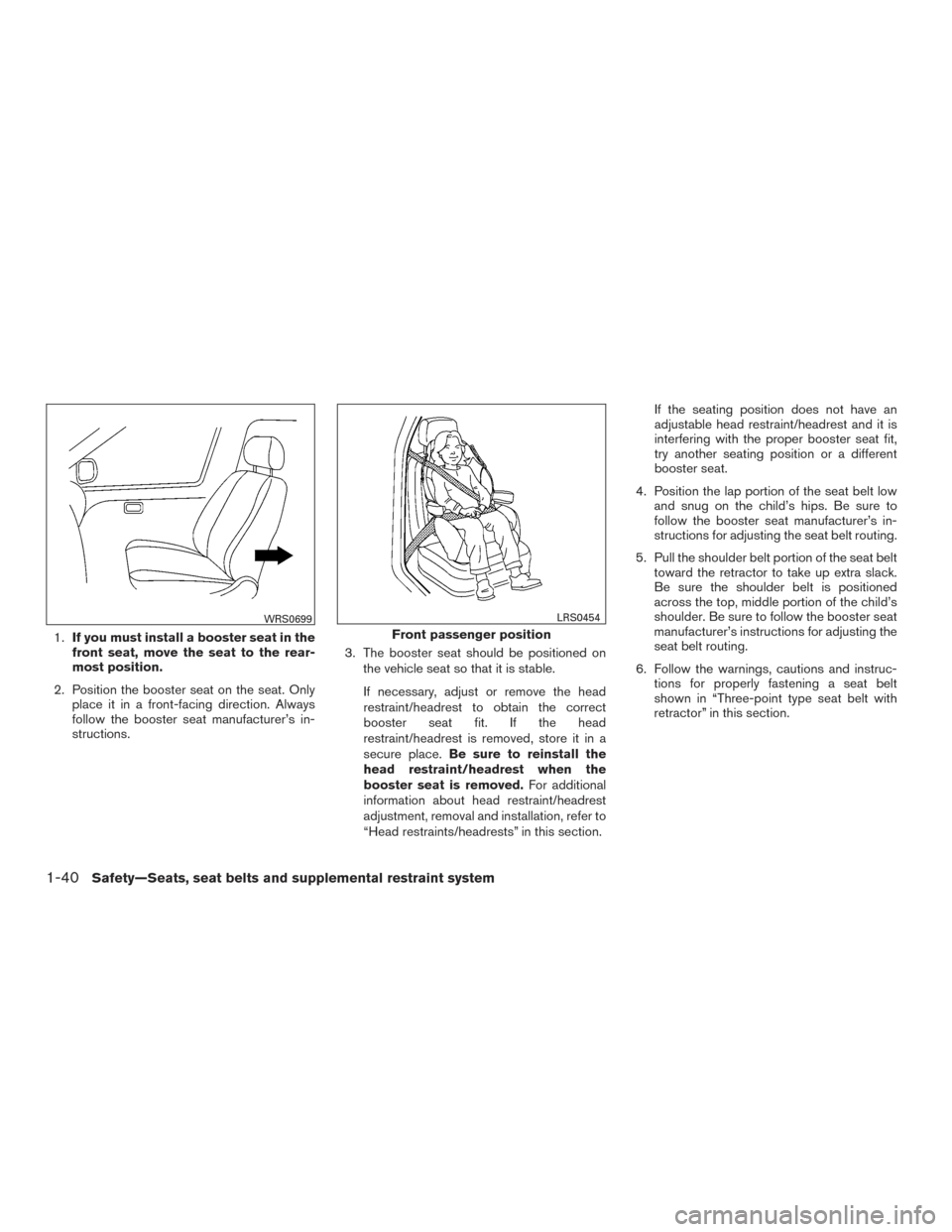
1.If you must install a booster seat in the
front seat, move the seat to the rear-
most position.
2. Position the booster seat on the seat. Only place it in a front-facing direction. Always
follow the booster seat manufacturer’s in-
structions. 3. The booster seat should be positioned on
the vehicle seat so that it is stable.
If necessary, adjust or remove the head
restraint/headrest to obtain the correct
booster seat fit. If the head
restraint/headrest is removed, store it in a
secure place. Be sure to reinstall the
head restraint/headrest when the
booster seat is removed. For additional
information about head restraint/headrest
adjustment, removal and installation, refer to
“Head restraints/headrests” in this section. If the seating position does not have an
adjustable head restraint/headrest and it is
interfering with the proper booster seat fit,
try another seating position or a different
booster seat.
4. Position the lap portion of the seat belt low and snug on the child’s hips. Be sure to
follow the booster seat manufacturer’s in-
structions for adjusting the seat belt routing.
5. Pull the shoulder belt portion of the seat belt toward the retractor to take up extra slack.
Be sure the shoulder belt is positioned
across the top, middle portion of the child’s
shoulder. Be sure to follow the booster seat
manufacturer’s instructions for adjusting the
seat belt routing.
6. Follow the warnings, cautions and instruc- tions for properly fastening a seat belt
shown in “Three-point type seat belt with
retractor” in this section.
WRS0699
Front passenger position
LRS0454
1-40Safety—Seats, seat belts and supplemental restraint system
Page 60 of 491
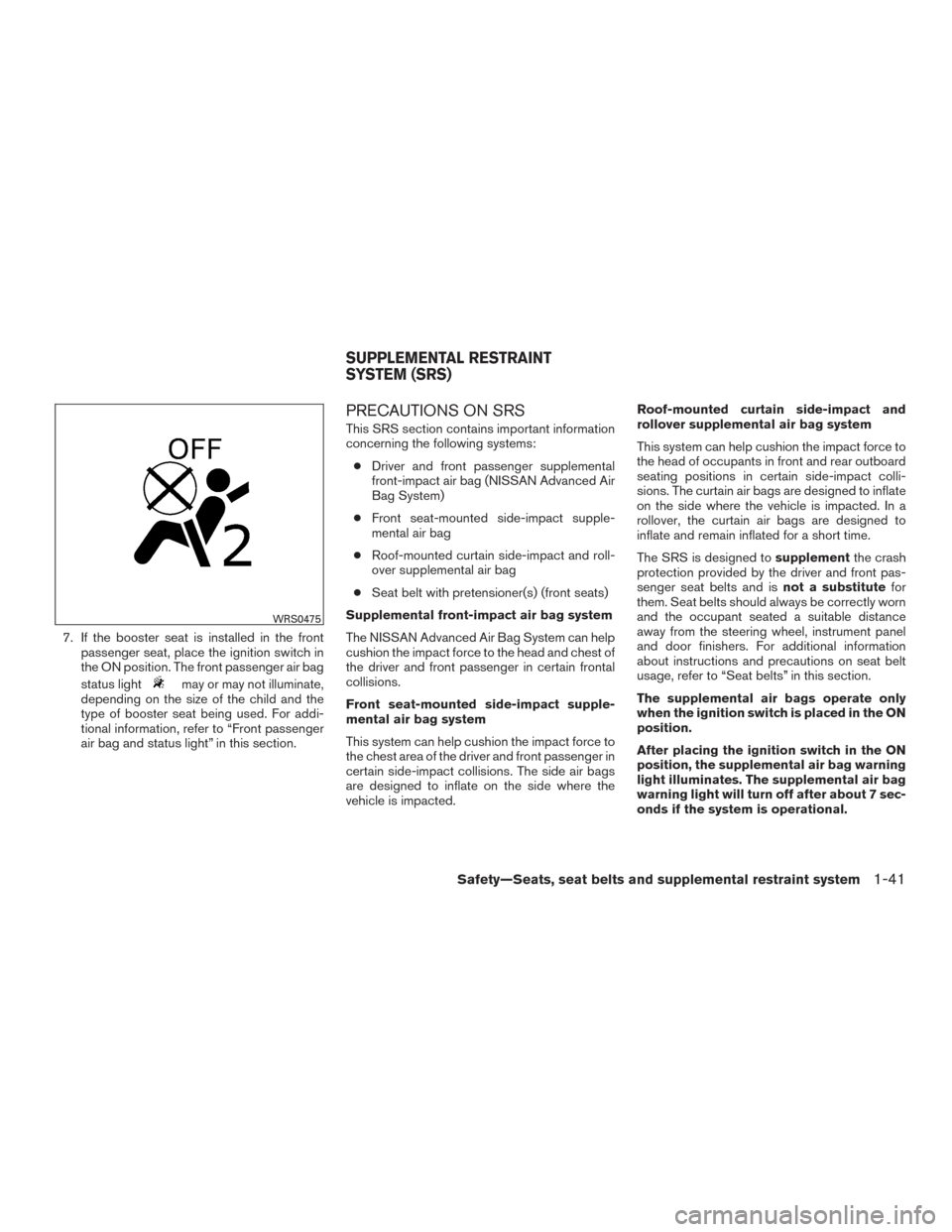
7. If the booster seat is installed in the frontpassenger seat, place the ignition switch in
the ON position. The front passenger air bag
status light
may or may not illuminate,
depending on the size of the child and the
type of booster seat being used. For addi-
tional information, refer to “Front passenger
air bag and status light” in this section.
PRECAUTIONS ON SRS
This SRS section contains important information
concerning the following systems:
● Driver and front passenger supplemental
front-impact air bag (NISSAN Advanced Air
Bag System)
● Front seat-mounted side-impact supple-
mental air bag
● Roof-mounted curtain side-impact and roll-
over supplemental air bag
● Seat belt with pretensioner(s) (front seats)
Supplemental front-impact air bag system
The NISSAN Advanced Air Bag System can help
cushion the impact force to the head and chest of
the driver and front passenger in certain frontal
collisions.
Front seat-mounted side-impact supple-
mental air bag system
This system can help cushion the impact force to
the chest area of the driver and front passenger in
certain side-impact collisions. The side air bags
are designed to inflate on the side where the
vehicle is impacted. Roof-mounted curtain side-impact and
rollover supplemental air bag system
This system can help cushion the impact force to
the head of occupants in front and rear outboard
seating positions in certain side-impact colli-
sions. The curtain air bags are designed to inflate
on the side where the vehicle is impacted. In a
rollover, the curtain air bags are designed to
inflate and remain inflated for a short time.
The SRS is designed to
supplementthe crash
protection provided by the driver and front pas-
senger seat belts and is not a substitutefor
them. Seat belts should always be correctly worn
and the occupant seated a suitable distance
away from the steering wheel, instrument panel
and door finishers. For additional information
about instructions and precautions on seat belt
usage, refer to “Seat belts” in this section.
The supplemental air bags operate only
when the ignition switch is placed in the ON
position.
After placing the ignition switch in the ON
position, the supplemental air bag warning
light illuminates. The supplemental air bag
warning light will turn off after about 7 sec-
onds if the system is operational.
WRS0475
SUPPLEMENTAL RESTRAINT
SYSTEM (SRS)
Safety—Seats, seat belts and supplemental restraint system1-41
Page 61 of 491
WARNING
●The front air bags ordinarily will not
inflate in the event of a side impact, rear
impact, rollover, or lower severity fron-
tal collision. Always wear your seat
belts to help reduce the risk or severity
of injury in various kinds of accidents
● The front passenger air bag will not
inflate if the passenger air bag status
light is lit. For additional information,
refer to “Front passenger air bag and
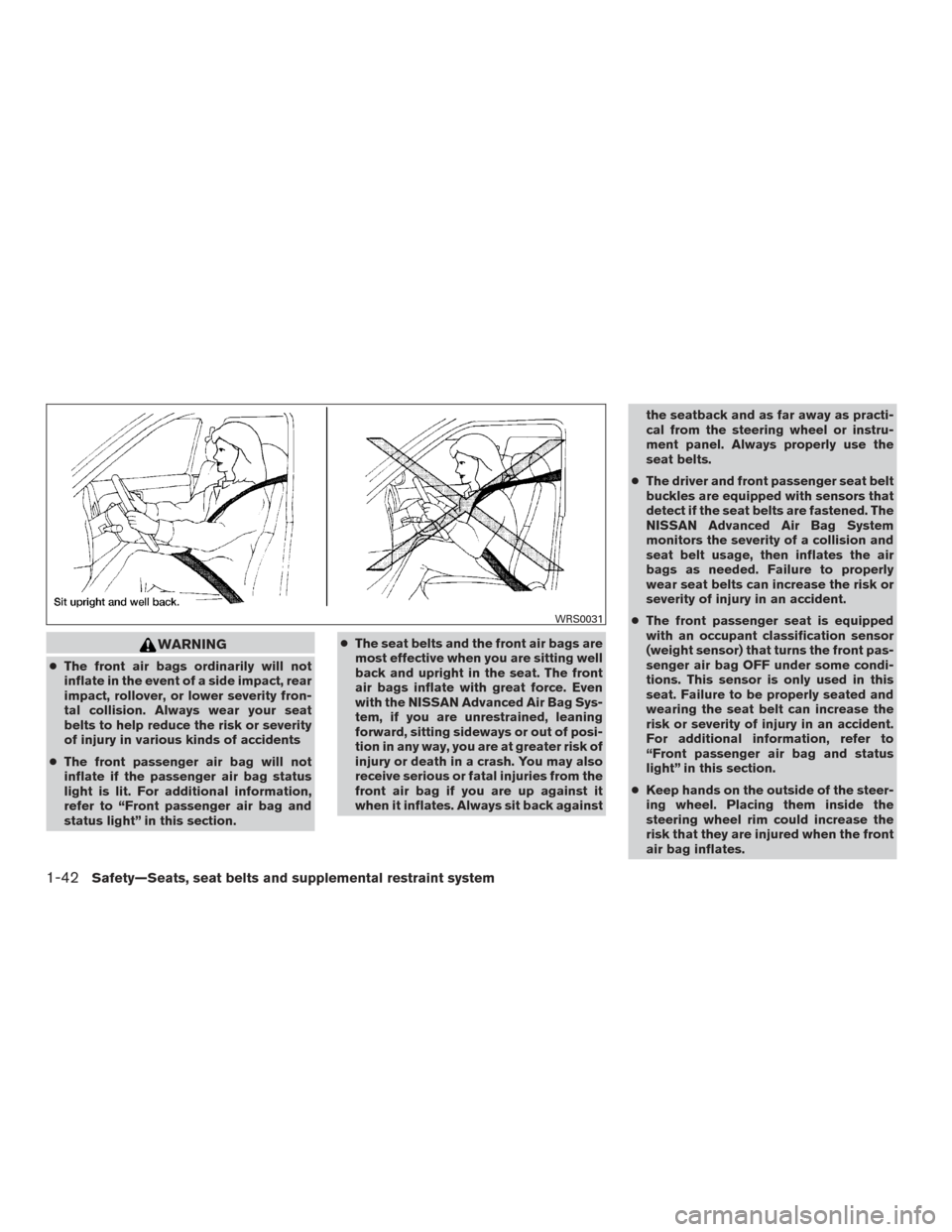
status light” in this section. ●
The seat belts and the front air bags are
most effective when you are sitting well
back and upright in the seat. The front
air bags inflate with great force. Even
with the NISSAN Advanced Air Bag Sys-
tem, if you are unrestrained, leaning
forward, sitting sideways or out of posi-
tion in any way, you are at greater risk of
injury or death in a crash. You may also
receive serious or fatal injuries from the
front air bag if you are up against it
when it inflates. Always sit back against the seatback and as far away as practi-
cal from the steering wheel or instru-
ment panel. Always properly use the
seat belts.
● The driver and front passenger seat belt
buckles are equipped with sensors that
detect if the seat belts are fastened. The
NISSAN Advanced Air Bag System
monitors the severity of a collision and
seat belt usage, then inflates the air
bags as needed. Failure to properly
wear seat belts can increase the risk or
severity of injury in an accident.
● The front passenger seat is equipped
with an occupant classification sensor
(weight sensor) that turns the front pas-
senger air bag OFF under some condi-
tions. This sensor is only used in this
seat. Failure to be properly seated and
wearing the seat belt can increase the
risk or severity of injury in an accident.
For additional information, refer to
“Front passenger air bag and status
light” in this section.
● Keep hands on the outside of the steer-
ing wheel. Placing them inside the
steering wheel rim could increase the
risk that they are injured when the front
air bag inflates.
WRS0031
1-42Safety—Seats, seat belts and supplemental restraint system
Page 62 of 491

WARNING
●Never let children ride unrestrained or
extend their hands or face out of the
window. Do not attempt to hold them in
your lap or arms. Some examples of
dangerous riding positions are shown
in the illustrations.
ARS1133ARS1041
Safety—Seats, seat belts and supplemental restraint system1-43
Page 63 of 491
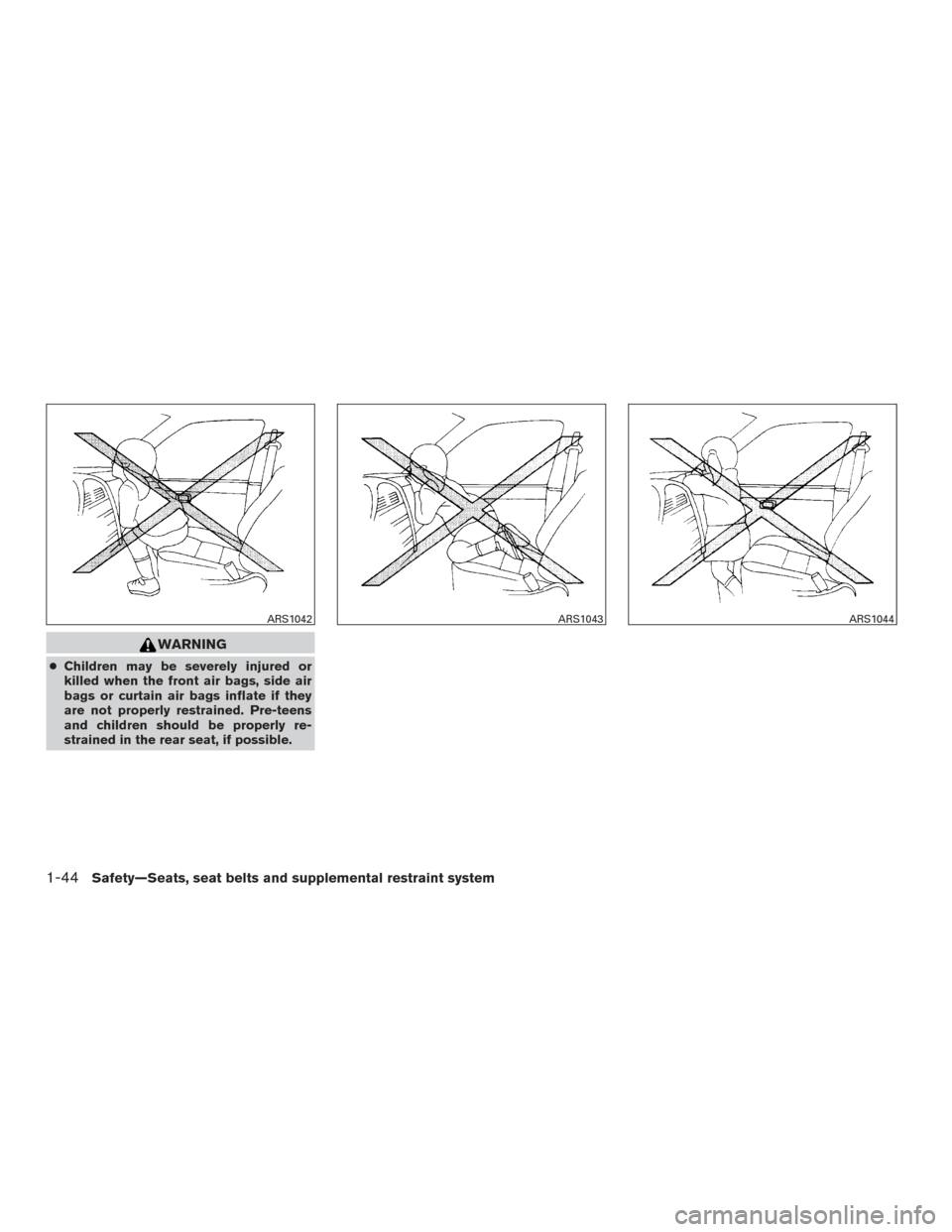
WARNING
●Children may be severely injured or
killed when the front air bags, side air
bags or curtain air bags inflate if they
are not properly restrained. Pre-teens
and children should be properly re-
strained in the rear seat, if possible.
ARS1042ARS1043ARS1044
1-44Safety—Seats, seat belts and supplemental restraint system
Page 64 of 491
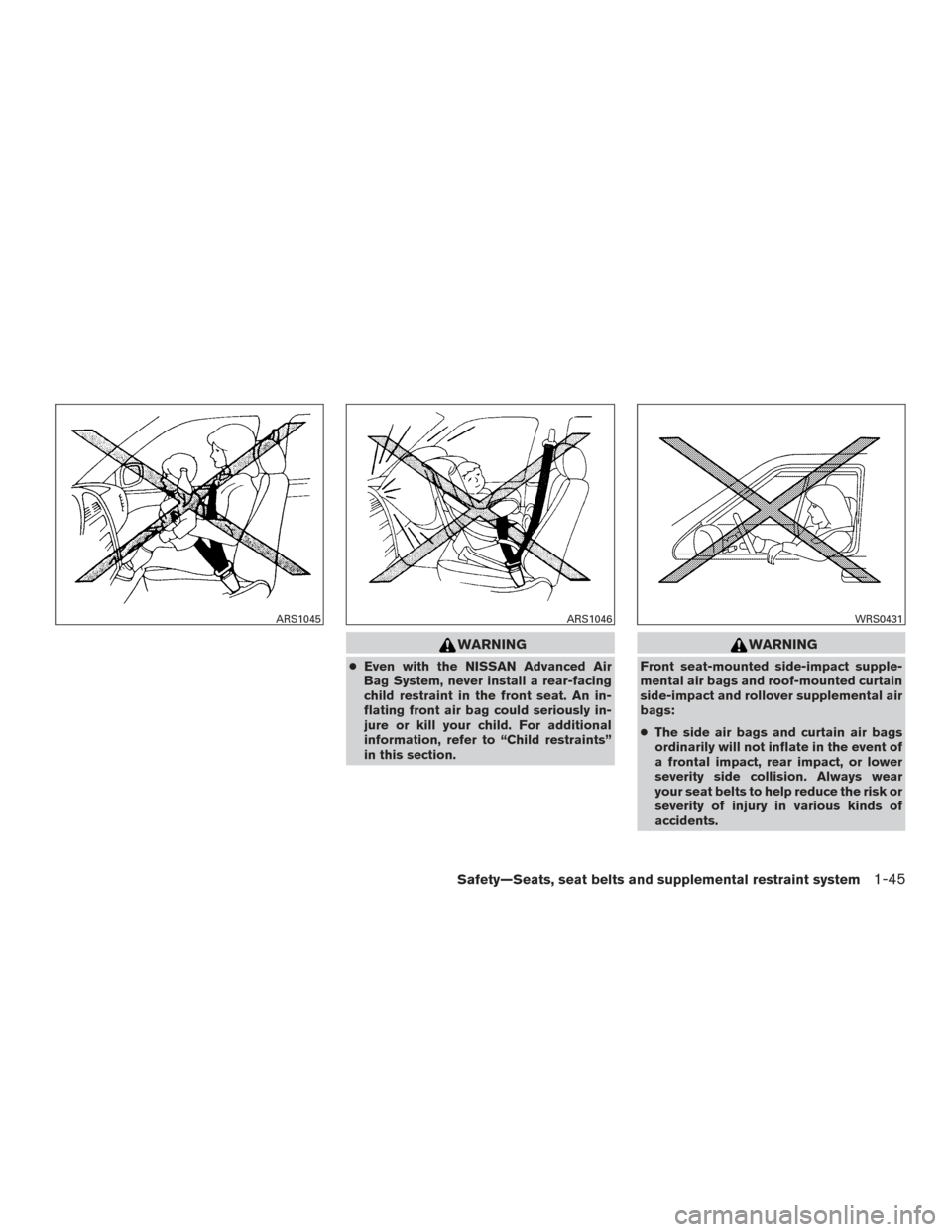
WARNING
●Even with the NISSAN Advanced Air
Bag System, never install a rear-facing
child restraint in the front seat. An in-
flating front air bag could seriously in-
jure or kill your child. For additional
information, refer to “Child restraints”
in this section.
WARNING
Front seat-mounted side-impact supple-
mental air bags and roof-mounted curtain
side-impact and rollover supplemental air
bags:
● The side air bags and curtain air bags
ordinarily will not inflate in the event of
a frontal impact, rear impact, or lower
severity side collision. Always wear
your seat belts to help reduce the risk or
severity of injury in various kinds of
accidents.
ARS1045ARS1046WRS0431
Safety—Seats, seat belts and supplemental restraint system1-45
Page 65 of 491
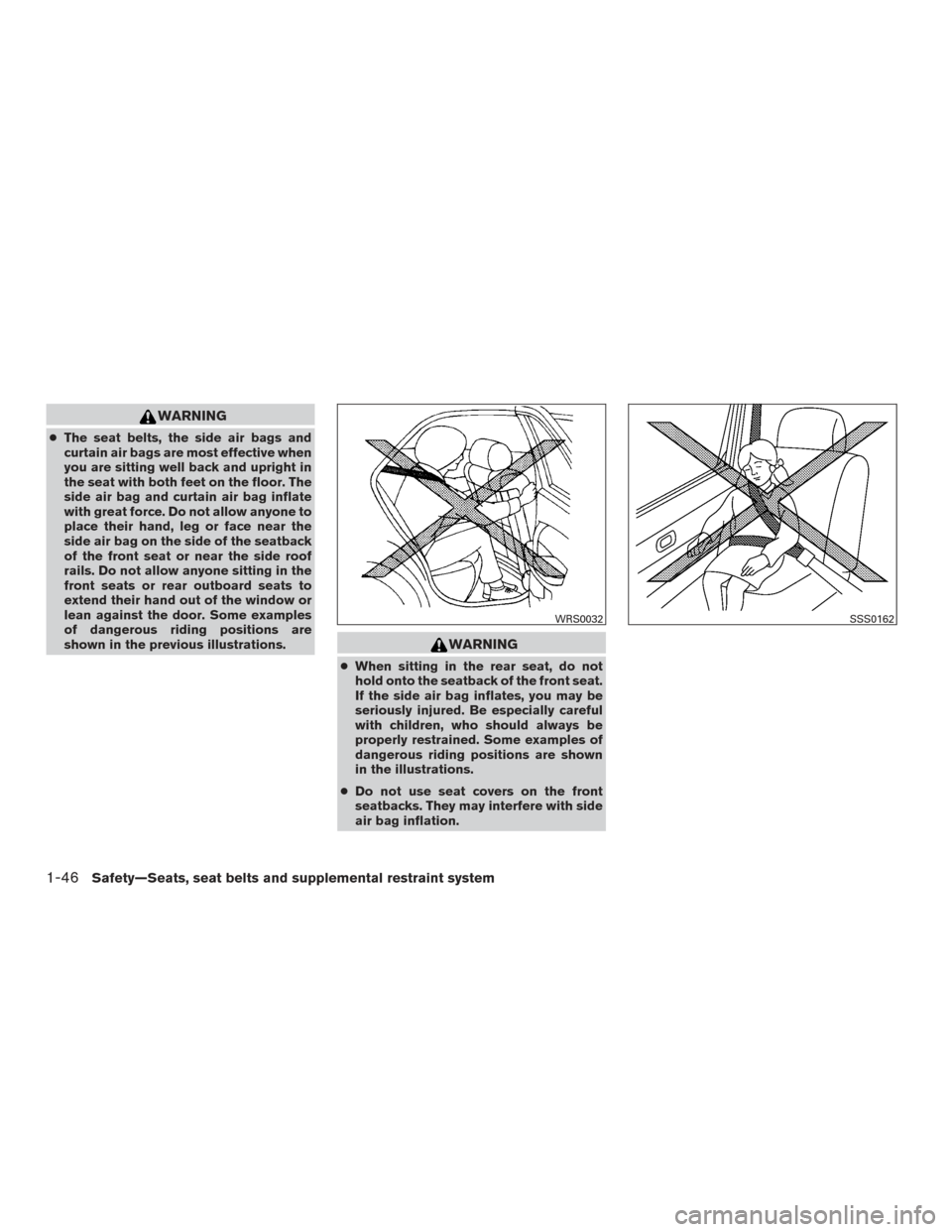
WARNING
●The seat belts, the side air bags and
curtain air bags are most effective when
you are sitting well back and upright in
the seat with both feet on the floor. The
side air bag and curtain air bag inflate
with great force. Do not allow anyone to
place their hand, leg or face near the
side air bag on the side of the seatback
of the front seat or near the side roof
rails. Do not allow anyone sitting in the
front seats or rear outboard seats to
extend their hand out of the window or
lean against the door. Some examples
of dangerous riding positions are
shown in the previous illustrations.
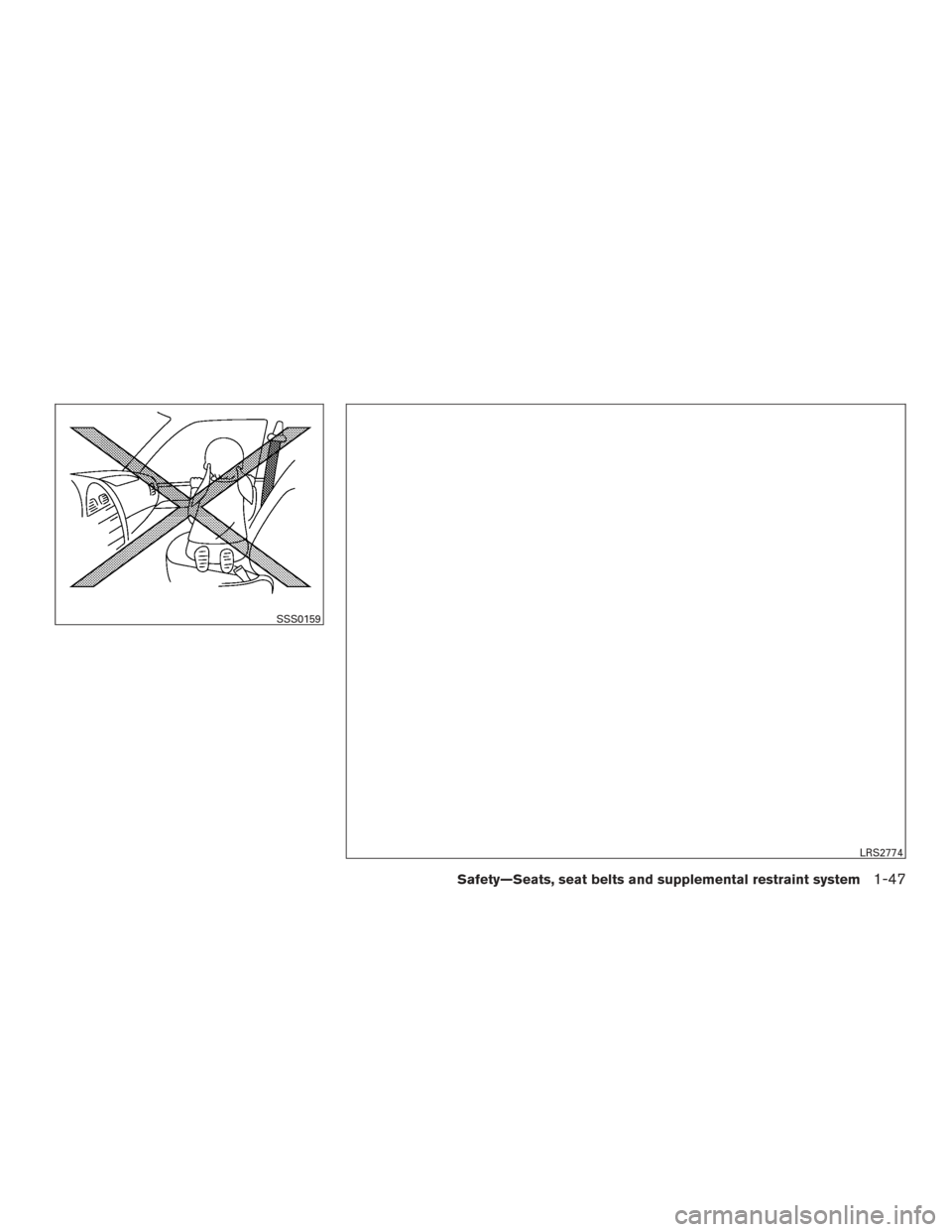
WARNING
● When sitting in the rear seat, do not
hold onto the seatback of the front seat.
If the side air bag inflates, you may be
seriously injured. Be especially careful
with children, who should always be
properly restrained. Some examples of
dangerous riding positions are shown
in the illustrations.
● Do not use seat covers on the front
seatbacks. They may interfere with side
air bag inflation.
WRS0032SSS0162
1-46Safety—Seats, seat belts and supplemental restraint system
Page 66 of 491
SSS0159
LRS2774
Safety—Seats, seat belts and supplemental restraint system1-47
Page 67 of 491
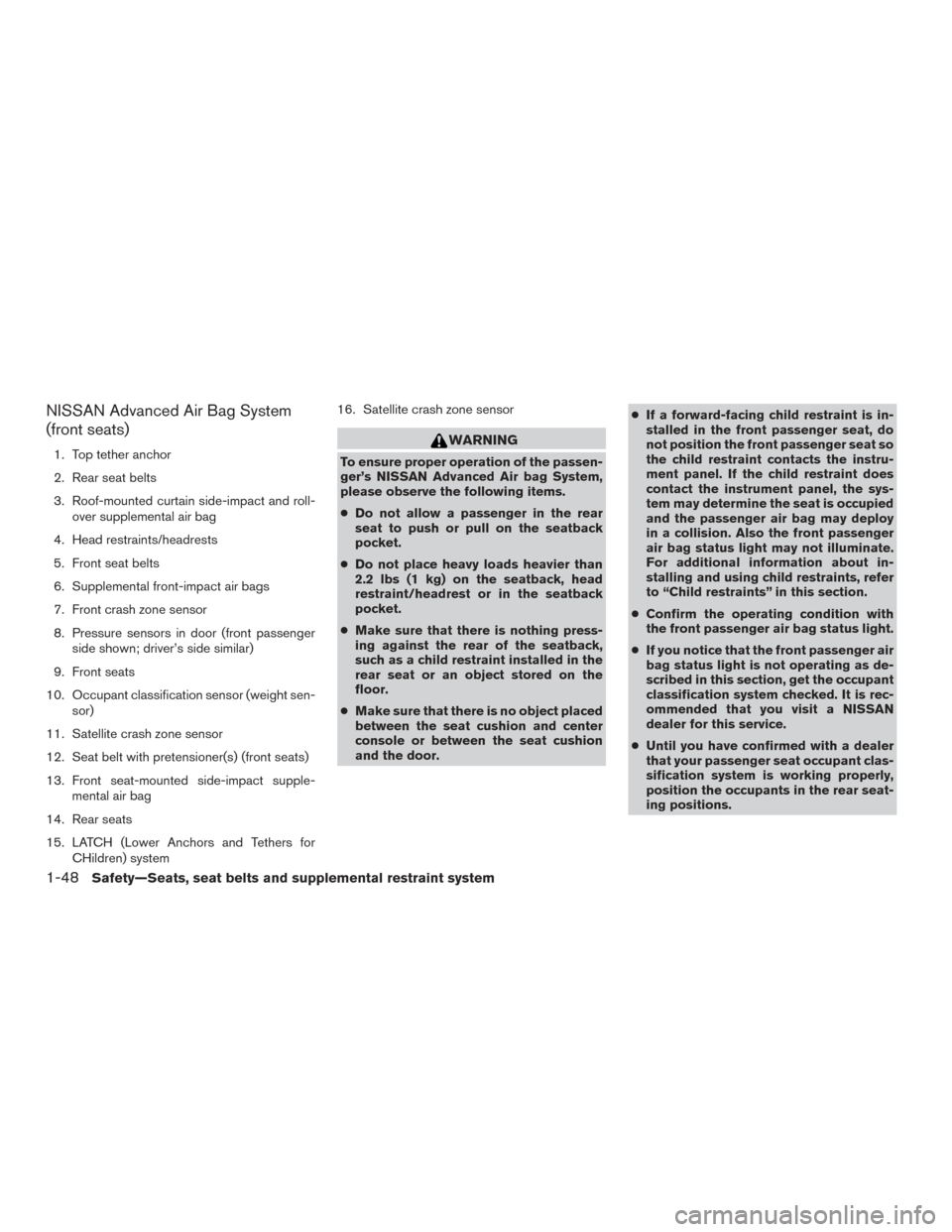
NISSAN Advanced Air Bag System
(front seats)
1. Top tether anchor
2. Rear seat belts
3. Roof-mounted curtain side-impact and roll-over supplemental air bag
4. Head restraints/headrests
5. Front seat belts
6. Supplemental front-impact air bags
7. Front crash zone sensor
8. Pressure sensors in door (front passenger side shown; driver’s side similar)
9. Front seats
10. Occupant classification sensor (weight sen- sor)
11. Satellite crash zone sensor
12. Seat belt with pretensioner(s) (front seats)
13. Front seat-mounted side-impact supple- mental air bag
14. Rear seats
15. LATCH (Lower Anchors and Tethers for CHildren) system 16. Satellite crash zone sensorWARNING
To ensure proper operation of the passen-
ger’s NISSAN Advanced Air bag System,
please observe the following items.
●
Do not allow a passenger in the rear
seat to push or pull on the seatback
pocket.
● Do not place heavy loads heavier than
2.2 lbs (1 kg) on the seatback, head
restraint/headrest or in the seatback
pocket.
● Make sure that there is nothing press-
ing against the rear of the seatback,
such as a child restraint installed in the
rear seat or an object stored on the
floor.
● Make sure that there is no object placed
between the seat cushion and center
console or between the seat cushion
and the door. ●
If a forward-facing child restraint is in-
stalled in the front passenger seat, do
not position the front passenger seat so
the child restraint contacts the instru-
ment panel. If the child restraint does
contact the instrument panel, the sys-
tem may determine the seat is occupied
and the passenger air bag may deploy
in a collision. Also the front passenger
air bag status light may not illuminate.
For additional information about in-
stalling and using child restraints, refer
to “Child restraints” in this section.
● Confirm the operating condition with
the front passenger air bag status light.
● If you notice that the front passenger air
bag status light is not operating as de-
scribed in this section, get the occupant
classification system checked. It is rec-
ommended that you visit a NISSAN
dealer for this service.
● Until you have confirmed with a dealer
that your passenger seat occupant clas-
sification system is working properly,
position the occupants in the rear seat-
ing positions.
1-48Safety—Seats, seat belts and supplemental restraint system