tire type NISSAN SENTRA 2018 Owner´s Manual
[x] Cancel search | Manufacturer: NISSAN, Model Year: 2018, Model line: SENTRA, Model: NISSAN SENTRA 2018Pages: 507, PDF Size: 5.59 MB
Page 454 of 507
∙ Always use tires of the same type,size, brand, construction and tread
pattern on all four wheels. Failure to
do so may result in a circumference
difference between tires on the front
and rear axles which can cause the
Vehicle Dynamic Control (VDC) system
to malfunction resulting in personal
injury or death, excessive tire wear
and may damage the transmission
and differential gears.
∙ For additional information regarding tires, refer to “Important Tire Safety
Information” (US) or “Tire Safety Infor-
mation” (Canada) in the Warranty In-
formation Booklet.
All season tires
NISSAN specifies All Season tires on some
models to provide good performance all
year, including snowy and icy road condi-
tions. All Season tires are identified by ALL
SEASON and/or M&S on the tire sidewall.
Snow tires have better snow traction than
All Season tires and may be more appropri-
ate in some areas.
Summer tires
NISSAN specifies summer tires on some
models to provide superior performance
on dry roads. Summer tire performance is
substantially reduced in snow and ice.
Summer tires do not have the tire traction
rating “M&S” on the tire sidewall.
If you plan to operate your vehicle in snowy
or icy conditions, NISSAN recommends the
use of SNOW tires or ALL SEASON tires on all
four wheels.
Snow tires
If snow tires are needed, it is necessary to
select tires equivalent in size and load rat-
ing to the original equipment tires. If you do
not, it can adversely affect the safety and
handling of your vehicle.
Generally, snow tires have lower speed rat-
ings than factory equipped tires and may
not match the potential maximum vehicle
speed. Never exceed the maximum speed
rating of the tire.
If you install snow tires, they must be the
same size, brand, construction and tread
pattern on all four wheels. For additional traction on icy roads, stud-
ded tires may be used. However, some U.S.
states and Canadian provinces prohibit
their use. Check local, state and provincial
laws before installing studded tires. Skid
and traction capabilities of studded snow
tires on wet or dry surfaces may be poorer
than that of non-studded snow tires.
TIRE CHAINS
CAUTION
Tire chains/cables should not be in-
stalled on 205/50R17 and 215/45ZR18
size tires. Installation of the tire
chains/cables on 205/50R17 and
215/45ZR18 size tires will cause damage
to the vehicle. If you plan to use tire
chains/cables, you should install
205/55R16 size tires on your vehicle.
Use of tire chains may be prohibited ac-
cording to location. Check the local laws
before installing tire chains. When installing
tire chains, make sure they are the proper
size for the tires on your vehicle and are
installed according to the chain manufac-
turer’s suggestions. Use only SAE class “S”
chains. Class “S” chains are used on ve-
hicles with restricted tire to vehicle clear-
ance. Vehicles that can use Class “S” chains
8-42Do-it-yourself
Page 455 of 507
are designed to meet the minimum clear-
ances between the tire and the closest ve-
hicle suspension or body component re-
quired to accommodate the use of a
winter traction device (tire chains or
cables). The minimum clearances are de-
termined using the factory equipped tires.
Other types may damage your vehicle. Use
chain tensioners when recommended by
the tire chain manufacturer to ensure a
tight fit. Loose end links of the tire chain
must be secured or removed to prevent
the possibility of whipping action damage
to the fenders or underbody. If possible,
avoid fully loading your vehicle when using
tire chains. In addition, drive at a reduced
speed. Otherwise, your vehicle may be
damaged and/or vehicle handling and
performance may be adversely affected.
Tire chains must be installed only on the
front wheels and not on the rear wheels.
Never install tire chains on a TEMPORARY
USE ONLY spare tire.
Do not use tire chains on dry roads. Driving
with chains in such conditions can cause
damage to the various mechanisms of the
vehicle due to some overstress.
CHANGING WHEELS AND TIRES
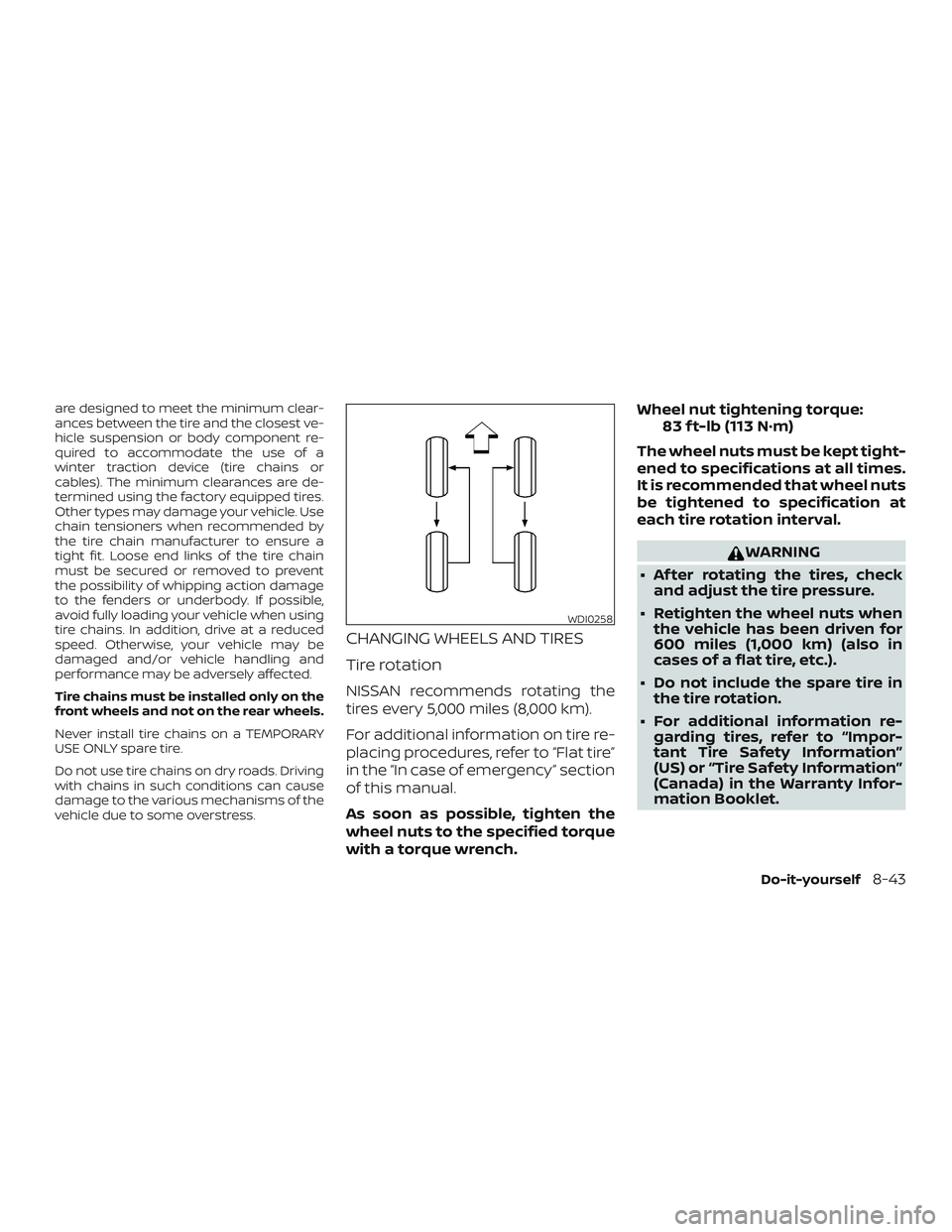
Tire rotation
NISSAN recommends rotating the
tires every 5,000 miles (8,000 km).
For additional information on tire re-
placing procedures, refer to “Flat tire”
in the “In case of emergency” section
of this manual.
As soon as possible, tighten the
wheel nuts to the specified torque
with a torque wrench.Wheel nut tightening torque:
83 f t-lb (113 N·m)
The wheel nuts must be kept tight-
ened to specifications at all times.
It is recommended that wheel nuts
be tightened to specification at
each tire rotation interval.
WARNING
∙ Af ter rotating the tires, check and adjust the tire pressure.
∙ Retighten the wheel nuts when the vehicle has been driven for
600 miles (1,000 km) (also in
cases of a flat tire, etc.).
∙ Do not include the spare tire in the tire rotation.
∙ For additional information re- garding tires, refer to “Impor-
tant Tire Safety Information”
(US) or “Tire Safety Information”
(Canada) in the Warranty Infor-
mation Booklet.
WDI0258
Do-it-yourself8-43
Page 456 of 507
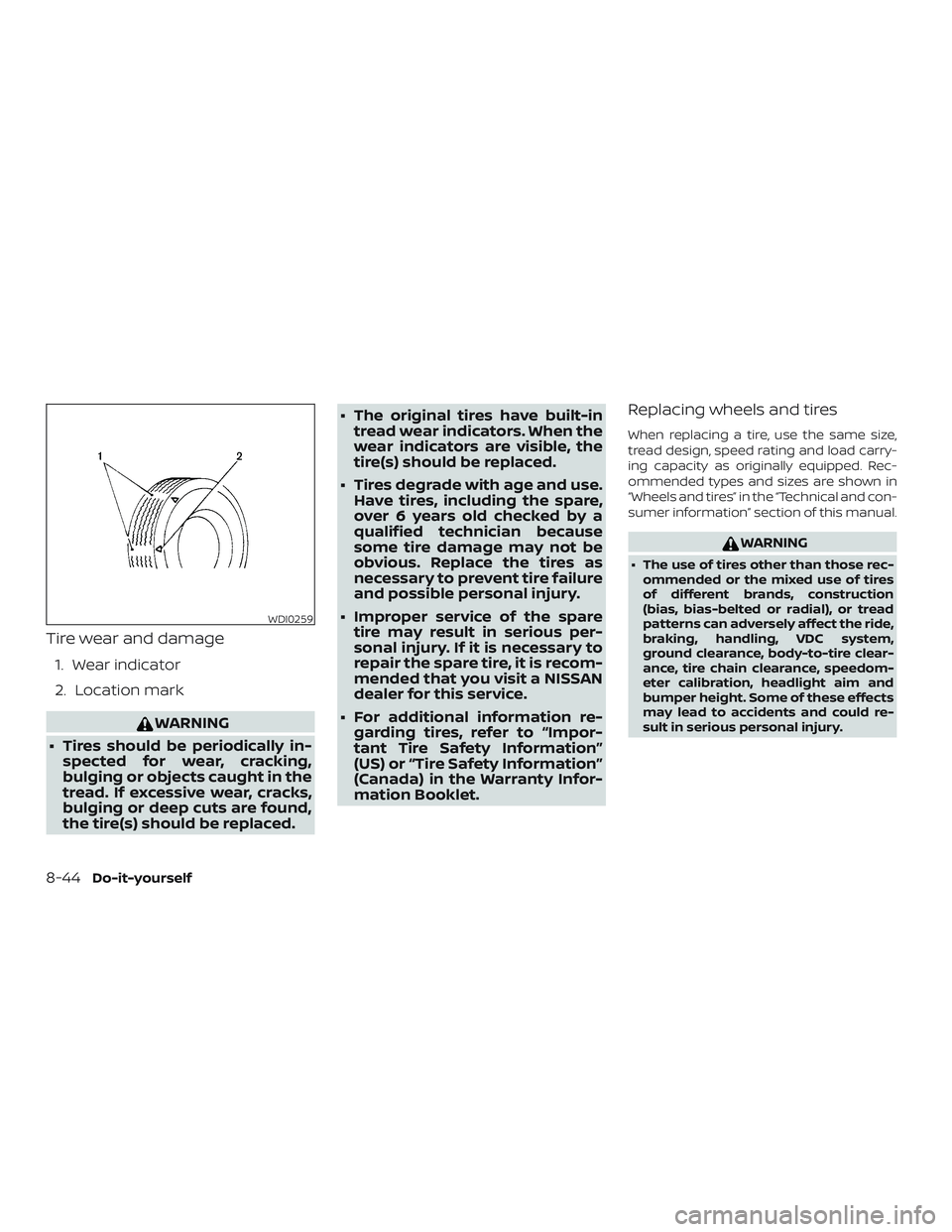
Tire wear and damage
1. Wear indicator
2. Location mark
WARNING
∙ Tires should be periodically in- spected for wear, cracking,
bulging or objects caught in the
tread. If excessive wear, cracks,
bulging or deep cuts are found,
the tire(s) should be replaced. ∙ The original tires have built-in
tread wear indicators. When the
wear indicators are visible, the
tire(s) should be replaced.
∙ Tires degrade with age and use. Have tires, including the spare,
over 6 years old checked by a
qualified technician because
some tire damage may not be
obvious. Replace the tires as
necessary to prevent tire failure
and possible personal injury.
∙ Improper service of the spare tire may result in serious per-
sonal injury. If it is necessary to
repair the spare tire, it is recom-
mended that you visit a NISSAN
dealer for this service.
∙ For additional information re- garding tires, refer to “Impor-
tant Tire Safety Information”
(US) or “Tire Safety Information”
(Canada) in the Warranty Infor-
mation Booklet.
Replacing wheels and tires
When replacing a tire, use the same size,
tread design, speed rating and load carry-
ing capacity as originally equipped. Rec-
ommended types and sizes are shown in
“Wheels and tires” in the “Technical and con-
sumer information” section of this manual.
WARNING
∙ The use of tires other than those rec-
ommended or the mixed use of tires
of different brands, construction
(bias, bias-belted or radial), or tread
patterns can adversely affect the ride,
braking, handling, VDC system,
ground clearance, body-to-tire clear-
ance, tire chain clearance, speedom-
eter calibration, headlight aim and
bumper height. Some of these effects
may lead to accidents and could re-
sult in serious personal injury.
WDI0259
8-44Do-it-yourself
Page 464 of 507
Engine coolant*:Replace coolant at the
specified interval. When adding or replac-
ing coolant, be sure to use only Genuine
NISSAN Long Life Antifreeze/Coolant (blue)
or equivalent with the proper mixture. (For
additional information on the proper mix-
ture for your area, refer to “Engine cooling
system” in the “Do-it-yourself ” section of
this manual.)
NOTE: Mixing any other type of coolant
or the use of non-distilled water may re-
duce the recommended service interval
of the coolant.
Engine oil and oil filter: Replace engine oil
and oil filter at the specified intervals. For
recommended oil grade and viscosity refer
to “Recommended fluids/lubricants and
capacities” in the “Technical and consumer
information” section of this manual.
Engine valve clearance*: Inspect only if
valve noise increases. Adjust valve clear-
ance if necessary.
Evaporative emissions control vapor
lines*: Check vapor lines for leaks or loose-
ness. Tighten connections or replace parts
as necessary.
Fuel filter: Periodic maintenance is not re-
quired. (in-tank type filter) Fuel lines*:
Check the fuel hoses, piping
and connections for leaks, looseness, or
deterioration. Tighten connections or re-
place parts as necessary.
Spark plugs: Replace at specified intervals.
Install new plugs of the type as originally
equipped.
CHASSIS AND BODY
MAINTENANCE:
Brake lines and cables: Visually inspect for
proper installation. Check for chafing,
cracks, deterioration, and signs of leaking.
Replace any deteriorated or damaged
parts immediately.
Brake pads, rotors, drums and linings:
Check for wear, deterioration and fluid
leaks. Replace any deteriorated or dam-
aged parts immediately.
Exhaust system: Visually inspect the ex-
haust pipes, muffler and hangers for leaks,
cracks, deterioration, and damage. Tighten
connections or replace parts as necessary.
In-cabin microfilter: Replace at specified
intervals. When driving for prolonged peri-
ods in dusty conditions, replace the filter
more frequently. Steering gear and linkage, axle and sus-
pension parts, drive shaf t boots:
Check
for damage, looseness, and leakage of oil
or grease. Under severe driving conditions,
inspect more frequently.
Tire rotation: Tires should be rotated every
5,000 miles (8,000 km) according to the in-
structions under “General maintenance” in
this section. When rotating tires, check for
damage and uneven wear. Replace if nec-
essary.
Transmission fluid/oil: Visually inspect for
signs of leakage at specified intervals. If
using a car-top carrier, or driving on rough
or muddy roads:
∙ Replace the manual transaxle gear oil every 20,000 miles or 24 months.
∙ Replace the CVT fluid every 60,000 miles (96,000 km) or request the dealer to in-
spect the fluid deterioration data using
a CONSULT. If the deterioration data is
more than 210000, replace the CVT fluid.
9-6Maintenance and schedules
Page 484 of 507
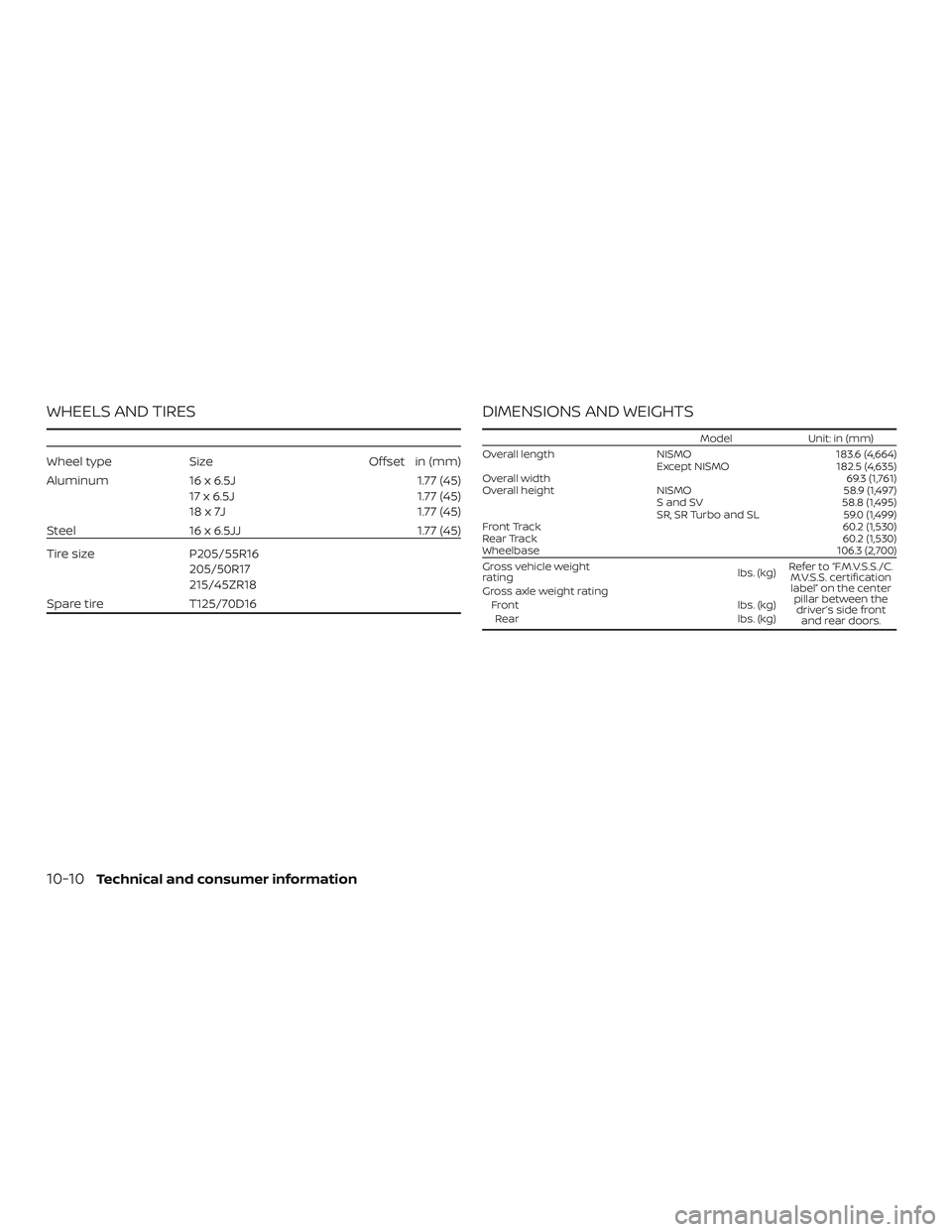
WHEELS AND TIRES
Wheel typeSize Offset in (mm)
Aluminum 16 x 6.5J
17 x 6.5J
18 x 7J 1.77 (45)
1.77 (45)
1.77 (45)
Steel 16 x 6.5JJ 1.77 (45)
Tire size P205/55R16
205/50R17
215/45ZR18
Spare tire T125/70D16
DIMENSIONS AND WEIGHTS
ModelUnit: in (mm)
Overall length NISMO 183.6 (4,664)
Except NISMO 182.5 (4,635)
Overall width 69.3 (1,761)
Overall height NISMO 58.9 (1,497)
S and SV 58.8 (1,495)
SR, SR Turbo and SL 59.0 (1,499)
Front Track 60.2 (1,530)
Rear Track 60.2 (1,530)
Wheelbase 106.3 (2,700)
Gross vehicle weight
rating lbs. (kg)Refer to “F.M.V.S.S./C.
M.V.S.S. certificationlabel” on the center pillar between thedriver’s side front and rear doors.
Gross axle weight rating
Front lbs. (kg)
Rear lbs. (kg)
10-10Technical and consumer information
Page 503 of 507
StartingBefore starting the engine ........5-14
Jumpstarting.............6-9,8-15
Precautions when starting and
driving.....................5-2
Push starting ................6-11
Starting the engine ............5-15
Starting the engine ..............5-15
Starting the engine (models with NISSAN
Intelligent Key® system) ...........5-16
Steering Power steering system ..........5-71
Steering wheel .................3-30
Steering wheel audio control switch . . .4-72
Stoplight....................8-33
Storage.....................2-50
Storagetray ..................2-52
Sunglasses case ................2-54
Sunglasses holder ..............2-54
Sunroof .....................2-59
Sunroof (see Moonroof ) ...........2-59
Sunvisors....................3-30
Supplemental air bag warning labels . . .1-62
Supplemental air bag warning
light.................... .1-63, 2-19
Supplemental front impact air bag
system ..................... .1-51
Supplemental restraint system Information and warning labels . . . .1-62
Precautions on supplemental restraint
system ....................1-44
Supplemental restraint system
(Supplemental air bag system) .......1-44
Supplemental side and curtain side-impact
airbagsystem................ .1-59Switch
Autolightswitch..............2-42
Automatic power window switch . . .2-58
Foglightswitch..............2-46
Hazard warning flasher switch ......6-2
Headlight and turn signal switch ....2-41
Headlightcontrolswitch.........2-41
Ignition switch ................5-9
Instrument brightness control .....2-45
Power door lock switch ..........3-6
Rear window and outside mirror
defrosterswitch..............2-40
Turn signal switch .............2-45
T
Tachometer ...................2-7
Temperature gauge Engine coolant temperature gauge. . .2-7
Thef t (NISSAN Vehicle Immobilizer System),
engine start ............2-38,5 -11, 5-14
Three-waycatalyst...............5-2
Tilt Telescopicsteering............3-30
Tire Flattire..................6-3,6-3
Spare tire ...............6-4,8-46
Tire and Loading Information label . .10-13
Tire chains .................8-42
Tire pressure ................8-35
Tirerotation ................8-43
Types of tires ................8-41
Uniform tire quality grading ......10-18
Wheels and tires ..............8-35
Wheel/tire size ...............10-10 Tire pressure
Lowtirepressurewarninglight.....2-16
Tire Pressure Monitoring System
(TPMS)....................2-6,5-3
Towing 2-wheel drive models ...........6-14
4-wheel drive models ...........6-13
Flattowing.................10-18
Trailertowing...............10-18
Towingatrailer................10-18
Towingyourvehicle..............6-12
Transceiver HomeLink® Universal Transceiver . . .2-63, 2-64, 2-65, 2-66, 2-66, 2-67
Transmission Continuously Variable Transmission (CVT)
fluid......................8-11
Driving with Continuously Variable
Transmission (CVT) ..........5-9,5-17
Driving with manual
transmission.............5-10, 5-23
Travel (See registering a vehicle in another
country) .....................10-11
Trip computer ..................2-9
Trip odometer ...............2-4,2-5
T
roubleshooting guide
(NISSAN voice recognition system) ....4-106
Trunk access through the rear seat ....3-27
Trunklid.....................3-26
Trunk lid lock opener lever ..........3-26
Trunklight....................2-63
Turn signal switch ...............2-45
11-7