oil viscosity NISSAN SENTRA 2018 Owner´s Manual
[x] Cancel search | Manufacturer: NISSAN, Model Year: 2018, Model line: SENTRA, Model: NISSAN SENTRA 2018Pages: 507, PDF Size: 5.59 MB
Page 376 of 507
∙ Keep your engine tuned up.
∙ Follow the recommended scheduledmaintenance.
∙ Keep the tires inflated to the correct pressure. Low tire pressure increases
tire wear and lowers fuel economy.
∙ Keep the wheels in correct alignment. Improper alignment increases tire wear
and lowers fuel economy.
∙ Use the recommended viscosity engine oil. For additional information, refer to
“Engine oil and oil filter recommenda-
tions” in the “Technical and consumer
information” section of this manual.
WARNING
∙ Do not stop or park the vehicle overflammable materials such as dry
grass, waste paper or rags. They may
ignite and cause a fire. ∙ Safe parking procedures require that
both the parking brake be set and the
transmission placed in P (Park) for
Continuously Variable Transmission
(CVT) models or in an appropriate
gear for manual transmission (M/T)
models. Failure to do so could cause
the vehicle to move unexpectedly or
roll away and result in an accident.
Make sure the shif t lever has been
pushed as far forward as it can go and
cannot be moved without depressing
the foot brake pedal.
SSD0488
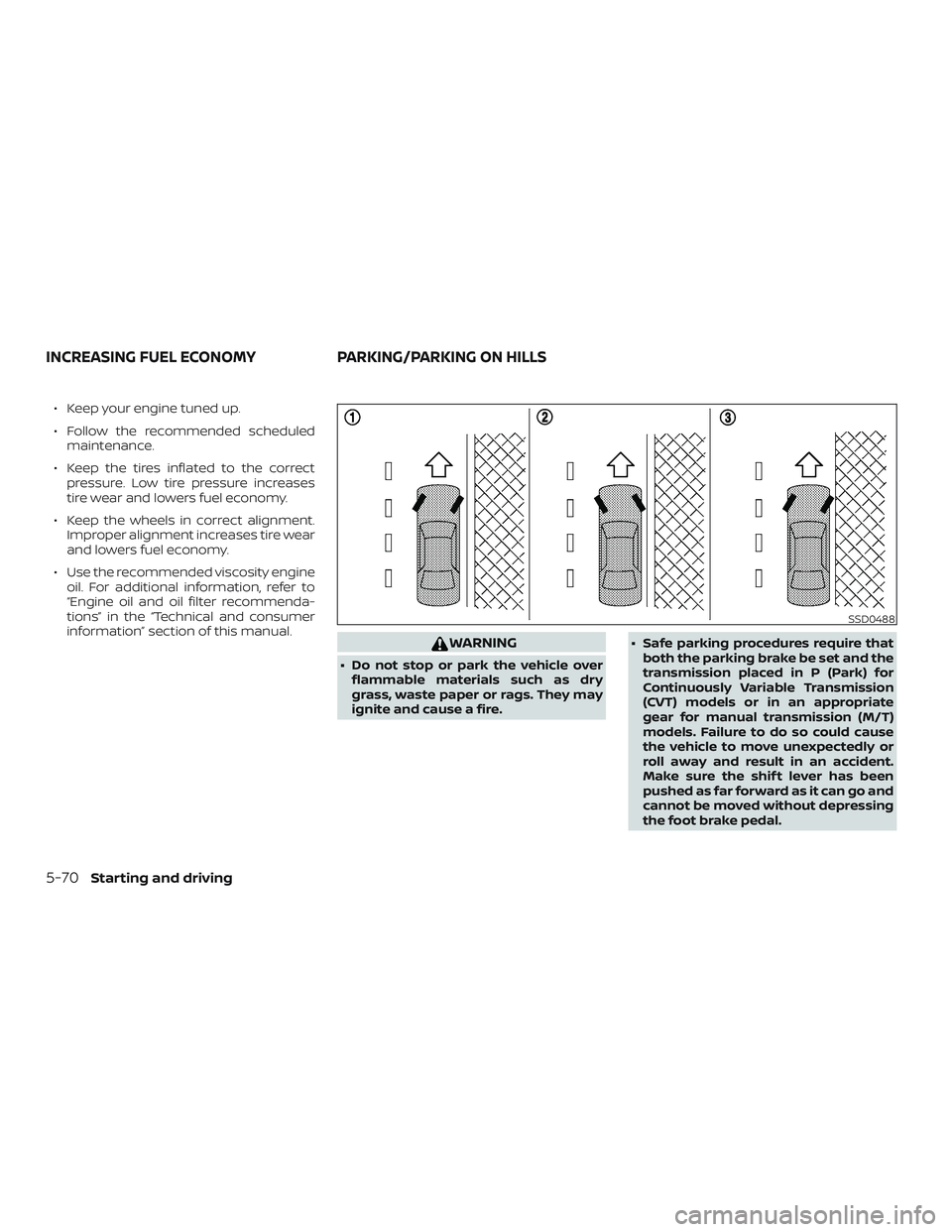
INCREASING FUEL ECONOMY PARKING/PARKING ON HILLS
5-70Starting and driving
Page 464 of 507
Engine coolant*:Replace coolant at the
specified interval. When adding or replac-
ing coolant, be sure to use only Genuine
NISSAN Long Life Antifreeze/Coolant (blue)
or equivalent with the proper mixture. (For
additional information on the proper mix-
ture for your area, refer to “Engine cooling
system” in the “Do-it-yourself ” section of
this manual.)
NOTE: Mixing any other type of coolant
or the use of non-distilled water may re-
duce the recommended service interval
of the coolant.
Engine oil and oil filter: Replace engine oil
and oil filter at the specified intervals. For
recommended oil grade and viscosity refer
to “Recommended fluids/lubricants and
capacities” in the “Technical and consumer
information” section of this manual.
Engine valve clearance*: Inspect only if
valve noise increases. Adjust valve clear-
ance if necessary.
Evaporative emissions control vapor
lines*: Check vapor lines for leaks or loose-
ness. Tighten connections or replace parts
as necessary.
Fuel filter: Periodic maintenance is not re-
quired. (in-tank type filter) Fuel lines*:
Check the fuel hoses, piping
and connections for leaks, looseness, or
deterioration. Tighten connections or re-
place parts as necessary.
Spark plugs: Replace at specified intervals.
Install new plugs of the type as originally
equipped.
CHASSIS AND BODY
MAINTENANCE:
Brake lines and cables: Visually inspect for
proper installation. Check for chafing,
cracks, deterioration, and signs of leaking.
Replace any deteriorated or damaged
parts immediately.
Brake pads, rotors, drums and linings:
Check for wear, deterioration and fluid
leaks. Replace any deteriorated or dam-
aged parts immediately.
Exhaust system: Visually inspect the ex-
haust pipes, muffler and hangers for leaks,
cracks, deterioration, and damage. Tighten
connections or replace parts as necessary.
In-cabin microfilter: Replace at specified
intervals. When driving for prolonged peri-
ods in dusty conditions, replace the filter
more frequently. Steering gear and linkage, axle and sus-
pension parts, drive shaf t boots:
Check
for damage, looseness, and leakage of oil
or grease. Under severe driving conditions,
inspect more frequently.
Tire rotation: Tires should be rotated every
5,000 miles (8,000 km) according to the in-
structions under “General maintenance” in
this section. When rotating tires, check for
damage and uneven wear. Replace if nec-
essary.
Transmission fluid/oil: Visually inspect for
signs of leakage at specified intervals. If
using a car-top carrier, or driving on rough
or muddy roads:
∙ Replace the manual transaxle gear oil every 20,000 miles or 24 months.
∙ Replace the CVT fluid every 60,000 miles (96,000 km) or request the dealer to in-
spect the fluid deterioration data using
a CONSULT. If the deterioration data is
more than 210000, replace the CVT fluid.
9-6Maintenance and schedules
Page 476 of 507
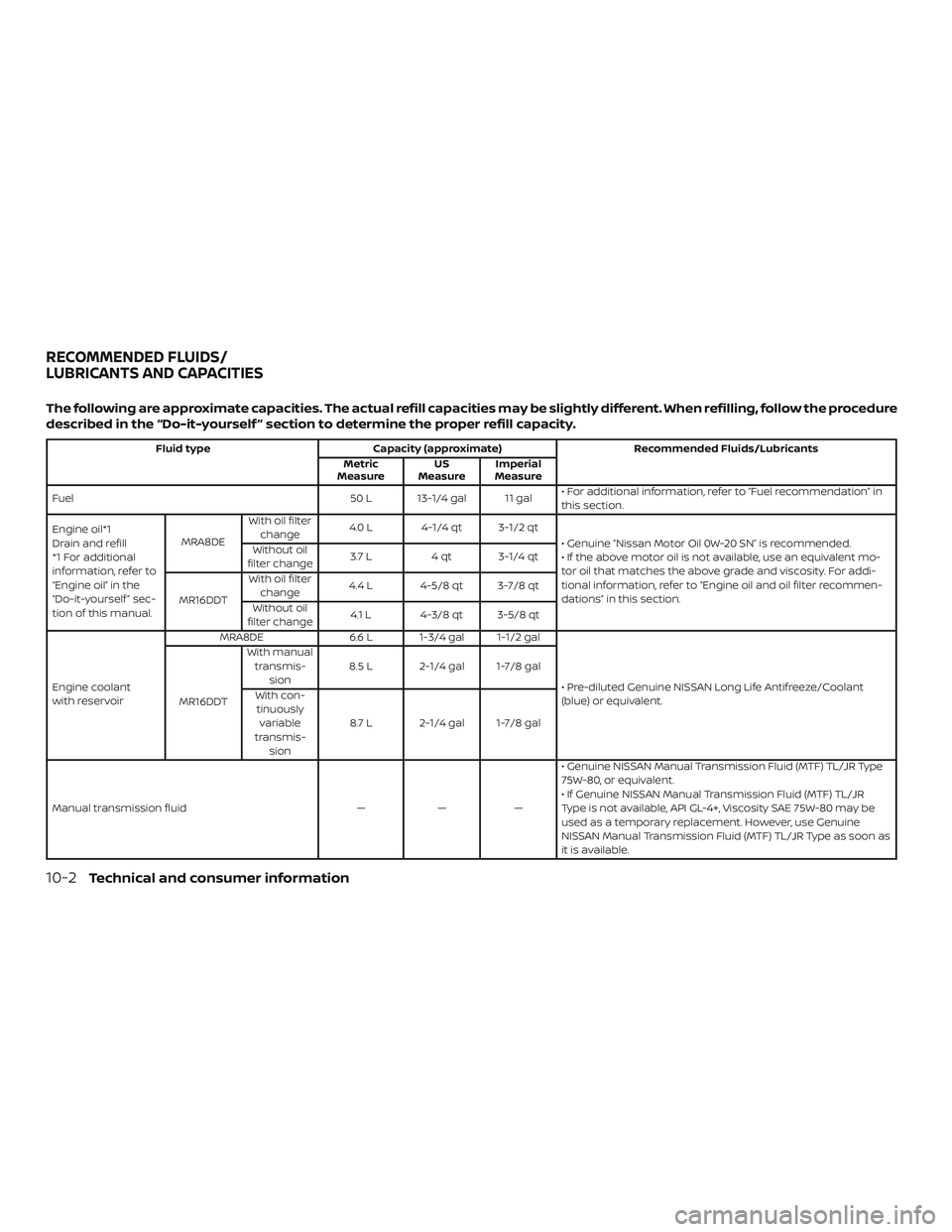
The following are approximate capacities. The actual refill capacities may be slightly different. When refilling, follow the procedure
described in the “Do-it-yourself ” section to determine the proper refill capacity.
Fluid typeCapacity (approximate) Recommended Fluids/Lubricants
Metric
Measure US
Measure Imperial
Measure
Fuel 50 L 13-1/4 gal 11 gal• For additional information, refer to “Fuel recommendation” in
this section.
Engine oil*1
Drain and refill
*1 For additional
information, refer to
“Engine oil” in the
“Do-it-yourself ” sec-
tion of this manual. MRA8DE
With oil filter
change 4.0 L 4-1/4 qt 3-1/2 qt
• Genuine “Nissan Motor Oil 0W-20 SN” is recommended.
• If the above motor oil is not available, use an equivalent mo-
tor oil that matches the above grade and viscosity. For addi-
tional information, refer to “Engine oil and oil filter recommen-
dations” in this section.
Without oil
filter change 3.7 L
4 qt 3-1/4 qt
MR16DDT With oil filter
change 4.4 L 4-5/8 qt 3-7/8 qt
Without oil
filter change 4.1 L 4-3/8 qt 3-5/8 qt
Engine coolant
with reservoir MRA8DE
6.6 L 1-3/4 gal 1-1/2 gal
• Pre-diluted Genuine NISSAN Long Life Antifreeze/Coolant
(blue) or equivalent.
MR16DDT With manual
transmis- sion 8.5 L 2-1/4 gal 1-7/8 gal
With con- tinuously variable
transmis- sion 8.7 L 2-1/4 gal 1-7/8 gal
Manual transmission fluid ———• Genuine NISSAN Manual Transmission Fluid (MTF) TL/JR Type
75W-80, or equivalent.
• If Genuine NISSAN Manual Transmission Fluid (MTF) TL/JR
Type is not available, API GL-4+, Viscosity SAE 75W-80 may be
used as a temporary replacement. However, use Genuine
NISSAN Manual Transmission Fluid (MTF) TL/JR Type as soon as
it is available.
RECOMMENDED FLUIDS/
LUBRICANTS AND CAPACITIES
10-2Technical and consumer information
Page 481 of 507
ENGINE OIL AND OIL FILTER
RECOMMENDATIONS
Selecting the correct oil
It is essential to choose the correct grade,
quality and viscosity engine oil to ensure
satisfactory engine life and performance.
For additional information, refer to “Recom-
mended fluids/lubricants and capacities”
in this section. NISSAN recommends the
use of an energy conserving oil in order to
improve fuel economy.
Select only engine oils that meet the
American Petroleum Institute (API) certifi-cation or International Lubricant Standard-
ization and Approval Committee (ILSAC)
certification and SAE viscosity standard.
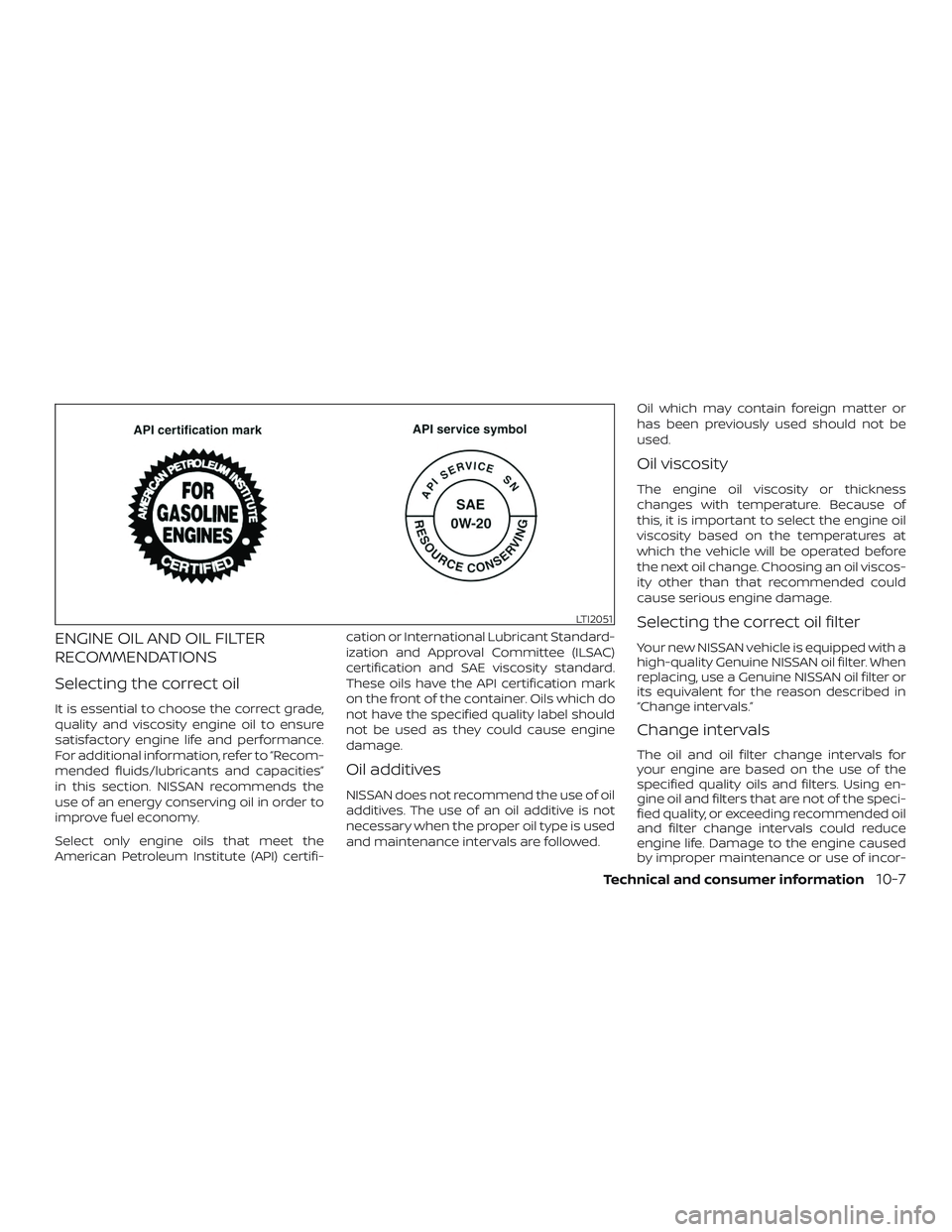
These oils have the API certification mark
on the front of the container. Oils which do
not have the specified quality label should
not be used as they could cause engine
damage.
Oil additives
NISSAN does not recommend the use of oil
additives. The use of an oil additive is not
necessary when the proper oil type is used
and maintenance intervals are followed.Oil which may contain foreign matter or
has been previously used should not be
used.
Oil viscosity
The engine oil viscosity or thickness
changes with temperature. Because of
this, it is important to select the engine oil
viscosity based on the temperatures at
which the vehicle will be operated before
the next oil change. Choosing an oil viscos-
ity other than that recommended could
cause serious engine damage.
Selecting the correct oil filter
Your new NISSAN vehicle is equipped with a
high-quality Genuine NISSAN oil filter. When
replacing, use a Genuine NISSAN oil filter or
its equivalent for the reason described in
“Change intervals.”
Change intervals
The oil and oil filter change intervals for
your engine are based on the use of the
specified quality oils and filters. Using en-
gine oil and filters that are not of the speci-
fied quality, or exceeding recommended oil
and filter change intervals could reduce
engine life. Damage to the engine caused
by improper maintenance or use of incor-
LTI2051
Technical and consumer information10-7
Page 482 of 507
rect oil and filter quality and/or viscosity is
not covered by the NISSAN New Vehicle
Limited Warranty.
Your engine was filled with a high-quality
engine oil when it was built. You do not have
to change the oil before the first recom-
mended change interval. Oil and filter
change intervals depend upon how you
use your vehicle.
Operation under the following conditions
may require more frequent oil and filter
changes:∙ repeated short distance driving at cold outside temperatures
∙ driving in dusty conditions
∙ extensive idling
∙ stop and go commuting
For additional information, refer to the
“Maintenance and schedules” section of
this manual.AIR CONDITIONER SYSTEM (if so
equipped) REFRIGERANT AND OIL
RECOMMENDATIONS
The air conditioner system in your
NISSAN vehicle must be charged with the
refrigerant HFC-134a (R-134a) and
NISSAN A/C system oil Type S (DH-PS) or
the exact equivalents.
CAUTION
The use of any other refrigerant or oil
may cause severe damage to the air
conditioning system and will require
the replacement of all air conditioner
system components.
The refrigerant HFC-134a (R-134a) in your
NISSAN vehicle does not harm the earth’s
ozone layer. Although this refrigerant does
not affect the earth’s atmosphere, certain
government regulations require the recov-
ery and recycling of any refrigerant during
automotive air conditioner system service.
A NISSAN dealer has the trained techni-
cians and equipment needed to recover
and recycle your air conditioner system re-
frigerant. It is recommended that you visit a NISSAN
dealer when servicing your air conditioner
system.
10-8Technical and consumer information
Page 499 of 507
E
E-CALL (SOS) SWITCH .............2-49
ECO mode switch ...............5-26
Economy - fuel .................5-70
Emergency engine shutoff ..........5-13
Emission control information label . . . .10-12
Emission control system warranty . . . .10-19
Engine Before starting the engine ........5-14
Capacities and recommended
fuel/lubricants...............10-2
Changing engine coolant .........8-6
Changing engine oil ............8-8
Changing engine oil filter .........8-10
Checking engine coolant level ......8-6
Checking engine oil level .........8-7
Engine compartment check
locations...................8-3
Engine coolant temperature gauge. . .2-7
Engine cooling system ..........8-5
Engine oil ...................8-7
Engine oil and oil filter
recommendation .............10-7
Engine oil pressure warning light ....2-15
Engine oil viscosity .............10-7
Engine serial number ..........10-12
Engine specifications ...........10-9
Starting the engine ............5-15
Engine Block Heater .............5-78
Engine coolant temperature gauge .....2-7
Enterbutton...................4-4
EventDatarecorders ............10-21
Exhaust gas (Carbon monoxide) .......5-2
Explanation of maintenance items .....9-2Explanation of scheduled maintenance
items .......................9-5
Extended storage switch
..........8-25
Eyeglasscase.................2-54
F
Flashers
(See hazard warning flasher switch) ....6-2
Flattire....................6-3,6-3
Floormatpositioningaid...........7-7
Fluid Brakefluid..................8-12
Capacities and recommended
fuel/lubricants...............10-2
Clutchfluid.................8-12
Continuously Variable Transmission (CVT)
fluid......................8-11
Engine coolant ...............8-5
Engine oil ...................8-7
F.M.V.S.S. certification label .........10-12
Foglightswitch................2-46
Front air bag system
(See supplemental restraint system) . . . .1-51
Front-door pocket ..............2-50
Front power seat adjustment ........1-5
Frontseats....................1-2
Fuel Capacities and recommended
fuel/lubricants...............10-2
Fuel economy ...............5-70
Fuel-filler cap ................3-28
Fuel-filler door lock opener lever ....3-27
Fuel-filler lid .................3-28
Fuel gauge ..................2-8 Fueloctanerating.............10-6
Fuel recommendation
..........10-4
Loose fuel cap warning .......2-6, 2-33
Fuelefficientdrivingtips...........5-68
Fuel-filler door .................3-27
Fuel gauge ....................2-8
Fuses.......................8-22
Fusiblelinks...................8-23
G
Gar
age door opener, HomeLink® Universal
Transceiver . .2-63, 2-64, 2-65, 2-66, 2-66, 2-67
Gascap.....................3-28
Gauge Engine coolant temperature gauge. . .2-7
Fuel gauge ..................2-8
Odometer ..................2-5
Speedometer ..............2-4,2-5
Tachometer .................2-7
Trip computer ................2-9
Trip odometer .............2-4, 2-5
General maintenance .............9-2
Glovebox................... .2-53
H
Hands-free phone system, Bluetooth® . .4-79
Hazardwarningflasherswitch........6-2
Headlight and turn signal switch ......2-41
Headlightcontrolswitch...........2-41
Headlights ...................8-29
Headrestraints..................1-7
Heatedseats..................2-47
11-3
Page 501 of 507
Passenger air bag and status light. . .1-54
Security indicator light..........2-21
Spotlights(Seemaplight)........2-61
Trunklight..................2-63
Warning/indicator lights and audible
reminders ...............2-19,3-21
Lights......................8-29 Maplights..................2-61
Lock Child safety rear door lock ........3-7
Door locks ..................3-5
Fuel-filler door lock opener lever ....3-27
Power door locks ..............3-6
Trunk lid lock opener lever ........3-26
Loose fuel cap warning .........2-6,2-33
Lowfuelwarninglight......2-16,2-18,2-33
Low tire pressure warning light .......2-16
Low windshield-washer fluid warning
light ....................2-18,2-34
Luggage
(See vehicle loading information) .....10-14
M
Maintenance General maintenance ...........9-2
Insidethevehicle..............9-3
Maintenance precautions .........8-2
Outsidethevehicle.............9-2
Seat belt maintenance ..........1-20
Under the hood and vehicle .......9-4
Maintenance log ................9-14
Maintenance requirements ..........9-2
Maintenance schedules ............9-7Maintenance under severe operation
conditions....................9-13
Malfunctionindicatorlight..........2-20
Manual front seat adjustment
........1-3
Maplights....................2-61
Map pocket ...................2-51
Meters and gauges ...............2-3
Instrument brightness control .....2-45
Mirror Automatic anti-glare inside mirror . . .3-32
Outsidemirrorcontrol..........3-33
Outsidemirrors..............3-33
Rearview...................3-32
Vanitymirror................3-31
Mirrors......................3-32
Mobile apps ...................4-74
Moonroof .................2-59,2-59
N
NissanConnect® ................4-74
NissanConnect® Services ..........4-75
NISSAN Intelligent Key® ..........3-2,3-11
NISSAN Intelligent Key® battery discharge
indicator.....................5-13
NISSAN Vehicle Immobilizer
System ...............2-38,5 -11, 5-14
O
Octane rating (See fuel octane rating) . .10-6
Odometer ....................2-5 Oil
Capacities and recommended
fuel/lubricants...............10-2
Changing engine oil ............8-8
Changing engine oil filter .........8-10
Checking engine oil level .........8-7
Engine oil ...................8-7
Engine oil and oil filter
recommendation .............10-7
Engine oil viscosity .............10-7
One shot call ..............4-83,4-94
Outsidemirrorcontrol............3-33
Outsidemirrors................3-33
Overhead sunglasses holder ........2-54
Overheat Ifyourvehicleoverheats.........6-11
Owner's manual order form ........10-22
Owner's manual/service manual order
information..................10-22
P
Parking Parking/parkingonhills.........5-70
Parkingbrake .................5-25
Phone, Bluetooth® hands-free system . .4-79
Power Power door locks ..............3-6
P
oweroutlet............... .2-49
Powerrearwindows ...........2-57
Power steering system ..........5-71
Powerwindows..............2-56
Rearpowerwindows...........2-57
Poweroutlet................. .2-49
Powersteering.................5-71
11-5