light NISSAN SENTRA 2023 Owners Manual
[x] Cancel search | Manufacturer: NISSAN, Model Year: 2023, Model line: SENTRA, Model: NISSAN SENTRA 2023Pages: 556, PDF Size: 6.11 MB
Page 504 of 556
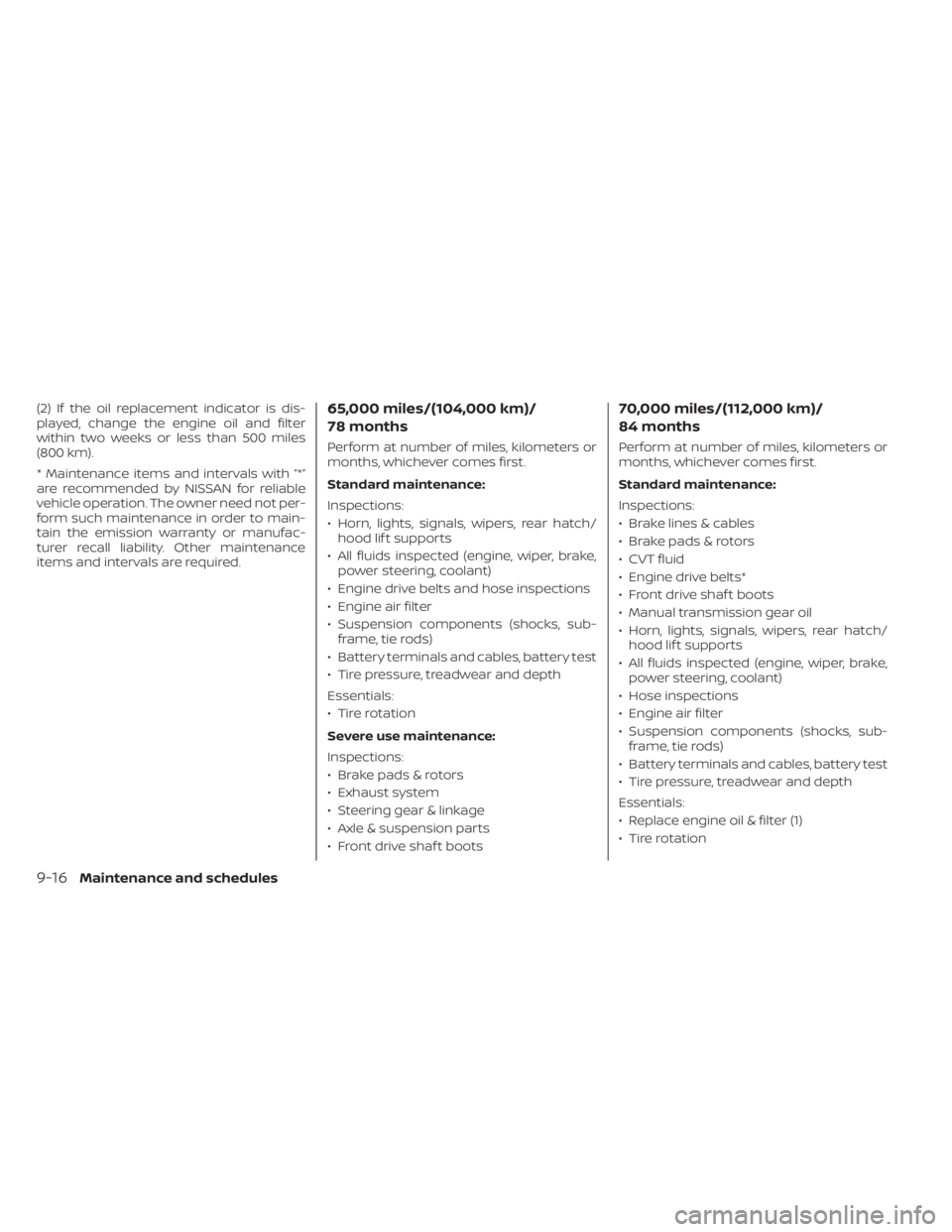
(2) If the oil replacement indicator is dis-
played, change the engine oil and filter
within two weeks or less than 500 miles
(800 km).
* Maintenance items and intervals with “*”
are recommended by NISSAN for reliable
vehicle operation. The owner need not per-
form such maintenance in order to main-
tain the emission warranty or manufac-
turer recall liability. Other maintenance
items and intervals are required.65,000 miles/(104,000 km)/
78 months
Perform at number of miles, kilometers or
months, whichever comes first.
Standard maintenance:
Inspections:
• Horn, lights, signals, wipers, rear hatch/hood lif t supports
• All fluids inspected (engine, wiper, brake, power steering, coolant)
• Engine drive belts and hose inspections
• Engine air filter
• Suspension components (shocks, sub- frame, tie rods)
• Battery terminals and cables, battery test
• Tire pressure, treadwear and depth
Essentials:
• Tire rotation
Severe use maintenance:
Inspections:
• Brake pads & rotors
• Exhaust system
• Steering gear & linkage
• Axle & suspension parts
• Front drive shaf t boots
70,000 miles/(112,000 km)/
84 months
Perform at number of miles, kilometers or
months, whichever comes first.
Standard maintenance:
Inspections:
• Brake lines & cables
• Brake pads & rotors
• CVT fluid
• Engine drive belts*
• Front drive shaf t boots
• Manual transmission gear oil
• Horn, lights, signals, wipers, rear hatch/ hood lif t supports
• All fluids inspected (engine, wiper, brake, power steering, coolant)
• Hose inspections
• Engine air filter
• Suspension components (shocks, sub- frame, tie rods)
• Battery terminals and cables, battery test
• Tire pressure, treadwear and depth
Essentials:
• Replace engine oil & filter (1)
• Tire rotation
9-16Maintenance and schedules
Page 505 of 556
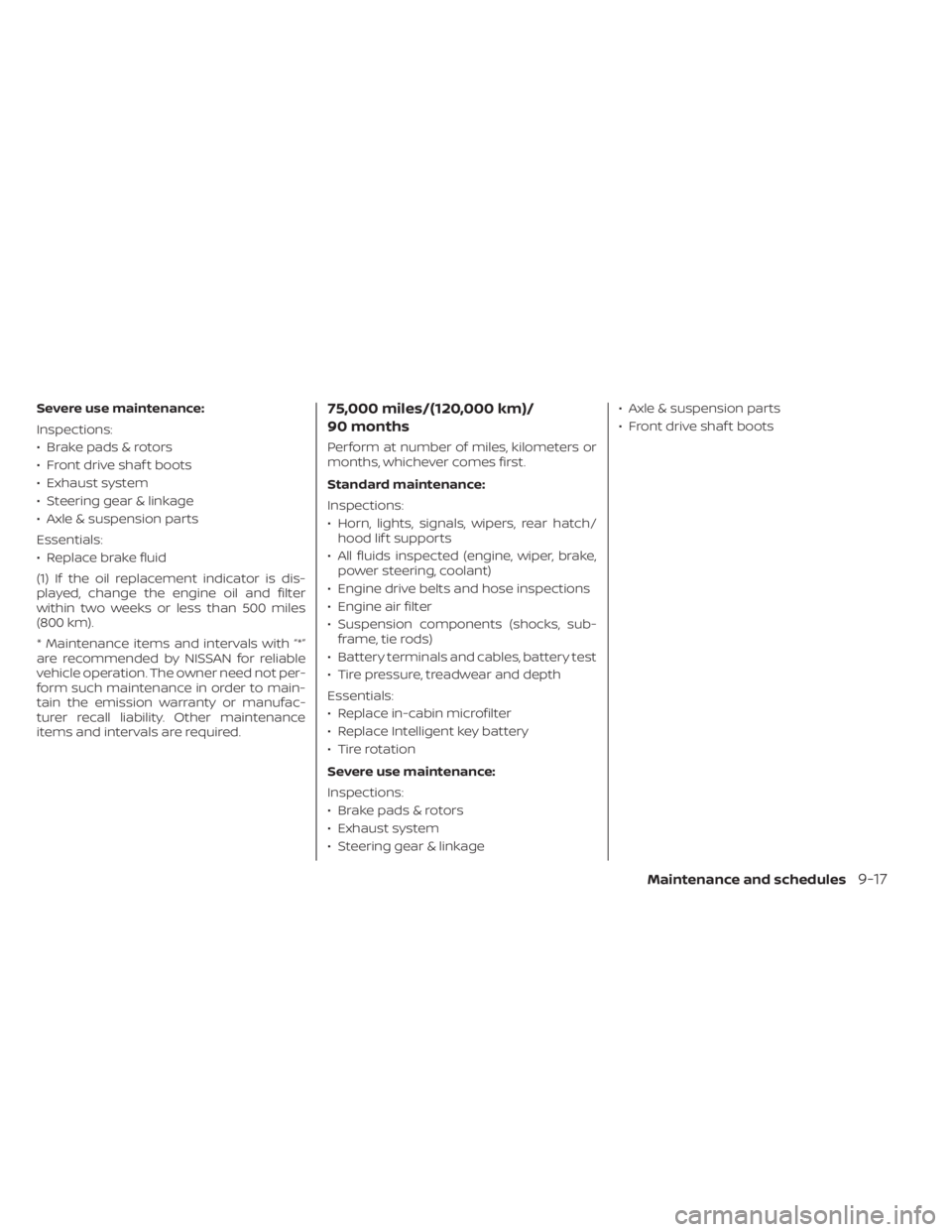
Severe use maintenance:
Inspections:
• Brake pads & rotors
• Front drive shaf t boots
• Exhaust system
• Steering gear & linkage
• Axle & suspension parts
Essentials:
• Replace brake fluid
(1) If the oil replacement indicator is dis-
played, change the engine oil and filter
within two weeks or less than 500 miles
(800 km).
* Maintenance items and intervals with “*”
are recommended by NISSAN for reliable
vehicle operation. The owner need not per-
form such maintenance in order to main-
tain the emission warranty or manufac-
turer recall liability. Other maintenance
items and intervals are required.75,000 miles/(120,000 km)/
90 months
Perform at number of miles, kilometers or
months, whichever comes first.
Standard maintenance:
Inspections:
• Horn, lights, signals, wipers, rear hatch/hood lif t supports
• All fluids inspected (engine, wiper, brake, power steering, coolant)
• Engine drive belts and hose inspections
• Engine air filter
• Suspension components (shocks, sub- frame, tie rods)
• Battery terminals and cables, battery test
• Tire pressure, treadwear and depth
Essentials:
• Replace in-cabin microfilter
• Replace Intelligent key battery
• Tire rotation
Severe use maintenance:
Inspections:
• Brake pads & rotors
• Exhaust system
• Steering gear & linkage • Axle & suspension parts
• Front drive shaf t boots
Maintenance and schedules9-17
Page 506 of 556
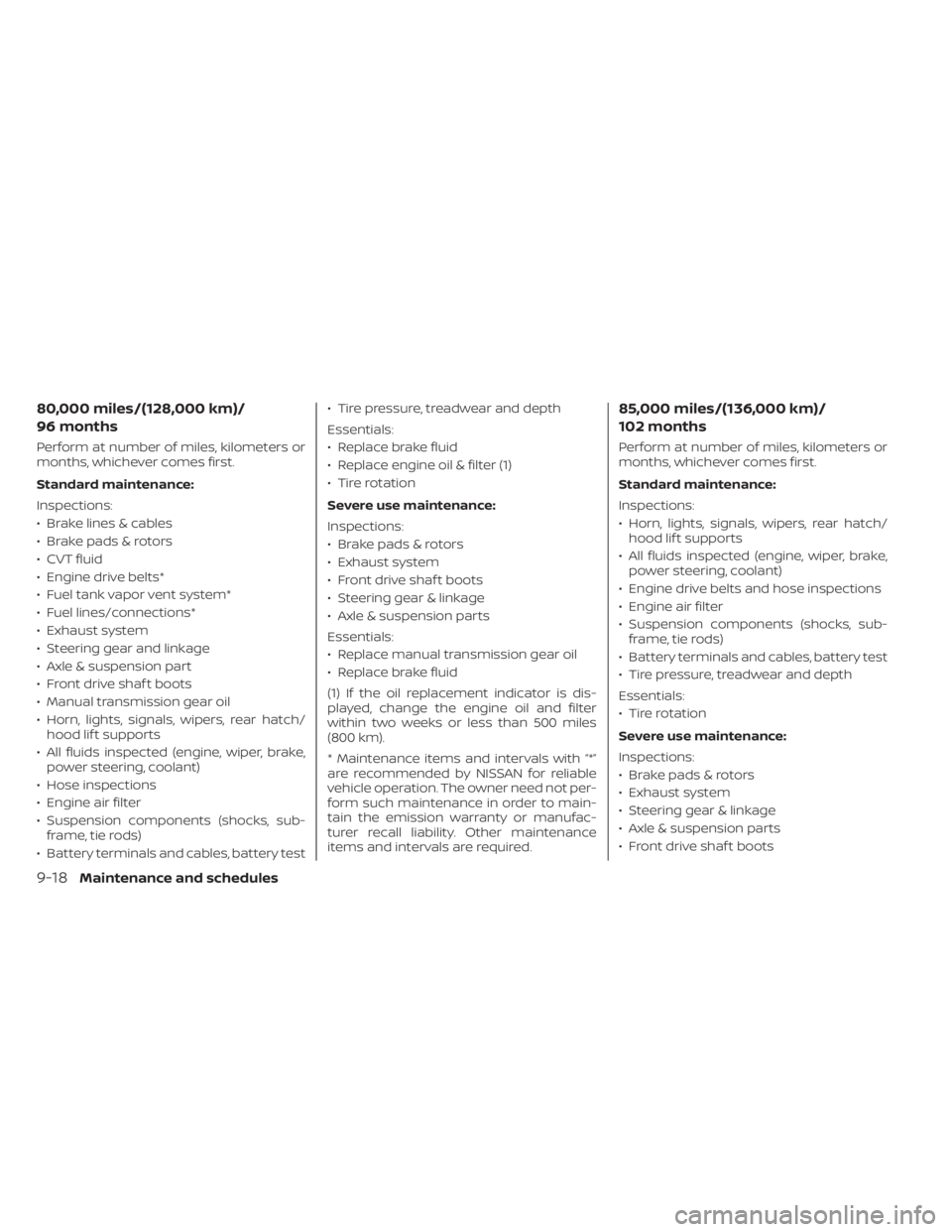
80,000 miles/(128,000 km)/
96 months
Perform at number of miles, kilometers or
months, whichever comes first.
Standard maintenance:
Inspections:
• Brake lines & cables
• Brake pads & rotors
• CVT fluid
• Engine drive belts*
• Fuel tank vapor vent system*
• Fuel lines/connections*
• Exhaust system
• Steering gear and linkage
• Axle & suspension part
• Front drive shaf t boots
• Manual transmission gear oil
• Horn, lights, signals, wipers, rear hatch/hood lif t supports
• All fluids inspected (engine, wiper, brake, power steering, coolant)
• Hose inspections
• Engine air filter
• Suspension components (shocks, sub- frame, tie rods)
• Battery terminals and cables, battery test • Tire pressure, treadwear and depth
Essentials:
• Replace brake fluid
• Replace engine oil & filter (1)
• Tire rotation
Severe use maintenance:
Inspections:
• Brake pads & rotors
• Exhaust system
• Front drive shaf t boots
• Steering gear & linkage
• Axle & suspension parts
Essentials:
• Replace manual transmission gear oil
• Replace brake fluid
(1) If the oil replacement indicator is dis-
played, change the engine oil and filter
within two weeks or less than 500 miles
(800 km).
* Maintenance items and intervals with “*”
are recommended by NISSAN for reliable
vehicle operation. The owner need not per-
form such maintenance in order to main-
tain the emission warranty or manufac-
turer recall liability. Other maintenance
items and intervals are required.
85,000 miles/(136,000 km)/
102 months
Perform at number of miles, kilometers or
months, whichever comes first.
Standard maintenance:
Inspections:
• Horn, lights, signals, wipers, rear hatch/
hood lif t supports
• All fluids inspected (engine, wiper, brake, power steering, coolant)
• Engine drive belts and hose inspections
• Engine air filter
• Suspension components (shocks, sub- frame, tie rods)
• Battery terminals and cables, battery test
• Tire pressure, treadwear and depth
Essentials:
• Tire rotation
Severe use maintenance:
Inspections:
• Brake pads & rotors
• Exhaust system
• Steering gear & linkage
• Axle & suspension parts
• Front drive shaf t boots
9-18Maintenance and schedules
Page 507 of 556
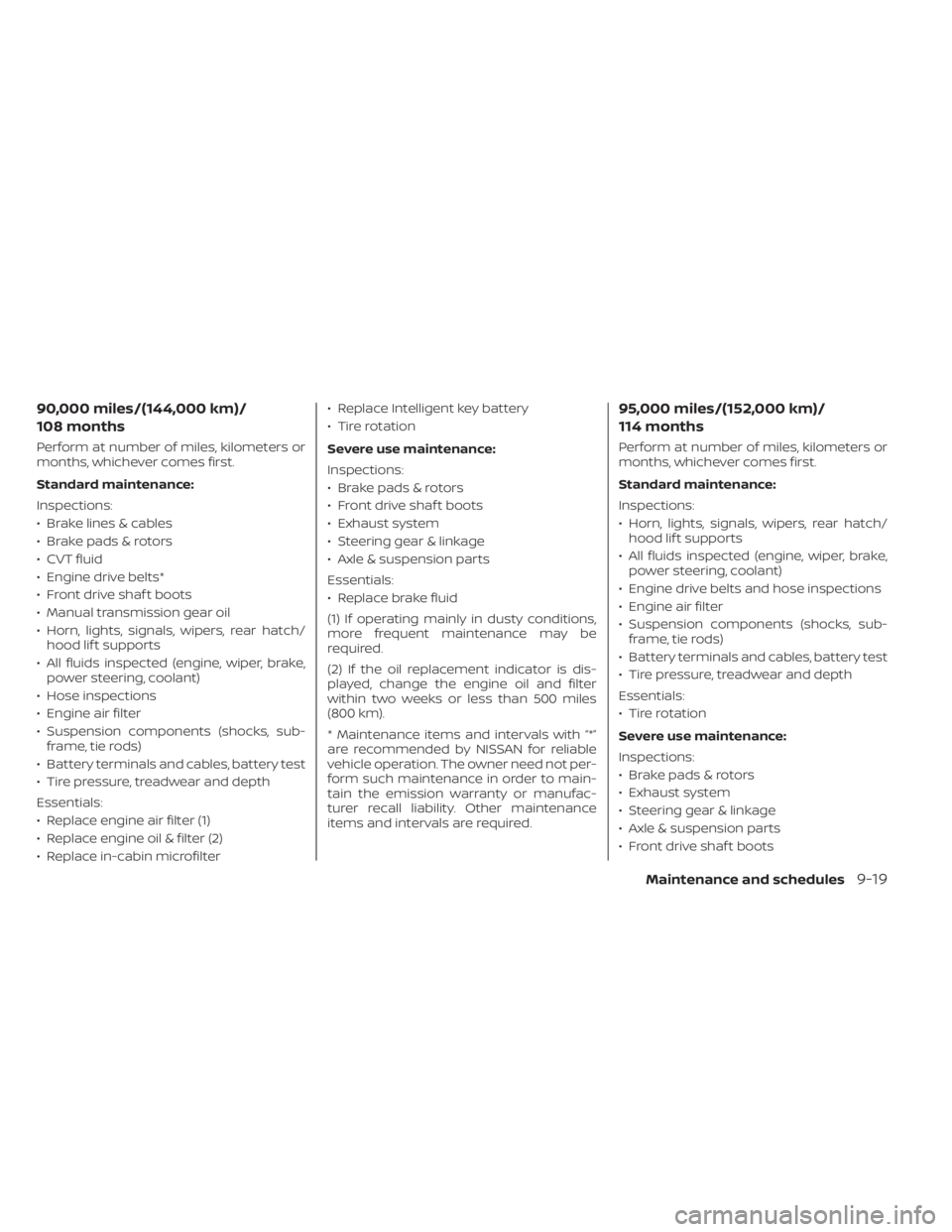
90,000 miles/(144,000 km)/
108 months
Perform at number of miles, kilometers or
months, whichever comes first.
Standard maintenance:
Inspections:
• Brake lines & cables
• Brake pads & rotors
• CVT fluid
• Engine drive belts*
• Front drive shaf t boots
• Manual transmission gear oil
• Horn, lights, signals, wipers, rear hatch/hood lif t supports
• All fluids inspected (engine, wiper, brake, power steering, coolant)
• Hose inspections
• Engine air filter
• Suspension components (shocks, sub- frame, tie rods)
• Battery terminals and cables, battery test
• Tire pressure, treadwear and depth
Essentials:
• Replace engine air filter (1)
• Replace engine oil & filter (2)
• Replace in-cabin microfilter • Replace Intelligent key battery
• Tire rotation
Severe use maintenance:
Inspections:
• Brake pads & rotors
• Front drive shaf t boots
• Exhaust system
• Steering gear & linkage
• Axle & suspension parts
Essentials:
• Replace brake fluid
(1) If operating mainly in dusty conditions,
more frequent maintenance may be
required.
(2) If the oil replacement indicator is dis-
played, change the engine oil and filter
within two weeks or less than 500 miles
(800 km).
* Maintenance items and intervals with “*”
are recommended by NISSAN for reliable
vehicle operation. The owner need not per-
form such maintenance in order to main-
tain the emission warranty or manufac-
turer recall liability. Other maintenance
items and intervals are required.
95,000 miles/(152,000 km)/
114 months
Perform at number of miles, kilometers or
months, whichever comes first.
Standard maintenance:
Inspections:
• Horn, lights, signals, wipers, rear hatch/
hood lif t supports
• All fluids inspected (engine, wiper, brake, power steering, coolant)
• Engine drive belts and hose inspections
• Engine air filter
• Suspension components (shocks, sub- frame, tie rods)
• Battery terminals and cables, battery test
• Tire pressure, treadwear and depth
Essentials:
• Tire rotation
Severe use maintenance:
Inspections:
• Brake pads & rotors
• Exhaust system
• Steering gear & linkage
• Axle & suspension parts
• Front drive shaf t boots
Maintenance and schedules9-19
Page 508 of 556
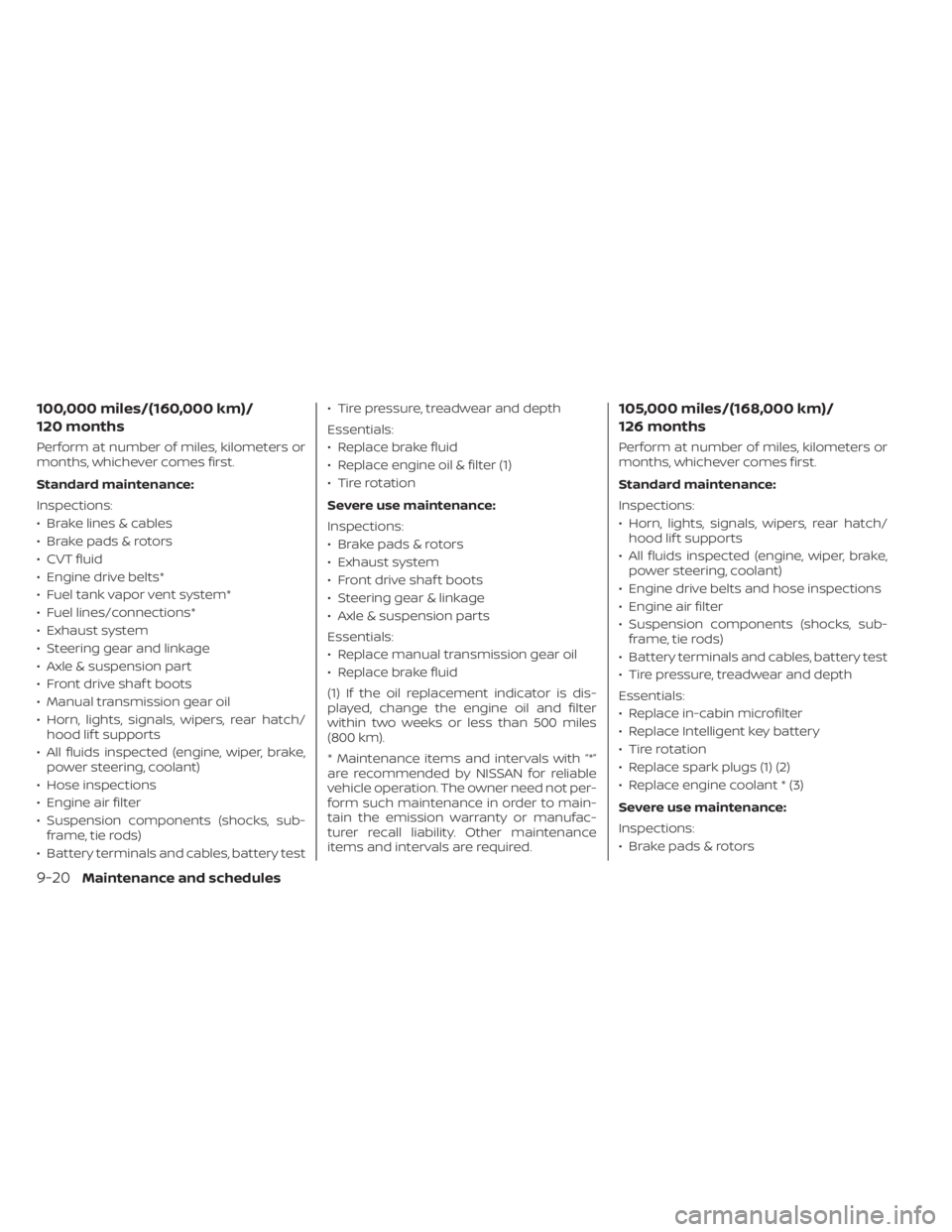
100,000 miles/(160,000 km)/
120 months
Perform at number of miles, kilometers or
months, whichever comes first.
Standard maintenance:
Inspections:
• Brake lines & cables
• Brake pads & rotors
• CVT fluid
• Engine drive belts*
• Fuel tank vapor vent system*
• Fuel lines/connections*
• Exhaust system
• Steering gear and linkage
• Axle & suspension part
• Front drive shaf t boots
• Manual transmission gear oil
• Horn, lights, signals, wipers, rear hatch/hood lif t supports
• All fluids inspected (engine, wiper, brake, power steering, coolant)
• Hose inspections
• Engine air filter
• Suspension components (shocks, sub- frame, tie rods)
• Battery terminals and cables, battery test • Tire pressure, treadwear and depth
Essentials:
• Replace brake fluid
• Replace engine oil & filter (1)
• Tire rotation
Severe use maintenance:
Inspections:
• Brake pads & rotors
• Exhaust system
• Front drive shaf t boots
• Steering gear & linkage
• Axle & suspension parts
Essentials:
• Replace manual transmission gear oil
• Replace brake fluid
(1) If the oil replacement indicator is dis-
played, change the engine oil and filter
within two weeks or less than 500 miles
(800 km).
* Maintenance items and intervals with “*”
are recommended by NISSAN for reliable
vehicle operation. The owner need not per-
form such maintenance in order to main-
tain the emission warranty or manufac-
turer recall liability. Other maintenance
items and intervals are required.
105,000 miles/(168,000 km)/
126 months
Perform at number of miles, kilometers or
months, whichever comes first.
Standard maintenance:
Inspections:
• Horn, lights, signals, wipers, rear hatch/
hood lif t supports
• All fluids inspected (engine, wiper, brake, power steering, coolant)
• Engine drive belts and hose inspections
• Engine air filter
• Suspension components (shocks, sub- frame, tie rods)
• Battery terminals and cables, battery test
• Tire pressure, treadwear and depth
Essentials:
• Replace in-cabin microfilter
• Replace Intelligent key battery
• Tire rotation
• Replace spark plugs (1) (2)
• Replace engine coolant * (3)
Severe use maintenance:
Inspections:
• Brake pads & rotors
9-20Maintenance and schedules
Page 509 of 556
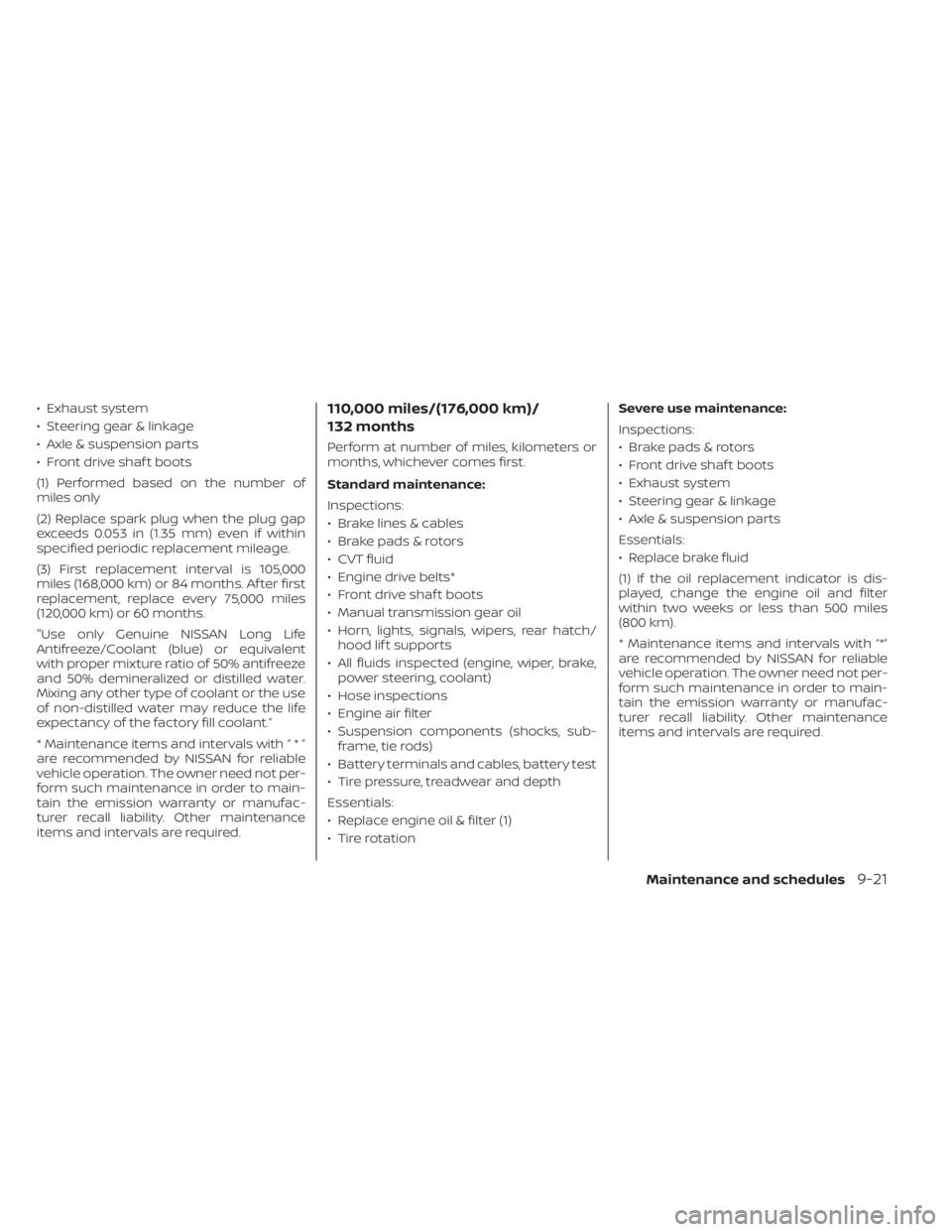
• Exhaust system
• Steering gear & linkage
• Axle & suspension parts
• Front drive shaf t boots
(1) Performed based on the number of
miles only
(2) Replace spark plug when the plug gap
exceeds 0.053 in (1.35 mm) even if within
specified periodic replacement mileage.
(3) First replacement interval is 105,000
miles (168,000 km) or 84 months. Af ter first
replacement, replace every 75,000 miles
(120,000 km) or 60 months.
"Use only Genuine NISSAN Long Life
Antifreeze/Coolant (blue) or equivalent
with proper mixture ratio of 50% antifreeze
and 50% demineralized or distilled water.
Mixing any other type of coolant or the use
of non-distilled water may reduce the life
expectancy of the factory fill coolant.”
* Maintenance items and intervals with“*”
are recommended by NISSAN for reliable
vehicle operation. The owner need not per-
form such maintenance in order to main-
tain the emission warranty or manufac-
turer recall liability. Other maintenance
items and intervals are required.110,000 miles/(176,000 km)/
132 months
Perform at number of miles, kilometers or
months, whichever comes first.
Standard maintenance:
Inspections:
• Brake lines & cables
• Brake pads & rotors
• CVT fluid
• Engine drive belts*
• Front drive shaf t boots
• Manual transmission gear oil
• Horn, lights, signals, wipers, rear hatch/hood lif t supports
• All fluids inspected (engine, wiper, brake, power steering, coolant)
• Hose inspections
• Engine air filter
• Suspension components (shocks, sub- frame, tie rods)
• Battery terminals and cables, battery test
• Tire pressure, treadwear and depth
Essentials:
• Replace engine oil & filter (1)
• Tire rotation Severe use maintenance:
Inspections:
• Brake pads & rotors
• Front drive shaf t boots
• Exhaust system
• Steering gear & linkage
• Axle & suspension parts
Essentials:
• Replace brake fluid
(1) If the oil replacement indicator is dis-
played, change the engine oil and filter
within two weeks or less than 500 miles
(800 km).
* Maintenance items and intervals with “*”
are recommended by NISSAN for reliable
vehicle operation. The owner need not per-
form such maintenance in order to main-
tain the emission warranty or manufac-
turer recall liability. Other maintenance
items and intervals are required.
Maintenance and schedules9-21
Page 510 of 556
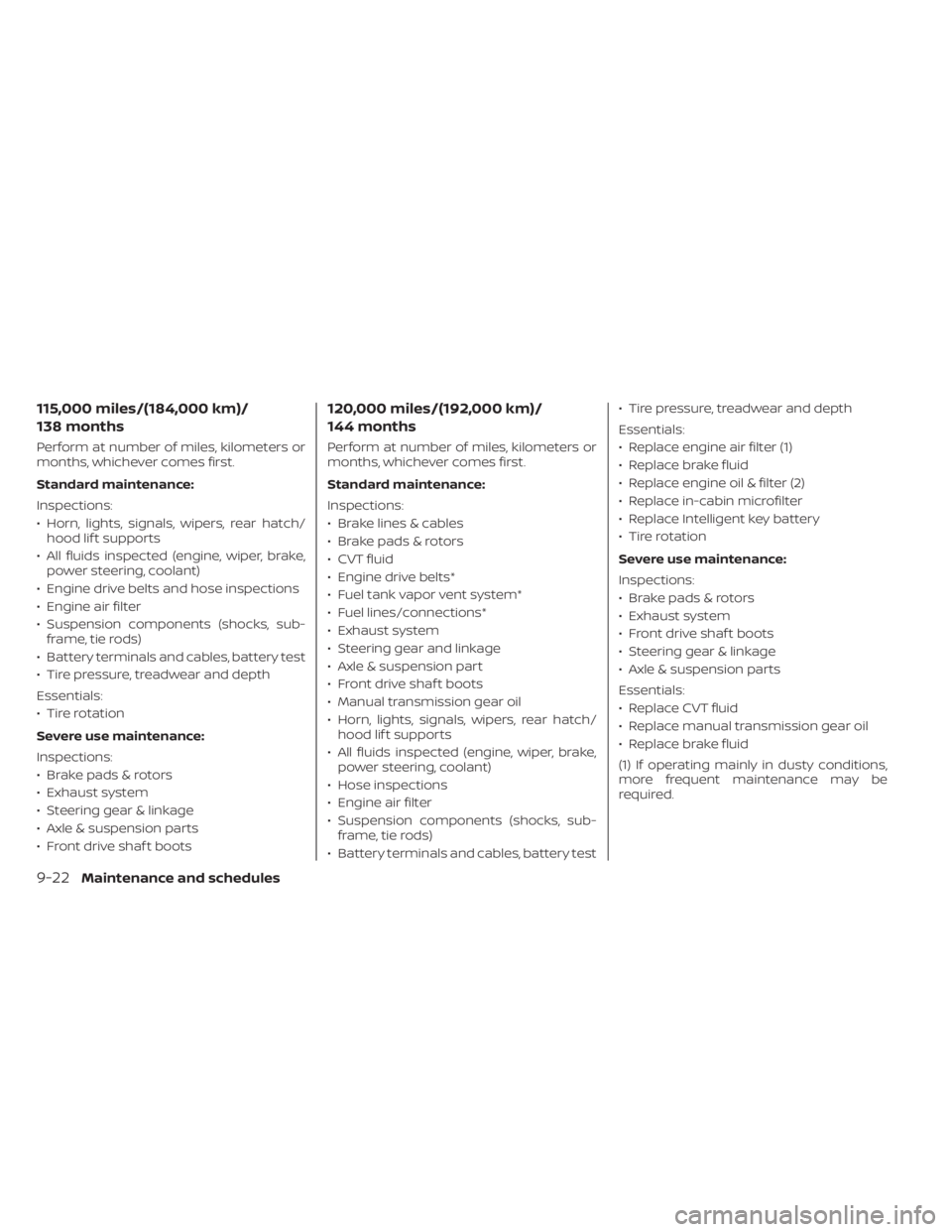
115,000 miles/(184,000 km)/
138 months
Perform at number of miles, kilometers or
months, whichever comes first.
Standard maintenance:
Inspections:
• Horn, lights, signals, wipers, rear hatch/hood lif t supports
• All fluids inspected (engine, wiper, brake, power steering, coolant)
• Engine drive belts and hose inspections
• Engine air filter
• Suspension components (shocks, sub- frame, tie rods)
• Battery terminals and cables, battery test
• Tire pressure, treadwear and depth
Essentials:
• Tire rotation
Severe use maintenance:
Inspections:
• Brake pads & rotors
• Exhaust system
• Steering gear & linkage
• Axle & suspension parts
• Front drive shaf t boots
120,000 miles/(192,000 km)/
144 months
Perform at number of miles, kilometers or
months, whichever comes first.
Standard maintenance:
Inspections:
• Brake lines & cables
• Brake pads & rotors
• CVT fluid
• Engine drive belts*
• Fuel tank vapor vent system*
• Fuel lines/connections*
• Exhaust system
• Steering gear and linkage
• Axle & suspension part
• Front drive shaf t boots
• Manual transmission gear oil
• Horn, lights, signals, wipers, rear hatch/ hood lif t supports
• All fluids inspected (engine, wiper, brake, power steering, coolant)
• Hose inspections
• Engine air filter
• Suspension components (shocks, sub- frame, tie rods)
• Battery terminals and cables, battery test • Tire pressure, treadwear and depth
Essentials:
• Replace engine air filter (1)
• Replace brake fluid
• Replace engine oil & filter (2)
• Replace in-cabin microfilter
• Replace Intelligent key battery
• Tire rotation
Severe use maintenance:
Inspections:
• Brake pads & rotors
• Exhaust system
• Front drive shaf t boots
• Steering gear & linkage
• Axle & suspension parts
Essentials:
• Replace CVT fluid
• Replace manual transmission gear oil
• Replace brake fluid
(1) If operating mainly in dusty conditions,
more frequent maintenance may be
required.
9-22Maintenance and schedules
Page 514 of 556
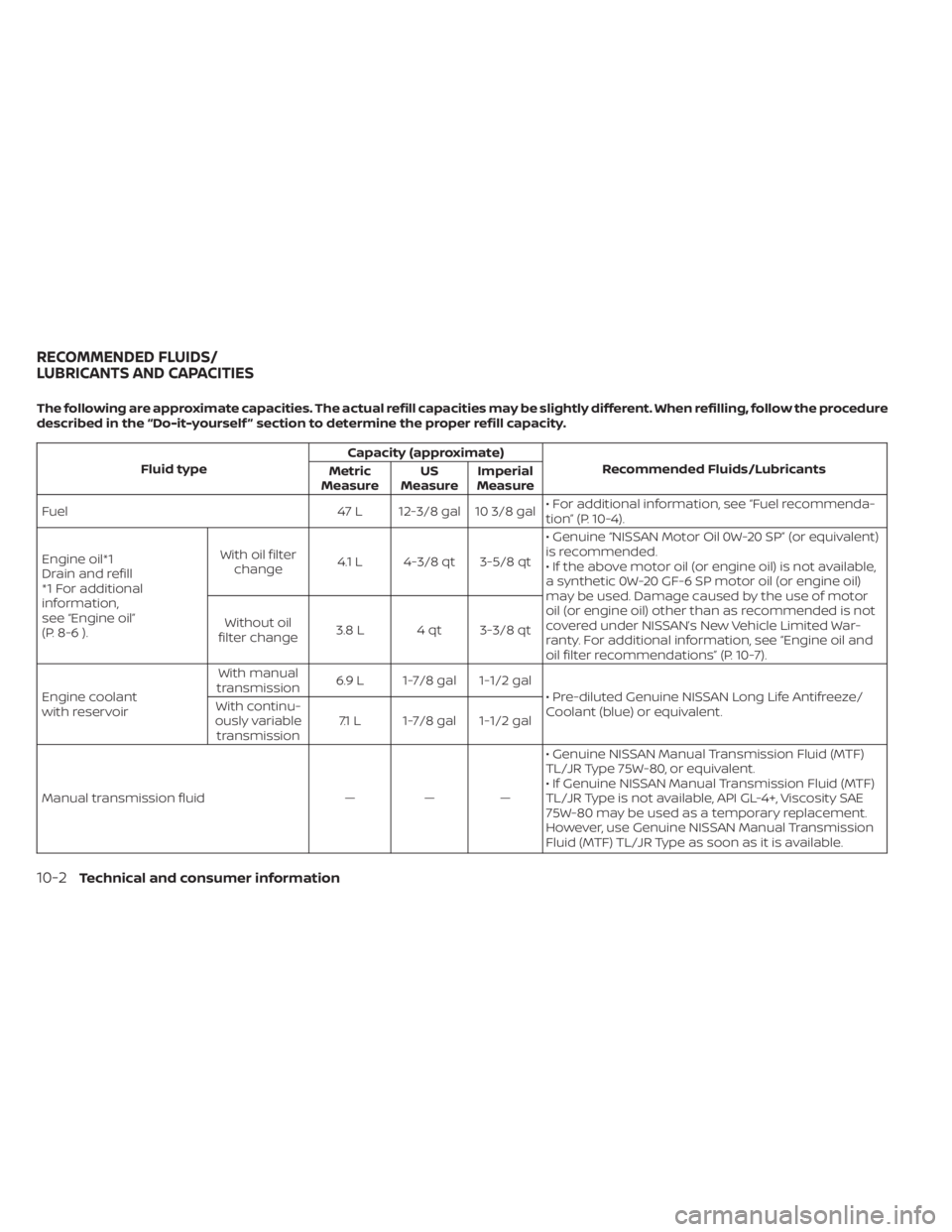
The following are approximate capacities. The actual refill capacities may be slightly different. When refilling, follow the procedure
described in the “Do-it-yourself ” section to determine the proper refill capacity.
Fluid typeCapacity (approximate)
Recommended Fluids/Lubricants
Metric
Measure US
Measure Imperial
Measure
Fuel 47 L 12-3/8 gal 10 3/8 gal• For additional information, see “Fuel recommenda-
tion” (P. 10-4).
Engine oil*1
Drain and refill
*1 For additional
information,
see “Engine oil”
(P. 8-6 ). With oil filter
change 4.1 L 4-3/8 qt 3-5/8 qt • Genuine “NISSAN Motor Oil 0W-20 SP” (or equivalent)
is recommended.
• If the above motor oil (or engine oil) is not available,
a synthetic 0W-20 GF-6 SP motor oil (or engine oil)
may be used. Damage caused by the use of motor
oil (or engine oil) other than as recommended is not
covered under NISSAN’s New Vehicle Limited War-
ranty. For additional information, see “Engine oil and
oil filter recommendations” (P. 10-7).
Without oil
filter change 3.8 L 4 qt 3-3/8 qt
Engine coolant
with reservoir With manual
transmission 6.9 L 1-7/8 gal 1-1/2 gal
• Pre-diluted Genuine NISSAN Long Life Antifreeze/
Coolant (blue) or equivalent.
With continu-
ously variable transmission 7.1 L 1-7/8 gal 1-1/2 gal
Manual transmission fluid —— — • Genuine NISSAN Manual Transmission Fluid (MTF)
TL/JR Type 75W-80, or equivalent.
• If Genuine NISSAN Manual Transmission Fluid (MTF)
TL/JR Type is not available, API GL-4+, Viscosity SAE
75W-80 may be used as a temporary replacement.
However, use Genuine NISSAN Manual Transmission
Fluid (MTF) TL/JR Type as soon as it is available.
RECOMMENDED FLUIDS/
LUBRICANTS AND CAPACITIES
10-2Technical and consumer information
Page 518 of 556
Af termarket fuel additives
NISSAN does not recommend the use of
any af termarket fuel additives (for ex-
ample, fuel injector cleaner, octane
booster, intake valve deposit removers,
etc.) which are sold commercially. Many of
these additives intended for gum, varnish
or deposit removal may contain active sol-
vents or similar ingredients that can be
harmful to the fuel system and engine.
Octane rating tips
Using unleaded gasoline with an octane
rating lower than recommended can
cause persistent, heavy “spark knock.”
(“Spark knock” is a metallic rapping
noise.) If severe, this can lead to engine
damage. If you detect a persistent heavy
spark knock even when using gasoline
of the stated octane rating, or if you hear
steady spark knock while holding a
steady speed on level roads, it is recom-
mended that you have a NISSAN dealer
correct the condition. Failure to correct
the condition is misuse of the vehicle, for
which NISSAN is not responsible.Incorrect ignition timing may result in
spark knock, af ter-run and/or overheating,
which may cause excessive fuel consump-
tion or engine damage. If any of the above
symptoms are encountered, have your ve-
hicle checked. It is recommended that you
visit a NISSAN dealer for servicing.
However, now and then you may notice
light spark knock for a short time while
accelerating or driving up hills. This is not
a cause for concern, because you get the
greatest fuel benefit when there is light
spark knock for a short time under heavy
engine load.
10-6Technical and consumer information
Page 536 of 556
Due to legal requirements in some states
and Canadian Provinces, your vehicle may
be required to be in what is called the
“ready condition” for an Inspection/
Maintenance (I/M) test of the emission
control system.
The vehicle is set to the “ready condition”
when it is driven through certain driving
patterns. Usually, the ready condition can
be obtained by ordinary usage of the
vehicle.
If a powertrain system component is re-
paired or the battery is disconnected, the
vehicle may be reset to a “not ready” condi-
tion. Before taking the I/M test, check the
vehicle's inspection/maintenance test
readiness condition. Place the ignition
switch in the ON position without starting
the engine. If the Malfunction Indicator
Light (MIL) comes on steady for 20 seconds
and then blinks for 10 seconds , the I/M test
condition is “not ready”. If the MIL does not
blink af ter 20 seconds, the I/M test condi-
tion is “ready”. It is recommended that you
visit a NISSAN dealer to set the “ready con-
dition” or to prepare the vehicle for testing.This vehicle is equipped with an Event Data
Recorder (EDR). The main purpose of an
EDR is to record, in certain crash or near
crash-like situations, such as an air bag
deployment or hitting a road obstacle, data
that will assist in understanding how a ve-
hicle's systems performed. The EDR is de-
signed to record data related to vehicle dy-
namics and safety systems for a short
period of time, typically 30 seconds or less.
The EDR in this vehicle is designed to re-
cord such data as:
• How various systems in your vehicle were
operating;
• Whether or not the driver and passenger safety belts were buckled/fastened;
• How far (if at all) the driver was depress- ing the accelerator and/or brake pedal;
and,
• How fast the vehicle was traveling.
• Sounds are not recorded. These data can help provide a better un-
derstanding of the circumstances in which
crashes and injuries occur. NOTE: EDR data
are recorded by your vehicle only if a non-
trivial crash situation occurs; no data are
recorded by the EDR under normal driving
conditions and no personal data (e.g.,
name, gender, age, and crash location) are
recorded. However, other parties, such as
law enforcement, could combine the EDR
data with the type of personally identif ying
data routinely acquired during a crash
investigation.
To read data recorded by an EDR, special
equipment is required, and access to the
vehicle or the EDR is needed. In addition to
the vehicle manufacturer and NISSAN
dealer, other parties, such as law enforce-
ment, that have the special equipment, can
read the information if they have access to
the vehicle or the EDR.
EDR data will only be accessed with the
consent of the vehicle owner or lessee or
as otherwise required or permitted by law.
READINESS FOR INSPECTION/
MAINTENANCE (I/M) TEST
EVENT DATA RECORDERS (EDR)
10-24Technical and consumer information