towing NISSAN SENTRA 2023 User Guide
[x] Cancel search | Manufacturer: NISSAN, Model Year: 2023, Model line: SENTRA, Model: NISSAN SENTRA 2023Pages: 556, PDF Size: 6.11 MB
Page 433 of 556
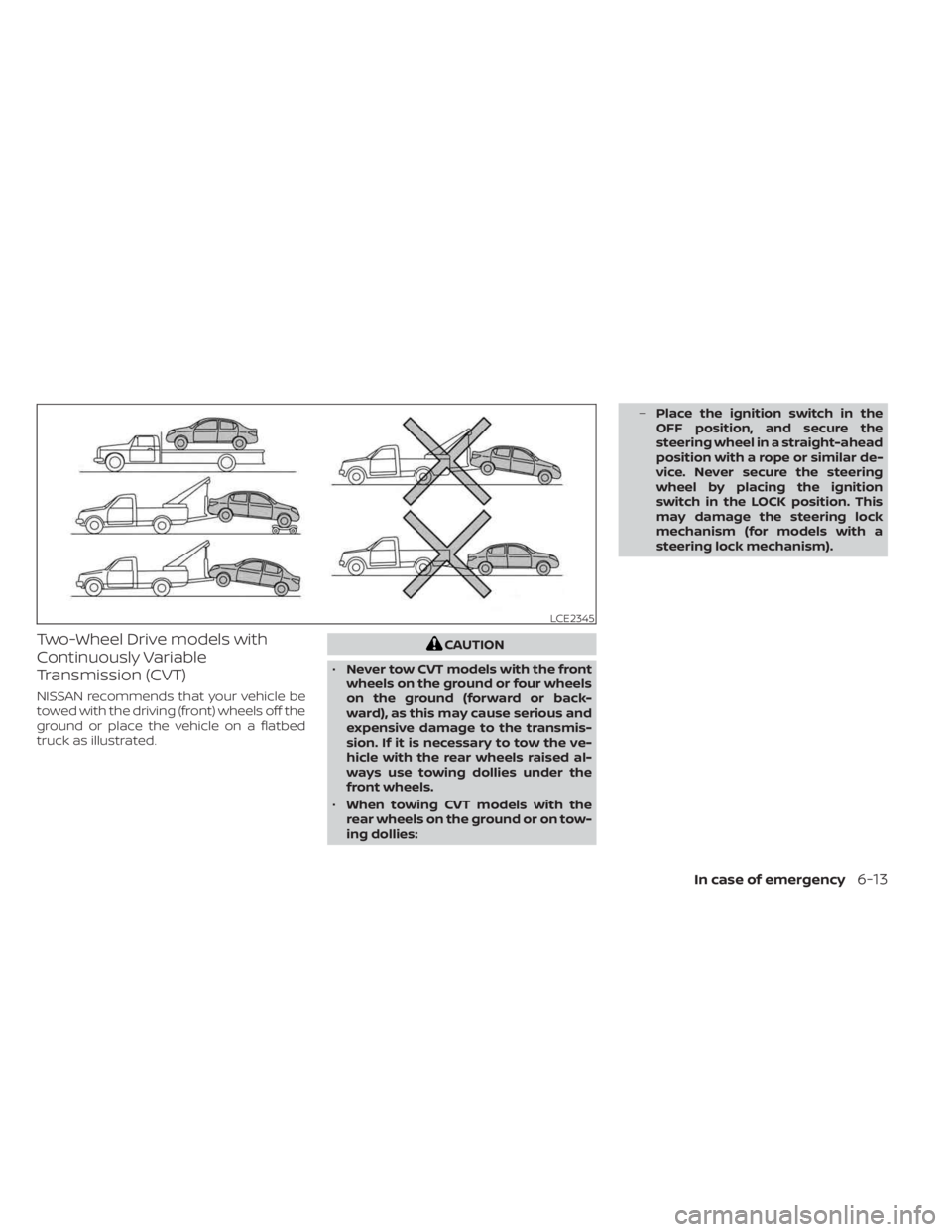
Two-Wheel Drive models with
Continuously Variable
Transmission (CVT)
NISSAN recommends that your vehicle be
towed with the driving (front) wheels off the
ground or place the vehicle on a flatbed
truck as illustrated.
CAUTION
• Never tow CVT models with the front
wheels on the ground or four wheels
on the ground (forward or back-
ward), as this may cause serious and
expensive damage to the transmis-
sion. If it is necessary to tow the ve-
hicle with the rear wheels raised al-
ways use towing dollies under the
front wheels.
• When towing CVT models with the
rear wheels on the ground or on tow-
ing dollies: –
Place the ignition switch in the
OFF position, and secure the
steering wheel in a straight-ahead
position with a rope or similar de-
vice. Never secure the steering
wheel by placing the ignition
switch in the LOCK position. This
may damage the steering lock
mechanism (for models with a
steering lock mechanism).
LCE2345
In case of emergency6-13
Page 434 of 556
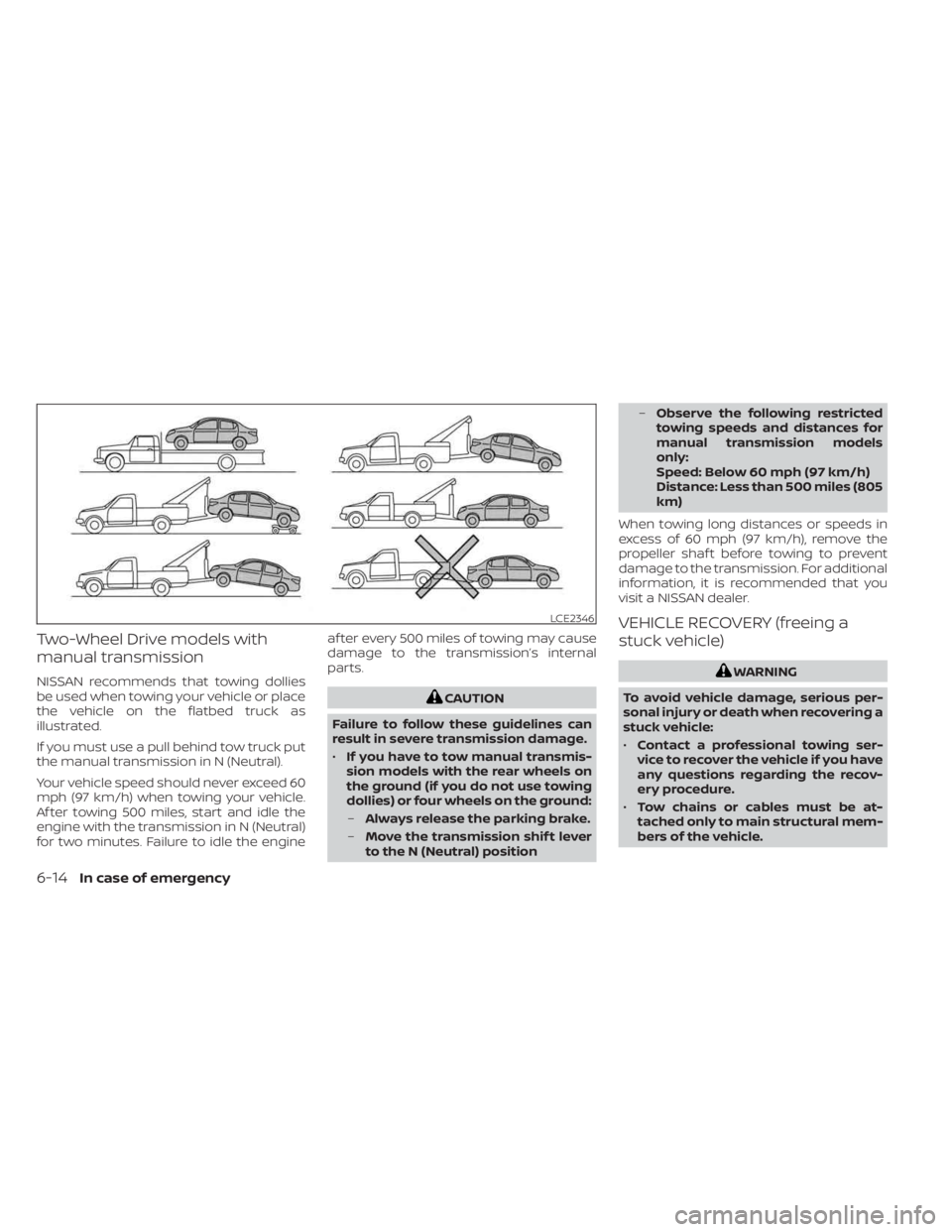
Two-Wheel Drive models with
manual transmission
NISSAN recommends that towing dollies
be used when towing your vehicle or place
the vehicle on the flatbed truck as
illustrated.
If you must use a pull behind tow truck put
the manual transmission in N (Neutral).
Your vehicle speed should never exceed 60
mph (97 km/h) when towing your vehicle.
Af ter towing 500 miles, start and idle the
engine with the transmission in N (Neutral)
for two minutes. Failure to idle the engineaf ter every 500 miles of towing may cause
damage to the transmission’s internal
parts.
CAUTION
Failure to follow these guidelines can
result in severe transmission damage.
• If you have to tow manual transmis-
sion models with the rear wheels on
the ground (if you do not use towing
dollies) or four wheels on the ground:
– Always release the parking brake.
– Move the transmission shif t lever
to the N (Neutral) position –
Observe the following restricted
towing speeds and distances for
manual transmission models
only:
Speed: Below 60 mph (97 km/h)
Distance: Less than 500 miles (805
km)
When towing long distances or speeds in
excess of 60 mph (97 km/h), remove the
propeller shaf t before towing to prevent
damage to the transmission. For additional
information, it is recommended that you
visit a NISSAN dealer.
VEHICLE RECOVERY (freeing a
stuck vehicle)
WARNING
To avoid vehicle damage, serious per-
sonal injury or death when recovering a
stuck vehicle:
• Contact a professional towing ser-
vice to recover the vehicle if you have
any questions regarding the recov-
ery procedure.
• Tow chains or cables must be at-
tached only to main structural mem-
bers of the vehicle.
LCE2346
6-14In case of emergency
Page 435 of 556
•Do not use the vehicle tie-downs to
tow or free a stuck vehicle.
• Only use devices specifically de-
signed for vehicle recovery and fol-
low the manufacturer's instructions.
• Always pull the recovery device
straight out from the front of the ve-
hicle. Never pull at an angle.
• Route recovery devices so they do
not touch any part of the vehicle ex-
cept the attachment point.
If your vehicle is stuck in sand, snow, mud,
etc., use a tow strap or other device de-
signed specifically for vehicle recovery. Al-
ways follow the manufacturer's instruc-
tions for the recovery device.
Rocking a stuck vehicle
WARNING
• Stand clear of a stuck vehicle.
• Do not spin your tires at high speed.
This could cause them to explode
and result in serious injury. Parts of
your vehicle could also overheat and
be damaged. If your vehicle is stuck in sand, snow, mud,
etc., use the following procedure:
1. Turn off the Vehicle Dynamic Control
(VDC) System.
2. Make sure the area in front and behind the vehicle is clear of obstructions.
3. Turn the steering wheel right and lef t to clear an area around the front tires.
4. Slowly rock the vehicle forward and backward.
• Shif t back and forth between R (Re- verse) and D (Drive) (Continuously Vari-
able Transmission models) or 1st (Low)
and R (Reverse) (manual transmission
models).
• Apply the accelerator as little as pos- sible to maintain the rocking motion.
• Release the accelerator pedal before shif ting between R (Reverse) and D
(Drive) (Continuously Variable Trans-
mission models) or 1st (Low) and R (Re-
verse) (manual transmission models).
• Do not spin the tires above 35 mph (55 km/h). 5. If the vehicle cannot be freed af ter a few
tries, contact a professional towing ser-
vice to remove the vehicle.
In case of emergency6-15
Page 496 of 556
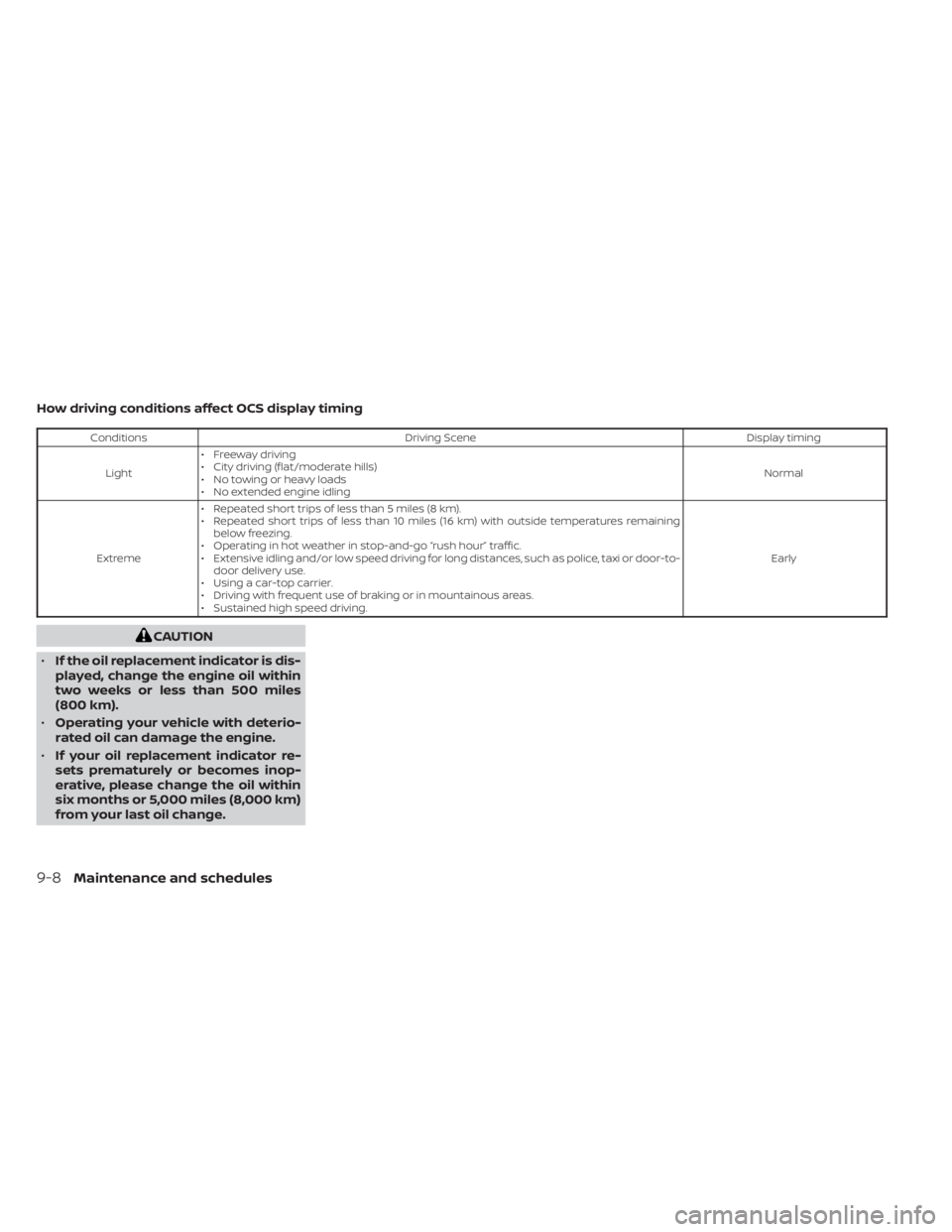
How driving conditions affect OCS display timing
ConditionsDriving Scene Display timing
Light • Freeway driving
• City driving (flat/moderate hills)
• No towing or heavy loads
• No extended engine idling Normal
Extreme • Repeated short trips of less than 5 miles (8 km).
• Repeated short trips of less than 10 miles (16 km) with outside temperatures remaining
below freezing.
• Operating in hot weather in stop-and-go “rush hour” traffic.
• Extensive idling and/or low speed driving for long distances, such as police, taxi or door-to- door delivery use.
• Using a car-top carrier.
• Driving with frequent use of braking or in mountainous areas.
• Sustained high speed driving. Early
CAUTION
• If the oil replacement indicator is dis-
played, change the engine oil within
two weeks or less than 500 miles
(800 km).
• Operating your vehicle with deterio-
rated oil can damage the engine.
• If your oil replacement indicator re-
sets prematurely or becomes inop-
erative, please change the oil within
six months or 5,000 miles (8,000 km)
from your last oil change.
9-8Maintenance and schedules
Page 513 of 556
10 Technical and consumer information
Recommended fluids/lubricants and
capacities...................................... 10-2
Fuel recommendation ......................10-4
Engine oil and oil filter
recommendations .......................... 10-7
Air conditioner system refrigerant and
oil recommendations .......................10-8
Specifications .................................. 10-9
Engine ...................................... 10-9
Wheels and tires ........................... 10-10
Dimensions and weights ....................10-11
When traveling or registering in another
country ....................................... 10-12
Vehicle identification .......................... 10-12
Vehicle Identification Number (VIN)
plate ....................................... 10-12
Vehicle identification number
(chassis number) ........................... 10-12
Engine serial number ......................10-13
F.M.V.S.S./C.M.V.S.S. certification label ........10-13 Emission control information label
.........10-13
Tire and Loading Information label .........10-14
Air conditioner specification label ..........10-14
Installing front license plate ...................10-15
Vehicle loading information ...................10-16
Terms ...................................... 10-16
Vehicle load capacity ....................... 10-17
Loading tips ................................ 10-19
Measurement of weights ...................10-20
Towing a trailer ................................ 10-20
Flat towing ................................. 10-20
Uniform tire quality grading ...................10-21
Emission control system warranty ............10-22
Reporting safety defects ......................10-22
Readiness for Inspection/Maintenance (I/M)
test ........................................... 10-24
Event Data Recorders (EDR) ...................10-24
Owner's Manual/Service Manual order
information ................................... 10-25
Page 531 of 556
5. Determine the combined weightof luggage and cargo being
loaded on the vehicle. That weight
may not safely exceed the avail-
able cargo and luggage load ca-
pacity calculated in step 4.
6. If your vehicle will be towing a trailer, load from your trailer will be
transferred to your vehicle. Con-
sult this manual to determine
how this reduces the available
cargo and luggage load capacity
of your vehicle.
Towing a trailer with a vehicle that is
not intended for towing may result in
an accident involving injury or death.
WARNING
Do not tow a trailer with your ve-
hicle. Towing a trailer may result
in an accident involving injury or
death. Before driving a loaded vehicle, con-
firm that you do not exceed the
(GVWR) or the (GAWR) for your ve-
hicle. For additional information, see
“Measurement of weights” (P. 10-20).
Also check tires for proper inflation
pressures. For additional informa-
tion, see “Tire and Loading Informa-
tion label” (P. 8-31).
LOADING TIPS
• The GVW must not exceed GVWR or
GAWR as specified on the F.M.V.S.S./
C.M.V.S.S. certification label.
• Do not load the front and rear axle to the GAWR. Doing so will exceed
the GVWR.
WARNING
• Properly secure all cargo with
ropes or straps to help prevent
it from sliding or shif ting. Do
not place cargo higher than the
seatbacks. In a sudden stop or
collision, unsecured cargo
could cause personal injury.
• Do not load your vehicle any
heavier than the GVWR or the
maximum front and rear
GAWRs. If you do, parts of your
vehicle can break, tire damage
could occur, or it can change
the way your vehicle handles.
This could result in loss of con-
trol and cause personal injury.
Technical and consumer information10-19
Page 532 of 556
•Overloading not only can
shorten the life of your vehicle
and the tire, but can also cause
unsafe vehicle handling and
longer braking distances. This
may cause a premature tire
failure which could result in a
serious accident and personal
injury. Failures caused by over-
loading are not covered by the
vehicle’s warranty.MEASUREMENT OF WEIGHTS
Secure loose items to prevent
weight shif ts that could affect the
balance of your vehicle. When the ve-
hicle is loaded, drive to a scale and
weigh the front and the rear wheels
separately to determine axle loads.
Individual axle loads should not ex-
ceed either of the Gross Axle Weight
Ratings (GAWR). The total of the axle
loads should not exceed the Gross
Vehicle Weight Rating (GVWR). These
ratings are given on the vehicle cer-
tification label. If weight ratings are
exceeded, move or remove items to
bring all weights below the ratings.
Do not tow a trailer with your vehicle.
FLAT TOWING
Towing your vehicle with all four wheels on
the ground is sometimes called flat towing.
This method is sometimes used when
towing a vehicle behind a recreational ve-
hicle, such as a motor home.
CAUTION
• Failure to follow these guidelines can
result in severe transmission
damage.
• Whenever flat towing your vehicle,
always tow forward, never backward.
• Never tow your front wheel drive ve-
hicle with the front tires on the
ground. Doing so may cause serious
and expensive damage to the
powertrain.
• DO NOT tow any continuously vari-
able transmission vehicle with all
four wheels on the ground (flat tow-
ing). Doing so WILL DAMAGE internal
transmission parts due to lack of
transmission lubrication.
• For emergency towing procedures
see “Towing recommended by
NISSAN” (P. 6-12).
TOWING A TRAILER
10-20Technical and consumer information
Page 533 of 556
Manual Transmission (if so
equipped)
• Always tow with the manual transmis-sion in N (Neutral).
• Af ter towing 500 miles (805 km), start and idle the engine with the transmission in N
(Neutral) for two minutes. Failure to idle
the engine af ter every 500 miles (805 km)
of towing may cause damage to internal
transmission parts.
Continuously Variable
Transmission (if so equipped)
To tow a vehicle equipped with a continu-
ously variable transmission, an appropriate
vehicle dolly MUSTbe placed under the
towed vehicle's drive wheels. Alwaysfollow
the dolly manufacturer's recommenda-
tions when using their product. DOT (Department of Transportation) Qual-
ity Grades: All passenger car tires must
conform to federal safety requirements in
addition to these grades.
Quality grades can be found where appli-
cable on the tire sidewall between tread
shoulder and maximum section width. For
example:
Treadwear 200 Traction AA Temperature
A
Treadwear
The treadwear grade is a comparative rat-
ing based on the wear rate of the tire when
tested under controlled conditions on a
specified government test course. For ex-
ample, a tire graded 150 would wear one
and one-half (1 1/2) times as well on the
government course as a tire graded 100.
The relative performance of tires depends
upon the actual conditions of their use,
however, and may depart significantly from
the norm due to variations in driving habits,
service practices and differences in road
characteristics and climate.
Traction AA, A, B and C
The traction grades, from highest to low-
est, are AA, A, B, and C. Those grades repre-
sent the tire's ability to stop on wet pave-ment as measured under controlled
conditions on specified government test
surfaces of asphalt and concrete. A tire
marked C may have poor traction
performance.
WARNING
The traction grade assigned to this tire
is based on straight-ahead braking
traction tests, and does not include ac-
celeration, cornering, hydroplaning, or
peak traction characteristics.
Temperature A, B and C
The temperature grades are A (the high-
est), B, and C, representing the tire’s resis-
tance to the generation of heat, and its
ability to dissipate heat when tested under
controlled conditions on a specified indoor
laboratory test wheel. Sustained high tem-
perature can cause the material of the tire
to degenerate and reduce tire life, and ex-
cessive temperature can lead to sudden
tire failure. The grade C corresponds to a
level of performance which all passenger
car tires must meet under the Federal Mo-
tor Safety Standard No. 109. Grades B and A
represent higher levels of performance on
the laboratory test wheel than the mini-
mum required by law.
UNIFORM TIRE QUALITY GRADING
Technical and consumer information10-21
Page 545 of 556
T
Tachometer...................2-6Temperature gauge
Engine coolant temperature gauge. . .2-6Thef t (NISSAN Vehicle Immobilizer System),
engine start...............2-49, 5-14Three-way catalyst...............5-4TiltTelescopic steering............3-26TireFlat tire................... .6-3Spare tire................6-4, 8-41Tire and Loading Information label. .10-14Tire chains..................8-37Tire pressure................8-29Tire rotation.................8-38Types of tires................8-36Uniform tire quality grading.......10-21Wheel/tire size...............10-10Wheels and tires..............8-29Tire pressure
Low tire pressure warning light.....2-13Tire Pressure Monitoring System
(TPMS)...................... .5-5Towing
2-wheel drive models...........6-134-wheel drive models...........6-13Flat towing................ .10-20Trailer towing...............10-20Towing a trailer................10-20Towing your vehicle..............6-12Traffic Sign Recognition (TSR)........5-25
Transmission
Continuously Variable Transmission
(CVT) fluid
..................8-10Driving with Continuously Variable
Transmission (CVT)............5-16Driving with manual transmission. . .5-21Travel (See registering a vehicle in
another country)...............10-12Trip odometer................. .2-5Trunk access through the rear seat. . . .3-23Trunk lid.....................3-22Trunk lid lock opener lever..........3-22Trunk light....................2-76Turn signal switch...............2-58
U
Uniform tire quality grading........10-21USB interface.................4-53USB/iPod® Charging Ports.........2-64
V
Vanity mirror..................3-27Variable voltage control system......8-15Vehicle dimensions and weights.....10-11Vehicle Dynamic Control (VDC)
system.....................5-131Vehicle identification.............10-12Vehicle identification number (VIN)
(Chassis number)...............10-12Vehicle identification number (VIN)
plate...................... .10-12
Vehicle immobilizer system.....2-49, 5-14Vehicle information display......2-18,2-32Vehicle loading information........10-16Vehicle recovery................6-14Vehicle security system...........2-48Vehicle security system
(NISSAN Vehicle Immobilizer System),
engine start
...............2-49, 5-14Vents...................... .4-31Visors......................3-26Voice Prompt Interrupt...........4-69
W
Warning
Air bag warning light........1-65, 2-12Battery charge warning light.......2-11Brake warning light............2-10Engine oil pressure warning light. . . .2-11Hazard warning flasher switch......6-2Loose fuel cap warning......2-28, 2-42Low fuel warning light.......2-28, 2-43Low tire pressure warning light.....2-13Low windshield-washer fluid
warning light.............2-28, 2-43Seat belt warning light.......1-15,2-12Supplemental air bag warning
light.................. .1-65, 2-12Vehicle security system.........2-48Warning labels (for SRS)..........1-65Warning lights, indicator lights and
audible reminders...............2-9
11-7