steering NISSAN TEANA 2008 Service Manual
[x] Cancel search | Manufacturer: NISSAN, Model Year: 2008, Model line: TEANA, Model: NISSAN TEANA 2008Pages: 5121, PDF Size: 69.03 MB
Page 4414 of 5121
ST-24
< ON-VEHICLE REPAIR >
STEERING GEAR AND LINKAGE
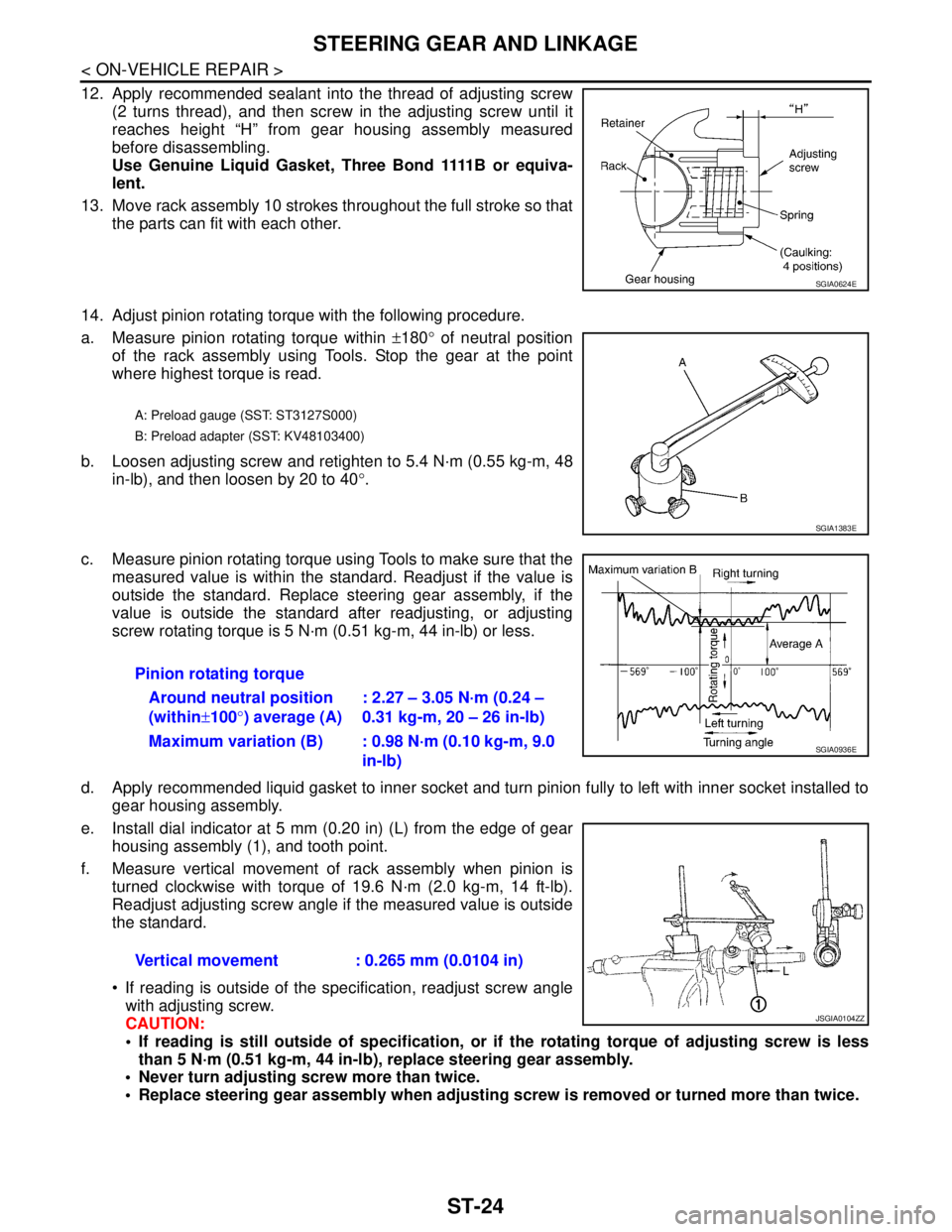
12. Apply recommended sealant into the thread of adjusting screw
(2 turns thread), and then screw in the adjusting screw until it
reaches height “H” from gear housing assembly measured
before disassembling.
Use Genuine Liquid Gasket, Three Bond 1111B or equiva-
lent.
13. Move rack assembly 10 strokes throughout the full stroke so that
the parts can fit with each other.
14. Adjust pinion rotating torque with the following procedure.
a. Measure pinion rotating torque within ±180° of neutral position
of the rack assembly using Tools. Stop the gear at the point
where highest torque is read.
b. Loosen adjusting screw and retighten to 5.4 N·m (0.55 kg-m, 48
in-lb), and then loosen by 20 to 40°.
c. Measure pinion rotating torque using Tools to make sure that the
measured value is within the standard. Readjust if the value is
outside the standard. Replace steering gear assembly, if the
value is outside the standard after readjusting, or adjusting
screw rotating torque is 5 N·m (0.51 kg-m, 44 in-lb) or less.
d. Apply recommended liquid gasket to inner socket and turn pinion fully to left with inner socket installed to
gear housing assembly.
e. Install dial indicator at 5 mm (0.20 in) (L) from the edge of gear
housing assembly (1), and tooth point.
f. Measure vertical movement of rack assembly when pinion is
turned clockwise with torque of 19.6 N·m (2.0 kg-m, 14 ft-lb).
Readjust adjusting screw angle if the measured value is outside
the standard.
If reading is outside of the specification, readjust screw angle
with adjusting screw.
CAUTION:
If reading is still outside of specification, or if the rotating torque of adjusting screw is less
than 5 N·m (0.51 kg-m, 44 in-lb), replace steering gear assembly.
Never turn adjusting screw more than twice.
Replace steering gear assembly when adjusting screw is removed or turned more than twice.
SGIA0624E
A: Preload gauge (SST: ST3127S000)
B: Preload adapter (SST: KV48103400)
SGIA1383E
Pinion rotating torque
Around neutral position
(within±100°) average (A): 2.27 – 3.05 N·m (0.24 –
0.31 kg-m, 20 – 26 in-lb)
Maximum variation (B) : 0.98 N·m (0.10 kg-m, 9.0
in-lb)
Vertical movement : 0.265 mm (0.0104 in)
SGIA0936E
JSGIA0104ZZ
Page 4415 of 5121
STEERING GEAR AND LINKAGE
ST-25
< ON-VEHICLE REPAIR >
C
D
E
F
H
I
J
K
L
MA
B
ST
N
O
P
15. Install large end of boot to gear housing assembly.
16. Install small end of boot to inner socket boot mounting groove.
17. Install boot clamp to boot small end.
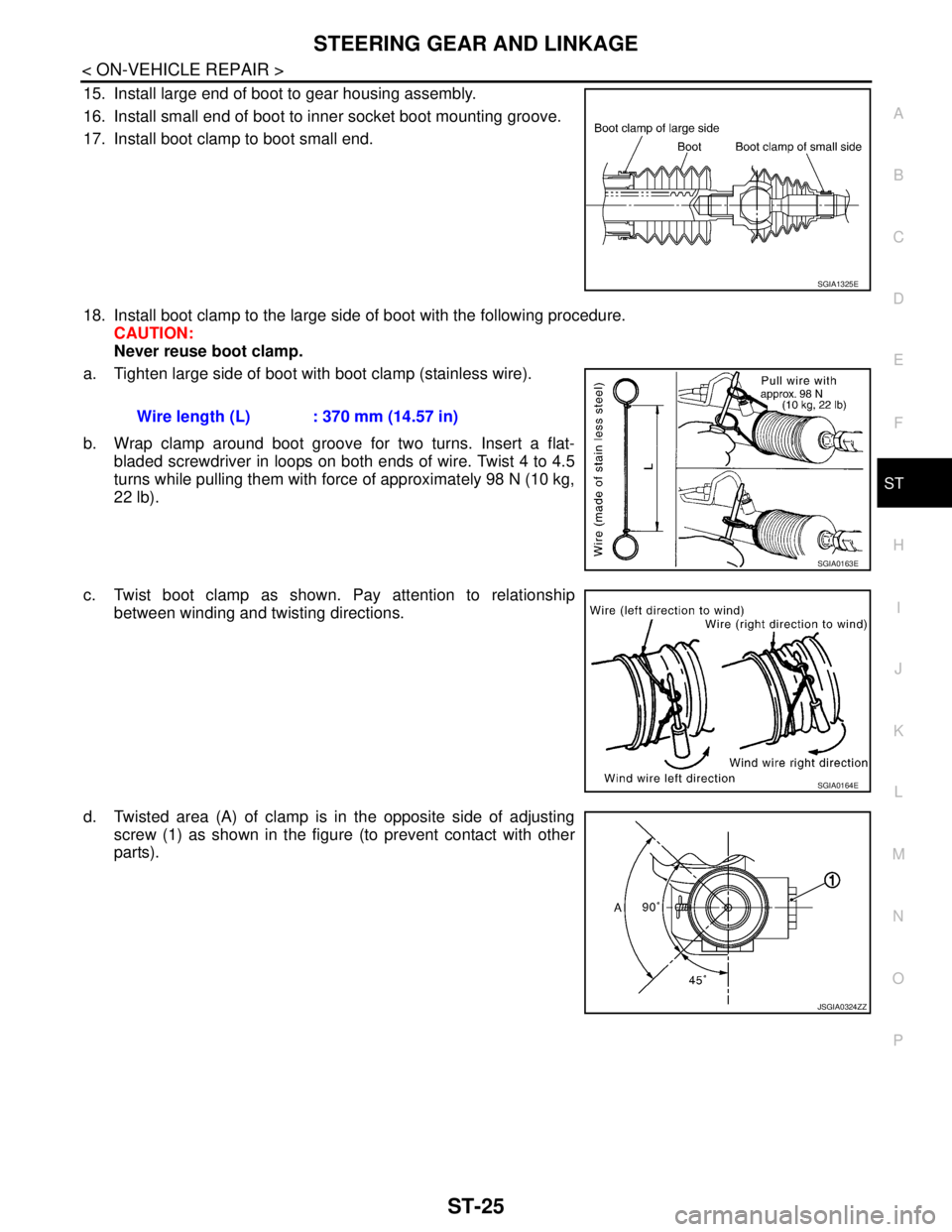
18. Install boot clamp to the large side of boot with the following procedure.
CAUTION:
Never reuse boot clamp.
a. Tighten large side of boot with boot clamp (stainless wire).
b. Wrap clamp around boot groove for two turns. Insert a flat-
bladed screwdriver in loops on both ends of wire. Twist 4 to 4.5
turns while pulling them with force of approximately 98 N (10 kg,
22 lb).
c. Twist boot clamp as shown. Pay attention to relationship
between winding and twisting directions.
d. Twisted area (A) of clamp is in the opposite side of adjusting
screw (1) as shown in the figure (to prevent contact with other
parts).
SGIA1325E
Wire length (L) : 370 mm (14.57 in)
SGIA0163E
SGIA0164E
JSGIA0324ZZ
Page 4416 of 5121
ST-26
< ON-VEHICLE REPAIR >
STEERING GEAR AND LINKAGE
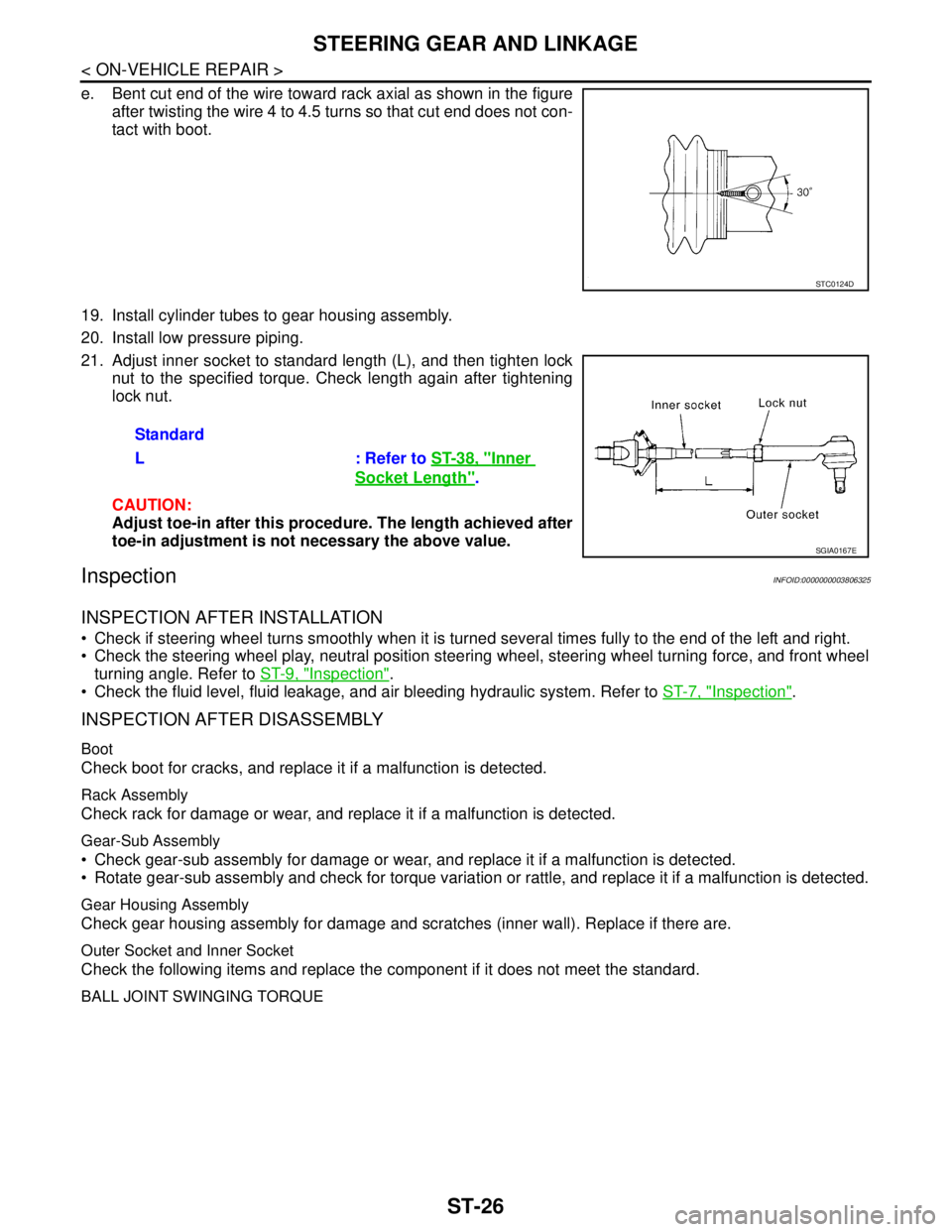
e. Bent cut end of the wire toward rack axial as shown in the figure
after twisting the wire 4 to 4.5 turns so that cut end does not con-
tact with boot.
19. Install cylinder tubes to gear housing assembly.
20. Install low pressure piping.
21. Adjust inner socket to standard length (L), and then tighten lock
nut to the specified torque. Check length again after tightening
lock nut.
CAUTION:
Adjust toe-in after this procedure. The length achieved after
toe-in adjustment is not necessary the above value.
InspectionINFOID:0000000003806325
INSPECTION AFTER INSTALLATION
Check if steering wheel turns smoothly when it is turned several times fully to the end of the left and right.
Check the steering wheel play, neutral position steering wheel, steering wheel turning force, and front wheel
turning angle. Refer to ST-9, "
Inspection".
Check the fluid level, fluid leakage, and air bleeding hydraulic system. Refer to ST-7, "
Inspection".
INSPECTION AFTER DISASSEMBLY
Boot
Check boot for cracks, and replace it if a malfunction is detected.
Rack Assembly
Check rack for damage or wear, and replace it if a malfunction is detected.
Gear-Sub Assembly
Check gear-sub assembly for damage or wear, and replace it if a malfunction is detected.
Rotate gear-sub assembly and check for torque variation or rattle, and replace it if a malfunction is detected.
Gear Housing Assembly
Check gear housing assembly for damage and scratches (inner wall). Replace if there are.
Outer Socket and Inner Socket
Check the following items and replace the component if it does not meet the standard.
BALL JOINT SWINGING TORQUE
STC0124D
Standard
L : Refer to ST-38, "
Inner
Socket Length".
SGIA0167E
Page 4417 of 5121
STEERING GEAR AND LINKAGE
ST-27
< ON-VEHICLE REPAIR >
C
D
E
F
H
I
J
K
L
MA
B
ST
N
O
P
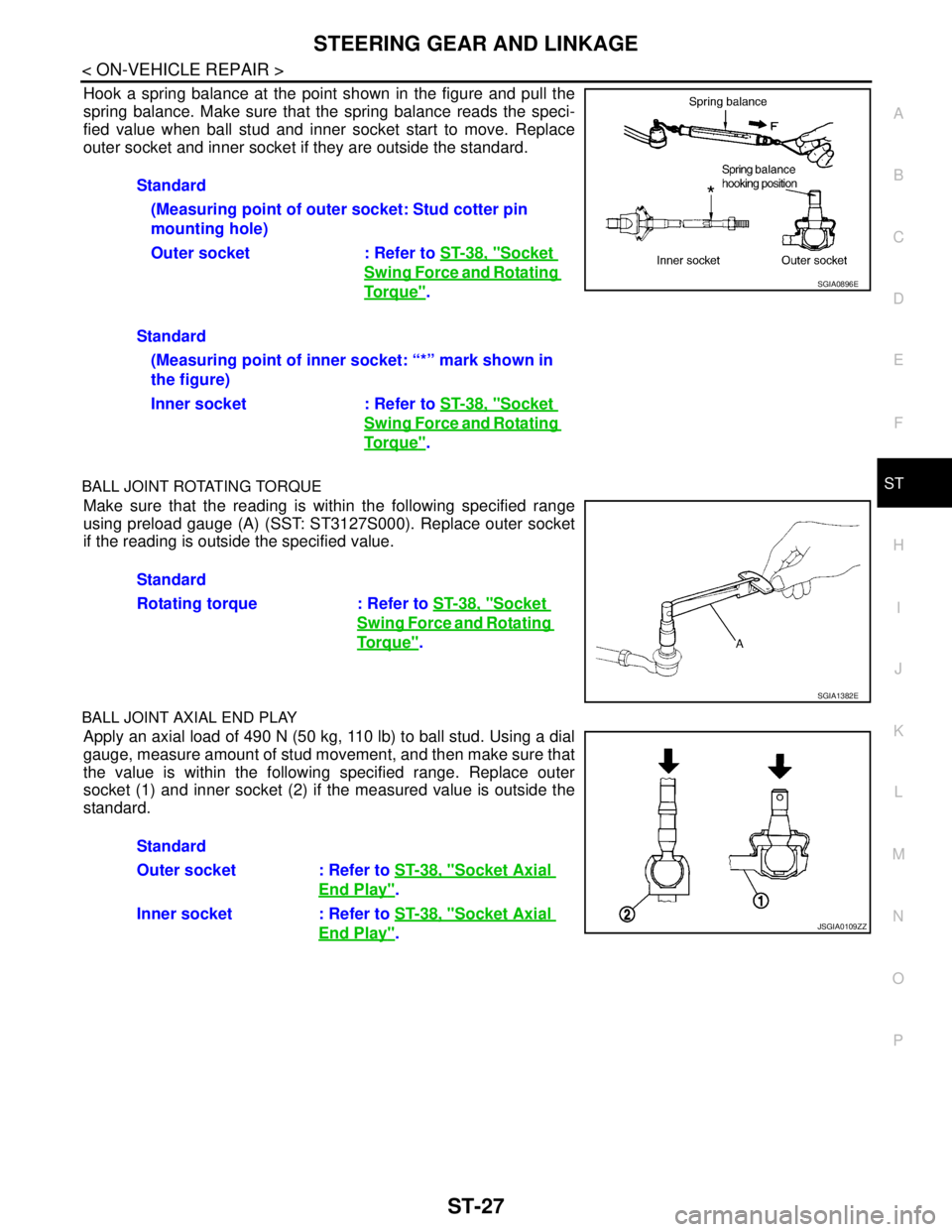
Hook a spring balance at the point shown in the figure and pull the
spring balance. Make sure that the spring balance reads the speci-
fied value when ball stud and inner socket start to move. Replace
outer socket and inner socket if they are outside the standard.
BALL JOINT ROTATING TORQUE
Make sure that the reading is within the following specified range
using preload gauge (A) (SST: ST3127S000). Replace outer socket
if the reading is outside the specified value.
BALL JOINT AXIAL END PLAY
Apply an axial load of 490 N (50 kg, 110 lb) to ball stud. Using a dial
gauge, measure amount of stud movement, and then make sure that
the value is within the following specified range. Replace outer
socket (1) and inner socket (2) if the measured value is outside the
standard.Standard
(Measuring point of outer socket: Stud cotter pin
mounting hole)
Outer socket : Refer to ST-38, "
Socket
Swing Force and Rotating
To r q u e".
Standard
(Measuring point of inner socket: “*” mark shown in
the figure)
Inner socket : Refer to ST-38, "
Socket
Swing Force and Rotating
To r q u e".
SGIA0896E
Standard
Rotating torque : Refer to ST-38, "
Socket
Swing Force and Rotating
Torque".
SGIA1382E
Standard
Outer socket : Refer to ST-38, "
Socket Axial
End Play".
Inner socket : Refer to ST-38, "
Socket Axial
End Play".JSGIA0109ZZ
Page 4418 of 5121
ST-28
< ON-VEHICLE REPAIR >
POWER STEERING OIL PUMP
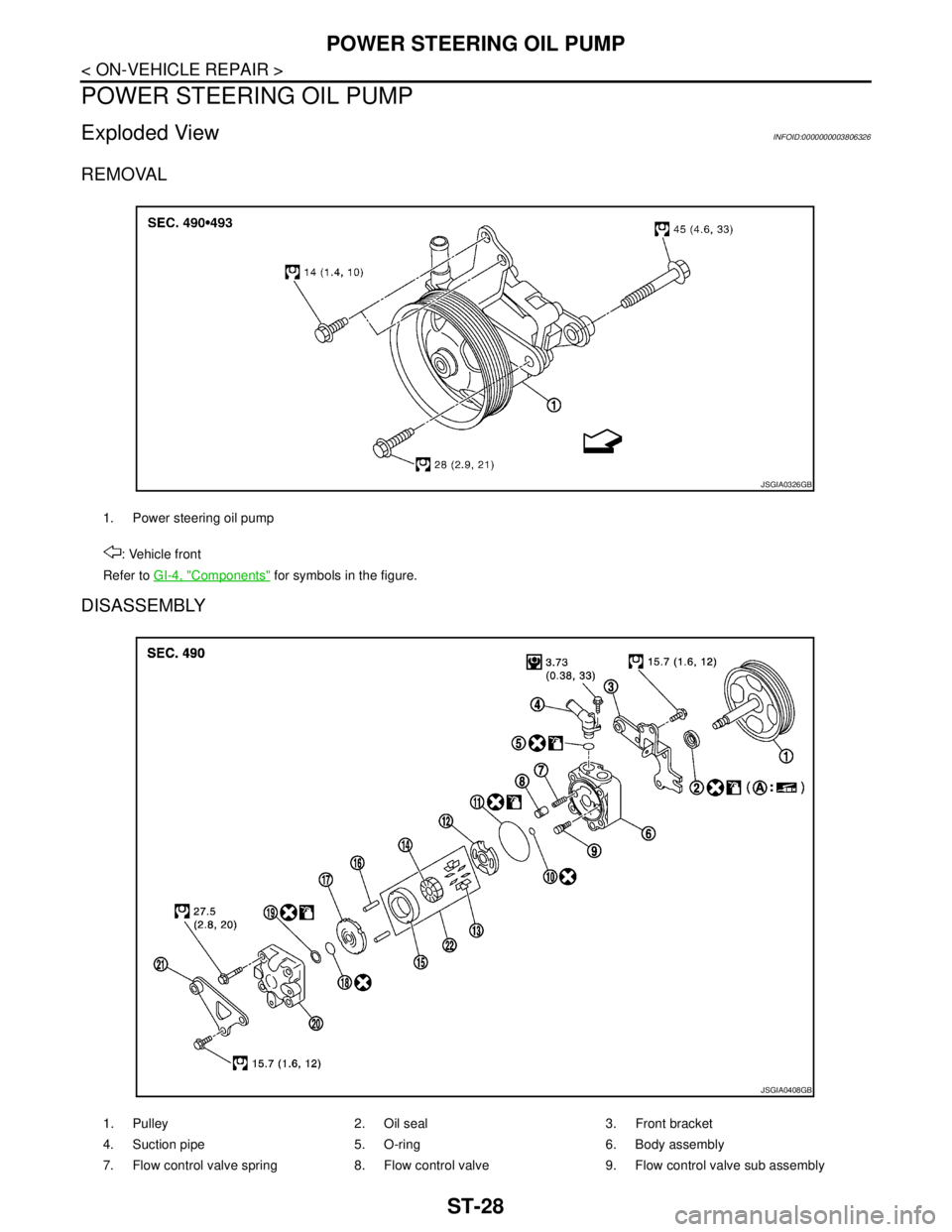
POWER STEERING OIL PUMP
Exploded ViewINFOID:0000000003806326
REMOVAL
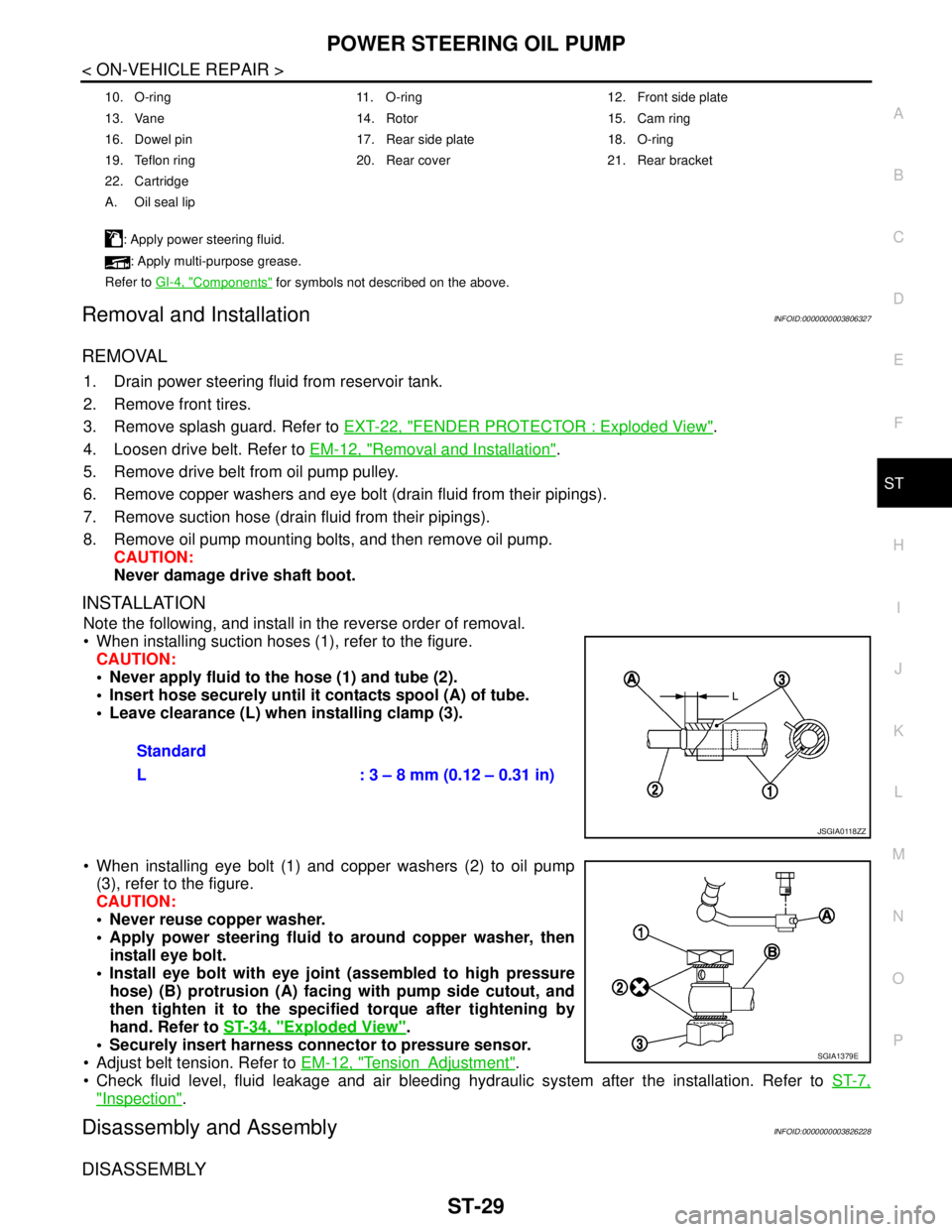
DISASSEMBLY
1. Power steering oil pump
: Vehicle front
Refer to GI-4, "
Components" for symbols in the figure.
JSGIA0326GB
1. Pulley 2. Oil seal 3. Front bracket
4. Suction pipe 5. O-ring 6. Body assembly
7. Flow control valve spring 8. Flow control valve 9. Flow control valve sub assembly
JSGIA0408GB
Page 4419 of 5121
POWER STEERING OIL PUMP
ST-29
< ON-VEHICLE REPAIR >
C
D
E
F
H
I
J
K
L
MA
B
ST
N
O
P
Removal and InstallationINFOID:0000000003806327
REMOVAL
1. Drain power steering fluid from reservoir tank.
2. Remove front tires.
3. Remove splash guard. Refer to EXT-22, "
FENDER PROTECTOR : Exploded View".
4. Loosen drive belt. Refer to EM-12, "
Removal and Installation".
5. Remove drive belt from oil pump pulley.
6. Remove copper washers and eye bolt (drain fluid from their pipings).
7. Remove suction hose (drain fluid from their pipings).
8. Remove oil pump mounting bolts, and then remove oil pump.
CAUTION:
Never damage drive shaft boot.
INSTALLATION
Note the following, and install in the reverse order of removal.
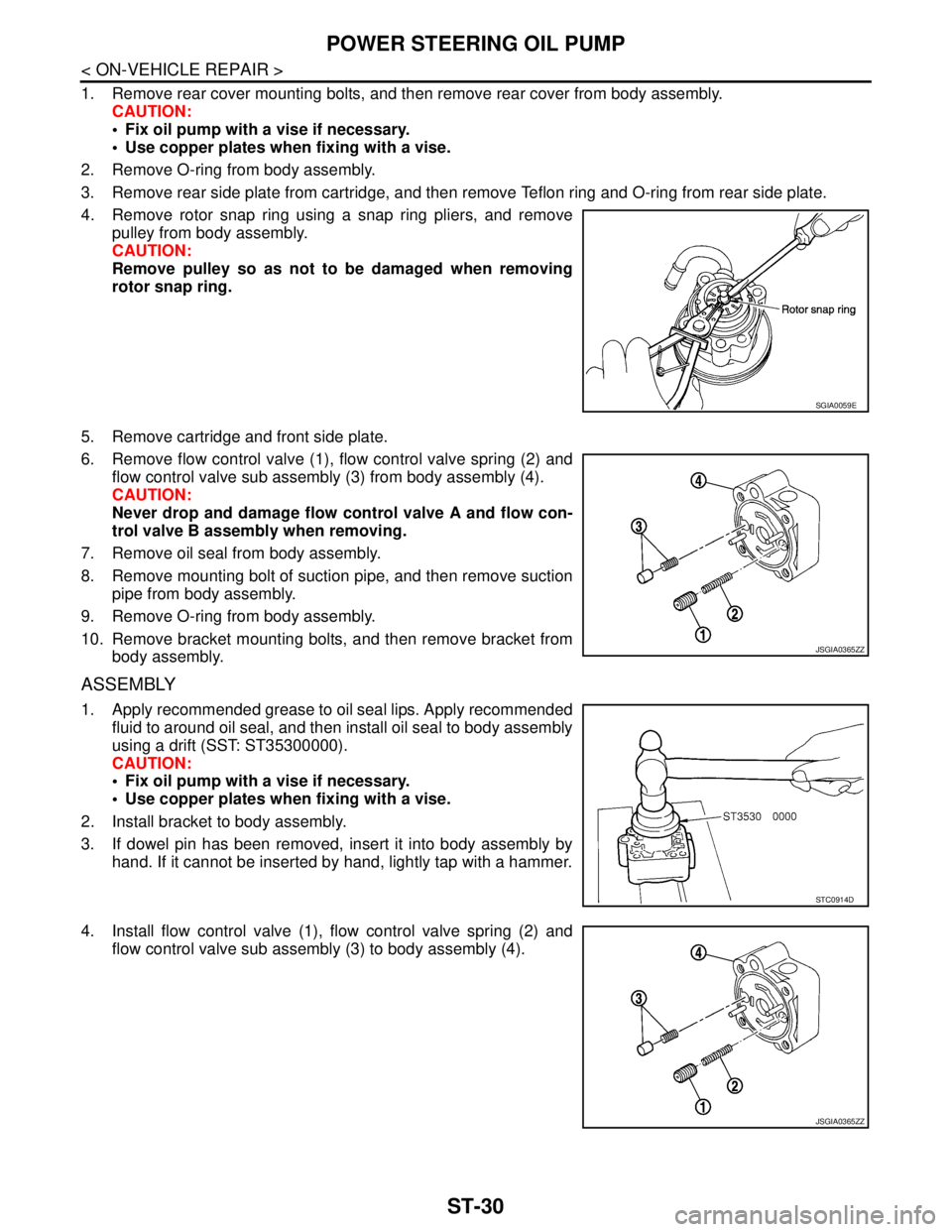
When installing suction hoses (1), refer to the figure.
CAUTION:
Never apply fluid to the hose (1) and tube (2).
Insert hose securely until it contacts spool (A) of tube.
Leave clearance (L) when installing clamp (3).
When installing eye bolt (1) and copper washers (2) to oil pump
(3), refer to the figure.
CAUTION:
Never reuse copper washer.
Apply power steering fluid to around copper washer, then
install eye bolt.
Install eye bolt with eye joint (assembled to high pressure
hose) (B) protrusion (A) facing with pump side cutout, and
then tighten it to the specified torque after tightening by
hand. Refer to ST-34, "
Exploded View".
Securely insert harness connector to pressure sensor.
Adjust belt tension. Refer to EM-12, "
TensionAdjustment".
Check fluid level, fluid leakage and air bleeding hydraulic system after the installation. Refer to ST-7,
"Inspection".
Disassembly and AssemblyINFOID:0000000003826228
DISASSEMBLY
10. O-ring 11. O-ring 12. Front side plate
13. Vane 14. Rotor 15. Cam ring
16. Dowel pin 17. Rear side plate 18. O-ring
19. Teflon ring 20. Rear cover 21. Rear bracket
22. Cartridge
A. Oil seal lip
: Apply power steering fluid.
: Apply multi-purpose grease.
Refer to GI-4, "
Components" for symbols not described on the above.
Standard
L : 3 – 8 mm (0.12 – 0.31 in)
JSGIA0118ZZ
SGIA1379E
Page 4420 of 5121
ST-30
< ON-VEHICLE REPAIR >
POWER STEERING OIL PUMP
1. Remove rear cover mounting bolts, and then remove rear cover from body assembly.
CAUTION:
Fix oil pump with a vise if necessary.
Use copper plates when fixing with a vise.
2. Remove O-ring from body assembly.
3. Remove rear side plate from cartridge, and then remove Teflon ring and O-ring from rear side plate.
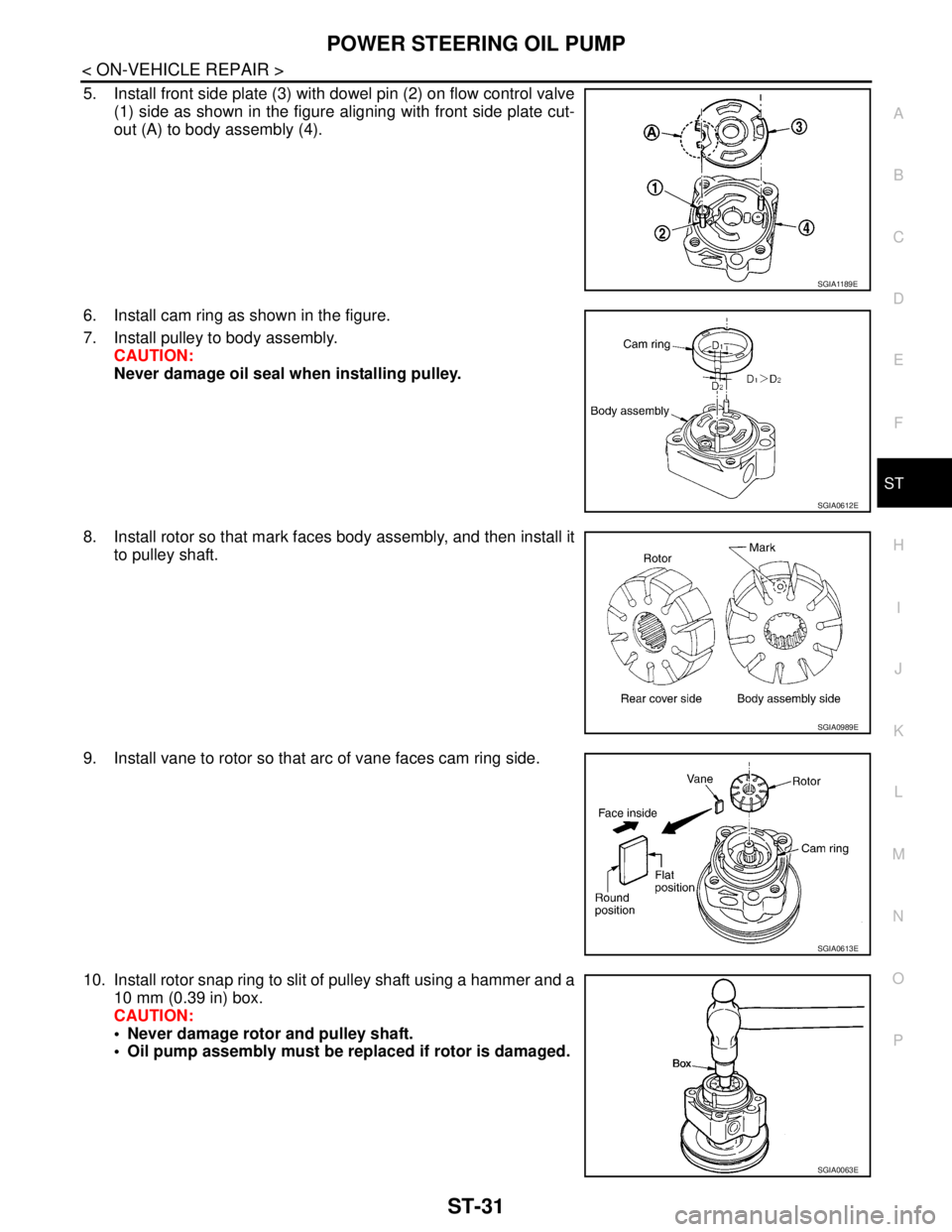
4. Remove rotor snap ring using a snap ring pliers, and remove
pulley from body assembly.
CAUTION:
Remove pulley so as not to be damaged when removing
rotor snap ring.
5. Remove cartridge and front side plate.
6. Remove flow control valve (1), flow control valve spring (2) and
flow control valve sub assembly (3) from body assembly (4).
CAUTION:
Never drop and damage flow control valve A and flow con-
trol valve B assembly when removing.
7. Remove oil seal from body assembly.
8. Remove mounting bolt of suction pipe, and then remove suction
pipe from body assembly.
9. Remove O-ring from body assembly.
10. Remove bracket mounting bolts, and then remove bracket from
body assembly.
ASSEMBLY
1. Apply recommended grease to oil seal lips. Apply recommended
fluid to around oil seal, and then install oil seal to body assembly
using a drift (SST: ST35300000).
CAUTION:
Fix oil pump with a vise if necessary.
Use copper plates when fixing with a vise.
2. Install bracket to body assembly.
3. If dowel pin has been removed, insert it into body assembly by
hand. If it cannot be inserted by hand, lightly tap with a hammer.
4. Install flow control valve (1), flow control valve spring (2) and
flow control valve sub assembly (3) to body assembly (4).
SGIA0059E
JSGIA0365ZZ
STC0914D
JSGIA0365ZZ
Page 4421 of 5121
POWER STEERING OIL PUMP
ST-31
< ON-VEHICLE REPAIR >
C
D
E
F
H
I
J
K
L
MA
B
ST
N
O
P
5. Install front side plate (3) with dowel pin (2) on flow control valve
(1) side as shown in the figure aligning with front side plate cut-
out (A) to body assembly (4).
6. Install cam ring as shown in the figure.
7. Install pulley to body assembly.
CAUTION:
Never damage oil seal when installing pulley.
8. Install rotor so that mark faces body assembly, and then install it
to pulley shaft.
9. Install vane to rotor so that arc of vane faces cam ring side.
10. Install rotor snap ring to slit of pulley shaft using a hammer and a
10 mm (0.39 in) box.
CAUTION:
Never damage rotor and pulley shaft.
Oil pump assembly must be replaced if rotor is damaged.
SGIA1189E
SGIA0612E
SGIA0989E
SGIA0613E
SGIA0063E
Page 4422 of 5121
ST-32
< ON-VEHICLE REPAIR >
POWER STEERING OIL PUMP
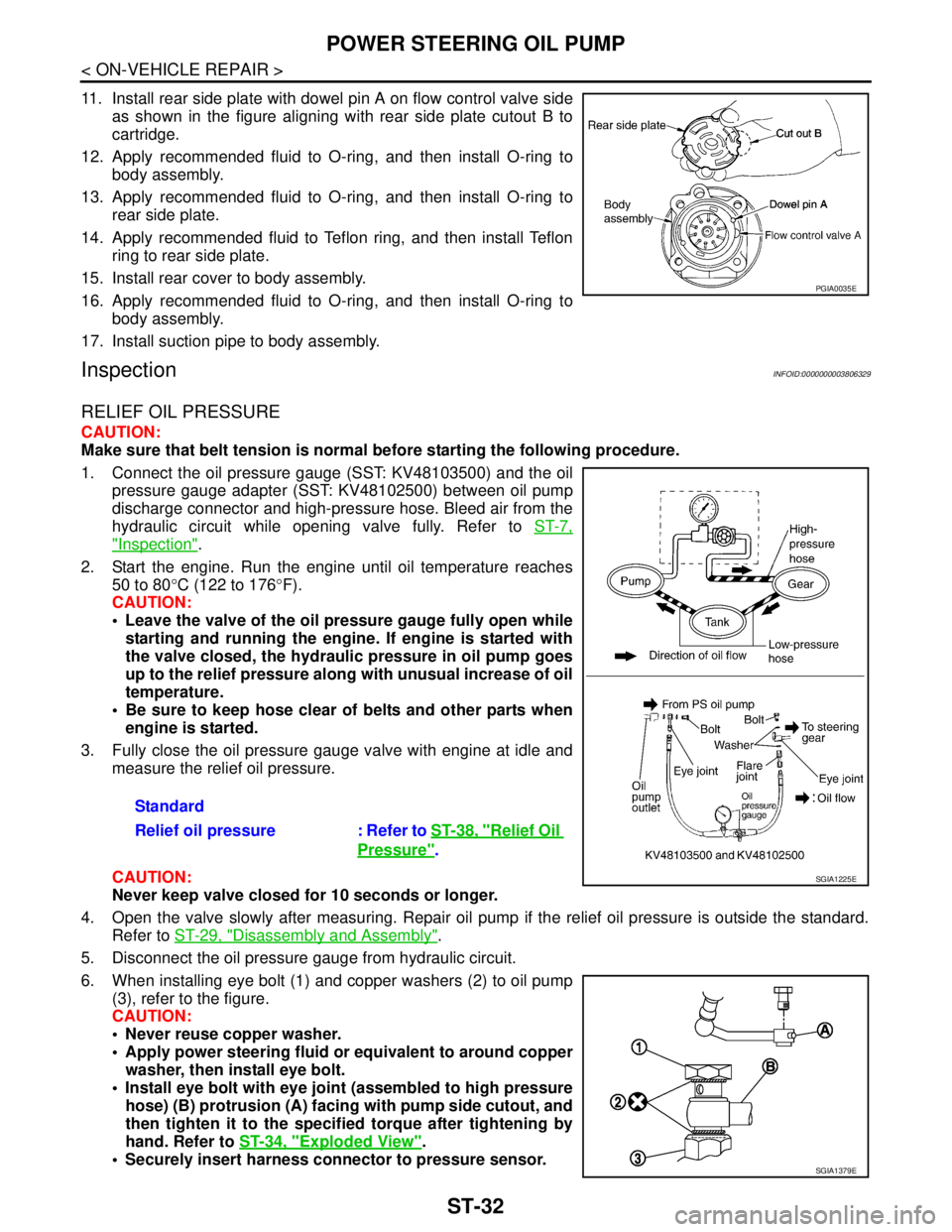
11. Install rear side plate with dowel pin A on flow control valve side
as shown in the figure aligning with rear side plate cutout B to
cartridge.
12. Apply recommended fluid to O-ring, and then install O-ring to
body assembly.
13. Apply recommended fluid to O-ring, and then install O-ring to
rear side plate.
14. Apply recommended fluid to Teflon ring, and then install Teflon
ring to rear side plate.
15. Install rear cover to body assembly.
16. Apply recommended fluid to O-ring, and then install O-ring to
body assembly.
17. Install suction pipe to body assembly.
InspectionINFOID:0000000003806329
RELIEF OIL PRESSURE
CAUTION:
Make sure that belt tension is normal before starting the following procedure.
1. Connect the oil pressure gauge (SST: KV48103500) and the oil
pressure gauge adapter (SST: KV48102500) between oil pump
discharge connector and high-pressure hose. Bleed air from the
hydraulic circuit while opening valve fully. Refer to ST-7,
"Inspection".
2. Start the engine. Run the engine until oil temperature reaches
50 to 80°C (122 to 176°F).
CAUTION:
Leave the valve of the oil pressure gauge fully open while
starting and running the engine. If engine is started with
the valve closed, the hydraulic pressure in oil pump goes
up to the relief pressure along with unusual increase of oil
temperature.
Be sure to keep hose clear of belts and other parts when
engine is started.
3. Fully close the oil pressure gauge valve with engine at idle and
measure the relief oil pressure.
CAUTION:
Never keep valve closed for 10 seconds or longer.
4. Open the valve slowly after measuring. Repair oil pump if the relief oil pressure is outside the standard.
Refer to ST-29, "
Disassembly and Assembly".
5. Disconnect the oil pressure gauge from hydraulic circuit.
6. When installing eye bolt (1) and copper washers (2) to oil pump
(3), refer to the figure.
CAUTION:
Never reuse copper washer.
Apply power steering fluid or equivalent to around copper
washer, then install eye bolt.
Install eye bolt with eye joint (assembled to high pressure
hose) (B) protrusion (A) facing with pump side cutout, and
then tighten it to the specified torque after tightening by
hand. Refer to ST-34, "
Exploded View".
Securely insert harness connector to pressure sensor.
PGIA0035E
Standard
Relief oil pressure : Refer to ST-38, "
Relief Oil
Pressure".
SGIA1225E
SGIA1379E
Page 4423 of 5121
POWER STEERING OIL PUMP
ST-33
< ON-VEHICLE REPAIR >
C
D
E
F
H
I
J
K
L
MA
B
ST
N
O
P
7. Check fluid level, fluid leakage and air bleeding hydraulic system after the installation. Refer to ST-7,
"Inspection".
BEFORE DISASSEMBLY
Disassemble oil pump only when the following malfunctions occur.
If oil leakage is found on oil pump.
Oil pump pulley is damaged or deformed.
Performance of oil pump is low.
AFTER DISASSEMBLY
Body Assembly and Rear Cover Inspection
Check body assembly and rear cover for internal damage. Replace rear cover if it is damaged. Replace oil
pump assembly if body assembly is damaged.
Cartridge Assembly Inspection
Check cam ring, rotor and vane for damage. Replace cartridge assembly if necessary.
Side Plate Inspection
Check side plate for damage. Replace side plate if necessary.
Flow Control Valve Inspection
Check flow control valve and spring for damage. Replace if necessary.