engine NISSAN TIIDA 2009 Service Repair Manual
[x] Cancel search | Manufacturer: NISSAN, Model Year: 2009, Model line: TIIDA, Model: NISSAN TIIDA 2009Pages: 4331, PDF Size: 58.04 MB
Page 3037 of 4331
" Removal and Installation " (ABS).
2. Remove brake caliper assembly with piping connected fr om steering knuckle. Temporarily secure it on the
vehicle side with a rope to avoid load on it. Refer to BR-25, " Component " .
3. Remove drive shafts (LH and RH) from steering knuckle. Refer to FAX-9, " Removal and Installation (Left
Side) " and
FAX-10, " Removal and Installation (Right Side) " .
4. Remove exhaust front tube. Refer to EX-5, " Component " .
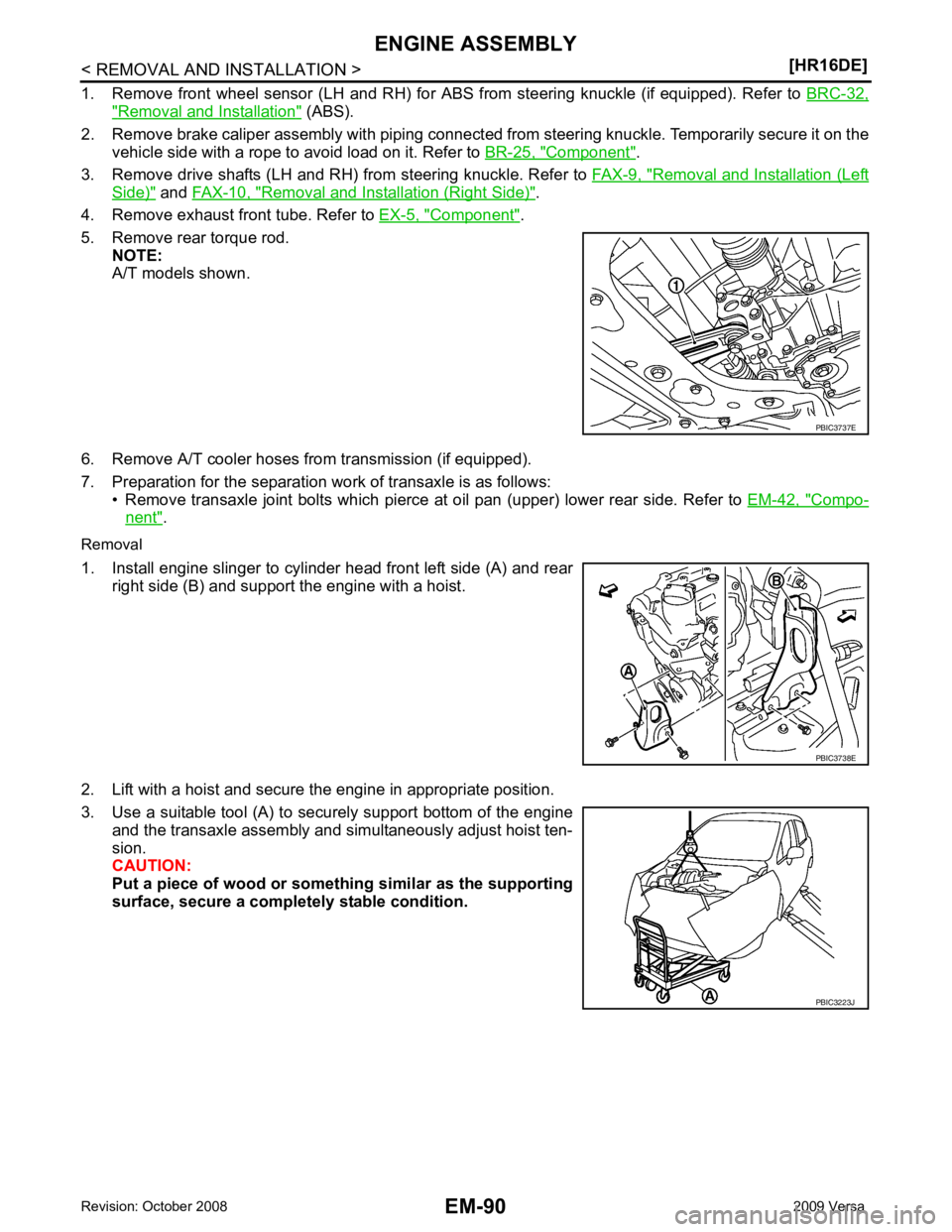
5. Remove rear torque rod. NOTE:
A/T models shown.
6. Remove A/T cooler hoses from transmission (if equipped).
7. Preparation for the separation work of transaxle is as follows: • Remove transaxle joint bolts which pierce at oil pan (upper) lower rear side. Refer to EM-42, " Compo-
nent " .
Removal
1. Install engine slinger to cylinder head front left side (A) and rear right side (B) and support the engine with a hoist.
2. Lift with a hoist and secure the engine in appropriate position.
3. Use a suitable tool (A) to securely support bottom of the engine and the transaxle assembly and simultaneously adjust hoist ten-
sion.
CAUTION:
Put a piece of wood or someth ing similar as the supporting
surface, secure a completely stable condition. PBIC3223J
Page 3038 of 4331
EM
NP
O
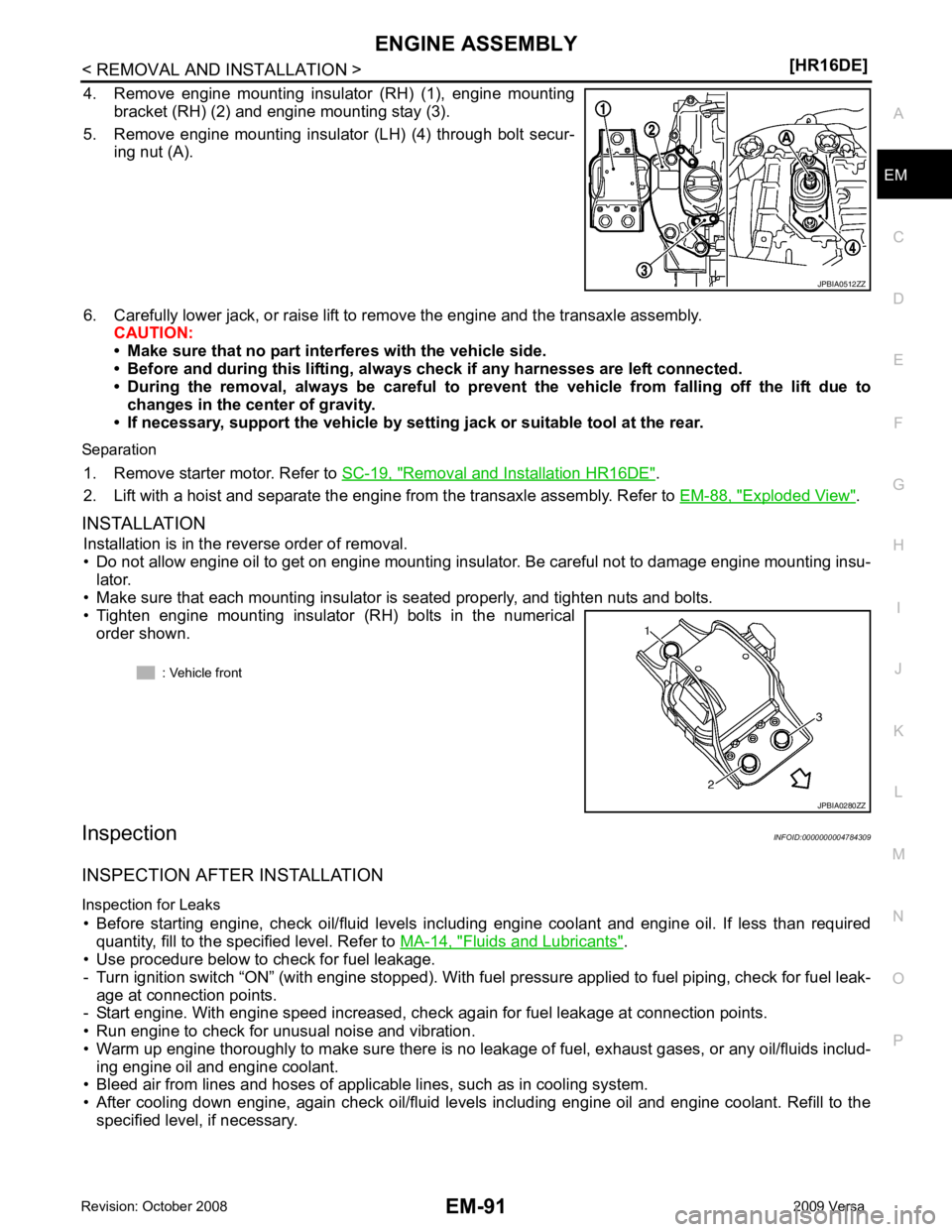
4. Remove engine mounting insulator (RH) (1), engine mounting
bracket (RH) (2) and engine mounting stay (3).
5. Remove engine mounting insulator (LH) (4) through bolt secur- ing nut (A).
6. Carefully lower jack, or raise lift to remove the engine and the transaxle assembly. CAUTION:
• Make sure that no part interferes with the vehicle side.
• Before and during this lifting, alw ays check if any harnesses are left connected.
• During the removal, always be careful to prevent the vehicle from falling off the lift due to
changes in the center of gravity.
• If necessary, support the vehicle by setting jack or suitable tool at the rear.
Separation 1. Remove starter motor. Refer to SC-19, " Removal and Installation HR16DE " .
2. Lift with a hoist and separate the engine from the transaxle assembly. Refer to EM-88, " Exploded View " .
INSTALLATION Installation is in the reverse order of removal.
• Do not allow engine oil to get on engine mounting insulator. Be careful not to damage engine mounting insu- lator.
• Make sure that each mounting insulator is seated properly, and tighten nuts and bolts.
• Tighten engine mounting insulator (RH) bolts in the numerical
order shown.
Inspection INFOID:0000000004784309
INSPECTION AFTER INSTALLATION
Inspection for Leaks • Before starting engine, check oil/fluid levels incl uding engine coolant and engine oil. If less than required
quantity, fill to the specified level. Refer to MA-14, " Fluids and Lubricants " .
• Use procedure below to check for fuel leakage.
- Turn ignition switch “ON” (with engine stopped). With fuel pressure applied to fuel piping, check for fuel leak-
age at connection points.
- Start engine. With engine speed increased, check again for fuel leakage at connection points.
• Run engine to check for unusual noise and vibration.
• Warm up engine thoroughly to make sure there is no leak age of fuel, exhaust gases, or any oil/fluids includ-
ing engine oil and engine coolant.
• Bleed air from lines and hoses of applicable lines, such as in cooling system.
• After cooling down engine, again check oil/fluid levels including engine oil and engine coolant. Refill to the specified level, if necessary.
Page 3040 of 4331
EM
NP
O
DISASSEMBLY AND ASSEMBLY
ENGINE STAND SETTING
Setting INFOID:0000000004784310
NOTE:
Explained here is how to disassemble with engine stand supporting transmission surface. When using differ-
ent type of engine stand, note with difference in steps and etc.
1. Remove the engine and the transaxle assembly from the vehicle, and separate the transaxle from the
engine. Refer to EM-88, " Exploded View " .
2. Remove clutch cover and clutch disc (if equipped). Refer to CL-15, " Removal and Installation " .
3. Remove flywheel or driveplate. • Secure flywheel or driveplate with Tool, and remove bolts.
CAUTION:
• Never disassemble flywheel.
• Never place flywheel or driveplate with signal plate facing down.
• When handling signal plate, take car e not to damage or scratch it.
• Handle signal plate in a manner that prevents it from becoming magnetized.
4. Lift the engine with a hoist to install it onto widely use engine stand. CAUTION:
• Use the engine stand that has a load capacity [approximately 135 kg (298 lb) or more] large
enough for supporting the engine weight.
• If the load capacity of stand is not adequate, remove the following parts beforehand to reduce the poten-
tial risk of overturning stand.
- Intake manifold: Refer to EM-28, " Exploded View " .
- Exhaust manifold: Refer to EM-31, " Exploded View " .
- Rocker cover: Refer to EM-46, " Exploded View " .
NOTE:
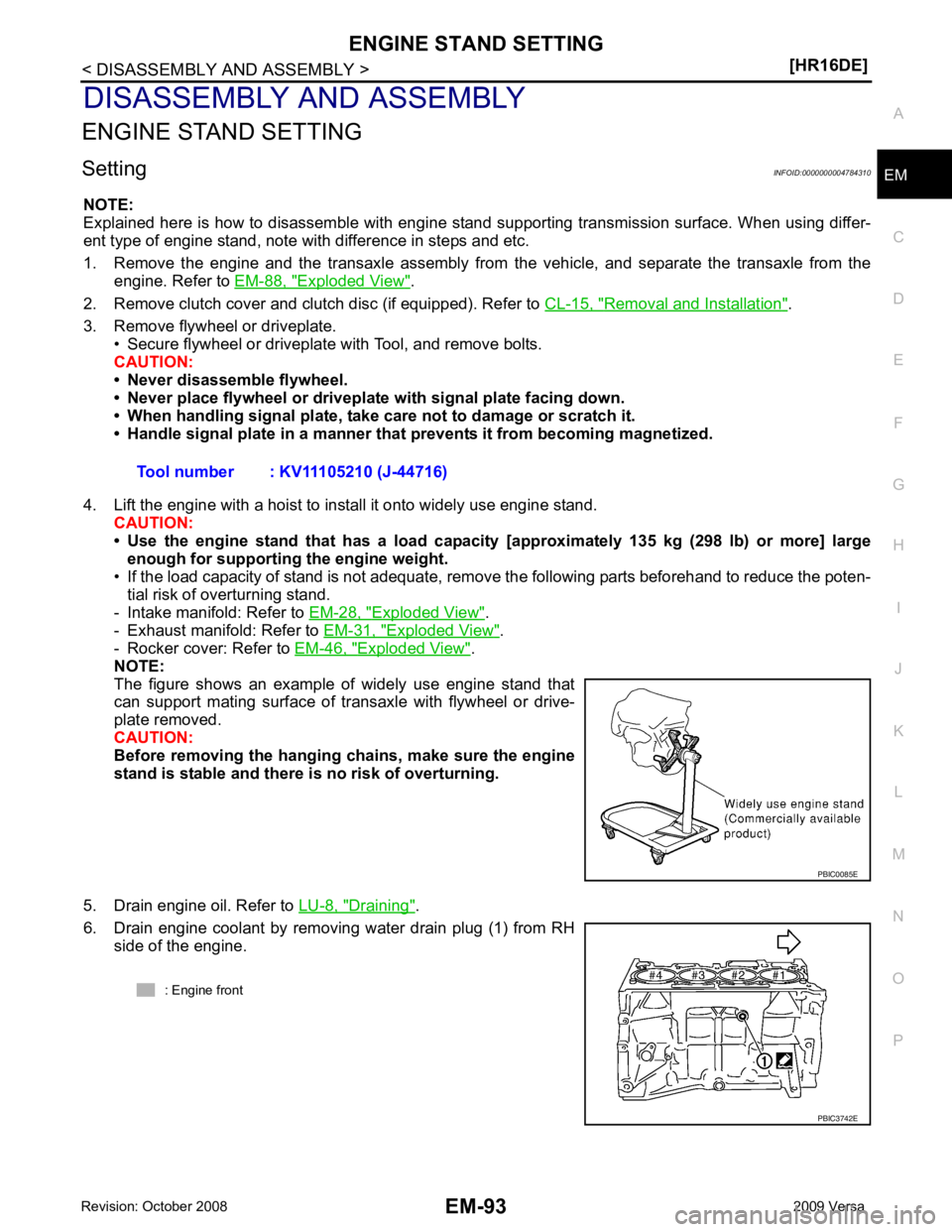
The figure shows an example of widely use engine stand that
can support mating surface of transaxle with flywheel or drive-
plate removed.
CAUTION:
Before removing the hanging chains, make sure the engine
stand is stable and there is no risk of overturning.
5. Drain engine oil. Refer to LU-8, " Draining " .
6. Drain engine coolant by removing water drain plug (1) from RH side of the engine. Tool number : KV11105210 (J-44716)
Page 3044 of 4331
EM
NP
O
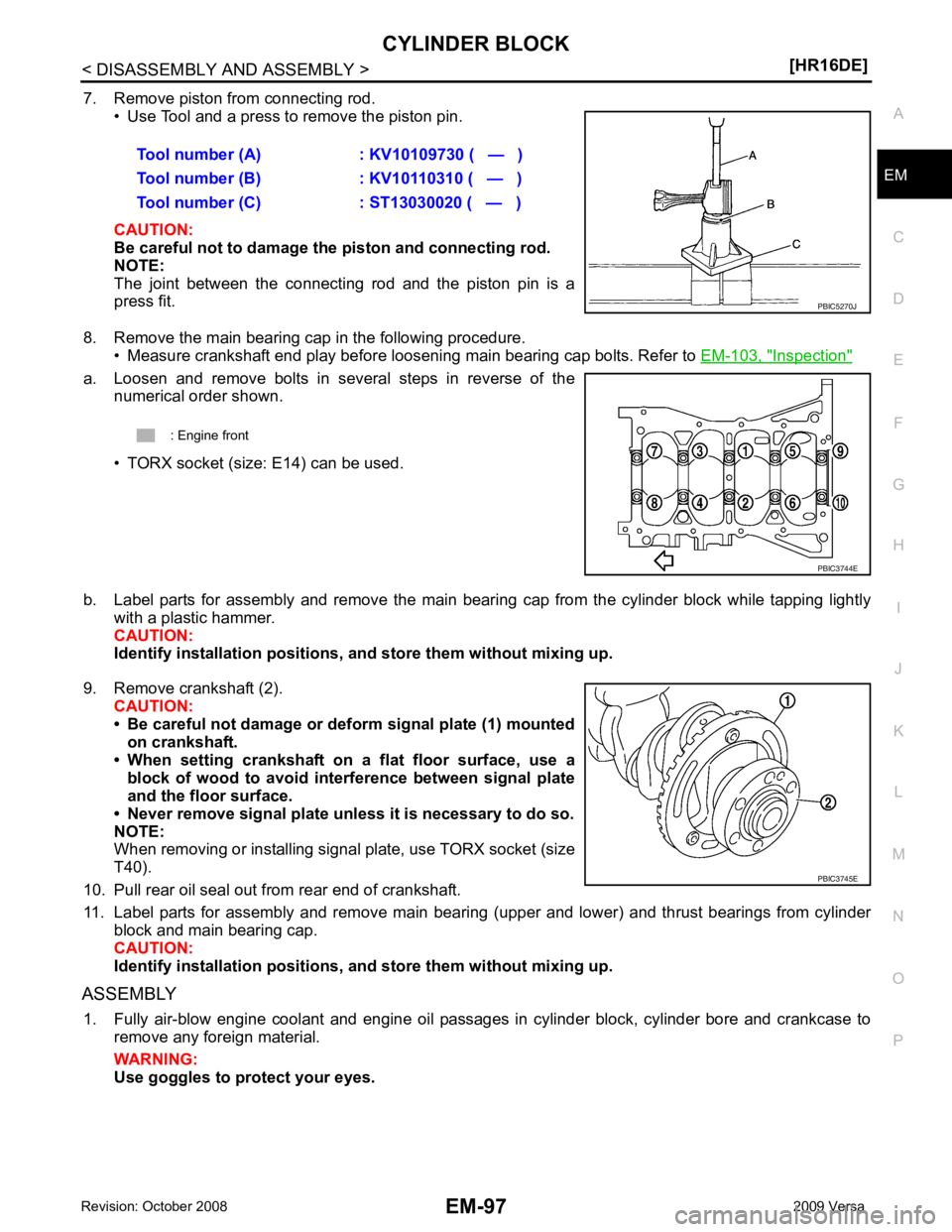
7. Remove piston from connecting rod.
• Use Tool and a press to remove the piston pin.
CAUTION:
Be careful not to damage the piston and connecting rod.
NOTE:
The joint between the connecting rod and the piston pin is a
press fit.
8. Remove the main bearing cap in the following procedure. • Measure crankshaft end play before loosening main bearing cap bolts. Refer to EM-103, " Inspection "
a. Loosen and remove bolts in several steps in reverse of the
numerical order shown.
• TORX socket (size: E14) can be used.
b. Label parts for assembly and remove the main beari ng cap from the cylinder block while tapping lightly
with a plastic hammer.
CAUTION:
Identify installation positions, and store th em without mixing up.
9. Remove crankshaft (2). CAUTION:
• Be careful not damage or deform signal plate (1) mounted on crankshaft.
• When setting crankshaft on a flat floor surface, use a
block of wood to avoid inte rference between signal plate
and the floor surface.
• Never remove signal plate unl ess it is necessary to do so.
NOTE:
When removing or installing signal plate, use TORX socket (size
T40).
10. Pull rear oil seal out from rear end of crankshaft.
11. Label parts for assembly and remove main bearing (upper and lower) and thrust bearings from cylinder block and main bearing cap.
CAUTION:
Identify installation positions, and store th em without mixing up.
ASSEMBLY 1. Fully air-blow engine coolant and engine oil passages in cylinder block, cylinder bore and crankcase to remove any foreign material.
WARNING:
Use goggles to protect your eyes. Tool number (A) : KV10109730 ( — )
Tool number (B) : KV10110310 ( — )
Tool number (C) : ST13030020 ( — )
Page 3045 of 4331
![NISSAN TIIDA 2009 Service Repair Manual EM-98< DISASSEMBLY AND ASSEMBLY >
[HR16DE]
CYLINDER BLOCK
2. Install water drain plug (1) to cylinder block as shown.
Use Genuine Silicone RTV Seal ant or equivalent. Refer to
GI-42, " Recomm](/img/5/57398/w960_57398-3044.png "NISSAN TIIDA 2009 Service Repair Manual EM-98< DISASSEMBLY AND ASSEMBLY >
[HR16DE]
CYLINDER BLOCK
2. Install water drain plug (1) to cylinder block as shown.
Use Genuine Silicone RTV Seal ant or equivalent. Refer to
GI-42, \" Recomm")
EM-98< DISASSEMBLY AND ASSEMBLY >
[HR16DE]
CYLINDER BLOCK
2. Install water drain plug (1) to cylinder block as shown.
Use Genuine Silicone RTV Seal ant or equivalent. Refer to
GI-42, " Recommended Chemical
Product and Sealant " .
3. Install main bearings and thrust bearings in their original positions with the following procedure:
a. Remove dust, dirt, and engine oil on the bearing mating surfaces of cylinder block.
b. Install thrust bearings to the both sides of the No. 3 journal hous- ing (B) on cylinder block.
• Install thrust bearings with the oil groove (A) facing crankshaft arm (outside).
c. Install the main bearings (1) paying attention to the direction. • Install the one with oil holes (A) onto cylinder block and the
one without oil holes onto main bearing cap.
• Before installing main bearings, apply new engine oil to the bearing surface (inside). Do not apply engine oil to the back
surface, but thoroughly clean it.
• Ensure the oil holes on cylinder block and those on the corre- sponding bearing are aligned.
• Install the main bearing in the position shown.
NOTE:
Install the main bearing in the center position with the following
dimension. For service operati on, the center position can be
checked visually. : Engine front PBIC3742E
: Engine front
PBIC3258J
PBIC3746E
1 : Cylinder block
2 : Main bearing (upper)
3 : Main bearing (lower)
4 : Main bearing cap
: Engine front PBIC3747E
Journal position No. 1 No. 2 No. 3 No. 4 No. 5
L1 [Unit: mm (in)] 1.65–2.05 1.25–1.65 2.30–2.70 1.25–1.65 1.60–2.00
(0.065-0.081) (0.049-0.065) (0.091-0.106) (0.049-0.065) (0.063-0.079)
L2 [Unit: mm (in)] 1.30–1.70 1.30–1.70 2.30–2.70 1.30–1.70 1.30–1.70
(0.051-0.067) (0.051-0.067) (0.091-0.106) (0.051-0.067) (0.051-0.067)
Page 3046 of 4331
EM
NP
O
CAUTION:
Dimension L1 of journal No. 3 is the distance fr om the housing base end surface (bulk) (not the
distance from the thrust bearing mounting end surface).
4. Install signal plate to crankshaft if removed.
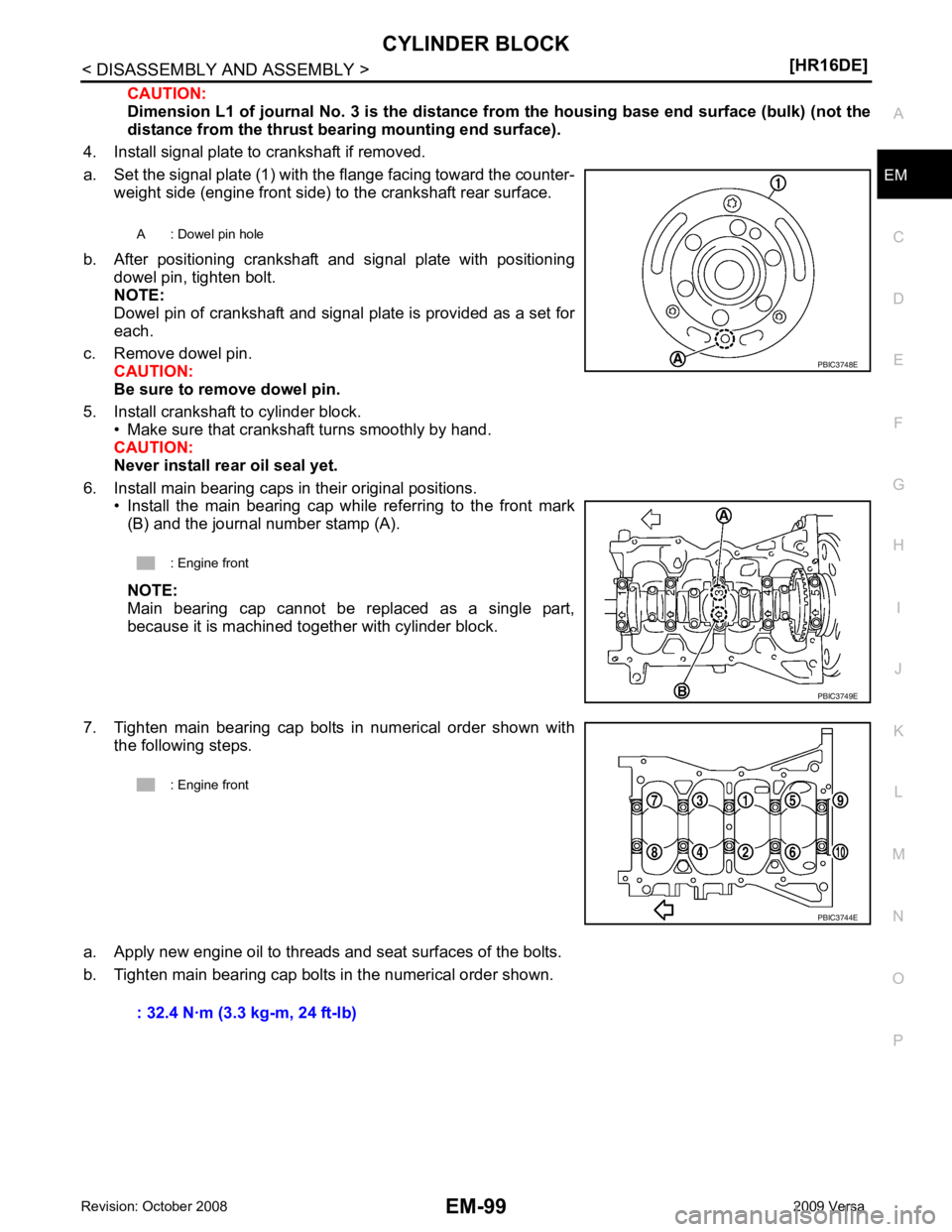
a. Set the signal plate (1) with the flange facing toward the counter- weight side (engine front side) to the crankshaft rear surface.
b. After positioning crankshaft and signal plate with positioning dowel pin, tighten bolt.
NOTE:
Dowel pin of crankshaft and signal plate is provided as a set for
each.
c. Remove dowel pin. CAUTION:
Be sure to remove dowel pin.
5. Install crankshaft to cylinder block. • Make sure that crankshaft turns smoothly by hand.
CAUTION:
Never install rear oil seal yet.
6. Install main bearing caps in their original positions. • Install the main bearing cap while referring to the front mark(B) and the journal number stamp (A).
NOTE:
Main bearing cap cannot be replaced as a single part,
because it is machined together with cylinder block.
7. Tighten main bearing cap bolts in numerical order shown with the following steps.
a. Apply new engine oil to threads and seat surfaces of the bolts.
b. Tighten main bearing cap bolts in the numerical order shown. A : Dowel pin hole
: Engine front PBIC3749E
Page 3048 of 4331
EM
NP
O
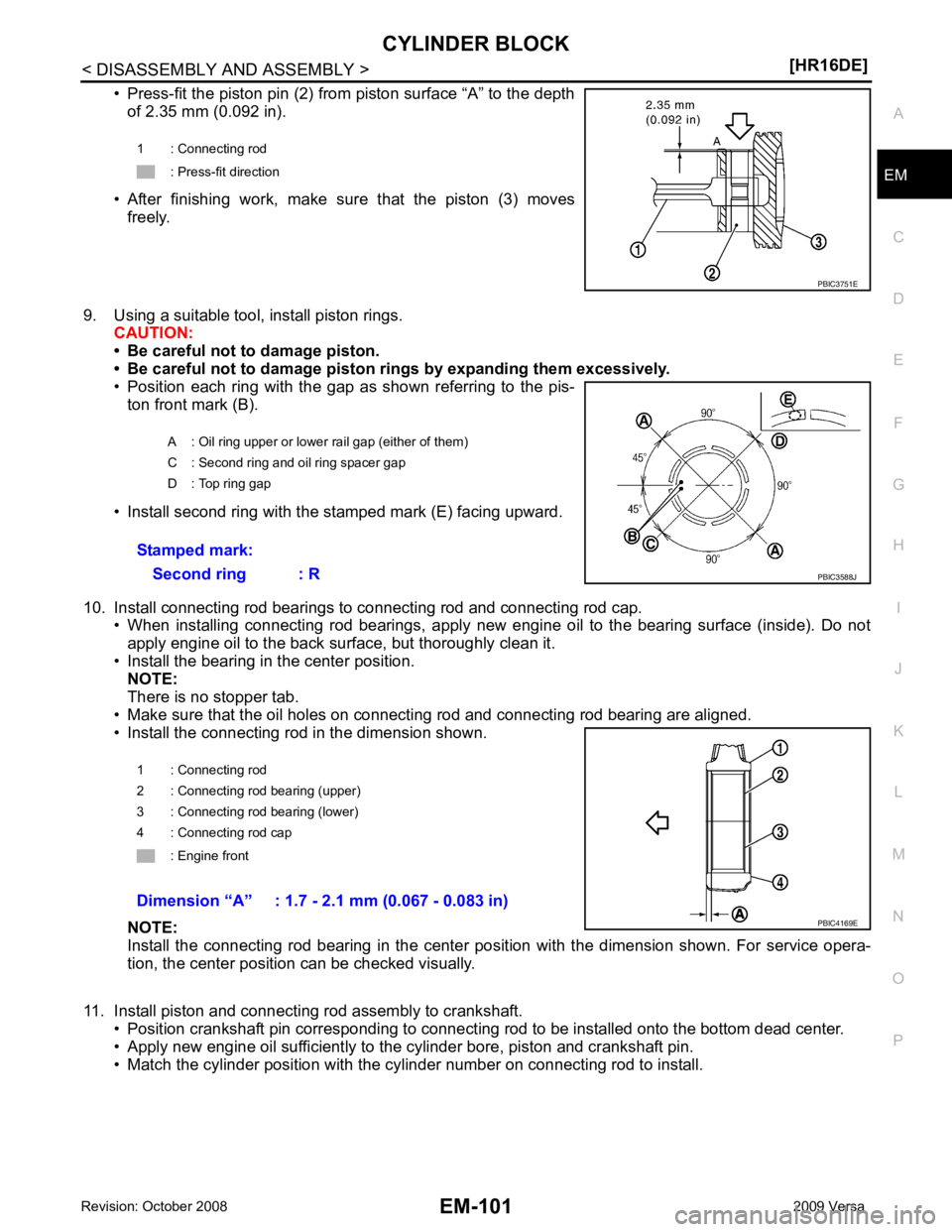
• Press-fit the piston pin (2) from piston surface “A” to the depth
of 2.35 mm (0.092 in).
• After finishing work, make sure that the piston (3) moves freely.
9. Using a suitable tool, install piston rings. CAUTION:
• Be careful not to damage piston.
• Be careful not to damage piston rings by expanding them excessively.
• Position each ring with the gap as shown referring to the pis-
ton front mark (B).
• Install second ring with the stamped mark (E) facing upward.
10. Install connecting rod bearings to connecting rod and connecting rod cap. • When installing connecting rod bearings, apply new engine oil to the bearing surface (inside). Do not
apply engine oil to the back surface, but thoroughly clean it.
• Install the bearing in the center position. NOTE:
There is no stopper tab.
• Make sure that the oil holes on connecting rod and connecting rod bearing are aligned.
• Install the connecting rod in the dimension shown.
NOTE:
Install the connecting rod bearing in the center pos ition with the dimension shown. For service opera-
tion, the center position can be checked visually.
11. Install piston and connecting rod assembly to crankshaft. • Position crankshaft pin corres ponding to connecting rod to be installed onto the bottom dead center.
• Apply new engine oil sufficiently to the cylinder bore, piston and crankshaft pin.
• Match the cylinder position with the cy linder number on connecting rod to install.
1 : Connecting rod
: Press-fit direction
Page 3049 of 4331
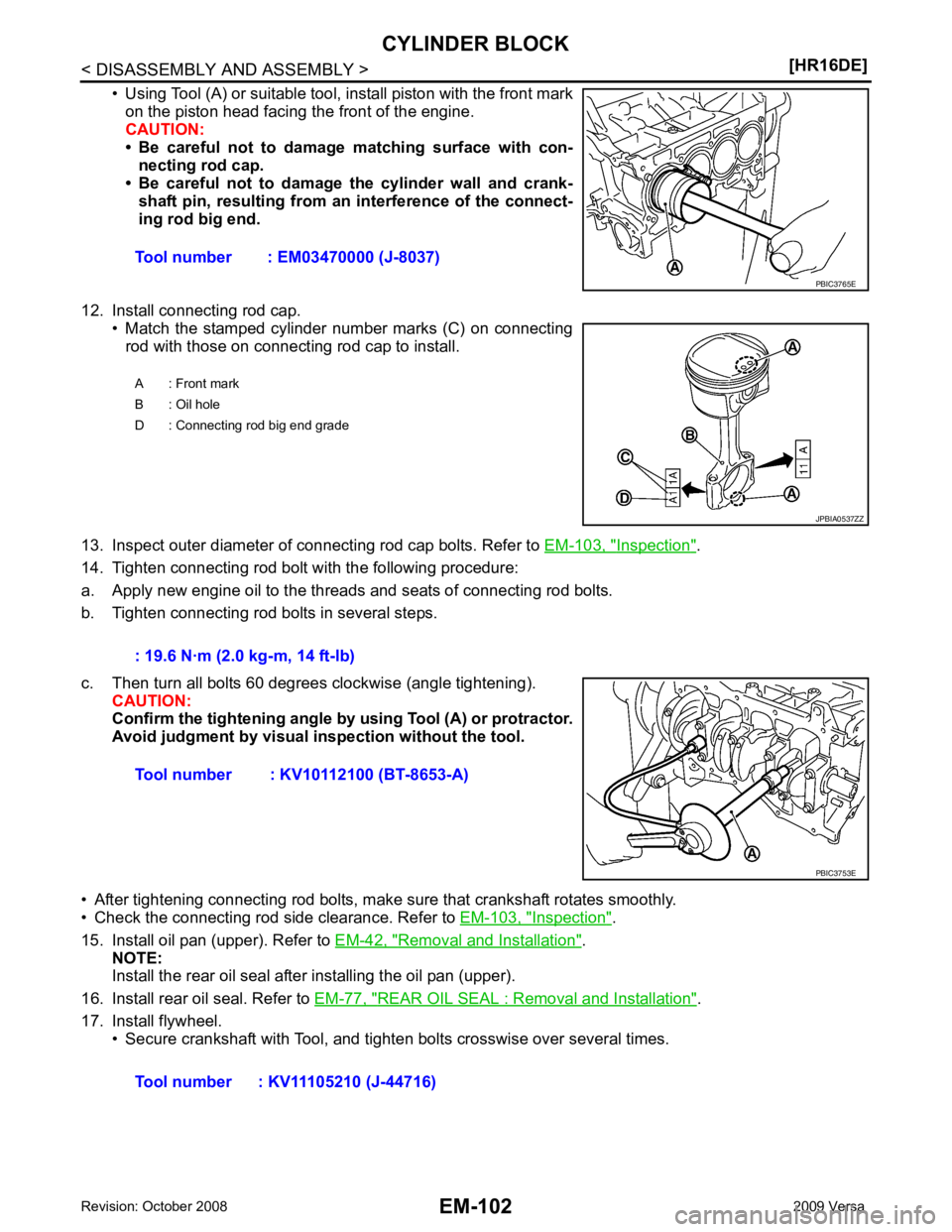
Inspection " .
14. Tighten connecting rod bolt with the following procedure:
a. Apply new engine oil to the threads and seats of connecting rod bolts.
b. Tighten connecting rod bolts in several steps.
c. Then turn all bolts 60 degrees clockwise (angle tightening). CAUTION:
Confirm the tightening angle by using Tool (A) or protractor.
Avoid judgment by visual inspection without the tool.
• After tightening connecting rod bolts, make sure that crankshaft rotates smoothly.
• Check the connecting rod side clearance. Refer to EM-103, " Inspection " .
15. Install oil pan (upper). Refer to EM-42, " Removal and Installation " .
NOTE:
Install the rear oil seal after installing the oil pan (upper).
16. Install rear oil seal. Refer to EM-77, " REAR OIL SEAL : Removal and Installation " .
17. Install flywheel. • Secure crankshaft with Tool, and tighten bolts crosswise over several times.Tool number : EM03470000 (J-8037)
Page 3050 of 4331
![NISSAN TIIDA 2009 Service Repair Manual CYLINDER BLOCK
EM-103
< DISASSEMBLY AND ASSEMBLY >
[HR16DE] C
D E
F
G H
I
J
K L
M A EM
NP
O
18. Install knock sensor (1).
• Install connectors so that they are positioned towards the rearof the engi](/img/5/57398/w960_57398-3049.png "NISSAN TIIDA 2009 Service Repair Manual CYLINDER BLOCK
EM-103
< DISASSEMBLY AND ASSEMBLY >
[HR16DE] C
D E
F
G H
I
J
K L
M A EM
NP
O
18. Install knock sensor (1).
• Install connectors so that they are positioned towards the rearof the engi")
CYLINDER BLOCK
EM-103
< DISASSEMBLY AND ASSEMBLY >
[HR16DE] C
D E
F
G H
I
J
K L
M A EM
NP
O
18. Install knock sensor (1).
• Install connectors so that they are positioned towards the rearof the engine.
CAUTION:
• Never tighten bolt while holding the connector.
• If any impact by dropping is applied to knock sensor,
replace it with a new one.
NOTE:
• Make sure that there is no foreign material on the cylinder block mating surface and the back surface of knock sensor.
• Make sure that knock sensor does not interfere with other parts.
19. Install crankshaft position sensor (POS) and cover. • Tighten bolts with it seated completely.
20. For the oil level gauge guide (1), fix the position (B) shown to the water inlet clip (A) after inserting to the cylinder block side.
21. Assembly is in the reverse order of disassembly after this step.
Inspection INFOID:0000000004784318
CRANKSHAFT END PLAY • Measure the clearance between thrust bearings and crankshaft arm when crankshaft is moved fully forward or backward with a dial
indicator (A).
• If the measured value exceeds the limit, replace thrust bearings, and measure again. If it still exceeds the limit, replace crankshaft
also.
CONNECTING ROD SIDE CLEARANCE • Measure the side clearance between connecting rod and crank- shaft arm with a feeler gauge (A).
• If the measured value exceeds the limit, replace connecting rod, and measure again. If it still exc eeds the standard, replace crank-
shaft also.
PISTON TO PISTON PIN OIL CLEARANCE
Piston Pin Hole Diameter : Engine front
PBIC3754E
PBIC3755E
Standard and Limit : Refer to
EM-121, " Cylinder Block " .
PBIC3762E
Standard : Refer to
EM-121, " Cylinder Block " .
PBIC3763E
Page 3054 of 4331
EM
NP
O
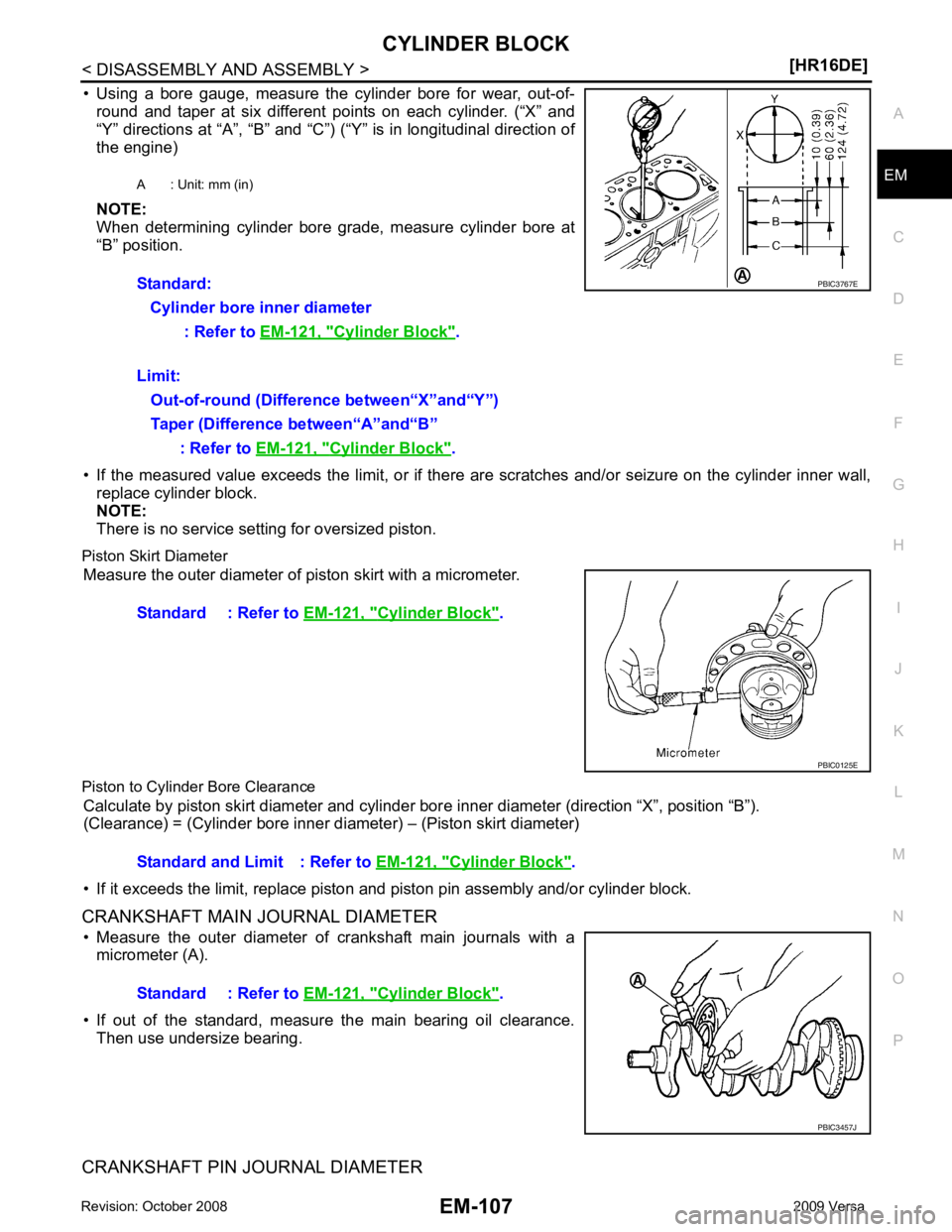
• Using a bore gauge, measure the cylinder bore for wear, out-of-
round and taper at six different points on each cylinder. (“X” and
“Y” directions at “A”, “B” and “C”) (“Y” is in longitudinal direction of
the engine)
NOTE:
When determining cylinder bore grade, measure cylinder bore at
“B” position.
• If the measured value exceeds the limit, or if there are scratches and/or seizure on the cylinder inner wall,
replace cylinder block.
NOTE:
There is no service setting for oversized piston.
Piston Skirt Diameter Measure the outer diameter of piston skirt with a micrometer.
Piston to Cylinder Bore Clearance Calculate by piston skirt diameter and cylinder bor e inner diameter (direction “X”, position “B”).
(Clearance) = (Cylinder bore inner di ameter) – (Piston skirt diameter)
• If it exceeds the limit, replace piston and piston pin assembly and/or cylinder block.
CRANKSHAFT MAIN JOURNAL DIAMETER • Measure the outer diameter of crankshaft main journals with a micrometer (A).
• If out of the standard, measure the main bearing oil clearance. Then use undersize bearing.
CRANKSHAFT PIN JOURNAL DIAMETER A : Unit: mm (in)
Standard: Cylinder bore inner diameter : Refer to EM-121, " Cylinder Block " .
Limit: Out-of-round (Difference between“X”and“Y”)
Taper (Difference between“A”and“B” : Refer to EM-121, " Cylinder Block " .
Cylinder Block " .
Cylinder Block " .
Standard : Refer to EM-121, " Cylinder Block " .