engine control NISSAN TIIDA 2009 Service Repair Manual
[x] Cancel search | Manufacturer: NISSAN, Model Year: 2009, Model line: TIIDA, Model: NISSAN TIIDA 2009Pages: 4331, PDF Size: 58.04 MB
Page 2102 of 4331

" Diagnosis Procedure " .
NOTE:
If 1st trip DTC is not detected during above proc edure, performing the following procedure is advised.
a. Turn ignition switch OFF and wait at least 10 seconds.
b. Start engine and drive the vehicle under the similar conditions to (1st trip) Freeze Frame Data for 10 min- utes. Refer to the table below.
Hold the accelerator pedal as steady as possible.
The similar conditions to (1st trip) Freeze Frame Da ta means the vehicle operation that the following con-
ditions should be satisfied at the same time.
7. If it is difficult to start engine at step 6, the fuel injection system has a malfunction, too.
Sensor Input Signal to ECM ECM function Actuator
Air fuel ratio (A/F) sensor 1 Density of oxygen in exhaust gas
(Mixture ratio feedback signal) Fuel injection control Fuel injectorDTC No.
Trouble diagnosis
name DTC detecting condition Possible cause
P0172
0172 Fuel injection system
too rich • Fuel injection system does not operate properly.
• The amount of mixture ratio compensation is too large. (The mixture ratio is too rich.) • Air fuel ratio (A/F) sensor 1
• Fuel injector
• Exhaust gas leaks
• Incorrect fuel pressure
• Mass air flow sensor Engine speed Engine speed in the freeze frame data
± 400 rpm
Vehicle speed Vehicle speed in the freeze frame data ± 10 km/h (6 MPH)
Engine coolant temperature (T)
condition When the freeze frame data shows lower than 70
°C (158 °F),
T should be lower than 70 °C (158 °F).
When the freeze frame data shows higher than or equal to 70 °C (158 °F),
T should be higher than or equal to 70 °C (158 °F).
Page 2116 of 4331
![NISSAN TIIDA 2009 Service Repair Manual EC-760< SERVICE INFOMATION >
[MR TYPE 1]
DTC P0222, P0223 TP SENSOR
DTC P0222, P0223 TP SENSOR
Component Description INFOID:0000000004537246
Electric throttle control actuator consists of thrott](/img/5/57398/w960_57398-2115.png "NISSAN TIIDA 2009 Service Repair Manual EC-760< SERVICE INFOMATION >
[MR TYPE 1]
DTC P0222, P0223 TP SENSOR
DTC P0222, P0223 TP SENSOR
Component Description INFOID:0000000004537246
Electric throttle control actuator consists of thrott")
EC-760< SERVICE INFOMATION >
[MR TYPE 1]
DTC P0222, P0223 TP SENSOR
DTC P0222, P0223 TP SENSOR
Component Description INFOID:0000000004537246
Electric throttle control actuator consists of throttle control motor,
throttle position sensor, etc. The throttle position sensor responds to
the throttle valve movement.
The throttle position sensor has two sensors. These sensors are a
kind of potentiometers which transform the throttle valve position into
output voltage, and emit the voltage signal to the ECM. In addition,
these sensors detect the opening and closing speed of the throttle
valve and feed the voltage signals to the ECM. The ECM judges the
current opening angle of the throttle valve from these signals and the
ECM controls the throttle control motor to make the throttle valve
opening angle properly in response to driving condition.
CONSULT-III Reference Value in Data Monitor Mode INFOID:0000000004537247
Specification data are reference values.
*: Throttle position sensor 2 signal is converted by ECM internally. Thus, it differs from ECM terminal voltage signal.
On Board Diagn osis Logic INFOID:0000000004537248
These self-diagnoses have the one trip detection logic.
NOTE:
If DTC P0222 or P0223 is displayed with DTC P0643, first perform the trouble diagnosis for DTC P0643.
Refer to EC-874 .
FAIL-SAFE MODE
When the malfunction is detected, the ECM enters fail-safe mode and the MIL lights up.
DTC Confirmation Procedure INFOID:0000000004537249
NOTE:
If DTC Confirmation Procedure has been previously conduc ted, always turn ignition switch OFF and wait at
least 10 seconds before conducting the next test.
TESTING CONDITION:
Before performing the following procedure, confirm that battery voltage is more than 8V at idle. PBIB0145E
MONITOR ITEM CONDITION SPECIFICATION
TP SEN 1-B1
TP SEN 2-B1* • Ignition switch: ON
(Engine stopped) Accelerator pedal: Fully released More than 0.36V
• Shift lever: D (A/T, CVT), 1st (M/T) Accelerator pedal: Fully depressed Less than 4.75VDTC No. Trouble diagnosis name DTC detecting condition Possible cause
P0222
0222 Throttle position sensor
1 circuit low input An excessively low voltage from the TP sensor
1 is sent to ECM. • Harness or connectors
(TP sensor 1 circuit is open or shorted.)
(APP sensor 2 circuit is shorted.)
• Electric throttle control actuator (TP sensor 1)
• Accelerator pedal position sensor
(APP sensor 2)
P0223
0223 Throttle position sensor
1 circuit high input An excessively high voltage from the TP sensor
1 is sent to ECM. Engine operation condition in fail-safe mode
The ECM controls the electric throttle control actuator in regulating the throttle opening in order for the idle position to be within +10
degrees.
The ECM regulates the opening speed of the throttle valve to be slower than the normal condition.
So, the acceleration will be poor.
Page 2131 of 4331
![NISSAN TIIDA 2009 Service Repair Manual DTC P0335 CKP SENSOR (POS)
EC-775
< SERVICE INFOMATION >
[MR TYPE 1] C
D E
F
G H
I
J
K L
M A EC
NP
O
DTC P0335 CKP SENSOR (POS)
Component Description INFOID:0000000004537264
The crankshaft position](/img/5/57398/w960_57398-2130.png "NISSAN TIIDA 2009 Service Repair Manual DTC P0335 CKP SENSOR (POS)
EC-775
< SERVICE INFOMATION >
[MR TYPE 1] C
D E
F
G H
I
J
K L
M A EC
NP
O
DTC P0335 CKP SENSOR (POS)
Component Description INFOID:0000000004537264
The crankshaft position")
DTC P0335 CKP SENSOR (POS)
EC-775
< SERVICE INFOMATION >
[MR TYPE 1] C
D E
F
G H
I
J
K L
M A EC
NP
O
DTC P0335 CKP SENSOR (POS)
Component Description INFOID:0000000004537264
The crankshaft position sensor (POS) is located on the cylinder
block rear housing facing the gear t eeth (cogs) of the signal plate at
the end of the crankshaft. It detects the fluctuation of the engine rev-
olution. The sensor consists of a permanent magnet and Hall IC.
When the engine is running, the high and low parts of the teeth
cause the gap with the sensor to change. The changing gap causes
the magnetic field near the sensor to change. Due to the changing
magnetic field, the voltage from the sensor changes. The ECM
receives the voltage signal and detects the fluctuation of the engine
revolution.
ECM receives the signals as shown in the figure.
CONSULT-III Reference Val ue in Data Monitor Mode INFOID:0000000004537265
Specification data are reference values.
On Board Diagnosis Logic INFOID:0000000004537266
DTC Confirmation Procedure INFOID:0000000004537267
NOTE:
If DTC Confirmation Procedure has been previously conduc ted, always turn ignition switch OFF and wait at
least 10 seconds before conducting the next test.
TESTING CONDITION: PBIA9209J
PBIB2997E
MONITOR ITEM CONDITION SPECIFICATION
ENG SPEED • Run engine and compare CONSULT-III value with the tachometer indica-
tion. Almost the same speed as the ta-
chometer indication. DTC No. Trouble diagnosis name DTC detecting condition Possible cause
P0335
0335 Crankshaft position sen-
sor (POS) circuit • The crankshaft position sensor (POS) signal is not
detected by the ECM during the first few seconds of
engine cranking.
• The proper pulse signal from the crankshaft position sensor (POS) is not sent to ECM while the engine is
running.
• The crankshaft position sensor (POS) signal is not in the normal pattern during engine running. • Harness or connectors
[Crankshaft position sensor (POS)
circuit is open or shorted.]
(Accelerator pedal position sensor
circuit is shorted.)
(Refrigerant pressure sensor circuit
is shorted.)
(EVAP control system pressure
sensor circuit is shorted.)
• Crankshaft position sensor (POS)
• Accelerator pedal position sensor
• Refrigerant pressure sensor
• EVAP control system pressure sen- sor
• Signal plate
Page 2133 of 4331
![NISSAN TIIDA 2009 Service Repair Manual DTC P0335 CKP SENSOR (POS)
EC-777
< SERVICE INFOMATION >
[MR TYPE 1] C
D E
F
G H
I
J
K L
M A EC
NP
O
Specification data are reference values
and are measured between each terminal and ground.
Pulse s](/img/5/57398/w960_57398-2132.png "NISSAN TIIDA 2009 Service Repair Manual DTC P0335 CKP SENSOR (POS)
EC-777
< SERVICE INFOMATION >
[MR TYPE 1] C
D E
F
G H
I
J
K L
M A EC
NP
O
Specification data are reference values
and are measured between each terminal and ground.
Pulse s")
DTC P0335 CKP SENSOR (POS)
EC-777
< SERVICE INFOMATION >
[MR TYPE 1] C
D E
F
G H
I
J
K L
M A EC
NP
O
Specification data are reference values
and are measured between each terminal and ground.
Pulse signal is measured by CONSULT-III.
CAUTION:
Do not use ECM ground terminals wh en measuring input/output voltage. Doing so may result in dam-
age to the ECM's transistor. Use a ground ot her than ECM terminals, such as the ground.
: Average voltage for pulse signal (Actual pulse signal can be confirmed by oscilloscope.)
Diagnosis Procedure INFOID:00000000045372691.
CHECK GROUND CONNECTIONS
1. Turn ignition switch OFF.
2. Loosen and retighten ground screws on the body. Refer to EC-632, " Ground Inspection " .
TERMI-
NAL NO. WIRE
COLOR ITEM CONDITION DATA (DC Voltage)
61 W Crankshaft position sensor
(POS) [Engine is running]
• Warm-up condition
• Idle speed NOTE:
The pulse cycle changes depending on rpm
at idle. Approximately 4.0V
[Engine is running]
• Engine speed: 2,000 rpm Approximately 4.0V
62 R Sensor ground
[Crankshaft position sensor
(POS)] [Engine is running]
• Warm-up condition
• Idle speed Approximately 0V
74 W Sensor power supply
(Refrigerant pressure sen-
sor) [Ignition switch: ON]
Approximately 5V
75 BR Sensor power supply
[Crankshaft position sensor
(POS)] [Ignition switch: ON]
Approximately 5V
76 W EVAP control system pres-
sure sensor power supply [Ignition switch: ON]
Approximately 5V
102 SB Sensor power supply
(APP sensor 2) [Ignition switch: ON]
Approximately 5V PBIB2998E
PBIB2999E
BBIA0698E
Page 2134 of 4331
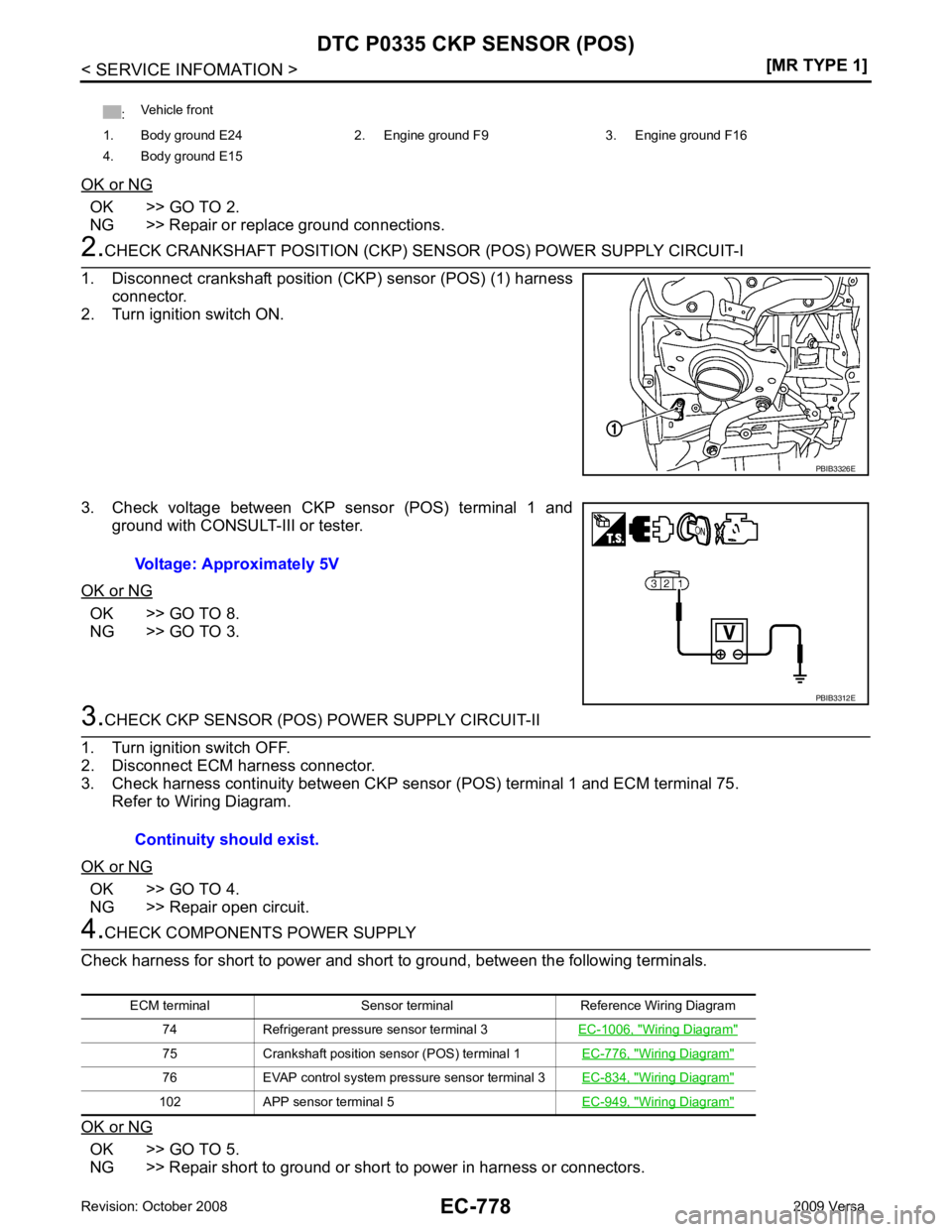
OK >> GO TO 2.
NG >> Repair or replace ground connections. OK >> GO TO 8.
NG >> GO TO 3. OK >> GO TO 4.
NG >> Repair open circuit. OK >> GO TO 5.
NG >> Repair short to ground or short to power in harness or connectors. :
Vehicle front
1. Body ground E24 2. Engine ground F9 3. Engine ground F16
4. Body ground E15 Wiring Diagram "
75 Crankshaft position sensor (POS) terminal 1
EC-776, " Wiring Diagram "
76 EVAP control system pressure sensor terminal 3
EC-834, " Wiring Diagram "
102 APP sensor terminal 5
EC-949, " Wiring Diagram "
Page 2137 of 4331
![NISSAN TIIDA 2009 Service Repair Manual DTC P0340 CMP SENSOR (PHASE)
EC-781
< SERVICE INFOMATION >
[MR TYPE 1] C
D E
F
G H
I
J
K L
M A EC
NP
O
DTC P0340 CMP SENSOR (PHASE)
Component Description INFOID:0000000004537272
The camshaft positio](/img/5/57398/w960_57398-2136.png "NISSAN TIIDA 2009 Service Repair Manual DTC P0340 CMP SENSOR (PHASE)
EC-781
< SERVICE INFOMATION >
[MR TYPE 1] C
D E
F
G H
I
J
K L
M A EC
NP
O
DTC P0340 CMP SENSOR (PHASE)
Component Description INFOID:0000000004537272
The camshaft positio")
DTC P0340 CMP SENSOR (PHASE)
EC-781
< SERVICE INFOMATION >
[MR TYPE 1] C
D E
F
G H
I
J
K L
M A EC
NP
O
DTC P0340 CMP SENSOR (PHASE)
Component Description INFOID:0000000004537272
The camshaft position sensor (PHASE) senses the protrusion of
camshaft (INT) to identify a particular cylinder. The camshaft position
sensor (PHASE) senses the pist on position. When the crankshaft
position sensor (POS) system becomes inoperative, the camshaft
position sensor (PHASE) provides various controls of engine parts
instead, utilizing timing of cylinder identification signals. The sensor
consists of a permanent magnet and Hall IC. When engine is run-
ning, the high and low parts of the teeth cause the gap with the sen-
sor to change. The changing gap causes the magnetic field near the
sensor to change. Due to the changing magnetic field, the voltage
from the sensor changes.
ECM receives the signals as shown in the figure.
CONSULT-III Reference Val ue in Data Monitor Mode INFOID:0000000004537273
Specification data are reference values.
On Board Diagnosis Logic INFOID:0000000004537274
NOTE:
If DTC P0340 is displayed with DTC P0643, first perform the trouble diagnosis for DTC P0643.
Refer to EC-874 .
DTC Confirmation Procedure INFOID:0000000004537275
NOTE:
If DTC Confirmation Procedure has been previously conduc ted, always turn ignition switch OFF and wait at
least 10 seconds before conducting the next test.
TESTING CONDITION:
Before performing the following procedure, confirm th at battery voltage is more than 10.5V with igni-
tion switch ON.
1. Crank engine for at least 2 seconds and run it for at least 5 seconds at idle speed. PBIA9875J
PBIB2997E
MONITOR ITEM CONDITION SPECIFICATION
ENG SPEED • Run engine and compare CONSULT-III value with the tachometer indica-
tion. Almost the same speed as the ta-
chometer indication. DTC No. Trouble diagnosis name DTC detecting condition Possible cause
P0340
0340 Camshaft position sensor
(PHASE) circuit • The cylinder No. signal is not sent to ECM for
the first few seconds during engine cranking.
• The cylinder No. signal is not set to ECM dur- ing engine running.
• The cylinder No. signal is not in the normal
pattern during engine running. • Harness or connectors
[Camshaft position sensor (PHASE) cir-
cuit is open or shorted.]
• Camshaft position sensor (PHASE)
• Camshaft (INT)
• Starter motor (Refer to SC-9 .)
• Starting system circuit (Refer to SC-9 )
• Dead (Weak) battery
Page 2149 of 4331
![NISSAN TIIDA 2009 Service Repair Manual DTC P0441 EVAP CONTROL SYSTEM
EC-793
< SERVICE INFOMATION >
[MR TYPE 1] C
D E
F
G H
I
J
K L
M A EC
NP
O
1. Start engine and warm it up to normal operating temperature.
2. Turn ignition switch OFF and](/img/5/57398/w960_57398-2148.png "NISSAN TIIDA 2009 Service Repair Manual DTC P0441 EVAP CONTROL SYSTEM
EC-793
< SERVICE INFOMATION >
[MR TYPE 1] C
D E
F
G H
I
J
K L
M A EC
NP
O
1. Start engine and warm it up to normal operating temperature.
2. Turn ignition switch OFF and")
DTC P0441 EVAP CONTROL SYSTEM
EC-793
< SERVICE INFOMATION >
[MR TYPE 1] C
D E
F
G H
I
J
K L
M A EC
NP
O
1. Start engine and warm it up to normal operating temperature.
2. Turn ignition switch OFF and wait at least 10 seconds.
3. Start engine and let it idle for at least 70 seconds.
4. Select “PURG FLOW P0441” of “EVAPORATIVE SYSTEM” in “DTC CONFIRMATION” mode with CON-
SULT-III.
5. Touch “START”.
If “COMPLETED” is displayed, go to step 7.
6. When the following conditions are met, “TESTING ” will be displayed on the CONSULT-III screen. Maintain
the conditions continuously until “TES TING” changes to “COMPLETED”. (It will take at least 35 seconds.)
If TESTING is not changed for a long time, retry from step 2.
7. Make sure that “OK” is displayed after touching “S ELF-DIAG RESULTS”. If “NG” is displayed, refer to EC-793, " Diagnosis Procedure " .
Overall Function Check INFOID:0000000004537287
Use this procedure to check the overall monitoring func tion of the EVAP control system purge flow monitoring.
During this check, a 1st trip DTC might not be confirmed.
WITH GST
1. Lift up drive wheels.
2. Start engine and warm it up to normal operating temperature.
3. Turn ignition switch OFF and wait at least 10 seconds.
4. Start engine and wait at least 70 seconds.
5. Set voltmeter probes to ECM te rminals 42 (EVAP control system
pressure sensor signal) and ground.
6. Check EVAP control system pressure sensor value at idle speed and note it.
7. Establish and maintain the following conditions for at least 1 minute.
8. Verify that EVAP contro l system pressure sensor value stays 0. 1V less than the value at idle speed (mea-
sured at step 6) for at least 1 second.
9. If NG, go to EC-793, " Diagnosis Procedure " .
Diagnosis Procedure INFOID:00000000045372881.
CHECK EVAP CANISTER
1. Turn ignition switch OFF.
2. Check EVAP canister for cracks.
OK or NG OK (With CONSULT-III)>>GO TO 2.
OK (Without CONSULT-III)>>GO TO 3.
NG >> Replace EVAP canister. 2.
CHECK PURGE FLOW
Shift lever Suitable position
VHCL SPEED SE 32 - 120 km/h (20 - 75 MPH)
ENG SPEED 500 - 3,800 rpm
B/FUEL SCHDL 1.0 - 10.0 msec
COOLAN TEMP/S More than 0 °C Air conditioner switch ON
Headlamp switch ON
Rear window defogger switch ON
Engine speed Approx. 3,000 rpm
Shift lever Any position other than P, N or R PBIB3313E
Page 2150 of 4331
![NISSAN TIIDA 2009 Service Repair Manual EC-794< SERVICE INFOMATION >
[MR TYPE 1]
DTC P0441 EVAP CONTROL SYSTEM
With CONSULT-III
1. Disconnect vacuum hose connected to EVAP canister purge volume control solenoid valve at EVAP ser-
vice po](/img/5/57398/w960_57398-2149.png "NISSAN TIIDA 2009 Service Repair Manual EC-794< SERVICE INFOMATION >
[MR TYPE 1]
DTC P0441 EVAP CONTROL SYSTEM
With CONSULT-III
1. Disconnect vacuum hose connected to EVAP canister purge volume control solenoid valve at EVAP ser-
vice po")
EC-794< SERVICE INFOMATION >
[MR TYPE 1]
DTC P0441 EVAP CONTROL SYSTEM
With CONSULT-III
1. Disconnect vacuum hose connected to EVAP canister purge volume control solenoid valve at EVAP ser-
vice port and install vacuum gauge. For the location of EVAP service port, refer to EC-527, " Description " .
2. Start engine and let it idle.
3. Select “PURG VOL CONT/V” in “A CTIVE TEST” mode with CONSULT-III.
4. Rev engine up to 2,000 rpm.
5. Touch “Qd” and “Qu” on CONSULT-III screen to adjust “PURG VOL CONT/V” opening and check vacuum
existence.
OK or NG OK >> GO TO 7.
NG >> GO TO 4. 3.
CHECK PURGE FLOW
Without CONSULT-III
1. Start engine and warm it up to normal operating temperature.
2. Stop engine.
3. Disconnect vacuum hose connected to EVAP canister purge volume control solenoid valve at EVAP ser-
vice port and install vacuum gauge. For the location of EVAP service port, refer to EC-527, " Description " .
4. Start engine and let it idle.
Do not depress accelerator pedal even slightly.
5. Check vacuum gauge indication before 60 seconds passed after starting engine.
6. Revving engine up to 2,000 rpm after 100 seconds passed after starting engine.
OK or NG OK >> GO TO 7.
NG >> GO TO 4. 4.
CHECK EVAP PURGE LINE
1. Turn ignition switch OFF.
2. Check EVAP purge line for improper connection or disconnection.
Refer to EC-527, " Description " .
OK or NG OK >> GO TO 5.
NG >> Repair it. 5.
CHECK EVAP PURGE HOSE AND PURGE PORT
1. Disconnect purge hoses connected to EVAP service port A and
EVAP canister purge volume control solenoid valve B.
2. Blow air into each hose and EVAP purge port C.
PURG VOL CONT/V VACUUM
100% Should exist.
0% should not exist. Vacuum should not exist.
Vacuum should exist. SEF367U
Page 2153 of 4331
![NISSAN TIIDA 2009 Service Repair Manual DTC P0442 EVAP CONTROL SYSTEM
EC-797
< SERVICE INFOMATION >
[MR TYPE 1] C
D E
F
G H
I
J
K L
M A EC
NP
O
DTC P0442 EVAP CONTROL SYSTEM
On Board Diagnosis Logic INFOID:0000000004537289
This diagnosis de](/img/5/57398/w960_57398-2152.png "NISSAN TIIDA 2009 Service Repair Manual DTC P0442 EVAP CONTROL SYSTEM
EC-797
< SERVICE INFOMATION >
[MR TYPE 1] C
D E
F
G H
I
J
K L
M A EC
NP
O
DTC P0442 EVAP CONTROL SYSTEM
On Board Diagnosis Logic INFOID:0000000004537289
This diagnosis de")
DTC P0442 EVAP CONTROL SYSTEM
EC-797
< SERVICE INFOMATION >
[MR TYPE 1] C
D E
F
G H
I
J
K L
M A EC
NP
O
DTC P0442 EVAP CONTROL SYSTEM
On Board Diagnosis Logic INFOID:0000000004537289
This diagnosis detects leaks in the EVAP purge line using engine intake manifold vacuum.
If pressure does not increase, the ECM will check for l eaks in the line between the fuel tank and EVAP canister
purge volume control solenoid valve, under the following Vacuum test conditions.
The EVAP canister vent control valve is closed to s hut the EVAP purge line off. The EVAP canister purge vol-
ume control solenoid valve will then be opened to depressurize the EVAP purge line using intake manifold
vacuum. After this occurs, the EVAP canister purge volume control solenoid valve will be closed.
CAUTION:
• Use only a genuine NISSAN fuel filler cap as a replacemen t. If an incorrect fuel filler cap is used, the
MIL may come on.
• If the fuel filler cap is not tigh tened properly, the MIL may come on.
• Use only a genuine NISSAN rubber tube as a replacement.
DTC Confirmation Procedure INFOID:0000000004537290
NOTE: DTC No. Trouble diagnosis name DTC detecting condition Possible cause
P0442
0442 EVAP control system
small leak detected
(negative pressure) EVAP control system has a leak, EVAP
control system does not operate prop-
erly. • Incorrect fuel tank vacuum relief valve
• Incorrect fuel filler cap used
• Fuel filler cap remains open or fails to close.
• Foreign matter caught in fuel filler cap.
• Leak is in line between intake manifold and EVAP canister purge volume control solenoid valve.
• Foreign matter caught in EVAP canister vent con- trol valve.
• EVAP canister or fuel tank leaks
• EVAP purge line (pipe and rubber tube) leaks
• EVAP purge line rubber tube bent
• Loose or disconnected rubber tube
• EVAP canister vent control valve and the circuit
• EVAP canister purge volume control solenoid valve and the circuit
• Fuel tank temperature sensor
• O-ring of EVAP canister vent control valve is missing or damaged
• EVAP canister is saturated with water
• EVAP control system pressure sensor
• Fuel level sensor and the circuit
• Refueling EVAP vapor cut valve
• ORVR system leaks PBIB1026E
Page 2154 of 4331
![NISSAN TIIDA 2009 Service Repair Manual EC-798< SERVICE INFOMATION >
[MR TYPE 1]
DTC P0442 EVAP CONTROL SYSTEM
If DTC Confirmation Procedure has been previously conduc ted, always turn ignition switch OFF and wait at
least 10](/img/5/57398/w960_57398-2153.png "NISSAN TIIDA 2009 Service Repair Manual EC-798< SERVICE INFOMATION >
[MR TYPE 1]
DTC P0442 EVAP CONTROL SYSTEM
If DTC Confirmation Procedure has been previously conduc ted, always turn ignition switch OFF and wait at
least 10")
EC-798< SERVICE INFOMATION >
[MR TYPE 1]
DTC P0442 EVAP CONTROL SYSTEM
If DTC Confirmation Procedure has been previously conduc ted, always turn ignition switch OFF and wait at
least 10 seconds before conducting the next test.
TESTING CONDITION:
• Perform “DTC WORK SUPPORT” when the fuel level is between 1/4 and 3/4 full, and vehicle is placed
on flat level surface.
• Always perform test at a temperature of 0 to 30 °C (32 to 86 °F).
• Open engine hood before conducting following procedure.
WITH CONSULT-III
1. Turn ignition switch ON.
2. Turn ignition switch OFF and wait at least 10 seconds.
3. Turn ignition switch ON and select “DATA MONITOR” mode with CONSULT-III.
4. Check the following conditions are met.
COOLAN TEMP/S: 0 - 70 °C (32 - 158 °F)
INT/A TEMP SE: 0 - 30 °C (32 - 86 °F)
5. Select “EVAP SML LEAK P0442/P1442” of “EV APORATIVE SYSTEM” in “DTC WORK SUPPORT” mode
with CONSULT-III.
Follow the instruction displayed.
NOTE:
If the engine speed cannot be maintained within t he range displayed on the CONSULT-III screen, go to
EC-566, " Basic Inspection " .
6. Make sure that “OK” is displayed. If “NG” is displayed, refer to EC-798, " Diagnosis Procedure " .
NOTE:
Make sure that EVAP hoses are connected to th e EVAP canister purge volume control solenoid
valve properly.
WITH GST
NOTE:
Be sure to read the explanation of Driving Pattern on EC-542, " Emission-related Diagnostic Information "
before driving vehicle.
1. Start engine.
2. Drive vehicle according to Driving Pattern, EC-542, " Emission-related Diagnostic Information " .
3. Stop vehicle.
4. Turn ignition switch OFF and wait at leas t 10 seconds and then turn ignition switch ON.
5. Select Service $07 with GST.
- If P0442 is displayed on the screen, go to EC-798, " Diagnosis Procedure " .
- If P0441 is displayed on the screen, go to EC-793, " Diagnosis Procedure " for DTC P0441.
Diagnosis Procedure INFOID:00000000045372911.
CHECK FUEL FILLER CAP DESIGN
1. Turn ignition switch OFF.
2. Check for genuine NISSAN fuel filler cap design.
OK or NG OK >> GO TO 2.
NG >> Replace with genuine NISSAN fuel filler cap. 2.
CHECK FUEL FILLER CAP INSTALLATION
Check that the cap is tightened proper ly by rotating the cap clockwise.
OK or NG OK >> GO TO 3.
NG >> 1. Open fuel filler cap, then clean cap and fuel filler neck threads using air blower. SEF915U