Tire NISSAN TIIDA 2009 Service Owner's Manual
[x] Cancel search | Manufacturer: NISSAN, Model Year: 2009, Model line: TIIDA, Model: NISSAN TIIDA 2009Pages: 4331, PDF Size: 58.04 MB
Page 987 of 4331
CVT
N
O P
The CVT fluid temperature rises in the range of 50 - 80
°C (122 - 176 °F) during 10 minutes of driving.
3. After warming up CVT, remove the oil pressure detection plug and install the oil pressure gauge [special service tool: - (OTC3492)].
CAUTION:
When using the oil pressure gauge, be sure to use the O-ring attached to the oil pressure detec-
tion plug.
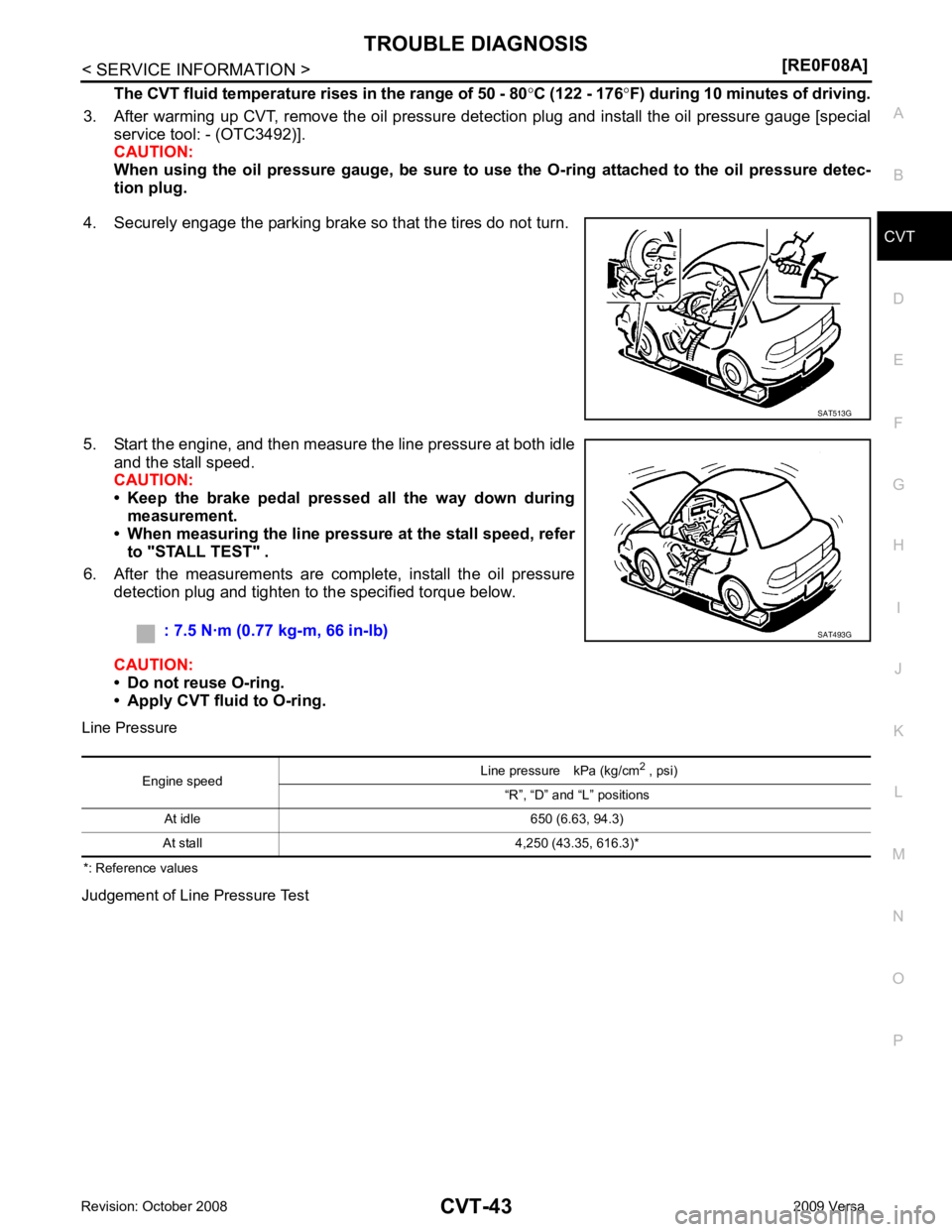
4. Securely engage the parking brake so that the tires do not turn.
5. Start the engine, and then measure the line pressure at both idle and the stall speed.
CAUTION:
• Keep the brake pedal pressed all the way down during
measurement.
• When measuring the line pressure at the stall speed, refer
to "STALL TEST" .
6. After the measurements are complete, install the oil pressure detection plug and tighten to the specified torque below.
CAUTION:
• Do not reuse O-ring.
• Apply CVT fluid to O-ring.
Line Pressure
*: Reference values
Judgement of Line Pressure Test
Page 1136 of 4331
![NISSAN TIIDA 2009 Service Owners Manual CVT-192< SERVICE INFORMATION >
[RE0F08B]
PRECAUTIONS
Rotate bayonet ring counterclockwise, pull out CVT unit harness
connector upward and disconnect it.
INSTALLATION
1. Align CVT unit harne](/img/5/57398/w960_57398-1135.png "NISSAN TIIDA 2009 Service Owners Manual CVT-192< SERVICE INFORMATION >
[RE0F08B]
PRECAUTIONS
Rotate bayonet ring counterclockwise, pull out CVT unit harness
connector upward and disconnect it.
INSTALLATION
1. Align CVT unit harne")
CVT-192< SERVICE INFORMATION >
[RE0F08B]
PRECAUTIONS
Rotate bayonet ring counterclockwise, pull out CVT unit harness
connector upward and disconnect it.
INSTALLATION
1. Align CVT unit harness connector terminal body marking with bayonet ring marking, insert CVT unit harness connector, and
then rotate bayonet ring clockwise.
2. Rotate bayonet ring clockwise until CVT unit harness connector terminal body marking is aligned with the bayonet ring marking
(linear slit) as shown.
CAUTION:
• Securely align CVT unit ha rness connector terminal body
marking with bayonet ring mark ing (linear slit). Do not
make a half fit condition as shown.
• Do not mistake the bayonet ring marking (linear slit) for
other dent portion.
Precaution INFOID:0000000004305566
NOTE:
If any malfunction occurs in the RE0F08B m odel transaxle, replace the entire transaxle assembly. SCIA2096E
SCIA2097E
SCIA2098E
SCIA2099E
Page 1140 of 4331
![NISSAN TIIDA 2009 Service Owners Manual CVT-196< SERVICE INFORMATION >
[RE0F08B]
CVT FLUID
CVT FLUID
Checking CVT Fluid INFOID:0000000004305570
FLUID LEVEL CHECK
Fluid level should be checked with the fluid warmed up to 50 ° to 80 °C (122](/img/5/57398/w960_57398-1139.png "NISSAN TIIDA 2009 Service Owners Manual CVT-196< SERVICE INFORMATION >
[RE0F08B]
CVT FLUID
CVT FLUID
Checking CVT Fluid INFOID:0000000004305570
FLUID LEVEL CHECK
Fluid level should be checked with the fluid warmed up to 50 ° to 80 °C (122")
CVT-196< SERVICE INFORMATION >
[RE0F08B]
CVT FLUID
CVT FLUID
Checking CVT Fluid INFOID:0000000004305570
FLUID LEVEL CHECK
Fluid level should be checked with the fluid warmed up to 50 ° to 80 °C (122 ° to 176 °F).
1. Check for fluid leakage.
2. With the engine warmed up, drive the vehicle to warm up the CVT fluid. When ambient temperature is 20 °C (68 °F), it takes
about 10 minutes for the CVT fluid to warm up to 50 ° to 80 °C
(122 ° to 176 °F).
3. Park the vehicle on a level surface and set the parking brake.
4. With engine at idle, while depressing brake pedal, move the selector lever throughout the entire shift range and return it to
the “P” position.
5. Press the tab on the CVT fluid level gauge to release the lock and pull out the CVT fluid level gauge from the CVT fluid charg-
ing pipe.
6. Wipe fluid off the CVT fluid level gauge. Then rotate the CVT fluid level gauge 180 ° and re-insert it into the CVT charging pipe
as far as it will go.
CAUTION:
Always use lint free paper towels to wipe fluid off the CVT
fluid level gauge.
7. Remove the CVT fluid level gauge and check that the fluid level is within the specified range as shown. If the fluid level is at or
below the low side of the range, add the necessary specified
NISSAN CVT fluid through the CVT charging pipe.
CAUTION:
• Only use specified NISSAN CVT fluid.
• Do not overfill the CVT.
8. Install the CVT fluid level gauge to the CVT fluid charging pipe until it locks. CAUTION:
When CVT fluid level gauge is in stalled into the CVT fluid charging pipe, make sure that the CVT
fluid level gauge is securely locked in place. SMA146B
SCIA1933E
SCIA1931E
Fluid grade: Refer to
MA-14, " Fluids and Lubri-
cants " .
SCIA1932E
Page 1164 of 4331
![NISSAN TIIDA 2009 Service Owners Manual CVT-220< SERVICE INFORMATION >
[RE0F08B]
TROUBLE DIAGNOSIS
• Inspect for fluid leakage and check the fluid level. Refer to CVT-196, " Checking CVT Fluid " .
Fluid Condition Check
Inspect the fluid](/img/5/57398/w960_57398-1163.png "NISSAN TIIDA 2009 Service Owners Manual CVT-220< SERVICE INFORMATION >
[RE0F08B]
TROUBLE DIAGNOSIS
• Inspect for fluid leakage and check the fluid level. Refer to CVT-196, \" Checking CVT Fluid \" .
Fluid Condition Check
Inspect the fluid")
CVT-220< SERVICE INFORMATION >
[RE0F08B]
TROUBLE DIAGNOSIS
• Inspect for fluid leakage and check the fluid level. Refer to CVT-196, " Checking CVT Fluid " .
Fluid Condition Check
Inspect the fluid condition.
STALL TEST
Stall Test Procedure
1. Inspect the amount of engine oil. Replenish the engine oil if necessary.
2. Drive for about 10 minutes to wa rm up the vehicle so that the
CVT fluid temperature is 50 to 80 °C (122 to 176 °F). Inspect the
amount of CVT fluid. Replenish if necessary.
3. Securely engage the parking brake so that the tires do not turn.
4. Install a tachometer where it can be seen by driver during test. •It is good practice to mark the point of specified engine
rpm on indicator.
5. Start engine, apply foot brake, and place selector lever in “D” position.Fluid status Conceivable cause Required operation
Varnished (viscous
varnish state) Clutch, brake
scorched Replace the CVT fluid and check the
CVT main unit and the vehicle for
malfunctions (wire harnesses, cool-
er pipes, etc.)
Milky white or
cloudy Water in the fluidReplace the CVT fluid and check for
places where water is getting in.
Large amount of
metal powder mixed
in Unusual wear of
sliding parts within
CVT Replace the CVT fluid and check for
improper operation of the CVT. SAT638A
SAT647B
SAT513G
SAT775B
Page 1166 of 4331
![NISSAN TIIDA 2009 Service Owners Manual CVT-222< SERVICE INFORMATION >
[RE0F08B]
TROUBLE DIAGNOSIS
The CVT fluid temperature rises in the range of 50 - 80 °C (122 - 176 °F) during 10 minutes of driving.
3. After warming up CVT, remove the](/img/5/57398/w960_57398-1165.png "NISSAN TIIDA 2009 Service Owners Manual CVT-222< SERVICE INFORMATION >
[RE0F08B]
TROUBLE DIAGNOSIS
The CVT fluid temperature rises in the range of 50 - 80 °C (122 - 176 °F) during 10 minutes of driving.
3. After warming up CVT, remove the")
CVT-222< SERVICE INFORMATION >
[RE0F08B]
TROUBLE DIAGNOSIS
The CVT fluid temperature rises in the range of 50 - 80 °C (122 - 176 °F) during 10 minutes of driving.
3. After warming up CVT, remove the oil pressure detection plug and install the oil pressure gauge [special service tool: - (OTC3492)].
CAUTION:
When using the oil pressure gauge, be sure to u se the O-ring attached to the oil pressure detec-
tion plug.
4. Securely engage the parking brake so that the tires do not turn.
5. Start the engine, and then measure the line pressure at both idle and the stall speed.
CAUTION:
• Keep the brake pedal pressed all the way down during
measurement.
• When measuring the line pressure at the stall speed, refer
to "STALL TEST" .
6. After the measurements are complete, install the oil pressure detection plug and tighten to the specified torque below.
CAUTION:
• Do not reuse O-ring.
• Apply CVT fluid to O-ring.
Line Pressure
Judgement of Line Pressure Test SAT513G
: 7.5 N·m (0.77 kg-m, 66 in-lb)
SAT493G
Engine speed
Line pressure kPa (kg/cm
2
, psi)
“R”, “D” and “L” positions
At idle CVT-357, " Line Pressure "
At stall
Page 1314 of 4331
![NISSAN TIIDA 2009 Service Owners Manual CONSULT-III display Malfunction Reference page
CAN COMM CIRC [U1000] Malfunction is detected in CAN communication lines.
CAUTION:
Even when there is no malfunct ion on CAN communication system, mal-
f](/img/5/57398/w960_57398-1313.png "NISSAN TIIDA 2009 Service Owners Manual CONSULT-III display Malfunction Reference page
CAN COMM CIRC [U1000] Malfunction is detected in CAN communication lines.
CAUTION:
Even when there is no malfunct ion on CAN communication system, mal-
f")
CONSULT-III display Malfunction Reference page
CAN COMM CIRC [U1000] Malfunction is detected in CAN communication lines.
CAUTION:
Even when there is no malfunct ion on CAN communication system, mal-
function may be misinterpreted when battery has low voltage (when main-
taining 7 - 8 V for about 2 seconds) or 10A fuse [No. 14, located in the fuse
block (J/B)] is removed. DI-18VEHICLE SPEED CIRC [B2205]
Malfunction is detected when an erroneous speed signal is input.
CAUTION:
Even when there is no malfunction on speed signal system, malfunctions
may be misinterpreted when battery has low voltage (when maintaining 7
- 8 V for about 2 seconds). DI-15Display item [Unit]
MAIN
SIGNALS SELECTION
FROM MENU Contents
SPEED METER [km/h] X X The value of vehicle speed sign
al, which is input from ABS ac-
tuator and electric unit (control unit).
SPEED OUTPUT [km/h] X X The value of vehicle speed signal, which is transmitted to each
unit with CAN communication.
TACHO METER [rpm] X X The value of engine speed signal, which is input from ECM.
W TEMP METER [ °C] X X The value of engine coolant temperature signal, which is input
from ECM.
FUEL METER [lit.] X X The value, which processes a resistance signal from fuel
gauge.
DISTANCE [km] X X The value, which is calculated by vehicle speed signal from
ABS actuator and electric unit (con trol unit), fuel gauge and fuel
consumption signal from ECM.
FUEL W/L [ON/OFF] X X Indicates [ON/OFF] condition of low-fuel warning lamp.
C-ENG W/L [ON/OFF] X Indicates [ON/OFF] condition of malfunction indicator lamp
(MIL).
AIR PRES W/L X Indicates [ON/OFF] condition of low tire pressure warning lamp.
SEAT BELT W/L X Indicates [ON/OFF] condition of seat belt warning lamp.
BUZZER [ON/OFF] X X Indicates [ON/ OFF] condition of buzzer.
DOOR W/L [ON/OFF] X Indicates [ON/OFF] condition of door warning lamp.
HI-BEAM IND [ON/OFF] X Indicat es [ON/OFF] condition of high beam indicator lamp.
Page 1512 of 4331
![NISSAN TIIDA 2009 Service Owners Manual EC-156< COMPONENT DIAGNOSIS >
[HR16DE]
P0102, P0103 MAF SENSOR
P0102, P0103 MAF SENSOR
Description INFOID:0000000004780075
The mass air flow sensor (1) is placed in the stream of intake a](/img/5/57398/w960_57398-1511.png "NISSAN TIIDA 2009 Service Owners Manual EC-156< COMPONENT DIAGNOSIS >
[HR16DE]
P0102, P0103 MAF SENSOR
P0102, P0103 MAF SENSOR
Description INFOID:0000000004780075
The mass air flow sensor (1) is placed in the stream of intake a")
EC-156< COMPONENT DIAGNOSIS >
[HR16DE]
P0102, P0103 MAF SENSOR
P0102, P0103 MAF SENSOR
Description INFOID:0000000004780075
The mass air flow sensor (1) is placed in the stream of intake air. It
measures the intake flow rate by measuring a part of the entire
intake flow. The mass air flow sensor controls the temperature of the
hot wire to a certain amount. The heat generated by the hot wire is
reduced as the intake air flows around it. The more air, the greater
the heat loss.
Therefore, the electric current supplied to hot wire is changed to
maintain the temperature of the hot wire as air flow increases. The
ECM detects the air flow by means of this current change.
DTC Logic INFOID:0000000004780076
DTC DETECTION LOGIC
DTC CONFIRMATION PROCEDURE 1.
PRECONDITIONING
If DTC Confirmation Procedure has been previously conduc ted, always turn ignition switch OFF and wait at
least 10 seconds before conducting the next test.
Which DTC is detected? P0102 >> GO TO 2.
P0103 >> GO TO 3. 2.
PERFORM DTC CONFIRMATION PROCEDURE FOR DTC P0102
1. Start engine and wait at least 5 seconds.
2. Check DTC.
Is DTC detected? YES >> Go to
EC-157, " Diagnosis Procedure " .
NO >> INSPECTION END 3.
PERFORM DTC CONFIRMATION PROCEDURE FOR DTC P0103-I
1. Turn ignition switch ON and wait at least 5 seconds.
2. Check DTC.
Is DTC detected? YES >> Go to
EC-157, " Diagnosis Procedure " .
NO >> GO TO 4. 4.
PERFORM DTC CONFIRMATION PROCEDURE FOR DTC P0103-II
1. Start engine and wait at least 5 seconds.
2. Check DTC.
Is DTC detected? YES >> Go to
EC-157, " Diagnosis Procedure " .
NO >> INSPECTION END PBIA9559J
DTC No. Trouble diagnosis name DTC detecting condition Possible cause
P0102 Mass air flow sensor circuit
low input An excessively low voltage from the sensor is
sent to ECM. • Harness or connectors
(The sensor circuit is open or shorted.)
• Intake air leaks
• Mass air flow sensor
P0103 Mass air flow sensor circuit
high input An excessively high voltage from the sensor is
sent to ECM. • Harness or connectors
(The sensor circuit is open or shorted.)
• Mass air flow sensor
Page 2011 of 4331
![NISSAN TIIDA 2009 Service Owners Manual DTC P0101 MAF SENSOR
EC-655
< SERVICE INFOMATION >
[MR TYPE 1] C
D E
F
G H
I
J
K L
M A EC
NP
O
DTC P0101 MAF SENSOR
Component Description INFOID:0000000004537112
The mass air flow sensor (1) is](/img/5/57398/w960_57398-2010.png "NISSAN TIIDA 2009 Service Owners Manual DTC P0101 MAF SENSOR
EC-655
< SERVICE INFOMATION >
[MR TYPE 1] C
D E
F
G H
I
J
K L
M A EC
NP
O
DTC P0101 MAF SENSOR
Component Description INFOID:0000000004537112
The mass air flow sensor (1) is")
DTC P0101 MAF SENSOR
EC-655
< SERVICE INFOMATION >
[MR TYPE 1] C
D E
F
G H
I
J
K L
M A EC
NP
O
DTC P0101 MAF SENSOR
Component Description INFOID:0000000004537112
The mass air flow sensor (1) is plac ed in the stream of intake air. It
measures the intake flow rate by measuring a part of the entire
intake flow. The mass air flow sens or controls the temperature of the
hot wire to a certain amount. The heat generated by the hot wire is
reduced as the intake air flows around it. The more air, the greater
the heat loss.
Therefore, the electric current supplied to hot wire is changed to
maintain the temperature of the hot wire as air flow increases. The
ECM detects the air flow by means of this current change.
CONSULT-III Reference Val ue in Data Monitor Mode INFOID:0000000004537113
Specification data are reference values.
On Board Diagnosis Logic INFOID:0000000004537114
DTC Confirmation Procedure INFOID:0000000004537115
Perform PROCEDURE FOR MALFUNCTION A first.
If the DTC cannot be confirmed, perform PROCEDURE FOR MALFUNCTION B.
NOTE:
If DTC Confirmation Procedure has been previously conduc ted, always turn ignition switch OFF and wait at
least 10 seconds before conducting the next test. PBIA9559J
MONITOR ITEM CONDITION SPECIFICATION
MAS A/F SE-B1 • See EC-618 .
CAL/LD VALUE • Engine: After warming up
• Shift lever: P or N (A/T, CVT), Neutral (M/T)
• Air conditioner switch: OFF
• No load Idle 10% - 35%
2,500 rpm 10% - 35%
MASS AIRFLOW • Engine: After warming up
• Shift lever: P or N (A/T, CVT),
Neutral (M/T)
• Air conditioner switch: OFF
• No load Idle 1.0 - 4.0 g·m/s
2,500 rpm 4.0 - 10.0 g·m/s DTC No. Trouble diagnosis name DTC detecting condition Possible cause
P0101
0101 Mass air flow sensor cir-
cuit range/performance A)
A high voltage from the sensor is sent to ECM
under light load driving condition. • Harness or connectors
(Mass air flow sensor circuit is
open or shorted.)
• Mass air flow sensor
• EVAP control system pressure
sensor
• Intake air temperature sensor
B) A low voltage from the sensor is sent to ECM un-
der heavy load driving condition. • Harness or connectors
(Mass air flow sensor circuit is
open or shorted.)
• Intake air leaks
• Mass air flow sensor
• EVAP control system pressure sensor
• Intake air temperature sensor
Page 2019 of 4331
![NISSAN TIIDA 2009 Service Owners Manual DTC P0102, P0103 MAF SENSOR
EC-663
< SERVICE INFOMATION >
[MR TYPE 1] C
D E
F
G H
I
J
K L
M A EC
NP
O
DTC P0102, P0103 MAF SENSOR
Component Description INFOID:0000000004537121
The mass air flow se](/img/5/57398/w960_57398-2018.png "NISSAN TIIDA 2009 Service Owners Manual DTC P0102, P0103 MAF SENSOR
EC-663
< SERVICE INFOMATION >
[MR TYPE 1] C
D E
F
G H
I
J
K L
M A EC
NP
O
DTC P0102, P0103 MAF SENSOR
Component Description INFOID:0000000004537121
The mass air flow se")
DTC P0102, P0103 MAF SENSOR
EC-663
< SERVICE INFOMATION >
[MR TYPE 1] C
D E
F
G H
I
J
K L
M A EC
NP
O
DTC P0102, P0103 MAF SENSOR
Component Description INFOID:0000000004537121
The mass air flow sensor (1) is plac ed in the stream of intake air. It
measures the intake flow rate by measuring a part of the entire
intake flow. The mass air flow sens or controls the temperature of the
hot wire to a certain amount. The heat generated by the hot wire is
reduced as the intake air flows around it. The more air, the greater
the heat loss.
Therefore, the electric current supplied to hot wire is changed to
maintain the temperature of the hot wire as air flow increases. The
ECM detects the air flow by means of this current change.
CONSULT-III Reference Val ue in Data Monitor Mode INFOID:0000000004537122
Specification data are reference values.
On Board Diagnosis Logic INFOID:0000000004537123
These self-diagnoses have the on e trip detection logic.
FAIL-SAFE MODE When the malfunction is detec ted, the ECM enters fail-safe mode and the MIL lights up.
DTC Confirmation Procedure INFOID:0000000004537124
NOTE:
If DTC Confirmation Procedure has been previously conduc ted, always turn ignition switch OFF and wait at
least 10 seconds before conducting the next test. PBIA9559J
MONITOR ITEM CONDITION SPECIFICATION
MAS A/F SE-B1 See EC-618 .
CAL/LD VALUE • Engine: After warming up
• Shift lever: P or N (A/T, CVT), Neutral (M/T)
• Air conditioner switch: OFF
• No load Idle 10% - 35%
2,500 rpm 10% - 35%
MASS AIRFLOW • Engine: After warming up
• Shift lever: P or N (A/T, CVT),
Neutral (M/T)
• Air conditioner switch: OFF
• No load Idle 1.0 - 4.0 g·m/s
2,500 rpm 4.0 - 10.0 g·m/s DTC No.
Trouble diagnosis
name DTC detecting condition Possible cause
P0102
0102 Mass air flow sensor
circuit low input An excessively low voltage from the sensor is sent
to ECM. • Harness or connectors
(Mass air flow sensor circuit is open or short-
ed.)
• Intake air leaks
• Mass air flow sensor
P0103
0103 Mass air flow sensor
circuit high input An excessively high voltage from the sensor is
sent to ECM. • Harness or connectors
(Mass air flow sensor circuit is open or short-
ed.)
• Mass air flow sensor Detected items Engine operating condition in fail-safe mode
Mass air flow sensor circuit Engine speed will not rise more than 2,400 rpm due to the fuel cut.
Page 2526 of 4331
![NISSAN TIIDA 2009 Service Owners Manual EC-1170< SERVICE INFOMATION >
[MR TYPE 2]
DTC P0101 MAF SENSOR
DTC P0101 MAF SENSOR
Component Description INFOID:0000000004499998
The mass air flow sensor (1) is placed in the stream of in](/img/5/57398/w960_57398-2525.png "NISSAN TIIDA 2009 Service Owners Manual EC-1170< SERVICE INFOMATION >
[MR TYPE 2]
DTC P0101 MAF SENSOR
DTC P0101 MAF SENSOR
Component Description INFOID:0000000004499998
The mass air flow sensor (1) is placed in the stream of in")
EC-1170< SERVICE INFOMATION >
[MR TYPE 2]
DTC P0101 MAF SENSOR
DTC P0101 MAF SENSOR
Component Description INFOID:0000000004499998
The mass air flow sensor (1) is placed in the stream of intake air. It
measures the intake flow rate by measuring a part of the entire
intake flow. The mass air flow sensor controls the temperature of the
hot wire to a certain amount. The heat generated by the hot wire is
reduced as the intake air flows around it. The more air, the greater
the heat loss.
Therefore, the electric current supplied to hot wire is changed to
maintain the temperature of the hot wire as air flow increases. The
ECM detects the air flow by means of this current change.
CONSULT-III Reference Value in Data Monitor Mode INFOID:0000000004499999
Specification data are reference values.
On Board Diagn osis Logic INFOID:0000000004500000
DTC Confirmation Procedure INFOID:0000000004500001
Perform PROCEDURE FOR MALFUNCTION A first.
If the DTC cannot be confirmed, perform PROCEDURE FOR MALFUNCTION B.
NOTE:
If DTC Confirmation Procedure has been previously conduc ted, always turn ignition switch OFF and wait at
least 10 seconds before conducting the next test. PBIA9559J
MONITOR ITEM CONDITION SPECIFICATION
MAS A/F SE-B1 • See EC-1130 .
CAL/LD VALUE • Engine: After warming up
• Shift lever: P or N (A/T, CVT), Neutral (M/T)
• Air conditioner switch: OFF
• No load Idle 10% - 35%
2,500 rpm 10% - 35%
MASS AIRFLOW • Engine: After warming up
• Shift lever: P or N (A/T, CVT),
Neutral (M/T)
• Air conditioner switch: OFF
• No load Idle 1.0 - 4.0 g·m/s
2,500 rpm 4.0 - 10.0 g·m/s DTC No. Trouble diagnosis name DTC detecting condition Possible cause
P0101
0101 Mass air flow sensor cir-
cuit range/performance A)
A high voltage from the sensor is sent to ECM
under light load driving condition. • Harness or connectors
(Mass air flow sensor circuit is
open or shorted.)
• Mass air flow sensor
• EVAP control system pressure
sensor
• Intake air temperature sensor
B) A low voltage from the sensor is sent to ECM un-
der heavy load driving condition. • Harness or connectors
(Mass air flow sensor circuit is
open or shorted.)
• Intake air leaks
• Mass air flow sensor
• EVAP control system pressure sensor
• Intake air temperature sensor