Catalyst NISSAN TIIDA 2011 Service Workshop Manual
[x] Cancel search | Manufacturer: NISSAN, Model Year: 2011, Model line: TIIDA, Model: NISSAN TIIDA 2011Pages: 3787, PDF Size: 78.35 MB
Page 2077 of 3787
![NISSAN TIIDA 2011 Service Workshop Manual DTC P0300 - P0304 MULTIPLE CYLINDER MISFIRE, NO. 1 - 4 CYLINDER MIS-
FIRE
EC-783
< SERVICE INFORMATION > [MR18DE]
C
D
E
F
G H
I
J
K L
M A
EC
NP
O
DTC P0300 - P0304 MULTIPLE CYLINDER
MISFIRE, NO. 1 -](/img/5/57396/w960_57396-2076.png "NISSAN TIIDA 2011 Service Workshop Manual DTC P0300 - P0304 MULTIPLE CYLINDER MISFIRE, NO. 1 - 4 CYLINDER MIS-
FIRE
EC-783
< SERVICE INFORMATION > [MR18DE]
C
D
E
F
G H
I
J
K L
M A
EC
NP
O
DTC P0300 - P0304 MULTIPLE CYLINDER
MISFIRE, NO. 1 -")
DTC P0300 - P0304 MULTIPLE CYLINDER MISFIRE, NO. 1 - 4 CYLINDER MIS-
FIRE
EC-783
< SERVICE INFORMATION > [MR18DE]
C
D
E
F
G H
I
J
K L
M A
EC
NP
O
DTC P0300 - P0304 MULTIPLE CYLINDER
MISFIRE, NO. 1 - 4 CYLINDER
MISFIRE
On Board Diagnosis LogicINFOID:0000000006341945
When a misfire occurs, engine speed will fluctuate. If the engine speed fluctuates enough to cause the crank-
shaft position (CKP) sensor (POS) signal to vary, ECM can determine that a misfire is occurring.
The misfire detection logic consists of the following two conditions.
1. One Trip Detection Logic (Three Way Catalyst Damage) On the 1st trip, when a misfire condition occurs that can damage the three way catalyst (TWC) due to
overheating, the MIL will blink.
When a misfire condition occurs, the ECM monitors the CKP sensor (POS) signal every 200 engine revo-
lutions for a change.
When the misfire condition decreases to a level t hat will not damage the TWC, the MIL will turn off.
If another misfire condition occurs that can damage the TWC on a second trip, the MIL will blink.
When the misfire condition decreases to a level t hat will not damage the TWC, the MIL will remain on.
If another misfire condition occurs that can damage the TWC, the MIL will begin to blink again.
2. Two Trip Detection Logic (Exhaust quality deterioration) For misfire conditions that will not damage the TWC (but will affect vehicle emissions), the MIL will only
light when the misfire is detected on a second trip. Du ring this condition, the ECM monitors the CKP sen-
sor signal every 1,000 engine revolutions.
A misfire malfunction can be detected on any one cylinder or on multiple cylinders.
DTC Confirmation ProcedureINFOID:0000000006341946
CAUTION:
Always drive vehicle in safe manner according to traf fic conditions and obey all traffic laws when driv-
ing.
NOTE:
If DTC Confirmation Procedure has been previously conducted, always turn ignition switch OFF and wait at
least 10 seconds before conducting the next test.
1. Start engine and warm it up to normal operating temperature.
2. Turn ignition switch OFF and wait at least 10 seconds.
3. Restart engine and let it idle for about 15 minutes.
4. Check 1st trip DTC.
5. If 1st trip DTC is detected, go to EC-784, "
Diagnosis Procedure".
NOTE:
If 1st trip DTC is not detected during above proc edure, performing the following procedure is advised.
a. Turn ignition switch OFF and wait at least 10 seconds.
b. Start engine and drive the vehicle under the similar conditi ons to (1st trip) Freeze Frame Data for a certain
time. Refer to table below.
Sensor Input Signal to ECM ECM function
Crankshaft position sensor (POS) Engine speedOn board diagnosis of misfire
DTC No. Trouble diagnosis name DTC detecting condition Possible cause
P0300
0300 Multiple cylinder misfire
detected
Multiple cylinder misfire.
• Improper spark plug
• Insufficient compression
• Incorrect fuel pressure
• Fuel injector circuit is open or shorted
• Fuel injector
• Intake air leak
• The ignition signal circuit is open or shorted
• Lack of fuel
• Drive plate or flywheel
• Air fuel ratio (A/F) sensor 1
• Incorrect PCV hose connection
P0301
0301
No.1 cylinder misfire de-
tected
No. 1 cylinder misfires.
P0302
0302 No. 2 cylinder misfire
detected
No. 2 cylinder misfires.
P0303
0303 No. 3 cylinder misfire
detected
No. 3 cylinder misfires.
P0304
0304 No. 4 cylinder misfire
detected
No. 4 cylinder misfires.
Revision: May 2010
2011 Versa
Page 2078 of 3787
![NISSAN TIIDA 2011 Service Workshop Manual EC-784
< SERVICE INFORMATION >[MR18DE]
DTC P0300 - P0304 MULTIPLE CYLINDER
MISFIRE, NO. 1 - 4 CYLINDER MIS-
FIRE
Hold the accelerator pedal as steady as possible.
The similar conditions to (1st trip)](/img/5/57396/w960_57396-2077.png "NISSAN TIIDA 2011 Service Workshop Manual EC-784
< SERVICE INFORMATION >[MR18DE]
DTC P0300 - P0304 MULTIPLE CYLINDER
MISFIRE, NO. 1 - 4 CYLINDER MIS-
FIRE
Hold the accelerator pedal as steady as possible.
The similar conditions to (1st trip)")
EC-784
< SERVICE INFORMATION >[MR18DE]
DTC P0300 - P0304 MULTIPLE CYLINDER
MISFIRE, NO. 1 - 4 CYLINDER MIS-
FIRE
Hold the accelerator pedal as steady as possible.
The similar conditions to (1st trip) Freeze Frame Da ta means the vehicle operation that the following con-
dition should be satisfied at the same time:
The time to driving varies according to the engine speed in the freeze frame data.
Refer to the following table.
Diagnosis ProcedureINFOID:0000000006341947
1.CHECK FOR INTAKE AIR LEAK AND PCV HOSE
1. Start engine and run it at idle speed.
2. Listen for the sound of the intake air leak.
3. Check PCV hose connection.
OK or NG
OK >> GO TO 2.
NG >> Repair or replace.
2.CHECK FOR EXHAUST SYSTEM CLOGGING
Stop engine and visually check exhaust tube, three way catalyst and muffler for dents.
OK or NG
OK >> GO TO 3.
NG >> Repair or replace.
3.PERFORM POWER BALANCE TEST
With CONSULT-III
1. Perform “POWER BALANCE” in “ACTIVE TEST” mode.
2. Is there any cylinder which does not produce a momentary engine speed drop?
Without CONSULT-III
When disconnecting each fuel inje ctor (1) harness connector one at
a time, is there any cylinder which does not produce a momentary
engine speed drop?
Ye s o r N o
Engine speed Engine speed in the freeze frame data ± 400 rpm
Vehicle speed Vehicle speed in the freeze frame data ± 10 km/h (6 MPH)
Basic fuel schedule Basic fuel schedule in the freeze frame data × (1 ± 0.1)
Engine coolant temperature
(T) condition When the freeze frame data shows lower than 70
°C (158 °F), T should be lower than 70 °C (158 °F)
When the freeze frame data shows higher than or equal to 70 °C (158 °F), T should be higher than or
equal to 70° C (158°F)
Engine speed Time
Around 1,000 rpm Approximately 10 minutes
Around 2,000 rpm Approximately 5 minutes
More than 3,000 rpm Approximately 3.5 minutes
PBIA9870J
Revision: May 2010 2011 Versa
Page 2099 of 3787
![NISSAN TIIDA 2011 Service Workshop Manual DTC P0420 THREE WAY CATALYST FUNCTIONEC-805
< SERVICE INFORMATION > [MR18DE]
C
D
E
F
G H
I
J
K L
M A
EC
NP
O
DTC P0420 THREE WAY CATALYST FUNCTION
On Board Diagnosis LogicINFOID:0000000006341971
The E](/img/5/57396/w960_57396-2098.png "NISSAN TIIDA 2011 Service Workshop Manual DTC P0420 THREE WAY CATALYST FUNCTIONEC-805
< SERVICE INFORMATION > [MR18DE]
C
D
E
F
G H
I
J
K L
M A
EC
NP
O
DTC P0420 THREE WAY CATALYST FUNCTION
On Board Diagnosis LogicINFOID:0000000006341971
The E")
DTC P0420 THREE WAY CATALYST FUNCTIONEC-805
< SERVICE INFORMATION > [MR18DE]
C
D
E
F
G H
I
J
K L
M A
EC
NP
O
DTC P0420 THREE WAY CATALYST FUNCTION
On Board Diagnosis LogicINFOID:0000000006341971
The ECM monitors the switching frequency ratio of air fuel ratio (A/F)
sensor 1 and heated oxygen sensor 2.
A three way catalyst (manifold) with high oxygen storage capacity
will indicate a low switching frequency of heated oxygen sensor 2.
As oxygen storage capacity decreases, the heated oxygen sensor 2
switching frequency will increase.
When the frequency ratio of air fuel ratio (A/F) sensor 1 and heated
oxygen sensor 2 approaches a specified limit value, the three way
catalyst (manifold) malfunction is diagnosed.
DTC Confirmation ProcedureINFOID:0000000006341972
NOTE:
If DTC Confirmation Procedure has been previously conducted, always turn ignition switch OFF and wait at
least 10 seconds before conducting the next test.
WITH CONSULT-III
TESTING CONDITION:
Do not hold engine speed for more
than the specified minutes below.
1. Turn ignition switch ON and select “DATA MONITOR” mode with CONSULT-III.
2. Start engine and warm it up to the normal operating temperature.
3. Turn ignition switch OFF and wait at least 10 seconds.
4. Start engine and keep the engine speed between 3,500 and 4,000 rpm for at least 1 minute under no load.
5. Let engine idle for 1 minute.
6. Make sure that “COOLAN TEMP/S” indicates more than 70 °C (158° F).
If not, warm up engine and go to next step when “COOLAN TEMP/S” indication reaches to 70°C (158° F).
7. Open engine hood.
8. Select “DTC & SRT CONFIRMATION” then “SRT WORK SUPPORT” mode with CONSULT-III.
9. Rev engine up to 2,000 to 3,000 rpm and hold it for 3 consecutive minutes then release the accelerator pedal completely.
If “INCMP” of “CATALYST” changed to “CMPLT”, go to step 12.
10. Wait 5 seconds at idle.
11. Rev engine up to 2,000 to 3,000 rpm and maintain it unt il “INCMP” of “CATALYST” changes to “CMPLT” (It
will take approximately 5 minutes).
If not “CMPLT”, stop engine and cool it down to less than 70 °C (158° F) and then retest from step 1.
12. Check 1st trip DTC. If 1st trip DTC is detected, go to EC-806, "
Diagnosis Procedure".
Overall Function CheckINFOID:0000000006341973
Use this procedure to check the overall function of the three way catalyst (manifold). During this check, a 1st
trip DTC might not be confirmed.
SEF484YB
DTC No. Trouble diagnosis name DTC detecting conditionPossible cause
P0420
0420 Catalyst system efficiency
below threshold • Three way catalyst (manifold) does not operate
properly.
• Three way catalyst (manifold) does not have enough oxygen storage capacity. • Three way catalyst (manifold)
• Exhaust tube
• Intake air leaks
• Fuel injector
• Fuel injector leaks
• Spark plug
• Improper ignition timing
Revision: May 2010
2011 Versa
Page 2100 of 3787
![NISSAN TIIDA 2011 Service Workshop Manual EC-806
< SERVICE INFORMATION >[MR18DE]
DTC P0420 THREE WAY CATALYST FUNCTION
WITH GST
1. Start engine and warm it up to the normal operating temperature.
2. Turn ignition switch OFF and wait at least](/img/5/57396/w960_57396-2099.png "NISSAN TIIDA 2011 Service Workshop Manual EC-806
< SERVICE INFORMATION >[MR18DE]
DTC P0420 THREE WAY CATALYST FUNCTION
WITH GST
1. Start engine and warm it up to the normal operating temperature.
2. Turn ignition switch OFF and wait at least")
EC-806
< SERVICE INFORMATION >[MR18DE]
DTC P0420 THREE WAY CATALYST FUNCTION
WITH GST
1. Start engine and warm it up to the normal operating temperature.
2. Turn ignition switch OFF and wait at least 10 seconds.
3. Start engine and keep the engine speed between 3,500 and
4,000 rpm for at least 1 minute under no load.
4. Let engine idle for 1 minute.
5. Open engine hood.
6. Set voltmeter probe between ECM terminals 50 (HO2S2 signal) and ground.
7. Keep engine speed at 2,500 rpm constant under no load.
8. Make sure that the voltage does not vary for more than 5 sec- onds.
If the voltage fluctuation cycle takes less than 5 seconds, go to
EC-806, "
Diagnosis Procedure".
• 1 cycle: 0.6 - 1.0 → 0 - 0.3 → 0.6 - 1.0
Diagnosis ProcedureINFOID:0000000006341974
1.CHECK EXHAUST SYSTEM
Visually check exhaust tubes and muffler for dent.
OK or NG
OK >> GO TO 2.
NG >> Repair or replace.
2.CHECK EXHAUST GAS LEAK
1. Start engine and run it at idle.
2. Listen for an exhaust gas leak before the three way catalyst (manifold).
OK or NG
OK >> GO TO 3.
NG >> Repair or replace.
3.CHECK INTAKE AIR LEAK
Listen for an intake air leak after the mass air flow sensor.
OK or NG
OK >> GO TO 4.
NG >> Repair or replace.
4.CHECK IGNITION TIMING
Check the following items. Refer to EC-574, "
Basic Inspection".
PBIB2996E
PBIB1216E
Revision: May 2010 2011 Versa
Page 2101 of 3787
![NISSAN TIIDA 2011 Service Workshop Manual DTC P0420 THREE WAY CATALYST FUNCTIONEC-807
< SERVICE INFORMATION > [MR18DE]
C
D
E
F
G H
I
J
K L
M A
EC
NP
O
OK or NG
OK >> GO TO 5.
NG >> Follow the
EC-574, "
Basic Inspection".
5.CHECK FUEL INJECTO](/img/5/57396/w960_57396-2100.png "NISSAN TIIDA 2011 Service Workshop Manual DTC P0420 THREE WAY CATALYST FUNCTIONEC-807
< SERVICE INFORMATION > [MR18DE]
C
D
E
F
G H
I
J
K L
M A
EC
NP
O
OK or NG
OK >> GO TO 5.
NG >> Follow the
EC-574, \"
Basic Inspection\".
5.CHECK FUEL INJECTO")
DTC P0420 THREE WAY CATALYST FUNCTIONEC-807
< SERVICE INFORMATION > [MR18DE]
C
D
E
F
G H
I
J
K L
M A
EC
NP
O
OK or NG
OK >> GO TO 5.
NG >> Follow the
EC-574, "
Basic Inspection".
5.CHECK FUEL INJECTOR
1. Stop engine and turn ignition switch OFF.
2. Disconnect ECM harness connector.
3. Turn ignition switch ON.
4. Check voltage between ECM terminals 25, 29, 30, 31 and ground with CONSULT-III or tester. Refer to Wiring Diagram for fuel injectors, EC-1010, "
Wiring Diagram".
OK or NG
OK >> GO TO 6.
NG >> Perform EC-1011, "
Diagnosis Procedure".
6.CHECK FUNCTION OF IGNITION COIL-I
CAUTION:
Do the following procedure in the place where ventilation is good without the combustible.
1. Turn ignition switch OFF.
2. Remove fuel pump (1) fuse in IPDM E/R (2) to release fuel pres- sure.
NOTE:
Do not use CONSULT-III to release fuel pressure, or fuel pres-
sure applies again during the following procedure.
- : Vehicle front
3. Start engine.
4. After engine stalls, crank it two or three times to release all fuel pressure.
5. Turn ignition switch OFF.
6. Remove all ignition coil harness connectors to avoid the electri- cal discharge from the ignition coils.
7. Remove ignition coil and spark plug of the cylinder to be checked.
8. Crank engine for 5 seconds or more to remove combustion gas in the cylinder.
9. Connect spark plug and harness connector to ignition coil.
10. Fix ignition coil using a rope etc. with gap of 13 - 17 mm (0.52 - 0.66 in) between the edge of the spark plug and grounded metal
portion as shown in the figure.
11. Crank engine for about 3 seconds, and check whether spark is
generated between the spark plug and the grounded metal por-
tion.
CAUTION:
• Do not approach to the spark plug and the ignition coilwithin 50 cm. Be careful not to get an electrical shock
while checking, because the el ectrical discharge voltage
becomes 20 kV or more.
Items Specifications
Target idle speed A/T: 700 ±
50 rpm (in P or N position)
CVT: 700 ± 50 rpm (in P or N position)
M/T: 700 ± 50 rpm (in Neutral position)
Ignition timing A/T: 13 ±
5° BTDC (in P or N position)
CVT: 13 ± 5 ° BTDC (in P or N position)
M/T: 13 ± 5 ° BTDC (in Neutral position)
Voltage: Battery voltage
Spark should be generated.
PBIB2958E
PBIB2325E
Revision: May 2010 2011 Versa
Page 2102 of 3787
![NISSAN TIIDA 2011 Service Workshop Manual EC-808
< SERVICE INFORMATION >[MR18DE]
DTC P0420 THREE WAY CATALYST FUNCTION
• It might cause to damage the igni
tion coil if the gap of more than 17 mm (0.66 in) is taken.
NOTE:
When the gap is les](/img/5/57396/w960_57396-2101.png "NISSAN TIIDA 2011 Service Workshop Manual EC-808
< SERVICE INFORMATION >[MR18DE]
DTC P0420 THREE WAY CATALYST FUNCTION
• It might cause to damage the igni
tion coil if the gap of more than 17 mm (0.66 in) is taken.
NOTE:
When the gap is les")
EC-808
< SERVICE INFORMATION >[MR18DE]
DTC P0420 THREE WAY CATALYST FUNCTION
• It might cause to damage the igni
tion coil if the gap of more than 17 mm (0.66 in) is taken.
NOTE:
When the gap is less than 13 mm (0.52 in), the sp ark might be generated even if the coil is mal-
functioning.
OK or NG
OK >> GO TO 10.
NG >> GO TO 7.
7.CHECK FUNCTION OF IGNITION COIL-II
1. Turn ignition switch OFF.
2. Disconnect spark plug and connect a known-good spark plug.
3. Crank engine for about 3 seconds, and recheck whether spark is generated between the spark plug and the grounded metal portion.
OK or NG
OK >> GO TO 8.
NG >> Check ignition coil, power transistor and their circuits. Refer to EC-1019
.
8.CHECK SPARK PLUG
Check the initial spark plug for fouling, etc.
OK or NG
OK >> Replace spark plug(s) with standard type one(s). For spark plug type, refer to EM-230, "
Standard and Limit".
NG >> 1. Repair or clean spark plug.
2. GO TO 9.
9.CHECK FUNCTION OF IGNITION COIL-III
1. Reconnect the initial spark plugs.
2. Crank engine for about 3 seconds, and recheck whether spark is generated between the spark plug and the grounded portion.
OK or NG
OK >> INSPECTION END
NG >> Replace spark plug(s) with standard type one(s). For spark plug type, refer to EM-230, "
Standard
and Limit".
10.CHECK FUEL INJECTOR
1. Turn ignition switch OFF.
2. Remove fuel injector assembly. Refer to EM-154, "
Removal and Installation".
Keep fuel hose and all fuel injectors connected to fuel tube.
3. Disconnect all ignition coil harness connectors.
4. Reconnect all fuel injector harness connectors disconnected.
5. Turn ignition switch ON. Make sure fuel does not drip from fuel injector.
OK or NG
OK (Does not drip.)>>GO TO 11.
NG (Drips.)>>Replace the fuel injector(s) from which fuel is dripping.
11 .CHECK INTERMITTENT INCIDENT
Refer to EC-632
.
Spark should be generated.
SEF156I
Spark should be generated.
Revision: May 2010
2011 Versa
Page 2103 of 3787
![NISSAN TIIDA 2011 Service Workshop Manual DTC P0420 THREE WAY CATALYST FUNCTIONEC-809
< SERVICE INFORMATION > [MR18DE]
C
D
E
F
G H
I
J
K L
M A
EC
NP
O
Trouble is fixed.>>
INSPECTION END
Trouble is not fixed.>>Replace three way catalyst (manif](/img/5/57396/w960_57396-2102.png "NISSAN TIIDA 2011 Service Workshop Manual DTC P0420 THREE WAY CATALYST FUNCTIONEC-809
< SERVICE INFORMATION > [MR18DE]
C
D
E
F
G H
I
J
K L
M A
EC
NP
O
Trouble is fixed.>>
INSPECTION END
Trouble is not fixed.>>Replace three way catalyst (manif")
DTC P0420 THREE WAY CATALYST FUNCTIONEC-809
< SERVICE INFORMATION > [MR18DE]
C
D
E
F
G H
I
J
K L
M A
EC
NP
O
Trouble is fixed.>>
INSPECTION END
Trouble is not fixed.>>Replace three way catalyst (manifold).
Revision: May 2010 2011 Versa
Page 2187 of 3787
![NISSAN TIIDA 2011 Service Workshop Manual DTC P050A, P050B, P050E COLD START CONTROLEC-893
< SERVICE INFORMATION > [MR18DE]
C
D
E
F
G H
I
J
K L
M A
EC
NP
O
DTC P050A, P050B, P050E COLD START CONTROL
DescriptionINFOID:0000000006342118
ECM cont](/img/5/57396/w960_57396-2186.png "NISSAN TIIDA 2011 Service Workshop Manual DTC P050A, P050B, P050E COLD START CONTROLEC-893
< SERVICE INFORMATION > [MR18DE]
C
D
E
F
G H
I
J
K L
M A
EC
NP
O
DTC P050A, P050B, P050E COLD START CONTROL
DescriptionINFOID:0000000006342118
ECM cont")
DTC P050A, P050B, P050E COLD START CONTROLEC-893
< SERVICE INFORMATION > [MR18DE]
C
D
E
F
G H
I
J
K L
M A
EC
NP
O
DTC P050A, P050B, P050E COLD START CONTROL
DescriptionINFOID:0000000006342118
ECM controls ignition timing and engine idle speed when engine is started with prewarming up condition.
This control promotes the activation of three way catalyst by heating the catalyst and reduces emissions.
On Board Diagnosis LogicINFOID:0000000006342119
DTC Confirmation ProcedureINFOID:0000000006342120
NOTE:
• If DTC Confirmation Procedure has been previously conduc
ted, always turn ignition switch OFF and wait at
least 10 seconds before conducting the next test.
• If DTC P050A, P050B or P050E is displayed with ot her DTC, first perform the trouble diagnosis for
other DTC.
TESTING CONDITION:
Before performing the following procedure, confirm that battery voltage is more than 11 V at idle.
1.PERFORM DTC CONFIRMATION PROCEDURE-I
WITH CONSULT-III
1. Turn ignition switch OFF and wait at least 10 seconds.
2. Turn ignition switch ON.
3. Select “DATA MONITOR” mode with CONSULT-III.
4. Check the indication of “COOLAN TEMP/S”.
WITH GST
Follow the procedure “WITH CONSULT-III” above.
Is the value of
“COOLAN TEMP/S” between 20°C (68°F) and 36°C (97°F)?
YES >> GO TO 2.
NO-1 [If it is below 20° C (68°F)]>>Warm up the engine unit the value of “COOLAN TEMP/S” reaches 20 °C
(68 °F) or more. Retry from step 1.
NO-2 [If it is above 36 °C (97 °F)]>>Cool engine down to less than 36 °C (97° F). Retry from step 1.
2.PERFORM DTC CONFIRMATION PROCEDURE-II
WITH CONSULT-III
1. Set the select lever in N range.
2. Start the engine and warm up in idle with the value of “COOLAN TEMP/S”\
between 20 °C (68° F) and 40° C
(104° F) for more than 15 seconds.
3. Check 1st trip DTC.
WITH GST
Follow the procedure “WITH CONSULT-III” above.
Is 1st trip DTC detected?
YES >> Go to EC-894, "Diagnosis Procedure".
NO >> INSPECTION END
DTC No. Trouble diagnosis name DTC detecting conditionPossible cause
P050A
050A Cold start idle air control system
performance ECM does not control engine idle speed properly
when engine is started with pre-warming up con-
dition.
• Lack of intake air volume
• Fuel injection system
•ECM
P050B
050B
Cold start ignition timing perfor-
mance ECM does not control ignition timing properly
when engine is started with pre-warming up con-
dition.
P050E
050E Cold start engine exhaust temper-
ature too low The temperature of the catalyst inlet does not
rise to the proper temperature when the engine
is started with pre-warming up condition.
Revision: May 2010
2011 Versa
Page 2705 of 3787

GI-1
GENERAL INFORMATION
C
DE
F
G H
I
J
K L
M B
GI
SECTION GI
N
O P
CONTENTS
GENERAL INFORMATION
SERVICE INFORMATION .. ..........................2
PRECAUTIONS .............................................. .....2
Description .......................................................... ......2
Precaution for Supplemental Restraint System
(SRS) "AIR BAG" and "SEAT BELT PRE-TEN-
SIONER" ...................................................................
2
Precaution Necessary for Steering Wheel Rota-
tion After Battery Disconnect ............................... ......
2
General Precaution ...................................................3
Precaution for Three Way Catalyst ...........................4
Precaution for Fuel (Unleaded Regular Gasoline
Recommended) .........................................................
4
Precaution for Multiport Fuel Injection System or
Engine Control System .............................................
5
Precaution for Hoses .................................................5
Precaution for Engine Oils ........................................6
Precaution for Air Conditioning .................................6
HOW TO USE THIS MANUAL ............................7
Description .......................................................... ......7
Terms ........................................................................7
Units ..........................................................................7
Contents ....................................................................7
Relation between Illustrations and Descriptions .......8
Component ................................................................8
How to Follow Trouble Diagnosis ..............................9
How to Read Wiring Diagram ..................................13
Abbreviations ...................................................... ....20
SERVICE INFORMATION FOR ELECTRICAL
INCIDENT ...........................................................
22
How to Check Terminal ...........................................22
How to Perform Efficient Diagnosis for an Electri-
cal Incident .......................................................... ....
25
Control Units and Electrical Parts ............................32
CONSULT-III CHECKING SYSTEM .................35
Description ...............................................................35
Function and System Application ............................35
CONSULT-III Data Link Connector (DLC) Circuit ....36
LIFTING POINT .................................................38
Special Service Tool ................................................38
Garage Jack and Safety Stand and 2-Pole Lift .......38
Board-On Lift ...........................................................39
TOW TRUCK TOWING .....................................40
Tow Truck Towing ...................................................40
Vehicle Recovery (Freeing a Stuck Vehicle) ...........40
TIGHTENING TORQUE OF STANDARD
BOLTS ...............................................................
41
Tightening Torque Table .........................................41
RECOMMENDED CHEMICAL PRODUCTS
AND SEALANTS ...............................................
42
Recommended Chemical Product and Sealant .......42
IDENTIFICATION INFORMATION ....................43
Model Variation ........................................................43
Dimensions ..............................................................46
Wheels & Tires ........................................................46
TERMINOLOGY ................................................47
SAE J1930 Terminology List ...................................47
Revision: May 2010 2011 Versa
Page 2708 of 3787
GI-4
< SERVICE INFORMATION >
PRECAUTIONS
• Replace oil seals, gaskets, packings, O-rings, locking washers, cotter pins, self-locking nuts, etc. with new
ones.
• Replace inner and outer races of tapered roller bearings and needle bearings as a set.
• Arrange the disassembled parts in accordance with their assembled locations and sequence.
• Do not touch the terminals of electrical com ponents which use microcomputers (such as ECM).
Static electricity may damage internal electronic components.
• After disconnecting vacuum or air hoses, atta ch a tag to indicate the proper connection.
• Use only the fluids and lubricants specified in this manual.
• Use approved bonding agent, sealants or their equivalents when required.
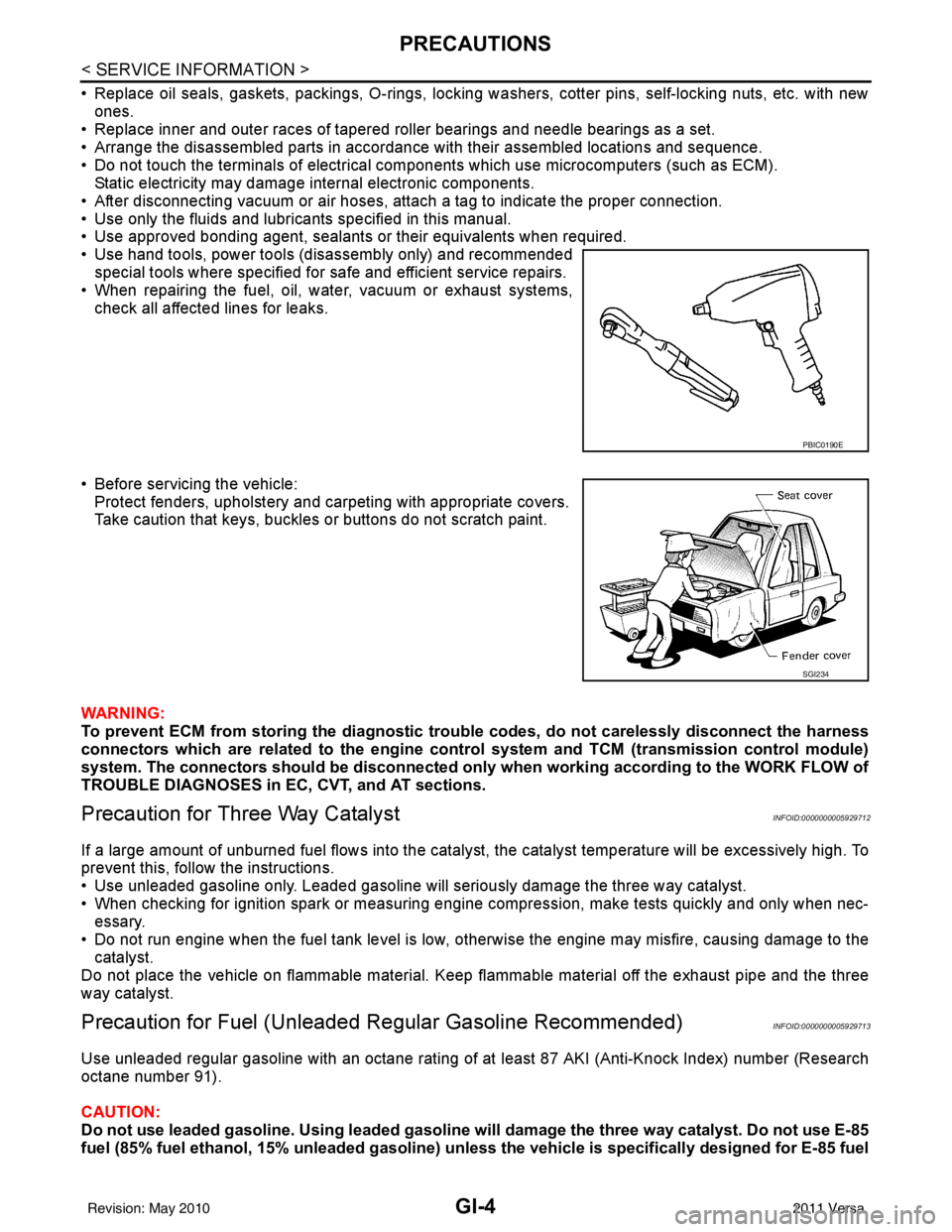
• Use hand tools, power tools (disassembly only) and recommended special tools where specified for safe and efficient service repairs.
• When repairing the fuel, oil, water, vacuum or exhaust systems, check all affected lines for leaks.
• Before servicing the vehicle: Protect fenders, upholstery and carpeting with appropriate covers.
Take caution that keys, buckles or buttons do not scratch paint.
WARNING:
To prevent ECM from storing the diagnostic tro uble codes, do not carelessly disconnect the harness
connectors which are related to the engine control system and TCM (transmission control module)
system. The connectors should be disconnected only when working according to the WORK FLOW of
TROUBLE DIAGNOSES in EC, CVT, and AT sections.
Precaution for Three Way CatalystINFOID:0000000005929712
If a large amount of unburned fuel flows into the catalyst , the catalyst temperature will be excessively high. To
prevent this, follow the instructions.
• Use unleaded gasoline only. Leaded gasoline will seriously damage the three way catalyst.
• When checking for ignition spark or measuring engine compression, make tests quickly and only when nec- essary.
• Do not run engine when the fuel tank level is low, otherwise the engine may misfire, causing damage to the
catalyst.
Do not place the vehicle on flammable material. Keep flammable material off the exhaust pipe and the three
way catalyst.
Precaution for Fuel (Unleade d Regular Gasoline Recommended)INFOID:0000000005929713
Use unleaded regular gasoline with an octane rating of at least 87 AKI (Anti-Knock Index) number (Research
octane number 91).
CAUTION:
Do not use leaded gasoline. Using leaded gasoline will damage the three way catalyst. Do not use E-85
fuel (85% fuel ethanol, 15% unleaded gasoline) unless the vehicle is specifically designed for E-85 fuel
PBIC0190E
SGI234
Revision: May 2010 2011 Versa