check engine light NISSAN TITAN 2004 1.G Owner's Manual
[x] Cancel search | Manufacturer: NISSAN, Model Year: 2004, Model line: TITAN, Model: NISSAN TITAN 2004 1.GPages: 328, PDF Size: 4.93 MB
Page 247 of 328

8 Maintenance and do-it-yourself
Maintenance requirements..........................8-2
General maintenance..............................8-2
Explanation of general maintenance items.........8-2
Maintenance precautions...........................8-5
Engine compartment check locations................8-6
Engine cooling system.............................8-7
Checking engine coolant level...................8-8
Changing engine coolant........................8-8
Engine oil.........................................8-8
Checking engine oil level........................8-8
Changing engine oil............................8-9
Changing engine oil filter.......................8-10
5-speed automatic transmission fluid...............8-11
Power steering fluid...............................8-11
Brake fluid.......................................8-12
Brake fluid....................................8-12
Window washer fluid.............................8-12
Window washer fluid reservoir..................8-12
Battery..........................................8-13
Jump starting.................................8-14
Drive belts.......................................8-15
Spark plugs......................................8-15
Replacing spark plugs.........................8-15Air cleaner.......................................8-16
In-cabin microfilter.............................8-16
Windshield wiper blades..........................8-18
Cleaning.....................................8-18
Replacing....................................8-19
Parking brake and brake pedal.....................8-20
Checking parking brake........................8-20
Checking brake pedal..........................8-20
Brake booster.................................8-21
Fuses...........................................8-21
Engine compartment...........................8-21
Passenger compartment.......................8-22
Keyfob battery replacement........................8-23
Lights...........................................8-24
Headlights....................................8-24
Fog lights (if so equipped)......................8-24
Exterior and interior lights.......................8-26
Wheels and tires.................................8-30
Tire pressure..................................8-30
Tire labeling...................................8-32
Types of tires..................................8-35
Tire chains....................................8-35
Changing wheels and tires.....................8-36
ZREVIEW COPY:Ð2004 Titan(tzw)
Owners Manual(owners)ÐUSA English(nna)
02/23/04Ðdebbie
X
Page 257 of 328
5. Wipe the engine oil filter mounting surface
with a clean rag.
Be sure to remove any old gasket material
remaining on the mounting surface of the
engine.
6. Coat the gasket on the new filter with clean
engine oil.
7. Screw on the oil filter until a slight resistance
is felt, then tighten an additional 2/3 turn.
8. Start the engine and check for leakage
around the oil filter. Correct as required.
9. Turn the engine off and wait more than 10
minutes. Check the oil level. Add engine oil if
necessary.When checking or replacement is required, we
recommend your NISSAN dealer for servicing.
WARNING
cUse only Genuine Nissan Matic J ATF.
Do not mix with other fluids.
cUsing automatic transmission fluid
other than Genuine Nissan Matic J ATF
will cause deterioration in driveability
and automatic transmission durability,
and may damage the automatic trans-
mission, which is not covered by the
NISSAN new vehicle limited warranty.
The specified automatic transmission fluid is also
described on caution labels located in the engine
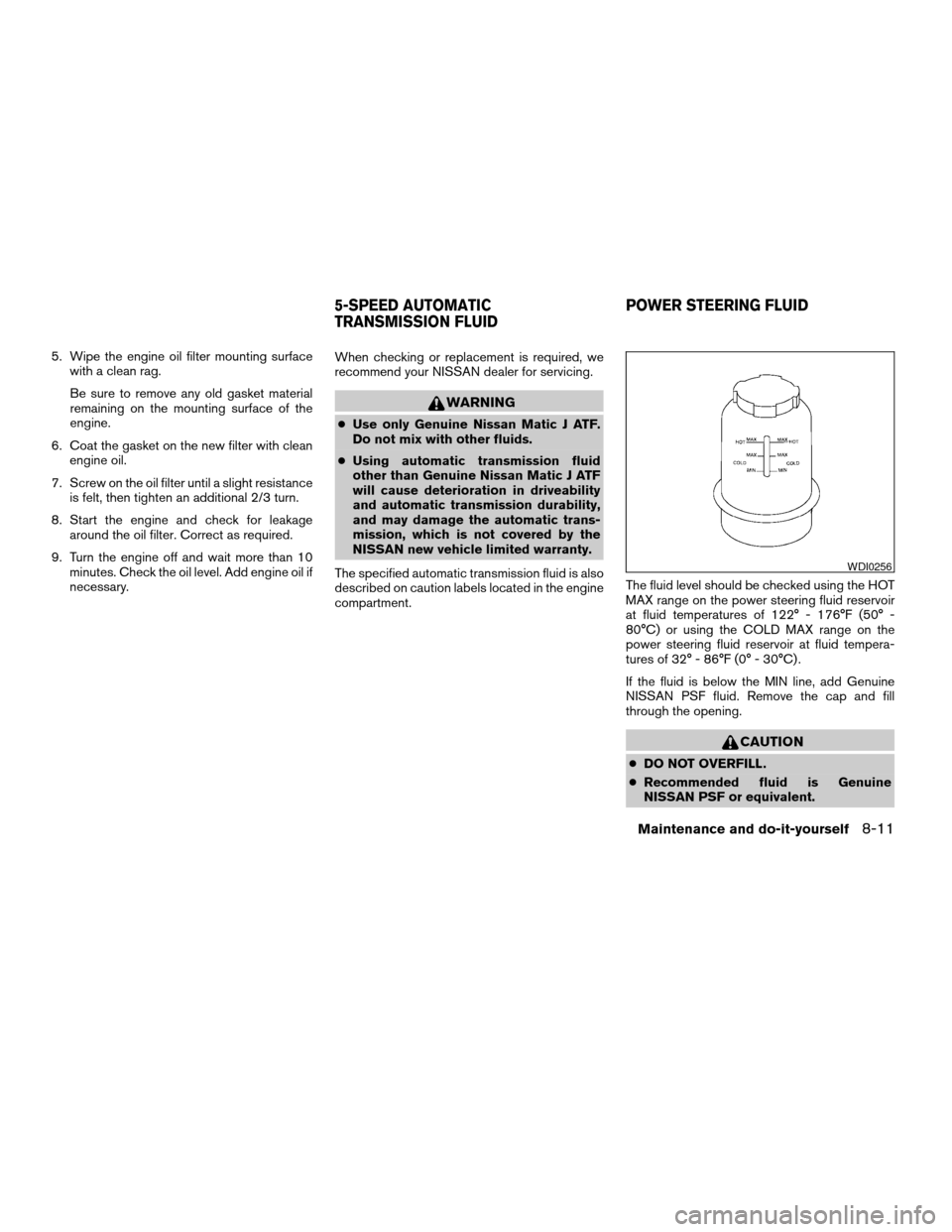
compartment.The fluid level should be checked using the HOT
MAX range on the power steering fluid reservoir
at fluid temperatures of 122° - 176°F (50° -
80°C) or using the COLD MAX range on the
power steering fluid reservoir at fluid tempera-
tures of 32° - 86°F (0° - 30°C) .
If the fluid is below the MIN line, add Genuine
NISSAN PSF fluid. Remove the cap and fill
through the opening.
CAUTION
cDO NOT OVERFILL.
cRecommended fluid is Genuine
NISSAN PSF or equivalent.
WDI0256
5-SPEED AUTOMATIC
TRANSMISSION FLUIDPOWER STEERING FLUID
Maintenance and do-it-yourself8-11
ZREVIEW COPY:Ð2004 Titan(tzw)
Owners Manual(owners)ÐUSA English(nna)
02/23/04Ðdebbie
X
Page 266 of 328
CHECKING PARKING BRAKE
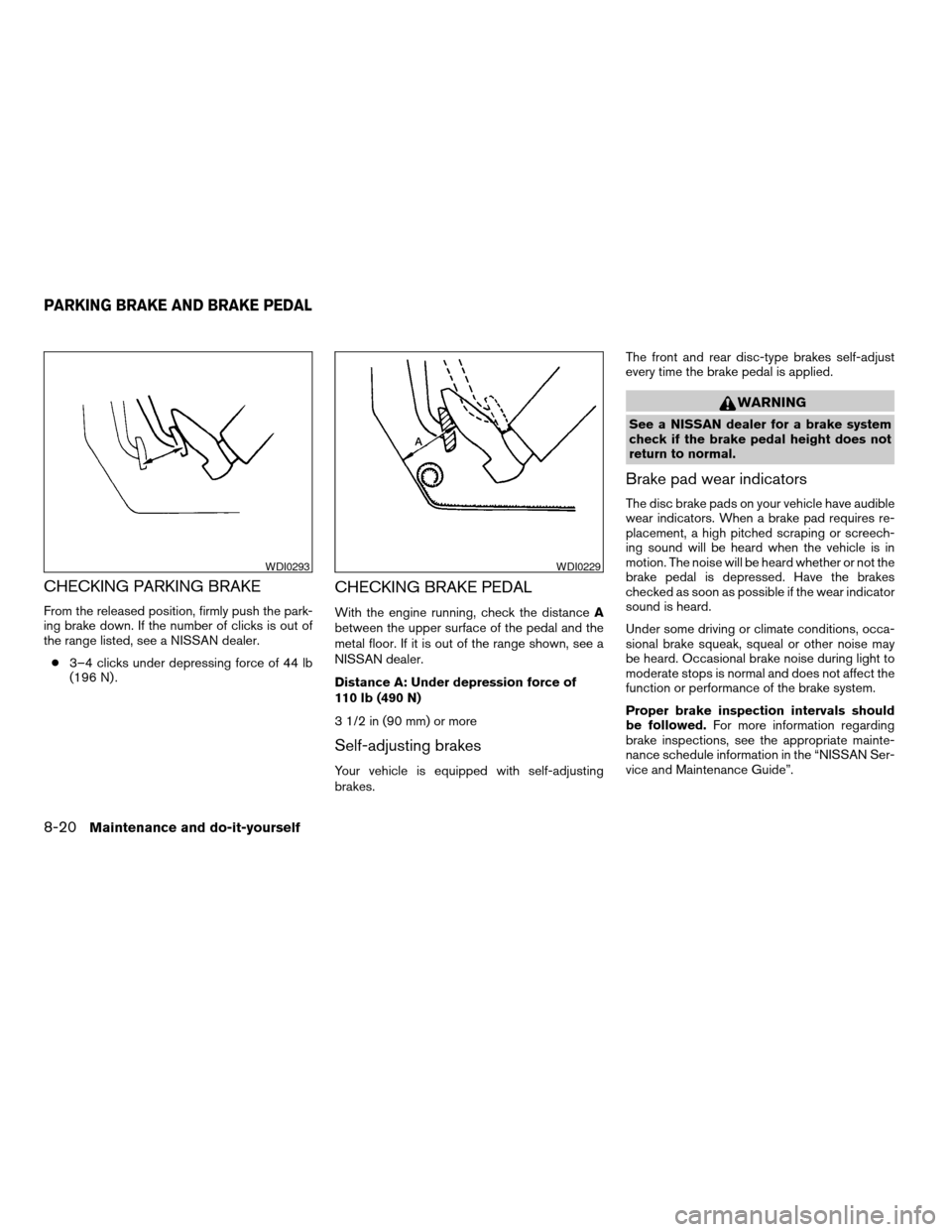
From the released position, firmly push the park-
ing brake down. If the number of clicks is out of
the range listed, see a NISSAN dealer.
c3–4 clicks under depressing force of 44 lb
(196 N) .
CHECKING BRAKE PEDAL
With the engine running, check the distanceA
between the upper surface of the pedal and the
metal floor. If it is out of the range shown, see a
NISSAN dealer.
Distance A: Under depression force of
110 lb (490 N)
3 1/2 in (90 mm) or more
Self-adjusting brakes
Your vehicle is equipped with self-adjusting
brakes.The front and rear disc-type brakes self-adjust
every time the brake pedal is applied.
WARNING
See a NISSAN dealer for a brake system
check if the brake pedal height does not
return to normal.
Brake pad wear indicators
The disc brake pads on your vehicle have audible
wear indicators. When a brake pad requires re-
placement, a high pitched scraping or screech-
ing sound will be heard when the vehicle is in
motion. The noise will be heard whether or not the
brake pedal is depressed. Have the brakes
checked as soon as possible if the wear indicator
sound is heard.
Under some driving or climate conditions, occa-
sional brake squeak, squeal or other noise may
be heard. Occasional brake noise during light to
moderate stops is normal and does not affect the
function or performance of the brake system.
Proper brake inspection intervals should
be followed.For more information regarding
brake inspections, see the appropriate mainte-
nance schedule information in the “NISSAN Ser-
vice and Maintenance Guide”.
WDI0293WDI0229
PARKING BRAKE AND BRAKE PEDAL
8-20Maintenance and do-it-yourself
ZREVIEW COPY:Ð2004 Titan(tzw)
Owners Manual(owners)ÐUSA English(nna)
02/23/04Ðdebbie
X
Page 267 of 328
BRAKE BOOSTER
Check the brake booster function as follows:
1. With the engine off, press and release the
brake pedal several times. When brake
pedal movement (distance of travel) remains
the same from one pedal application to the
next, continue on to the next step.
2. While depressing the brake pedal, start the
engine. The pedal height should drop a little.
3. With the brake pedal depressed, stop the
engine. Keep the pedal depressed for about
30 seconds. The pedal height should not
change.
4. Run the engine for one minute without de-
pressing the brake pedal, then turn it off.
Depress the brake pedal several times. The
pedal travel distance will decrease gradually
with each depression as the vacuum is re-
leased from the booster.
If the brakes do not operate properly, have the
brakes checked by a NISSAN dealer.
ENGINE COMPARTMENT
CAUTION
Never use a fuse of a higher or lower
amperage rating than specified on the
fuse box cover. This could damage the
electrical system or cause a fire.
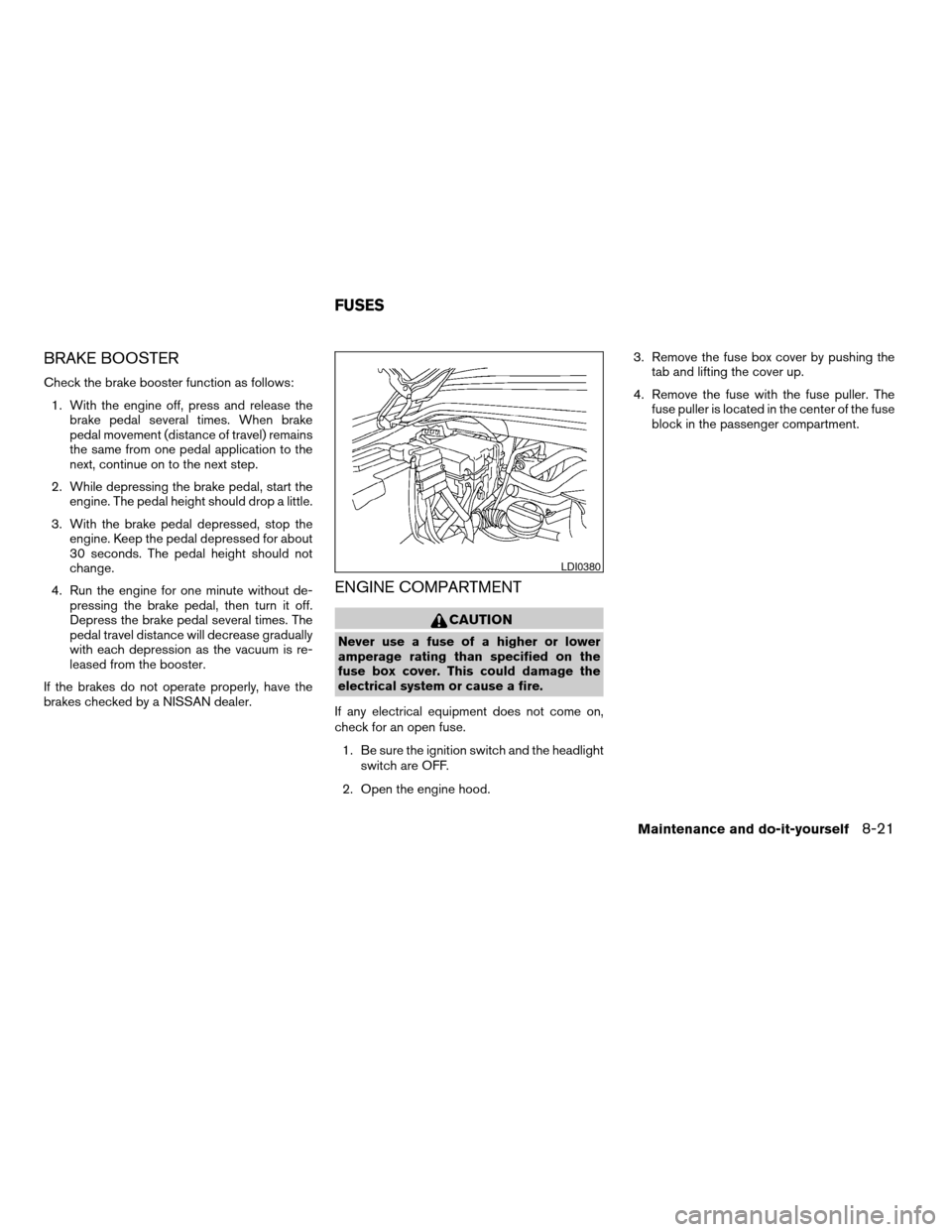
If any electrical equipment does not come on,
check for an open fuse.
1. Be sure the ignition switch and the headlight
switch are OFF.
2. Open the engine hood.3. Remove the fuse box cover by pushing the
tab and lifting the cover up.
4. Remove the fuse with the fuse puller. The
fuse puller is located in the center of the fuse
block in the passenger compartment.
LDI0380
FUSES
Maintenance and do-it-yourself8-21
ZREVIEW COPY:Ð2004 Titan(tzw)
Owners Manual(owners)ÐUSA English(nna)
02/23/04Ðdebbie
X
Page 288 of 328

southern Idaho, western South Dakota, western
Nebraska, and the part of Texas which is directly
south of New Mexico.
Using unleaded gasoline with an octane
rating lower than stated above can cause
persistent, heavy “spark knock.” (“Spark
knock” is a metallic rapping noise.) If se-
vere, this can lead to engine damage. If you
detect a persistent heavy spark knock even
when using gasoline of the stated octane
rating, or if you hear steady spark knock
while holding a steady speed on level
roads, have a NISSAN dealer correct the
condition. Failure to correct the condition
is misuse of the vehicle, for which NISSAN
is not responsible.
Incorrect ignition timing may result in spark
knock, after-run and/or overheating, which may
cause excessive fuel consumption or engine
damage. If any of the above symptoms are en-
countered, have your vehicle checked at a
NISSAN dealer.
However, now and then you may notice
light spark knock for a short time while
accelerating or driving up hills. This is not a
cause for concern, because you get the
greatest fuel benefit when there is light
spark knock for a short time under heavy
engine load.
ENGINE OIL AND OIL FILTER
RECOMMENDATION
Selecting the correct oil
It is essential to choose engine oil with the cor-
rect quality and viscosity to ensure satisfactory
engine life and performance. NISSAN recom-
mends the use of a low friction oil (energy con-
serving oil) in order to improve fuel economy and
conserve energy. Oils which do not have the
specified quality label should not be used as they
could cause engine damage.
Only those engine oils with the American Petro-
leum Institute (API) CERTIFICATION MARK onthe front of the container should be used. This
type of oil supersedes the existing API SG, SH, or
SJ and Energy Conserving II categories.
If you cannot find engine oil with the API CERTI-
FICATION MARK, use API grade SL Energy
Conserving oil. An oil with a single designation
SL, or in combination with other categories (for
example, SL/CF) may also be used if one with the
API CERTIFICATION MARK cannot be found. An
ILSAC grade GF-III oil can also be used.
NISSAN recommends mineral based oils. These
oils must, however, meet the API quality and SAE
viscosity ratings specified for your vehicle.
WTI0082
9-4Technical and consumer information
ZREVIEW COPY:Ð2004 Titan(tzw)
Owners Manual(owners)ÐUSA English(nna)
02/23/04Ðdebbie
X
Page 315 of 328
cCheck your hitch, trailer wiring harness con-
nections, and trailer wheel lug nuts after 50
miles (80 km) of travel and at every break.
cWhen stopped in traffic for long periods of
time in hot weather, put the vehicle in the P
(Park) position.
When towing a trailer, final drive gear oil
should be replaced and transmission
oil/fluid should be changed more fre-
quently. For additional information, see the
“Maintenance and do-it-yourself” section
earlier in this manual.
Tow mode
Tow mode should be used when pulling a heavy
trailer or hauling a heavy load. Press the tow
button to activate the tow mode. The tow indica-
tor in the instrument panel illuminates when the
tow mode is selected. Press the Tow button
again to turn the tow mode OFF. The Tow mode is
automatically cancelled when the key is turned
OFF.
The Tow mode does the following:
cReduces transmissions shifts when pulling a
trailer or hauling a load.
cProvides similar shift feel to driver when the
vehicle is towing.The Tow mode should be used when the vehicle
and trailer weight is at least 75% of the vehicle’s
GCWR. Tow mode is most useful in the following
driving conditions when towing a heavy trailer or
hauling a heavy load:
cRolling terrain.
cStop and go traffic.
cBusy parking lots.
Driving the vehicle in the Tow mode with no
trailer/load or light trailer/light load will not cause
any damage. However, fuel economy may be
reduced and the transmission/engine driving
characteristics may feel unusual.
When towing a trailer, final drive gear oil
should be replaced and transmission
oil/fluid should be changed more fre-
quently. For additional information, see the
“Maintenance and do-it-yourself” section
earlier in this manual.
FLAT TOWING
Towing your vehicle with all four wheels on the
ground is sometimes called flat towing. This
method is sometimes used when towing a vehicle
behind a recreational vehicle, such as a motor
home.
CAUTION
cFailure to follow these guidelines can
result in severe transmission damage.
cWhenever flat towing your vehicle, al-
ways tow forward, never backward.
cDO NOT tow any automatic transmis-
sion vehicle with all four wheels on the
ground (flat towing) . Doing so WILL
DAMAGE internal transmission parts
due to lack of transmission lubrication.
cFor emergency towing procedures refer
to “Towing recommended by NISSAN”
in the “In case of emergency” section of
this manual.
Automatic Transmission
To tow a vehicle equipped with an automatic
transmission, an appropriate vehicle dollyMUST
be placed under the towed vehicle’s drive
wheels.Alwaysfollow the dolly manufacturer’s
recommendations when using their product.
Technical and consumer information9-31
ZREVIEW COPY:Ð2004 Titan(tzw)
Owners Manual(owners)ÐUSA English(nna)
02/23/04Ðdebbie
X
Page 321 of 328

10 Index
4WD warning light...............2-14
A
Adjusting pedal position............3-13
Air bag (See supplemental restraint system). .1-11
Air bag system
Front (See supplemental front impact air
bag system).................1-18
Air bag warning labels.............1-25
Air bag warning light...........1-26, 2-16
Air cleaner housing filter............8-16
Air conditioner
Air conditioner operation..........4-15
Air conditioner service...........4-19
Air conditioner specification label.....9-11
Air conditioner system refrigerant and
lubrication recommendations........9-6
Heater and air conditioner controls. . . .4-12
Servicing air conditioner..........4-19
Air flow charts..................4-16
Alarm system
(See vehicle security system).........2-20
Anchor point locations.............1-45
Antenna.....................4-38
Anti-lock brake system (ABS).........5-28
Anti-lock brake warning light..........2-13
Audible reminders................2-19
Audio system..................4-19
AM-FM-SAT radio with compact disc (CD)
changer...................4-29Compact Disc (CD) changer.......4-33
Compact disc (CD) player.........4-24
FM-AM radio with compact disc (CD)
player....................4-22
Radio....................4-19
Rear audio controls.............4-37
Steering wheel audio control switch. . . .4-36
Autolight switch.................2-24
Automatic
Automatic drive positioner.........3-21
Automatic power window switch.....2-44
Automatic transmission position indicator
light.....................2-16
Driving with automatic transmission.....5-9
Transmission selector lever lock
release....................5-15
Automatic anti-glare inside mirror.......3-16
Automatic transmission fluid temperature
gauge.......................2-7
AUX jack.....................4-35
B
Battery......................8-13
Charge warning light............2-14
Battery replacement
(See remote keyless entry system) . . .3-10, 8-23
Before starting the engine............5-8
Belts (See drive belts).............8-15
Brake
Anti-lock brake system (ABS).......5-28Brake booster................8-21
Brake fluid..................8-12
Brake light (See stop light).........8-26
Brake pedal.................8-20
Brake system................5-27
Brake warning light.............2-13
Brake wear indicators........2-19, 8-20
Parking brake check............8-20
Parking brake operation..........5-16
Self-adjusting brakes............8-20
Break-in schedule................5-19
Brightness control
Instrument panel..............2-26
Bulb check/instrument panel..........2-12
Bulb replacement................8-26
C
Capacities and recommended
fuel/lubricants...................9-2
Car phone or CB radio.............4-47
Cargo light switch...............2-28
Cargo (See vehicle loading information) . . .9-12
CD care and cleaning.............4-35
CD changer (See audio system)........4-33
CD player (See audio system).........4-24
Check engine indicator light
(See malfunction indicator lamp).......2-17
Child restraint with top tether strap......1-45
Child restraints.......1-29, 1-30, 1-36, 1-43
Precautions on child restraints.......1-36
ZREVIEW COPY:Ð2004 Titan(tzw)
Owners Manual(owners)ÐUSA English(nna)
03/01/04Ðdebbie
X
Page 322 of 328

Top tether strap anchor point locations . .1-45
Child safety rear door lock............3-6
Chimes, audible reminders...........2-19
Cigarette lighter.................2-33
Cleaning exterior and interior..........7-2
Clock...................4-23, 4-30
(models with navigation system)......4-9
Cold weather driving..............5-31
Compact disc (CD) player...........4-24
Compass display.................2-8
Control panel buttons..............4-2
Controls
Audio controls (steering wheel)......4-36
Heater and air conditioner controls. . . .4-12
Rear audio controls.............4-37
Coolant
Capacities and recommended
fuel/lubricants.................9-2
Changing engine coolant..........8-8
Checking engine coolant level........8-8
Engine coolant temperature gauge.....2-5
Corrosion protection...............7-5
Cruise control..................5-17
Cup holders...................2-39
Curtain side-impact and rollover air bag . . .1-23
D
Daytime running light system
(Canada only)..................2-26
Digital video disc DVD.............4-38
Dimensions and weights.............9-8
Door locks....................3-3
Door open warning light............2-14
Drive belts....................8-15Drive positioner, Automatic...........3-21
Driving
Cold weather driving............5-31
Driving with automatic transmission.....5-9
Precautions when starting and driving . . .5-2
E
Economy - fuel.................5-19
Electronic locking rear differential system . . .5-25
Electronic locking rear differential system
switch......................2-30
Emission control information label.......9-10
Emission control system warranty.......9-33
Engine
Before starting the engine..........5-8
Capacities and recommended
fuel/lubricants.................9-2
Changing engine coolant..........8-8
Changing engine oil.............8-9
Changing engine oil filter..........8-10
Checking engine coolant level........8-8
Checking engine oil level..........8-8
Engine compartment check locations. . . .8-7
Engine coolant temperature gauge.....2-5
Engine cooling system............8-7
Engine oil...................8-8
Engine oil and oil filter recommendation . .9-4
Engine oil viscosity..............9-5
Engine serial number............9-10
Engine specifications.............9-7
Starting the engine..............5-9
Engine oil pressure gauge............2-6
Event data recorders..............9-34
Exhaust gas (Carbon monoxide)........5-2Eyeglass case..................2-37
F
Flashers
(See hazard warning flasher switch)......2-27
Flat tire......................6-2
Floor mat positioning aid.............7-4
Fluid
Brake fluid..................8-12
Capacities and recommended
fuel/lubricants.................9-2
Engine coolant................8-7
Engine oil...................8-8
Power steering fluid.............8-11
Window washer fluid............8-12
F.M.V.S.S. certification label..........9-10
Fog light switch.................2-27
Front air bag system
(See supplemental restraint system).....1-18
Front seats....................1-2
Fuel
Capacities and recommended
fuel/lubricants.................9-2
Fuel economy................5-19
Fuel filler cap................3-11
Fuel filler lid.................3-11
Fuel filler lid and cap............3-11
Fuel gauge..................2-6
Fuel octane rating..............9-3
Fuel recommendation............9-3
Fuses......................8-21
Fusible links...................8-22
10-2
ZREVIEW COPY:Ð2004 Titan(tzw)
Owners Manual(owners)ÐUSA English(nna)
03/01/04Ðdebbie
X
Page 323 of 328
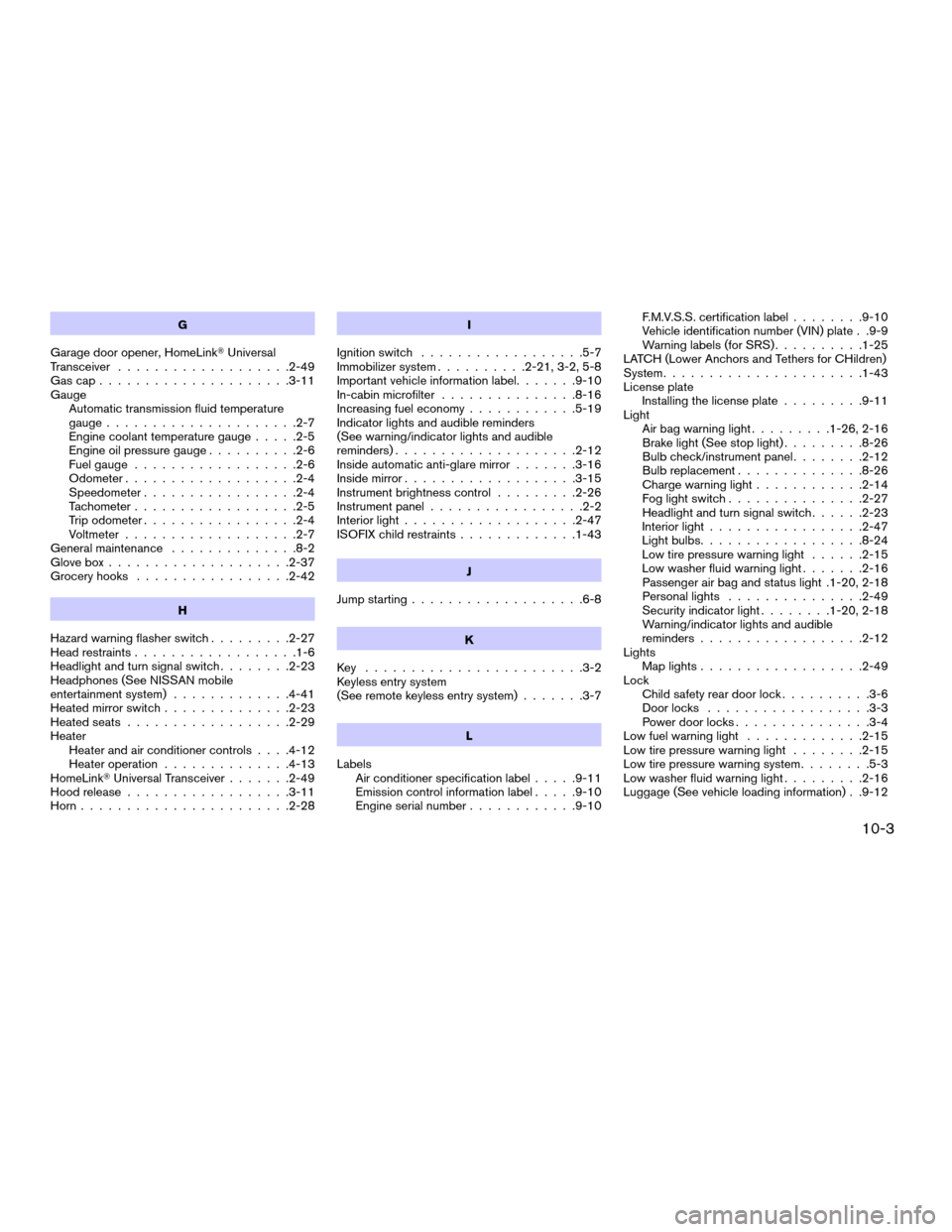
G
Garage door opener, HomeLinkTUniversal
Transceiver...................2-49
Gascap.....................3-11
Gauge
Automatic transmission fluid temperature
gauge.....................2-7
Engine coolant temperature gauge.....2-5
Engine oil pressure gauge..........2-6
Fuel gauge..................2-6
Odometer...................2-4
Speedometer.................2-4
Tachometer..................2-5
Trip odometer.................2-4
Voltmeter...................2-7
General maintenance..............8-2
Glove box....................2-37
Grocery hooks.................2-42
H
Hazard warning flasher switch.........2-27
Head restraints..................1-6
Headlight and turn signal switch........2-23
Headphones (See NISSAN mobile
entertainment system).............4-41
Heated mirror switch..............2-23
Heated seats..................2-29
Heater
Heater and air conditioner controls. . . .4-12
Heater operation..............4-13
HomeLinkTUniversal Transceiver.......2-49
Hood release..................3-11
Horn.......................2-28I
Ignition switch..................5-7
Immobilizer system..........2-21, 3-2, 5-8
Important vehicle information label.......9-10
In-cabin microfilter...............8-16
Increasing fuel economy............5-19
Indicator lights and audible reminders
(See warning/indicator lights and audible
reminders)....................2-12
Inside automatic anti-glare mirror.......3-16
Inside mirror...................3-15
Instrument brightness control.........2-26
Instrument panel.................2-2
Interior light...................2-47
ISOFIX child restraints.............1-43
J
Jump starting...................6-8
K
Key ........................3-2
Keyless entry system
(See remote keyless entry system).......3-7
L
Labels
Air conditioner specification label.....9-11
Emission control information label.....9-10
Engine serial number............9-10F.M.V.S.S. certification label........9-10
Vehicle identification number (VIN) plate . .9-9
Warning labels (for SRS)..........1-25
LATCH (Lower Anchors and Tethers for CHildren)
System......................1-43
License plate
Installing the license plate.........9-11
Light
Air bag warning light.........1-26, 2-16
Brake light (See stop light).........8-26
Bulb check/instrument panel........2-12
Bulb replacement..............8-26
Charge warning light............2-14
Fog light switch...............2-27
Headlight and turn signal switch......2-23
Interior light.................2-47
Light bulbs..................8-24
Low tire pressure warning light......2-15
Low washer fluid warning light.......2-16
Passenger air bag and status light .1-20, 2-18
Personal lights...............2-49
Security indicator light........1-20, 2-18
Warning/indicator lights and audible
reminders..................2-12
Lights
Map lights..................2-49
Lock
Child safety rear door lock..........3-6
Door locks..................3-3
Power door locks...............3-4
Low fuel warning light.............2-15
Low tire pressure warning light........2-15
Low tire pressure warning system........5-3
Low washer fluid warning light.........2-16
Luggage (See vehicle loading information) . .9-12
10-3
ZREVIEW COPY:Ð2004 Titan(tzw)
Owners Manual(owners)ÐUSA English(nna)
03/01/04Ðdebbie
X
Page 324 of 328
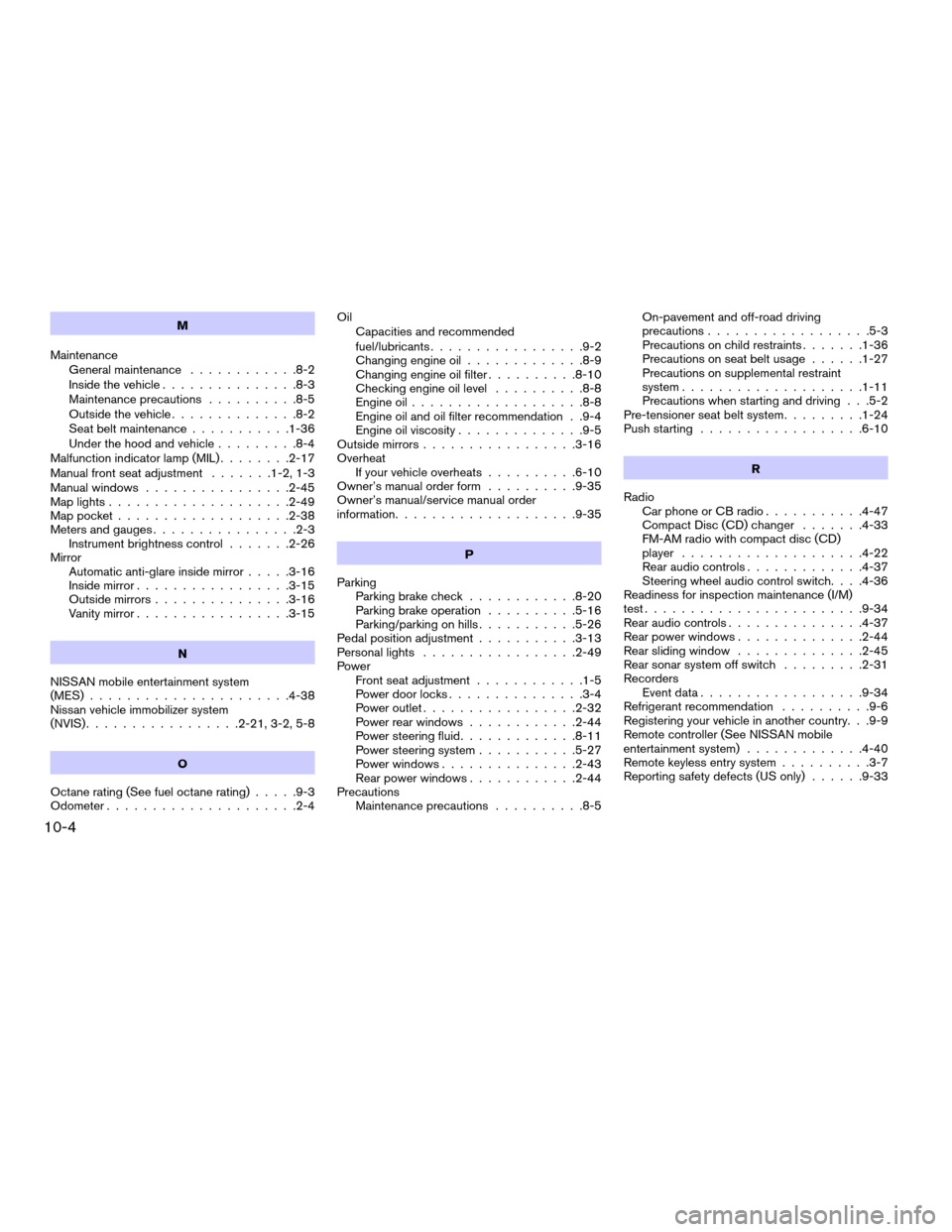
M
Maintenance
General maintenance............8-2
Inside the vehicle...............8-3
Maintenance precautions..........8-5
Outside the vehicle..............8-2
Seat belt maintenance...........1-36
Under the hood and vehicle.........8-4
Malfunction indicator lamp (MIL)........2-17
Manual front seat adjustment.......1-2, 1-3
Manual windows................2-45
Map lights....................2-49
Map pocket...................2-38
Meters and gauges................2-3
Instrument brightness control.......2-26
Mirror
Automatic anti-glare inside mirror.....3-16
Inside mirror.................3-15
Outside mirrors...............3-16
Vanity mirror.................3-15
N
NISSAN mobile entertainment system
(MES)......................4-38
Nissan vehicle immobilizer system
(NVIS).................2-21, 3-2, 5-8
O
Octane rating (See fuel octane rating).....9-3
Odometer.....................2-4Oil
Capacities and recommended
fuel/lubricants.................9-2
Changing engine oil.............8-9
Changing engine oil filter..........8-10
Checking engine oil level..........8-8
Engine oil...................8-8
Engine oil and oil filter recommendation . .9-4
Engine oil viscosity..............9-5
Outside mirrors.................3-16
Overheat
If your vehicle overheats..........6-10
Owner’s manual order form..........9-35
Owner’s manual/service manual order
information....................9-35
P
Parking
Parking brake check............8-20
Parking brake operation..........5-16
Parking/parking on hills...........5-26
Pedal position adjustment...........3-13
Personal lights.................2-49
Power
Front seat adjustment............1-5
Power door locks...............3-4
Power outlet.................2-32
Power rear windows............2-44
Power steering fluid.............8-11
Power steering system...........5-27
Power windows...............2-43
Rear power windows............2-44
Precautions
Maintenance precautions..........8-5On-pavement and off-road driving
precautions..................5-3
Precautions on child restraints.......1-36
Precautions on seat belt usage......1-27
Precautions on supplemental restraint
system....................1-11
Precautions when starting and driving . . .5-2
Pre-tensioner seat belt system.........1-24
Push starting..................6-10
R
Radio
Car phone or CB radio...........4-47
Compact Disc (CD) changer.......4-33
FM-AM radio with compact disc (CD)
player....................4-22
Rear audio controls.............4-37
Steering wheel audio control switch. . . .4-36
Readiness for inspection maintenance (I/M)
test........................9-34
Rear audio controls...............4-37
Rear power windows..............2-44
Rear sliding window..............2-45
Rear sonar system off switch.........2-31
Recorders
Event data..................9-34
Refrigerant recommendation..........9-6
Registering your vehicle in another country. . .9-9
Remote controller (See NISSAN mobile
entertainment system).............4-40
Remote keyless entry system..........3-7
Reporting safety defects (US only)......9-33
10-4
ZREVIEW COPY:Ð2004 Titan(tzw)
Owners Manual(owners)ÐUSA English(nna)
03/01/04Ðdebbie
X