transmission oil NISSAN TITAN 2016 2.G Owner's Manual
[x] Cancel search | Manufacturer: NISSAN, Model Year: 2016, Model line: TITAN, Model: NISSAN TITAN 2016 2.GPages: 636, PDF Size: 7.17 MB
Page 563 of 636
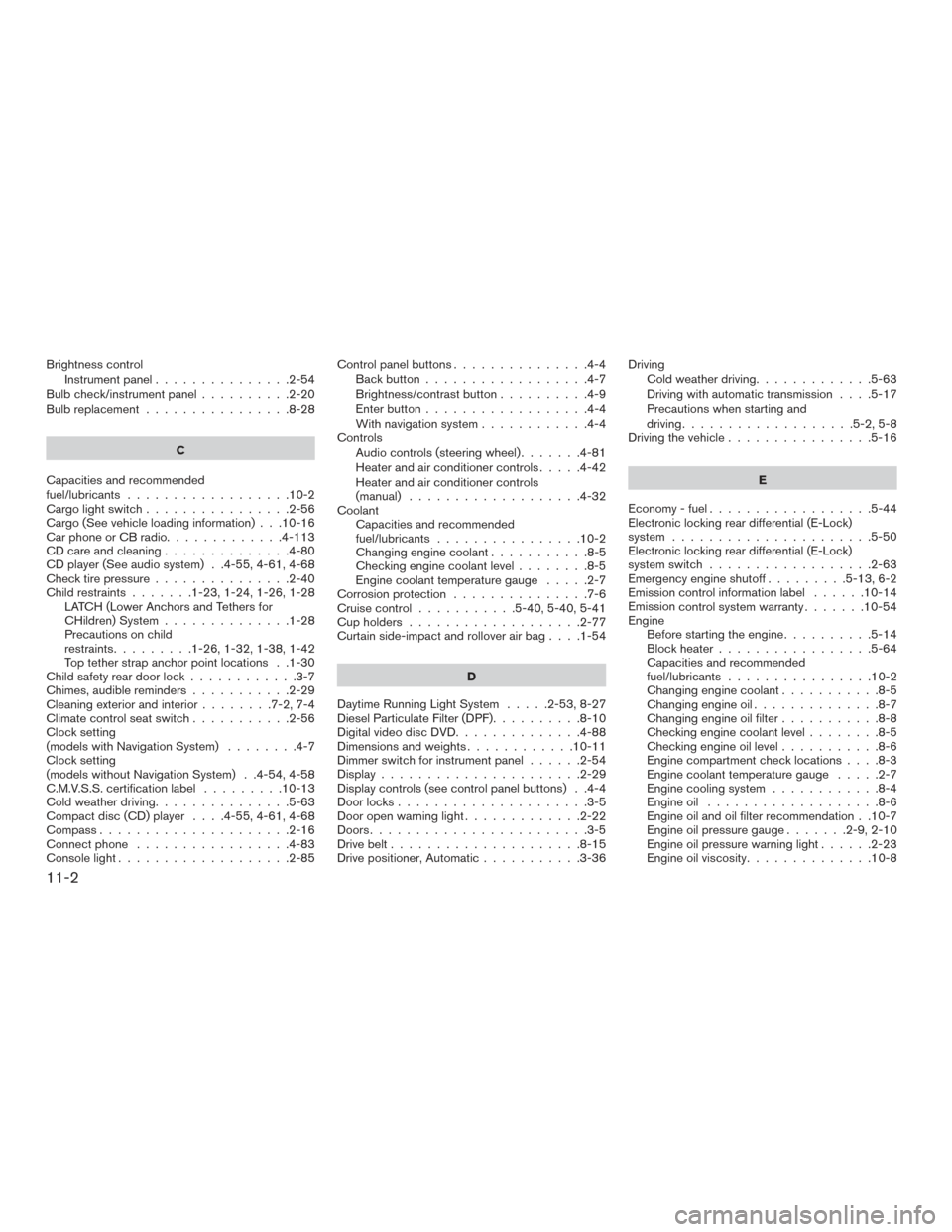
Brightness controlInstrument panel ...............2-54
Bulb check/instrument panel ..........2-20
Bulb replacement ................8-28
C
Capacities and recommended
fuel/lubricants ..................10-2
Cargolightswitch................2-56
Cargo (See vehicle loading information) . . .10-16
Car phone or CB radio .............4-113
CD care and cleaning ..............4-80
CD player (See audio system) . .4-55, 4-61, 4-68
Check tire pressure ...............2-40
Child restraints .......1-23,1-24,1-26,1-28
LATCH (Lower Anchors and Tethers for
CHildren) System ..............1-28
Precautions on child
restraints.........1-26,1-32,1-38,1-42
Top tether strap anchor point locations . .1-30
Child safety rear door lock ............3-7
Chimes, audible reminders ...........2-29
Cleaningexteriorandinterior........7-2,7-4
Climatecontrolseatswitch...........2-56
Clock setting
(models with Navigation System) ........4-7
Clock setting
(models without Navigation System) . .4-54, 4-58
C.M.V.S.S. certification label .........10-13
Cold weather driving ...............5-63
Compact disc (CD) player ....4-55,4-61,4-68
Compass .....................2-16
Connect phone .................4-83
Consolelight...................2-85 Control panel buttons
...............4-4
Back button ..................4-7
Brightness/contrast button ..........4-9
Enterbutton..................4-4
With navigation system ............4-4
Controls Audio controls (steering wheel) .......4-81
Heater and air conditioner controls .....4-42
Heater and air conditioner controls
(manual) ...................4-32
Coolant Capacities and recommended
fuel/lubricants ................10-2
Changingenginecoolant...........8-5
Checking engine coolant level ........8-5
Engine coolant temperature gauge .....2-7
Corrosion protection ...............7-6
Cruisecontrol ...........5-40,5-40,5-41
Cupholders...................2-77
Curtainside-impactandrolloverairbag....1-54
D
Daytime Running Light System .....2-53,8-27
Diesel Particulate Filter (DPF) ..........8-10
Digital video disc DVD ..............4-88
Dimensionsandweights............10-11
Dimmer switch for instrument panel ......2-54
Display......................2-29
Display controls (see control panel buttons) . .4-4
Door locks .....................3-5
Door open warning light .............2-22
Doors ........................3-5
Drive belt .....................8-15
Drive positioner, Automatic ...........3-36Driving
Cold weather driving .............5-63
Driving with automatic transmission ....5-17
Precautions when starting and
driving ...................5-2,5-8
Driving the vehicle ................5-16
E
Economy-fuel..................5-44
Electronic locking rear differential (E-Lock)
system ......................5-50
Electronic locking rear differential (E-Lock)
system switch ..................2-63
Emergency engine shutoff .........5-13,6-2
Emission control information label ......10-14
Emission
control system warranty .......10-54
Engine Before starting the engine ..........5-14
Blockheater.................5-64
Capacities and recommended
fuel/lubricants ................10-2
Changing engine coolant ...........8-5
Changingengineoil..............8-7
Changing engine oil filter ...........8-8
Checking engine coolant level ........8-5
Checking engine oil level ...........8-6
Engine compartment check locations ....8-3
Engine coolant temperature gauge .....2-7
Engine cooling system ............8-4
Engineoil ...................8-6
Engine oil and oil filter recommendation . .10-7
Engineoilpressuregauge.......2-9,2-10
Engine oil pressure warning light ......2-23
Engine oil viscosity ..............10-8
11-2
Page 564 of 636
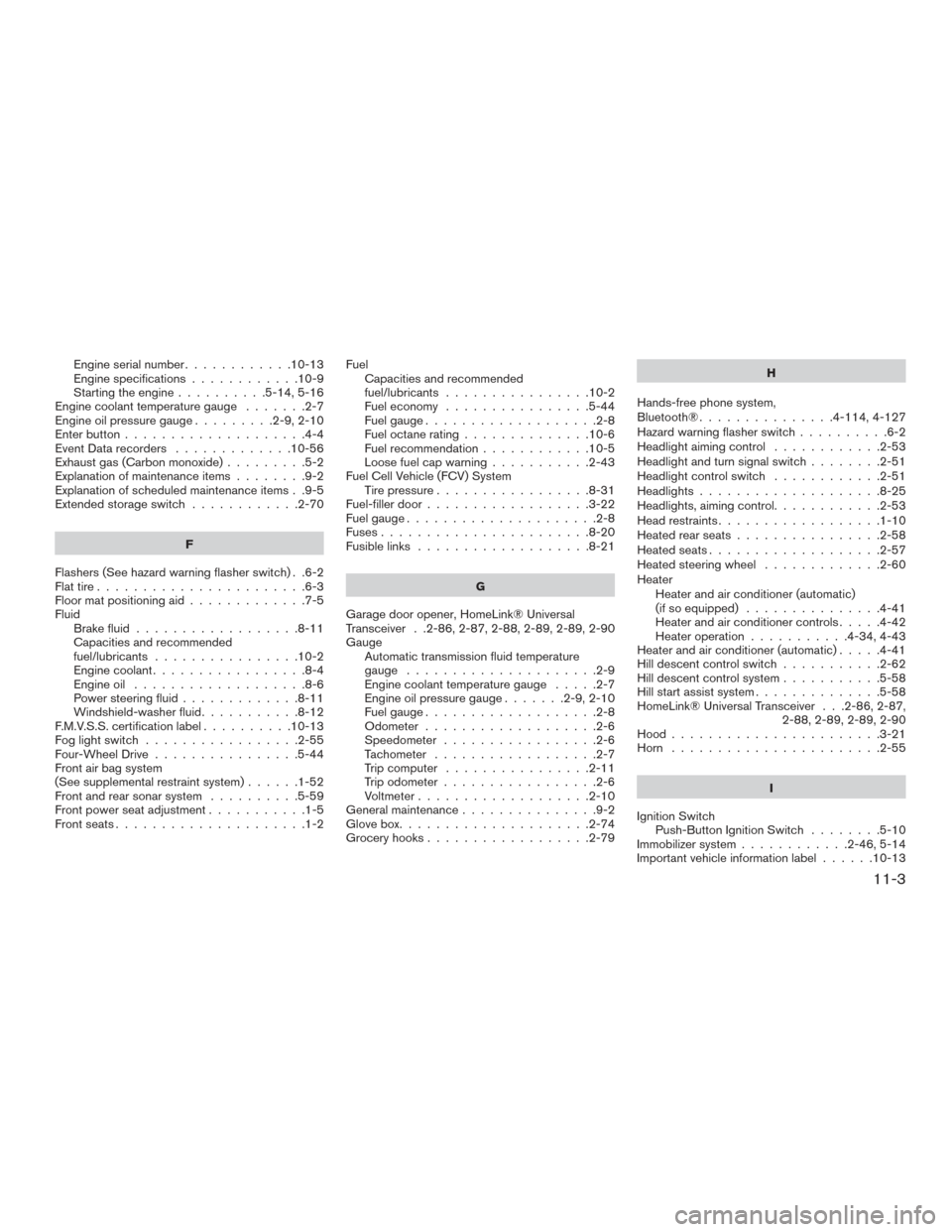
Engine serial number............10-13
Engine specifications ............10-9
Starting the engine ..........5-14,5-16
Engine coolant temperature gauge .......2-7
Engineoilpressuregauge.........2-9,2-10
Enterbutton....................4-4
Event Data recorders .............10-56
Exhaust gas (Carbon monoxide) .........5-2
Explanation of maintenance items ........9-2
Explanation of scheduled maintenance items . .9-5
Extendedstorageswitch ............2-70
F
Flashers (See hazard warning flasher switch) . .6-2
Flat tire .......................6-3
Floor mat positioning aid .............7-5
Fluid Brake fluid ..................8-11
Capacities and recommended
fuel/lubricants ................10-2
Engine coolant .................8-4
Engine oil ...................8-6
Power steering fluid .............8-11
Windshield-washerfluid...........8-12
F.M.V.S.S. certification label ..........10-13
Foglightswitch .................2-55
Four-Wheel Drive ................5-44
Front air bag system
(See supplemental restraint system) ......1-52
Front and rear sonar system ..........5-59
Front power seat adjustment ...........1-5
Frontseats.....................1-2 Fuel
Capacities and recommended
fuel/lubricants ................10-2
Fuel economy ................5-44
Fuel gauge ...................2-8
Fuel octane rating ..............10-6
Fuel recommendation ............10-5
Loose fuel cap warning ...........2-43
Fuel Cell Vehicle (FCV) System Tirepressure.................8-31
Fuel-filler door ..................3-22
Fuelgauge.....................2-8
Fuses.......................8-20
Fusiblelinks ...................8-21
G
Garage door opener, HomeLink® Universal
Transceiver . .2-86, 2-87, 2-88, 2-89, 2-89, 2-90
Gauge Automatic transmission fluid temperature
gauge .....................2-9
Engine coolant temperature gauge .....2-7
Engine oil pressure gauge .......2-9,2-10
Fuel gauge ...................2-8
Odometer ...................2-6
Speedometer .................2-6
Tachometer ..................2-7
Trip computer ................2-11
Trip odometer .................2-6
Voltmeter...................2-10
General maintenance ...............9-2
Glovebox.....................2-74
Grocery hooks ..................2-79 H
Hands-free phone system,
Bluetooth®...............4-114, 4-127
Hazard warning flasher switch ..........6-2
Headlightaimingcontrol ............2-53
Headlightandturnsignalswitch........2-51
Headlightcontrolswitch ............2-51
Headlights....................8-25
Headlights, aiming control ............2-53
Head restraints ..................1-10
Heated rear seats ................2-58
Heated seats ...................2-57
Heated steering wheel .............2-60
Heater Heater
and air conditioner (automatic)
(if so equipped) ...............4-41
Heater and air conditioner controls .....4-42
Heater operation ...........4-34,4-43
Heater and air conditioner (automatic) .....4-41
Hill descent control switch ...........2-62
Hill descent control system ...........5-58
Hill start assist system ..............5-58
HomeLink® Universal Transceiver . . .2-86, 2-87, 2-88, 2-89, 2-89, 2-90
Hood.......................3-21
Horn .......................2-55
I
Ignition Switch Push-Button Ignition Switch ........5-10
Immobilizer system ............2-46,5-14
Important vehicle information label ......10-13
11-3
Page 568 of 636
T
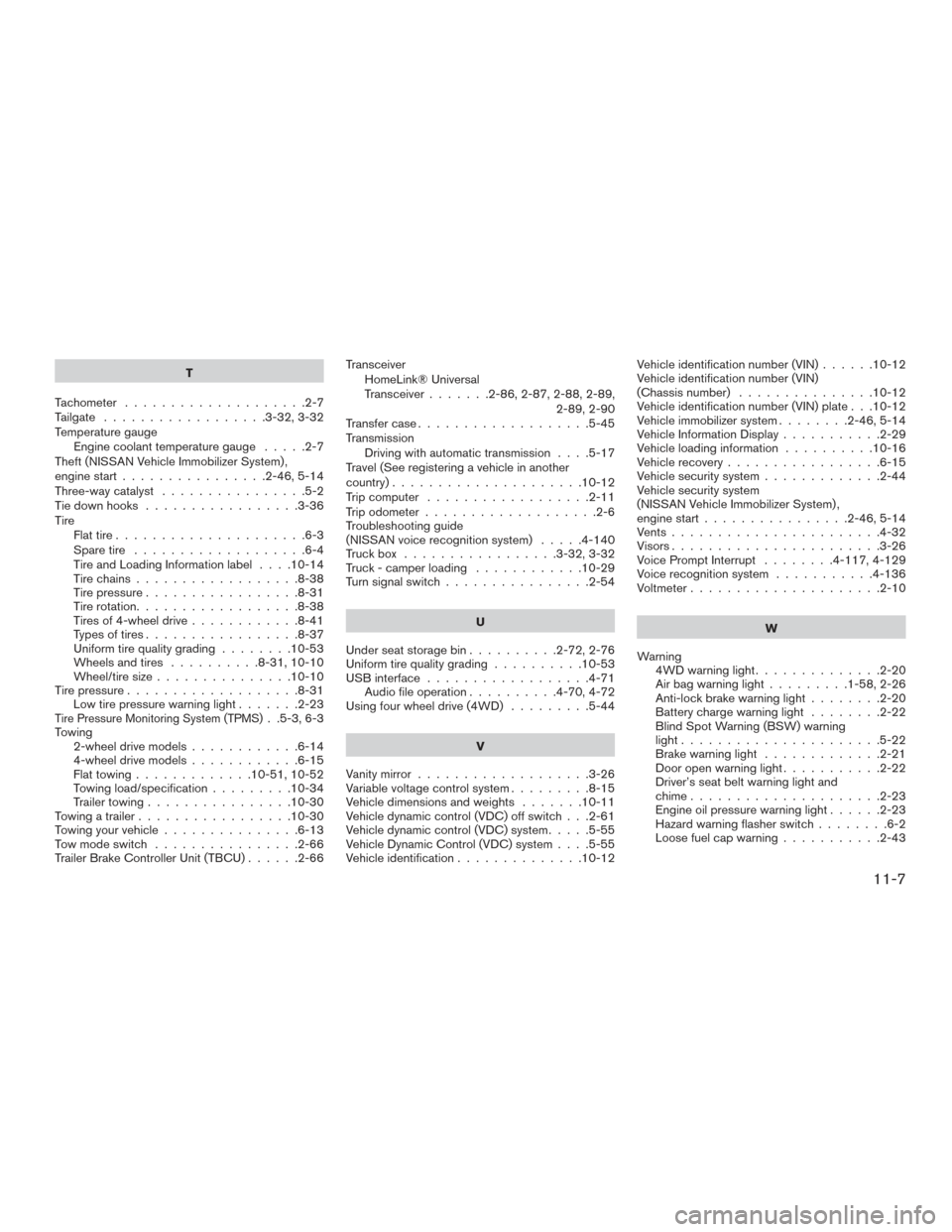
Tachometer ....................2-7
Tailgate ..................3-32,3-32
Temperature gauge Engine coolant temperature gauge .....2-7
Theft (NISSAN Vehicle Immobilizer System) ,
engine start ................2-46,5-14
Three-way catalyst ................5-2
Tie down hooks .................3-36
Tire Flat tire .....................6-3
Spare tire ...................6-4
TireandLoadingInformationlabel ....10-14
Tire chains ..................8-38
Tirepressure.................8-31
Tire rotation..................8-38
Tires of 4-wheel drive ............8-41
Types of tires .................8-37
Uniform tire quality grading ........10-53
Wheels and tires ..........8-31,10-10
Wheel/tire size ...............10-10
Tirepressure...................8-31 Low tire pressure warning light .......2-23
Tire Pressure Monitoring System (TPMS). .5-3, 6-3
Towing 2-wheel drive models ............6-14
4-wheel drive models ............6-15
Flattowing.............10-51,10-52
Towing load/specification .........10-34
Trailer towing ................10-30
Towing a trailer .................10-30
Towingyourvehicle...............6-13
Tow mode switch ................2-66
Trailer Brake Controller Unit (TBCU) ......2-66Transceiver
HomeLink® Universal
Transceiver .......2-86,2-87,2-88,2-89,
2-89, 2-90
Transfer case ...................5-45
Transmission Driving with automatic transmission ....5-17
Travel (See registering a vehicle in another
country) .....................10-12
Trip computer ..................2-11
Trip odometer ...................2-6
Troubleshooting guide
(NISSAN voice recognition system) .....4-140
Truckbox .................3-32,3-32
Truck - camper loading ............10-29
Turn signal switch ................2-54
U
Under seat storage bin ..........2-72,2-76
Uniform tire quality grading ..........10-53
USB interface ..................4-71
Audio file operation ..........4-70,4-72
Using four wheel drive (4WD) .........5-44
V
Vanity mirror ...................3-26
Variable voltage control system .........8-15
Vehicle dimensions and weights .......10-11
Vehicle dynamic control (VDC) off switch . . .2-61
Vehicle dynamic control (VDC) system .....5-55
Vehicle Dynamic Control (VDC) system ....5-55
Vehicle identification ..............10-12 Vehicle identification number (VIN)
......10-12
Vehicle identification number (VIN)
(Chassis number) ...............10-12
Vehicle identification number (VIN) plate . . .10-12
Vehicle immobilizer system ........2-46,5-14
Vehicle Information Display ...........2-29
Vehicle loading information ..........10-16
Vehicle recovery .................6-15
Vehicle security system .............2-44
Vehicle security system
(NISSAN Vehicle Immobilizer System) ,
enginestart................2-46,5-14
Vents.......................4-32
Visors.......................3-26
Voice Prompt Interrupt ........4-117, 4-129
Voice recognition system ...........4-136
Voltmeter.....................2-10
W
Warning 4WD warning light ..............2-20
Airbagwarninglight.........1-58,2-26
Anti-lock brake warning light ........2-20
Battery charge warning light ........2-22
Blind Spot Warning (BSW) warning
light......................5-22
Brake warning light .............2-21
Door open warning light ...........2-22
Driver’s seat belt warning light and
chime.....................2-23
Engine oil pressure warning light ......2-23
Hazard warning flasher switch ........6-2
Loose fuel cap warning ...........2-43
11-7
Page 579 of 636
Preventive maintenance is the easiest and least
expensive type of maintenance. Keep records of
regularly scheduled maintenance and follow the
maintenance schedule recommendations out-
lined in the “Titan Owner’s Manual”.
Use the correct fuel, lubricating oil, and coolant in
your engine. Blending engine oil with fuel is pro-
hibited for engines with an aftertreatment system.
For additional information refer to the “Capacities
and Specifications” section in this manual.
A NISSAN dealership knows your vehicle. When
you require any service or have any questions,
they will be glad to assist you with the extensive
resources available to them.
DIESEL ENGINE OPERATION
The operation of the diesel engine in your new
vehicle varies from the operation of traditional
gasoline engines found in other vehicles. Read-
ing this supplement will familiarize you and other
operators of the vehicle with the unique mainte-
nance and operating procedures that will prolong
the life of the diesel engine and related systems.
ENGINE BREAK-IN
RECOMMENDATIONS
●Warm up the engine before operating it un-
der load
● Do not operate the engine at idle for ex-
tended periods
● Prevent engine lugging by selecting the ap-
propriate transmission gear
● Monitor the vehicle oil pressure and tem-
perature gauges
● Check fluid levels frequently (Oil & Coolant)
● Vary the throttle position at highway speeds
when carrying weight or towing
NOTE:
Extended light or no load operation will
extend the time before the engine reaches
its full efficiency. If the engine is operated
in this manner, reduced fuel economy and
power may be observed.
The aforementioned procedure should be ob-
served for the first 6,000 miles. The engine run-in
is improved by operating the vehicle under load.
DIESEL FUEL SYSTEM
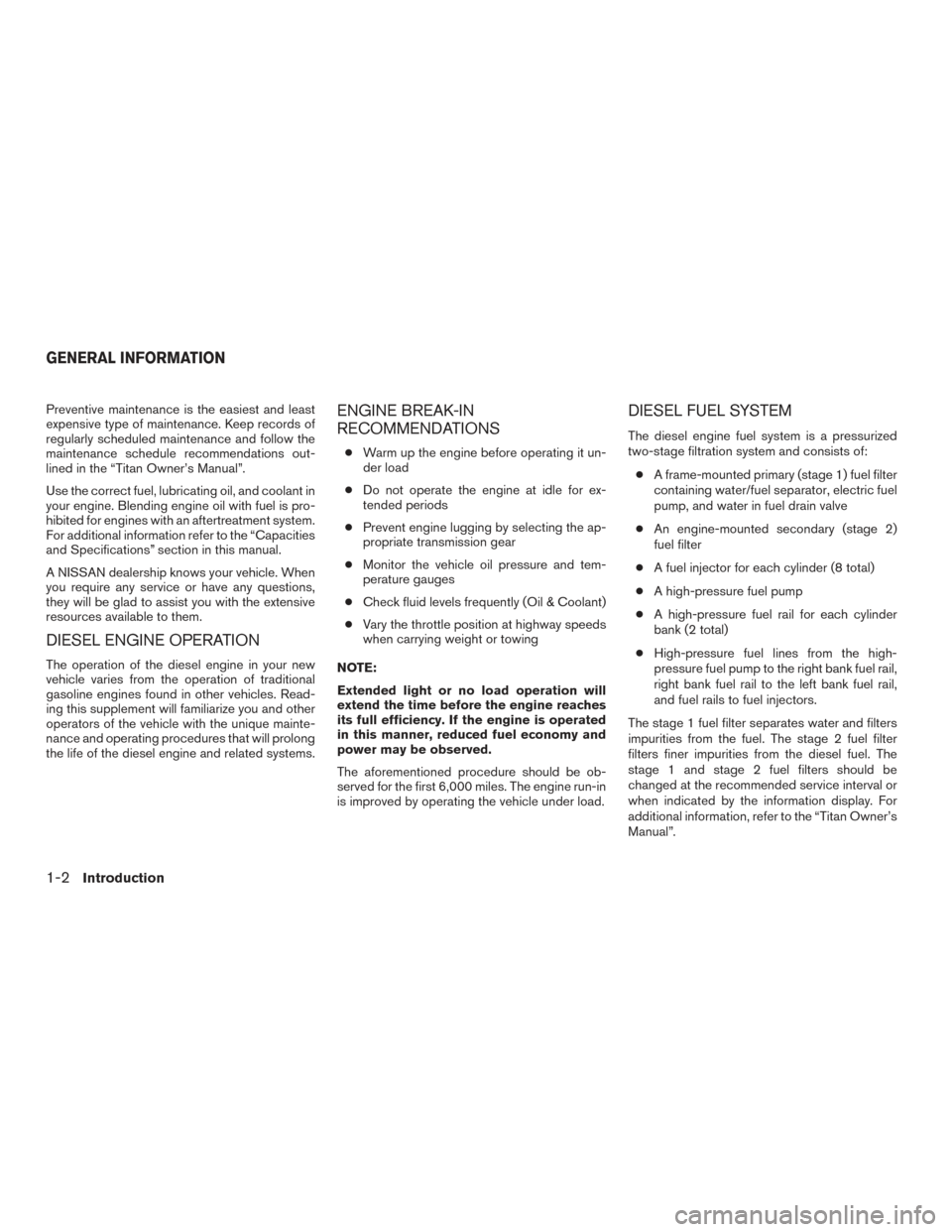
The diesel engine fuel system is a pressurized
two-stage filtration system and consists of: ● A frame-mounted primary (stage 1) fuel filter
containing water/fuel separator, electric fuel
pump, and water in fuel drain valve
● An engine-mounted secondary (stage 2)
fuel filter
● A fuel injector for each cylinder (8 total)
● A high-pressure fuel pump
● A high-pressure fuel rail for each cylinder
bank (2 total)
● High-pressure fuel lines from the high-
pressure fuel pump to the right bank fuel rail,
right bank fuel rail to the left bank fuel rail,
and fuel rails to fuel injectors.
The stage 1 fuel filter separates water and filters
impurities from the fuel. The stage 2 fuel filter
filters finer impurities from the diesel fuel. The
stage 1 and stage 2 fuel filters should be
changed at the recommended service interval or
when indicated by the information display. For
additional information, refer to the “Titan Owner’s
Manual”.
GENERAL INFORMATION
1-2Introduction
Page 592 of 636
3. Allow the engine to idle for at least 30 sec-onds after starting. Do not race the engine
while warming it up. Drive at moderate
speed for a short distance first, especially in
cold weather.
In cold weather, keep the engine running for
a minimum of 2–3 minutes before shutting it
off. Starting and stopping the engine over a
short period of time may make the vehicle
more difficult to start.
SWITCHING ENGINE OFF
Press the ignition to the off position.
To prolong the engine life (especially after ex-
tended high speed, high ambient temperature, or
during heavy load operation, such as trailering) , it
is recommended that a hot engine be idled for
3–5 minutes before shutting down. This allows
the turbocharged engine to cool down.
ENGINE BREAK-IN
RECOMMENDATIONS
● Warm up the engine before operating it un-
der load.
● Do not operate the engine at idle for ex-
tended periods.
● Prevent engine lugging by selecting the ap-
propriate transmission gear. ●
Monitor the vehicle oil pressure and tem-
perature gauges.
● Check fluid levels frequently (oil and cool-
ant) .
● Vary the throttle position at highway speeds
when carrying weight or towing.
NOTE:
Extended light or no load operation will
extend the time before the engine reaches
its full efficiency. If the engine is operated
in this manner reduced fuel economy and
power may be observed.
The aforementioned procedure should be ob-
served for the first 6,000 miles. The engine run-in
is improved by operating the vehicle under load.
REMOTE START (if so equipped)
CAUTION
Laws in some jurisdictions prohibit use of
remote start. Vehicles started with the remote start require the
ignition switch to be placed in the ON position
before the shift lever can be moved from the P
(Park) position. To place the ignition switch to the
ON position, follow these steps:
1. Make sure that the Intelligent Key is on you.
2. Apply the brake.
3. Press the ignition switch once to the ON position.
For additional information, refer to “NISSAN In-
telligent Key®” in the “Pre-driving checks and
adjustments” section of your owner’s manual.
ENGINE BLOCK HEATER (if so
equipped)
The power cable to operate the heater is avail-
able as a service part from an authorized NISSAN
dealer.
For additional information, refer to “Engine block
heater” in the “Starting and Driving” section of
your owner’s manual.
Starting and Stopping the Engine3-3