check engine NISSAN TITAN 2016 2.G Repair Manual
[x] Cancel search | Manufacturer: NISSAN, Model Year: 2016, Model line: TITAN, Model: NISSAN TITAN 2016 2.GPages: 636, PDF Size: 7.17 MB
Page 490 of 636
UnderbodyThe underbody is frequently ex-
posed to corrosive substances such as those
used on icy roads or to control dust. It is very
important to remove these substances from the
underbody, otherwise rust may form on the floor
pan, frame, fuel lines and exhaust system. At the
end of winter, the underbody should be thor-
oughly flushed with plain water, in those areas
where mud and dirt may have accumulated. For
additional information, refer to the “Appearance
and care” section of this manual.
Windshield-washer fluid* Check that there is
adequate fluid in the reservoir. The following descriptions are provided to give
you a better understanding of the scheduled
maintenance items that should be regularly
checked or replaced. The maintenance schedule
indicates at which mileage/time intervals each
item requires service.
Items marked with
“*”are recommended by
NISSAN for reliable vehicle operation. You are
not required to perform maintenance on these
items in order to maintain the warranties which
come with your NISSAN. Other maintenance
items and intervals are required.
When applicable, additional information can be
found in the “Do-it-yourself” section of this
manual.
NOTE: NISSAN does not advocate the use of
non-OEM approved aftermarket flushing sys-tems and strongly advises against performingthese services on a NISSAN product. Many of theaftermarket flushing systems use non-OEM ap-proved chemicals or solvents, the use of whichhas not been validated by NISSAN.
For recommended fuel, lubricants, fluids, grease,
and refrigerant, refer to “Recommended
fluids/lubricants and capacities” in the “Technical
and consumer information section of this
manual.
EMISSION CONTROL SYSTEM
MAINTENANCE:
Drive Belts*
Check engine drive belts for wear, fraying or
cracking and for proper tension. Replace any
damaged drive belts.
Engine Air Filter
Replace at specified intervals. When driving for
prolonged periods in dusty conditions,
check/replace the filter more frequently.
Engine Coolant*
Replace coolant at the specified interval. When
adding or replacing coolant, be sure to use only
Genuine NISSAN Long Life Antifreeze/Coolant
(blue) or equivalent with the proper mixture. (For
additional information on the proper mixture for
your area, refer to Engine cooling system” in the
“Do-it-yourself” section of this manual or the “Ti-
tan Diesel Owner’s Manual”.)
NOTE: Mixing any other type of coolant or the use
of non-distilled water may reduce the recom-
mended service interval of the coolant.
EXPLANATION OF SCHEDULED
MAINTENANCE ITEMS
Maintenance and schedules9-5
Page 491 of 636
Engine Oil and Oil Filter
Replace engine oil and oil filter at the specified
intervals. For recommended oil grade and viscos-
ity refer to “Recommended fluids/lubricants and
capacities” in the “Technical and consumer infor-
mation” section of this manual.
Fuel Filter (diesel engine only)
Replace the fuel filter and drain the water at the
specified intervals.
Fuel Lines*
Check the fuel hoses, piping and connections for
leaks, looseness, or deterioration. Tighten con-
nections or replace parts as necessary.
CHASSIS AND BODY
MAINTENANCE:
Brake Lines and Cables
Visually inspect for proper installation. Check for
chafing, cracks, deterioration, and signs of leak-
ing. Replace any deteriorated or damaged parts
immediately.
Brake Pads, Rotors, Drums, & Linings
Check for wear, deterioration and fluid leaks.
Replace any deteriorated or damaged parts im-
mediately.Exhaust System
Visually inspect the exhaust pipes, muffler and hang-
ers for leaks, cracks, deterioration, and damage.
Tighten connections or replace parts as necessary.
In-Cabin Microfilter
Replace at specified intervals. When driving for
prolonged periods in dusty conditions, replace
the filter more frequently.
Propeller Shaft(s)
Check for damage, looseness, and grease leak-
age. (4WD/AWD/RWD) .
Steering Gear and Linkage, Axle and Sus-
pension Parts, Drive Shaft Boots
Check for damage, looseness, and leakage of oil
or grease. Under severe driving conditions, in-
spect more frequently.
Tire Rotation
Tires should be rotated every 5,000 miles
(8,000 km) according to the instructions under
“General maintenance” in this section. When ro-
tating tires, check for damage and uneven wear.
Replace if necessary.
Transmission Fluid/Oil, Differential Oil,
Transfer Case Oil
Visually inspect for signs of leakage at specified
intervals.Replace automatic transmission fluid at specified
intervals. (For diesel engine models)
If towing a trailer, using a camper or car-top
carrier, or driving on rough or muddy roads:
● Replace the differential oil every
20,000 miles (32,000 km) or 24 months.
● Replace the automatic transmission fluid
ever 30,000 miles (48,000 km) or
24 months. (For gasoline engine models)
Off-Road Maintenance
Check the following items frequently whenever you
drive off-road through deep sand, mud or water:
● Brake pads and rotors
● Brake linings and drums
● Brake lines and hoses
● Differential, transmission and transfer case
oil
● Steering linkage
● Propeller shaft(s) and front drive shafts
● Engine air filter
● Clutch housing drain (4WD only)
9-6Maintenance and schedules
Page 512 of 636
countered, have your vehicle checked. It is rec-
ommended that you visit a NISSAN dealer for
servicing.
However, now and then you may notice
light spark knock for a short time while
accelerating or driving up hills. This is not a
cause for concern, because you get the
greatest fuel benefit when there is light
spark knock for a short time under heavy
engine load.
ENGINE OIL AND OIL FILTER
RECOMMENDATIONS (for gas
engine only)
For diesel engine oil and oil filter recommenda-
tions, refer to “Engine oil and oil filter recommen-
dations” section of the “Titan Diesel Owner’s
Manual”.
Selecting the correct oil
It is essential to choose the correct grade, quality
and viscosity engine oil to ensure satisfactory
engine life and performance. For additional infor-
mation, refer to “Recommended fluids/lubricants
and capacities” in this section. NISSAN recom-mends the use of an energy conserving oil in
order to improve fuel economy.
Select only engine oils that meet the American
Petroleum Institute (API) certification or Interna-
tional Lubricant Standardization and Approval
Committee (ILSAC) certification and SAE vis-
cosity standard. These oils have the API certifica-
tion mark on the front of the container. Oils which
do not have the specified quality label should not
be used as they could cause engine damage.
LTI2051
Technical and consumer information10-7
Page 534 of 636
CREW CAB MODELS
Crew Cab short wheel base models should
not be used to carry a slide-in camper.
LOCATION FOR CENTER OF
GRAVITY
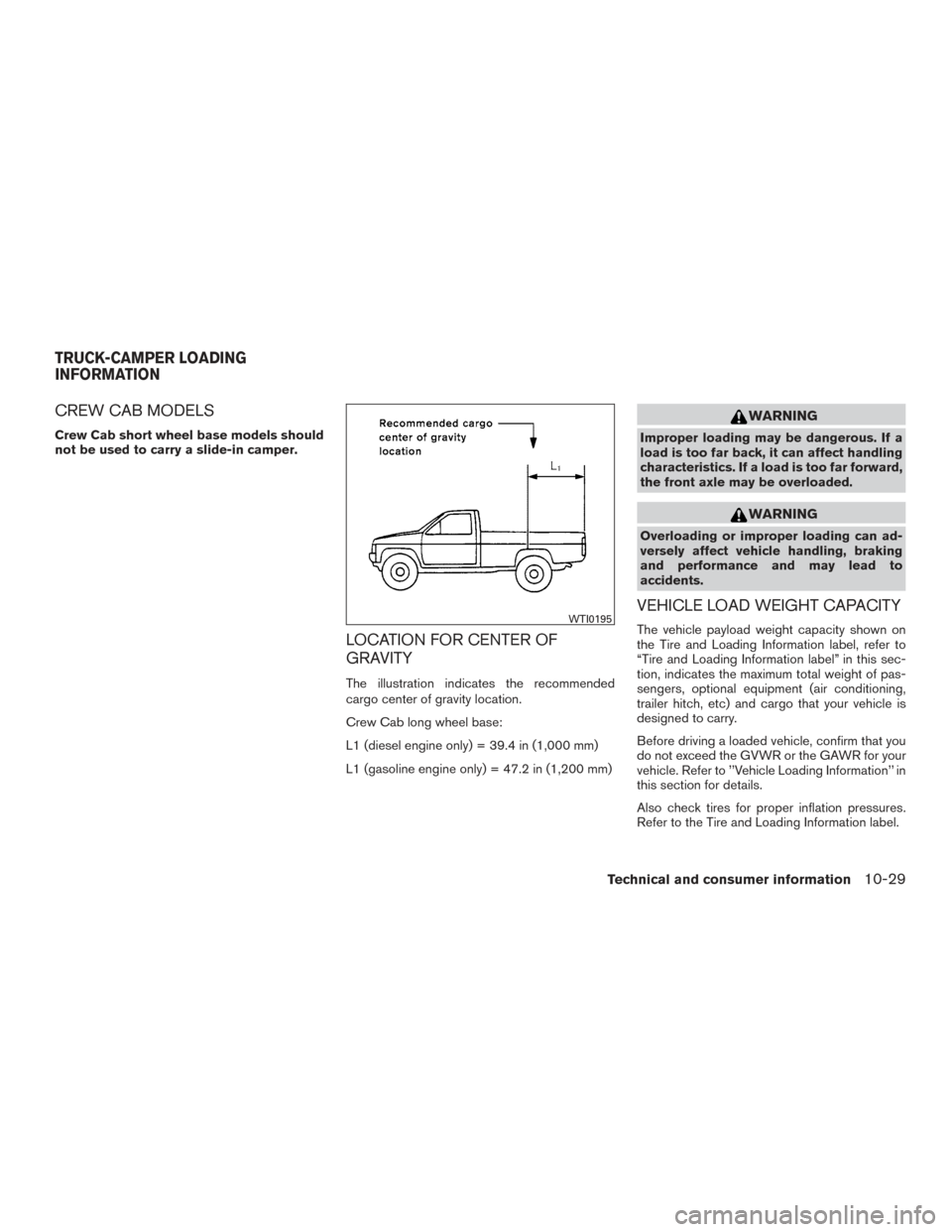
The illustration indicates the recommended
cargo center of gravity location.
Crew Cab long wheel base:
L1 (diesel engine only) = 39.4 in (1,000 mm)
L1 (gasoline engine only) = 47.2 in (1,200 mm)
WARNING
Improper loading may be dangerous. If a
load is too far back, it can affect handling
characteristics. If a load is too far forward,
the front axle may be overloaded.
WARNING
Overloading or improper loading can ad-
versely affect vehicle handling, braking
and performance and may lead to
accidents.
VEHICLE LOAD WEIGHT CAPACITY
The vehicle payload weight capacity shown on
the Tire and Loading Information label, refer to
“Tire and Loading Information label” in this sec-
tion, indicates the maximum total weight of pas-
sengers, optional equipment (air conditioning,
trailer hitch, etc) and cargo that your vehicle is
designed to carry.
Before driving a loaded vehicle, confirm that you
do not exceed the GVWR or the GAWR for your
vehicle. Refer to ’’Vehicle Loading Information’’ in
this section for details.
Also check tires for proper inflation pressures.
Refer to the Tire and Loading Information label.WTI0195
TRUCK-CAMPER LOADING
INFORMATION
Technical and consumer information10-29
Page 556 of 636
NOTE:
Trailer Sway Assist cannot reduce trailer
sway in all situations.● Be careful when passing other vehicles.
Passing while towing a trailer requires con-
siderably more distance than normal pass-
ing. Remember, the length of the trailer must
also pass the other vehicle before you can
safely change lanes.
● Use the Tow Mode or downshift the trans-
mission to a lower gear for engine braking
when driving down steep or long hills. This
will help slow the vehicle without applying
the brakes.
● Avoid holding the brake pedal down too long
or too frequently. This could cause the
brakes to overheat, resulting in reduced
braking efficiency.
● Increase your following distance to allow for
greater stopping distances while towing a
trailer. Anticipate stops and brake gradually.
● NISSAN recommends that the cruise con-
trol (if so equipped) not be used while tow-
ing a trailer. ●
Some states or provinces have specific
regulations and speed limits for vehicles that
are towing trailers. Obey the local speed
limits.
● Check your hitch, trailer wiring harness con-
nections, and trailer wheel lug nuts after
50 miles (80 km) of travel and at every break.
● When launching a boat, don’t allow the wa-
ter level to go over the exhaust tail pipe or
rear bumper.
● Make sure you disconnect the trailer lights
before backing the trailer into the water or
the trailer lights may burn out.
When towing a trailer, final drive gear oil
should be replaced and transmission
oil/fluid should be changed more fre-
quently. For additional information, refer to
the “Do-it-yourself” section in this manual.
Tow mode
Using tow mode is recommended when pulling a
heavy trailer or hauling a heavy load. Press the
TOW MODE switch to activate tow mode. The
indicator light on the TOW MODE switch illumi-
nates when tow mode is selected. Press the
TOW MODE switch again to turn tow mode off.
Tow mode is automatically cancelled when the
ignition switch is turned off. Tow mode includes the following features:
● Grade logic — Adjusts transmission shifts
when pulling a trailer or hauling a load up a
grade.
● Downhill Speed Control (DSC) — automati-
cally downshifts when driving down a grade
with a trailer or heavy load to help control
vehicle speed.
Driving the vehicle in the tow mode with no
trailer/load or light trailer/light load will not cause
any damage. However, fuel economy may be
reduced and the transmission/engine driving
characteristics may feel unusual.
When towing a trailer, final drive gear oil
should be replaced and transmission
oil/fluid should be changed more fre-
quently. For additional information, refer to
the “Maintenance and do-it-yourself” sec-
tion in this manual.FLAT TOWING FOR 2-WHEEL
DRIVE (2WD) VEHICLE (if so
equipped)
Towing your vehicle with all four wheels on the
ground is sometimes called flat towing. This
method is sometimes used when towing a vehicle
behind a recreational vehicle, such as a motor
home.
Technical and consumer information10-51
Page 560 of 636
https://wwwapps.tc.gc.ca/Saf-Sec-Sur/
7/PCDB-BDPP/fc-cp.aspx?lang=fra
(French speakers)
Additional information concerning motor
vehicle safety may be obtained from Trans-
port Canada’s Road Safety Information
Centre at 1-800-333-0371 or online at
www.tc.gc.ca/roadsafety (English speak-
ers) or www.tc.gc.ca/securiteroutiere
(French speakers) .
To notify NISSAN of any safety concerns
please contact our Consumer Information
Centre toll free at 1-800-387-0122.
WARNING
A vehicle equipped with Four-Wheel Drive
(4WD) should never be tested using a two
wheel dynamometer (such as the dyna-
mometers used by some states for emis-
sions testing) , or similar equipment. Make
sure you inform the test facility personnel
that your vehicle is equipped with 4WD
before it is placed on a dynamometer.
Using the wrong test equipment may re-
sult in transmission damage or unex-
pected vehicle movement which could re-
sult in serious vehicle damage or personal
injury.
Due to legal requirements in some states and
Canadian Provinces, your vehicle may be re-
quired to be in what is called the “ready condi-
tion” for an Inspection/Maintenance (I/M) test of
the emission control system.
The vehicle is set to the “ready condition” when it
is driven through certain driving patterns. Usually,
the ready condition can be obtained by ordinary
usage of the vehicle. If a powertrain system component is repaired or
the battery is disconnected, the vehicle may be
reset to a “not ready” condition. Before taking the
I/M test, check the vehicle’s
inspection/maintenance test readiness condi-
tion. Place the ignition switch in the ON position
without starting the engine. If the Malfunction
Indicator Light (MIL) comes on steady for 20 sec-
onds and then blinks for 10 seconds, the I/M test
condition is “not ready”. If the MIL does not blink
after 20 seconds, the I/M test condition is
“ready”. It is recommended that you visit a
NISSAN dealer to set the “ready condition” or to
prepare the vehicle for testing.
diesel engine only
For additional information, refer to “Recom-
mended fluids/lubricants and capacities” chart of
the “Titan Diesel Owner’s Manual”.
READINESS FOR INSPECTION/
MAINTENANCE (I/M) TEST (gas
engine only)
Technical and consumer information10-55
Page 563 of 636
Brightness controlInstrument panel ...............2-54
Bulb check/instrument panel ..........2-20
Bulb replacement ................8-28
C
Capacities and recommended
fuel/lubricants ..................10-2
Cargolightswitch................2-56
Cargo (See vehicle loading information) . . .10-16
Car phone or CB radio .............4-113
CD care and cleaning ..............4-80
CD player (See audio system) . .4-55, 4-61, 4-68
Check tire pressure ...............2-40
Child restraints .......1-23,1-24,1-26,1-28
LATCH (Lower Anchors and Tethers for
CHildren) System ..............1-28
Precautions on child
restraints.........1-26,1-32,1-38,1-42
Top tether strap anchor point locations . .1-30
Child safety rear door lock ............3-7
Chimes, audible reminders ...........2-29
Cleaningexteriorandinterior........7-2,7-4
Climatecontrolseatswitch...........2-56
Clock setting
(models with Navigation System) ........4-7
Clock setting
(models without Navigation System) . .4-54, 4-58
C.M.V.S.S. certification label .........10-13
Cold weather driving ...............5-63
Compact disc (CD) player ....4-55,4-61,4-68
Compass .....................2-16
Connect phone .................4-83
Consolelight...................2-85 Control panel buttons
...............4-4
Back button ..................4-7
Brightness/contrast button ..........4-9
Enterbutton..................4-4
With navigation system ............4-4
Controls Audio controls (steering wheel) .......4-81
Heater and air conditioner controls .....4-42
Heater and air conditioner controls
(manual) ...................4-32
Coolant Capacities and recommended
fuel/lubricants ................10-2
Changingenginecoolant...........8-5
Checking engine coolant level ........8-5
Engine coolant temperature gauge .....2-7
Corrosion protection ...............7-6
Cruisecontrol ...........5-40,5-40,5-41
Cupholders...................2-77
Curtainside-impactandrolloverairbag....1-54
D
Daytime Running Light System .....2-53,8-27
Diesel Particulate Filter (DPF) ..........8-10
Digital video disc DVD ..............4-88
Dimensionsandweights............10-11
Dimmer switch for instrument panel ......2-54
Display......................2-29
Display controls (see control panel buttons) . .4-4
Door locks .....................3-5
Door open warning light .............2-22
Doors ........................3-5
Drive belt .....................8-15
Drive positioner, Automatic ...........3-36Driving
Cold weather driving .............5-63
Driving with automatic transmission ....5-17
Precautions when starting and
driving ...................5-2,5-8
Driving the vehicle ................5-16
E
Economy-fuel..................5-44
Electronic locking rear differential (E-Lock)
system ......................5-50
Electronic locking rear differential (E-Lock)
system switch ..................2-63
Emergency engine shutoff .........5-13,6-2
Emission control information label ......10-14
Emission
control system warranty .......10-54
Engine Before starting the engine ..........5-14
Blockheater.................5-64
Capacities and recommended
fuel/lubricants ................10-2
Changing engine coolant ...........8-5
Changingengineoil..............8-7
Changing engine oil filter ...........8-8
Checking engine coolant level ........8-5
Checking engine oil level ...........8-6
Engine compartment check locations ....8-3
Engine coolant temperature gauge .....2-7
Engine cooling system ............8-4
Engineoil ...................8-6
Engine oil and oil filter recommendation . .10-7
Engineoilpressuregauge.......2-9,2-10
Engine oil pressure warning light ......2-23
Engine oil viscosity ..............10-8
11-2
Page 565 of 636
In-cabin microfilter................8-17
Increasing fuel economy .............5-44
Indicator lights and audible reminders
(See warning/indicator lights and audible
reminders).............2-19,2-20,2-26
Informationdisplay................2-29
Inside automatic anti-glare mirror ....3-27,3-28
Instrument brightness control ..........2-54
Instrument panel ...............0-6,2-2
Instrument panel dimmer switch ........2-54
Intelligent Key system Key operating range ..............3-9
Key operation ................3-10
Mechanicalkey ................3-4
Remote keyless entry operation.......3-13
Troubleshooting guide ............3-18
Warning signals ...............3-18
Interiorlight....................2-84
iPod®Player ...............4-73,4-75
ISOFIX child restraints .............1-28
J
Jump starting ...............6-10,8-14
K
Key.........................3-2
Key fob battery replacement ..........8-23
Keyless entry With Intelligent Key system
(See Intelligent Key system) .........3-13
Keys NISSAN Intelligent Key® ........3-2,3-8 NISSAN Vehicle Immobilizer System keys . .3-4
L
Labels Air conditioner specification label .....10-14
C.M.V.S.S. certification label .......10-13
Emission control information label ....10-14
Engine serial number ............10-13
F.M.V.S.S. certification label ........10-13
Tire and Loading Information label ....10-14
Vehicle identification number (VIN) ....10-12
Vehicle identification number (VIN)
plate.....................10-12
Warning labels (for SRS) ..........1-57
LATCH (Lower Anchors and Tethers for CHildren)
System ......................1-28
License plate Installing the license plate .........10-15
Light Air bag warning light .........1-58,2-26
Brake light (See stop light) .........8-28
Bulb check/instrument panel ........2-20
Bulbreplacement..............8-28
Charge warning light ............2-22
Consolelight.................2-85
Exterior and Interior lights ..........8-28
Foglights...................8-26
Foglightswitch ...............2-55
Headlight and turn signal switch ......2-51
Headlight control switch ..........2-51
Headlights..................8-25
Interiorlight..................2-84
Lightbulbs..................8-25
Low tire pressure warning light .......2-23Low windshield-washer fluid warning
light......................2-41
Personal lights
................2-86
Security indicator light ............2-28
Warning/indicator lights and audible
reminders ............2 -19, 2-20, 2-26
Lights.......................8-25 Maplights ..................2-85
Lock Child safety rear door lock ..........3-7
Door locks ...................3-5
Power door locks ............3-6,3-7
Loose fuel cap warning .............2-43
Low fuel warning light . . .2-23, 2-25, 2-39, 2-40
Low tire pressure warning light .........2-23
Low windshield-washer fluid warning light . . .2-41
Luggage
(See vehicle loading information) . .10-16
M
Maintenance General maintenance .............9-2
Insidethevehicle...............9-3
Maintenance precautions ...........8-2
Outside the vehicle ..............9-2
Seat belt maintenance ............1-23
Under the hood and vehicle .........9-4
Maintenancelog.................9-18
Maintenance requirements ............9-2
Malfunction indicator light ........2-25,2-27
Manual front seat adjustment ...........1-4
Maplights ....................2-85
Mappocket....................2-71
Memory Seat ...................3-36
Meters and gauges .............2-4,2-9
11-4
Page 566 of 636
Instrument brightness control........2-54
Mirror Automatic anti-glare inside mirror . .3-27, 3-28
Outside mirrors ...............3-28
Rearview ...................3-27
Vanity mirror .................3-26
Mirrors ......................3-27
Mobileapps ...................4-83
Moving Object Detection (MOD) ........4-28
N
NissanConnect
SM................4-83
NissanConnectSMServices...........4-84
NISSAN Intelligent Key® ..........3-2,3-8
NISSAN mobile entertainment system
(MES) .......................4-88
NISSAN Vehicle Immobilizer System . .2-46, 5-14
NISSAN voice recognition system ......4-136
O
Octanerating(Seefueloctanerating).....10-6
Odometer .....................2-6
Oil Capacities and recommended
fuel/lubricants ................10-2
Changing engine oil ..............8-7
Changing engine oil filter ...........8-8
Checking engine oil level ...........8-6
Engine oil ...................8-6
Engine oil and oil filter recommendation . .10-7
Engine oil viscosity ..............10-8
Oneshotcall .........4- 117, 4-117, 4-129Outside mirrors
.................3-28
Overheat If your vehicle overheats ...........6-12
Owner’s manual order form ..........10-56
Owner’s manual/service manual order
information ...................10-56
P
Parking Parking brake operation ...........5-22
Parking/parking on hills ...........5-53
Parking brake ...................5-22
Personallights..................2-86
Phone, Bluetooth® hands-free
system .................4- 114, 4-127
Power Front seat adjustment .............1-5
Power door locks ............3-6,3-7
Power outlet ..........2-67,2-67,2-69
Power rear windows .............2-81
Power steering fluid .............8-11
Power steering system ...........5-53
Power windows ...............2-80
Rear power windows ............2-81
Power inverter switch ..............2-64
Power outlet ............2-67,2-67,2-69
Power steering ..................5-53
Power steering fluid ...............8-11
Precautions Maintenance precautions ...........8-2
On-pavement and off-road driving
precautions ..................5-6
Precautions on booster
seats...........1-26,1-32,1-38,1-42 Precautions on child
restraints
.........1-26,1-32,1-38,1-42
Precautions on seat belt usage .......1-15
Precautions on supplemental restraint
system ....................1-45
Precautions when starting and
driving ...................5-2,5-8
Push starting ...................6-12
R
Radio CarphoneorCBradio...........4-113
FM/AM radio with compact disc (CD)
player .....................4-53
FM/AM/SAT radio with compact disc (CD)
player .................4-57,4-63
Steering wheel audio control switch . . . .4-81
Rainsensor....................2-49
Readiness for inspection maintenance (I/M)
test .......................10-55
Rear power windows ..............2-81
Rearseat......................1-4
Rear sliding window ...............
2-82
Rear sonar system off switch ..........2-65
Rearview mirror .................3-27
RearView Monitor ................4-10
Rear window and/or outside mirror defroster
switch.......................2-50
Recommended Fluids ..............10-2
Recorders EventData .................10-56
Refrigerant recommendation ..........10-8
Registering a vehicle in another country . . .10-12
Remote Start ...............3-19,5-15
11-5
Page 579 of 636
Preventive maintenance is the easiest and least
expensive type of maintenance. Keep records of
regularly scheduled maintenance and follow the
maintenance schedule recommendations out-
lined in the “Titan Owner’s Manual”.
Use the correct fuel, lubricating oil, and coolant in
your engine. Blending engine oil with fuel is pro-
hibited for engines with an aftertreatment system.
For additional information refer to the “Capacities
and Specifications” section in this manual.
A NISSAN dealership knows your vehicle. When
you require any service or have any questions,
they will be glad to assist you with the extensive
resources available to them.
DIESEL ENGINE OPERATION
The operation of the diesel engine in your new
vehicle varies from the operation of traditional
gasoline engines found in other vehicles. Read-
ing this supplement will familiarize you and other
operators of the vehicle with the unique mainte-
nance and operating procedures that will prolong
the life of the diesel engine and related systems.
ENGINE BREAK-IN
RECOMMENDATIONS
●Warm up the engine before operating it un-
der load
● Do not operate the engine at idle for ex-
tended periods
● Prevent engine lugging by selecting the ap-
propriate transmission gear
● Monitor the vehicle oil pressure and tem-
perature gauges
● Check fluid levels frequently (Oil & Coolant)
● Vary the throttle position at highway speeds
when carrying weight or towing
NOTE:
Extended light or no load operation will
extend the time before the engine reaches
its full efficiency. If the engine is operated
in this manner, reduced fuel economy and
power may be observed.
The aforementioned procedure should be ob-
served for the first 6,000 miles. The engine run-in
is improved by operating the vehicle under load.
DIESEL FUEL SYSTEM
The diesel engine fuel system is a pressurized
two-stage filtration system and consists of: ● A frame-mounted primary (stage 1) fuel filter
containing water/fuel separator, electric fuel
pump, and water in fuel drain valve
● An engine-mounted secondary (stage 2)
fuel filter
● A fuel injector for each cylinder (8 total)
● A high-pressure fuel pump
● A high-pressure fuel rail for each cylinder
bank (2 total)
● High-pressure fuel lines from the high-
pressure fuel pump to the right bank fuel rail,
right bank fuel rail to the left bank fuel rail,
and fuel rails to fuel injectors.
The stage 1 fuel filter separates water and filters
impurities from the fuel. The stage 2 fuel filter
filters finer impurities from the diesel fuel. The
stage 1 and stage 2 fuel filters should be
changed at the recommended service interval or
when indicated by the information display. For
additional information, refer to the “Titan Owner’s
Manual”.
GENERAL INFORMATION
1-2Introduction