check transmission fluid NISSAN TITAN 2016 2.G Owners Manual
[x] Cancel search | Manufacturer: NISSAN, Model Year: 2016, Model line: TITAN, Model: NISSAN TITAN 2016 2.GPages: 636, PDF Size: 7.17 MB
Page 90 of 636
AUXILIARY GAUGES (if so equipped)
1. Exhaust temperature gauge (if so equipped)
2. Automatic Transmission fluid temperaturegauge
3. Turbo meter (if so equipped)
4. Engine oil pressure gauge
5. Engine oil temperature gauge
6. Voltmeter Exhaust temperature gauge (if so
equipped)
For additional information, refer to the “Titan Die-
sel Owner’s Manual”.
Automatic Transmission fluid temperature
gauge
This gauge indicates the temperature of the au-
tomatic transmission fluid.
CAUTION
●
This gauge is not designed to indicate
low automatic transmission fluid level.
Use the dipstick to check the fluid level.
For additional information, refer to “6-
speed automatic transmission fluid” in
the “Do-it-yourself” section of this
manual.
● If the gauge indicates automatic trans-
mission fluid temperature over the nor-
mal range, stop the vehicle as soon as
safely possible. It is recommended that
you have the vehicle checked by a
NISSAN dealer. Continued operation of
the vehicle may seriously damage the
transmission.
Turbo meter (if so equipped)
For additional information, refer to the “Titan Die-
sel Owner’s Manual”.
Engine oil pressure gauge
The gauge indicates the engine lubrication sys-
tem oil pressure while the engine is running. The
bar should be in the middle of the gauge when
the engine is running.
LIC3390
Instruments and controls2-9
Page 116 of 636
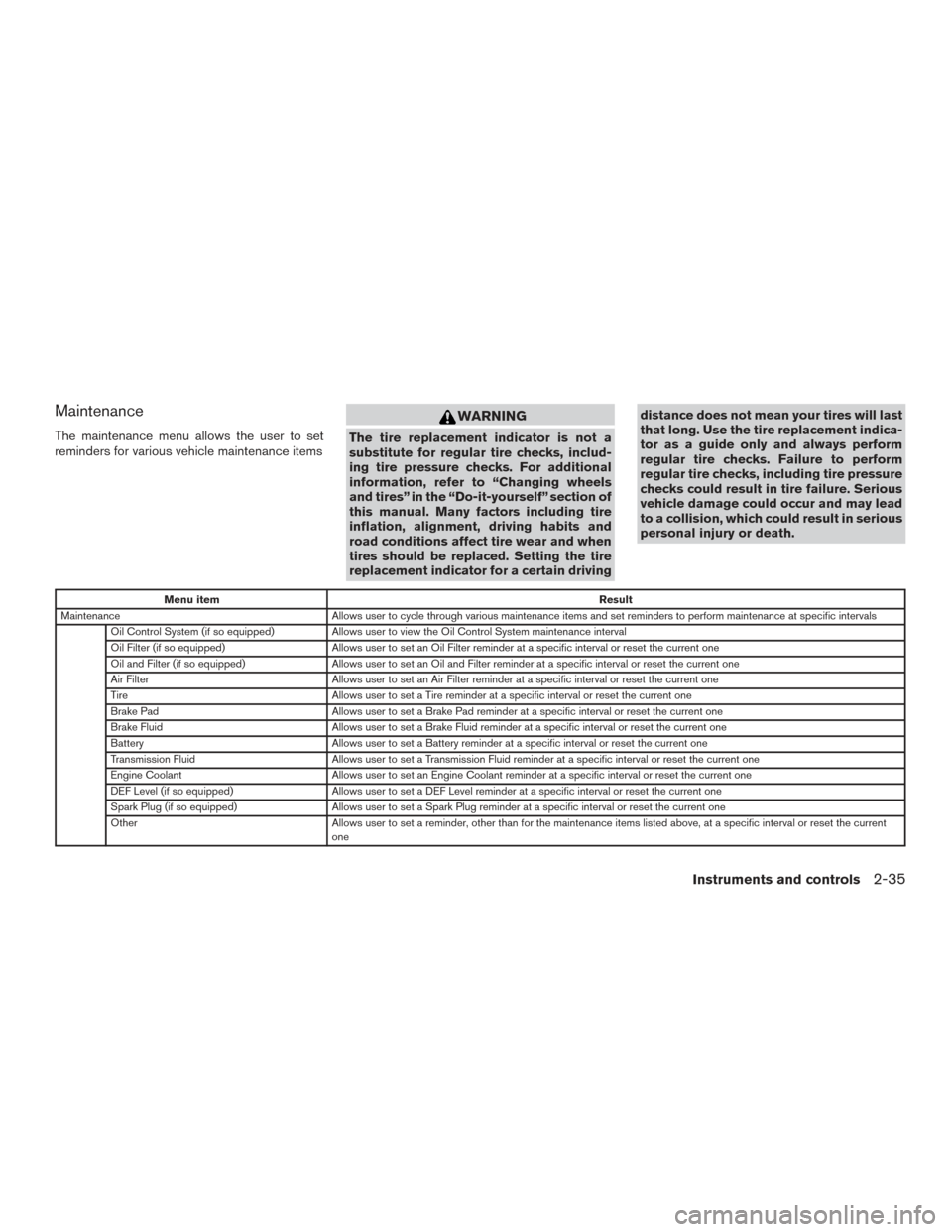
Maintenance
The maintenance menu allows the user to set
reminders for various vehicle maintenance items
WARNING
The tire replacement indicator is not a
substitute for regular tire checks, includ-
ing tire pressure checks. For additional
information, refer to “Changing wheels
and tires” in the “Do-it-yourself” section of
this manual. Many factors including tire
inflation, alignment, driving habits and
road conditions affect tire wear and when
tires should be replaced. Setting the tire
replacement indicator for a certain drivingdistance does not mean your tires will last
that long. Use the tire replacement indica-
tor as a guide only and always perform
regular tire checks. Failure to perform
regular tire checks, including tire pressure
checks could result in tire failure. Serious
vehicle damage could occur and may lead
to a collision, which could result in serious
personal injury or death.
Menu item
Result
Maintenance Allows user to cycle through various maintenance items and set reminders to perform maintenance at specific intervals
Oil Control System (if so equipped) Allows user to view the Oil Control System maintenance interval
Oil Filter (if so equipped) Allows user to set an Oil Filter reminder at a specific interval or reset the current one
Oil and Filter (if so equipped) Allows user to set an Oil and Filter reminder at a specific interval or reset the current one
Air Filter Allows user to set an Air Filter reminder at a specific interval or reset the current one
Tire Allows user to set a Tire reminder at a specific interval or reset the current one
Brake Pad Allows user to set a Brake Pad reminder at a specific interval or reset the current one
Brake Fluid Allows user to set a Brake Fluid reminder at a specific interval or reset the current one
Battery Allows user to set a Battery reminder at a specific interval or reset the current one
Transmission Fluid Allows user to set a Transmission Fluid reminder at a specific interval or reset the current one
Engine Coolant Allows user to set an Engine Coolant reminder at a specific interval or reset the current one
DEF Level (if so equipped) Allows user to set a DEF Level reminder at a specific interval or reset the current one
Spark Plug (if so equipped) Allows user to set a Spark Plug reminder at a specific interval or reset the current one
Other Allows user to set a reminder, other than for the maintenance items listed above, at a specific interval or reset the current
one
Instruments and controls2-35
Page 120 of 636
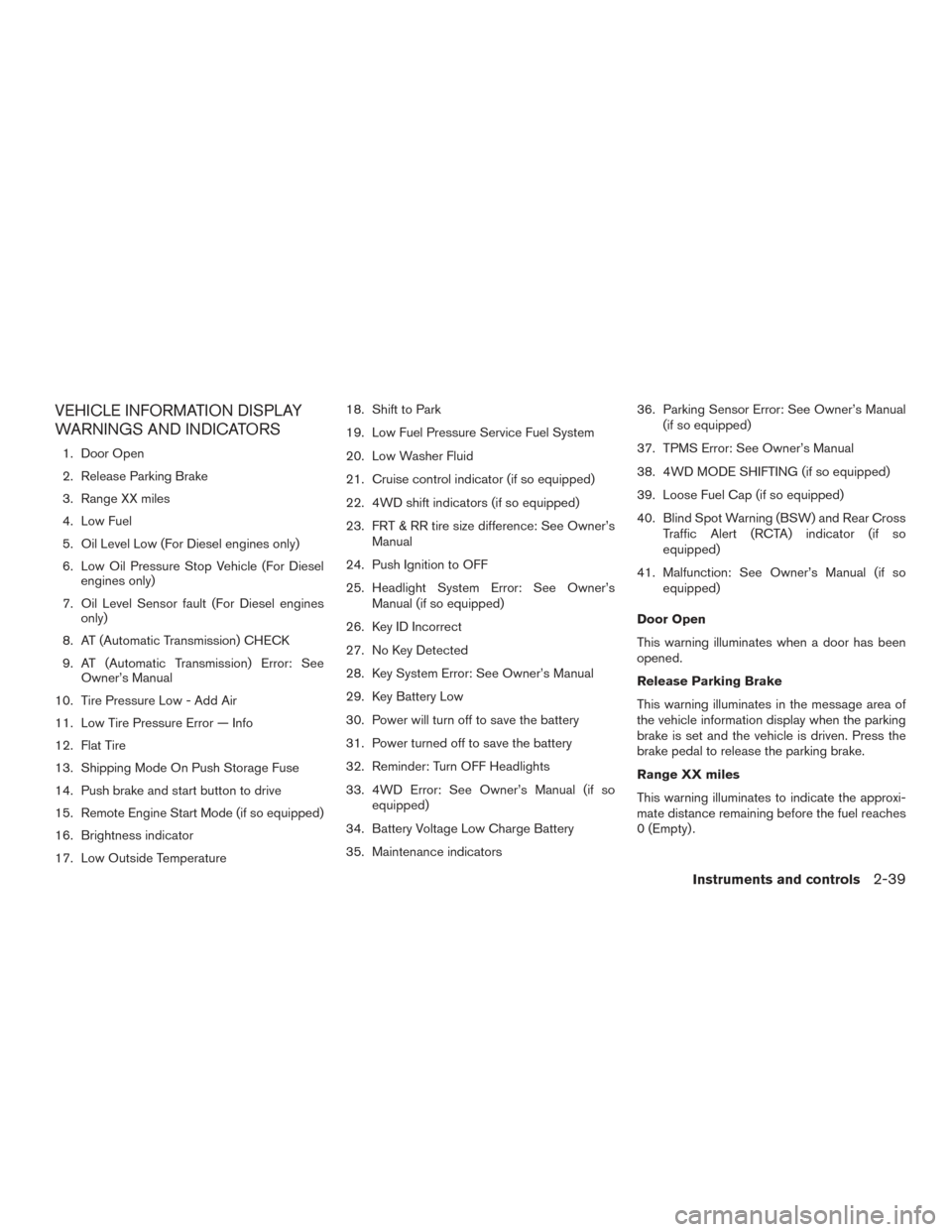
VEHICLE INFORMATION DISPLAY
WARNINGS AND INDICATORS
1. Door Open
2. Release Parking Brake
3. Range XX miles
4. Low Fuel
5. Oil Level Low (For Diesel engines only)
6. Low Oil Pressure Stop Vehicle (For Dieselengines only)
7. Oil Level Sensor fault (For Diesel engines only)
8. AT (Automatic Transmission) CHECK
9. AT (Automatic Transmission) Error: See Owner’s Manual
10. Tire Pressure Low - Add Air
11. Low Tire Pressure Error — Info
12. Flat Tire
13. Shipping Mode On Push Storage Fuse
14. Push brake and start button to drive
15. Remote Engine Start Mode (if so equipped)
16. Brightness indicator
17. Low Outside Temperature 18. Shift to Park
19. Low Fuel Pressure Service Fuel System
20. Low Washer Fluid
21. Cruise control indicator (if so equipped)
22. 4WD shift indicators (if so equipped)
23. FRT & RR tire size difference: See Owner’s
Manual
24. Push Ignition to OFF
25. Headlight System Error: See Owner’s Manual (if so equipped)
26. Key ID Incorrect
27. No Key Detected
28. Key System Error: See Owner’s Manual
29. Key Battery Low
30. Power will turn off to save the battery
31. Power turned off to save the battery
32. Reminder: Turn OFF Headlights
33. 4WD Error: See Owner’s Manual (if so equipped)
34. Battery Voltage Low Charge Battery
35. Maintenance indicators 36. Parking Sensor Error: See Owner’s Manual
(if so equipped)
37. TPMS Error: See Owner’s Manual
38. 4WD MODE SHIFTING (if so equipped)
39. Loose Fuel Cap (if so equipped)
40. Blind Spot Warning (BSW) and Rear Cross Traffic Alert (RCTA) indicator (if so
equipped)
41. Malfunction: See Owner’s Manual (if so equipped)
Door Open
This warning illuminates when a door has been
opened.
Release Parking Brake
This warning illuminates in the message area of
the vehicle information display when the parking
brake is set and the vehicle is driven. Press the
brake pedal to release the parking brake.
Range XX miles
This warning illuminates to indicate the approxi-
mate distance remaining before the fuel reaches
0 (Empty) .
Instruments and controls2-39
Page 443 of 636
8 Do-it-yourself
Maintenance precautions...........................8-2
Engine compartment check locations ................8-3
Engine cooling system .............................8-4
Checking engine coolant level ...................8-5
Changing engine coolant ........................8-5
Engine oil .........................................8-6
Checking engine oil level ........................8-6
Changing engine oil ............................8-7
Changing engine oil filter ........................8-8
Fuel filter (CUMMINS 5.0L) .........................8-9
Fuel filter replacement (stage 1) ..................8-9
Fuel filter replacement (stage 2) ..................8-9
Draining water .................................8-9
Fuel system priming .............................8-9
Diesel particulate filter (DPF) .......................8-10
Automatic regeneration ........................ 8-10
6-speed automatic transmission fluid (ATF)
(diesel engine only) ............................... 8-10
7-speed automatic transmission fluid (ATF)
(gasoline engine only) ............................. 8-10
Power steering fluid ............................... 8-11
Brake fluid ....................................... 8-11
Windshield-washer fluid ........................... 8-12Windshield-washer fluid reservoir . .
.............8-12
Battery .......................................... 8-13
Jump starting ................................. 8-14
Variable voltage control system (if so equipped) ......8-15
Drive belt ........................................ 8-15
Spark plugs (gasoline engine only) .................8-16
Replacing spark plugs ......................... 8-16
Air cleaner ....................................... 8-17
In-cabin microfilter ............................. 8-17
Windshield wiper blades .......................... 8-18
Cleaning ..................................... 8-18
Replacing .................................... 8-18
Brakes .......................................... 8-19
Fuses ........................................... 8-20
Engine compartment ........................... 8-20
Passenger compartment .......................8-22
Battery replacement .............................. 8-23
NISSAN
Intelligent Key® ....................... 8-24
Lights ........................................... 8-25
Headlights .................................... 8-25
Fog lights (if so equipped) ......................8-26
Daytime running light (DRL) (if so equipped) ......8-27
Exterior and interior lights .......................8-28
Page 453 of 636
For additional information, refer to the “Titan Die-
sel Owner’s Manual”.
AUTOMATIC REGENERATION
For additional information, refer to the “Titan Die-
sel Owner’s Manual”.When checking or replacement is required, we
recommend a NISSAN dealer for servicing.
CAUTION
●
NISSAN recommends using Genuine
NISSAN Matic K ATF. Do not mix with
other fluids.
● Do not use CVT fluid or manual trans-
mission fluid in this transmission. Dam-
age caused by the use of fluids other
than as recommended is not covered
under NISSAN’s New Vehicle Limited
Warranty.
● Using fluids that are not equivalent to
Genuine NISSAN Matic K ATF may also
damage the transmission. Damage
caused by the use of fluids other than as
recommended is not covered under
NISSAN’s New Vehicle Limited
Warranty.
The specified automatic transmission fluid is also
described on caution labels located in the engine
compartment. When checking or replacement is required, we
recommend a NISSAN dealer for servicing.
CAUTION
●
NISSAN recommends using Genuine
NISSAN Matic S ATF. Do not mix with
other fluids.
● Do not use CVT fluid or manual trans-
mission fluid in this transmission. Dam-
age caused by the use of fluids other
than as recommended is not covered
under NISSAN’s New Vehicle Limited
Warranty.
● Using fluids that are not equivalent to
Genuine NISSAN Matic S ATF may also
damage the transmission. Damage
caused by the use of fluids other than as
recommended is not covered under
NISSAN’s New Vehicle Limited
Warranty.
The specified automatic transmission fluid is also
described on caution labels located in the engine
compartment.
DIESEL PARTICULATE FILTER (DPF) 6-SPEED AUTOMATIC TRANSMISSION FLUID (ATF) (diesel
engine only)7-SPEED AUTOMATIC
TRANSMISSION FLUID (ATF)
(gasoline engine only)
8-10Do-it-yourself
Page 491 of 636
Engine Oil and Oil Filter
Replace engine oil and oil filter at the specified
intervals. For recommended oil grade and viscos-
ity refer to “Recommended fluids/lubricants and
capacities” in the “Technical and consumer infor-
mation” section of this manual.
Fuel Filter (diesel engine only)
Replace the fuel filter and drain the water at the
specified intervals.
Fuel Lines*
Check the fuel hoses, piping and connections for
leaks, looseness, or deterioration. Tighten con-
nections or replace parts as necessary.
CHASSIS AND BODY
MAINTENANCE:
Brake Lines and Cables
Visually inspect for proper installation. Check for
chafing, cracks, deterioration, and signs of leak-
ing. Replace any deteriorated or damaged parts
immediately.
Brake Pads, Rotors, Drums, & Linings
Check for wear, deterioration and fluid leaks.
Replace any deteriorated or damaged parts im-
mediately.Exhaust System
Visually inspect the exhaust pipes, muffler and hang-
ers for leaks, cracks, deterioration, and damage.
Tighten connections or replace parts as necessary.
In-Cabin Microfilter
Replace at specified intervals. When driving for
prolonged periods in dusty conditions, replace
the filter more frequently.
Propeller Shaft(s)
Check for damage, looseness, and grease leak-
age. (4WD/AWD/RWD) .
Steering Gear and Linkage, Axle and Sus-
pension Parts, Drive Shaft Boots
Check for damage, looseness, and leakage of oil
or grease. Under severe driving conditions, in-
spect more frequently.
Tire Rotation
Tires should be rotated every 5,000 miles
(8,000 km) according to the instructions under
“General maintenance” in this section. When ro-
tating tires, check for damage and uneven wear.
Replace if necessary.
Transmission Fluid/Oil, Differential Oil,
Transfer Case Oil
Visually inspect for signs of leakage at specified
intervals.Replace automatic transmission fluid at specified
intervals. (For diesel engine models)
If towing a trailer, using a camper or car-top
carrier, or driving on rough or muddy roads:
● Replace the differential oil every
20,000 miles (32,000 km) or 24 months.
● Replace the automatic transmission fluid
ever 30,000 miles (48,000 km) or
24 months. (For gasoline engine models)
Off-Road Maintenance
Check the following items frequently whenever you
drive off-road through deep sand, mud or water:
● Brake pads and rotors
● Brake linings and drums
● Brake lines and hoses
● Differential, transmission and transfer case
oil
● Steering linkage
● Propeller shaft(s) and front drive shafts
● Engine air filter
● Clutch housing drain (4WD only)
9-6Maintenance and schedules
Page 556 of 636
NOTE:
Trailer Sway Assist cannot reduce trailer
sway in all situations.● Be careful when passing other vehicles.
Passing while towing a trailer requires con-
siderably more distance than normal pass-
ing. Remember, the length of the trailer must
also pass the other vehicle before you can
safely change lanes.
● Use the Tow Mode or downshift the trans-
mission to a lower gear for engine braking
when driving down steep or long hills. This
will help slow the vehicle without applying
the brakes.
● Avoid holding the brake pedal down too long
or too frequently. This could cause the
brakes to overheat, resulting in reduced
braking efficiency.
● Increase your following distance to allow for
greater stopping distances while towing a
trailer. Anticipate stops and brake gradually.
● NISSAN recommends that the cruise con-
trol (if so equipped) not be used while tow-
ing a trailer. ●
Some states or provinces have specific
regulations and speed limits for vehicles that
are towing trailers. Obey the local speed
limits.
● Check your hitch, trailer wiring harness con-
nections, and trailer wheel lug nuts after
50 miles (80 km) of travel and at every break.
● When launching a boat, don’t allow the wa-
ter level to go over the exhaust tail pipe or
rear bumper.
● Make sure you disconnect the trailer lights
before backing the trailer into the water or
the trailer lights may burn out.
When towing a trailer, final drive gear oil
should be replaced and transmission
oil/fluid should be changed more fre-
quently. For additional information, refer to
the “Do-it-yourself” section in this manual.
Tow mode
Using tow mode is recommended when pulling a
heavy trailer or hauling a heavy load. Press the
TOW MODE switch to activate tow mode. The
indicator light on the TOW MODE switch illumi-
nates when tow mode is selected. Press the
TOW MODE switch again to turn tow mode off.
Tow mode is automatically cancelled when the
ignition switch is turned off. Tow mode includes the following features:
● Grade logic — Adjusts transmission shifts
when pulling a trailer or hauling a load up a
grade.
● Downhill Speed Control (DSC) — automati-
cally downshifts when driving down a grade
with a trailer or heavy load to help control
vehicle speed.
Driving the vehicle in the tow mode with no
trailer/load or light trailer/light load will not cause
any damage. However, fuel economy may be
reduced and the transmission/engine driving
characteristics may feel unusual.
When towing a trailer, final drive gear oil
should be replaced and transmission
oil/fluid should be changed more fre-
quently. For additional information, refer to
the “Maintenance and do-it-yourself” sec-
tion in this manual.FLAT TOWING FOR 2-WHEEL
DRIVE (2WD) VEHICLE (if so
equipped)
Towing your vehicle with all four wheels on the
ground is sometimes called flat towing. This
method is sometimes used when towing a vehicle
behind a recreational vehicle, such as a motor
home.
Technical and consumer information10-51
Page 560 of 636
https://wwwapps.tc.gc.ca/Saf-Sec-Sur/
7/PCDB-BDPP/fc-cp.aspx?lang=fra
(French speakers)
Additional information concerning motor
vehicle safety may be obtained from Trans-
port Canada’s Road Safety Information
Centre at 1-800-333-0371 or online at
www.tc.gc.ca/roadsafety (English speak-
ers) or www.tc.gc.ca/securiteroutiere
(French speakers) .
To notify NISSAN of any safety concerns
please contact our Consumer Information
Centre toll free at 1-800-387-0122.
WARNING
A vehicle equipped with Four-Wheel Drive
(4WD) should never be tested using a two
wheel dynamometer (such as the dyna-
mometers used by some states for emis-
sions testing) , or similar equipment. Make
sure you inform the test facility personnel
that your vehicle is equipped with 4WD
before it is placed on a dynamometer.
Using the wrong test equipment may re-
sult in transmission damage or unex-
pected vehicle movement which could re-
sult in serious vehicle damage or personal
injury.
Due to legal requirements in some states and
Canadian Provinces, your vehicle may be re-
quired to be in what is called the “ready condi-
tion” for an Inspection/Maintenance (I/M) test of
the emission control system.
The vehicle is set to the “ready condition” when it
is driven through certain driving patterns. Usually,
the ready condition can be obtained by ordinary
usage of the vehicle. If a powertrain system component is repaired or
the battery is disconnected, the vehicle may be
reset to a “not ready” condition. Before taking the
I/M test, check the vehicle’s
inspection/maintenance test readiness condi-
tion. Place the ignition switch in the ON position
without starting the engine. If the Malfunction
Indicator Light (MIL) comes on steady for 20 sec-
onds and then blinks for 10 seconds, the I/M test
condition is “not ready”. If the MIL does not blink
after 20 seconds, the I/M test condition is
“ready”. It is recommended that you visit a
NISSAN dealer to set the “ready condition” or to
prepare the vehicle for testing.
diesel engine only
For additional information, refer to “Recom-
mended fluids/lubricants and capacities” chart of
the “Titan Diesel Owner’s Manual”.
READINESS FOR INSPECTION/
MAINTENANCE (I/M) TEST (gas
engine only)
Technical and consumer information10-55
Page 579 of 636
Preventive maintenance is the easiest and least
expensive type of maintenance. Keep records of
regularly scheduled maintenance and follow the
maintenance schedule recommendations out-
lined in the “Titan Owner’s Manual”.
Use the correct fuel, lubricating oil, and coolant in
your engine. Blending engine oil with fuel is pro-
hibited for engines with an aftertreatment system.
For additional information refer to the “Capacities
and Specifications” section in this manual.
A NISSAN dealership knows your vehicle. When
you require any service or have any questions,
they will be glad to assist you with the extensive
resources available to them.
DIESEL ENGINE OPERATION
The operation of the diesel engine in your new
vehicle varies from the operation of traditional
gasoline engines found in other vehicles. Read-
ing this supplement will familiarize you and other
operators of the vehicle with the unique mainte-
nance and operating procedures that will prolong
the life of the diesel engine and related systems.
ENGINE BREAK-IN
RECOMMENDATIONS
●Warm up the engine before operating it un-
der load
● Do not operate the engine at idle for ex-
tended periods
● Prevent engine lugging by selecting the ap-
propriate transmission gear
● Monitor the vehicle oil pressure and tem-
perature gauges
● Check fluid levels frequently (Oil & Coolant)
● Vary the throttle position at highway speeds
when carrying weight or towing
NOTE:
Extended light or no load operation will
extend the time before the engine reaches
its full efficiency. If the engine is operated
in this manner, reduced fuel economy and
power may be observed.
The aforementioned procedure should be ob-
served for the first 6,000 miles. The engine run-in
is improved by operating the vehicle under load.
DIESEL FUEL SYSTEM
The diesel engine fuel system is a pressurized
two-stage filtration system and consists of: ● A frame-mounted primary (stage 1) fuel filter
containing water/fuel separator, electric fuel
pump, and water in fuel drain valve
● An engine-mounted secondary (stage 2)
fuel filter
● A fuel injector for each cylinder (8 total)
● A high-pressure fuel pump
● A high-pressure fuel rail for each cylinder
bank (2 total)
● High-pressure fuel lines from the high-
pressure fuel pump to the right bank fuel rail,
right bank fuel rail to the left bank fuel rail,
and fuel rails to fuel injectors.
The stage 1 fuel filter separates water and filters
impurities from the fuel. The stage 2 fuel filter
filters finer impurities from the diesel fuel. The
stage 1 and stage 2 fuel filters should be
changed at the recommended service interval or
when indicated by the information display. For
additional information, refer to the “Titan Owner’s
Manual”.
GENERAL INFORMATION
1-2Introduction
Page 592 of 636
3. Allow the engine to idle for at least 30 sec-onds after starting. Do not race the engine
while warming it up. Drive at moderate
speed for a short distance first, especially in
cold weather.
In cold weather, keep the engine running for
a minimum of 2–3 minutes before shutting it
off. Starting and stopping the engine over a
short period of time may make the vehicle
more difficult to start.
SWITCHING ENGINE OFF
Press the ignition to the off position.
To prolong the engine life (especially after ex-
tended high speed, high ambient temperature, or
during heavy load operation, such as trailering) , it
is recommended that a hot engine be idled for
3–5 minutes before shutting down. This allows
the turbocharged engine to cool down.
ENGINE BREAK-IN
RECOMMENDATIONS
● Warm up the engine before operating it un-
der load.
● Do not operate the engine at idle for ex-
tended periods.
● Prevent engine lugging by selecting the ap-
propriate transmission gear. ●
Monitor the vehicle oil pressure and tem-
perature gauges.
● Check fluid levels frequently (oil and cool-
ant) .
● Vary the throttle position at highway speeds
when carrying weight or towing.
NOTE:
Extended light or no load operation will
extend the time before the engine reaches
its full efficiency. If the engine is operated
in this manner reduced fuel economy and
power may be observed.
The aforementioned procedure should be ob-
served for the first 6,000 miles. The engine run-in
is improved by operating the vehicle under load.
REMOTE START (if so equipped)
CAUTION
Laws in some jurisdictions prohibit use of
remote start. Vehicles started with the remote start require the
ignition switch to be placed in the ON position
before the shift lever can be moved from the P
(Park) position. To place the ignition switch to the
ON position, follow these steps:
1. Make sure that the Intelligent Key is on you.
2. Apply the brake.
3. Press the ignition switch once to the ON position.
For additional information, refer to “NISSAN In-
telligent Key®” in the “Pre-driving checks and
adjustments” section of your owner’s manual.
ENGINE BLOCK HEATER (if so
equipped)
The power cable to operate the heater is avail-
able as a service part from an authorized NISSAN
dealer.
For additional information, refer to “Engine block
heater” in the “Starting and Driving” section of
your owner’s manual.
Starting and Stopping the Engine3-3