engine NISSAN TITAN 2017 2.G Owners Manual
[x] Cancel search | Manufacturer: NISSAN, Model Year: 2017, Model line: TITAN, Model: NISSAN TITAN 2017 2.GPages: 671, PDF Size: 7.96 MB
Page 569 of 671
WARNING
Overloading or improper loading of a
trailer and its cargo can adversely affect
vehicle handling, braking and perfor-
mance and may lead to accidents.
CAUTION
●Do not tow a trailer or haul a heavy load
for the first 500 miles (805 km) . Your
engine, axle or other parts could be
damaged.
● For the first 500 miles (805 km) that you
tow a trailer, do not drive over 50 mph
(80 km/h) and do not make starts at full
throttle. This helps the engine and other
parts of your vehicle wear in at the
heavier load.
Your new vehicle was designed to be used pri-
marily to carry passengers and cargo. Remember
that towing a trailer places additional loads on
your vehicle’s engine, drive train, steering, brak-
ing and other systems.
A NISSAN Towing Guide (U.S. only) is available
on the website at www.nissanusa.com. This
guide includes information on trailer towing ca-
pability and the special equipment required for
proper towing.
MAXIMUM LOAD LIMITS
Maximum trailer loads
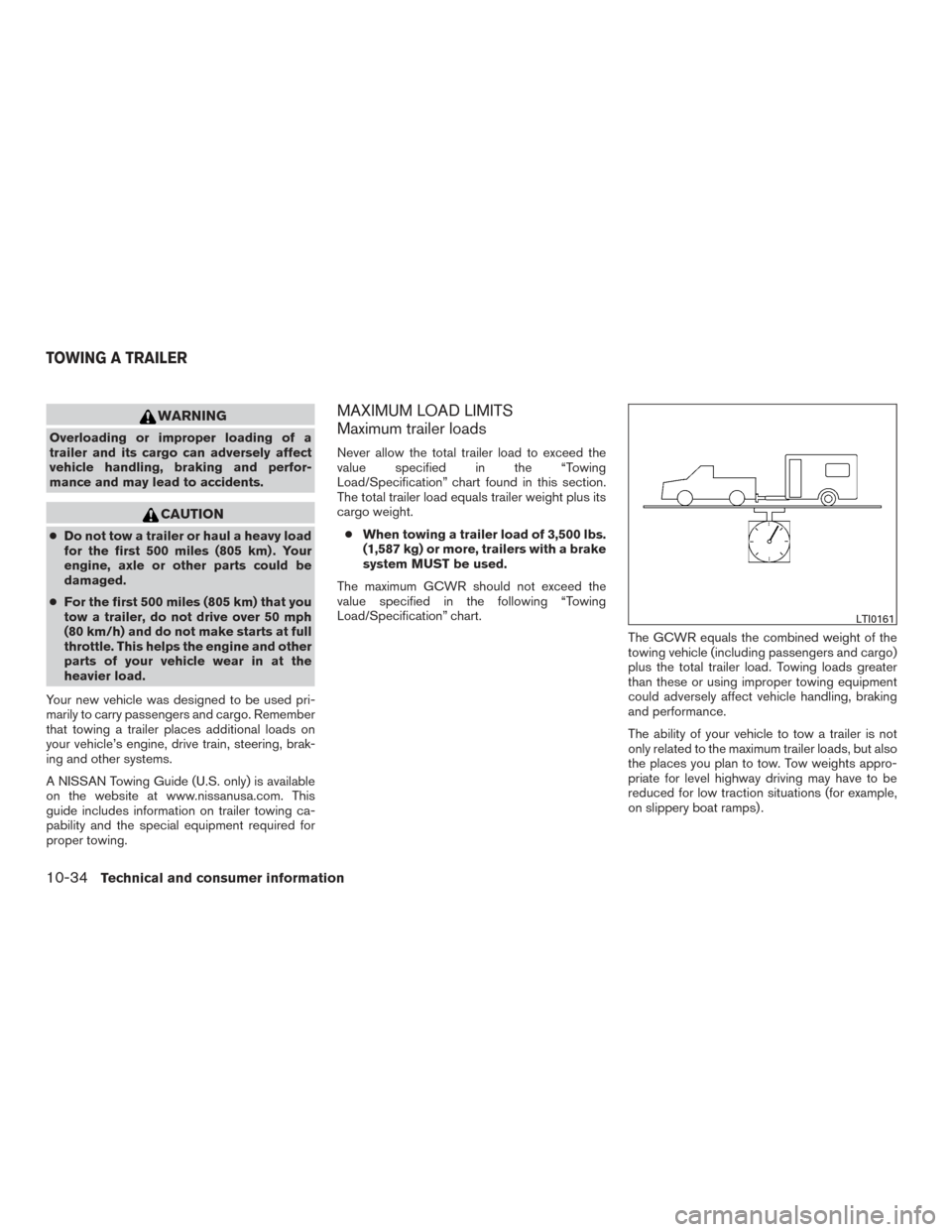
Never allow the total trailer load to exceed the
value specified in the “Towing
Load/Specification” chart found in this section.
The total trailer load equals trailer weight plus its
cargo weight. ● When towing a trailer load of 3,500 lbs.
(1,587 kg) or more, trailers with a brake
system MUST be used.
The maximum GCWR should not exceed the
value specified in the following “Towing
Load/Specification” chart. The GCWR equals the combined weight of the
towing vehicle (including passengers and cargo)
plus the total trailer load. Towing loads greater
than these or using improper towing equipment
could adversely affect vehicle handling, braking
and performance.
The ability of your vehicle to tow a trailer is not
only related to the maximum trailer loads, but also
the places you plan to tow. Tow weights appro-
priate for level highway driving may have to be
reduced for low traction situations (for example,
on slippery boat ramps) .
LTI0161
TOWING A TRAILER
10-34Technical and consumer information
Page 570 of 671
Temperature conditions can also affect towing.
For example, towing a heavy trailer in high outside
temperatures on graded roads can affect engine
performance and cause overheating. The engine
protection mode, which helps reduce the chance
of engine damage, could activate and automati-
cally decrease engine power. Vehicle speed may
decrease under high load. Plan your trip carefully
to account for trailer and vehicle load, weather
and road conditions.
WARNING
Overheating can result in reduced engine
power and vehicle speed. The reduced
speed may be lower than other traffic,
which could increase the chance of a col-
lision. Be especially careful when driving.
If the vehicle cannot maintain a safe driv-
ing speed, pull to the side of the road in a
safe area. Allow the engine to cool and
return to normal operation. For additional
information, refer to “If your vehicle over-
heats” in the “In case of emergency” sec-
tion of this manual.
CAUTION
Vehicle damage resulting from improper
towing procedures is not covered by
NISSAN warranties.
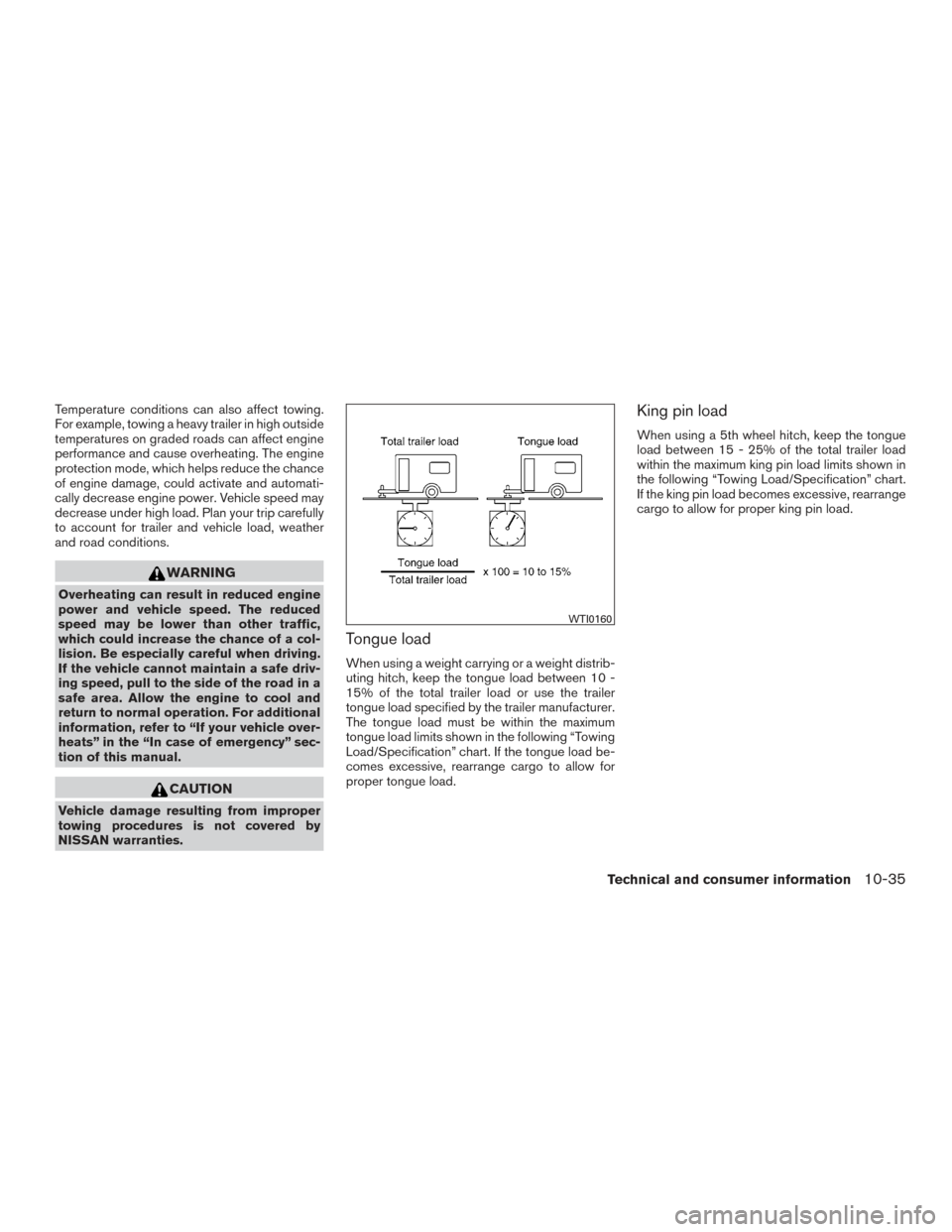
Tongue load
When using a weight carrying or a weight distrib-
uting hitch, keep the tongue load between 10 -
15% of the total trailer load or use the trailer
tongue load specified by the trailer manufacturer.
The tongue load must be within the maximum
tongue load limits shown in the following “Towing
Load/Specification” chart. If the tongue load be-
comes excessive, rearrange cargo to allow for
proper tongue load.
King pin load
When using a 5th wheel hitch, keep the tongue
load between 15 - 25% of the total trailer load
within the maximum king pin load limits shown in
the following “Towing Load/Specification” chart.
If the king pin load becomes excessive, rearrange
cargo to allow for proper king pin load.
WTI0160
Technical and consumer information10-35
Page 573 of 671
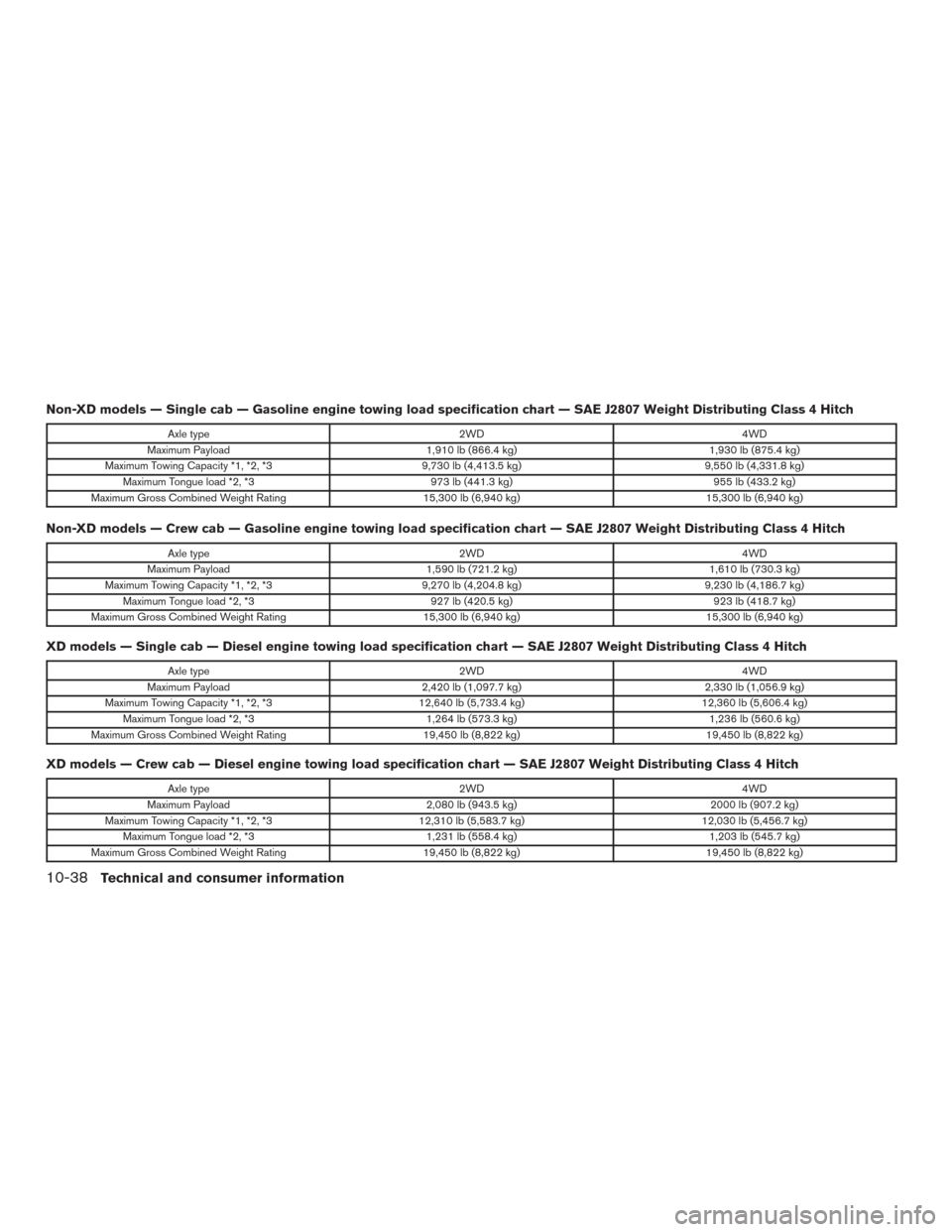
Non-XD models — Single cab — Gasoline engine towing load specification chart — SAE J2807 Weight Distributing Class 4 Hitch
Axle type2WD4WD
Maximum Payload 1,910 lb (866.4 kg) 1,930 lb (875.4 kg)
Maximum Towing Capacity *1, *2, *3 9,730 lb (4,413.5 kg)9,550 lb (4,331.8 kg)
Maximum Tongue load *2, *3 973 lb (441.3 kg)955 lb (433.2 kg)
Maximum Gross Combined Weight Rating 15,300 lb (6,940 kg)15,300 lb (6,940 kg)
Non-XD models — Crew cab — Gasoline engine towing load specification chart — SAE J2807 Weight Distributing Class 4 Hitch
Axle type 2WD4WD
Maximum Payload 1,590 lb (721.2 kg) 1,610 lb (730.3 kg)
Maximum Towing Capacity *1, *2, *3 9,270 lb (4,204.8 kg)9,230 lb (4,186.7 kg)
Maximum Tongue load *2, *3 927 lb (420.5 kg)923 lb (418.7 kg)
Maximum Gross Combined Weight Rating 15,300 lb (6,940 kg)15,300 lb (6,940 kg)
XD models — Single cab — Diesel engine towing load specification chart — SAE J2807 Weight Distributing Class 4 Hitch
Axle type 2WD4WD
Maximum Payload 2,420 lb (1,097.7 kg) 2,330 lb (1,056.9 kg)
Maximum Towing Capacity *1, *2, *3 12,640 lb (5,733.4 kg)12,360 lb (5,606.4 kg)
Maximum Tongue load *2, *3 1,264 lb (573.3 kg)1,236 lb (560.6 kg)
Maximum Gross Combined Weight Rating 19,450 lb (8,822 kg)19,450 lb (8,822 kg)
XD models — Crew cab — Diesel engine towing load specification chart — SAE J2807 Weight Distributing Class 4 Hitch
Axle type 2WD4WD
Maximum Payload 2,080 lb (943.5 kg) 2000 lb (907.2 kg)
Maximum Towing Capacity *1, *2, *3 12,310 lb (5,583.7 kg)12,030 lb (5,456.7 kg)
Maximum Tongue load *2, *3 1,231 lb (558.4 kg)1,203 lb (545.7 kg)
Maximum Gross Combined Weight Rating 19,450 lb (8,822 kg)19,450 lb (8,822 kg)
10-38Technical and consumer information
Page 574 of 671
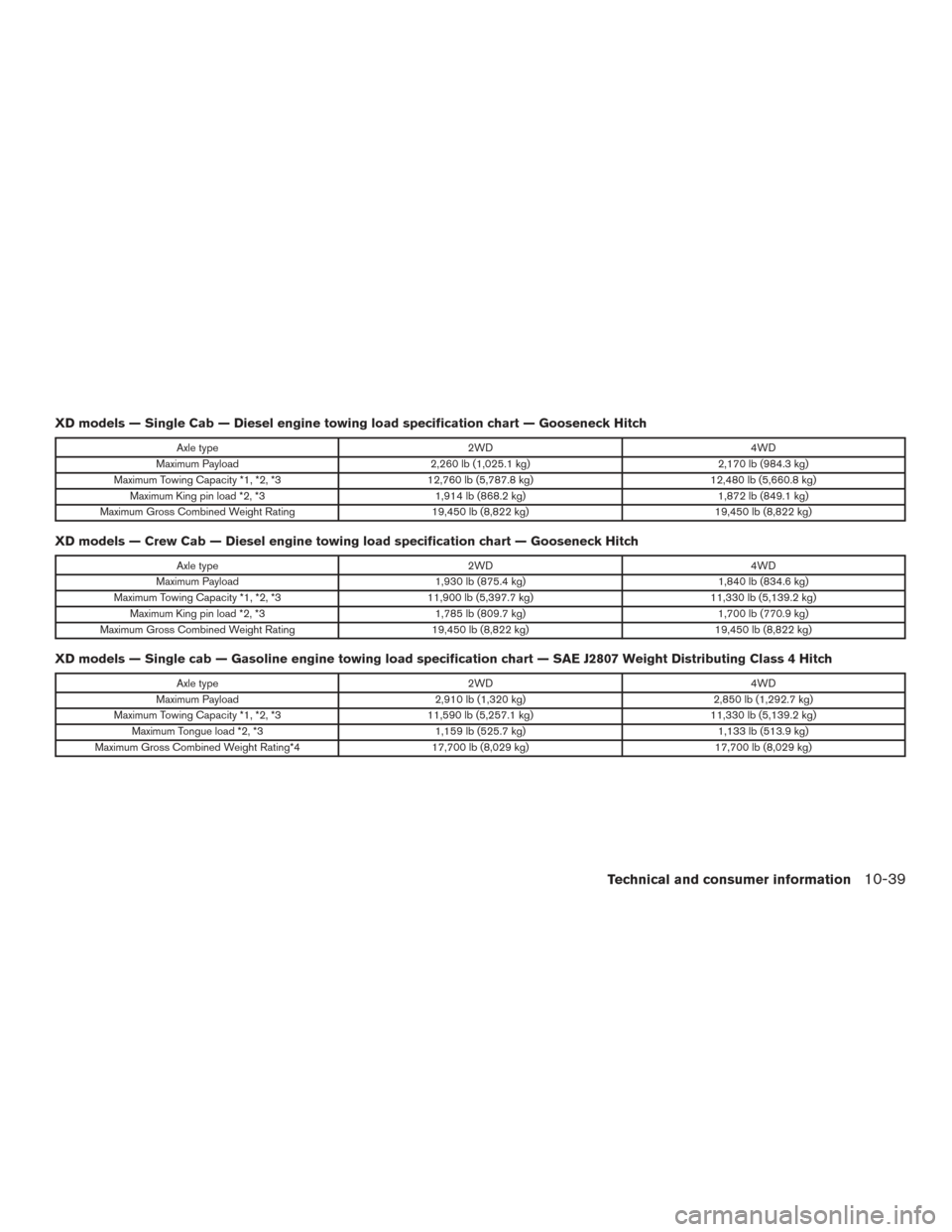
XD models — Single Cab — Diesel engine towing load specification chart — Gooseneck Hitch
Axle type2WD4WD
Maximum Payload 2,260 lb (1,025.1 kg) 2,170 lb (984.3 kg)
Maximum Towing Capacity *1, *2, *3 12,760 lb (5,787.8 kg)12,480 lb (5,660.8 kg)
Maximum King pin load *2, *3 1,914 lb (868.2 kg)1,872 lb (849.1 kg)
Maximum Gross Combined Weight Rating 19,450 lb (8,822 kg)19,450 lb (8,822 kg)
XD models — Crew Cab — Diesel engine towing load specification chart — Gooseneck Hitch
Axle type 2WD4WD
Maximum Payload 1,930 lb (875.4 kg) 1,840 lb (834.6 kg)
Maximum Towing Capacity *1, *2, *3 11,900 lb (5,397.7 kg)11,330 lb (5,139.2 kg)
Maximum King pin load *2, *3 1,785 lb (809.7 kg)1,700 lb (770.9 kg)
Maximum Gross Combined Weight Rating 19,450 lb (8,822 kg)19,450 lb (8,822 kg)
XD models — Single cab — Gasoline engine towing load specification chart — SAE J2807 Weight Distributing Class 4 Hitch
Axle type 2WD4WD
Maximum Payload 2,910 lb (1,320 kg)2,850 lb (1,292.7 kg)
Maximum Towing Capacity *1, *2, *3 11,590 lb (5,257.1 kg)11,330 lb (5,139.2 kg)
Maximum Tongue load *2, *3 1,159 lb (525.7 kg)1,133 lb (513.9 kg)
Maximum Gross Combined Weight Rating*4 17,700 lb (8,029 kg)17,700 lb (8,029 kg)
Technical and consumer information10-39
Page 575 of 671
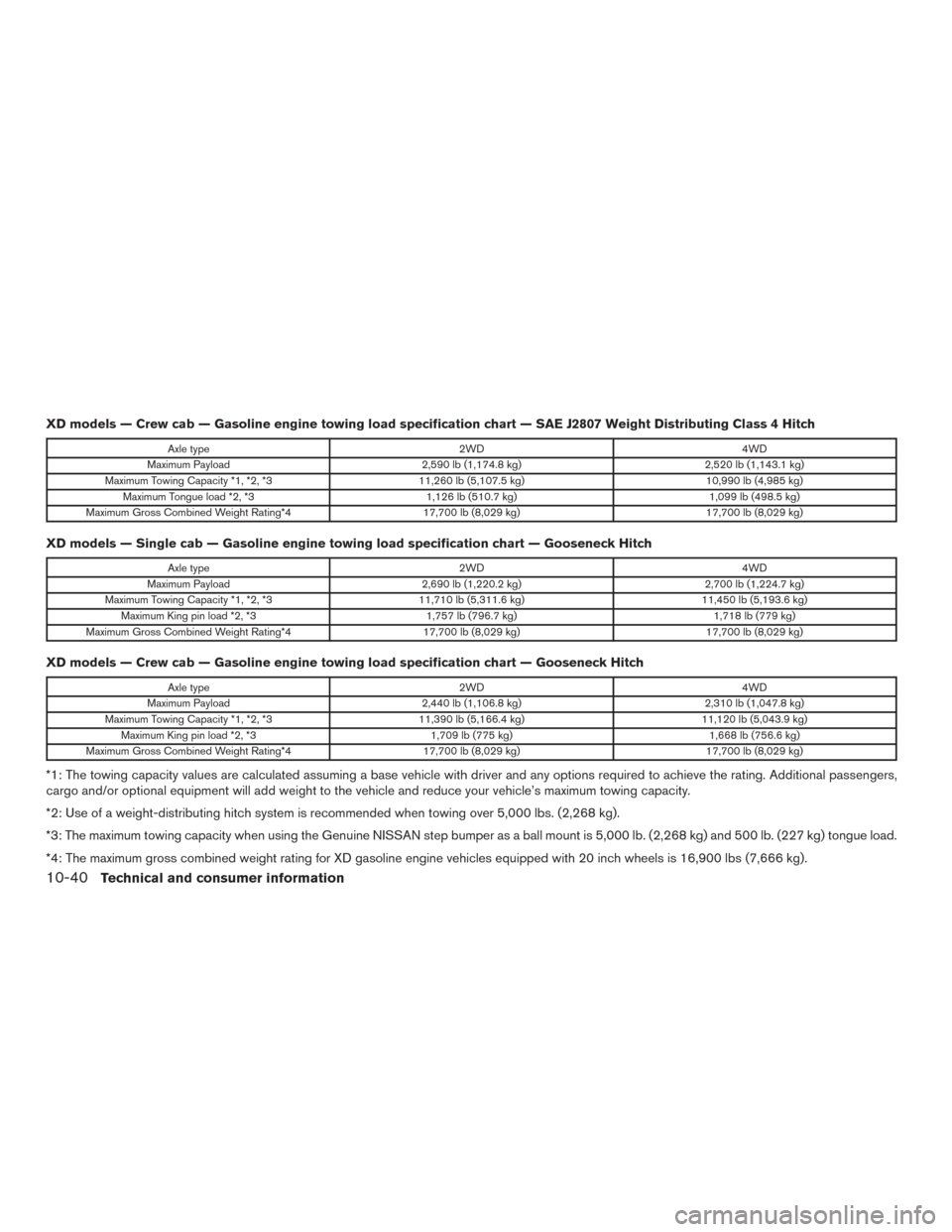
XD models — Crew cab — Gasoline engine towing load specification chart — SAE J2807 Weight Distributing Class 4 Hitch
Axle type2WD4WD
Maximum Payload 2,590 lb (1,174.8 kg) 2,520 lb (1,143.1 kg)
Maximum Towing Capacity *1, *2, *3 11,260 lb (5,107.5 kg)10,990 lb (4,985 kg)
Maximum Tongue load *2, *3 1,126 lb (510.7 kg)1,099 lb (498.5 kg)
Maximum Gross Combined Weight Rating*4 17,700 lb (8,029 kg)17,700 lb (8,029 kg)
XD models — Single cab — Gasoline engine towing load specification chart — Gooseneck Hitch
Axle type 2WD4WD
Maximum Payload 2,690 lb (1,220.2 kg) 2,700 lb (1,224.7 kg)
Maximum Towing Capacity *1, *2, *3 11,710 lb (5,311.6 kg)11,450 lb (5,193.6 kg)
Maximum King pin load *2, *3 1,757 lb (796.7 kg)1,718 lb (779 kg)
Maximum Gross Combined Weight Rating*4 17,700 lb (8,029 kg)17,700 lb (8,029 kg)
XD models — Crew cab — Gasoline engine towing load specification chart — Gooseneck Hitch
Axle type 2WD4WD
Maximum Payload 2,440 lb (1,106.8 kg) 2,310 lb (1,047.8 kg)
Maximum Towing Capacity *1, *2, *3 11,390 lb (5,166.4 kg)11,120 lb (5,043.9 kg)
Maximum King pin load *2, *3 1,709 lb (775 kg)1,668 lb (756.6 kg)
Maximum Gross Combined Weight Rating*4 17,700 lb (8,029 kg)17,700 lb (8,029 kg)
*1: The towing capacity values are calculated assuming a base vehicle with driver and any options required to achieve the rating. Additional passengers,
cargo and/or optional equipment will add weight to the vehicle and reduce your vehicle’s maximum towing capacity.
*2: Use of a weight-distributing hitch system is recommended when towing over 5,000 lbs. (2,268 kg).
*3: The maximum towing capacity when using the Genuine NISSAN step bumper as a ball mount is 5,000 lb. (2,268 kg) and 500 lb. (227 kg) tongue load.
*4: The maximum gross combined weight rating for XD gasoline engine vehicles equipped with 20 inch wheels is 16,900 lbs (7,666 kg).
10-40Technical and consumer information
Page 589 of 671
●Be certain your rearview mirrors conform to
all federal, state or local regulations. If not,
install any mirrors required for towing before
driving the vehicle.
● Determine the overall height of the vehicle
and trailer so the required clearance is
known.
Trailer towing tips
In order to gain skill and an understanding of the
vehicle’s behavior, you should practice turning,
stopping and backing up in an area which is free
from traffic. Steering stability and braking perfor-
mance will be somewhat different than under
normal driving conditions.
● Always secure items in the trailer to prevent
load shift while driving.
● Lock the trailer hitch coupler with a pin or
lock to prevent the coupler from inadver-
tently becoming unlatched.
● Avoid abrupt starts, acceleration or stops.
● Avoid sharp turns or lane changes.
● Always drive your vehicle at a moderate
speed. ●
When backing up, hold the bottom of the
steering wheel with one hand. Move your
hand in the direction in which you want the
trailer to go. Make small corrections and
back up slowly. If possible, have someone
guide you when you are backing up.
Always block the wheels on both vehicle and
trailer when parking. Parking on a slope is not
recommended; however, if you must do so:CAUTION
If you move the shift selector to the P
(Park) position before blocking the
wheels and applying the parking brake,
transmission damage could occur.
1. Apply and hold the brake pedal.
2. Have someone place blocks on the downhill side of the vehicle and trailer wheels.
3. After the wheel blocks are in place, slowly release the brake pedal until the blocks ab-
sorb the vehicle load.
4. Apply the parking brake.
5. Shift the transmission into P (Park) . 6. Make sure the
indicator light (if so
equipped) indicates the transfer case is in
4H, 4L, or 2H and that the ATP light is off. If
the
indicator light is flashing, or the
ATP light is ON, make sure the transmission
is in P (Park) (A/T) and turn the 4WD switch
to 2WD or 4H. For additional information,
refer to “Automatic transmission park warn-
ing light” in the “Instruments and controls”
section and “Using 4-wheel drive (4WD)” in
the “Starting and driving” section of this
manual.
7. Turn off the engine.
To drive away:
1. Start the vehicle.
2. Apply and hold the brake pedal.
3. Shift the transmission into gear.
4. Release the parking brake.
5. Drive slowly until the vehicle and trailer are clear from the blocks.
6. Apply and hold the brake pedal.
7. Have someone retrieve and store the blocks.
10-54Technical and consumer information
Page 590 of 671
●While going downhill, the weight of the
trailer pushing on the tow vehicle may de-
crease overall stability. Therefore, to main-
tain adequate control, reduce your speed
and shift to a lower gear. Avoid long or
repeated use of the brakes when descend-
ing a hill, as this reduces their effectiveness
and could cause overheating. Shifting to a
lower gear instead provides “engine brak-
ing” and reduces the need to brake as fre-
quently.
● If the engine coolant temperature rises to a
high temperature, refer to “If your vehicle
overheats” in the “In case of emergency”
section of this owner’s manual.
● Trailer towing requires more fuel than normal
circumstances.
● Avoid towing a trailer for your vehicle’s first
500 miles (805 km) .
● For the first 500 miles (805 km) that you do
tow, do not drive over 50 mph (80 km/h).
● Have your vehicle serviced more often than
at intervals specified. For additional informa-
tion, refer to “Maintenance schedules” in the
“Maintenance and schedule” section of this
manual. ●
When making a turn, your trailer wheels will
be closer to the inside of the turn than your
vehicle wheels. To compensate for this,
make a larger than normal turning radius
during the turn.
● Crosswinds and rough roads will adversely
affect vehicle/trailer handling, possibly caus-
ing vehicle sway. When being passed by
larger vehicles, be prepared for possible
changes in crosswinds that could affect ve-
hicle handling.
Trailer Sway Assist:
To minimize trailer sway, your vehicle may apply
braking to individual wheels based on input from
your vehicle sensors and vehicle speed. Trailer
sway control is a function of the Vehicle Dynamic
Control (VDC) system and is active when the
VDC function is enabled.
CAUTION
If the VDC-OFF switch is on (meaning VDC
system OFF) , the Trailer Sway Assist is
also disabled
When Trailer Sway Assist is in operation, the
VDC warning light blinks. When vehicle control is
regained, VDC warning light will turn OFF. For additional information about the VDC system,
refer to “Vehicle Dynamic Control (VDC) OFF
switch” and Vehicle Dynamic Control (VDC) sys-
tem” sections of this manual.
If Trailer Sway Assist activates, do the fol-
lowing:
1. Take your foot off the accelerator pedal to allow the vehicle to coast and steer as
straight ahead as the road conditions allow.
This combination will help stabilize the ve-
hicle
CAUTION
Do not try to correct trailer sway by steer-
ing or applying the brakes.
2. When the trailer sway stops, gently apply the brakes and pull to the side of the road in a
safe area.
3. Try to rearrange the trailer load so it is bal- anced. For additional information, refer to
“Pre-towing tips” in this section.
Technical and consumer information10-55
Page 591 of 671
NOTE:
Trailer Sway Assist cannot reduce trailer
sway in all situations.● Be careful when passing other vehicles.
Passing while towing a trailer requires con-
siderably more distance than normal pass-
ing. Remember, the length of the trailer must
also pass the other vehicle before you can
safely change lanes.
● Use the Tow Mode or downshift the trans-
mission to a lower gear for engine braking
when driving down steep or long hills. This
will help slow the vehicle without applying
the brakes.
● Avoid holding the brake pedal down too long
or too frequently. This could cause the
brakes to overheat, resulting in reduced
braking efficiency.
● Increase your following distance to allow for
greater stopping distances while towing a
trailer. Anticipate stops and brake gradually.
● NISSAN recommends that the cruise con-
trol (if so equipped) not be used while tow-
ing a trailer. ●
Some states or provinces have specific
regulations and speed limits for vehicles that
are towing trailers. Obey the local speed
limits.
● Check your hitch, trailer wiring harness con-
nections, and trailer wheel lug nuts after
50 miles (80 km) of travel and at every break.
● When launching a boat, don’t allow the wa-
ter level to go over the exhaust tail pipe or
rear bumper.
● Make sure you disconnect the trailer lights
before backing the trailer into the water or
the trailer lights may burn out.
When towing a trailer, final drive gear oil
should be replaced and transmission
oil/fluid should be changed more fre-
quently. For additional information, refer to
the “Do-it-yourself” section in this manual.
Tow mode
Using tow mode is recommended when pulling a
heavy trailer or hauling a heavy load. Press the
TOW MODE switch to activate tow mode. The
indicator light on the TOW MODE switch illumi-
nates when tow mode is selected. Press the
TOW MODE switch again to turn tow mode off.
Tow mode is automatically canceled when the
ignition switch is turned off. Tow mode includes the following features:
● Grade logic — Adjusts transmission shifts
when pulling a trailer or hauling a load up a
grade.
● Downhill Speed Control (DSC) — automati-
cally downshifts when driving down a grade
with a trailer or heavy load to help control
vehicle speed.
Driving the vehicle in the tow mode with no
trailer/load or light trailer/light load will not cause
any damage. However, fuel economy may be
reduced and the transmission/engine driving
characteristics may feel unusual.
When towing a trailer, final drive gear oil
should be replaced and transmission
oil/fluid should be changed more fre-
quently. For additional information, refer to
the “Do-it-yourself” section of this manual.
FLAT TOWING FOR 2-WHEEL
DRIVE (2WD) VEHICLE (if so
equipped)
Towing your vehicle with all four wheels on the
ground is sometimes called flat towing. This
method is sometimes used when towing a vehicle
behind a recreational vehicle, such as a motor
home.
10-56Technical and consumer information
Page 595 of 671
https://wwwapps.tc.gc.ca/Saf-Sec-Sur/
7/PCDB-BDPP/fc-cp.aspx?lang=fra
(French speakers)
Additional information concerning motor
vehicle safety may be obtained from Trans-
port Canada’s Road Safety Information
Centre at 1-800-333-0371 or online at
www.tc.gc.ca/roadsafety (English speak-
ers) or www.tc.gc.ca/securiteroutiere
(French speakers) .
To notify NISSAN of any safety concerns
please contact our Consumer Information
Centre toll free at 1-800-387-0122.
WARNING
A vehicle equipped with Four-Wheel Drive
(4WD) should never be tested using a two
wheel dynamometer (such as the dyna-
mometers used by some states for emis-
sions testing) , or similar equipment. Make
sure you inform the test facility personnel
that your vehicle is equipped with 4WD
before it is placed on a dynamometer.
Using the wrong test equipment may re-
sult in transmission damage or unex-
pected vehicle movement which could re-
sult in serious vehicle damage or personal
injury.
Due to legal requirements in some states and
Canadian Provinces, your vehicle may be re-
quired to be in what is called the “ready condi-
tion” for an Inspection/Maintenance (I/M) test of
the emission control system.
The vehicle is set to the “ready condition” when it
is driven through certain driving patterns. Usually,
the ready condition can be obtained by ordinary
usage of the vehicle. If a powertrain system component is repaired or
the battery is disconnected, the vehicle may be
reset to a “not ready” condition. Before taking the
I/M test, check the vehicle’s
inspection/maintenance test readiness condi-
tion. Place the ignition switch in the ON position
without starting the engine. If the Malfunction
Indicator Light (MIL) comes on steady for 20 sec-
onds and then blinks for 10 seconds, the I/M test
condition is “not ready”. If the MIL does not blink
after 20 seconds, the I/M test condition is
“ready”. It is recommended that you visit a
NISSAN dealer to set the “ready condition” or to
prepare the vehicle for testing.
diesel engine only
For additional information, refer to the “Titan Die-
sel Owner’s Manual”.
READINESS FOR INSPECTION/
MAINTENANCE (I/M) TEST (gas
engine only)
10-60Technical and consumer information
Page 598 of 671
11 Index
4WD.......................5-44
4WDwarninglight...............2-22
4-Wheel Drive.................5-44
A
Aiming control, headlights ...........2-55
Air bag (See supplemental restraint
system) .....................1-51
Air bag system Front (See supplemental front impact
air bag system) ............1-58,1-72
Airbagwarninglabels.............1-77
Airbagwarninglight...........1-78,2-28
Air bag warning light, supplemental . .1-78, 2-28
Aircleaner....................8-18
Air cleaner housing filter ............8-18
Air conditioner Air conditioner operation ..........4-37
Air conditioner specification label ....10-18
Air conditioner system refrigerant and
oil recommendations ............10-8
Air conditioner system refrigerant
recommendations ..............10-8
Heater and air conditioner (automatic)
(if so equipped) ...............4-42
Heater and air conditioner controls ....4-43
Servicing air conditioner ..........4-45
Airflowcharts..................4-38
Alarm system (See vehicle security system). .2-47
Anchor point locations .............1-31
Antenna .....................4-83 Antifreeze
....................5-65
Anti-lock brake warning light ..........2-22
Anti-lock Braking System (ABS) ........5-55
Apps .......................4-83
AroundView®Monitor.............4-16
Audible reminders ...............2-31
Audio system ..................4-46
AMradioreception.............4-46
Bluetooth®audio..........4-79,4-80
Bluetooth® streaming audio ....4-79,4-80
Compact disc (CD) player . .4-56, 4-62, 4-69
FM/AM radio with compact disc (CD)
player ....................4-54
FM/AM/SAT radio with compact disc (CD)
player.................4-58,4-64
FMradioreception.............4-46
iPod® Player .............4-74,4-76
iPod® player operation .......4-74,4-76
Radio ....................4-46
Steering wheel audio control switch . . .4-82
USB interface ............4-70,4-72
USB
(Universal Serial Bus) Connection Port . .4-72
Autolight switch .................2-54
Automatic Automatic drive positioner .....3-37,3-39
Automatic power window switch .....2-85
Driving with automatic transmission ....5-17
Automatic anti-glare inside mirror . . .3-28, 3-29
Automatic door locks ..............3-7
Automatic drive positioner .......3-37,3-39
Automatic transmission fluid temperature
gauge......................2-11 AUXjack ....................4-70
B
Back button ....................4-7
Battery ..................5-65, 8-14
Charge warning light ............2-24
Battery replacement ..............8-25
Keyfob ...................8-25
NISSAN Intelligent Key® ..........8-25
Before starting the engine ...........5-14
Belt (See drive belt) ..............8-17
Blind Spot Warning (BSW) warning
system......................5-22
Block heater Engine ....................5-66
Bluetooth® audio ............4-79,4-80
Bluetooth® hands-free phone
system.................4- 114, 4-126
Boosterseats..................1-47
Brake Anti-lock Braking System (ABS) ......5-55
Brake fluid ..................8-13
Brakelight(Seestoplight).........8-29
Brake system ................5-54
Brakewarninglight.............2-24
Brakewearindicators........2-31,8-20
Parking brake operation ..........5-22
Self-adjusting brakes ............8-20
Brake assist ...................5-56
Brake fluid ....................8-13
Brakes ......................8-20