weight NISSAN TITAN 2019 Owner´s Manual
[x] Cancel search | Manufacturer: NISSAN, Model Year: 2019, Model line: TITAN, Model: NISSAN TITAN 2019Pages: 682, PDF Size: 7.99 MB
Page 582 of 682
WARNING
Do not exceed Gross Combined Weight
Rating (GVWR). For additional informa-
tion about GVWR, refer to “Towing
load/specification” in this section of the
manual.
Pre-towing tips
∙ Be certain your vehicle maintains a levelposition when a loaded and/or un-
loaded trailer is hitched. Do not drive the
vehicle if it has an abnormal nose-up or
nose-down condition; check for im-
proper tongue load, overload, worn sus-
pension or other possible causes of ei-
ther condition.
∙ Always secure items in the trailer to pre- vent load shif t while driving.
∙ Keep the cargo load as low as possible in the trailer to keep the trailer center of
gravity low.
∙ Load the trailer so approximately 60% of the trailer load is in the front half and
40% is in the back half. Also make sure
the load is balanced side to side.
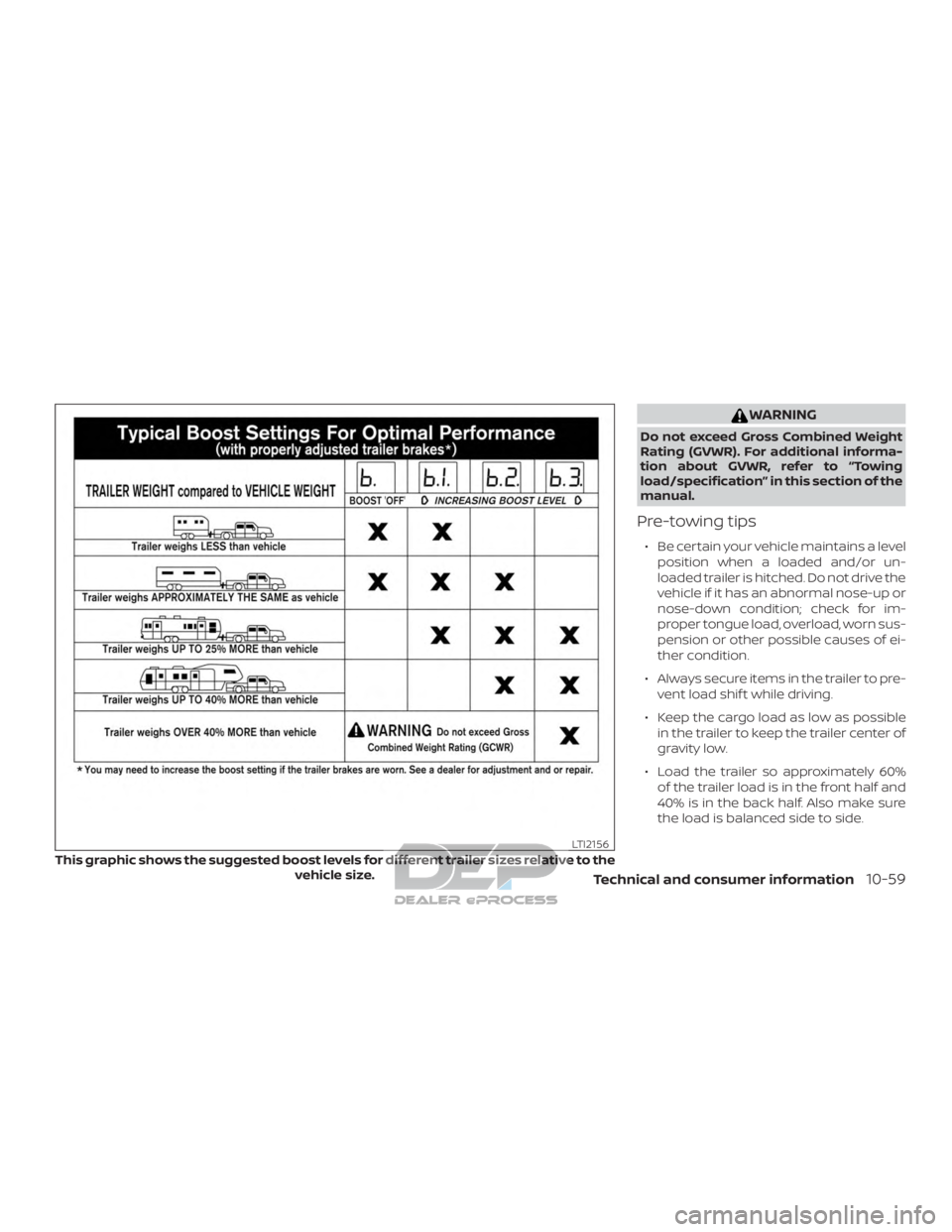
This graphic shows the suggested boost levels for different trailer sizes relative to the vehicle size.
LTI2156
Technical and consumer information10-59
Page 584 of 682
∙ While going downhill, the weight of thetrailer pushing on the tow vehicle may
decrease overall stability. Therefore, to
maintain adequate control, reduce your
speed and shif t to a lower gear. Avoid
long or repeated use of the brakes
when descending a hill, as this reduces
their effectiveness and could cause
overheating. Shif ting to a lower gear in-
stead provides “engine braking” and re-
duces the need to brake as frequently.
∙ If the engine coolant temperature rises to a high temperature, refer to “If your
vehicle overheats” in the “In case of
emergency” section of this owner’s
manual.
∙ Trailer towing requires more fuel than normal circumstances.
∙ Avoid towing a trailer for your vehicle’s first 500 miles (805 km).
∙ For the first 500 miles (805 km) that you do tow, do not drive over 50 mph
(80 km/h).
∙ Have your vehicle serviced more of ten than at intervals specified. For addi-
tional information, refer to “Mainte-
nance schedules” in the “Maintenance
and schedule” section of this manual. ∙ When making a turn, your trailer wheels
will be closer to the inside of the turn
than your vehicle wheels. To compen-
sate for this, make a larger than normal
turning radius during the turn.
∙ Crosswinds and rough roads will ad- versely affect vehicle/trailer handling,
possibly causing vehicle sway. When
being passed by larger vehicles, be pre-
pared for possible changes in cross-
winds that could affect vehicle han-
dling.
Trailer Sway Assist :
To minimize trailer sway, your vehicle may
apply braking to individual wheels based
on input from your vehicle sensors and ve-
hicle speed. Trailer sway control is a func-
tion of the Vehicle Dynamic Control (VDC)
system and is active when the VDC func-
tion is enabled.
CAUTION
If the VDC-OFF switch is on (meaning
VDC system OFF), the Trailer Sway As-
sist is also disabled When Trailer Sway Assist is in operation, the
VDC warning light blinks. When vehicle con-
trol is regained, VDC warning light will turn
OFF.
For additional information about the VDC
system, refer to “Vehicle Dynamic Control
(VDC) OFF switch” in the “Instruments and
controls” section and “Vehicle Dynamic
Control (VDC) system” in the “Starting and
driving” section of this manual.
If Trailer Sway Assist activates, do the fol-
lowing:
1. Take your foot off the accelerator pedal to allow the vehicle to coast and steer
as straight ahead as the road condi-
tions allow. This combination will help
stabilize the vehicle
CAUTION
Do not try to correct trailer sway by
steering or applying the brakes.
2. When the trailer sway stops, gently ap- ply the brakes and pull to the side of the
road in a safe area.
3. Try to rearrange the trailer load so it is balanced. For additional information,
refer to “Pre-towing tips” in this section.
Technical and consumer information10-61
Page 593 of 682
Top tether strap anchor point
locations...................1-31
Child safety rear door lock ..........3-10
Chimes, audible reminders .........2-25
Cleaningexteriorandinterior......7-2,7-4
Climatecontrolseatswitch.........2-55
C.M.V.S.S. certification label .........10-20
Coldweatherdriving.............5-68
Compass ....................2-12
Console light ..................2-88
Controls Heater and air conditioner controls . .4-39
Heater and air conditioner controls
(manual) ...................4-29
Coolant Capacities and recommended
fuel/lubricants...............10-2
Changing engine coolant .........8-6
Checking engine coolant level ......8-6
Engine coolant temperature gauge . .2-8
Corrosionprotection..............7-7
Cruisecontrol...........5-41,5-41,5-42
Cupholders...................2-78
Curtain side-impact and rollover air
bag........................1-78
D
Daytime Running Light System . . .2-52, 8-30
Diesel Particulate Filter (DPF) .........8-11
DigitalvideodiscDVD ............4-44
Dimensions and weights ..........10-12
Dimmer switch for instrument panel . . .2-53
Display......................2-26
Door locks ..................3-5,3-6 Door open warning light
...........2-19
Drivebelt ....................8-19
Drive positioner, Automatic ......3-43,3-45
Driving Cold weather driving ...........5-68
Driving with automatic
transmission ................5-17
Precautions when starting and
driving..................5-2,5-9
Drivingthevehicle...............5-17
E
Eco Drive Report ................5-53
Economy - fuel .................5-44
Electronic locking rear differential (E-Lock)
system ......................5-52
Electronic locking rear differential (E-Lock)
system switch .................2-62
Emergency engine shutoff .......5-13,6-2
Emission control information label . . . .10-20
Emission control system warranty . . . .10-65
Engine Before starting the engine ........5-15
Blockheater................5-70
Capacities and recommended
fuel/lubricants...............10-2
Changing engine coolant .........8-6
Changing engine oil ............8-8
Changing engine oil filter .........8-9
Checking engine coolant level ......8-6
Checking engine oil level .........8-7
Engine compartment check
locations...................8-3
Engine coolant temperature gauge . .2-8 Engine cooling system
..........8-5
Engine oil ...................8-7
Engine oil and oil filter
recommendation .............10-7
Engine oil pressure gauge .....2-10,2-11
Engine oil pressure warning light ....2-19
Engine oil viscosity ............10-8
Engine serial numbe r..........10-19
Engine specifications ..........10-10
Engine coolant temperature gauge ....2-8
Engine oil pressure gauge .......2-10,2-11
EventDatarecorders............10-67
Exhaust gas (Carbon monoxide) .......5-2
Explanation of maintenance items .....9-2
Explanation of scheduled maintenance
items .......................9-5
Extended storage switch ..........2-70
Eyeglasscase..................2-77
F
Flashers
(Seehazardwarningflasherswitch)....6-2
Flattire....................6-3,6-4
F lo
ormatpositioningaid...........7-5
Fluid Brakefluid..................8-13
Capacities and recommended
fuel/lubricants...............10-2
Engine coolant ...............8-5
Engine oil ...................8-7
Powersteeringfluid............8-12
Windshield-washer fluid .........8-13
F.M.V.S.S. certification label .........10-20
Foglightswitch................2-54
11-2
Page 598 of 682
Towing load/specification.......10-42
Trailertowing...............10-38
Towingatrailer................10-38
Towingyourvehicle..............6-17
Tow mode switch ...............2-65
Trailer Brake Controller Unit (TBCU) ....2-66
Transceiver HomeLink® Universal Transceiver . . .2-89, 2-90, 2-91, 2-92, 2-92, 2-93
Transfer case shif ting procedures .....5-46
Transmission
Driving with automatic transmission. .5-17
Travel (See registering a vehicle in another
country) .....................10-18
Trip odometer ..................2-7
Truckbox.................3-39,3-39
Truck - camper loading ...........10-36
Turn signal switch ...............2-53
U
Under seat storage bin .........2-73,2-77
Uniform tire quality grading ........10-64
USB/iPod® Charging Ports..........4-43
Using 4-wheel drive ..............5-45
V
Vanitymirror..................3-33
Variable voltage control system ......8-19
Vehicle dimensions and weights .....10-12
Vehicle Dynamic Control (VDC) OFF
switch......................2-60
Vehicle Dynamic Control (VDC) system . .5-59 Vehicle identification
.............10-18
Vehicle identification number (VIN) . . . .10-18
Vehicle identification number (VIN)
(Chassis number) ...............10-18
Vehicle identification number (VIN)
plate.......................10-18
Vehicle immobilizer system ......2-44,5-14
VehicleInformationDisplay.........2-26
Vehicle loading information ........10-23
Vehiclerecovery.............6-19,6-20
Vehicle security system ...........2-43
Vehicle security system (NISSAN Vehicle
Immobilizer System), engine start . .2-44, 5-14
Vents.......................4-29
Visors ......................3-32
Voltmeter ....................2-11
W
Warning Airbagwarninglight........1-81, 2-22
Anti-lock brake warning light ......2-17
Battery charge warning light ......2-19
Brakewarninglight............2-18
Door open warning light .........2-19
Engine oil pressure warning light ....2-19
Hazard warning flasher switch ......6-2
Loose fuel cap warning .........2-40
Lowfuelwarninglight.......2-22,2-37
Lowtirepressurewarninglight.....2-20
Low windshield-washer fluid warning
light......................2-38
Passenger air bag and status light . . .1-63
Passenger's seat belt warning light and
chime....................2-22 Seatbeltwarninglight.......1-18, 2-19
Supplemental air bag warning
light...................1-81, 2-22
Vehicle security system
.........2-43
Warning/indicator lights and audible
reminders ...............2-17,2-23
Warning labels (for SRS) .........1-80
Warning/indicator lights and audible
reminders .................2-17,2-23
Audible reminders ..........2-17,2-23
Indicatorlights............2-17,2-23
Warninglights ............2-17,2-23
Warninglights ..............2-17,2-23
Warning lights, indicator lights and audible
reminders ....................2-16
Warningsystemsswitch...........2-59
Weights
(See dimensions and weights) .......10-12
Wheels and tires ............8-35,10-11
Wheel/tire size .................10-11
When traveling or registering in another
country .....................10-18
Windows ....................2-83 Locking passengers' windows .....2-84
Powerrearwindows...........2-84
Powerwindows..............2-83
Rearpowerwindows...........2-84
Rearslidingwindow ...........2-86
Windshield-washer fluid ...........8-13
Windshield wiper blades ...........8-21
Wiper Wiper blades ................8-21
Wiper and washer switch ..........2-46
11-7
Page 623 of 682
Preventive maintenance is the easiest and
least expensive type of maintenance. Keep
records of regularly scheduled mainte-
nance and follow the maintenance sched-
ule recommendations outlined in the Titan
Owner’s Manual.
Use the correct fuel, lubricating oil, and
coolant in your engine. Blending engine oil
with fuel is prohibited for engines with an
af tertreatment system. For additional in-
formation, refer to the “Capacities and
specifications” section of this manual.
A NISSAN dealership knows your vehicle.
When you require any service or have any
questions, they will be glad to assist you
with the extensive resources available to
them.
DIESEL ENGINE OPERATION
The operation of the diesel engine in your
new vehicle varies from the operation of
traditional gasoline engines found in other
vehicles. Reading this supplement will fa-
miliarize you and other operators of the
vehicle with the unique maintenance and
operating procedures that will prolong the
life of the diesel engine and related sys-
tems.
ENGINE BREAK-IN
RECOMMENDATIONS
∙ Warm up the engine before operating itunder load
∙ Do not operate the engine at idle for extended periods
∙ Prevent engine lugging by selecting the appropriate transmission gear
∙ Monitor the vehicle oil pressure and temperature gauges
∙ Check fluid levels frequently (Oil & Cool- ant)
∙ Vary the throttle position at highway speeds when carrying weight or towing
NOTE:
Extended light or no load operation will
extend the time before the engine
reaches its full efficiency. If the engine is
operated in this manner, reduced fuel
economy and power may be observed.
The aforementioned procedure should be
observed for the first 6,000 miles. The en-
gine run-in is improved by operating the
vehicle under load.
DIESEL FUEL SYSTEM
The diesel engine fuel system is a pressur-
ized two-stage filtration system and con-
sists of: ∙ A frame-mounted primary (stage 1) fuel filter containing water/fuel separator,
electric fuel pump, and water in fuel
drain valve
∙ An engine-mounted secondary (stage 2) fuel filter
∙ A fuel injector for each cylinder (8 total)
∙ A high-pressure fuel pump
∙ A high-pressure fuel rail for each cylin- der bank (2 total)
∙ High-pressure fuel lines from the high- pressure fuel pump to the right bank
fuel rail, right bank fuel rail to the lef t
bank fuel rail, and fuel rails to fuel injec-
tors.
GENERAL INFORMATION
1-2Introduction
Page 638 of 682
CAUTION
If the engine does not start, place the
ignition switch in the OFF position and
wait 10 seconds before cranking again,
otherwise the starter could be
damaged.3. Allow the engine to idle for at least 30 seconds af ter starting. Do not race
the engine while warming it up. Drive at
a moderate speed for a short distance
first, especially in cold weather.
In cold weather, keep the engine run-
ning for a minimum of 2–3 minutes
before shutting it off. Starting and
stopping the engine over a short pe-
riod of time may make the vehicle
more difficult to start.
SWITCHING ENGINE OFF
Push the ignition switch to the OFF posi-
tion.
To prolong the engine life (especially af ter
extended high speed, high ambient tem-
perature, or during heavy load operation,
such as trailering), it is recommended that
a hot engine be idled for 3–5 minutes be-
fore shutting down. This allows the turbo-
charged engine to cool down.
ENGINE BREAK-IN
RECOMMENDATIONS
∙ Warm up the engine before operating it under load.
∙ Do not operate the engine at idle for extended periods.
∙ Prevent engine lugging by selecting the appropriate transmission gear.
∙ Monitor the vehicle oil pressure and temperature gauges.
∙ Check fluid levels frequently (oil and coolant).
∙ Vary the throttle position at highway speeds when carrying weight or tow-
ing.
NOTE:
Extended light or no load operation will
extend the time before the engine
reaches its full efficiency. If the engine is
operated in this manner, reduced fuel
economy and power may be observed.
The aforementioned procedure should be
observed for the first 6,000 miles. The en-
gine run-in is improved by operating the
vehicle under load.
REMOTE ENGINE START (if so
equipped)
CAUTION
Laws in some jurisdictions prohibit use
of Remote Engine Start.
Vehicles started with the Remote Engine
Start require the ignition switch to be
placed in the ON position before the shif t
lever can be moved from the P (Park) posi-
tion. To place the ignition switch in the ON
position, follow these steps: 1. Make sure that the Intelligent Key is on you.
2. Apply the brake.
3. Push the ignition switch once to the ON position.
For additional information, refer to “NISSAN
Intelligent Key®” in the “Pre-driving checks
and adjustments” section of the Titan
Owner’s Manual.
Starting and Stopping the Engine3-3