check transmission fluid NISSAN TITAN 2019 Owner´s Manual
[x] Cancel search | Manufacturer: NISSAN, Model Year: 2019, Model line: TITAN, Model: NISSAN TITAN 2019Pages: 682, PDF Size: 7.99 MB
Page 133 of 682
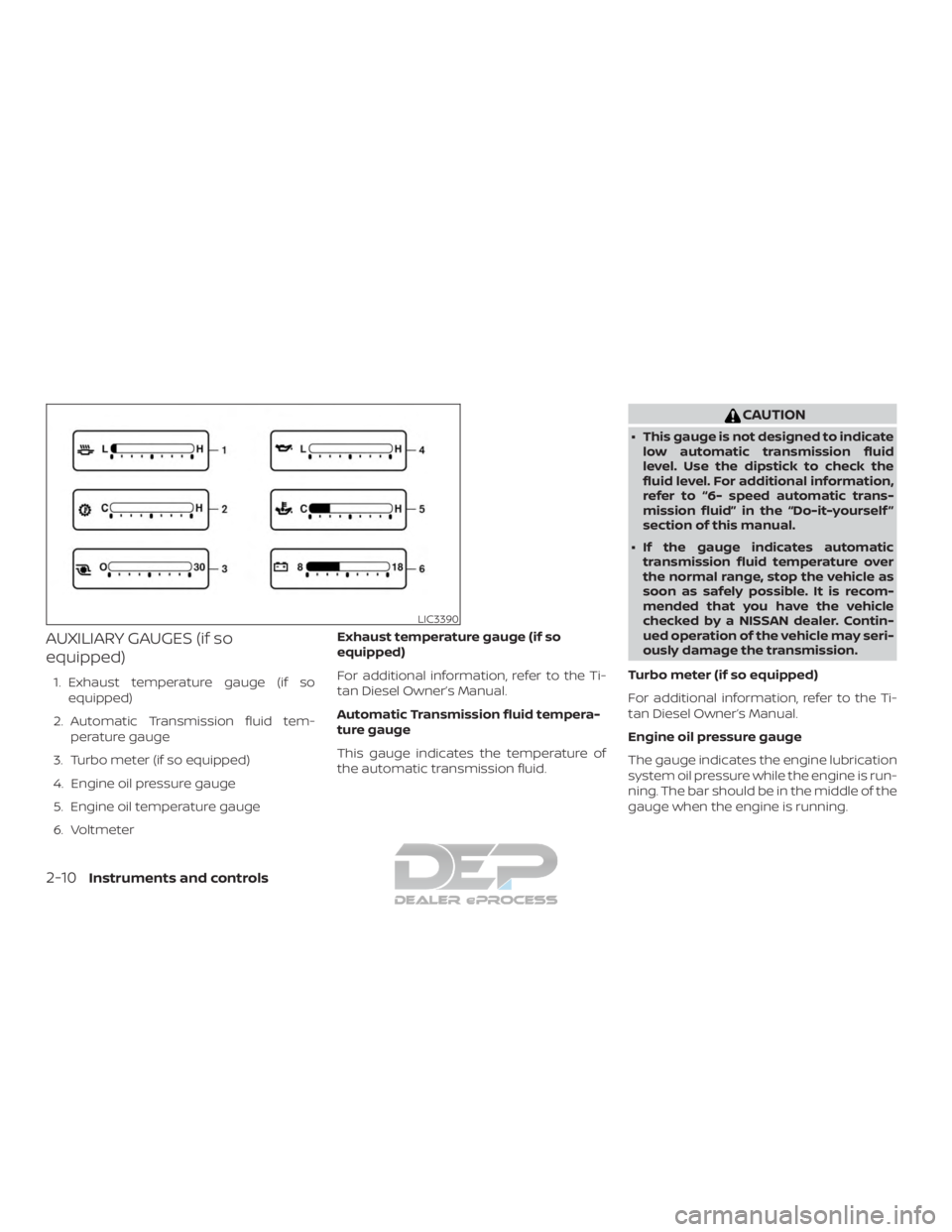
AUXILIARY GAUGES (if so
equipped)
1. Exhaust temperature gauge (if soequipped)
2. Automatic Transmission fluid tem- perature gauge
3. Turbo meter (if so equipped)
4. Engine oil pressure gauge
5. Engine oil temperature gauge
6. Voltmeter Exhaust temperature gauge (if so
equipped)
For additional information, refer to the Ti-
tan Diesel Owner’s Manual.
Automatic Transmission fluid tempera-
ture gauge
This gauge indicates the temperature of
the automatic transmission fluid.
CAUTION
∙ This gauge is not designed to indicate
low automatic transmission fluid
level. Use the dipstick to check the
fluid level. For additional information,
refer to “6- speed automatic trans-
mission fluid” in the “Do-it-yourself ”
section of this manual.
∙ If the gauge indicates automatic transmission fluid temperature over
the normal range, stop the vehicle as
soon as safely possible. It is recom-
mended that you have the vehicle
checked by a NISSAN dealer. Contin-
ued operation of the vehicle may seri-
ously damage the transmission.
Turbo meter (if so equipped)
For additional information, refer to the Ti-
tan Diesel Owner’s Manual.
Engine oil pressure gauge
The gauge indicates the engine lubrication
system oil pressure while the engine is run-
ning. The bar should be in the middle of the
gauge when the engine is running.
LIC3390
2-10Instruments and controls
Page 141 of 682
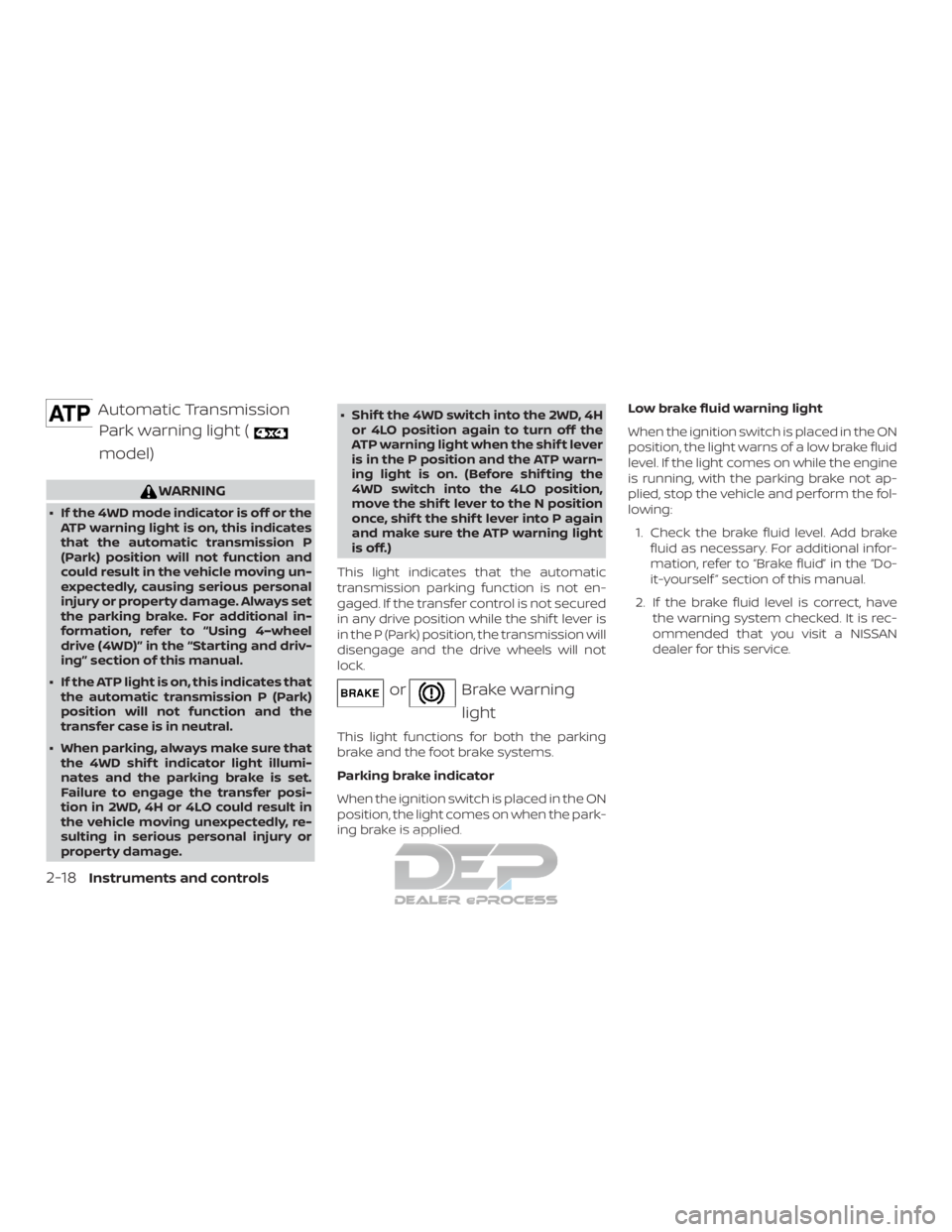
Automatic TransmissionPark warning light (
model)
WARNING
∙ If the 4WD mode indicator is off or the ATP warning light is on, this indicates
that the automatic transmission P
(Park) position will not function and
could result in the vehicle moving un-
expectedly, causing serious personal
injury or property damage. Always set
the parking brake. For additional in-
formation, refer to “Using 4–wheel
drive (4WD)” in the “Starting and driv-
ing” section of this manual.
∙ If the ATP light is on, this indicates that the automatic transmission P (Park)
position will not function and the
transfer case is in neutral.
∙ When parking, always make sure that the 4WD shif t indicator light illumi-
nates and the parking brake is set.
Failure to engage the transfer posi-
tion in 2WD, 4H or 4LO could result in
the vehicle moving unexpectedly, re-
sulting in serious personal injury or
property damage. ∙ Shif t the 4WD switch into the 2WD, 4H
or 4LO position again to turn off the
ATP warning light when the shif t lever
is in the P position and the ATP warn-
ing light is on. (Before shif ting the
4WD switch into the 4LO position,
move the shif t lever to the N position
once, shif t the shif t lever into P again
and make sure the ATP warning light
is off.)
This light indicates that the automatic
transmission parking function is not en-
gaged. If the transfer control is not secured
in any drive position while the shif t lever is
in the P (Park) position, the transmission will
disengage and the drive wheels will not
lock.
orBrake warning light
This light functions for both the parking
brake and the foot brake systems.
Parking brake indicator
When the ignition switch is placed in the ON
position, the light comes on when the park-
ing brake is applied. Low brake fluid warning light
When the ignition switch is placed in the ON
position, the light warns of a low brake fluid
level. If the light comes on while the engine
is running, with the parking brake not ap-
plied, stop the vehicle and perform the fol-
lowing:
1. Check the brake fluid level. Add brake fluid as necessary. For additional infor-
mation, refer to “Brake fluid” in the “Do-
it-yourself ” section of this manual.
2. If the brake fluid level is correct, have the warning system checked. It is rec-
ommended that you visit a NISSAN
dealer for this service.
2-18Instruments and controls
Page 156 of 682
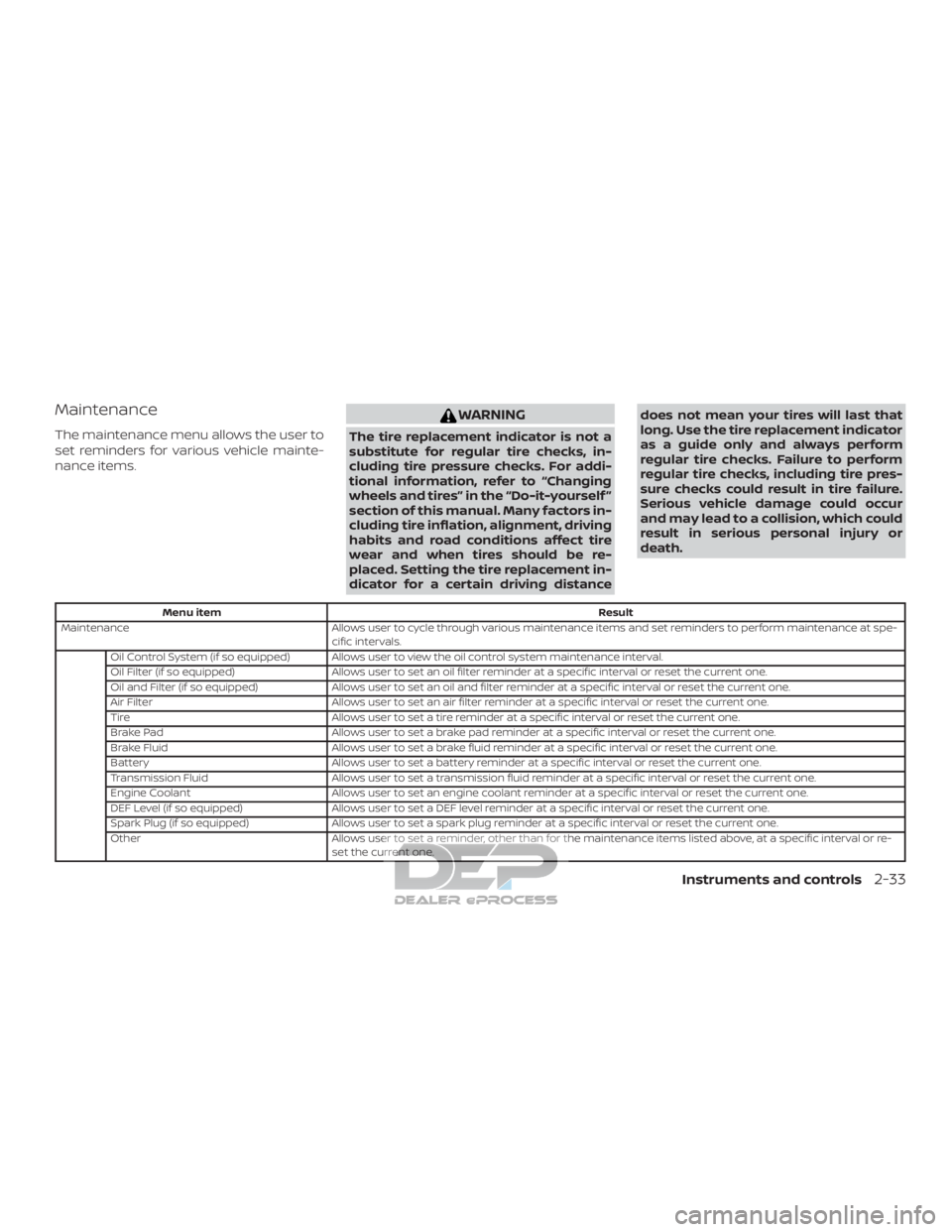
Maintenance
The maintenance menu allows the user to
set reminders for various vehicle mainte-
nance items.
WARNING
The tire replacement indicator is not a
substitute for regular tire checks, in-
cluding tire pressure checks. For addi-
tional information, refer to “Changing
wheels and tires” in the “Do-it-yourself ”
section of this manual. Many factors in-
cluding tire inflation, alignment, driving
habits and road conditions affect tire
wear and when tires should be re-
placed. Setting the tire replacement in-
dicator for a certain driving distancedoes not mean your tires will last that
long. Use the tire replacement indicator
as a guide only and always perform
regular tire checks. Failure to perform
regular tire checks, including tire pres-
sure checks could result in tire failure.
Serious vehicle damage could occur
and may lead to a collision, which could
result in serious personal injury or
death.
Menu item
Result
Maintenance Allows user to cycle through various maintenance items and set reminders to perform maintenance at spe-
cific intervals.
Oil Control System (if so equipped) Allows user to view the oil control system maintenance interval.
Oil Filter (if so equipped) Allows user to set an oil filter reminder at a specific interval or reset the current one.
Oil and Filter (if so equipped) Allows user to set an oil and filter reminder at a specific interval or reset the current one.
Air Filter Allows user to set an air filter reminder at a specific interval or reset the current one.
Tire Allows user to set a tire reminder at a specific interval or reset the current one.
Brake Pad Allows user to set a brake pad reminder at a specific interval or reset the current one.
Brake Fluid Allows user to set a brake fluid reminder at a specific interval or reset the current one.
Battery Allows user to set a battery reminder at a specific interval or reset the current one.
Transmission Fluid Allows user to set a transmission fluid reminder at a specific interval or reset the current one.
Engine Coolant Allows user to set an engine coolant reminder at a specific interval or reset the current one.
DEF Level (if so equipped) Allows user to set a DEF level reminder at a specific interval or reset the current one.
Spark Plug (if so equipped) Allows user to set a spark plug reminder at a specific interval or reset the current one.
Other Allows user to set a reminder, other than for the maintenance items listed above, at a specific interval or re-
set the current one.
Instruments and controls2-33
Page 159 of 682
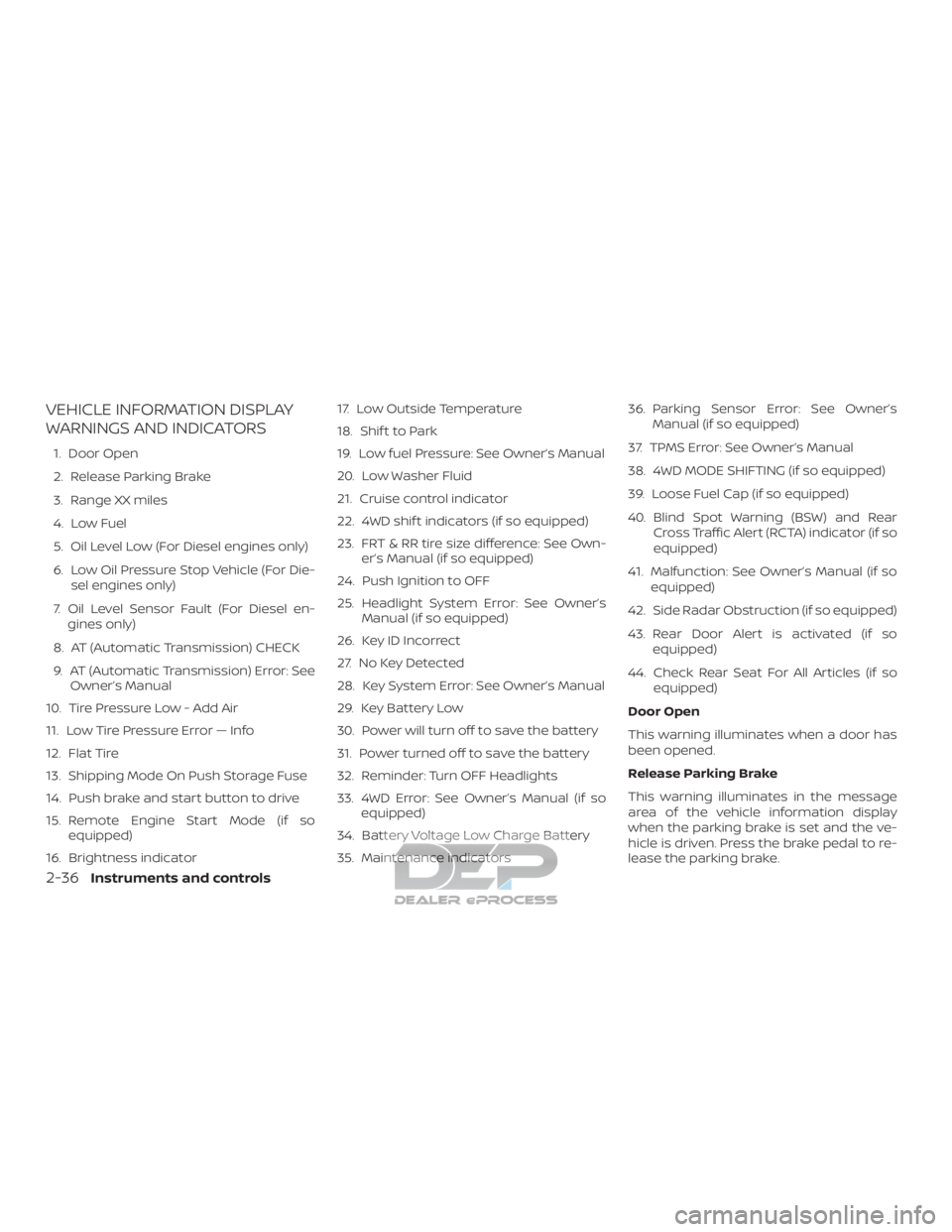
VEHICLE INFORMATION DISPLAY
WARNINGS AND INDICATORS
1. Door Open
2. Release Parking Brake
3. Range XX miles
4. Low Fuel
5. Oil Level Low (For Diesel engines only)
6. Low Oil Pressure Stop Vehicle (For Die-sel engines only)
7. Oil Level Sensor Fault (For Diesel en- gines only)
8. AT (Automatic Transmission) CHECK
9. AT (Automatic Transmission) Error: See Owner’s Manual
10. Tire Pressure Low - Add Air
11. Low Tire Pressure Error — Info
12. Flat Tire
13. Shipping Mode On Push Storage Fuse
14. Push brake and start button to drive
15. Remote Engine Start Mode (if so equipped)
16. Brightness indicator 17. Low Outside Temperature
18. Shif t to Park
19. Low fuel Pressure: See Owner’s Manual
20. Low Washer Fluid
21. Cruise control indicator
22. 4WD shif t indicators (if so equipped)
23. FRT & RR tire size difference: See Own-
er’s Manual (if so equipped)
24. Push Ignition to OFF
25. Headlight System Error: See Owner’s Manual (if so equipped)
26. Key ID Incorrect
27. No Key Detected
28. Key System Error: See Owner’s Manual
29. Key Battery Low
30. Power will turn off to save the battery
31. Power turned off to save the battery
32. Reminder: Turn OFF Headlights
33. 4WD Error: See Owner’s Manual (if so equipped)
34. Battery Voltage Low Charge Battery
35. Maintenance indicators 36. Parking Sensor Error: See Owner’s
Manual (if so equipped)
37. TPMS Error: See Owner’s Manual
38. 4WD MODE SHIFTING (if so equipped)
39. Loose Fuel Cap (if so equipped)
40. Blind Spot Warning (BSW) and Rear Cross Traffic Alert (RCTA) indicator (if so
equipped)
41. Malfunction: See Owner’s Manual (if so equipped)
42. Side Radar Obstruction (if so equipped)
43. Rear Door Alert is activated (if so equipped)
44. Check Rear Seat For All Articles (if so equipped)
Door Open
This warning illuminates when a door has
been opened.
Release Parking Brake
This warning illuminates in the message
area of the vehicle information display
when the parking brake is set and the ve-
hicle is driven. Press the brake pedal to re-
lease the parking brake.
2-36Instruments and controls
Page 453 of 682
8 Do-it-yourself
Maintenance precautions.......................8-2
Engine compartment check locations ...........8-3
Engine cooling system ..........................8-5
Checking engine coolant level ................8-6
Changing engine coolant .....................8-6
Engine oil ........................................8-7
Checking engine oil level .....................8-7
Changing engine oil ..........................8-8
Changing engine oil filter .....................8-9
Fuel filter (CUMMINS 5.0L) ........................8-11
Fuel filter replacement (stage 1) ...............8-11
Fuel filter replacement (stage 2) ..............8-11
Draining water ............................... 8-11
Fuel system priming .......................... 8-11
Diesel Particulate Filter (DPF) .....................8-11
Automatic regeneration ......................8-11
6-speed Automatic Transmission Fluid (ATF)
(diesel engine only) .............................. 8-11
7-speed Automatic Transmission Fluid (ATF)
(gasoline engine only) .......................... 8-12
Power Steering Fluid (PSF) ......................8-12
Brake fluid ...................................... 8-13
Windshield-washer fluid ........................8-13
Windshield-washer fluid reservoir ............8-13Battery.........................................
8-15
Jump starting ............................... 8-18
Variable voltage control (if so equipped) ........8-18
Drive belt ....................................... 8-19
Spark plugs (gasoline engine only) ..............8-19
Replacing spark plugs ....................... 8-19
Air cleaner ...................................... 8-20
In-cabin microfilter .......................... 8-21
Windshield wiper blades ........................8-21
Cleaning .................................... 8-21
Replacing ................................... 8-21
Brakes.......................................... 8-22
Fuses ........................................... 8-23
Engine compartment .......................8-24
Passenger compartment ....................8-25
Batter yr
eplacement ........................... 8-27
NISSAN Intelligent Key® ......................8-27
Lights .......................................... 8-29
Headlights ................................... 8-29
Fog lights (if so equipped) ...................8-29
Daytime Running Light (DRL)
(if so equipped) .............................. 8-30
Exterior and interior lights ...................8-32
Page 464 of 682
FUEL FILTER REPLACEMENT (stage
1)
For additional information, refer to the Ti-
tan Diesel Owner’s Manual.
FUEL FILTER REPLACEMENT (stage
2)
For additional information, refer to the Ti-
tan Diesel Owner’s Manual.
DRAINING WATER
For additional information, refer to the Ti-
tan Diesel Owner’s Manual.
FUEL SYSTEM PRIMING
For additional information, refer to the Ti-
tan Diesel Owner’s Manual.For additional information, refer to the Ti-
tan Diesel Owner’s Manual.
AUTOMATIC REGENERATION
For additional information, refer to the Ti-
tan Diesel Owner’s Manual.
When checking or replacement is required,
it is recommended that you visit a NISSAN
dealer for this service.CAUTION
∙ NISSAN recommends using Genuine
NISSAN Matic K ATF. Do not mix with
other fluids.
∙ Do not use CVT fluid or manual trans- mission fluid in this transmission.
Damage caused by the use of fluids
other than as recommended is not
covered under NISSAN’s New Vehicle
Limited Warranty.
∙ Using fluids that are not equivalent to Genuine NISSAN Matic K ATF may also
damage the transmission. Damage
caused by the use of fluids other than
as recommended is not covered un-
der NISSAN’s New Vehicle Limited
Warranty.
The specified automatic transmission fluid
is also described on caution labels located
in the engine compartment.
FUEL FILTER (CUMMINS 5.0L) DIESEL PARTICULATE FILTER (DPF) 6-SPEED AUTOMATIC
TRANSMISSION FLUID (ATF) (diesel
engine only)
Do-it-yourself8-11
Page 465 of 682
When checking or replacement is required,
it is recommended that you visit a NISSAN
dealer for this service.
CAUTION
∙ NISSAN recommends using GenuineNISSAN Matic S ATF. Do not mix with
other fluids.
∙ Do not use CVT fluid or manual trans- mission fluid in this transmission.
Damage caused by the use of fluids
other than as recommended is not
covered under NISSAN’s New Vehicle
Limited Warranty.
∙ Using fluids that are not equivalent to Genuine NISSAN Matic S ATF may also
damage the transmission. Damage
caused by the use of fluids other than
as recommended is not covered un-
der NISSAN’s New Vehicle Limited
Warranty.
The specified automatic transmission fluid
is also described on caution labels located
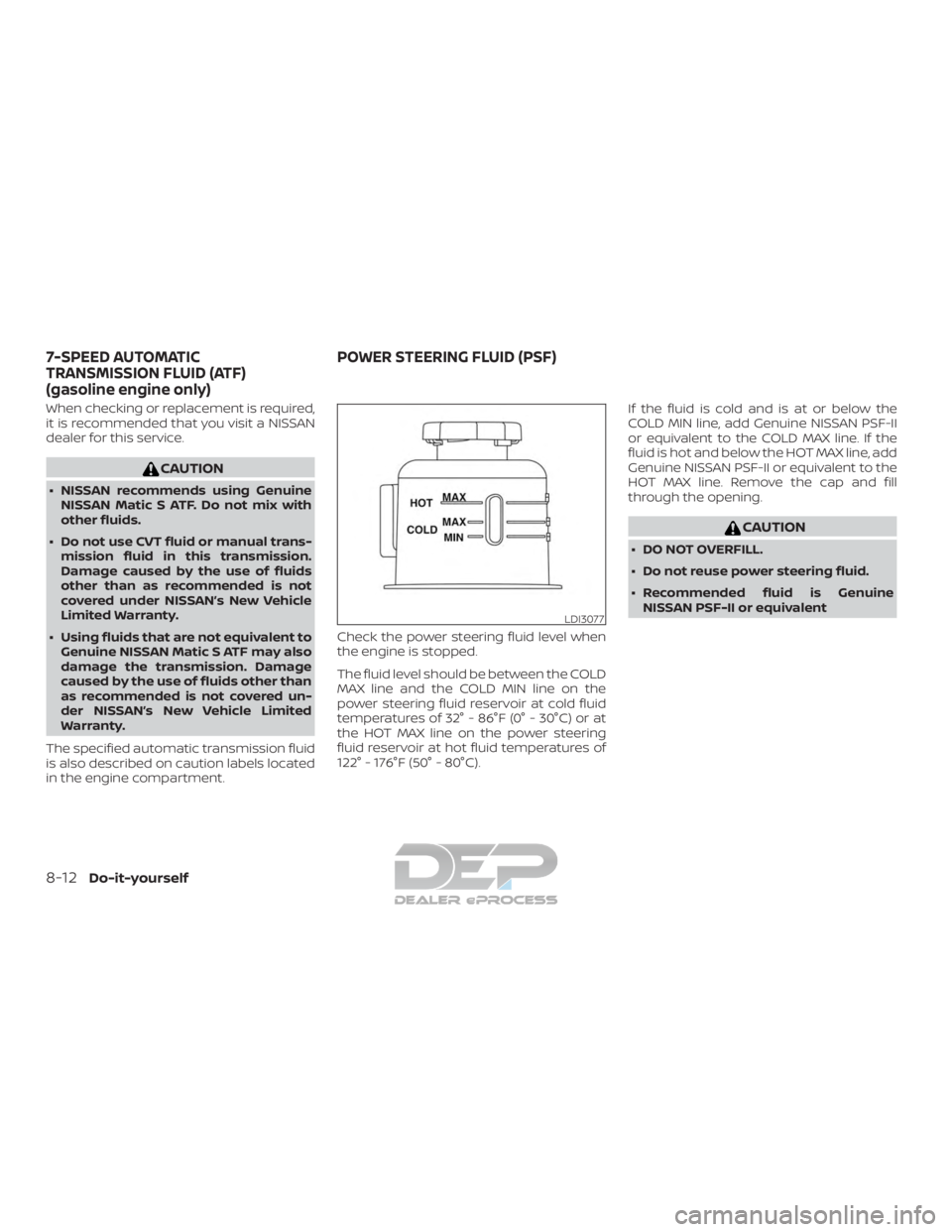
in the engine compartment. Check the power steering fluid level when
the engine is stopped.
The fluid level should be between the COLD
MAX line and the COLD MIN line on the
power steering fluid reservoir at cold fluid
temperatures of 32° - 86°F (0° - 30°C) or at
the HOT MAX line on the power steering
fluid reservoir at hot fluid temperatures of
122° - 176°F (50° - 80°C).If the fluid is cold and is at or below the
COLD MIN line, add Genuine NISSAN PSF-II
or equivalent to the COLD MAX line. If the
fluid is hot and below the HOT MAX line, add
Genuine NISSAN PSF-II or equivalent to the
HOT MAX line. Remove the cap and fill
through the opening.
CAUTION
∙ DO NOT OVERFILL.
∙ Do not reuse power steering fluid.
∙ Recommended fluid is Genuine
NISSAN PSF-II or equivalent
LDI3077
7-SPEED AUTOMATIC
TRANSMISSION FLUID (ATF)
(gasoline engine only) POWER STEERING FLUID (PSF)
8-12Do-it-yourself
Page 507 of 682
Engine Oil and Oil Filter:Replace engine
oil and oil filter at the specified intervals. For
recommended oil grade and viscosity refer
to “Recommended fluids/lubricants and
capacities” in the “Technical and consumer
information” section of this manual.
Engine Valve Clearance* (gasoline en-
gine only):
Inspect only if valve noise in-
creases. Adjust valve clearance if necessary.
Evaporative Emissions Control Vapor
Lines* (gasoline engine only): Check va-
por lines for leaks or looseness. Tighten
connections or replace parts as necessary.
Fuel Filter (diesel engine only): Replace
the fuel filter and drain the water at the
specified intervals.
Fuel Lines*: Check the fuel hoses, piping
and connections for leaks, looseness, or
deterioration. Tighten connections or re-
place parts as necessary.
CHASSIS AND BODY
MAINTENANCE:
Brake Lines and Cables: Visually inspect
for proper installation. Check for chafing,
cracks, deterioration, and signs of leaking.
Replace any deteriorated or damaged
parts immediately. Brake Pads and Rotors:
Check for wear,
deterioration and fluid leaks. Replace any
deteriorated or damaged parts immedi-
ately.
Exhaust System: Visually inspect the ex-
haust pipes, muffler and hangers for leaks,
cracks, deterioration, and damage. Tighten
connections or replace parts as necessary.
In-Cabin Microfilter: Replace at specified
intervals. When driving for prolonged peri-
ods in dusty conditions, replace the filter
more frequently.
Propeller Shaf t(s): Check for damage,
looseness, and grease leakage.
(4WD/AWD/RWD).
Steering Gear and Linkage, Axle and Sus-
pension Parts, Drive Shaf t Boots: Check
for damage, looseness, and leakage of oil
or grease. Under severe driving conditions,
inspect more frequently.
Tire Rotation: Tires should be rotated ev-
ery 5,000 miles (8,000 km) according to the
instructions under “General maintenance”
in this section. When rotating tires, check
for damage and uneven wear. Replace if
necessary. Transmission Fluid/Oil, Differential Oil,
Transfer Case Oil:
Visually inspect for signs
of leakage at specified intervals.
Replace automatic transmission fluid at
specified intervals. (For diesel engine models)
If towing a trailer, using a camper or car-top
carrier, or driving on rough or muddy roads:
∙ Replace the differential oil every 20,000 miles (32,000 km) or 24 months.
∙
Replace the automatic transmission fluid
ever 30,000 miles (48,000 km) or
24 months. (For gasoline engine models)
Off-Road Maintenance: Check the follow-
ing items frequently whenever you drive
off-road through deep sand, mud or water:
∙ Brake pads and rotors
∙ Brake lines and hoses
∙ Differential, transmission and transfer case oil
∙ Steering linkage
∙ Propeller shaf t(s) and front drive shaf ts
∙ Engine air filter
∙ Clutch housing drain (4WD only)
9-6Maintenance and schedules
Page 585 of 682
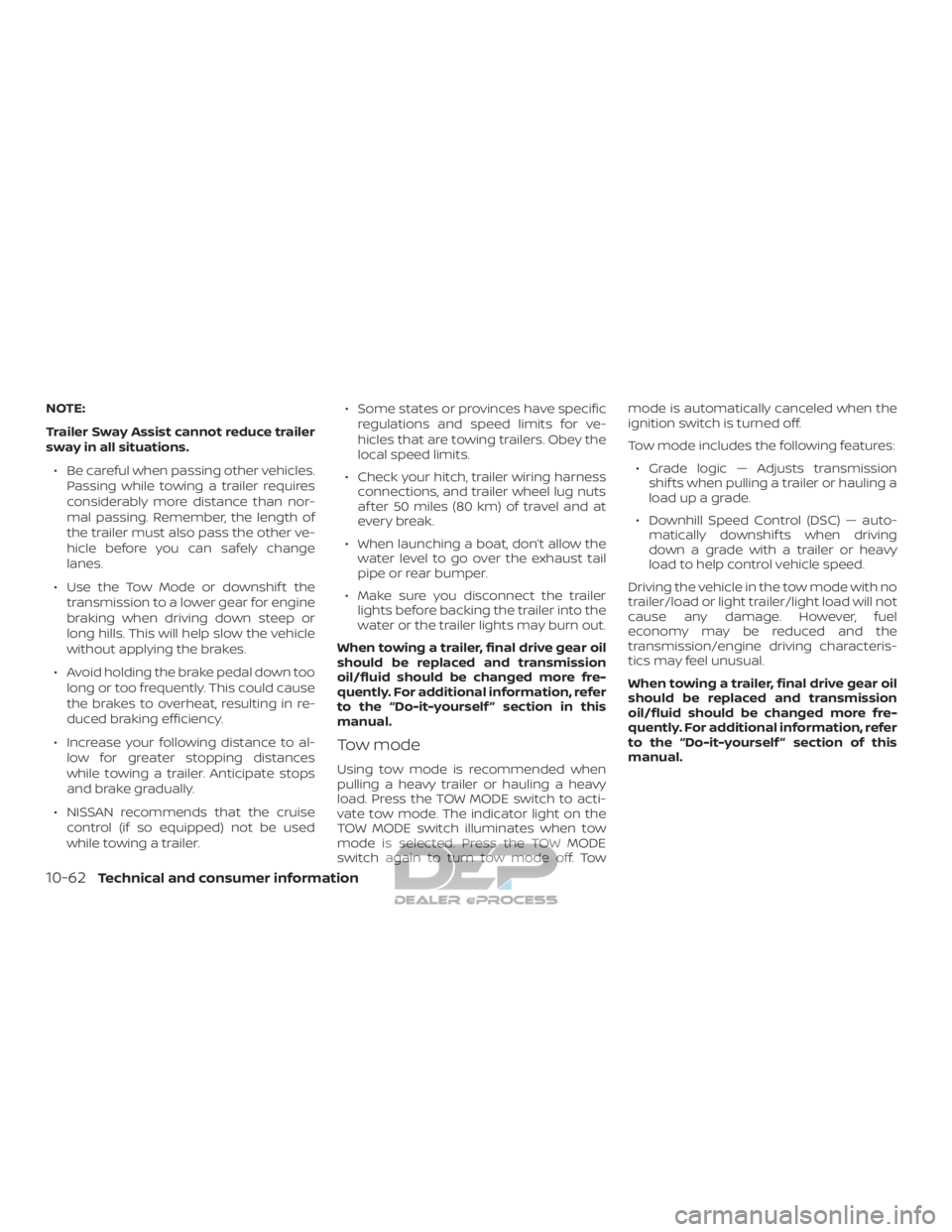
NOTE:
Trailer Sway Assist cannot reduce trailer
sway in all situations.∙ Be careful when passing other vehicles. Passing while towing a trailer requires
considerably more distance than nor-
mal passing. Remember, the length of
the trailer must also pass the other ve-
hicle before you can safely change
lanes.
∙ Use the Tow Mode or downshif t the transmission to a lower gear for engine
braking when driving down steep or
long hills. This will help slow the vehicle
without applying the brakes.
∙ Avoid holding the brake pedal down too long or too frequently. This could cause
the brakes to overheat, resulting in re-
duced braking efficiency.
∙ Increase your following distance to al- low for greater stopping distances
while towing a trailer. Anticipate stops
and brake gradually.
∙ NISSAN recommends that the cruise control (if so equipped) not be used
while towing a trailer. ∙ Some states or provinces have specific
regulations and speed limits for ve-
hicles that are towing trailers. Obey the
local speed limits.
∙ Check your hitch, trailer wiring harness connections, and trailer wheel lug nuts
af ter 50 miles (80 km) of travel and at
every break.
∙ When launching a boat, don’t allow the water level to go over the exhaust tail
pipe or rear bumper.
∙ Make sure you disconnect the trailer lights before backing the trailer into the
water or the trailer lights may burn out.
When towing a trailer, final drive gear oil
should be replaced and transmission
oil/fluid should be changed more fre-
quently. For additional information, refer
to the “Do-it-yourself ” section in this
manual.
Tow mode
Using tow mode is recommended when
pulling a heavy trailer or hauling a heavy
load. Press the TOW MODE switch to acti-
vate tow mode. The indicator light on the
TOW MODE switch illuminates when tow
mode is selected. Press the TOW MODE
switch again to turn tow mode off. Tow mode is automatically canceled when the
ignition switch is turned off.
Tow mode includes the following features:
∙ Grade logic — Adjusts transmission shif ts when pulling a trailer or hauling a
load up a grade.
∙ Downhill Speed Control (DSC) — auto- matically downshif ts when driving
down a grade with a trailer or heavy
load to help control vehicle speed.
Driving the vehicle in the tow mode with no
trailer/load or light trailer/light load will not
cause any damage. However, fuel
economy may be reduced and the
transmission/engine driving characteris-
tics may feel unusual.
When towing a trailer, final drive gear oil
should be replaced and transmission
oil/fluid should be changed more fre-
quently. For additional information, refer
to the “Do-it-yourself ” section of this
manual.
10-62Technical and consumer information
Page 592 of 682
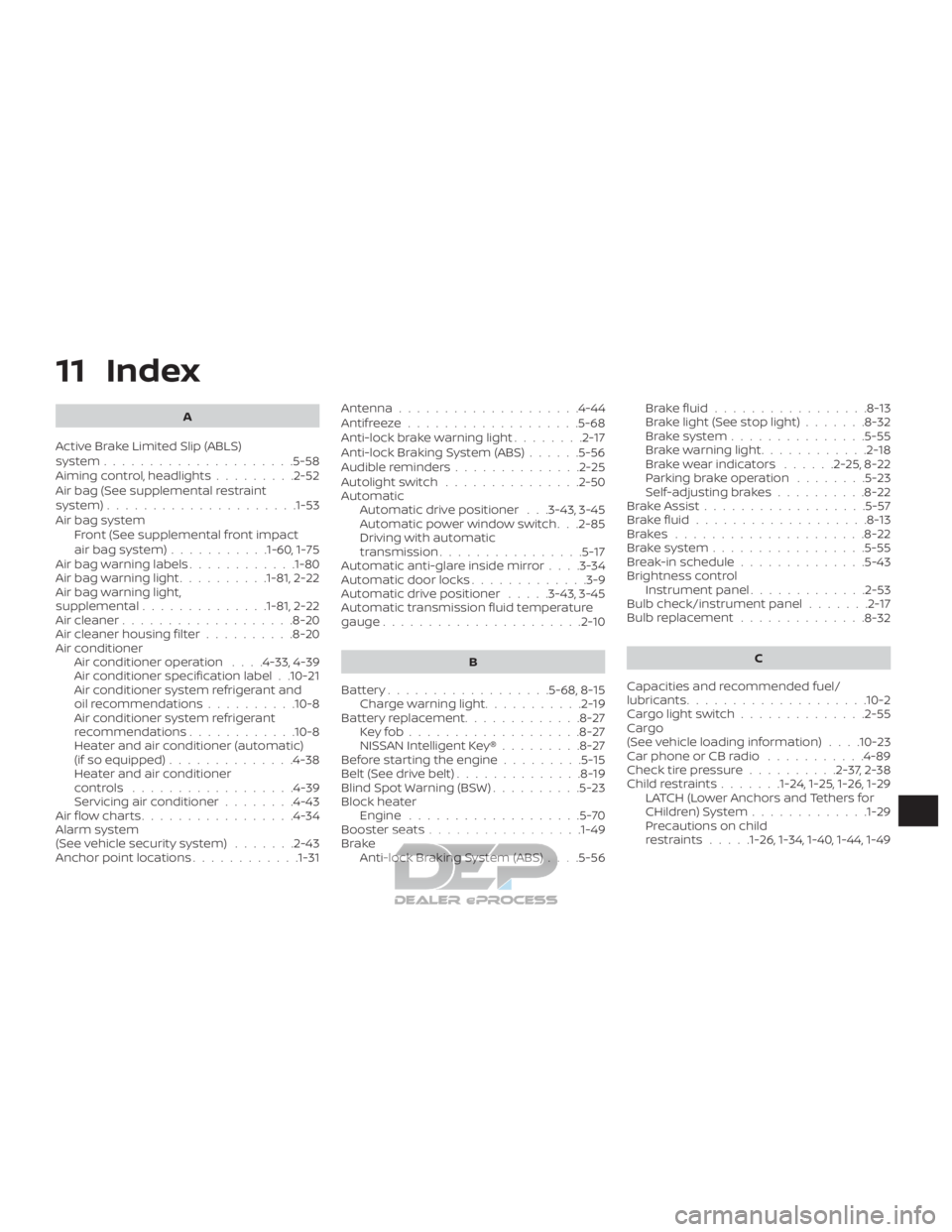
11 Index
A
Active Brake Limited Slip (ABLS)
system .....................5-58
Aimingcontrol,headlights.........2-52
Air bag (See supplemental restraint
system) .................... .1-53
Air bag system Front (See supplemental front impact
airbagsystem)...........1-60, 1-75
Air bag warning labels ............1-80
Airbagwarninglight..........1-81, 2-22
Air bag warning light,
supplemental ..............1-81, 2-22
Air cleaner ...................8-20
Air cleaner housing filter ..........8-20
Air conditioner Air conditioner operation ....4-33,4-39
Air conditioner specification label . .10-21
Air conditioner system refrigerant and
oil recommendations ..........10-8
Air conditioner system refrigerant
recommendations ............10-8
Heater and air conditioner (automatic)
(if so equipped) ..............4-38
Heater and air conditioner
controls ..................4-39
Servicing air conditioner ........4-43
Air flow charts .................4-34
Alarm system
(See vehicle security system) .......2-43
Anchor point locations ............1-31 Antenna
....................4-44
Antifreeze ...................5-68
Anti-lock brake warning light ........2-17
Anti-lock Braking System (ABS) ......5-56
Audible reminders ..............2-25
Autolightswitch ...............2-50
Automatic Automatic drive positioner . . .3-43, 3-45
Automatic power window switch . . .2-85
Driving with automatic
transmission ................5-17
Automatic anti-glare inside mirror . . . .3-34
Automatic door locks .............3-9
Automatic drive positioner .....3-43,3-45
Automatic transmission fluid temperature
gauge ......................2-10
B
Battery..................5-68,8-15 Charge warning light ...........2-19
Battery replacement .............8-27
Keyfob...................8-27
NISSAN Intelligent Key® .........8-27
Before starting the engine .........5-15
Belt(Seedrivebelt)..............8-19
Blind Spot Warning (BSW) ..........5-23
Block heater Engine ...................5-70
Booster seats .................1-49
Brake Anti-lock Braking System (ABS) ....5-56Brakefluid.................8-13
Brakelight(Seestoplight).......
8-32
Brakesystem...............5-55
Brakewarninglight............2-18
Brakewearindicators ......2-25,8-22
Parking brake operation ........5-23
Self-adjustingbrakes..........8-22
Brake Assist ..................5-57
Brakefluid...................8-13
Brakes .....................8-22
Brakesystem................ .5-55
Break-in schedule ..............5-43
Brightness control Instrument panel .............2-53
Bulb check/instrument panel .......2-17
Bulb replacement ..............
8-
32
C
Capacities and recommended fuel/
lubricants....................10-2
Cargolightswitch..............2-55
Cargo
(See vehicle loading information) ....10-23
Car phone or CB radio ...........4-89
Check tire pressure ..........2-37, 2-38
Childrestraints.......1-24, 1-25, 1-26, 1-29 LATCH (Lower Anchors and Tethers for
CHildren)System.............1-29
Precautions on child
restraints.....1-26, 1-34, 1-40, 1-44, 1-49