warning light NISSAN TITAN 2019 Owner´s Manual
[x] Cancel search | Manufacturer: NISSAN, Model Year: 2019, Model line: TITAN, Model: NISSAN TITAN 2019Pages: 682, PDF Size: 7.99 MB
Page 3 of 682
If you have a flat tire, refer to “Flat tire” in
the “In case of emergency ” section of
this manual.
TIRE PRESSURE
Tire Pressure Monitoring System
(TPMS)
WARNING
Radio waves could adversely af-
fect electric medical equipment.
Those who use a pacemaker
should contact the electric medi-
cal equipment manufacturer for
the possible influences before
use.
This vehicle is equipped with the Tire
Pressure Monitoring System (TPMS).
It monitors tire pressure of all four
tires except the spare. When the low
tire pressure warning light is lit and
the “Tire Pressure Low - Add Air”
warning appears in the vehicle infor-
mation display, one or more of your
tires is significantly under-inflated. If
equipped, the system also displays
pressure of all tires (except the spare tire) on the display screen by send-
ing a signal from a sensor that is
installed in each wheel.
The TPMS will activate only when the
vehicle is driven at speeds above
16 mph (25 km/h). Also, this system
may not detect a sudden drop in tire
pressure (for example a flat tire while
driving).
For additional information, refer to
“Warning lights, indicator lights and
audible reminders” in the “Instru-
ments and controls” section, “Tire
Pressure Monitoring System (TPMS)”
in the “Starting and driving” section,
and “Flat tire” in the “In case of emer-
gency” section of this manual.
Tire inflation pressure
Check the tire pressures (including
the spare) of ten and always prior to
long distance trips. The recom-
mended tire pressure specifications
are shown on the F.M.V.S.S./C.M.V.S.S.
certification label or the Tire and
Loading Information label under the“Cold Tire Pressure” heading. The Tire
and Loading Information label is af-
fixed to the driver side center pillar.
Tire pressures should be checked
regularly because:
∙ Most tires naturally lose air over time.
∙ Tires can lose air suddenly when driven over potholes or other ob-
jects or if the vehicle strikes a
curb while parking.
The tire pressures should be
checked when the tires are cold. The
tires are considered COLD af ter the
vehicle has been parked for 3 or
more hours, or driven less than 1 mile
(1.6 km) at moderate speeds.
The TPMS with Easy-Fill Tire Alert
provides visual and audible signals
outside the vehicle for inflating tires
to the recommended COLD tire
pressure. For additional information,
refer to “TPMS with Easy-Fill Tire
Alert” in the “Starting and driving”
section of this manual.
WHEELS AND TIRES
Page 13 of 682
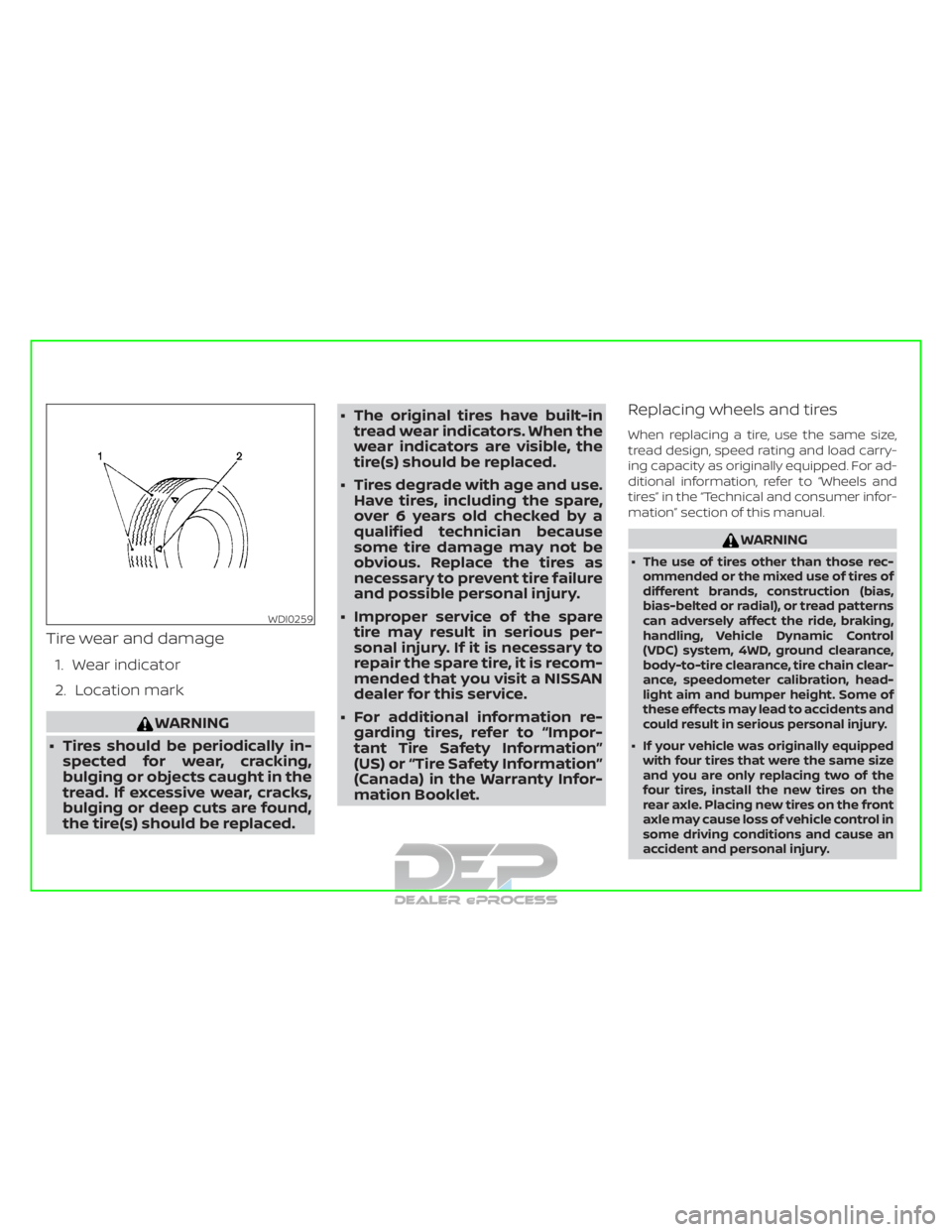
Tire wear and damage
1. Wear indicator
2. Location mark
WARNING
∙ Tires should be periodically in- spected for wear, cracking,
bulging or objects caught in the
tread. If excessive wear, cracks,
bulging or deep cuts are found,
the tire(s) should be replaced. ∙ The original tires have built-in
tread wear indicators. When the
wear indicators are visible, the
tire(s) should be replaced.
∙ Tires degrade with age and use. Have tires, including the spare,
over 6 years old checked by a
qualified technician because
some tire damage may not be
obvious. Replace the tires as
necessary to prevent tire failure
and possible personal injury.
∙ Improper service of the spare tire may result in serious per-
sonal injury. If it is necessary to
repair the spare tire, it is recom-
mended that you visit a NISSAN
dealer for this service.
∙ For additional information re- garding tires, refer to “Impor-
tant Tire Safety Information”
(US) or “Tire Safety Information”
(Canada) in the Warranty Infor-
mation Booklet.
Replacing wheels and tires
When replacing a tire, use the same size,
tread design, speed rating and load carry-
ing capacity as originally equipped. For ad-
ditional information, refer to “Wheels and
tires” in the “Technical and consumer infor-
mation” section of this manual.
WARNING
∙The use of tires other than those rec-
ommended or the mixed use of tires of
different brands, construction (bias,
bias-belted or radial), or tread patterns
can adversely affect the ride, braking,
handling, Vehicle Dynamic Control
(VDC) system, 4WD, ground clearance,
body-to-tire clearance, tire chain clear-
ance, speedometer calibration, head-
light aim and bumper height. Some of
these effects may lead to accidents and
could result in serious personal injury.
∙If your vehicle was originally equipped
with four tires that were the same size
and you are only replacing two of the
four tires, install the new tires on the
rear axle. Placing new tires on the front
axle may cause loss of vehicle control in
some driving conditions and cause an
accident and personal injury.
WDI0259
Page 14 of 682
∙ If the wheels are changed for any rea-son, always replace with wheels
which have the same off-set dimen-
sion. Wheels of a different off-set
could cause premature tire wear, de-
grade vehicle handling characteris-
tics, affect the VDC system and/or in-
terference with the brake discs. Such
interference can lead to decreased
braking efficiency and/or early brake
pad wear. For additional information
on wheel off-set dimensions, refer to
“Wheels and tires” in the “Technical
and consumer information” section of
this manual.
∙ When replacing a wheel without the TPMS such as the spare tire, TPMS will
not function and the low tire pressure
warning light will flash for approxi-
mately 1 minute. The light will remain
on af ter 1 minute. Have your tires re-
placed and/or TPMS system reset as
soon as possible. It is recommended
that you visit a NISSAN dealer for this
service.
∙ Replacing tires with those not origi- nally specified by NISSAN could affect
the proper operation of the TPMS. ∙ The TPMS sensor may be damaged if
it is not handled correctly. Be careful
when handling the TPMS sensor.
∙ When replacing the TPMS sensor, the ID registration may be required. It is
recommended that you visit a NISSAN
dealer for ID registration.
∙ Do not use a valve stem cap that is not specified by NISSAN. The valve stem
cap may become stuck.
∙ Be sure that the valve stem caps are correctly fitted. Otherwise the valve
may be clogged up with dirt and
cause a malfunction or loss of
pressure.
∙ Do not install a damaged or deformed wheel or tire even if it has been re-
paired. Such wheels or tires could
have structural damage and could fail
without warning.
∙ The use of retread tires is not recommended.
∙ For additional information regarding tires, refer to “Important Tire Safety
Information” (US) or “Tire Safety Infor-
mation” (Canada) in the Warranty In-
formation Booklet.Four-wheel drive models
CAUTION
Always use tires of the same type, size,
brand, construction (bias, bias-belted
or radial), and tread pattern on all four
wheels. Failure to do so may result in a
circumference difference between tires
on the front and rear axles which will
cause excessive tire wear and may
damage the transmission, transfer case
and differential gears.
If excessive tire wear is found, it is recom-
mended that all four tires be replaced with
tires of the same size, brand, construction
and tread pattern. The tire pressure and
wheel alignment should also be checked
and corrected as necessary. It is recom-
mended that you visit a NISSAN dealer for
this service.
Wheel balance
Unbalanced wheels may affect vehicle
handling and tire life. Even with regular use,
wheels can get out of balance. Therefore,
they should be balanced as required.
Page 26 of 682
0 Illustrated table of contents
Air bags, seat belts and child restraints..........0-2
Exterior front ....................................0-4
Exterior rear .....................................0-6
Passenger compartment ........................0-7 Instrument panel
................................0-8
Engine compartment check locations ..........0-10
Warning and indicator lights ....................0-13
Page 33 of 682
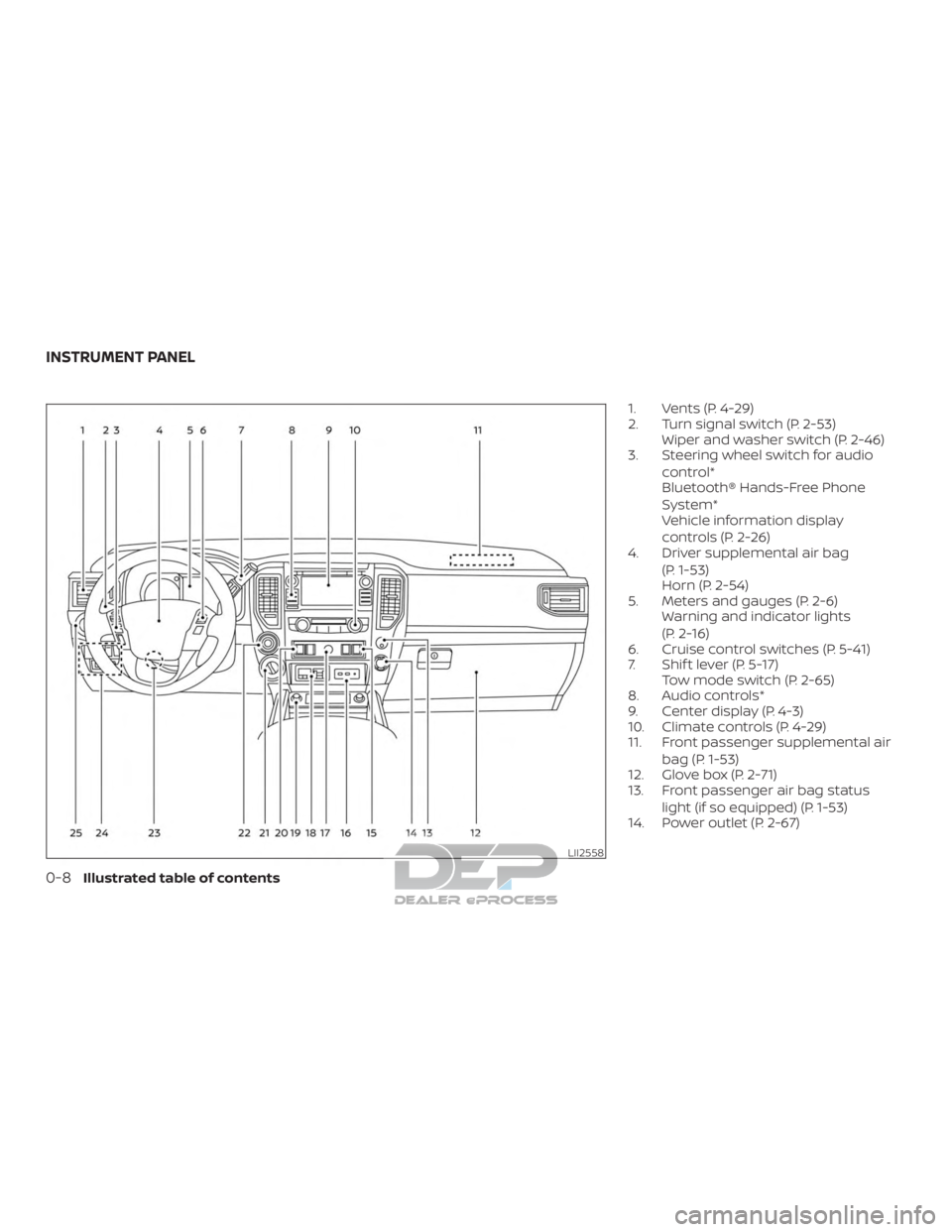
1. Vents (P. 4-29)
2. Turn signal switch (P. 2-53)Wiper and washer switch (P. 2-46)
3. Steering wheel switch for audio
control*
Bluetooth® Hands-Free Phone
System*
Vehicle information display
controls (P. 2-26)
4. Driver supplemental air bag
(P. 1-53)
Horn (P. 2-54)
5. Meters and gauges (P. 2-6) Warning and indicator lights
(P. 2-16)
6. Cruise control switches (P. 5-41)
7. Shif t lever (P. 5-17) Tow mode switch (P. 2-65)
8. Audio controls*
9. Center display (P. 4-3)
10. Climate controls (P. 4-29)
11. Front passenger supplemental air
bag (P. 1-53)
12. Glove box (P. 2-71)
13. Front passenger air bag status
light (if so equipped) (P. 1-53)
14. Power outlet (P. 2-67)
LII2558
INSTRUMENT PANEL
0-8Illustrated table of contents
Page 34 of 682
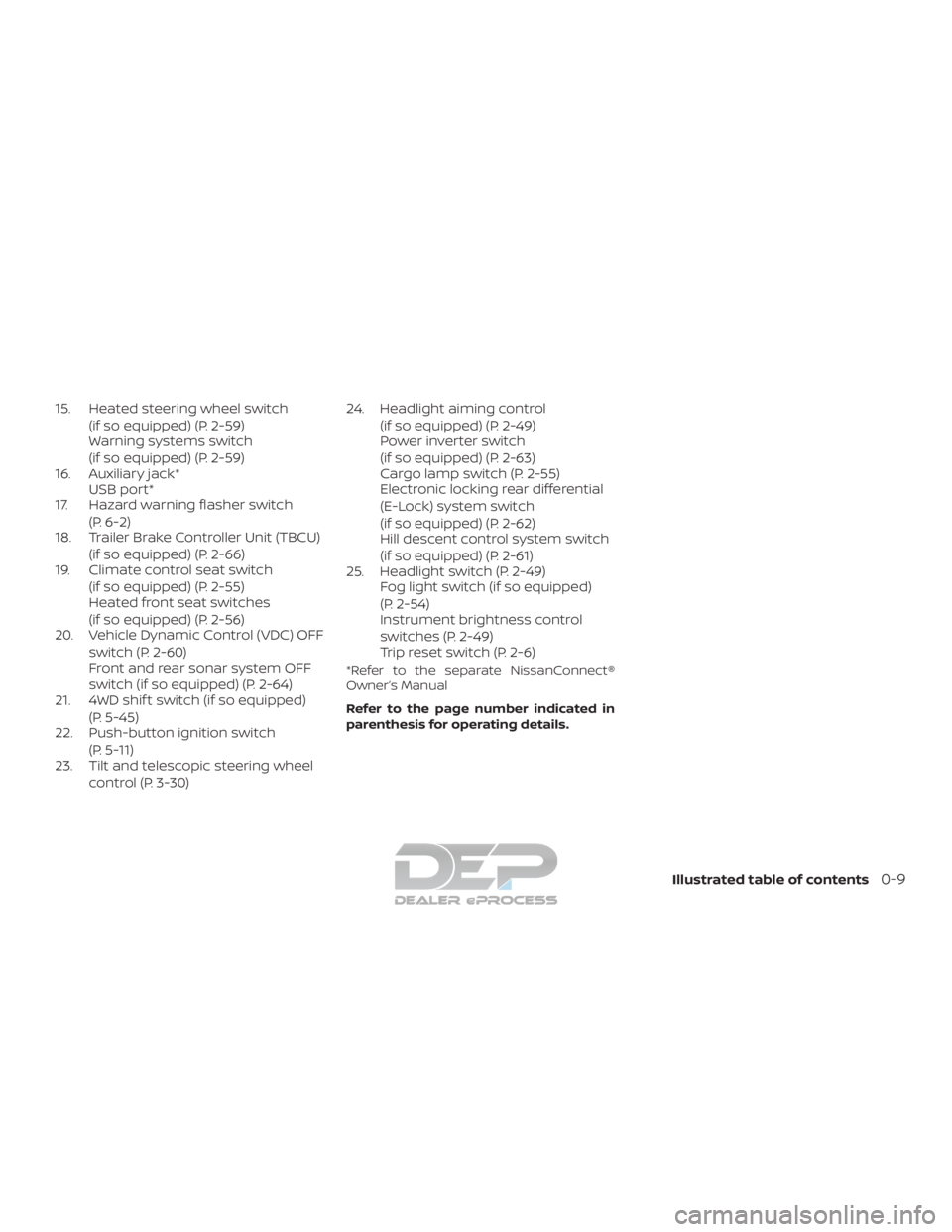
15. Heated steering wheel switch(if so equipped) (P. 2-59)
Warning systems switch
(if so equipped) (P. 2-59)
16. Auxiliary jack* USB port*
17. Hazard warning flasher switch
(P. 6-2)
18. Trailer Brake Controller Unit (TBCU)
(if so equipped) (P. 2-66)
19. Climate control seat switch
(if so equipped) (P. 2-55)
Heated front seat switches
(if so equipped) (P. 2-56)
20. Vehicle Dynamic Control (VDC) OFF
switch (P. 2-60)
Front and rear sonar system OFF
switch (if so equipped) (P. 2-64)
21. 4WD shif t switch (if so equipped)
(P. 5-45)
22. Push-button ignition switch
(P. 5-11)
23. Tilt and telescopic steering wheel
control (P. 3-30) 24. Headlight aiming control
(if so equipped) (P. 2-49)
Power inverter switch
(if so equipped) (P. 2-63)
Cargo lamp switch (P. 2-55)
Electronic locking rear differential
(E-Lock) system switch
(if so equipped) (P. 2-62)
Hill descent control system switch
(if so equipped) (P. 2-61)
25. Headlight switch (P. 2-49) Fog light switch (if so equipped)
(P. 2-54)
Instrument brightness control
switches (P. 2-49)
Trip reset switch (P. 2-6)
*Refer to the separate NissanConnect®
Owner’s Manual
Refer to the page number indicated in
parenthesis for operating details.
Illustrated table of contents0-9
Page 38 of 682
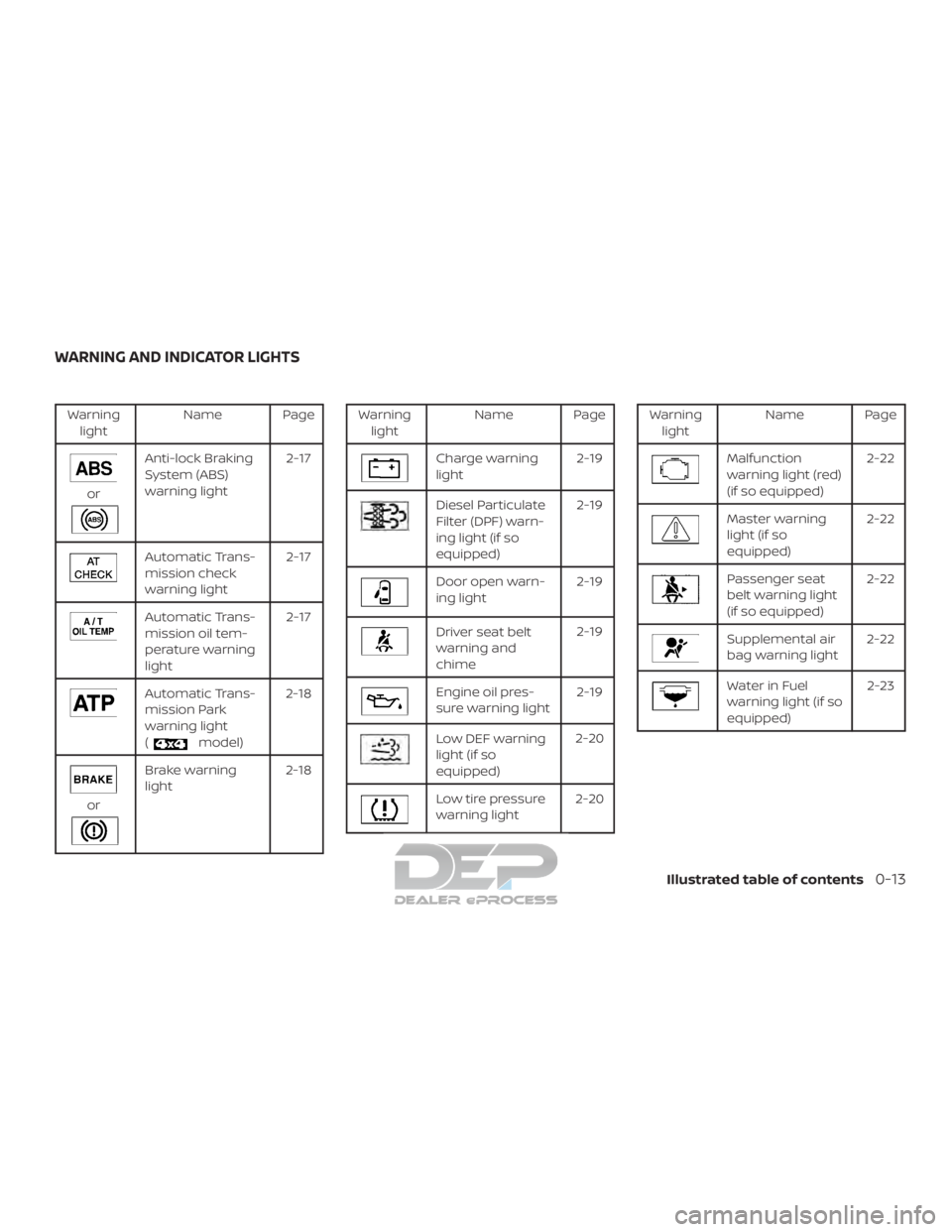
Warninglight Name Page
or
Anti-lock Braking
System (ABS)
warning light 2-17
Automatic Trans-
mission check
warning light2-17
Automatic Trans-
mission oil tem-
perature warning
light2-17
Automatic Trans-
mission Park
warning light
(
model)2-18
or
Brake warning
light
2-18
Warning
light Name Page
Charge warning
light 2-19
Diesel Particulate
Filter (DPF) warn-
ing light (if so
equipped)2-19
Door open warn-
ing light
2-19
Driver seat belt
warning and
chime2-19
Engine oil pres-
sure warning light
2-19
Low DEF warning
light (if so
equipped)2-20
Low tire pressure
warning light
2-20
Warning
light Name Page
Malfunction
warning light (red)
(if so equipped) 2-22
Master warning
light (if so
equipped)2-22
Passenger seat
belt warning light
(if so equipped)2-22
Supplemental air
bag warning light
2-22
Water in Fuel
warning light (if so
equipped) 2-23
WARNING AND INDICATOR LIGHTS
Illustrated table of contents0-13
Page 41 of 682
1 Safety—Seats, seat belts and
supplemental restraint system
Seats............................................ 1-2Front manual bench seat adjustment
(Single Cab models and if so equipped
for King Cab® and Crew Cab models) ..........1-3
Front manual captain’s chair seat
adjustment (if so equipped for
passenger seat for King Cab® and Crew
Cab models) .................................. 1-4
Front power captain’s chair seat
adjustment (if so equipped for Crew
Cab and King Cab® models) .................. 1-5
Front armrests (if so equipped) ................1-7
Rear armrests (Crew Cab models and if
so equipped for King Cab® models) ............1-7
Flexible seating ................................1-7
Head restraints/Headrests ......................1-10
Adjustable head restraint/headrest
components ................................. 1-12
Non-adjustable head restraint/
headrest components ........................ 1-12
Remove...................................... 1-12Removable (without Dual Head
Restraint/Headrest Rear Seat
Infotainment (RSI) System only)
...............1-13
Install ......................................... 1-13
Adjust ........................................ 1-14
Seatbelts ....................................... 1-15
Precautions on seat belt usage ...............1-15
Seat belt warning light ........................ 1-18
Pregnant women ............................. 1-18
Injured persons ............................... 1-18
Three-point type seat belt with
retractor ..................................... 1-18
Seat belt extenders .......................... 1-23
Seat belt maintenance ......................1-23
Child safety ..................................... 1-24
Infants ...................................... 1-25
Small children ............................... 1-25
Larger children .............................. 1-25
Child restraints ................................. 1-26
Precautions on child restraints ..............1-26
Page 42 of 682
LATCH (Lower Anchors and Tethers for
CHildren) system (Crew Cab models
and King Cab® models with rear bench
seat) ........................................1-29
Top tether anchor point locations ............1-31
Rear-facing child restraint installation
using LATCH (Crew Cab models and
King Cab® models with rear bench
seat) ........................................ 1-32
Rear-facing child restraint installation
using the seat belts (Crew Cab models
and King Cab® models with rear bench
seat) ........................................ 1-34
Rear-facing child restraint installation
using the seat belts (Single Cab models
and King Cab® Rear Seat Delete
models) ..................................... 1-36
Forward-facing child restraint
installation using LATCH (Crew Cab
models and King Cab® models with
rear bench seat) ............................. 1-37
Forward-facing child restraint
installation using the seat belts — rear
bench seat (Crew Cab models and King
Cab® models with rear bench seat) ..........1-40 Forward-facing child restraint
installation using the seat belts —
passenger seat and center seat
(Single Cab models and King Cab® Rear
Seat Delete models)
......................... 1-44
Booster seats ............................... 1-49
Supplemental Restraint System (SRS) ...........1-53
Precautions on SRS (with NISSAN
Advanced Air Bag System) (if so
equipped) ................................... 1-53
Precautions on SRS (without NISSAN
Advanced Air Bag System) (if so
equipped) ................................... 1-68
Front seat-mounted side-impact
supplemental air bag and roof-
mounted curtain side-impact and
rollover supplemental air bag systems ......1-78
Seat belt with pretensioner(s) (front
seats) ....................................... 1-79
Supplemental air bag warning labels ........1-80
Supplemental air bag warning light ...........1-81
Page 58 of 682
WARNING
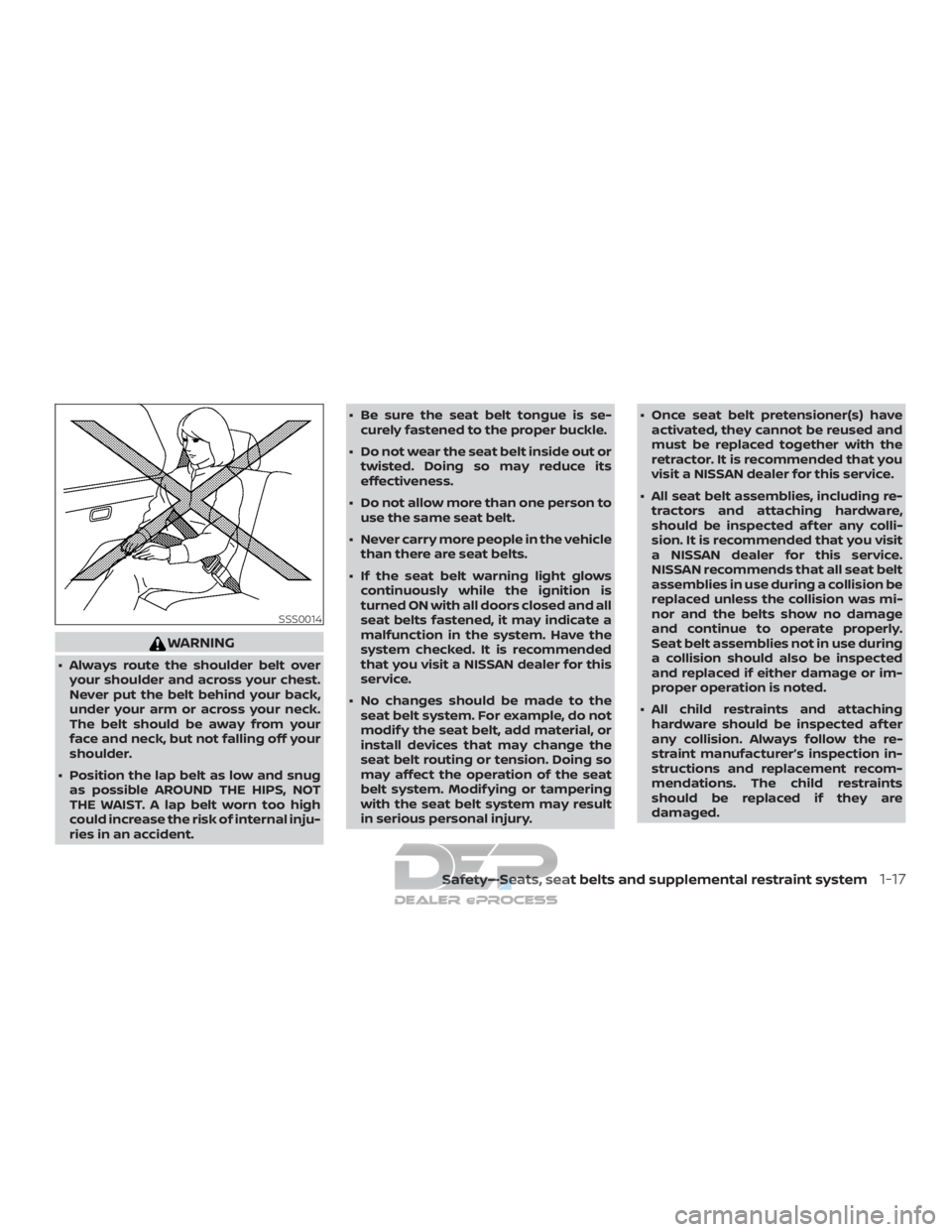
∙ Always route the shoulder belt overyour shoulder and across your chest.
Never put the belt behind your back,
under your arm or across your neck.
The belt should be away from your
face and neck, but not falling off your
shoulder.
∙ Position the lap belt as low and snug as possible AROUND THE HIPS, NOT
THE WAIST. A lap belt worn too high
could increase the risk of internal inju-
ries in an accident. ∙ Be sure the seat belt tongue is se-
curely fastened to the proper buckle.
∙ Do not wear the seat belt inside out or twisted. Doing so may reduce its
effectiveness.
∙ Do not allow more than one person to use the same seat belt.
∙ Never carry more people in the vehicle than there are seat belts.
∙ If the seat belt warning light glows continuously while the ignition is
turned ON with all doors closed and all
seat belts fastened, it may indicate a
malfunction in the system. Have the
system checked. It is recommended
that you visit a NISSAN dealer for this
service.
∙ No changes should be made to the seat belt system. For example, do not
modif y the seat belt, add material, or
install devices that may change the
seat belt routing or tension. Doing so
may affect the operation of the seat
belt system. Modif ying or tampering
with the seat belt system may result
in serious personal injury. ∙ Once seat belt pretensioner(s) have
activated, they cannot be reused and
must be replaced together with the
retractor. It is recommended that you
visit a NISSAN dealer for this service.
∙ All seat belt assemblies, including re- tractors and attaching hardware,
should be inspected af ter any colli-
sion. It is recommended that you visit
a NISSAN dealer for this service.
NISSAN recommends that all seat belt
assemblies in use during a collision be
replaced unless the collision was mi-
nor and the belts show no damage
and continue to operate properly.
Seat belt assemblies not in use during
a collision should also be inspected
and replaced if either damage or im-
proper operation is noted.
∙ All child restraints and attaching hardware should be inspected af ter
any collision. Always follow the re-
straint manufacturer’s inspection in-
structions and replacement recom-
mendations. The child restraints
should be replaced if they are
damaged.
SSS0014
Safety—Seats, seat belts and supplemental restraint system1-17