seats NISSAN TITAN 2020 Owner´s Manual
[x] Cancel search | Manufacturer: NISSAN, Model Year: 2020, Model line: TITAN, Model: NISSAN TITAN 2020Pages: 657, PDF Size: 5.1 MB
Page 537 of 657
the parking brake applied. If the parking
brake needs adjustment, it is recom-
mended that you visit a NISSAN dealer for
this service.
Seats:Check seat position controls such
as seat adjusters, seatback recliner, etc., to
ensure they operate smoothly and all
latches lock securely in every position.
Check that the head restraints/headrests
move up and down smoothly and the locks
(if so equipped) hold securely in all latched
positions.
Seat belts: Check that all parts of the seat
belt system (for example, buckles, anchors,
adjusters and retractors) operate properly
and smoothly, and are installed securely.
Check the belt webbing for cuts, fraying,
wear or damage.
Steering wheel: Check for changes in the
steering system, such as excessive free-
play, hard steering or strange noises.
Warning lights and chimes: Make sure all
warning lights and chimes are operating
properly.
Windshield wiper and washer*: Check
that the wipers and washer operate prop-
erly and that the wipers do not streak. Windshield defroster:
Check that the air
comes out of the defroster outlets properly
and in sufficient quantity when operating
the heater or air conditioner.
Under the hood and vehicle
The maintenance items listed here should
be checked periodically (for example, each
time you check the engine oil or refuel).
Battery* (for maintenance free batter-
ies): For vehicles equipped with a sealed
maintenance free battery. It is recom-
mended that you visit a NISSAN dealer for
service.
Battery* (for serviceable batteries):
Check the fluid level in each cell. The fluid
should be at the bottom of the filler open-
ing. Vehicles operated in high tempera-
tures or under severe conditions require
frequent checks of the battery fluid level.
NOTE:
Care should be taken to avoid situations
that can lead to potential battery dis-
charge and potential no-start conditions
such as:
1. Installation or extended use of elec-
tronic accessories that consume bat-
tery power when the engine is not run- ning (Phone chargers, GPS, DVD
players, etc.).
2. Vehicle is not driven regularly and/or
only driven short distances.
In these cases, the battery may need to
be charged to maintain battery health.
Brake fluid level*: Make sure that the brake
fluid level is between the MIN and MAX lines
on the reservoir.
Engine coolant level*: Check the coolant
level when the engine is cold.
Engine drive belts*: Make sure the drive
belts are not frayed, worn, cracked or oily.
Engine oil level*: Check the level af ter
parking the vehicle on a level surface with
the engine off. Wait more than 10 minutes
for the oil to drain back into the oil pan.
Exhaust system: Visually inspect the ex-
haust pipes, muffler and hangers for leaks,
cracks, deterioration and damage. Tighten
connections or replace parts as necessary.
For additional information, refer to “Exhaust
gas (carbon monoxide)” in the “Starting and
driving” section of this manual.
Fluid leaks: Check under the vehicle for
fuel, oil, water or other fluid leaks af ter the
vehicle has been parked for a while. Water
dripping from the air conditioner af ter use
9-4Maintenance and schedules
Page 571 of 657
WARNING
• It is extremely dangerous to
ride in a cargo area inside a ve-
hicle. In a collision, people rid-
ing in these areas are more
likely to be seriously injured or
killed.
• Do not allow people to ride in
any area of your vehicle that is
not equipped with seats and
seat belts.
• Be sure everyone in your ve-
hicle is in a seat and using a
seat belt properly.
TERMS
It is important to familiarize yourself
with the following terms before
loading your vehicle: • Curb Weight (actual weight of your
vehicle) - vehicle weight including:
standard and optional equipment,
fluids, emergency tools, and spare
tire assembly. This weight does
not include passengers and cargo.
• GVW (Gross Vehicle Weight) - curb weight plus the combined weight
of passengers and cargo.
• GVWR (Gross Vehicle Weight Rat- ing) - maximum total combined
weight of the unloaded vehicle,
passengers, luggage, hitch, trailer
tongue load and any other op-
tional equipment. This information
is located on the F.M.V.S.S./
C.M.V.S.S. certification label.
• GAWR (Gross Axle Weight Rating) - maximum weight (load) limit
specified for the front or rear axle.
This information is located on the
F.M.V.S.S./C.M.V.S.S. certification la-
bel. • GCWR (Gross Combined Weight
rating) - The maximum total
weight rating of the vehicle, pas-
sengers, cargo, and trailer.
• Vehicle Capacity Weight, Load limit, Total load capacity - maximum to-
tal weight limit specified of the load
(passengers and cargo) for the ve-
hicle. This is the maximum com-
bined weight of occupants and
cargo that can be loaded into the
vehicle. If the vehicle is used to tow
a trailer, the trailer tongue weight
must be included as part of the
cargo load. This information is lo-
cated on the Tire and Loading In-
formation label.
• Cargo capacity - permissible weight of cargo, the subtracted
weight of occupants from the load
limit.
VEHICLE LOADING INFORMATION
10-22Technical and consumer information
Page 594 of 657
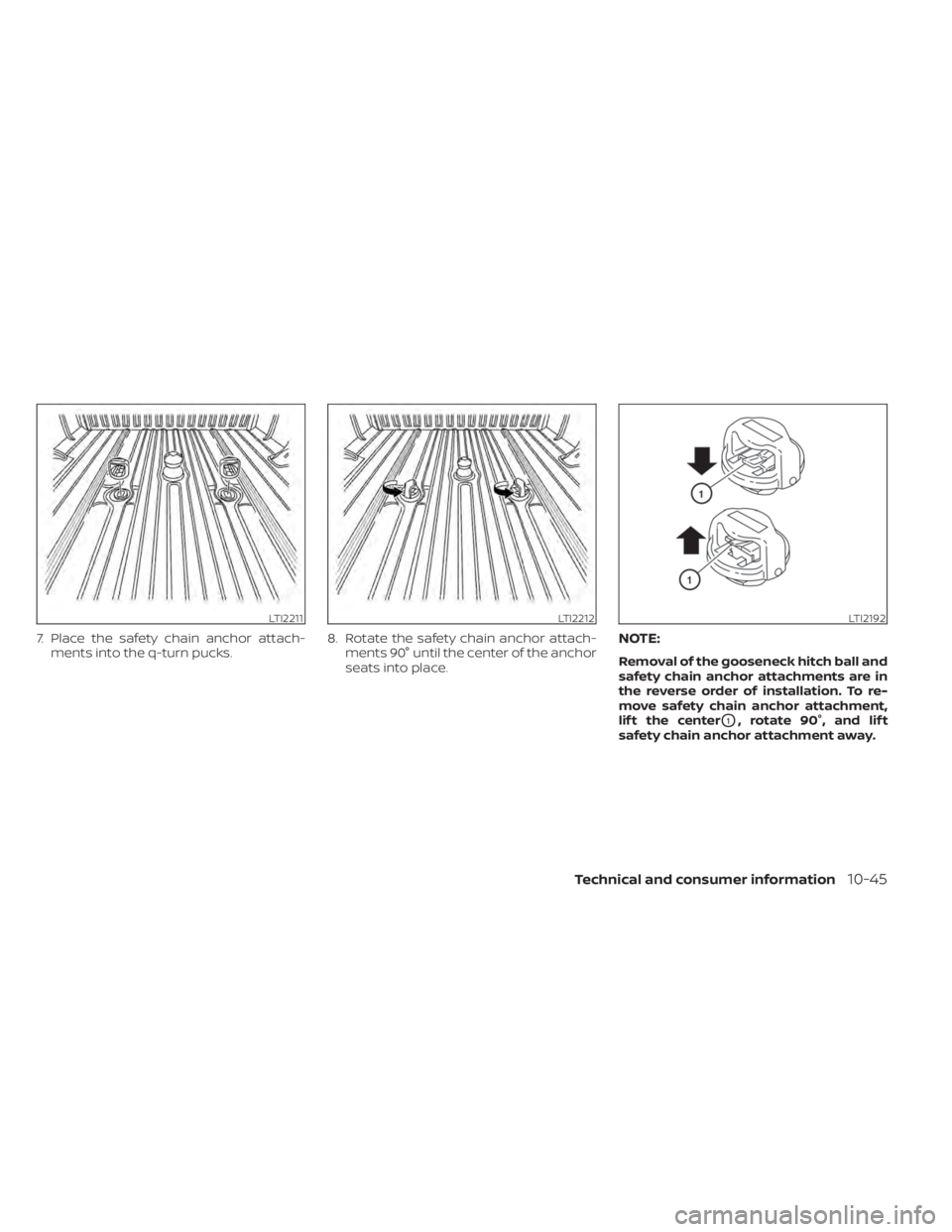
7. Place the safety chain anchor attach-ments into the q-turn pucks. 8. Rotate the safety chain anchor attach-
ments 90° until the center of the anchor
seats into place.NOTE:
Removal of the gooseneck hitch ball and
safety chain anchor attachments are in
the reverse order of installation. To re-
move safety chain anchor attachment,
lif t the center
O1, rotate 90°, and lif t
safety chain anchor attachment away.
LTI2211LTI2212LTI2192
Technical and consumer information10-45
Page 610 of 657
11 Index
A
Active Brake Limited Slip (ABLS)
system....................5-118Aiming control, headlights.........2-52Air bag (See supplemental restraint
system).....................1-52Air bag system
Front (See supplemental front
impact air bag system)
......1-59, 1-74Air bag warning labels............1-81Air bag warning light.........1-81, 2-18Air bag warning light,
supplemental..............1-81, 2-18Air cleaner...................8-19Air cleaner housing filter..........8-19Air conditionerAir conditioner operation. . . .4-32, 4-38Air conditioner specification label. .10-20Air conditioner system refrigerant
recommendations............10-8Air conditioner system refrigerant
and oil recommendations.......10-8Heater and air conditioner
(automatic) (if so equipped)......4-37Heater and air conditioner
controls.................. .4-38Servicing air conditioner........4-42Air flow charts................4-33Alarm system
(See vehicle security system).......2-40
Anchor point locations...........1-32Antenna................... .4-42Anti-lock brake warning light.......2-13Anti-lock Braking System (ABS)......5-116Antifreeze...................5-128Autolight switch...............2-48Automatic
Automatic drive positioner.......3-40Automatic power window switch. . .2-85Driving with automatic
transmission................5-18Automatic anti-glare inside mirror. . . .3-30Automatic door locks.............3-8Automatic drive positioner........3-40Automatic Emergency Braking
(AEB)...................2-13,2-17Automatic Emergency Braking (AEB)
with Pedestrian Detection.........5-80Automatic transmission fluid
temperature gauge.............2-10
B
Battery.................5- 128, 8-14Charge warning light...........2-15Battery replacement............8-25Key fob...................8-25NISSAN Intelligent Key®.........8-26Before starting the engine.........5-16Belt (See drive belt)..............8-17
Blind Spot Warning (BSW)..........5-32Block heater
Engine...................5-129Booster seats................ .1-48Brake
Anti-lock Braking System (ABS). . . .5-116Brake fluid.................8-12Brake light (See stop light).......8-30Brake system...............5-116Brake warning light............2-14Brake wear indicators.......2-21,8-21Parking brake operation.........5-23Self-adjusting brakes...........8-21Brake Assist..................5-117Brake fluid...................8-12Brake system................5-116Brakes.....................8-21Break-in schedule.............5-104Brightness controlInstrument panel.............2-53Bulb check/instrument panel.......2-13Bulb replacement..............8-30
C
C.M.V.S.S. certification label........10-18Capacities and recommended
fuel/lubricants................10-2Car phone or CB radio...........4-86
Page 612 of 657
F
Flashers (See hazard warning flasher
switch)......................6-2Flat tire...................6-3, 6-4Floor mat positioning aid...........7-6Fluid
Brake fluid..................8-12Capacities and recommended
fuel/lubricants...............10-2Engine coolant................8-5Engine oil...................8-7Power steering fluid............8-11Windshield-washer fluid.........8-13Fog light switch................2-54Front air bag system (See supplemental
restraint system)............1-59, 1-74Front and rear sonar system.......5-123Front power seat adjustment........1-6Front seats....................1-2Front-door pocket...........2-71,2-72FuelCapacities and recommended
fuel/lubricants
...............10-2Fuel economy...............5-105Fuel gauge................. .2-9Fuel octane rating.............10-6Fuel recommendation..........10-4Loose fuel cap warning..........2-37Fuel Cell Vehicle (FCV) System
Tire pressure................8-33Fuel efficient driving tips..........5-104Fuel gauge................... .2-9Fuel-filler door.................3-24
Fuses......................8-22Fusible links..................8-24
G
Garage door opener, HomeLink® Universal
Transceiver........2-92, 2-94, 2-95, 2-96Gauge
Automatic transmission fluid
temperature gauge
............2-10Engine coolant temperature gauge. . .2-8Engine oil pressure gauge........2-10Fuel gauge................. .2-9Odometer...................2-7Speedometer.................2-7Tachometer.................2-8Trip odometer................2-7Voltmeter..................2-10General maintenance.............9-2Glove box....................2-75Grocery hooks.................2-81
H
Hazard warning flasher switch........6-2Head restraints.................1-11Headlight aiming control..........2-52Headlight and turn signal switch.....2-46Headlight control switch...........2-47Headlights...................8-27Headlights, aiming control.........2-52Heated rear seats...............2-58Heated seats................. .2-57
Heated steering wheel switch.......2-59Heater
Heater and air conditioner (automatic)
(if so equipped)
...............4-37Heater and air conditioner controls. .4-38Heater operation..........4-30, 4-39Heater and air conditioner (automatic). .4-37Hill descent control switch..........2-61Hill descent control system........5-121Hill start assist system...........5-122HomeLink® Universal
Transceiver........2-92, 2-94, 2-95, 2-96Hood.......................3-23HookLuggage hook...............2-82Horn...................... .2-55
I
Ignition switch
Push-button ignition switch.......5-12Immobilizer system..........2-41, 5-16In-cabin microfilter..............8-19Increasing fuel economy..........5-105Indicator lights and audible reminders
(See warning/indicator lights and audible
reminders)
...................2-13Inside automatic anti-glare mirror. . . .3-30Instrument brightness control.......2-53Instrument panel.............0-6, 2-4Instrument panel dimmer switch.....2-53Intelligent Around View Monitor.......4-11
Index11-3
Page 614 of 657
Maintenance schedules............9-7Maintenance under severe operation
conditions....................9-10Malfunction indicator light..........2-19Manual front seat adjustment........1-4Map lights....................2-91Map pocket................2-71,2-72Memory Seat..................3-40Meters and gauges...........2-6, 2-10Instrument brightness control.....2-53Mirror
Automatic anti-glare inside mirror. . .3-30Outside mirrors..............3-30Rearview...................3-29Vanity mirror................3-29Mirrors......................3-29Moonroof................ .2-87, 7-5Moving Object Detection (MOD)......4-23
N
NISSAN Intelligent Key®..........3-2,3-9NISSAN Vehicle Immobilizer
System................. .2-41, 5-16NissanConnect® Owner's Manual......4-2
O
Octane rating (See fuel octane rating). .10-6Odometer....................2-7Oil
Capacities and recommended
fuel/lubricants
...............10-2
Changing engine oil............8-8Changing engine oil filter.........8-8Checking engine oil level..........8-7Engine oil...................8-7Engine oil and oil filter
recommendation.............10-7Engine oil viscosity.............10-7Outside mirrors................3-30Overhead sunglasses holder........2-77OverheatIf your vehicle overheats.........6-12Owner's manual order form........10-60Owner's manual/service manual order
information................. .10-60
P
Parking
Parking brake operation.........5-23Parking/parking on hills.........5-114Parking brake.................5-23Personal lights................ .2-91Power
Front seat adjustment...........1-6Power door locks..............3-6Power outlet.............2-67, 2-69Powerrearwindows...........2-85Power steering fluid............8-11Power steering system.........5-115Power windows..............2-83Rear power windows...........2-85Power inverter switch............2-64Power outlet..............2-67, 2-69
Power steering................5-115Power steering fluid..............8-11PrecautionsMaintenance precautions.........8-2On-pavement and off-road driving
precautions................ .5-8Precautions on booster
seats...........1-34, 1-40, 1-44, 1-48Precautions on child
restraints........1-34, 1-40, 1-44, 1-48Precautions on seat belt usage.....1-16Precautions on supplemental restraint
system.................1-52, 1-67Precautions when starting and
driving................. .5-4, 5-10Push starting..................6-12
R
Radio
Car phone or CB radio..........4-86Rain sensor.................. .2-44Readiness for inspection maintenance
(I/M) test................... .10-59Rear Automatic Braking (RAB).......5-75Rear Cross Traffic Alert (RCTA).......5-41Rear Door Alert.........2-37, 2-38, 2-66Rear power windows.............2-85Rear seat.................... .1-4Rear Seat Infotainment (RSI) System. . .4-43Rear sliding window.............2-87Rear sonar system OFF switch.......2-64
Index11-5
Page 615 of 657
Rear window and/or outside mirror
defroster switch................2-45Rearview mirror................3-29RearView Monitor................4-3Recommended Fluids............10-2RecordersEvent Data................ .10-59Refrigerant recommendation.......10-8Registering a vehicle in another
country.................... .10-17Remote Engine Start..........3-21,5-17Reporting safety defects (US only). . . .10-58
S
Safety
Child safety rear door lock.........3-9Child seat belts. .1-27, 1-34, 1-40, 1-44, 1-48Reporting safety defects (US only). .10-58Seat adjustmentFront manual seat adjustment......1-4Front power seat adjustment.......1-6Seat beltChild safety.................1-25Infants and small children.....1-25,1-26Injured person................1-19Larger children...............1-26Precautions on seat belt usage.....1-16Pregnant women..............1-19Seat belt extenders............1-24Seat belt maintenance..........1-24Seat belts................1-16,7-7Shoulder belt height adjustment. . . .1-23
Three-point type with retractor.....1-19Seat belt extenders..............1-24Seat belt warning light.........1-19,2-18Seatback pockets...............2-72SeatsAdjustment..................1-2Automatic drive positioner.......3-40Front seats..................1-2Heated seats................2-57Manual front seat adjustment......1-4Rear seat.................. .1-4Security indicator light............2-20Security system (NISSAN Vehicle Immobilizer
System), engine start.........2-41, 5-16Security systems
Vehicle security system.........2-40Self-adjusting brakes.............8-21Service manual order form........10-60Servicing air conditioner...........4-42Shif tingAutomatic transmission.........5-20Shoulder belt height adjustment......1-23Side air bag system (See supplemental side
air bag, curtain and rollover air bag
systems)
.....................1-77Snow plow................. .10-56Spark plug replacement...........8-18Spark plugs...................8-18Specifications.................10-9Speedometer..................2-7Speedometer and odometer........2-6SRS warning label...............1-81Stability control................5-119Standard maintenance.........9-7,9-8
Starting
Before starting the engine........5-16Jump starting............6-10,8-16Precautions when starting and
driving................. .5-4, 5-10Push starting................6-12Starting the engine
(gasoline engine only)............5-16Steering
Power steering fluid............8-11Power steering system.........5-115Steering wheel.................3-26Stop light................... .8-30Storage.....................2-71Storage tray..................2-75Sun visors....................3-28Sunglasses case................2-77Sunglasses holder...............2-77Sunroof..................2-87, 7-5Supplemental air bag warning labels. . .1-81Supplemental air bag warning
light................... .1-81, 2-18Supplemental front impact air bag
system..................1-59, 1-74Supplemental restraint system
Information and warning labels.....1-81Precautions on supplemental restraint
system................ .1-52, 1-67Supplemental restraint system
(Supplemental air bag system).......1-52Switch
Autolight switch..............2-48Automatic power window switch. . .2-85
11-6Index
Page 624 of 657
The information contained within this supplement updates the following information in the 2020
NISSAN TITAN Owner’s Manual.
In the “Illustrated table of contents section of the Owner’s Manual “ and in “Supplemental air
bag system” in the “Safety—Seats, seat belts and supplemental restraint system” section of
the Owner’s manual.
Read carefully and keep in the vehicle.
Printing: April 2020
Publication No. SU20EA 1A61U0
OWNER’S MANUAL SUPPLEMENT
Page 625 of 657
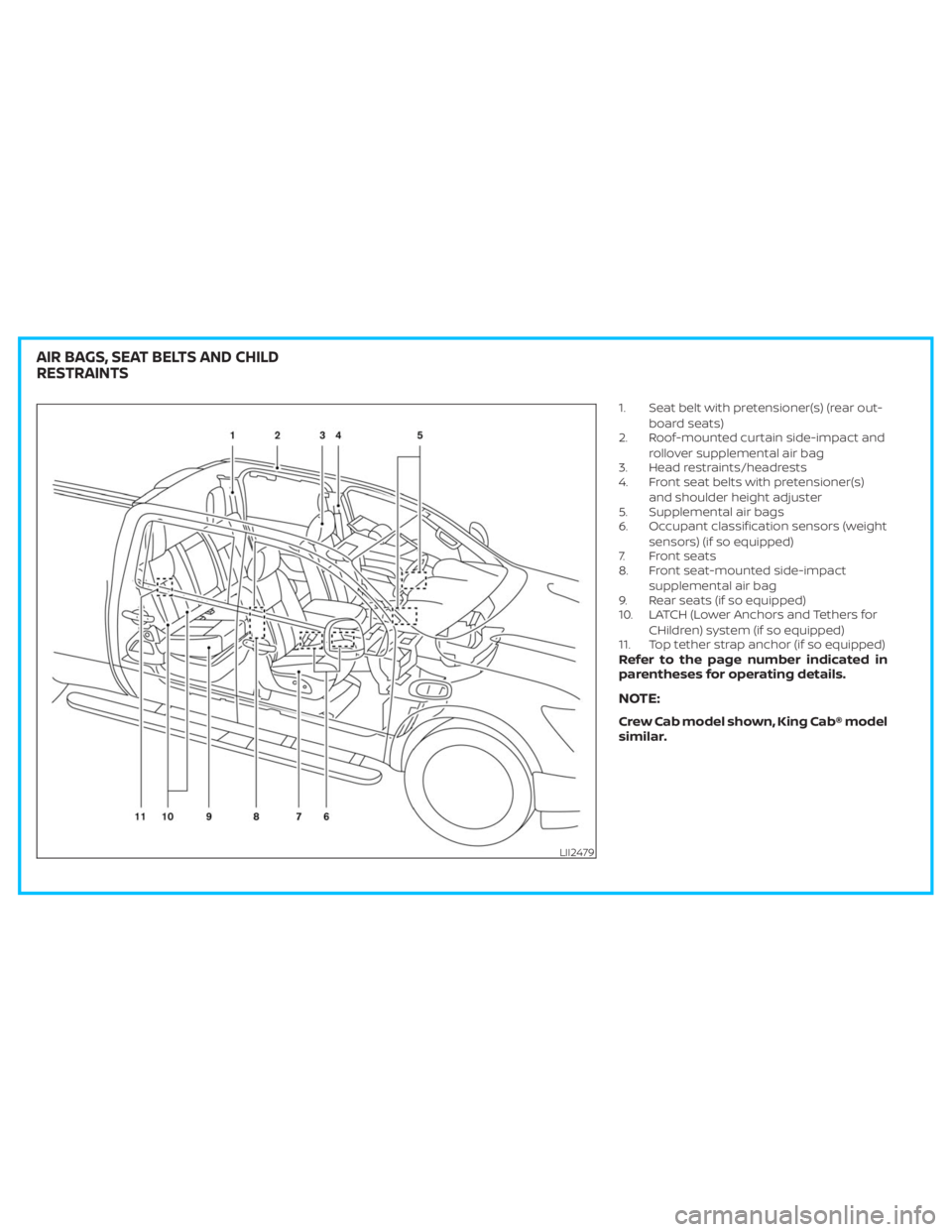
1. Seat belt with pretensioner(s) (rear out-
board seats)
2. Roof-mounted curtain side-impact and
rollover supplemental air bag
3. Head restraints/headrests
4. Front seat belts with pretensioner(s)
and shoulder height adjuster
5. Supplemental air bags
6. Occupant classification sensors (weight
sensors) (if so equipped)
7. Front seats
8. Front seat-mounted side-impact
supplemental air bag
9. Rear seats (if so equipped)
10. LATCH (Lower Anchors and Tethers for
CHildren) system (if so equipped)
11. Top tether strap anchor (if so equipped)
Refer to the page number indicated in
parentheses for operating details.
NOTE:
Crew Cab model shown, King Cab® model
similar.
LII2479
AIR BAGS, SEAT BELTS AND CHILD
RESTRAINTS
Page 626 of 657
PRECAUTIONS ON SRS (with
NISSAN Advanced Air Bag System)
(if so equipped)
This SRS section contains important infor-
mation concerning the following systems:
• Driver and front passenger supplemental
front-impact air bag (NISSAN Advanced
Air Bag System)
• Front seat-mounted side-impact supple-
mental air bag
• Roof-mounted curtain side-impact and
rollover supplemental air bag
• Driver and passenger supplemental knee
air bags
• Seat belt with pretensioner(s) (front seats
and rear outboard seats)
Supplemental front-impact air bag sys-
tem
The NISSAN Advanced Air Bag System can
help cushion the impact force to the head
and chest of the driver and right front pas-
senger in certain frontal collisions.
Front seat-mounted side-impact
supplemental air bag system
This system can help cushion the impact
force to the chest area of the driver and
right front passenger in certain side impactcollisions. The side air bag is designed to
inflate on the side where the vehicle is im-
pacted.
Roof-mounted curtain side-impact and
rollover supplemental air bag system
This system can help cushion the impact
force to the head of occupants in front and
rear outboard seating positions (if so
equipped) in certain side impact or rollover
collisions. In a side impact, the curtain air
bags are designed to inflate on the side
where the vehicle is impacted. In a rollover,
curtain air bags are designed to inflate and
remain inflated for a short time.
Driver and passenger supplemental
knee air bags
This system can help cushion the impact
force to the driver’s and front passenger’s
knees in certain collisions.
The SRS is designed tosupplementthe
crash protection provided by the seat belts
and isnot a substitutefor them. Seat belts
should always be correctly worn and the
occupant seated a suitable distance away
from the steering wheel, instrument panel
and door finishers. For additional informa-
tion, refer to “Seat belts” in this section.The supplemental air bags operate only
when the ignition switch is in the ON or
START position.
Af ter turning the ignition key to the ON
position, the supplemental air bag warn-
ing light illuminates. The supplemental
air bag warning light will turn off af ter
about 7 seconds if the system is opera-
tional.
SUPPLEMENTAL RESTRAINT SYSTEM
(SRS)