roof NISSAN TITAN 2020 Owner´s Manual
[x] Cancel search | Manufacturer: NISSAN, Model Year: 2020, Model line: TITAN, Model: NISSAN TITAN 2020Pages: 657, PDF Size: 5.1 MB
Page 648 of 657
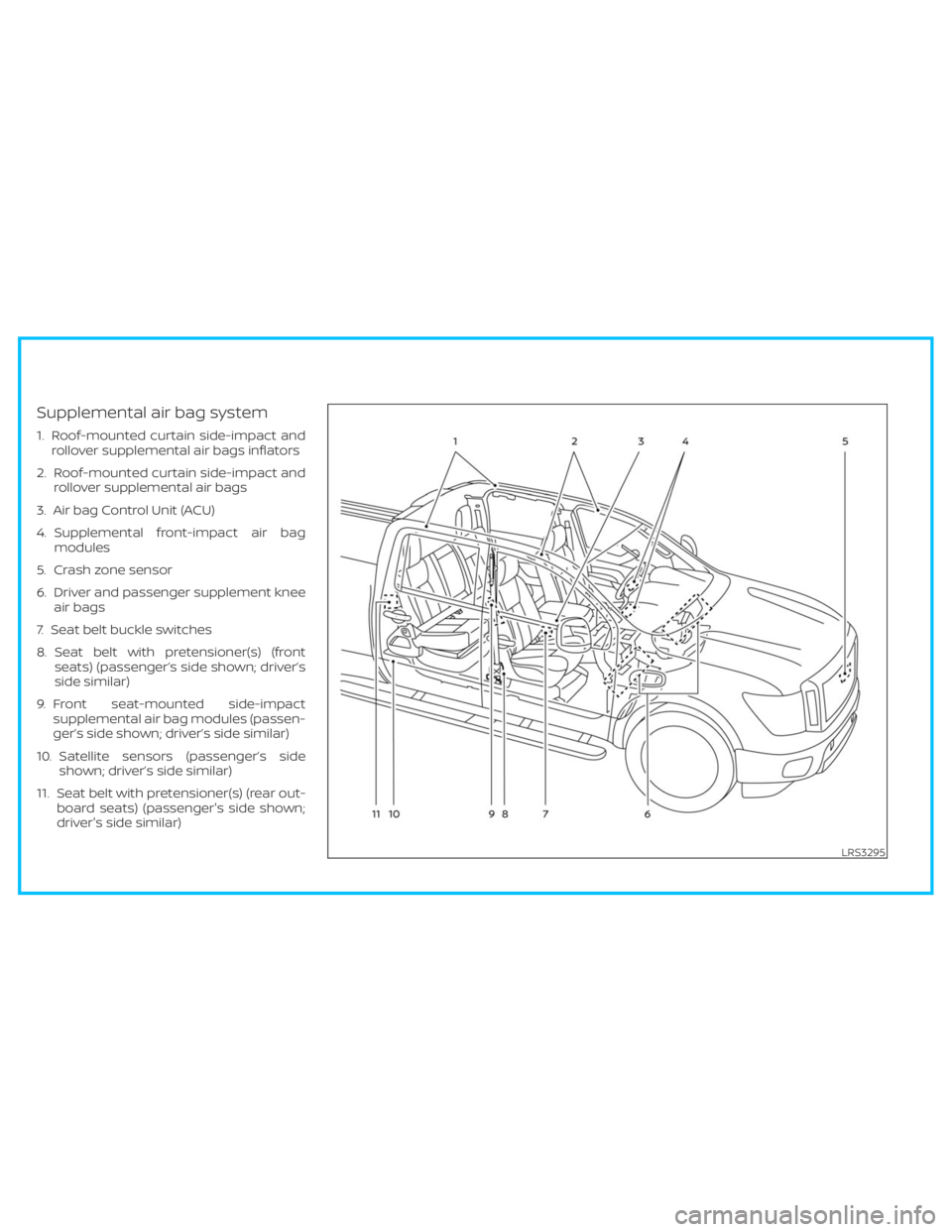
Supplemental air bag system
1. Roof-mounted curtain side-impact and
rollover supplemental air bags inflators
2. Roof-mounted curtain side-impact and
rollover supplemental air bags
3. Air bag Control Unit (ACU)
4. Supplemental front-impact air bag
modules
5. Crash zone sensor
6. Driver and passenger supplement knee
air bags
7. Seat belt buckle switches
8. Seat belt with pretensioner(s) (front
seats) (passenger’s side shown; driver’s
side similar)
9. Front seat-mounted side-impact
supplemental air bag modules (passen-
ger’s side shown; driver’s side similar)
10. Satellite sensors (passenger’s side
shown; driver’s side similar)
11. Seat belt with pretensioner(s) (rear out-
board seats) (passenger's side shown;
driver's side similar)
LRS3295
Page 651 of 657
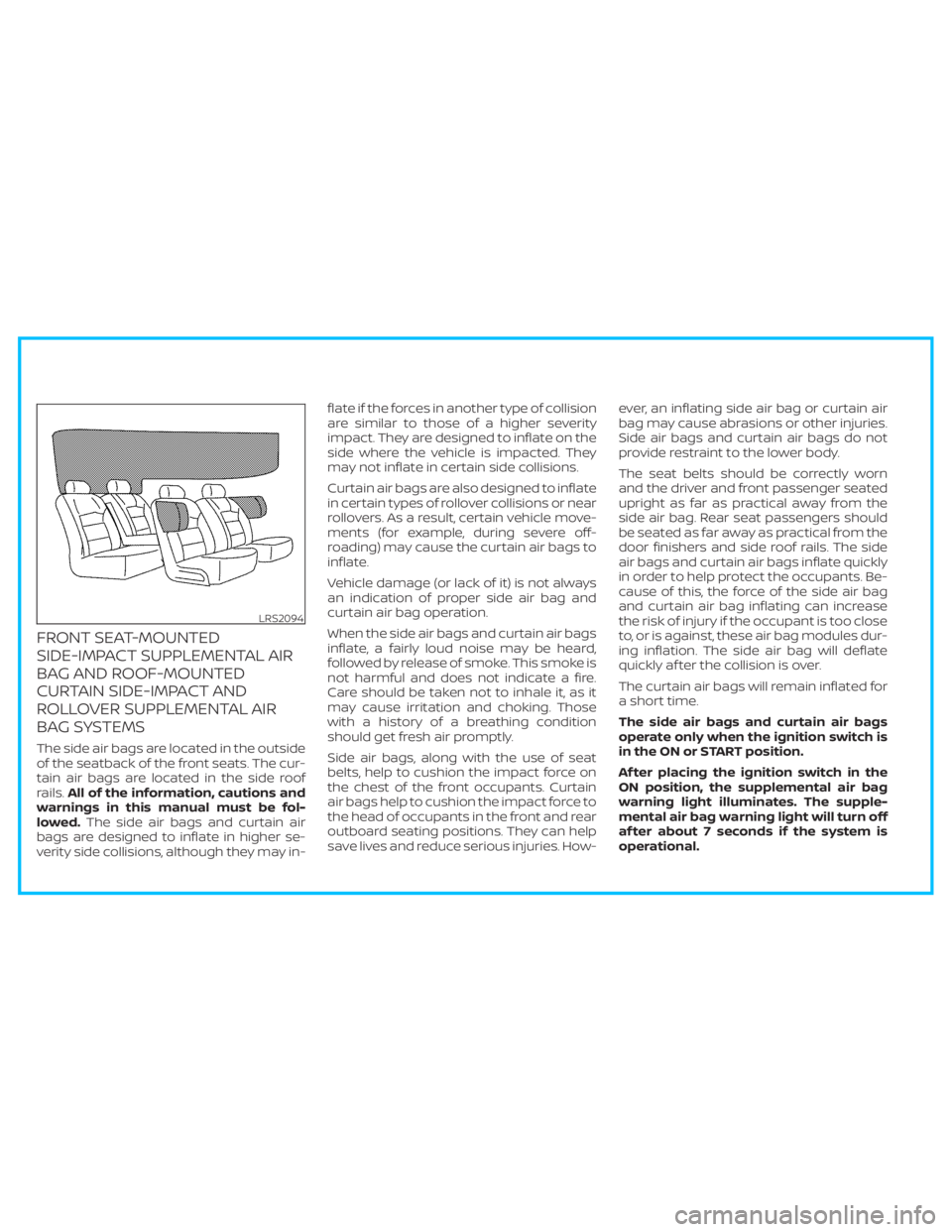
FRONT SEAT-MOUNTED
SIDE-IMPACT SUPPLEMENTAL AIR
BAG AND ROOF-MOUNTED
CURTAIN SIDE-IMPACT AND
ROLLOVER SUPPLEMENTAL AIR
BAG SYSTEMS
The side air bags are located in the outside
of the seatback of the front seats. The cur-
tain air bags are located in the side roof
rails.All of the information, cautions and
warnings in this manual must be fol-
lowed.The side air bags and curtain air
bags are designed to inflate in higher se-
verity side collisions, although they may in-flate if the forces in another type of collision
are similar to those of a higher severity
impact. They are designed to inflate on the
side where the vehicle is impacted. They
may not inflate in certain side collisions.
Curtain air bags are also designed to inflate
in certain types of rollover collisions or near
rollovers. As a result, certain vehicle move-
ments (for example, during severe off-
roading) may cause the curtain air bags to
inflate.
Vehicle damage (or lack of it) is not always
an indication of proper side air bag and
curtain air bag operation.
When the side air bags and curtain air bags
inflate, a fairly loud noise may be heard,
followed by release of smoke. This smoke is
not harmful and does not indicate a fire.
Care should be taken not to inhale it, as it
may cause irritation and choking. Those
with a history of a breathing condition
should get fresh air promptly.
Side air bags, along with the use of seat
belts, help to cushion the impact force on
the chest of the front occupants. Curtain
air bags help to cushion the impact force to
the head of occupants in the front and rear
outboard seating positions. They can help
save lives and reduce serious injuries. How-ever, an inflating side air bag or curtain air
bag may cause abrasions or other injuries.
Side air bags and curtain air bags do not
provide restraint to the lower body.
The seat belts should be correctly worn
and the driver and front passenger seated
upright as far as practical away from the
side air bag. Rear seat passengers should
be seated as far away as practical from the
door finishers and side roof rails. The side
air bags and curtain air bags inflate quickly
in order to help protect the occupants. Be-
cause of this, the force of the side air bag
and curtain air bag inflating can increase
the risk of injury if the occupant is too close
to, or is against, these air bag modules dur-
ing inflation. The side air bag will deflate
quickly af ter the collision is over.
The curtain air bags will remain inflated for
a short time.
The side air bags and curtain air bags
operate only when the ignition switch is
in the ON or START position.
Af ter placing the ignition switch in the
ON position, the supplemental air bag
warning light illuminates. The supple-
mental air bag warning light will turn off
af ter about 7 seconds if the system is
operational.
LRS2094