load capacity NISSAN TITAN 2021 Owner´s Manual
[x] Cancel search | Manufacturer: NISSAN, Model Year: 2021, Model line: TITAN, Model: NISSAN TITAN 2021Pages: 638, PDF Size: 4.31 MB
Page 603 of 638
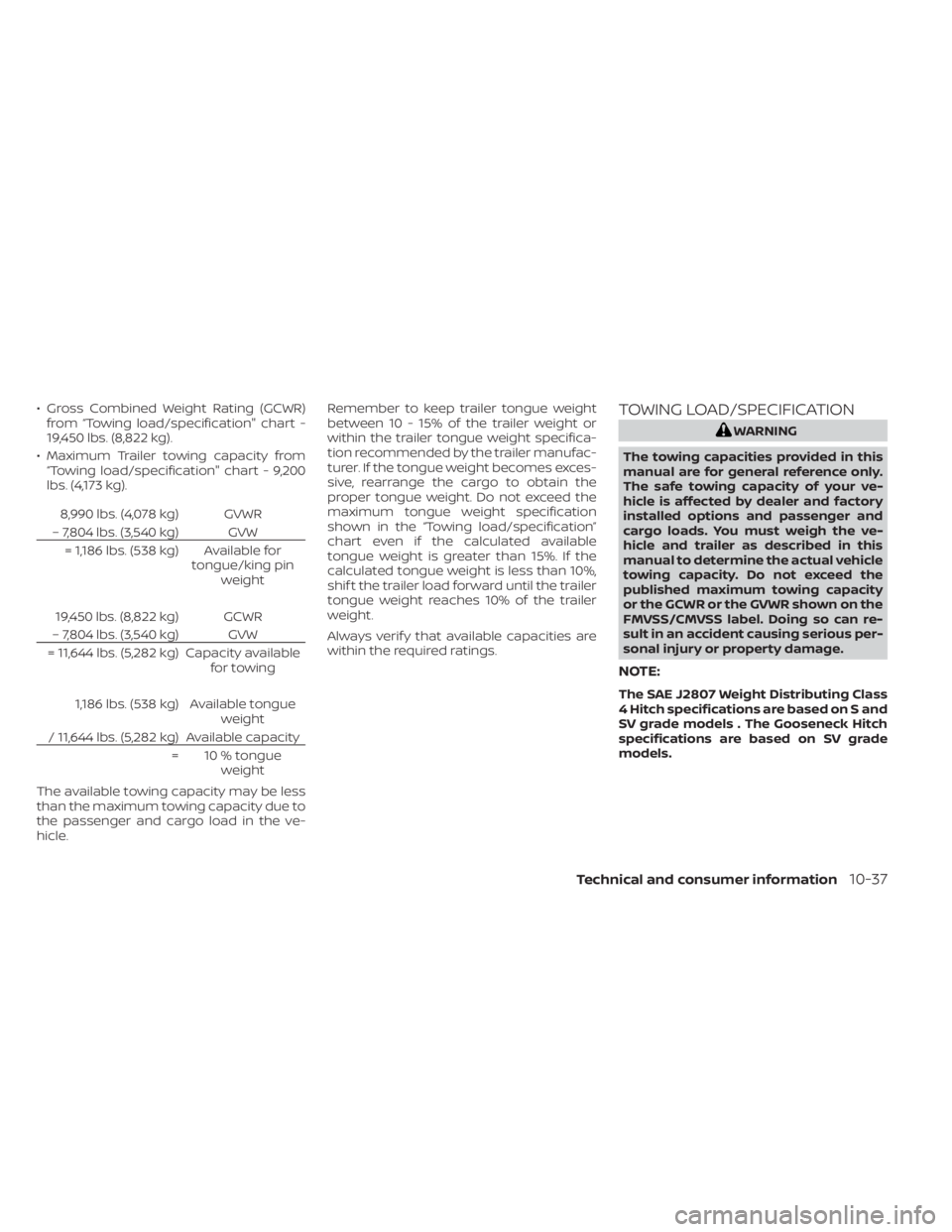
• Gross Combined Weight Rating (GCWR)from “Towing load/specification" chart -
19,450 lbs. (8,822 kg).
• Maximum Trailer towing capacity from “Towing load/specification" chart - 9,200
lbs. (4,173 kg).
8,990 lbs. (4,078 kg) GVWR
– 7,804 lbs. (3,540 kg) GVW = 1,186 lbs. (538 kg) Available for tongue/king pinweight
19,450 lbs. (8,822 kg) GCWR
– 7,804 lbs. (3,540 kg) GVW
= 11,644 lbs. (5,282 kg) Capacity available for towing
1,186 lbs. (538 kg) Available tongue weight
/ 11,644 lbs. (5,282 kg) Available capacity = 10 % tongueweight
The available towing capacity may be less
than the maximum towing capacity due to
the passenger and cargo load in the ve-
hicle. Remember to keep trailer tongue weight
between 10 - 15% of the trailer weight or
within the trailer tongue weight specifica-
tion recommended by the trailer manufac-
turer. If the tongue weight becomes exces-
sive, rearrange the cargo to obtain the
proper tongue weight. Do not exceed the
maximum tongue weight specification
shown in the “Towing load/specification”
chart even if the calculated available
tongue weight is greater than 15%. If the
calculated tongue weight is less than 10%,
shif t the trailer load forward until the trailer
tongue weight reaches 10% of the trailer
weight.
Always verif y that available capacities are
within the required ratings.
TOWING LOAD/SPECIFICATION
WARNING
The towing capacities provided in this
manual are for general reference only.
The safe towing capacity of your ve-
hicle is affected by dealer and factory
installed options and passenger and
cargo loads. You must weigh the ve-
hicle and trailer as described in this
manual to determine the actual vehicle
towing capacity. Do not exceed the
published maximum towing capacity
or the GCWR or the GVWR shown on the
FMVSS/CMVSS label. Doing so can re-
sult in an accident causing serious per-
sonal injury or property damage.
NOTE:
The SAE J2807 Weight Distributing Class
4 Hitch specifications are based on S and
SV grade models . The Gooseneck Hitch
specifications are based on SV grade
models.
Technical and consumer information10-37
Page 604 of 638
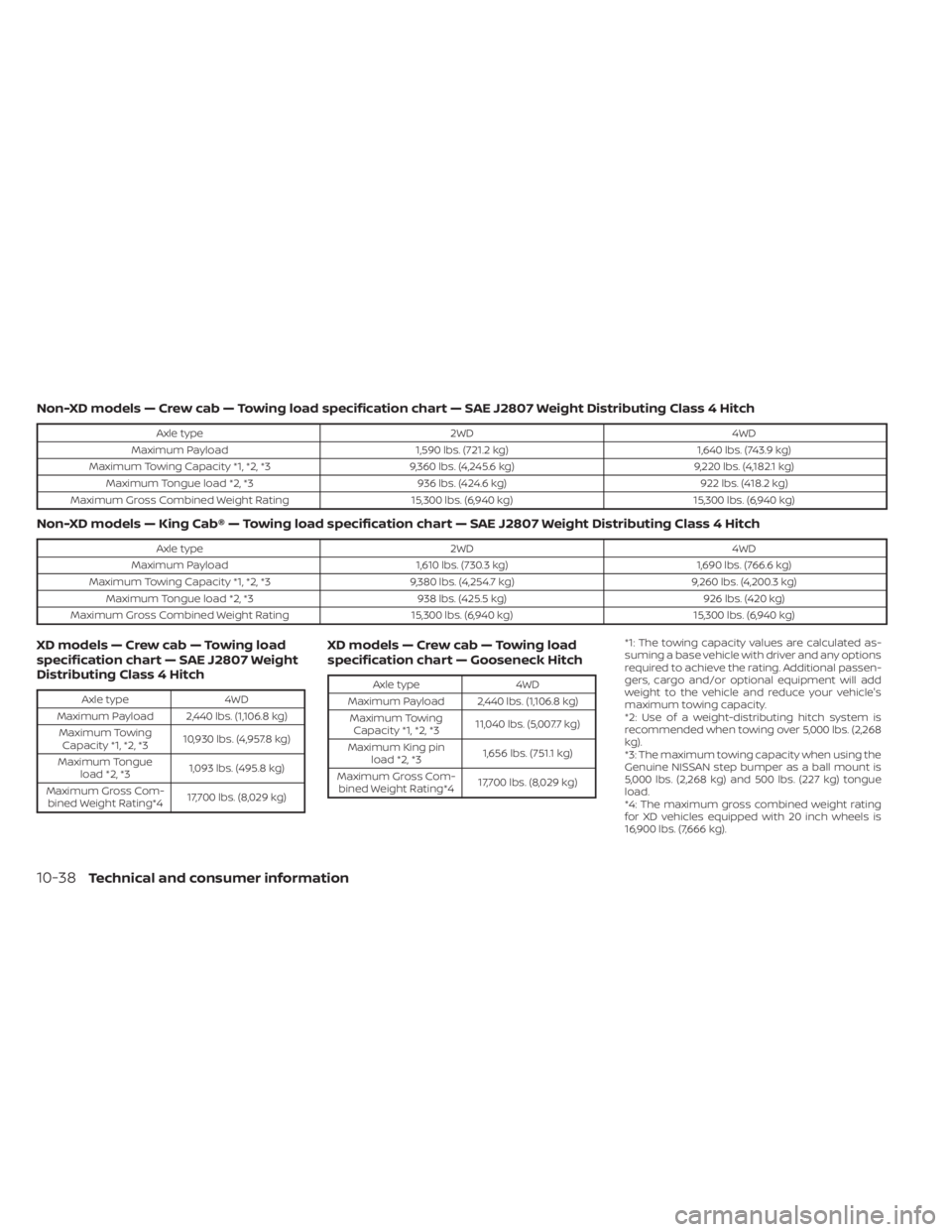
Non-XD models — Crew cab — Towing load specification chart — SAE J2807 Weight Distributing Class 4 Hitch
Axle type2WD4WD
Maximum Payload 1,590 lbs. (721.2 kg)1,640 lbs. (743.9 kg)
Maximum Towing Capacity *1, *2, *3 9,360 lbs. (4,245.6 kg)9,220 lbs. (4,182.1 kg)
Maximum Tongue load *2, *3 936 lbs. (424.6 kg)922 lbs. (418.2 kg)
Maximum Gross Combined Weight Rating 15,300 lbs. (6,940 kg)15,300 lbs. (6,940 kg)
Non-XD models — King Cab® — Towing load specification chart — SAE J2807 Weight Distributing Class 4 Hitch
Axle type 2WD4WD
Maximum Payload 1,610 lbs. (730.3 kg)1,690 lbs. (766.6 kg)
Maximum Towing Capacity *1, *2, *3 9,380 lbs. (4,254.7 kg)9,260 lbs. (4,200.3 kg)
Maximum Tongue load *2, *3 938 lbs. (425.5 kg)926 lbs. (420 kg)
Maximum Gross Combined Weight Rating 15,300 lbs. (6,940 kg)15,300 lbs. (6,940 kg)
XD models — Crew cab — Towing load
specification chart — SAE J2807 Weight
Distributing Class 4 Hitch
Axle type4WD
Maximum Payload 2,440 lbs. (1,106.8 kg) Maximum Towing Capacity *1, *2, *3 10,930 lbs. (4,957.8 kg)
Maximum Tongue load *2, *3 1,093 lbs. (495.8 kg)
Maximum Gross Com- bined Weight Rating*4 17,700 lbs. (8,029 kg)
XD models — Crew cab — Towing load
specification chart — Gooseneck Hitch
Axle type
4WD
Maximum Payload 2,440 lbs. (1,106.8 kg) Maximum Towing Capacity *1, *2, *3 11,040 lbs. (5,007.7 kg)
Maximum King pin load *2, *3 1,656 lbs. (751.1 kg)
Maximum Gross Com- bined Weight Rating*4 17,700 lbs. (8,029 kg) *1: The towing capacity values are calculated as-
suming a base vehicle with driver and any options
required to achieve the rating. Additional passen-
gers, cargo and/or optional equipment will add
weight to the vehicle and reduce your vehicle's
maximum towing capacity.
*2: Use of a weight-distributing hitch system is
recommended when towing over 5,000 lbs. (2,268
kg).
*3: The maximum towing capacity when using the
Genuine NISSAN step bumper as a ball mount is
5,000 lbs. (2,268 kg) and 500 lbs. (227 kg) tongue
load.
*4: The maximum gross combined weight rating
for XD vehicles equipped with 20 inch wheels is
16,900 lbs. (7,666 kg).
10-38Technical and consumer information
Page 607 of 638
WARNING
Properly adjust the weight distributing
hitch so the rear of the bumper is no
higher than the measured reference
height when the trailer is attached. If
the rear bumper is higher than the
measured reference height when
loaded, the vehicle may handle unpre-
dictably which could cause a loss of ve-
hicle control and cause serious per-
sonal injury or property damage.
Sway control device
Sudden maneuvers, wind gusts, and buf-
feting caused by other vehicles can affect
trailer handling. Sway control devices may
be used to help control these affects. If you
choose to use one, contact a reputable
trailer hitch supplier to make sure the sway
control device will work with the vehicle,
hitch, trailer and the trailer's brake system.
Follow the instructions provided by the
manufacturer for installing and using the
sway control device.
Class I hitch
Class I trailer hitch equipment (receiver, ball
mount and hitch ball) can be used to tow
trailers of a maximum weight of 2,000 lbs.
(907 kg).
Class II hitch
Class II trailer hitch equipment (receiver,
ball mount and hitch ball) can be used to
tow trailers of a maximum weight of 3,500
lbs. (1,587 kg).
Class III hitch
Class III trailer hitch equipment (receiver,
ball mount and hitch ball) can be used to
tow trailers of a maximum weight of 5,000
lbs. (2,268 kg).
Class IV hitch
Class IV hitches are weight carrying (WC)
and weight distributing (WD) hitches de-
pending on the vehicle and hitch specifica-
tions. Not all Class IV hitches are rated to be
both. See the specific hitch for that infor-
mation. Class IV trailer hitch equipment (re-
ceiver, ball mount and hitch ball) used as
weight carrying are rated up to 10,000 lbs.
(4,535 kg) gross trailer weight (GTW) with a
maximum trailer tongue weight (TW) of 1,000 lbs. (453 kg). Class IV hitches used for
weight distributing are rated up to 14,000
lbs. (6,350 kg) gross trailer weight (GTW)
with a maximum trailer tongue weight (TW)
of 1,400 lbs. (635 kg). A Class IV hitch usually
has a 2" square receiver opening. A higher
class drawbar does not increase the tow-
ing capacity of the hitch. To use this class of
hitch for weight distribution requires a
weight distribution system. Class IV hitches
attach to the vehicle frame only. A weight
distributing hitch should be used to tow
trailers that weigh over 5,000 lbs. (2,268 kg).
Your vehicle may be equipped with Class IV
weigh distributing trailer hitch that has a
14,000 lbs. (6,350 kg) maximum weight rat-
ing, but your vehicle is only capable of tow-
ing the maximum trailer weights shown in
the “Towing load/specification” chart in this
section.5th wheel/gooseneck
A 5th wheel or gooseneck trailer can be
towed by installing a 5th wheel or goose-
neck trailer hitch. These types of hitches
are mounted in the bed of the pick-up. A
professional trailer equipment supplier
Technical and consumer information10-41
Page 608 of 638
should install these hitches as it is very im-
portant to mount the hitch correctly to dis-
tribute the king pin weight for the proper
load carrying and sway control perfor-
mance.
The king pin weight should be 15% of the
fully loaded trailer. Make sure the king pin
weight does not cause the gross vehicle
weight to exceed the Gross Maximum
Weight Rating or the rear axle weight to
exceed the Rear Gross Axle Weight rating.
For additional information, see “Maximum
load limits” (P. 10-34).
The weight of the trailer should not exceed
the maximum towing capacity for the ve-
hicle. For additional information, see “Tow-
ing load/specification” chart (P. 10-37).
Make sure the trailer design allows for the
correct vehicle to trailer clearances before
purchasing a 5th wheel trailer.WARNING
• The hitch should not be attached to
or affect the operation of the impact-
absorbing bumper.
• Do not use axle-mounted hitches.
• Do not modif y the vehicle exhaust
system, brake system, etc. to install a
trailer hitch.
• To reduce the possibility of addi-
tional damage if your vehicle is
struck from the rear, where practical,
remove the receiver when not in use.
• Regularly check that all trailer hitch
mounting bolts are securely
mounted.
• When towing with the hitch ball
mounted to the rear bumper, do not
make sharp turns. The trailer may
contact the bumper and cause dam-
age to the bumper or trailer.
• When towing a 5th wheel trailer, do
not make sharp turns while driving or
backing. The trailer may contact the
vehicle and cause damage to both
the trailer and vehicle.
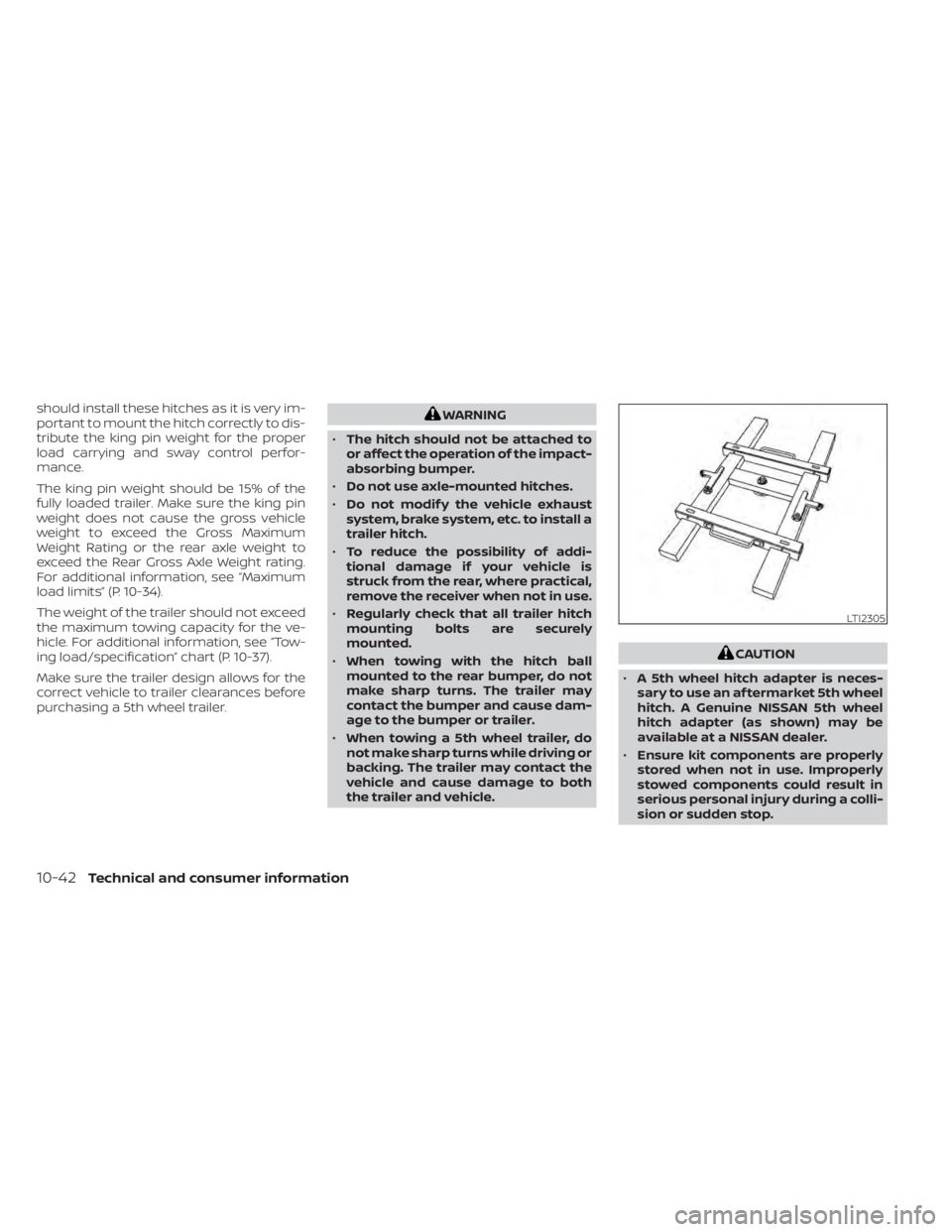
CAUTION
• A 5th wheel hitch adapter is neces-
sary to use an af termarket 5th wheel
hitch. A Genuine NISSAN 5th wheel
hitch adapter (as shown) may be
available at a NISSAN dealer.
• Ensure kit components are properly
stored when not in use. Improperly
stowed components could result in
serious personal injury during a colli-
sion or sudden stop.
LTI2305
10-42Technical and consumer information