wheel size NISSAN TITAN 2021 Owner´s Manual
[x] Cancel search | Manufacturer: NISSAN, Model Year: 2021, Model line: TITAN, Model: NISSAN TITAN 2021Pages: 638, PDF Size: 4.31 MB
Page 468 of 638
10. Securely store the flat tire beneath thevehicle, from where the full size spare
was removed. To reinstall the wheel, re-
move the center cap (if so equipped)
and insert the retainer chain through
the wheel. Be sure the rubber rim cover
(if so equipped) is centered on the
wheel before lif ting. Use the assembled
jacking rod to slowly rotate the winch
clockwise to raise the wheel to the
vehicle.
11. To reinstall the jack and tool kit, reverse steps 1 through 5.
NOTE:
Inspect the rubber rim cover every six
years and replace as necessary. It is rec-
ommended that you visit a NISSAN
dealer for this service.
CAUTION
• Be sure to center the spare tire sus-
pending plate on the wheel and then
lif t the spare tire.
• Failure to use the rubber rim cover
may allow the chain to get stuck in
the wheel nut holes when stowed.
Removing bolt-on wheel caps (if
so equipped)
CAUTION
Do not use your hands to pry off wheel
caps or wheel covers. Doing so could
result in personal injury.
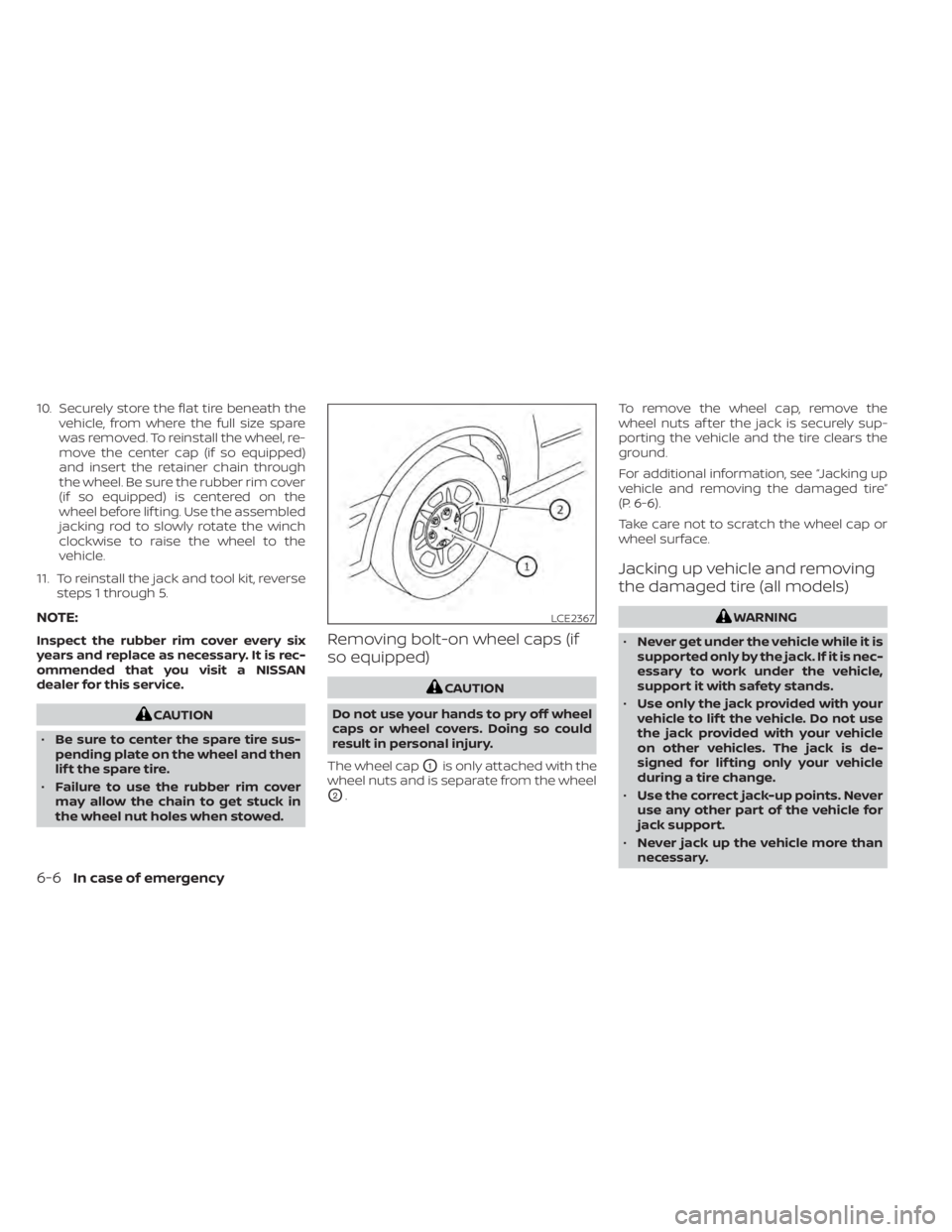
The wheel cap
O1is only attached with the
wheel nuts and is separate from the wheel
O2. To remove the wheel cap, remove the
wheel nuts af ter the jack is securely sup-
porting the vehicle and the tire clears the
ground.
For additional information, see “Jacking up
vehicle and removing the damaged tire”
(P. 6-6).
Take care not to scratch the wheel cap or
wheel surface.
Jacking up vehicle and removing
the damaged tire (all models)
WARNING
• Never get under the vehicle while it is
supported only by the jack. If it is nec-
essary to work under the vehicle,
support it with safety stands.
• Use only the jack provided with your
vehicle to lif t the vehicle. Do not use
the jack provided with your vehicle
on other vehicles. The jack is de-
signed for lif ting only your vehicle
during a tire change.
• Use the correct jack-up points. Never
use any other part of the vehicle for
jack support.
• Never jack up the vehicle more than
necessary.LCE2367
6-6In case of emergency
Page 525 of 638
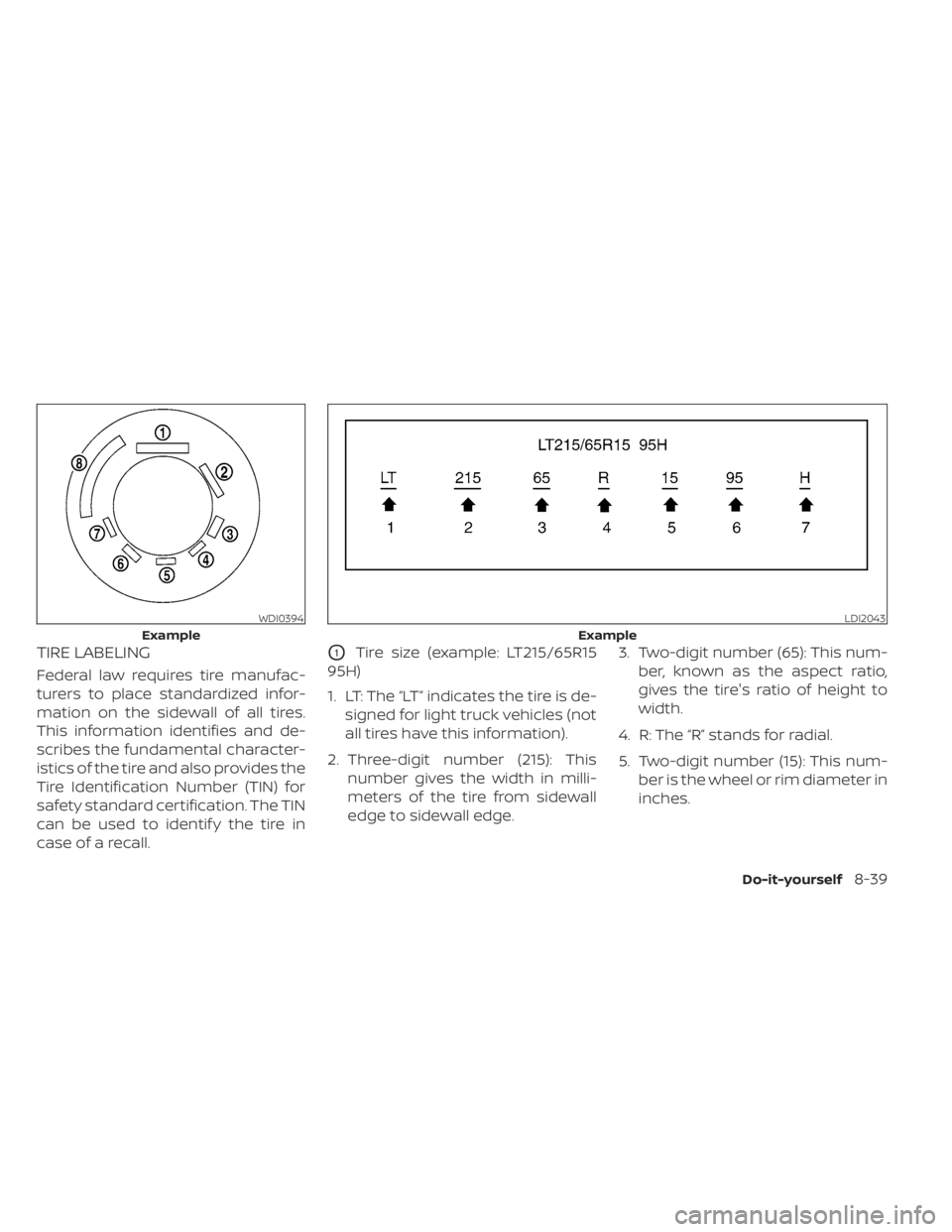
TIRE LABELING
Federal law requires tire manufac-
turers to place standardized infor-
mation on the sidewall of all tires.
This information identifies and de-
scribes the fundamental character-
istics of the tire and also provides the
Tire Identification Number (TIN) for
safety standard certification. The TIN
can be used to identif y the tire in
case of a recall.
O1Tire size (example: LT215/65R15
95H)
1. LT: The “LT” indicates the tire is de- signed for light truck vehicles (not
all tires have this information).
2. Three-digit number (215): This number gives the width in milli-
meters of the tire from sidewall
edge to sidewall edge. 3. Two-digit number (65): This num-
ber, known as the aspect ratio,
gives the tire's ratio of height to
width.
4. R: The “R” stands for radial.
5. Two-digit number (15): This num- ber is the wheel or rim diameter in
inches.
WDI0394
Example
LDI2043
Example
Do-it-yourself8-39
Page 528 of 638
•Always use tires of the same type,
size, brand, construction and tread
pattern on all four wheels. Failure to
do so may result in a circumference
difference between tires on the front
and rear axles which can cause the
Vehicle Dynamic Control (VDC) sys-
tem and 4WD system to malfunction
resulting in personal injury or death,
excessive tire wear and may damage
the transmission and differential
gears.
• For additional information regarding
tires, refer to “Important Tire Safety
Information” (US) or “Tire Safety In-
formation” (Canada) in the Warranty
Information Booklet.
All season tires
NISSAN specifies All Season tires on some
models to provide good performance all
year, including snowy and icy road condi-
tions. All Season tires are identified by ALL
SEASON and/or M&S on the tire sidewall.
Snow tires have better snow traction than
All Season tires and may be more appropri-
ate in some areas.
Summer tires
NISSAN specifies summer tires on some
models to provide superior performance
on dry roads. Summer tire performance is
substantially reduced in snow and ice.
Summer tires do not have the tire traction
rating “M&S” on the tire sidewall.
If you plan to operate your vehicle in snowy
or icy conditions, NISSAN recommends the
use of SNOW tires or ALL SEASON tires on all
four wheels.
Snow tires
If snow tires are needed, it is necessary to
select tires equivalent in size and load rat-
ing to the original equipment tires. If you do
not, it can adversely affect the safety and
handling of your vehicle.
Generally, snow tires have lower speed rat-
ings than factory equipped tires and may
not match the potential maximum vehicle
speed. Never exceed the maximum speed
rating of the tire.
If you install snow tires, they must be the
same size, brand, construction and tread
pattern on all four wheels.
For additional traction on icy roads, stud-
ded tires may be used. However, some U.S. states and Canadian provinces prohibit
their use. Check local, state and provincial
laws before installing studded tires. Skid
and traction capabilities of studded snow
tires on wet or dry surfaces may be poorer
than that of non-studded snow tires.
TIRE CHAINS
Use of tire chains may be prohibited ac-
cording to location. Check the local laws
before installing tire chains. When installing
tire chains, make sure they are the proper
size for the tires on your vehicle and are
installed according to the chain manufac-
turer's suggestions.
Use only SAE class “S”
chains. Class “S” chains are used on ve-
hicles with restricted tire to vehicle clear-
ance. Vehicles that can use Class “S” chains
are designed to meet the minimum clear-
ances between the tire and the closest ve-
hicle suspension or body component re-
quired to accommodate the use of a
winter traction device (tire chains or
cables). The minimum clearances are de-
termined using the factory equipped tire
size. Other types may damage your vehicle.
Use chain tensioners when recommended
by the tire chain manufacturer to ensure a
tight fit. Loose end links of the tire chain
must be secured or removed to prevent
the possibility of whipping action damage
8-42Do-it-yourself
Page 531 of 638
•Improper service of the spare
tire may result in serious per-
sonal injury. If it is necessary to
repair the spare tire, it is rec-
ommended that you visit a
NISSAN dealer for this service.
• For additional information re-
garding tires, refer to “Impor-
tant Tire Safety Information”
(US) or “Tire Safety Informa-
tion” (Canada) in the Warranty
Information Booklet.
Replacing wheels and tires
When replacing a tire, use the same size,
tread design, speed rating and load carry-
ing capacity as originally equipped. Rec-
ommended types and sizes are shown in
“Wheels and tires” (P. 8-35).
WARNING
• The use of tires other than those rec-
ommended or the mixed use of tires
of different brands, construction
(bias, bias-belted or radial), or tread
patterns can adversely affect the
ride, braking, handling, Vehicle Dy-
namic Control (VDC) system, 4WD,
ground clearance, body-to-tire clear-
ance, tire chain clearance, speedom-
eter calibration, headlight aim and
bumper height. Some of these ef-
fects may lead to accidents and
could result in serious personal
injury.
• If your vehicle was originally
equipped with four tires that were
the same size and you are only re-
placing two of the four tires, install
the new tires on the rear axle. Placing
new tires on the front axle may cause
loss of vehicle control in some driving
conditions and cause an accident
and personal injury. •
If the wheels are changed for any
reason, always replace with wheels
which have the same off-set dimen-
sion. Wheels of a different off-set
could cause premature tire wear, de-
grade vehicle handling characteris-
tics, affect the VDC system and/or in-
terference with the brake discs. Such
interference can lead to decreased
braking efficiency and/or early brake
pad/shoe wear. For additional infor-
mation on wheel-off set dimensions,
see “Wheels and tires” (P. 10-9).
• When using a wheel without the
TPMS such as the spare tire, the TPMS
will not function and the low tire
pressure warning light will flash for
approximately 1 minute. The light will
remain on af ter 1 minute. Have your
tires replaced and/or TPMS system
reset as soon as possible. It is recom-
mended that you visit a NISSAN
dealer for this service.
• Replacing tires with those not origi-
nally specified by NISSAN could af-
fect the proper operation of the
TPMS.
• The TPMS sensor may be damaged if
it is not handled correctly. Be careful
when handling the TPMS sensor.
Do-it-yourself8-45
Page 532 of 638
•When replacing the TPMS sensor, the
ID registration may be required. Con-
tact a NISSAN dealer for ID
registration.
• Do not use a valve stem cap that is
not specified by NISSAN. The valve
stem cap may become stuck.
• Be sure that the valve stem caps are
correctly fitted. Otherwise the valve
may be clogged up with dirt and
cause a malfunction or loss of
pressure.
• Do not install a damaged or de-
formed wheel or tire even if it has
been repaired. Such wheels or tires
could have structural damage and
could fail without warning.
• The use of retread tires is not
recommended.
• For additional information regarding
tires, refer to “Important Tire Safety
Information” (US) or “Tire Safety In-
formation” (Canada) in the Warranty
Information Booklet.Four-wheel drive models
CAUTION
Always use tires of the same type, size,
brand, construction (bias, bias-belted
or radial), and tread pattern on all four
wheels. Failure to do so may result in a
circumference difference between tires
on the front and rear axles which will
cause excessive tire wear and may
damage the transmission, transfer
case and differential gears.
If excessive tire wear is found, it is recom-
mended that all four tires be replaced with
tires of the same size, brand, construction
and tread pattern. The tire pressure and
wheel alignment should also be checked
and corrected as necessary. It is recom-
mended that you visit a NISSAN dealer for
this service.
Wheel balance
Unbalanced wheels may affect vehicle
handling and tire life. Even with regular use,
wheels can get out of balance. Therefore,
they should be balanced as required.
Wheel balance service should be per-
formed with the wheels off the vehicle. Spin balancing the wheels on the vehicle
could lead to mechanical damage.
•
For additional information regarding
tires, refer to “Important Tire Safety In-
formation” (US) or “Tire Safety Informa-
tion” (Canada) in the Warranty Informa-
tion Booklet.
Care of wheels
• Wash the wheels when washing the ve- hicle to maintain their appearance.
• Clean the inner side of the wheels when the wheel is changed or the underside of
the vehicle is washed.
• Do not use abrasive cleaners when washing the wheels.
• Inspect wheel rims regularly for dents or corrosion. Such damage may cause loss
of pressure or poor seal at the tire bead.
• NISSAN recommends waxing the road wheels to protect against road salt in ar-
eas where it is used during winter.
Spare tire (FULL SIZE TEMPORARY
USE ONLY spare tire)
When replacing a wheel without the TPMS
such as the spare tire, the TPMS will not
function.
8-46Do-it-yourself
Page 533 of 638
Your vehicle may be equipped with a full
size spare that is a different size or brand
than the tires originally installed on the ve-
hicle. This full size spare tire is intended for
temporary use only and should be re-
placed at the first opportunity.
Observe the following precautions if the
FULL SIZE TEMPORARY USE ONLY spare tire
must be used. Otherwise, your vehicle
could be damaged or involved in an acci-
dent:
WARNING
To help reduce the risk of a crash which
may result in personal injury or death:
• The TEMPORARY FULL SIZE spare tire
should be used for emergency use
only. It should be replaced with the
standard tire at the first opportunity
to avoid possible tire or differential
damage.
• Drive carefully while the TEMPORARY
FULL SIZE spare tire is installed. Avoid
sharp turns and abrupt braking while
driving. The vehicle driving perfor-
mance may be affected when driving
on wet or snow covered roads. •
When the TEMPORARY FULL SIZE
spare is installed, the following sys-
tems may not work correctly:
– Tire Pressure Monitoring System
(TPMS)
– Vehicle Dynamic Control (VDC)
System
• Periodically check the TEMPORARY
FULL SIZE spare tire inflation pres-
sure. Always keep the TEMPORARY
FULL SIZE inflated to the pressure
specification shown on the Tire and
Loading Information label.
• With the TEMPORARY FULL SIZE spare
tire installed do not drive the vehicle
at speeds faster than 50 mph (80
km/h).
• When driving on roads covered with
snow or ice, the TEMPORARY FULL
SIZE spare tire should be used on the
front wheels and the original tire
used on the rear wheels. Use tire
chains only on the drive wheels.
• Do not use the TEMPORARY FULL SIZE
spare tire on other vehicles.
• Do not use more than one TEMPO-
RARY FULL SIZE spare tire at the same
time. •
TEMPORARY FULL SIZE spare tire
Limitations (except for Pro 4X)
– 50mph MAX
– Towing allowed
• Customer can identif y TEMPORARY
FULL SIZE spare tire condition by
checking the Tire and loading infor-
mation label located on the B-pillar.
CAUTION
• Do not use tire chains on a TEMPO-
RARY FULL SIZE spare tire. Tire chains
will not fit properly and may cause
damage to the vehicle.
• Use of the TEMPORARY FULL SIZE
spare tire on a vehicle that has tires
larger than were originally equipped
can affect the 4WD system. This may
result in a circumference difference
between tires on front and rear axles
which can cause the 4WD system to
automatically place the vehicle in
2WD and flash the 4WD light. When
the TEMPORARY FULL SIZE spare tire
is replaces with a tire that matches all
other tires on the vehicle, and all tires
are properly inflated the 4WD system
will operate normally
Do-it-yourself8-47
Page 576 of 638
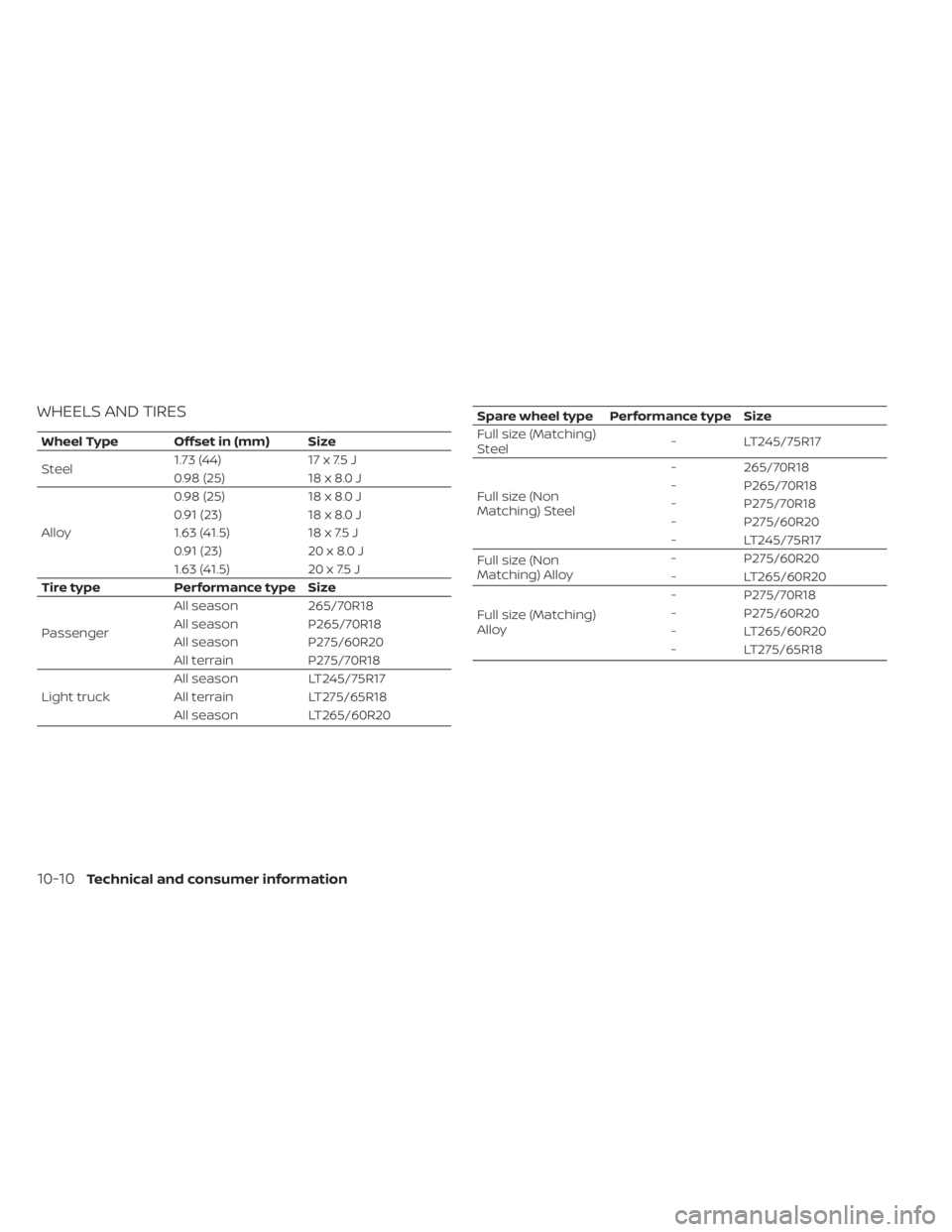
WHEELS AND TIRES
Wheel Type Offset in (mm) Size
Steel1.73 (44) 17 x 7.5 J
0.98 (25) 18 x 8.0 J
Alloy 0.98 (25) 18 x 8.0 J
0.91 (23) 18 x 8.0 J
1.63 (41.5) 18 x 7.5 J
0.91 (23) 20 x 8.0 J
1.63 (41.5) 20 x 7.5 J
Tire type Performance type Size
Passenger All season 265/70R18
All season P265/70R18
All season P275/60R20
All terrain P275/70R18
Light truck All season LT245/75R17
All terrain LT275/65R18
All season LT265/60R20
Spare wheel type Performance type Size
Full size (Matching)
Steel
- LT245/75R17
Full size (Non
Matching) Steel - 265/70R18
- P265/70R18
- P275/70R18
- P275/60R20
- LT245/75R17
Full size (Non
Matching) Alloy - P275/60R20
- LT265/60R20
Full size (Matching)
Alloy - P275/70R18
- P275/60R20
- LT265/60R20
- LT275/65R18
10-10Technical and consumer information
Page 605 of 638
TOWING SAFETY
Trailer hitch
Your vehicle may be equipped with an op-
tional trailer tow package. The trailer tow
package includes a receiver-type frame
mounted hitch. This hitch is rated for the
maximum towing capacity of this vehicle
when the proper towing equipment is
used. Choose a proper ball mount and
hitch ball that is rated for the trailer to be
towed. Genuine NISSAN ball mounts and
hitch balls are available at a NISSAN dealer.
If your vehicle is not equipped with the op-
tional trailer tow package, check the tow-
ing capacity of your bumper hitch or
receiver-type frame mounted hitch.
Choose a proper hitch for your vehicle and
trailer. A Genuine NISSAN trailer hitch is
available at a NISSAN dealer. Make sure the
trailer hitch is securely attached to the ve-
hicle to help avoid personal injury or prop-
erty damage due to sway caused by cross-
winds, rough road surfaces or passing
trucks.A hitch used for towing 5th wheel and
gooseneck trailers can also be installed on
your vehicle. Contact a professional sup-
plier of towing equipment to purchase and
have a 5th wheel or gooseneck hitch in-
stalled.
WARNING
Trailer hitch components have specific
weight ratings. Your vehicle may be ca-
pable of towing a trailer heavier than
the weight rating of the hitch compo-
nents. Never exceed the weight rating
of the hitch components. Doing so can
cause serious personal injury or prop-
erty damage.
Hitch ball
Choose a hitch ball of the proper size and
weight rating for your trailer:
• The required hitch ball size is stamped on most trailer couplers. Most hitch balls
also have the size printed on the top of
the ball.
• Choose the proper class hitch ball based on the trailer weight. • The diameter of the threaded shank of
the hitch ball must be matched to the ball
mount hole diameter. The hitch ball
shank should be no more than 1/16”
smaller than the hole in the ball mount.
• The threaded shank of the hitch ball must be long enough to be properly secured to
the ball mount. There should be at least 2
threads showing beyond the lock washer
and nut.
Ball mount
The hitch ball is attached to the ball mount
and the ball mount is inserted into the
hitch receiver. Choose a proper class ball
mount based on the trailer weight. Addi-
tionally, the ball mount should be chosen
to keep the trailer tongue level with the
ground.
Technical and consumer information10-39
Page 617 of 638
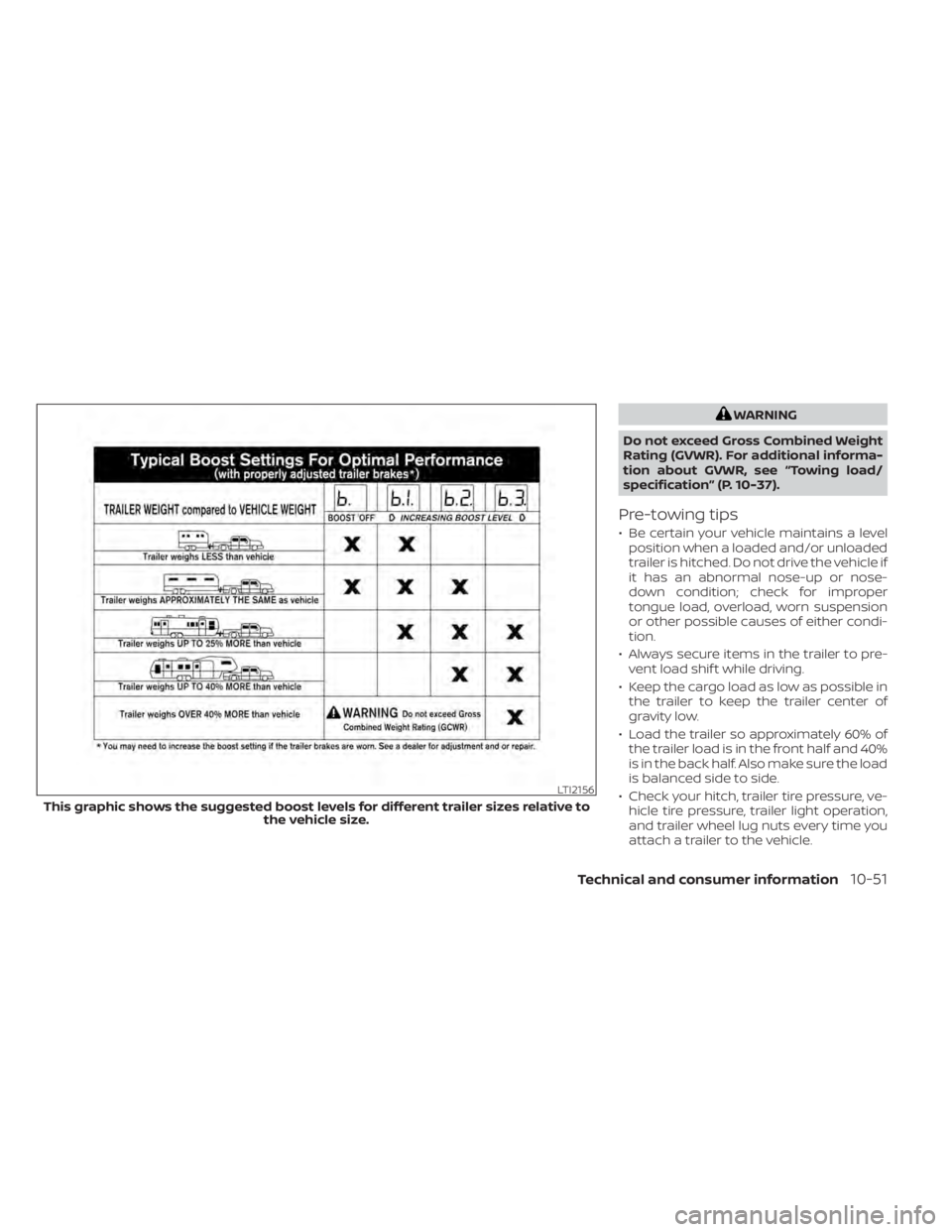
WARNING
Do not exceed Gross Combined Weight
Rating (GVWR). For additional informa-
tion about GVWR, see “Towing load/
specification” (P. 10-37).
Pre-towing tips
• Be certain your vehicle maintains a level position when a loaded and/or unloaded
trailer is hitched. Do not drive the vehicle if
it has an abnormal nose-up or nose-
down condition; check for improper
tongue load, overload, worn suspension
or other possible causes of either condi-
tion.
• Always secure items in the trailer to pre- vent load shif t while driving.
• Keep the cargo load as low as possible in the trailer to keep the trailer center of
gravity low.
• Load the trailer so approximately 60% of the trailer load is in the front half and 40%
is in the back half. Also make sure the load
is balanced side to side.
• Check your hitch, trailer tire pressure, ve- hicle tire pressure, trailer light operation,
and trailer wheel lug nuts every time you
attach a trailer to the vehicle.
LTI2156
This graphic shows the suggested boost levels for different trailer sizes relative to the vehicle size.
Technical and consumer information10-51
Page 633 of 638
Headlight control switch.........2-43Hill descent control switch........2-58Instrument brightness control.....2-50Power door lock switch..........3-6Power inverter switch...........2-61Rear sonar system OFF switch.....2-61Tow mode switch.............2-62Turn signal switch.............2-50
T
Tachometer...................2-8Tailgate.................... .3-36Temperature gauge
Engine coolant temperature gauge. . .2-8Thef t (NISSAN Vehicle Immobilizer System),
engine start...............2-38, 5-16Three-way catalyst...............5-4Tie down hooks................3-40TireFlat tire................... .6-3Spare tire...............6-4, 8-46Tire and Loading Information label. .10-19Tire chains.................8-42Tire pressure................8-35Tire rotation.................8-43Tires of 4-wheel drive...........8-46Types of tires................8-41Uniform tire quality grading......10-56Wheel/tire size...............10-10Wheels and tires..........8-35, 10-10Tire pressure................. .8-35Low tire pressure warning light.....2-18
Tire Pressure Monitoring System
(TPMS)................... .5-5, 6-3Tow mode switch...............2-62Towing
2-wheel drive models...........6-15Flat towing................ .10-55Towing load/specification.......10-37Trailer towing...............10-33Towing a trailer................10-33Towing your vehicle..............6-13Traffic Sign Recognition (TSR)........5-24Trailer Brake Controller Unit (TBCU). . . .2-63Transceiver
HomeLink® Universal
Transceiver
......2-89, 2-90, 2-92, 2-93Transfer case shif ting procedures. . . .5-106TransmissionDriving with automatic
transmission
................5-18Travel (See registering a vehicle in another
country).................... .10-17Trip odometer..................2-7Truck - camper loading...........10-31Truck box....................3-36Turn signal switch...............2-50
U
Under seat storage bin.....2-70,2-74,2-75Uniform tire quality grading........10-56USB/iPod® Charging Ports.........4-42Using 4-wheel drive.............5-105
V
Vanity mirror..................3-30Variable voltage control system......8-19Vehicle dimensions and weights.....10-11Vehicle Dynamic Control (VDC) OFF
switch..................... .2-57Vehicle Dynamic Control (VDC)
system.....................5-118Vehicle identification.............10-17Vehicle identification number (VIN). . . .10-17Vehicle identification number (VIN)
(Chassis number)...............10-17Vehicle identification number (VIN)
plate...................... .10-17Vehicle immobilizer system.....2-38, 5-16Vehicle information display.........2-22Vehicle loading information........10-22Vehicle recovery.............6-15,6-16Vehicle security system...........2-37Vehicle security system
(NISSAN Vehicle Immobilizer System),
engine start
...............2-38, 5-16Vents......................4-28Visors......................3-30Voltmeter....................2-10
W
Warning
Air bag warning light........1-82, 2-16Anti-lock brake warning light......2-13Battery charge warning light......2-14
11-7