maintenance schedule NISSAN TITAN 2021 Owner´s Manual
[x] Cancel search | Manufacturer: NISSAN, Model Year: 2021, Model line: TITAN, Model: NISSAN TITAN 2021Pages: 638, PDF Size: 4.31 MB
Page 565 of 638
Essentials:
• Replace engine oil & filter
• Lubricate steering stopper cap (XD mod-els only)120,000 miles/(192,000 km)/
96 months
Perform at number of miles, kilometers or
months, whichever comes first.
Standard maintenance:
Inspections:
• Automatic transmission fluid (1)
• Brake lines and cables
• Brake pads and rotors
• Engine drive belt *
• Fuel tank vapor vent system *
• Fuel lines/connections *
• Exhaust system
• Propeller shaf t
• Steering gear and linkage
• Axle and suspension parts
• Differential gear oil
• Transfer case oil (4WD models)
• Drive shaf t boots (4WD models)
• Horn, lights, signals, wipers, rear hatch/hood lif t supports
• All fluids inspected (engine, wiper, brake, power steering, coolant)
• Hose inspections
• Suspension components (shocks, sub- frame, tie rods) • Battery terminals and cables, battery test
• Tire pressure, treadwear and depth
Essentials:
• Replace engine air filter (2)
• Replace brake fluid
• Replace engine oil & filter
• Replace in-cabin microfilter
• Tire rotation
• Lubricate steering stopper cap (XD mod-
els only)
Severe maintenance:
Essentials:
• Replace automatic transmission fluid
• Replace transfer case oil (4WD models)
• Replace differential gear oil
(1) Request the dealer to inspect the fluid
deterioration data using a CONSULT. If the
deterioration data is more than 77000, re-
place the AT fluid.
(2) If operating mainly in dusty conditions,
more frequent maintenance may be required.
* Maintenance items and intervals with “*”
are recommended by NISSAN for reliable
vehicle operation. The owner need not per-
form such maintenance in order to main-
tain the emission warranty or manufac-
turer recall liability. Other maintenance
items and intervals are required.
Maintenance and schedules9-31
Page 574 of 638
Change intervals
The oil and oil filter change intervals for
your engine are based on the use of the
specified quality oils and filters. Using en-
gine oil and filters that are not of the speci-
fied quality, or exceeding recommended oil
and filter change intervals could reduce
engine life. Damage to the engine caused
by improper maintenance or use of incor-
rect oil and filter quality and/or viscosity is
not covered by the NISSAN New Vehicle
Limited Warranty.
Your engine was filled with a high-quality
engine oil when it was built. You do not have
to change the oil before the first recom-
mended change interval. Oil and filter
change intervals depend upon how you
use your vehicle.
Operation under the following conditions
may require more frequent oil and filter
changes:
• repeated short distance driving at coldoutside temperatures
• driving in dusty conditions
• extensive idling
• towing a trailer
• stop and go commuting For additional information, see the “Mainte-
nance and schedules” section of this
manual.
AIR CONDITIONER SYSTEM
REFRIGERANT AND OIL
RECOMMENDATIONS
The air conditioner system in your
NISSAN vehicle must be charged with the
refrigerant HFO-1234yf (R-1234yf ) and
NISSAN A/C system oil Type PAG
(VC100yf oil) or the exact equivalents.
CAUTION
The use of any other refrigerant or oil
may cause severe damage to the air
conditioning system and may require
the replacement of all air conditioner
system components. The refrigerant HFO-1234yf (R-1234yf ) in
your NISSAN vehicle does not harm the
earth's ozone layer. Although this refriger-
ant does not affect the earth's atmo-
sphere, certain government regulations re-
quire the recovery and recycling of any
refrigerant during automotive air condi-
tioner system service. Air conditioner sys-
tem should only be service by trained and
certified technicians to ensure proper and
safe operation (SAE J2845). A NISSAN dealer
has the trained technicians and equip-
ment needed to recover and recycle your
air conditioner system refrigerant. Only
new and SAE J2842 certified evaporator(s)
shall be used as replacement parts.
A damaged or leaking air conditioning
evaporator shall never be repaired or re-
placed with one removed from a used or
salvaged vehicle. To replace a damaged or
leaking evaporator, use only new and SAE
J2842 certified evaporator(s). It is recom-
mended that you visit a NISSAN dealer when
servicing your air conditioner system.
10-8Technical and consumer information
Page 619 of 638
• While going downhill, the weight of thetrailer pushing on the tow vehicle may
decrease overall stability. Therefore, to
maintain adequate control, reduce your
speed and shif t to a lower gear. Avoid
long or repeated use of the brakes when
descending a hill, as this reduces their
effectiveness and could cause overheat-
ing. Shif ting to a lower gear instead pro-
vides “engine braking” and reduces the
need to brake as frequently.
• If the engine coolant temperature rises to a high temperature, see “If your vehicle
overheats” (P. 6-12).
• Trailer towing requires more fuel than normal circumstances.
• Avoid towing a trailer for your vehicle's first 500 miles (805 km).
•
For the first 500 miles (805 km) that you do
tow, do not drive over 50 mph (80 km/h).
• Have your vehicle serviced more of ten than at intervals specified. For additional
information, see the “Maintenance and
schedules” section of this manual.
• When making a turn, your trailer wheels will be closer to the inside of the turn than
your vehicle wheels. To compensate for
this, make a larger than normal turning
radius during the turn. • Crosswinds and rough roads will ad-
versely affect vehicle/trailer handling,
possibly causing vehicle sway. When be-
ing passed by larger vehicles, be pre-
pared for possible changes in crosswinds
that could affect vehicle handling.
Trailer Sway Assist :
To minimize trailer sway, your vehicle may
apply braking to individual wheels based
on input from your vehicle sensors and ve-
hicle speed. Trailer sway control is a func-
tion of the Vehicle Dynamic Control (VDC)
system and is active when the VDC func-
tion is enabled.
CAUTION
If the VDC-OFF switch is on (meaning
VDC system OFF), the Trailer Sway As-
sist is also disabled
When Trailer Sway Assist is in operation, the
VDC warning light blinks. When vehicle con-
trol is regained, VDC warning light will turn
OFF.
For additional information about the VDC
system, see “Vehicle Dynamic Control (VDC)
OFF switch” (P. 2-57) and “Vehicle Dynamic
Control (VDC) system” (P. 5-118). If Trailer Sway Assist activates, do the fol-
lowing:
1. Take your foot off the accelerator pedal
to allow the vehicle to coast and steer as
straight ahead as the road conditions
allow. This combination will help stabilize
the vehicle
CAUTION
Do not try to correct trailer sway by
steering or applying the brakes.
2. When the trailer sway stops, gently apply the brakes and pull to the side of the
road in a safe area.
3. Try to rearrange the trailer load so it is balanced. For additional information,
see “Pre-towing tips” (P. 10-51).
NOTE:
Trailer Sway Assist cannot reduce trailer
sway in all situations.
• Be careful when passing other vehicles.Passing while towing a trailer requires
considerably more distance than normal
passing. Remember, the length of the
trailer must also pass the other vehicle
before you can safely change lanes.
Technical and consumer information10-53
Page 628 of 638
Cargo light switch...............2-52Check tire pressure..........2-32, 2-34Child restraints.......1-25,1-26,1-28,1-30LATCH (Lower Anchors and Tethers for
CHildren) System..............1-30Precautions on child
restraints........1-34, 1-40, 1-45, 1-49Top tether strap anchor point
locations.................. .1-32Child safety rear door lock..........3-9Cleaning exterior and interior......7-2,7-4Climate control seat switch.........2-52Cold weather driving............5-127Console light..................2-88Controls
Heater and air conditioner controls. .4-38Heater and air conditioner controls
(manual)...................4-29CoolantCapacities and recommended
fuel/lubricants
...............10-2Changing engine coolant.........8-6Checking engine coolant level......8-6Engine coolant temperature gauge. . .2-8Corrosion protection..............7-7Cruise control.............5-49, 5-50Cup holders..................2-76Curtain side-impact and rollover air
bag........................1-78
D
Daytime Running Light System. . .2-49, 8-30
Digital video disc DVD............4-43Dimensions and weights..........10-11Dimmer switch for instrument panel. . .2-50DisplayInformation display............2-22Door locks................... .3-4Drive belt....................8-19Driving
Cold weather driving...........5-127Driving with automatic
transmission................5-18Precautions when starting and
driving................. .5-4, 5-10Driving the vehicle...............5-18Dual power moonroof............2-85
E
Eco Drive Report...............5-113Economy - fuel................5-105Electronic locking rear differential (E-Lock)
system.....................5-112Electronic locking rear differential (E-Lock)
system switch.................2-59Emergency engine shutoff.......5-15,6-2Emission control information label. . . .10-19Emission control system warranty. . . .10-57Engine
Before starting the engine........5-16Block heater................5-128Capacities and recommended
fuel/lubricants...............10-2Changing engine coolant.........8-6
Changing engine oil.............8-7Changing engine oil filter.........8-7Checking engine coolant level......8-6Checking engine oil level..........8-7Engine compartment check
locations.................. .8-3Engine coolant temperature gauge. . .2-8Engine cooling system...........8-5Engine oil...................8-7Engine oil and oil filter
recommendation.............10-7Engine oil pressure gauge........2-10Engine oil pressure warning light. . . .2-15Engine oil viscosity.............10-7Engine serial number..........10-18Engine specifications...........10-9Starting the engine............5-16Engine coolant temperature gauge. . . .2-8Engine oil pressure gauge..........2-10Event Data recorders............10-60Exhaust gas (Carbon monoxide)......5-4Explanation of maintenance items.....9-2Explanation of scheduled maintenance
items...................... .9-5Extended storage switch..........2-68Eyeglass case.................2-75
F
Flashers (See hazard warning flasher
switch)......................6-2Flat tire......................6-3Floor mat positioning aid...........7-6
11-2
Page 630 of 638
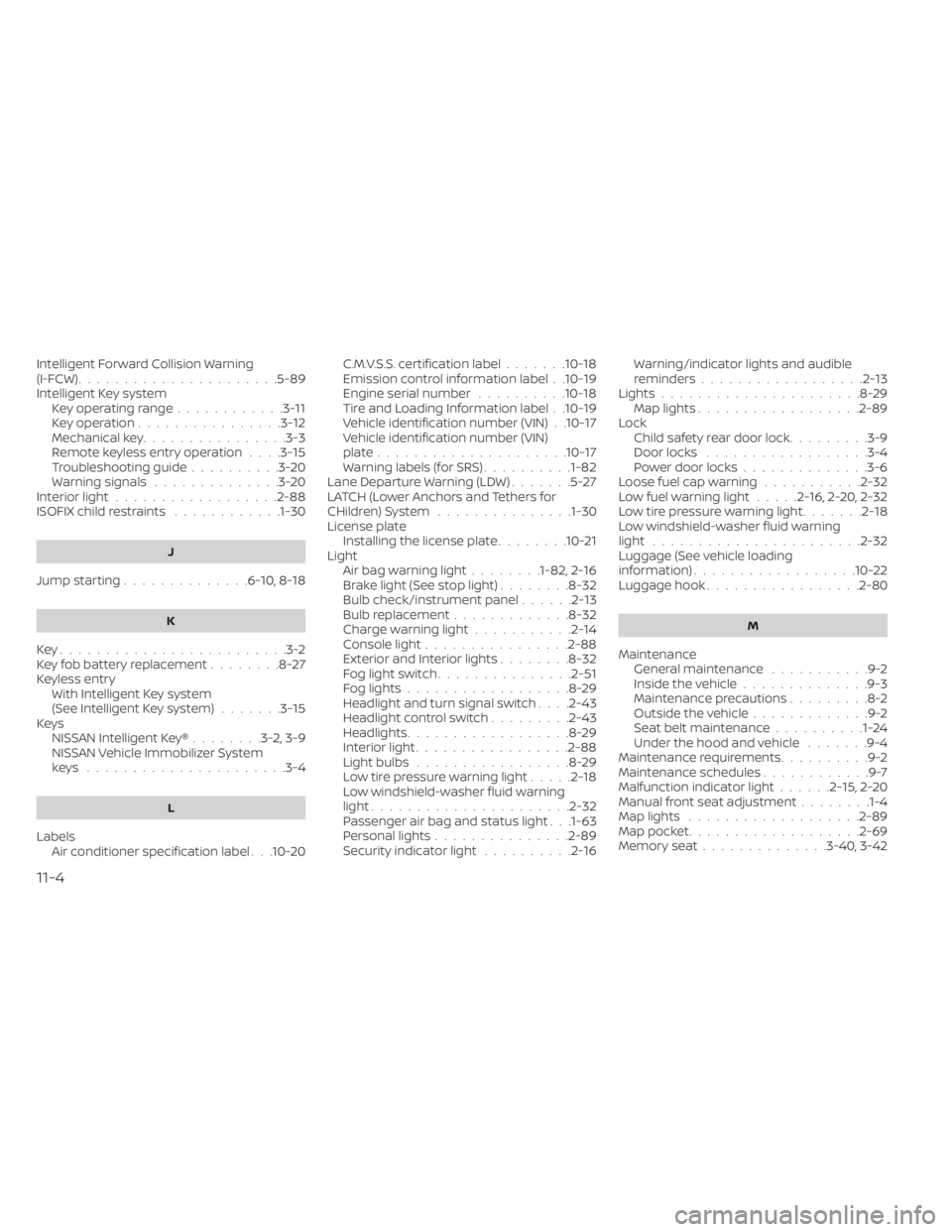
Intelligent Forward Collision Warning
(I-FCW)......................5-89Intelligent Key system
Key operating range............3-11Key operation................3-12Mechanical key................3-3Remote keyless entry operation. . . .3-15Troubleshooting guide..........3-20Warning signals..............3-20Interior light................. .2-88ISOFIX child restraints............1-30
J
Jump starting..............6-10,8-18
K
Key.........................3-2Key fob battery replacement........8-27Keyless entry
With Intelligent Key system
(See Intelligent Key system)
.......3-15KeysNISSAN Intelligent Key®........3-2,3-9NISSAN Vehicle Immobilizer System
keys..................... .3-4
L
Labels
Air conditioner specification label. . .10-20
C.M.V.S.S. certification label.......10-18Emission control information label. .10-19Engine serial number..........10-18Tire and Loading Information label. .10-19Vehicle identification number (VIN). .10-17Vehicle identification number (VIN)
plate.................... .10-17Warning labels (for SRS)..........1-82Lane Departure Warning (LDW).......5-27LATCH (Lower Anchors and Tethers for
CHildren) System...............1-30License plate
Installing the license plate........10-21LightAir bag warning light........1-82, 2-16Brake light (See stop light)........8-32Bulb check/instrument panel......2-13Bulb replacement.............8-32Charge warning light...........2-14Console light................2-88Exterior and Interior lights........8-32Fog light switch...............2-51Fog lights..................8-29Headlight and turn signal switch. . . .2-43Headlight control switch.........2-43Headlights..................8-29Interior light................ .2-88Light bulbs.................8-29Low tire pressure warning light.....2-18Low windshield-washer fluid warning
light..................... .2-32Passenger air bag and status light. . .1-63Personal lights...............2-89Security indicator light..........2-16
Warning/indicator lights and audible
reminders..................2-13Lights......................8-29Map lights..................2-89Lock
Child safety rear door lock.........3-9Door locks................. .3-4Power door locks..............3-6Loose fuel cap warning...........2-32Low fuel warning light.....2-16,2-20,2-32Low tire pressure warning light.......2-18Low windshield-washer fluid warning
light...................... .2-32Luggage (See vehicle loading
information)..................10-22Luggage hook.................2-80
M
Maintenance
General maintenance...........9-2Inside the vehicle..............9-3Maintenance precautions.........8-2Outside the vehicle.............9-2Seat belt maintenance..........1-24Under the hood and vehicle.......9-4Maintenance requirements..........9-2Maintenance schedules............9-7Malfunction indicator light......2-15,2-20Manual front seat adjustment........1-4Map lights.................. .2-89Map pocket...................2-69Memory seat..............3-40, 3-42
11-4