4WD NISSAN TITAN 2021 Owner´s Manual
[x] Cancel search | Manufacturer: NISSAN, Model Year: 2021, Model line: TITAN, Model: NISSAN TITAN 2021Pages: 638, PDF Size: 4.31 MB
Page 561 of 638
Essentials:
• Replace engine oil & filter
• Lubricate steering stopper cap (XD mod-els only)97,500 miles/(156,000 km)/
78 months
Perform at number of miles, kilometers or
months, whichever comes first.
Standard maintenance:
Inspections:
• Horn, lights, signals, wipers, rear hatch/hood lif t supports
• All fluids inspected (engine, wiper, brake, power steering, coolant)
• Engine drive belt and hose inspections
• Engine air filter
• Propeller shaf t
• Suspension components (shocks, sub- frame, tie rods)
• Differential gear oil
• Battery terminals and cables, battery test
• Tire pressure, treadwear and depth
Essentials:
• Replace engine oil & filter
• Tire rotation
Severe maintenance:
Not Applicable. Proceed to next interval
100,000 miles/(160,000 km)/
120 months
Perform at number of miles, kilometers or
months, whichever comes first.
Standard maintenance:
Not Applicable. Proceed to next interval
Severe maintenance:
Inspections:
• Brake pads & rotors
• Steering gear & linkage
• Axle & suspension parts
• Propeller shaf t
• Drive shaf t boots (4WD models)
• Exhaust system
• Horn, lights, signals, wipers, rear hatch/ hood lif t supports
• All fluids inspected (engine, wiper, brake, power steering, coolant)
• Engine drive belt and hose inspections
• Engine air filter
• Suspension components (shocks, sub- frame, tie rods)
• Battery terminals and cables, battery test
• Tire pressure, treadwear and depth
Maintenance and schedules9-27
Page 562 of 638
Essentials:
• Replace engine oil & filter
• Replace brake fluid
• Replace differential gear oil
• Lubricate steering stopper cap (XD mod-els only)
• Replace transfer case oil (4WD models)105,000 miles/(168,000 km)/
84 months
Perform at number of miles, kilometers or
months, whichever comes first.
Standard maintenance:
Inspections:
• Automatic transmission fluid (1)
• Brake lines and cables
• Brake pads and rotors
• Engine drive belt *
• Propeller shaf t
• Differential gear oil
• Transfer case oil (4WD models)
• Drive shaf t boots (4WD models)
• Horn, lights, signals, wipers, rear hatch/ hood lif t supports
• All fluids inspected (engine, wiper, brake, power steering, coolant)
• Hose inspections
• Engine air filter
• Suspension components (shocks, sub- frame, tie rods)
• Battery terminals and cables, battery test
• Tire pressure, treadwear and depth Essentials:
• Replace engine coolant * (2)
• Replace engine oil & filter
• Replace in-cabin microfilter
• Replace spark plugs
• Tire rotation
Severe maintenance:
Not Applicable. Proceed to next interval
(1) Request the dealer to inspect the fluid
deterioration data using a CONSULT. If the
deterioration data is more than 77000, re-
place the AT fluid.
(2) First replacement interval is 105,000
miles (168,000 km) or 84 months. Af ter first
replacement, replace every 75,000 miles
(120,000 km) or 60 months.
* Maintenance items and intervals with “*”
are recommended by NISSAN for reliable
vehicle operation. The owner need not per-
form such maintenance in order to main-
tain the emission warranty or manufac-
turer recall liability. Other maintenance
items and intervals are required.
9-28Maintenance and schedules
Page 563 of 638
105,000 miles/(168,000 km)/
126 months
Perform at number of miles, kilometers or
months, whichever comes first.
Standard maintenance:
Not Applicable. Proceed to next interval
Severe maintenance:
Inspections:
• Brake pads & rotors
• Steering gear & linkage
• Axle & suspension parts
• Propeller shaf t
• Drive shaf t boots (4WD models)
• Exhaust system
• Horn, lights, signals, wipers, rear hatch/hood lif t supports
• All fluids inspected (engine, wiper, brake, power steering, coolant)
• Engine drive belt and hose inspections
• Engine air filter
• Suspension components (shocks, sub- frame, tie rods)
• Differential gear oil
• Battery terminals and cables, battery test
• Tire pressure, treadwear and depth Essentials:
• Replace engine oil & filter
• Lubricate steering stopper cap (XD mod-
els only)
110,000 miles/(176,000 km)/
132 months
Perform at number of miles, kilometers or
months, whichever comes first.
Standard maintenance:
Not Applicable. Proceed to next interval
Severe maintenance:
Inspections:
• Brake pads & rotors
• Steering gear & linkage
• Axle & suspension parts
• Propeller shaf t
• Drive shaf t boots (4WD models)
• Exhaust system
• Horn, lights, signals, wipers, rear hatch/hood lif t supports
• All fluids inspected (engine, wiper, brake, power steering, coolant)
• Engine drive belt and hose inspections
• Engine air filter
• Suspension components (shocks, sub- frame, tie rods)
• Differential gear oil
• Battery terminals and cables, battery test
• Tire pressure, treadwear and depth
Maintenance and schedules9-29
Page 564 of 638
Essentials:
• Replace engine oil & filter
• Replace brake fluid
• Lubricate steering stopper cap (XD mod-els only)112,500 miles/(180,000 km)/
90 months
Perform at number of miles, kilometers or
months, whichever comes first.
Standard maintenance:
Inspections:
• Horn, lights, signals, wipers, rear hatch/hood lif t supports
• All fluids inspected (engine, wiper, brake, power steering, coolant)
• Engine drive belt and hose inspections
• Engine air filter
• Propeller shaf t
• Suspension components (shocks, sub- frame, tie rods)
• Differential gear oil
• Battery terminals and cables, battery test
• Tire pressure, treadwear and depth
Essentials:
• Replace engine oil & filter
• Replace intelligent key battery
• Tire rotation
Severe maintenance:
Not Applicable. Proceed to next interval
115,000 miles/(184,000 km)/
138 months
Perform at number of miles, kilometers or
months, whichever comes first.
Standard maintenance:
Not Applicable. Proceed to next interval
Severe maintenance:
Inspections:
• Brake pads & rotors
• Steering gear & linkage
• Axle & suspension parts
• Propeller shaf t
• Drive shaf t boots (4WD models)
• Exhaust system
• Horn, lights, signals, wipers, rear hatch/ hood lif t supports
• All fluids inspected (engine, wiper, brake, power steering, coolant)
• Engine drive belt and hose inspections
• Engine air filter
• Suspension components (shocks, sub- frame, tie rods)
• Differential gear oil
• Battery terminals and cables, battery test
• Tire pressure, treadwear and depth
9-30Maintenance and schedules
Page 565 of 638
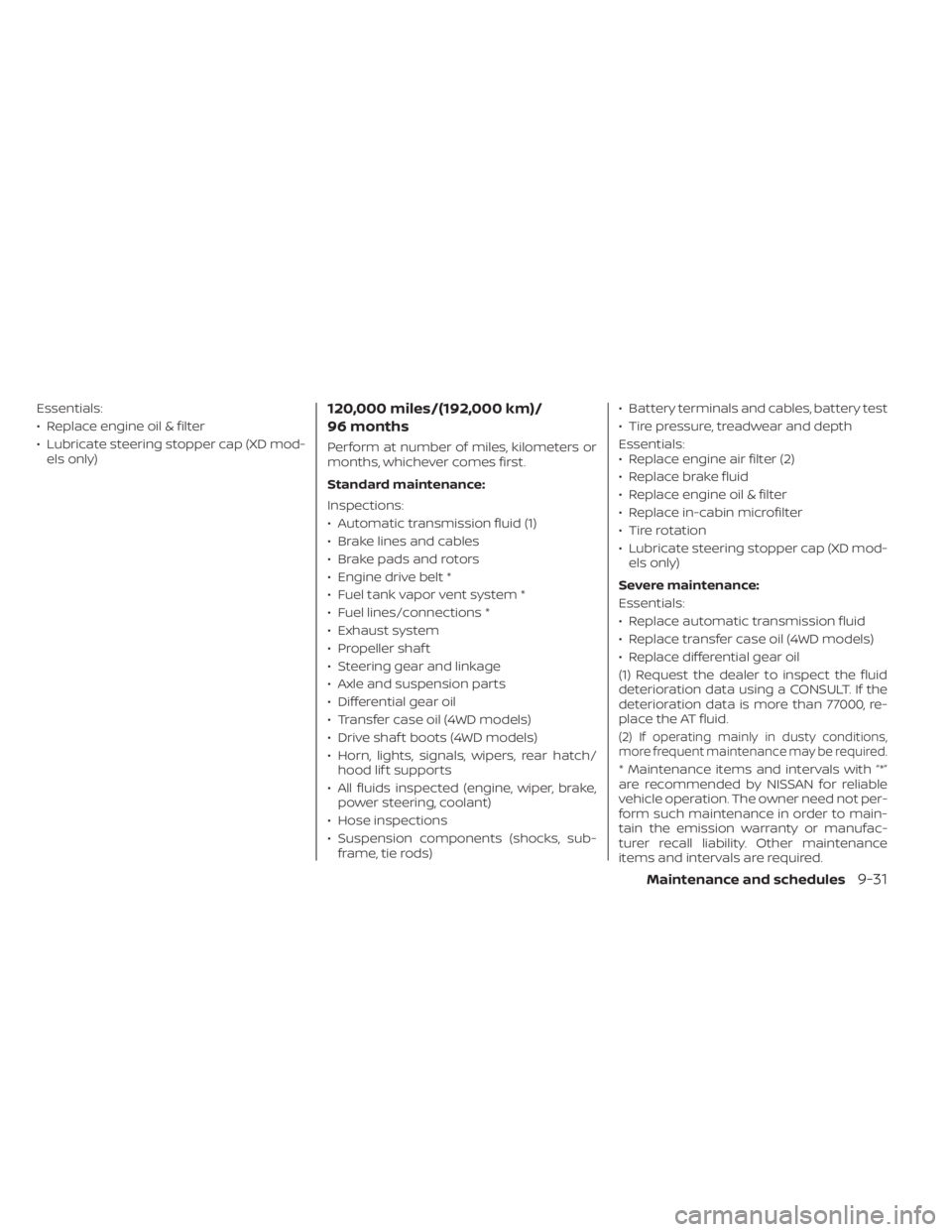
Essentials:
• Replace engine oil & filter
• Lubricate steering stopper cap (XD mod-els only)120,000 miles/(192,000 km)/
96 months
Perform at number of miles, kilometers or
months, whichever comes first.
Standard maintenance:
Inspections:
• Automatic transmission fluid (1)
• Brake lines and cables
• Brake pads and rotors
• Engine drive belt *
• Fuel tank vapor vent system *
• Fuel lines/connections *
• Exhaust system
• Propeller shaf t
• Steering gear and linkage
• Axle and suspension parts
• Differential gear oil
• Transfer case oil (4WD models)
• Drive shaf t boots (4WD models)
• Horn, lights, signals, wipers, rear hatch/hood lif t supports
• All fluids inspected (engine, wiper, brake, power steering, coolant)
• Hose inspections
• Suspension components (shocks, sub- frame, tie rods) • Battery terminals and cables, battery test
• Tire pressure, treadwear and depth
Essentials:
• Replace engine air filter (2)
• Replace brake fluid
• Replace engine oil & filter
• Replace in-cabin microfilter
• Tire rotation
• Lubricate steering stopper cap (XD mod-
els only)
Severe maintenance:
Essentials:
• Replace automatic transmission fluid
• Replace transfer case oil (4WD models)
• Replace differential gear oil
(1) Request the dealer to inspect the fluid
deterioration data using a CONSULT. If the
deterioration data is more than 77000, re-
place the AT fluid.
(2) If operating mainly in dusty conditions,
more frequent maintenance may be required.
* Maintenance items and intervals with “*”
are recommended by NISSAN for reliable
vehicle operation. The owner need not per-
form such maintenance in order to main-
tain the emission warranty or manufac-
turer recall liability. Other maintenance
items and intervals are required.
Maintenance and schedules9-31
Page 566 of 638
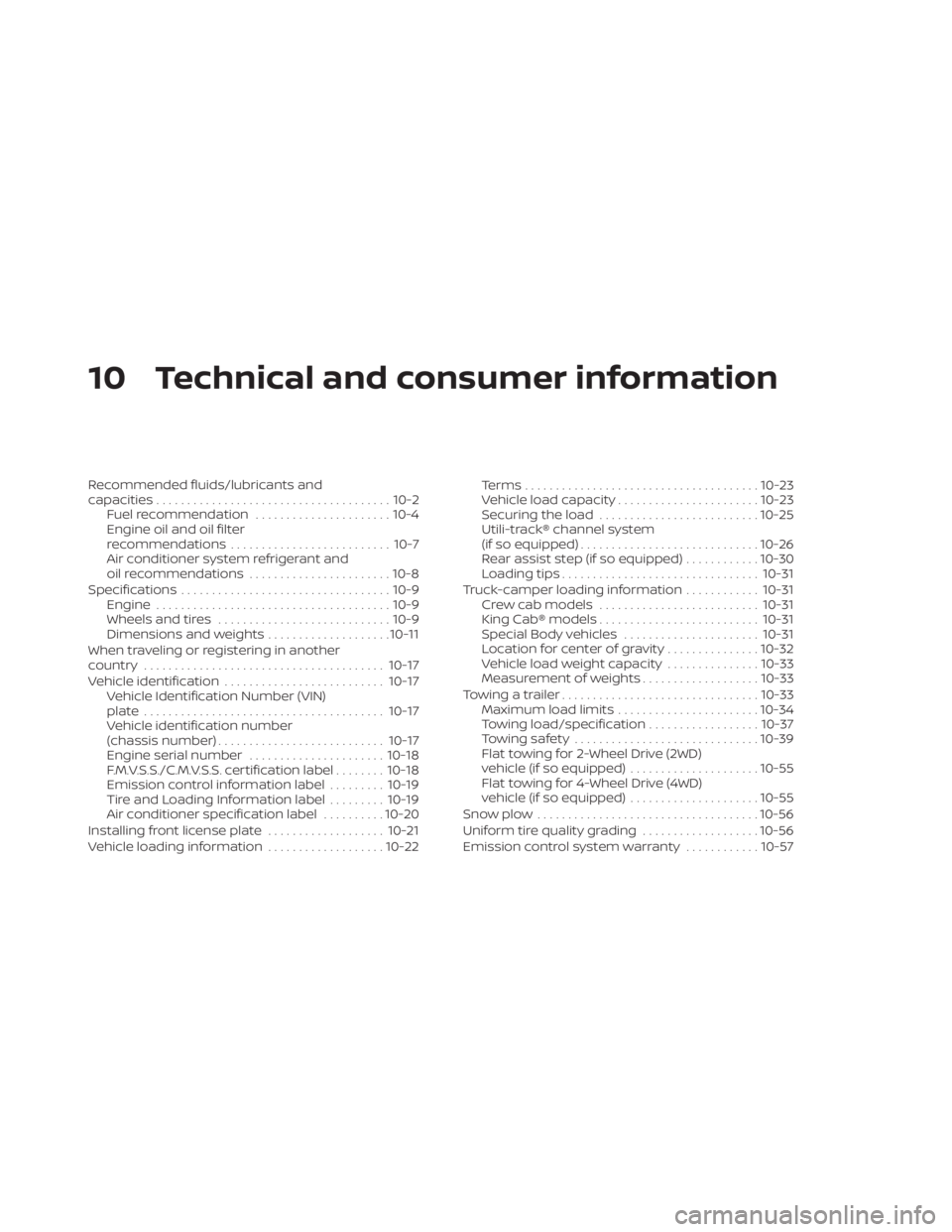
10 Technical and consumer information
Recommended fluids/lubricants and
capacities...................................... 10-2
Fuel recommendation ......................10-4
Engine oil and oil filter
recommendations .......................... 10-7
Air conditioner system refrigerant and
oil recommendations .......................10-8
Specifications .................................. 10-9
Engine ...................................... 10-9
Wheels and tires ............................ 10-9
Dimensions and weights ....................10-11
When traveling or registering in another
country ....................................... 10-17
Vehicle identification .......................... 10-17
Vehicle Identification Number (VIN)
plate ....................................... 10-17
Vehicle identification number
(chassis number) ........................... 10-17
Engine serial number ......................10-18
F.M.V.S.S./C.M.V.S.S. certification label ........10-18
Emission control information label .........10-19
Tire and Loading Information label .........10-19
Air conditioner specification label ..........10-20
Installing front license plate ...................10-21
Vehicle loading information ...................10-22Terms
...................................... 10-23
Vehicle load capacity ....................... 10-23
Securing the load .......................... 10-25
Utili-track® channel system
(if so equipped) ............................. 10-26
Rear assist step (if so equipped) ............10-30
Loading tips ................................ 10-31
Truck-camper loading information ............10-31
Crew cab models .......................... 10-31
King Cab® models .......................... 10-31
Special Body vehicles ......................10-31
Location for center of gravity ...............10-32
Vehicle load weight capacity ...............10-33
Measurement of weights ...................10-33
Towing a trailer ................................ 10-33
Maximum load limits ....................... 10-34
T
owing load/specification ..................10-37
Towing safety .............................. 10-39
Flat towing for 2-Wheel Drive (2WD)
vehicle (if so equipped) .....................10-55
Flat towing for 4-Wheel Drive (4WD)
vehicle (if so equipped) .....................10-55
Snowplow .................................... 10-56
Uniform tire quality grading ...................10-56
Emission control system warranty ............10-57
Page 577 of 638
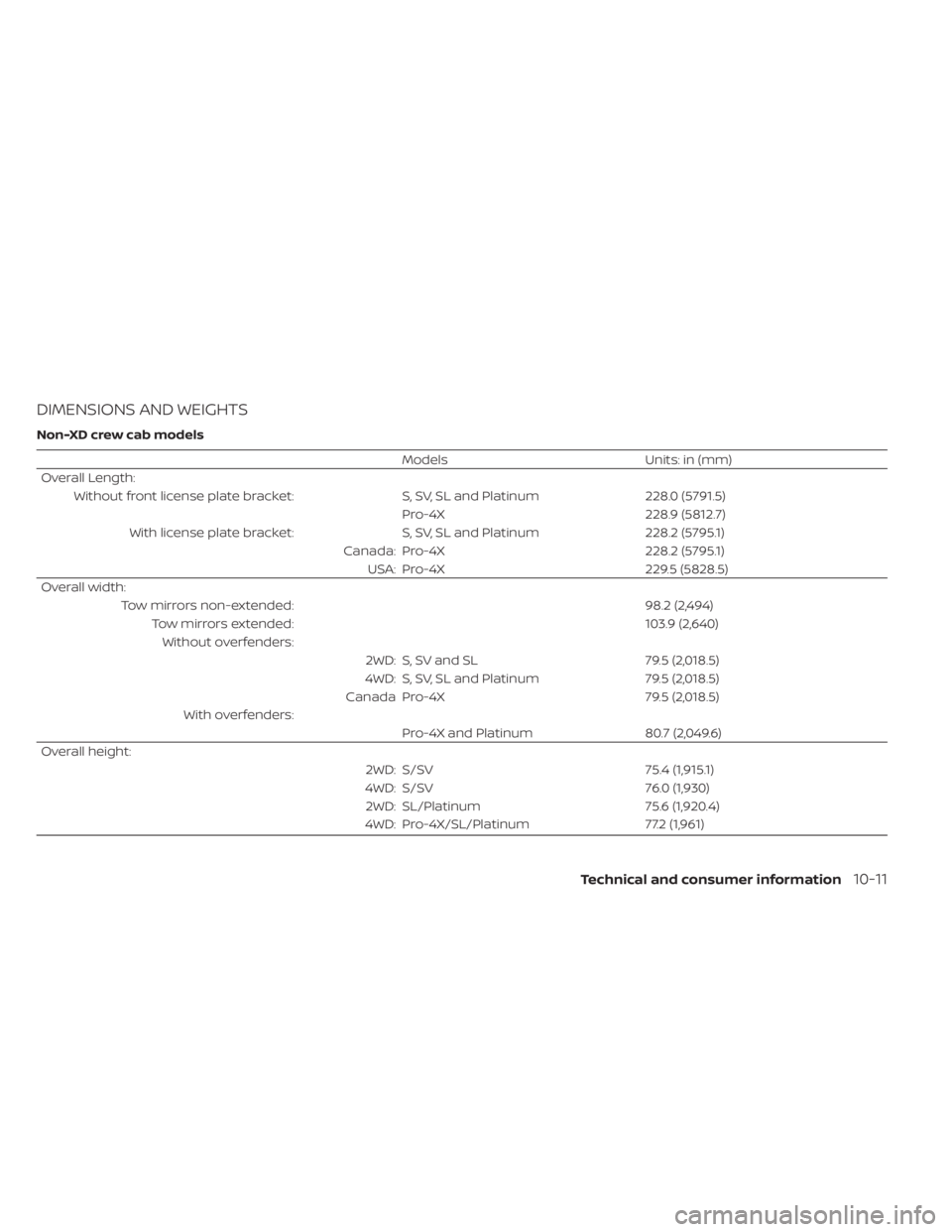
DIMENSIONS AND WEIGHTS
Non-XD crew cab models
ModelsUnits: in (mm)
Overall Length: Without front license plate bracket: S, SV, SL and Platinum228.0 (5791.5)
Pro-4X 228.9 (5812.7)
With license plate bracket: S, SV, SL and Platinum228.2 (5795.1)
Canada: Pro-4X 228.2 (5795.1)
USA: Pro-4X 229.5 (5828.5)
Overall width: Tow mirrors non-extended: 98.2 (2,494)
Tow mirrors extended: 103.9 (2,640)
Without overfenders: 2WD: S, SV and SL 79.5 (2,018.5)
4WD: S, SV, SL and Platinum 79.5 (2,018.5)
Canada Pro-4X 79.5 (2,018.5)
With overfenders: Pro-4X and Platinum 80.7 (2,049.6)
Overall height: 2WD: S/SV75.4 (1,915.1)
4WD: S/SV 76.0 (1,930)
2WD: SL/Platinum 75.6 (1,920.4)
4WD: Pro-4X/SL/Platinum 77.2 (1,961)
Technical and consumer information10-11
Page 581 of 638
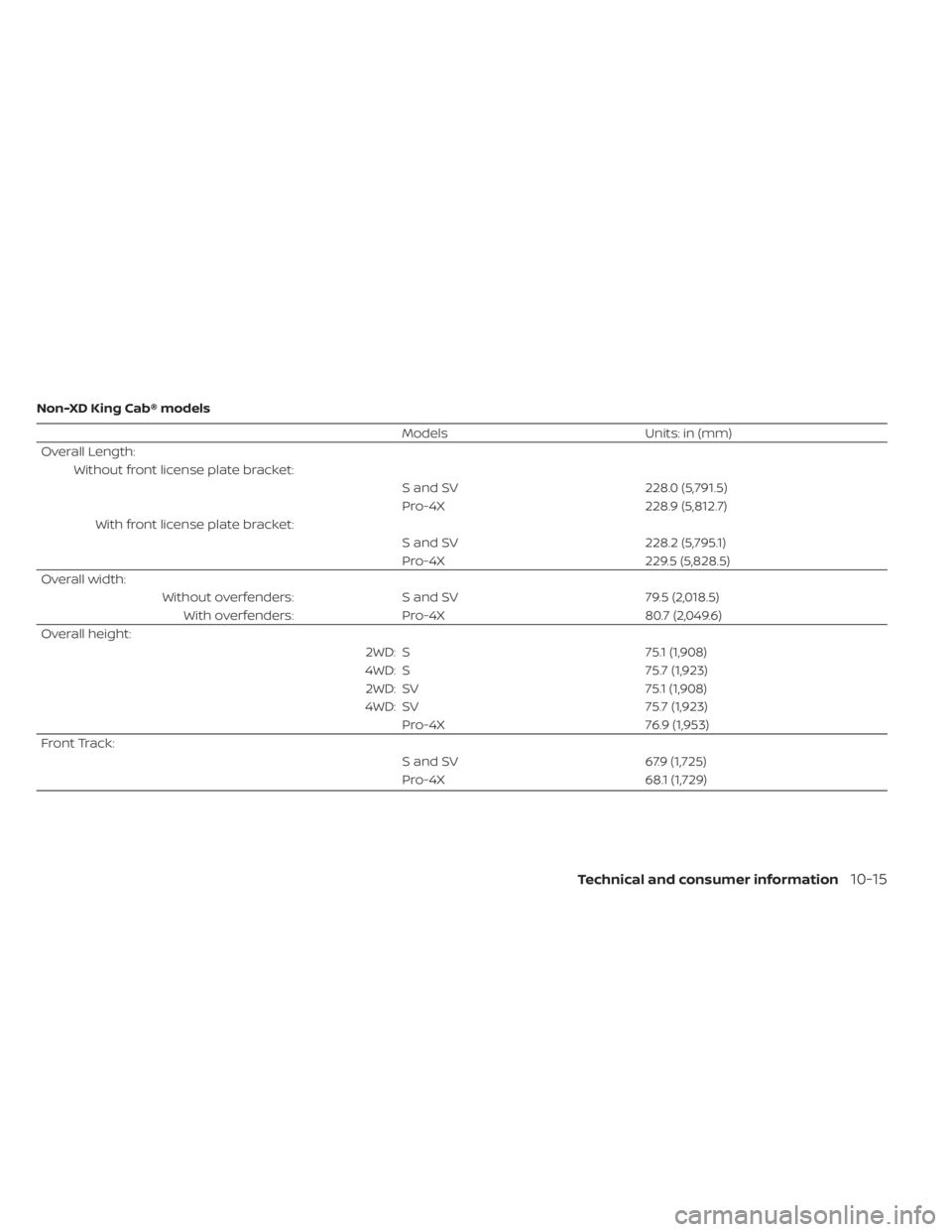
Non-XD King Cab® models
ModelsUnits: in (mm)
Overall Length: Without front license plate bracket: S and SV228.0 (5,791.5)
Pro-4X 228.9 (5,812.7)
With front license plate bracket: S and SV228.2 (5,795.1)
Pro-4X 229.5 (5,828.5)
Overall width: Without overfenders: S and SV 79.5 (2,018.5)
With overfenders: Pro-4X 80.7 (2,049.6)
Overall height: 2WD: S75.1 (1,908)
4WD: S 75.7 (1,923)
2WD: SV 75.1 (1,908)
4WD: SV 75.7 (1,923)
Pro-4X 76.9 (1,953)
Front Track: S and SV67.9 (1,725)
Pro-4X 68.1 (1,729)
Technical and consumer information10-15
Page 604 of 638
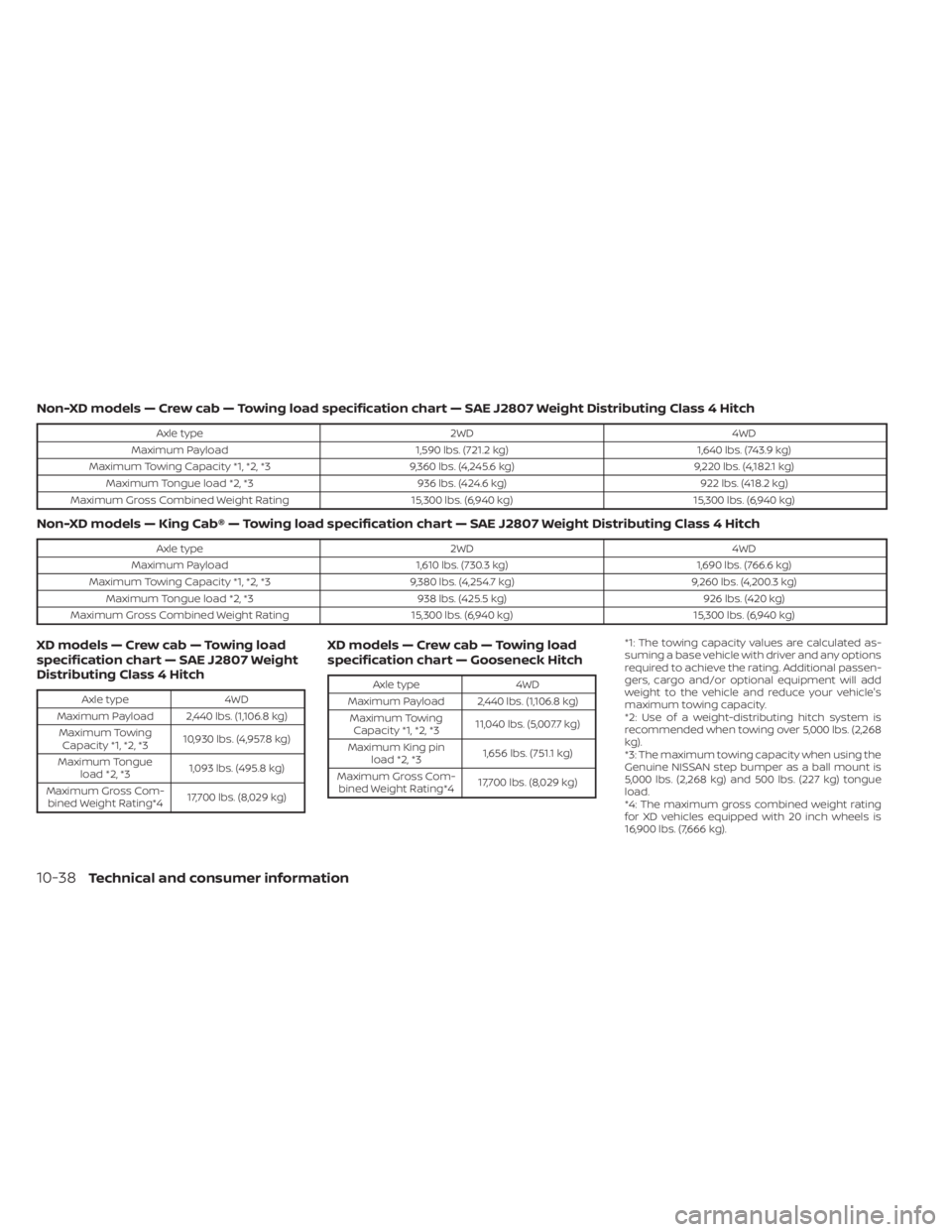
Non-XD models — Crew cab — Towing load specification chart — SAE J2807 Weight Distributing Class 4 Hitch
Axle type2WD4WD
Maximum Payload 1,590 lbs. (721.2 kg)1,640 lbs. (743.9 kg)
Maximum Towing Capacity *1, *2, *3 9,360 lbs. (4,245.6 kg)9,220 lbs. (4,182.1 kg)
Maximum Tongue load *2, *3 936 lbs. (424.6 kg)922 lbs. (418.2 kg)
Maximum Gross Combined Weight Rating 15,300 lbs. (6,940 kg)15,300 lbs. (6,940 kg)
Non-XD models — King Cab® — Towing load specification chart — SAE J2807 Weight Distributing Class 4 Hitch
Axle type 2WD4WD
Maximum Payload 1,610 lbs. (730.3 kg)1,690 lbs. (766.6 kg)
Maximum Towing Capacity *1, *2, *3 9,380 lbs. (4,254.7 kg)9,260 lbs. (4,200.3 kg)
Maximum Tongue load *2, *3 938 lbs. (425.5 kg)926 lbs. (420 kg)
Maximum Gross Combined Weight Rating 15,300 lbs. (6,940 kg)15,300 lbs. (6,940 kg)
XD models — Crew cab — Towing load
specification chart — SAE J2807 Weight
Distributing Class 4 Hitch
Axle type4WD
Maximum Payload 2,440 lbs. (1,106.8 kg) Maximum Towing Capacity *1, *2, *3 10,930 lbs. (4,957.8 kg)
Maximum Tongue load *2, *3 1,093 lbs. (495.8 kg)
Maximum Gross Com- bined Weight Rating*4 17,700 lbs. (8,029 kg)
XD models — Crew cab — Towing load
specification chart — Gooseneck Hitch
Axle type
4WD
Maximum Payload 2,440 lbs. (1,106.8 kg) Maximum Towing Capacity *1, *2, *3 11,040 lbs. (5,007.7 kg)
Maximum King pin load *2, *3 1,656 lbs. (751.1 kg)
Maximum Gross Com- bined Weight Rating*4 17,700 lbs. (8,029 kg) *1: The towing capacity values are calculated as-
suming a base vehicle with driver and any options
required to achieve the rating. Additional passen-
gers, cargo and/or optional equipment will add
weight to the vehicle and reduce your vehicle's
maximum towing capacity.
*2: Use of a weight-distributing hitch system is
recommended when towing over 5,000 lbs. (2,268
kg).
*3: The maximum towing capacity when using the
Genuine NISSAN step bumper as a ball mount is
5,000 lbs. (2,268 kg) and 500 lbs. (227 kg) tongue
load.
*4: The maximum gross combined weight rating
for XD vehicles equipped with 20 inch wheels is
16,900 lbs. (7,666 kg).
10-38Technical and consumer information
Page 618 of 638
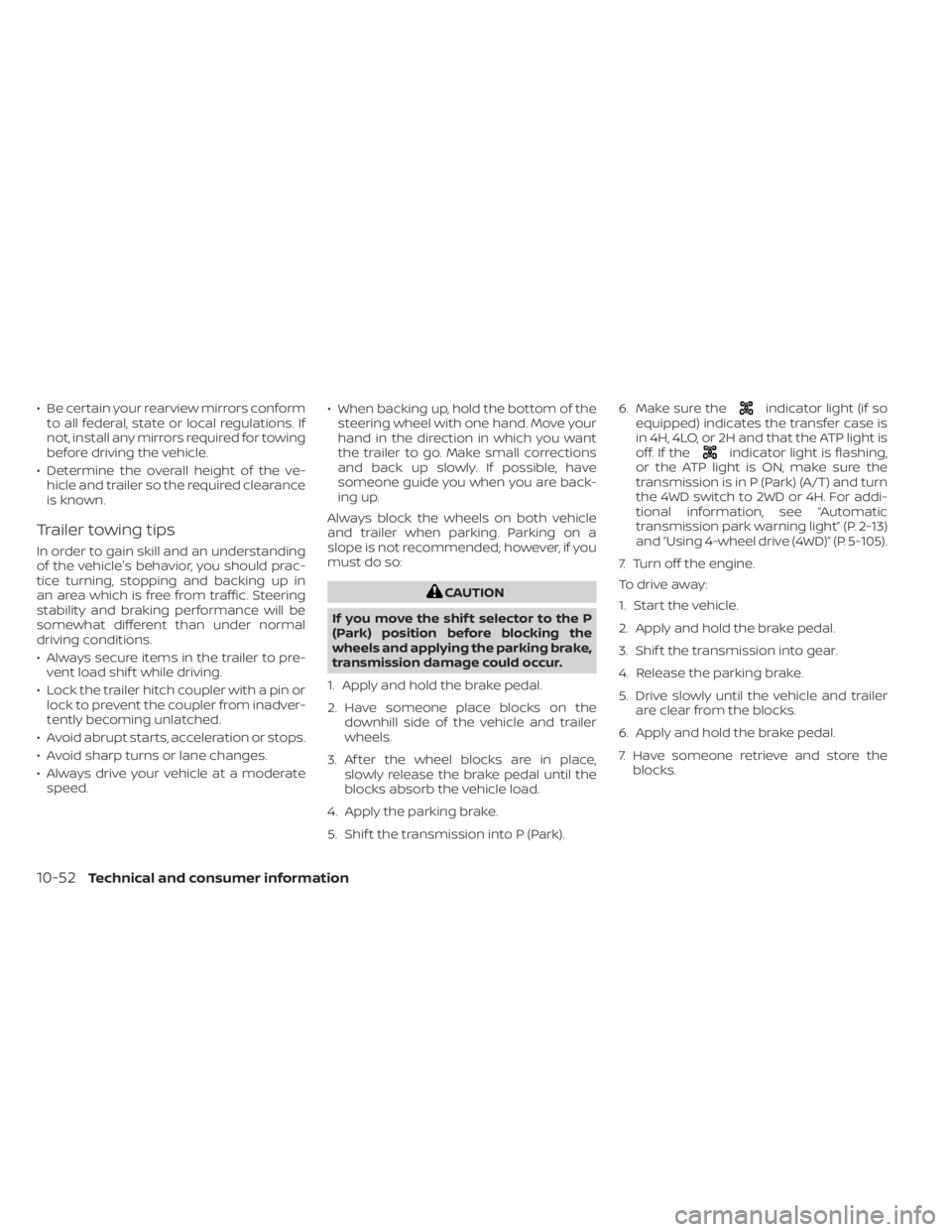
• Be certain your rearview mirrors conformto all federal, state or local regulations. If
not, install any mirrors required for towing
before driving the vehicle.
• Determine the overall height of the ve- hicle and trailer so the required clearance
is known.
Trailer towing tips
In order to gain skill and an understanding
of the vehicle's behavior, you should prac-
tice turning, stopping and backing up in
an area which is free from traffic. Steering
stability and braking performance will be
somewhat different than under normal
driving conditions.
• Always secure items in the trailer to pre-vent load shif t while driving.
• Lock the trailer hitch coupler with a pin or lock to prevent the coupler from inadver-
tently becoming unlatched.
• Avoid abrupt starts, acceleration or stops.
• Avoid sharp turns or lane changes.
• Always drive your vehicle at a moderate speed. • When backing up, hold the bottom of the
steering wheel with one hand. Move your
hand in the direction in which you want
the trailer to go. Make small corrections
and back up slowly. If possible, have
someone guide you when you are back-
ing up.
Always block the wheels on both vehicle
and trailer when parking. Parking on a
slope is not recommended; however, if you
must do so:
CAUTION
If you move the shif t selector to the P
(Park) position before blocking the
wheels and applying the parking brake,
transmission damage could occur.
1. Apply and hold the brake pedal.
2. Have someone place blocks on the downhill side of the vehicle and trailer
wheels.
3. Af ter the wheel blocks are in place, slowly release the brake pedal until the
blocks absorb the vehicle load.
4. Apply the parking brake.
5. Shif t the transmission into P (Park). 6. Make sure the
indicator light (if so
equipped) indicates the transfer case is
in 4H, 4LO, or 2H and that the ATP light is
off. If the
indicator light is flashing,
or the ATP light is ON, make sure the
transmission is in P (Park) (A/T) and turn
the 4WD switch to 2WD or 4H. For addi-
tional information, see “Automatic
transmission park warning light” (P. 2-13)
and “Using 4-wheel drive (4WD)” (P. 5-105).
7. Turn off the engine.
To drive away:
1. Start the vehicle.
2. Apply and hold the brake pedal.
3. Shif t the transmission into gear.
4. Release the parking brake.
5. Drive slowly until the vehicle and trailer are clear from the blocks.
6. Apply and hold the brake pedal.
7. Have someone retrieve and store the blocks.
10-52Technical and consumer information