window NISSAN TITAN 2021 Owner´s Manual
[x] Cancel search | Manufacturer: NISSAN, Model Year: 2021, Model line: TITAN, Model: NISSAN TITAN 2021Pages: 638, PDF Size: 4.31 MB
Page 13 of 638
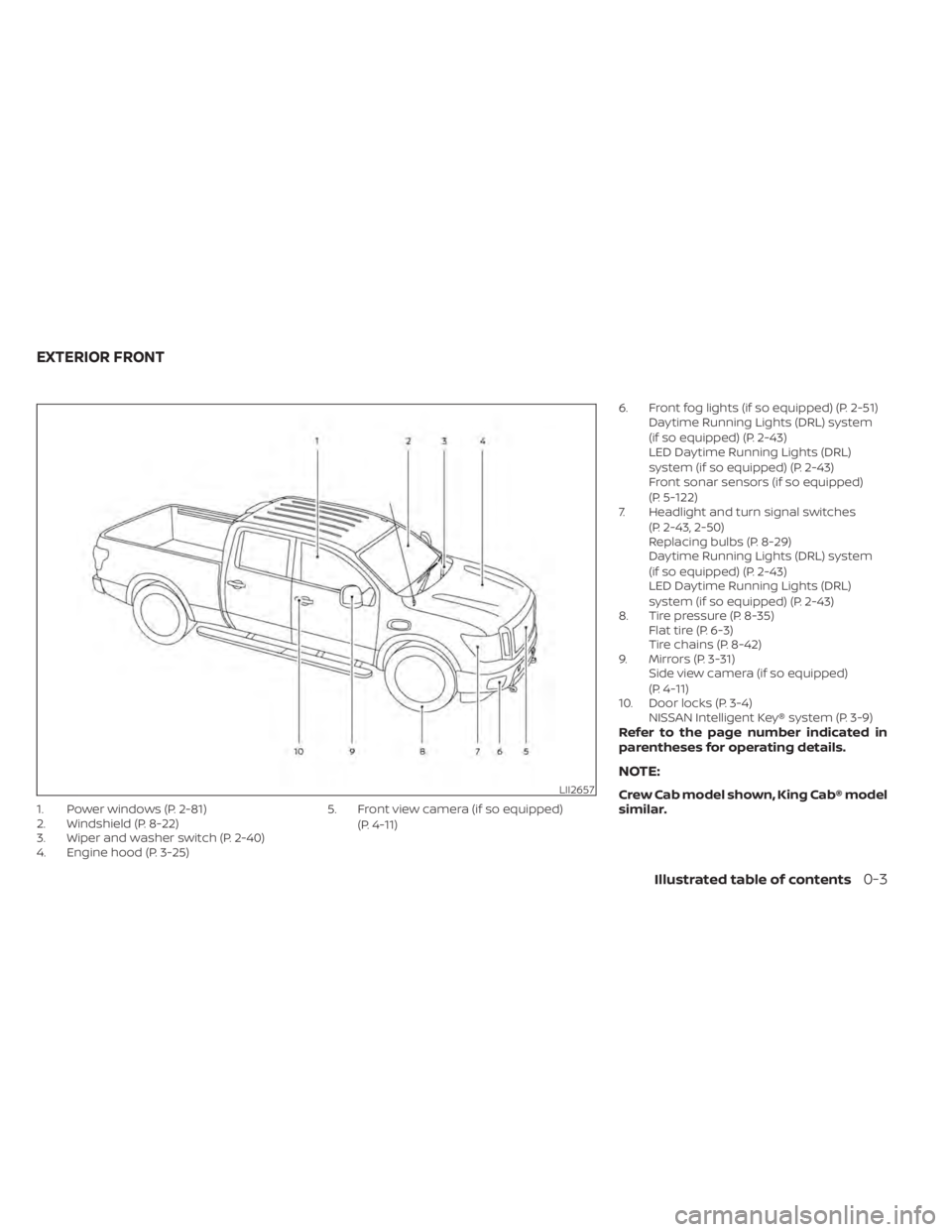
1. Power windows (P. 2-81)
2. Windshield (P. 8-22)
3. Wiper and washer switch (P. 2-40)
4. Engine hood (P. 3-25)5. Front view camera (if so equipped)
(P. 4-11) 6. Front fog lights (if so equipped) (P. 2-51)
Daytime Running Lights (DRL) system
(if so equipped) (P. 2-43)
LED Daytime Running Lights (DRL)
system (if so equipped) (P. 2-43)
Front sonar sensors (if so equipped)
(P. 5-122)
7. Headlight and turn signal switches
(P. 2-43, 2-50)
Replacing bulbs (P. 8-29)
Daytime Running Lights (DRL) system
(if so equipped) (P. 2-43)
LED Daytime Running Lights (DRL)
system (if so equipped) (P. 2-43)
8. Tire pressure (P. 8-35) Flat tire (P. 6-3)
Tire chains (P. 8-42)
9. Mirrors (P. 3-31) Side view camera (if so equipped)
(P. 4-11)
10. Door locks (P. 3-4) NISSAN Intelligent Key® system (P. 3-9)
Refer to the page number indicated in
parentheses for operating details.
NOTE:
Crew Cab model shown, King Cab® model
similar.LII2657
EXTERIOR FRONT
Illustrated table of contents0-3
Page 14 of 638
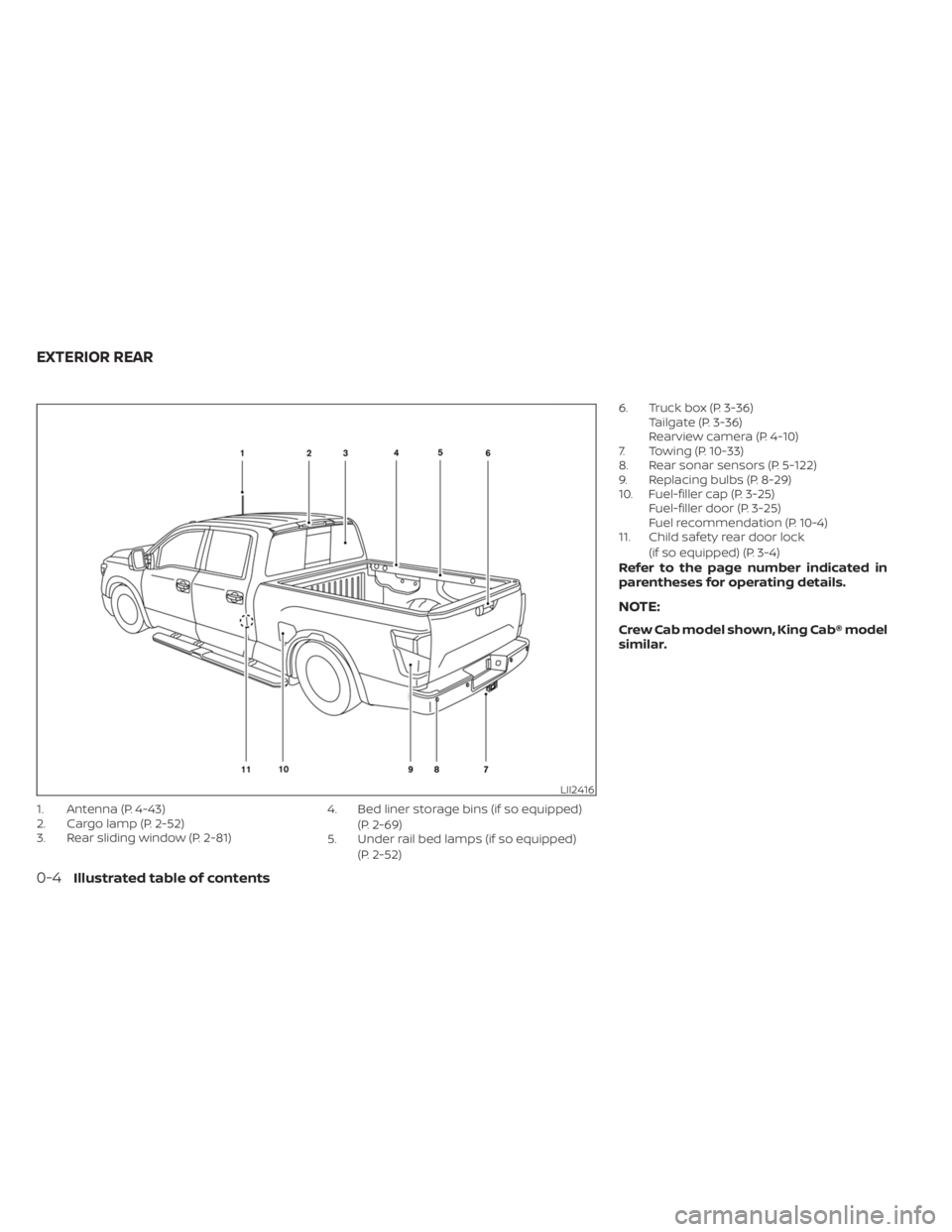
1. Antenna (P. 4-43)
2. Cargo lamp (P. 2-52)
3. Rear sliding window (P. 2-81)4. Bed liner storage bins (if so equipped)
(P. 2-69)
5. Under rail bed lamps (if so equipped)
(P. 2-52) 6. Truck box (P. 3-36)
Tailgate (P. 3-36)
Rearview camera (P. 4-10)
7. Towing (P. 10-33)
8. Rear sonar sensors (P. 5-122)
9. Replacing bulbs (P. 8-29)
10. Fuel-filler cap (P. 3-25) Fuel-filler door (P. 3-25)
Fuel recommendation (P. 10-4)
11. Child safety rear door lock
(if so equipped) (P. 3-4)
Refer to the page number indicated in
parentheses for operating details.
NOTE:
Crew Cab model shown, King Cab® model
similar.
LII2416
EXTERIOR REAR
0-4Illustrated table of contents
Page 78 of 638
WARNING
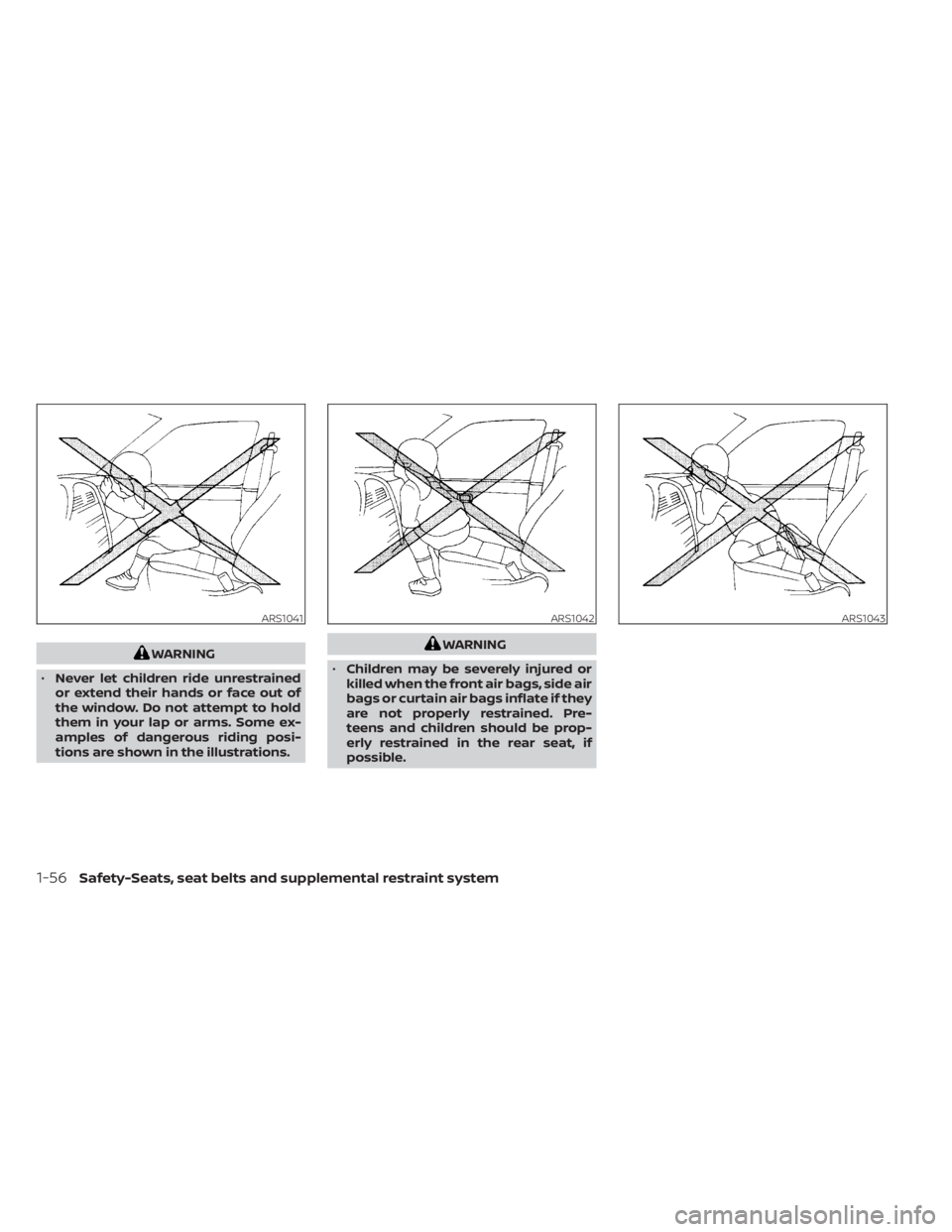
• Never let children ride unrestrained
or extend their hands or face out of
the window. Do not attempt to hold
them in your lap or arms. Some ex-
amples of dangerous riding posi-
tions are shown in the illustrations.WARNING
• Children may be severely injured or
killed when the front air bags, side air
bags or curtain air bags inflate if they
are not properly restrained. Pre-
teens and children should be prop-
erly restrained in the rear seat, if
possible.
ARS1041ARS1042ARS1043
1-56Safety-Seats, seat belts and supplemental restraint system
Page 80 of 638
WARNING
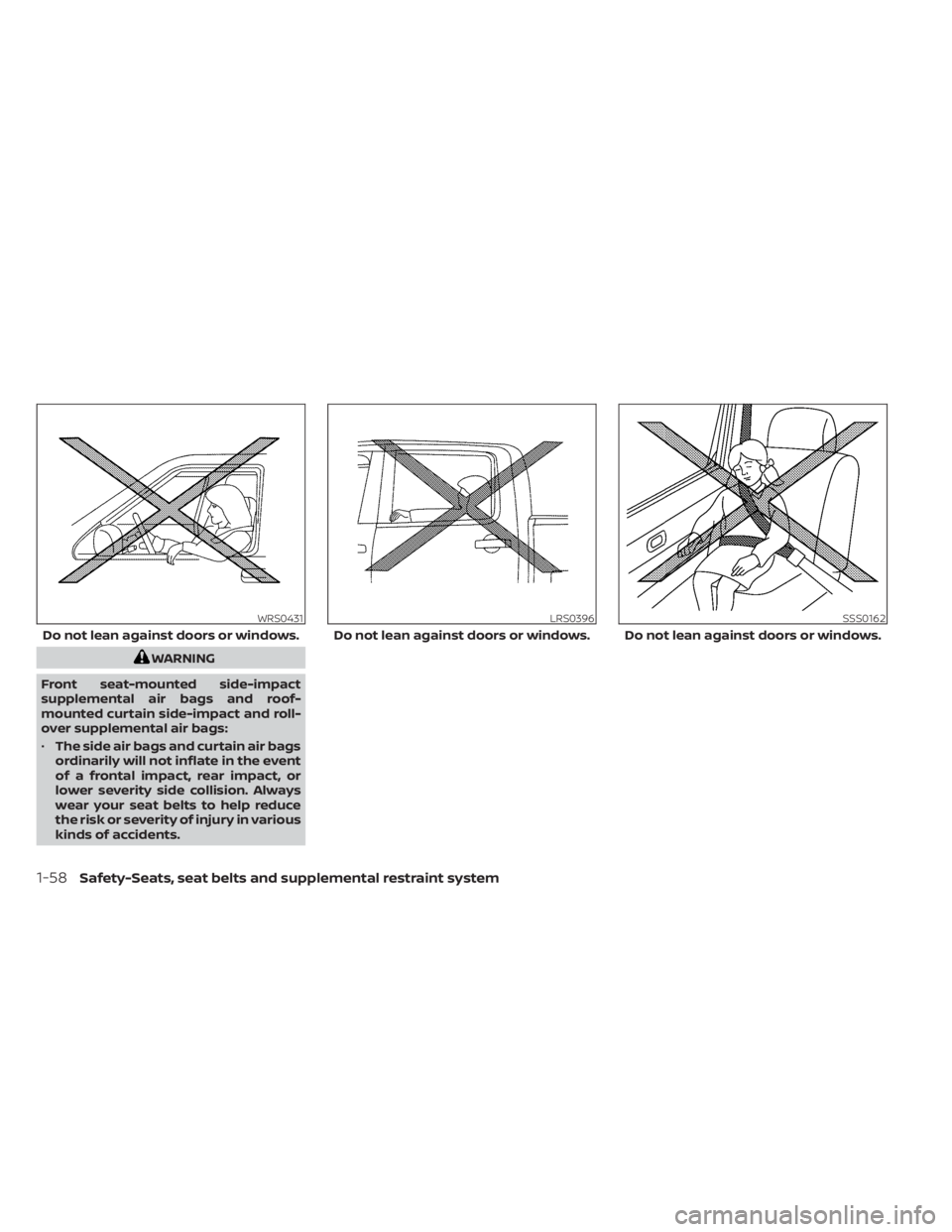
Front seat-mounted side-impact
supplemental air bags and roof-
mounted curtain side-impact and roll-
over supplemental air bags:
• The side air bags and curtain air bags
ordinarily will not inflate in the event
of a frontal impact, rear impact, or
lower severity side collision. Always
wear your seat belts to help reduce
the risk or severity of injury in various
kinds of accidents.
WRS0431
Do not lean against doors or windows.
LRS0396
Do not lean against doors or windows.
SSS0162
Do not lean against doors or windows.
1-58Safety-Seats, seat belts and supplemental restraint system
Page 92 of 638
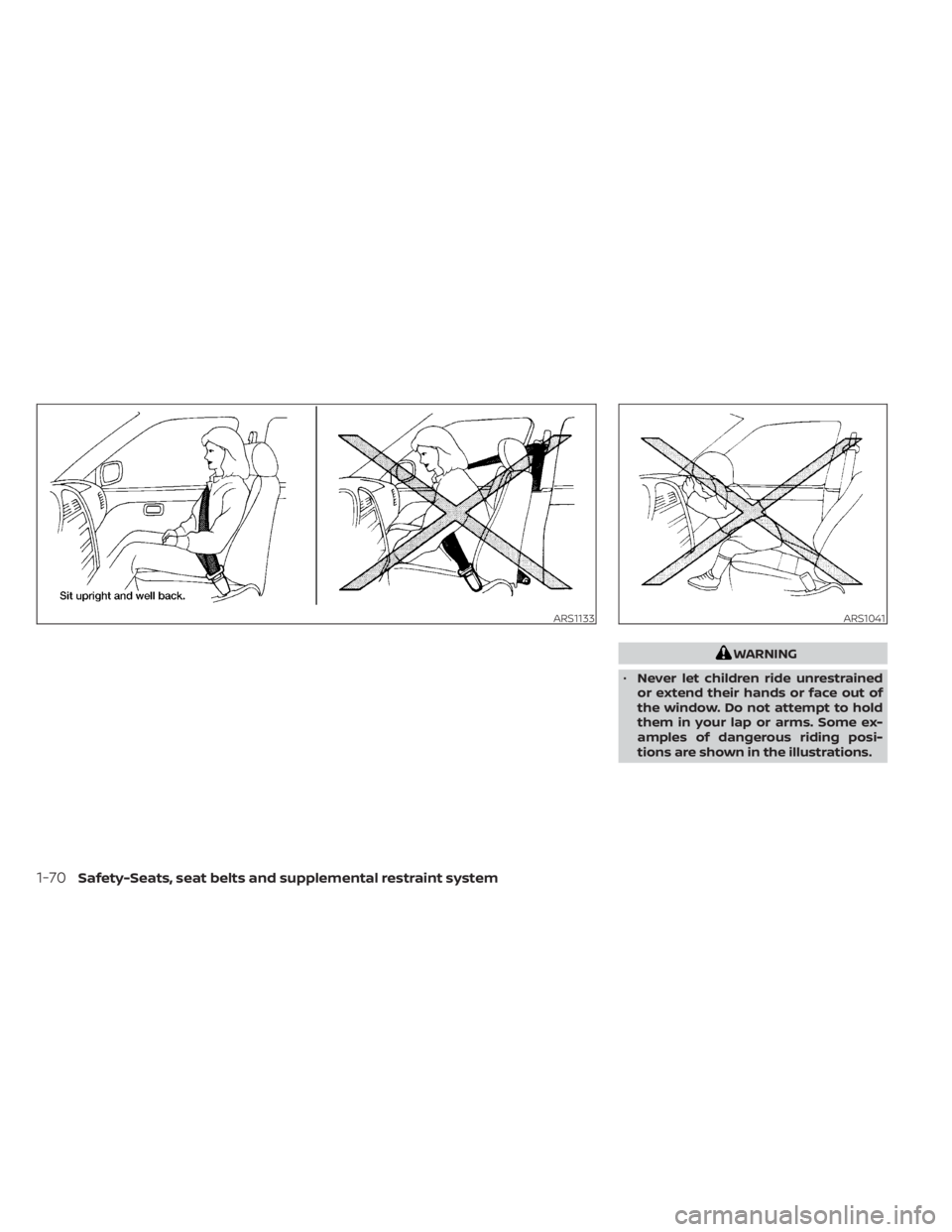
WARNING
• Never let children ride unrestrained
or extend their hands or face out of
the window. Do not attempt to hold
them in your lap or arms. Some ex-
amples of dangerous riding posi-
tions are shown in the illustrations.
ARS1133ARS1041
1-70Safety-Seats, seat belts and supplemental restraint system
Page 94 of 638
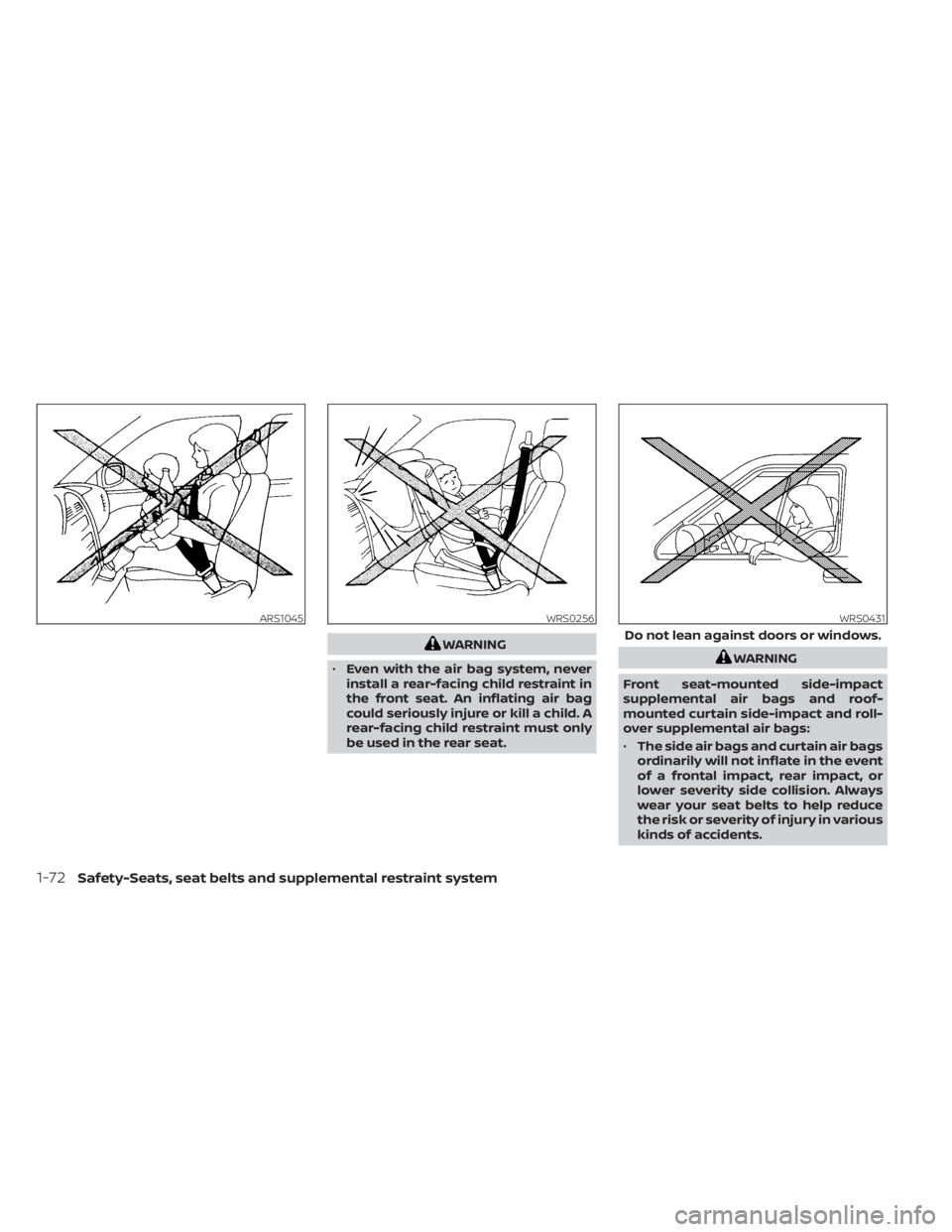
WARNING
• Even with the air bag system, never
install a rear-facing child restraint in
the front seat. An inflating air bag
could seriously injure or kill a child. A
rear-facing child restraint must only
be used in the rear seat.WARNING
Front seat-mounted side-impact
supplemental air bags and roof-
mounted curtain side-impact and roll-
over supplemental air bags:
• The side air bags and curtain air bags
ordinarily will not inflate in the event
of a frontal impact, rear impact, or
lower severity side collision. Always
wear your seat belts to help reduce
the risk or severity of injury in various
kinds of accidents.
ARS1045WRS0256WRS0431
Do not lean against doors or windows.
1-72Safety-Seats, seat belts and supplemental restraint system
Page 95 of 638
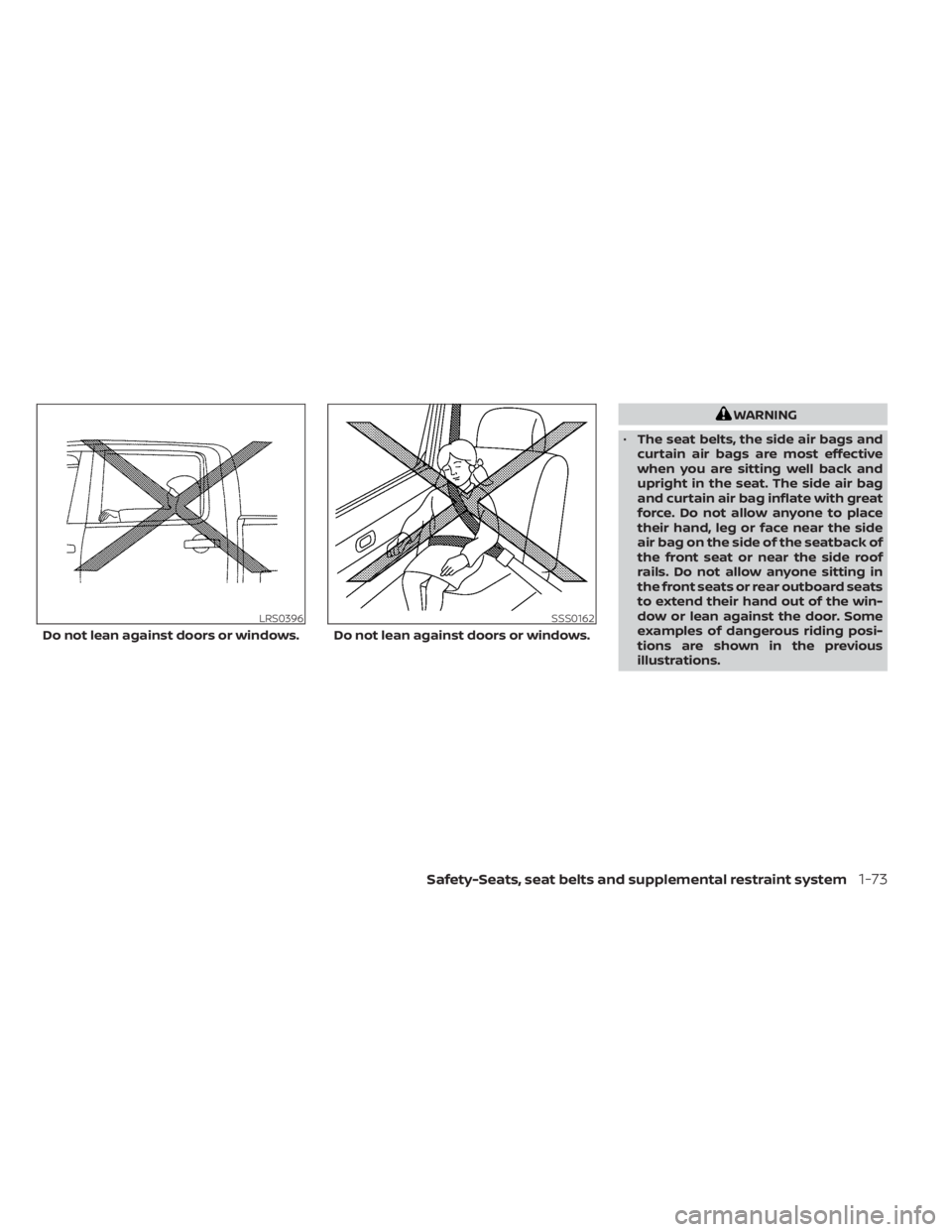
WARNING
• The seat belts, the side air bags and
curtain air bags are most effective
when you are sitting well back and
upright in the seat. The side air bag
and curtain air bag inflate with great
force. Do not allow anyone to place
their hand, leg or face near the side
air bag on the side of the seatback of
the front seat or near the side roof
rails. Do not allow anyone sitting in
the front seats or rear outboard seats
to extend their hand out of the win-
dow or lean against the door. Some
examples of dangerous riding posi-
tions are shown in the previous
illustrations.
LRS0396
Do not lean against doors or windows.
SSS0162
Do not lean against doors or windows.
Safety-Seats, seat belts and supplemental restraint system1-73
Page 107 of 638
2 Instruments and controls
Instrument panel................................2-4
Meters and gauges .............................2-6
Speedometer and odometer .................2-6
Tachometer ..................................2-8
Engine coolant temperature gauge ..........2-8
Fuel gauge ...................................2-9
Distance To Empty (DTE) .....................2-9
Auxiliary gauges (if so equipped) ............2-10
Off-road and 4–Wheel Drive (4WD)
monitor (if so equipped) ......................2-11
Warning lights, indicator lights and audible
reminders ...................................... 2-12
Checking lights .............................. 2-13
Warning/Indicator lights (red) ...............2-13
Warning/Indicator lights (yellow) ............2-17
Warning/Indicator lights (other) .............2-21
Audible reminders ........................... 2-22
Vehicle information display .....................2-22
How to use the vehicle information
display ...................................... 2-23
Startup display .............................. 2-23
Settings ..................................... 2-23
Vehicle information display warnings
and indicators ............................... 2-31
Security systems ............................... 2-37
Vehicle security system .....................2-37NISSAN Vehicle Immobilizer System
.........2-38
Wiper and washer switch .......................2-40
Switch operation ............................ 2-40
Rain-sensing auto wiper system
(if so equipped) .............................. 2-41
Rear window and/or outside mirror defroster
switch (if so equipped) ......................... 2-42
Headlight switch ............................... 2-43
Headlight control switch ....................2-43
Daytime Running Lights (DRL) system
(Type A) (if so equipped) .....................2-49
LED Daytime Running Lights (DRL)
system (Type B) (if so equipped) .............2-49
Instrument brightness control ..............2-50
Turn signal switch ........................... 2-50
Fog light switch (if so equipped) ................2-51
Horn ........................................... 2-52
Cargo lamp switch (if so equipped) .............2-52
Climate
controlled seat switches
(if so equipped) ................................. 2-52
Heated seat switches (if so equipped) ..........2-54
Heated rear seat switches (if so equipped) .....2-55
Heated steering wheel switch (if so equipped) . . 2-56
Warning systems switch .......................2-57
Vehicle Dynamic Control (VDC) OFF switch .....2-57
Page 108 of 638
Hill descent control switch (if so equipped).....2-58
Electronic locking rear differential (E-Lock)
system switch (if so equipped) .................2-59
Power inverter switch (if so equipped) ..........2-61
Parking Aids system switch ....................2-61
Tow mode switch .............................. 2-62
E-call (SOS) button (if so equipped) .............2-63
Trailer Brake Controller Unit (TBCU)
(if so equipped) ................................. 2-63
Rear Door Alert ................................. 2-63
Power outlets .................................. 2-64
12v Outlets .................................. 2-64
120v outlets (if so equipped) .................2-66
Extended storage switch .......................2-68
Storage ........................................ 2-69
Front-door pockets ......................... 2-69
Rear-door pockets .......................... 2-69
Console side pockets (if so equipped) .......2-69
Seatback pockets ........................... 2-70
Under-seat storage (if so equipped) .........2-70
Console box storage trays
(if so equipped) .............................. 2-72
Cell phone storage tray (if so equipped) .....2-72
Glovebox ................................... 2-72Console box (if so equipped)
................2-73
Center armrest storage (if so equipped) .....2-74
Under front seat storage bin
(if so equipped) .............................. 2-75
Overhead sunglasses storage
(if so equipped) .............................. 2-75
Cup holders ................................. 2-76
Grocery hooks (if so equipped) ..............2-79
Bed liner storage bins (if so equipped) .......2-79
Cargo hooks (if so equipped) ................2-80
C-Channel cargo hooks (if so equipped) .....2-80
Windows ....................................... 2-81
Power windows ............................. 2-81
Rear power window switch
(if so equipped) .............................. 2-84
Rear sliding window (if so equipped) .........2-85
Moonroof (if so equipped) ......................2-85
P
ower moonroof ............................ 2-85
Interior lights ................................... 2-88
Console light (if so equipped) ................2-88
Map lights (if so equipped) ...................2-89
Personal Lights (if so equipped) .............2-89
HomeLink® Universal Transceiver
(if so equipped) ................................. 2-89
Page 144 of 638
The system helps deter vehicle thef t but
cannot prevent it, nor can it prevent the
thef t of interior or exterior vehicle compo-
nents in all situations. Always secure your
vehicle even if parking for a brief period.
Never leave your keys in the vehicle, and
always lock the vehicle when unattended.
Be aware of your surroundings, and park in
secure, well-lit areas whenever possible.
Many devices offering additional protec-
tion, such as component locks, identifica-
tion markers, and tracking systems, are
available at auto supply stores and spe-
cialty shops. A NISSAN dealer may also offer
such equipment. Check with your insur-
ance company to see if you may be eligible
for discounts for various thef t protection
features.
How to arm the vehicle security
system
1. Close all windows.(The system can be
armed even if the windows are open.)
2. Remove the Intelligent Key from the vehicle.
3. Close all doors. Lock all doors. The doors can be locked with the Intelligent Key or
door handle request switch. 4. Confirm that the
security indicator
light stays on for about 30 seconds. The
vehicle security system is now pre-
armed. The vehicle security system will
automatically shif t into the armed
phase. The
security light begins to
flash once every three seconds. If during
the pre-armed phase one of the follow-
ing occurs, the system will not arm:
• Any door is unlocked with the Intelligent Key or door request switch.
• Ignition switch is placed in ACC or ON position.
• Even when the driver and/or passen-
gers are in the vehicle, the system will
activate with all the doors, hood and
locked with the ignition switch placed
in the LOCK position. When placing the
ignition switch in the ACC or ON posi-
tion, the system will be released.
• The lockable bedside storage com-
partment (if so equipped) is not pro-
tected by the vehicle security system.
Vehicle security system activation
The vehicle security system will give the
following alarm:
• The headlights blink and the horn sounds intermittently but synchronously. • The alarm automatically turns off af ter a
period of time. However, the alarm reacti-
vates if the vehicle is tampered with
again.
The alarm is activated by:
• opening any door or hood without using the Intelligent Key (even if the door is un-
locked by releasing the door inside lock
knob).
How to stop an activated alarm
The alarm stops only by pressing thebutton on the Intelligent Key.
NISSAN VEHICLE IMMOBILIZER
SYSTEM
The NISSAN Vehicle Immobilizer System
will not allow the engine to start without
the use of a registered key.
If the engine fails to start using a registered
key (for example, when interference is
caused by another registered key, an auto-
mated toll road device or automatic pay-
ment device on the key ring), restart the
engine using the following procedures:
1.
Leave the ignition switch placed in the ON
position for approximately 5 seconds.
2-38Instruments and controls