check NISSAN VERSA 2013 Owners Manual
[x] Cancel search | Manufacturer: NISSAN, Model Year: 2013, Model line: VERSA, Model: NISSAN VERSA 2013Pages: 331, PDF Size: 2.96 MB
Page 300 of 331
For additional traction on icy roads, studded tires
may be used. However, some U.S. states and
Canadian provinces prohibit their use. Check
local, state and provincial laws before installing
studded tires. Skid and traction capabilities of
studded snow tires on wet or dry surfaces may be
poorer than that of non-studded snow tires.
TIRE CHAINS
Use of tire chains may be prohibited according to
location. Check the local laws before installing
tire chains. When installing tire chains, make sure
they are the proper size for the tires on your
vehicle and are installed according to the chain
manufacturer’s suggestions.Use only SAE
class “S” chains. Class “S” chains are used on
vehicles with restricted tire to vehicle clearance.
Vehicles that can use Class “S” chains are de-
signed to meet the minimum clearances between
the tire and the closest vehicle suspension or
body component required to accommodate the
use of a winter traction device (tire chains or
cables) . The minimum clearances are determined
using the factory equipped tires. Other types may
damage your vehicle. Use chain tensioners when
recommended by the tire chain manufacturer to
ensure a tight fit. Loose end links of the tire chain
must be secured or removed to prevent the pos-
sibility of whipping action damage to the fenders
or underbody. If possible, avoid fully loading your
vehicle when using tire chains. In addition, drive at a reduced speed. Otherwise, your vehicle may
be damaged and/or vehicle handling and perfor-
mance may be adversely affected.
Tire chains must be installed only on the
front wheels and not on the rear wheels.
Never install tire chains on a TEMPORARY USE
ONLY spare tire.
Do not use tire chains on dry roads. Driving with
chains in such conditions can cause damage to
the various mechanisms of the vehicle due to
some overstress.
CHANGING WHEELS AND TIRES
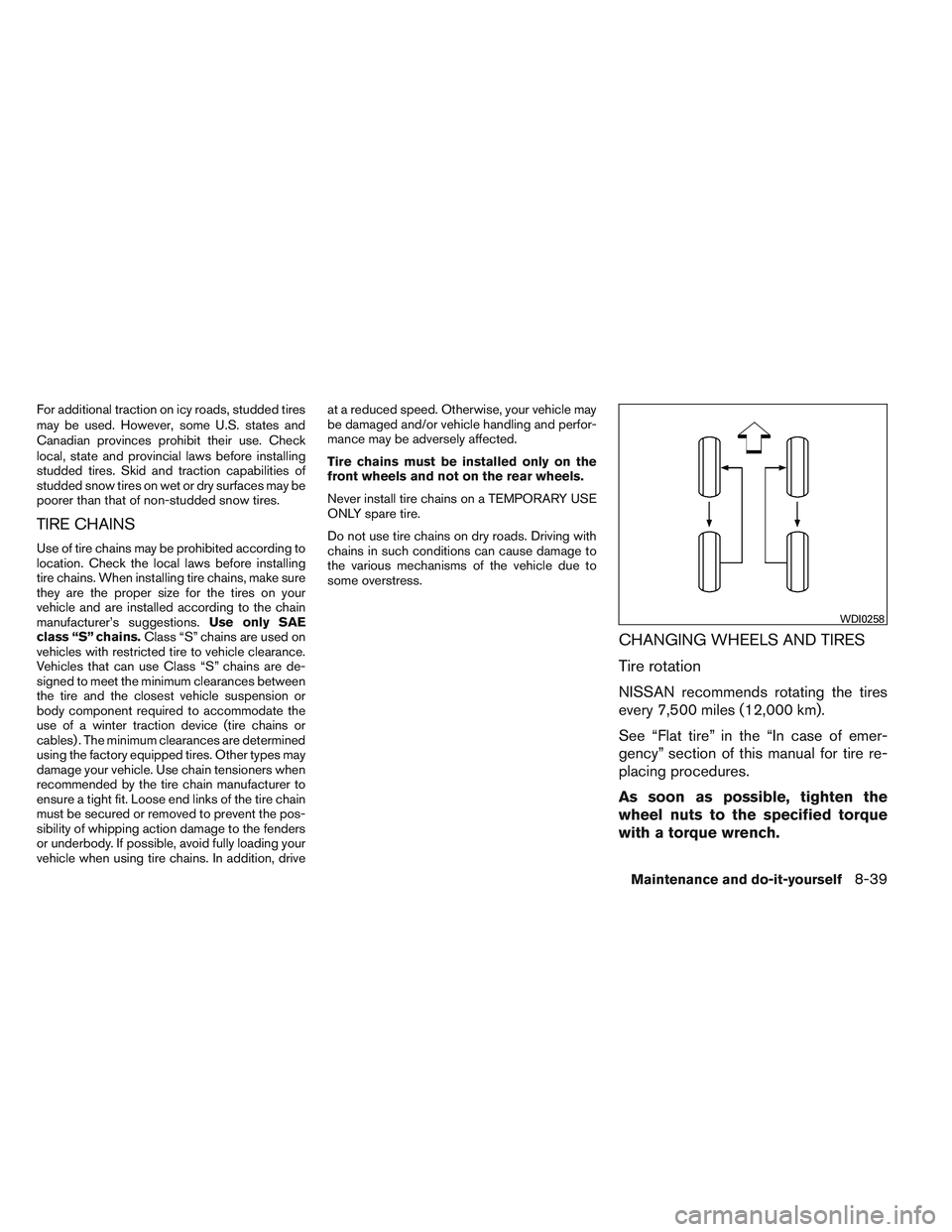
Tire rotation
NISSAN recommends rotating the tires
every 7,500 miles (12,000 km).
See “Flat tire” in the “In case of emer-
gency” section of this manual for tire re-
placing procedures.
As soon as possible, tighten the
wheel nuts to the specified torque
with a torque wrench.
WDI0258
Maintenance and do-it-yourself8-39
Page 301 of 331
Wheel nut tightening torque:83 ft-lb (113 N·m)
The wheel nuts must be kept tight-
ened to specifications at all times. It
is recommended that wheel nuts be
tightened to specification at each
tire rotation interval.
WARNING
● After rotating the tires, check and
adjust the tire pressure.
● Retighten the wheel nuts when
the vehicle has been driven for
600 miles (1,000 km) (also in
cases of a flat tire, etc.) .
● Do not include the spare tire in
the tire rotation.
● For additional information re-
garding tires, refer to “Important
Tire Safety Information” (US) or
“Tire Safety Information”
(Canada) in the Warranty Infor-
mation Booklet.
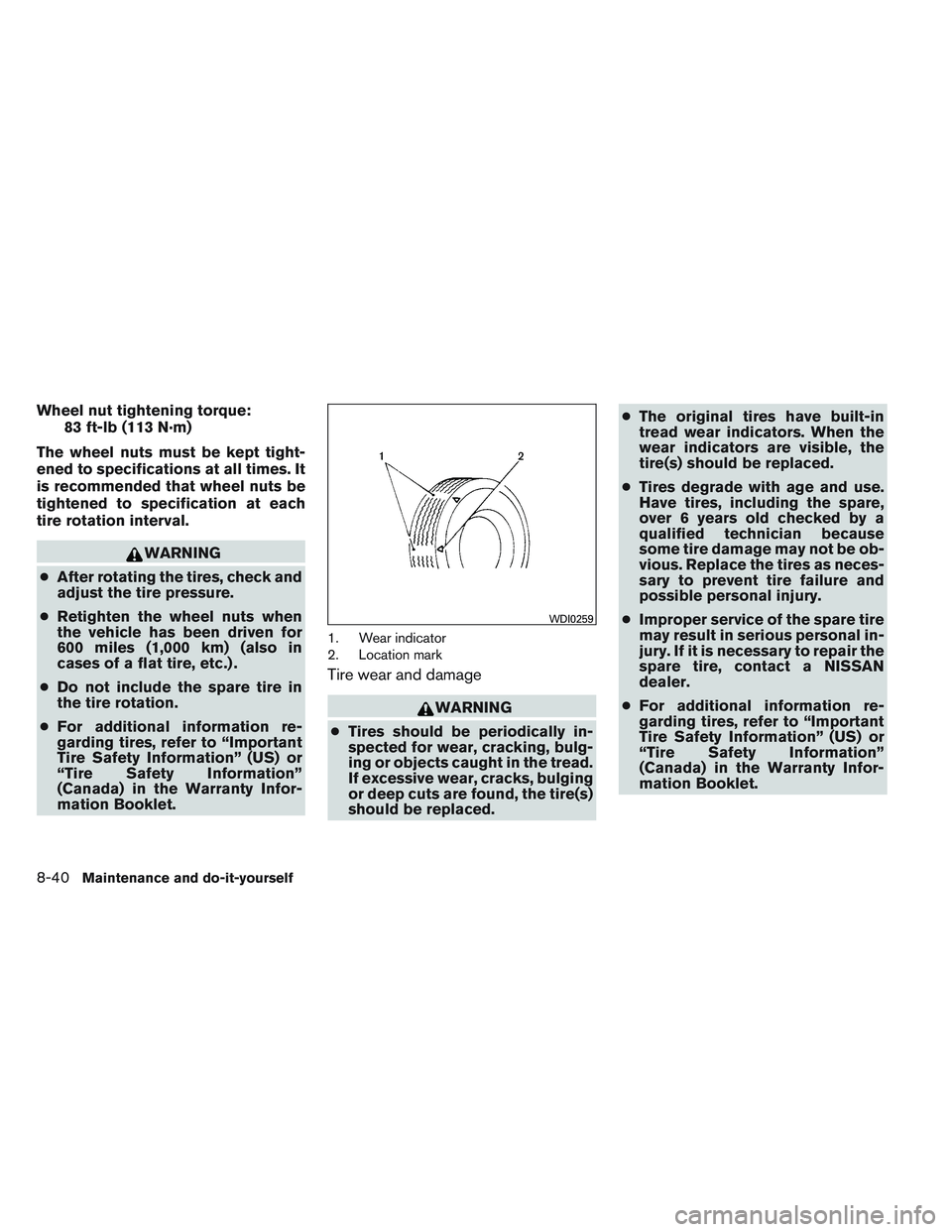
1. Wear indicator
2. Location mark
Tire wear and damage
WARNING
● Tires should be periodically in-
spected for wear, cracking, bulg-
ing or objects caught in the tread.
If excessive wear, cracks, bulging
or deep cuts are found, the tire(s)
should be replaced. ●
The original tires have built-in
tread wear indicators. When the
wear indicators are visible, the
tire(s) should be replaced.
● Tires degrade with age and use.
Have tires, including the spare,
over 6 years old checked by a
qualified technician because
some tire damage may not be ob-
vious. Replace the tires as neces-
sary to prevent tire failure and
possible personal injury.
● Improper service of the spare tire
may result in serious personal in-
jury. If it is necessary to repair the
spare tire, contact a NISSAN
dealer.
● For additional information re-
garding tires, refer to “Important
Tire Safety Information” (US) or
“Tire Safety Information”
(Canada) in the Warranty Infor-
mation Booklet.
WDI0259
8-40Maintenance and do-it-yourself
Page 303 of 331
Care of wheels
●Wash the wheels when washing the vehicle
to maintain their appearance.
● Clean the inner side of the wheels when the
wheel is changed or the underside of the
vehicle is washed.
● Do not use abrasive cleaners when washing
the wheels.
● Inspect wheel rims regularly for dents or
corrosion. Such damage may cause loss of
pressure or poor seal at the tire bead.
● NISSAN recommends waxing the road
wheels to protect against road salt in areas
where it is used during winter.
Spare tire (TEMPORARY USE ONLY
spare tire)
Observe the following precautions if the TEM-
PORARY USE ONLY spare tire must be used.
Otherwise, your vehicle could be damaged or
involved in an accident:
WARNING
● The spare tire should be used for emer-
gency use only. It should be replaced
with the standard tire at the first oppor-
tunity to avoid possible tire or differen-
tial damage.
● Drive carefully while the TEMPORARY
USE ONLY spare tire is installed. Avoid
sharp turns and abrupt braking while
driving.
● Periodically check spare tire inflation
pressure. Always keep the pressure of
the TEMPORARY USE ONLY spare tire
at 60 psi (420 kPa, 4.2 bar) .
● With the TEMPORARY USE ONLY spare
tire installed do not drive the vehicle at
speeds faster than 50 MPH (80 km/h).
● When driving on roads covered with
snow or ice, the TEMPORARY USE
ONLY spare tire should be used on the
rear wheels and the original tire used
on the front wheels (drive wheels) . Use
tire chains only on the front (original)
tires. ●
Tire tread of the TEMPORARY USE
ONLY spare tire will wear at a faster rate
than the standard tire. Replace the
spare tire as soon as the tread wear
indicators appear.
● Do not use the spare tire on other
vehicles.
● Do not use more than one spare tire at
the same time.
● Do not tow a trailer when the TEMPO-
RARY USE ONLY spare tire is installed.
CAUTION
● Do not use tire chains on a TEMPO-
RARY USE ONLY spare tire. Tire chains
will not fit properly and may cause dam-
age to the vehicle.
● Because the TEMPORARY USE ONLY
spare tire is smaller than the original
tire, ground clearance is reduced. To
avoid damage to the vehicle, do not
drive over obstacles. Also, do not drive
the vehicle through an automatic car
wash since it may get caught.
8-42Maintenance and do-it-yourself
Page 307 of 331
●If a methanol blend is used, it should
contain no more than 5% methanol
(methyl alcohol, wood alcohol) . It
should also contain a suitable amount
of appropriate cosolvents and corro-
sion inhibitors. If not properly formu-
lated with appropriate cosolvents and
corrosion inhibitors, such methanol
blends may cause fuel system damage
and/or vehicle performance problems.
At this time, sufficient data is not avail-
able to ensure that all methanol blends
are suitable for use in NISSAN ve-
hicles.
If any driveability problems such as engine stall-
ing and difficult hot-starting are experienced after
using oxygenate-blend fuels, immediately
change to a non-oxygenate fuel or a fuel with a
low blend of MTBE.
Take care not to spill gasoline during refu-
eling. Gasoline containing oxygenates can
cause paint damage.
E–15 fuel
E-15 fuel is a mixture of approximately 15% fuel
ethanol and 85% unleaded gasoline. E-15 can
only be used in vehicles designed to run on E-15
fuel. Do not use E-15 in your vehicle. U.S. gov-
ernment regulations require fuel ethanol dispens-
ing pumps to be identified with small, square, orange and black label with the common abbre-
viation or the appropriate percentage for that
region.
E–85 fuel
E-85 fuel is a mixture of approximately 85% fuel
ethanol and 15% unleaded gasoline. E-85 can
only be used in a Flexible Fuel Vehicle (FFV) . Do
not use E-85 in your vehicle. U.S. government
regulations require fuel ethanol dispensing
pumps to be identified by a small, square, orange
and black label with the common abbreviation or
the appropriate percentage for that region.
Aftermarket fuel additives
NISSAN does not recommend the use of any
aftermarket fuel additives (for example, fuel injec-
tor cleaner, octane booster, intake valve deposit
removers, etc.) which are sold commercially.
Many of these additives intended for gum, varnish
or deposit removal may contain active solvents or
similar ingredients that can be harmful to the fuel
system and engine.
Octane rating tips
Using unleaded gasoline with an octane
rating lower than recommended can cause
persistent, heavy “spark knock.” (“Spark
knock” is a metallic rapping noise.) If se-
vere, this can lead to engine damage. If youdetect a persistent heavy spark knock even
when using gasoline of the stated octane
rating, or if you hear steady spark knock
while holding a steady speed on level
roads, have a NISSAN dealer correct the
condition. Failure to correct the condition
is misuse of the vehicle, for which NISSAN
is not responsible.
Incorrect ignition timing may result in spark
knock, after-run and/or overheating, which may
cause excessive fuel consumption or engine
damage. If any of the above symptoms are en-
countered, have your vehicle checked at a
NISSAN dealer.
However, now and then you may notice
light spark knock for a short time while
accelerating or driving up hills. This is not a
cause for concern, because you get the
greatest fuel benefit when there is light
spark knock for a short time under heavy
engine load.
9-4Technical and consumer information
Page 318 of 331
5. Determine the combined weight ofluggage and cargo being loaded on
the vehicle. That weight may not
safely exceed the available cargo and
luggage load capacity calculated in
Step 4.
Before driving a loaded vehicle, confirm
that you do not exceed the Gross Vehicle
Weight Rating (GVWR) or the Gross Axle
Weight Rating (GAWR) for your vehicle.
See “Measurement of weights” later in
this section.
Also check tires for proper inflation pres-
sures. See the Tire and Loading Informa-
tion label.
LOADING TIPS
● The GVW must not exceed GVWR
or GAWR as specified on the
F.M.V.S.S./C.M.V.S.S. certification
label.
● Do not load the front and rear axle to
the GAWR. Doing so will exceed the
GVWR.
WARNING
● Properly secure all cargo with
ropes or straps to help prevent it
from sliding or shifting. Do not
place cargo higher than the seat-
backs. In a sudden stop or colli-
sion, unsecured cargo could
cause personal injury.
● Do not load your vehicle any
heavier than the GVWR or the
maximum front and rear GAWRs.
If you do, parts of your vehicle
can break, tire damage could oc-
cur, or it can change the way your
vehicle handles. This could result
in loss of control and cause per-
sonal injury. ●
Overloading not only can shorten
the life of your vehicle and the
tire, but can also cause unsafe
vehicle handling and longer brak-
ing distances. This may cause a
premature tire failure which
could result in a serious accident
and personal injury. Failures
caused by overloading are not
covered by the vehicle’s
warranty.
MEASUREMENT OF WEIGHTS
Secure loose items to prevent weight
shifts that could affect the balance of your
vehicle. When the vehicle is loaded, drive
to a scale and weigh the front and the rear
wheels separately to determine axle
loads. Individual axle loads should not ex-
ceed either of the gross axle weight rat-
ings (GAWR) . The total of the axle loads
should not exceed the gross vehicle
weight rating (GVWR) . These ratings are
given on the vehicle certification label. If
weight ratings are exceeded, move or re-
move items to bring all weights below the
ratings.
Technical and consumer information9-15
Page 322 of 331
Due to legal requirements in some states and
Canadian Provinces, your vehicle may be re-
quired to be in what is called the “ready condi-
tion” for an Inspection/Maintenance (I/M) test of
the emission control system.
The vehicle is set to the “ready condition” when it
is driven through certain driving patterns. Usually,
the ready condition can be obtained by ordinary
usage of the vehicle.
If a powertrain system component is repaired or
the battery is disconnected, the vehicle may be
reset to a “not ready” condition. Before taking the
I/M test, check the vehicle’s
inspection/maintenance test readiness condi-
tion. Place the ignition switch in the ON position
without starting the engine. If the Malfunction
Indicator Light (MIL) comes on steady for 20 sec-
onds and then blinks for 10 seconds , the I/M test
condition is “not ready”. If the MIL does not blink
after 20 seconds, the I/M test condition is
“ready”. Contact a NISSAN dealer to set the
“ready condition” or to prepare the vehicle for
testing.This vehicle is equipped with an Event Data Re-
corder (EDR) . The main purpose of an EDR is to
record, in certain crash or near crash-like situa-
tions, such as an air bag deployment or hitting a
road obstacle, data that will assist in understand-
ing how a vehicle’s systems performed. The EDR
is designed to record data related to vehicle
dynamics and safety systems for a short period of
time, typically 30 seconds or less. The EDR in this
vehicle is designed to record such data as:
● How various systems in your vehicle were
operating;
● Whether or not the driver and passenger
safety belts were buckled/fastened;
● How far (if at all) the driver was depressing
the accelerator and/or brake pedal; and,
● How fast the vehicle was traveling.
● Sounds are not recorded. These data can help provide a better understand-
ing of the circumstances in which crashes and
injuries occur. NOTE: EDR data are recorded by
your vehicle only if a nontrivial crash situation
occurs; no data are recorded by the EDR under
normal driving conditions and no personal data
(e.g. name, gender, age and crash location) are
recorded. However, other parties, such as law
enforcement, could combine the EDR data with
the type of personally identifying data routinely
acquired during a crash investigation.
To read data recorded by an EDR, special equip-
ment is required and access to the vehicle or the
EDR is needed. In addition to the vehicle manu-
facturer and NISSAN dealer, other parties, such
as law enforcement, that have the special equip-
ment, can read the information if they have ac-
cess to the vehicle or the EDR. EDR data will only
be accessed with the consent of the vehicle
owner or lessee or as otherwise required or per-
mitted by law.
READINESS FOR INSPECTION/
MAINTENANCE (I/M) TEST
EVENT DATA RECORDERS (EDR)
Technical and consumer information9-19
Page 324 of 331
10 Index
A
ABS (Anti-lock Braking System) ........5-27
Air bag (See supplemental restraint
system) .....................1-36
Air bag system Front (See supplemental front impact air bag
system) ...................1-43
Side and curtain (See supplemental
side air bag and curtain side-impact
air bag system) ...............1-48
Airbagwarninglabels.............1-50
Airbagwarninglight...........1-51,2-16
Air cleaner housing filter ............8-17
Air conditioner Air conditioner operation ..........4-16
Air conditioner service ...........4-21
Air conditioner specification label .....9-11
Air conditioner system refrigerant and
oil recommendations .............9-6
Heater and air conditioner controls ....4-14
Servicing air conditioner ..........4-21
Airflowcharts..................4-17
Anchor point locations .............1-22
Antenna.....................4-52
Anti-lock brake warning light ..........2-12
Anti-lock Braking System (ABS) ........5-27
Armrests .....................1-5
Audible reminders ...............2-19
Audio system ..................4-21
Compact disc (CD) player . .4-33, 4-36, 4-41 FM/AM radio with compact disc
(CD) player
..............4-31,4-34
FM/AM/SAT radio with compact disc
(CD) player .................4-38
Audio System iPod®Player.............4-46,4-49
Audio system Radio ....................4-21
Steering wheel audio control switch . . .4-52
USB interface ................4-44
Automatic Automatic power window switch .....2-30
Automatic transmission fluid (ATF) ....8-11
Automatic door locks ..............3-7
AUXjack..............4-33,4-37,4-43
B
Battery ......................8-13
Chargewarninglight............2-13
Before starting the engine ...........5-12
Belt (See drive belt) ..............8-16
Block heater Engine ....................5-31
Bluetooth® hands-free phone system ....4-54
Boosterseats..................1-32
Brake Anti-lock Braking System (ABS) ......5-27
Brake fluid ..................8-12
Brake light (See stop light) .........8-28
Brake system ................5-26
Brake warning light .............2-12 Brake wear indicators
........2-19,8-20
Parking brake operation ..........5-19
Self-adjusting brakes ............8-20
Brakes ......................8-20
Break-inschedule ...............5-22
Brightness/contrast button ...........4-8
Brightness control Instrument panel ..............2-24
Bulb check/instrument panel ..........2-12
Bulbreplacement................8-28
C
Capacities and recommended
fuel/lubricants ...................9-2
Cargo (See vehicle loading information) . . .9-12
CarphoneorCBradio.............4-53
CDcareandcleaning .............4-51
CD player (See audio system) . .4-33, 4-36, 4-41
Child restraints .......1-17,1-18,1-19,1-21
Precautions on child
restraints ........1-19,1-24,1-29,1-32
Top tether strap anchor point locations . .1-22
Child safety rear door lock ............3-7
Chimes,audiblereminders...........2-19
Cleaning
exterior and interior ..........7-2
Clock...................4-32,4-35
C.M.V.S.S. certification label ..........9-10
Cold weather driving ..............5-30
Compact disc (CD) player ....4-33,4-36,4-41
Continuously Variable Transmission (CVT) . .5-15
Page 325 of 331
Continuously Variable Transmission
(CVT) fluid..................8-12
Driving with Continuously Variable
Transmission (CVT) .............5-15
Controlpanelbuttons...............4-2 Brightness/contrast button ..........4-8
Enterbutton..................4-2
Setting button .................4-5
Controls Audiocontrols(steeringwheel).......4-52
Heater and air conditioner controls .....4-14
Coolant Capacities and recommended
fuel/lubricants .................9-2
Changing engine coolant ...........8-8
Checking engine coolant level ........8-8
Corrosionprotection ...............7-6
Cruise control ..................5-20
Cupholders...................2-28
Curtain side-impact air bag system
(See supplemental side air bag and curtain
side-impact air bag system) ...........1-48
D
Daytime running light system (Canada only) . .2-23
Defroster switch Rear window defroster switch .......2-22
Dimensionsandweights.............9-8
Dimmer switch for instrument panel ......2-24
Display controls (see control panel buttons) . .4-2
Door locks .....................3-5
Door open warning light .............2-13
Drive belt .....................8-16 Driving
Cold weather driving ............5-30
Driving with Continuously Variable
Transmission (CVT) .............5-15
Driving with manual transmission ......5-18
Precautions when starting and driving ....5-2
E
Economy - fuel ..................5-24
Emission control information label .......9-10
Emission control system warranty .......9-17
Engine Before starting the engine ..........5-12
Block heater .................5-31
Capacities and recommended
fuel/lubricants .................9-2
Changing engine coolant ...........8-8
Changing engine oil .............8-10
Changing engine oil filter ..........8-11
Checking engine coolant level ........8-8
Checking engine oil level ...........8-9
Engine compartment check locations ....8-6
Engine cooling system ............8-7
Engineoil ...................8-9
Engine oil and oil filter recommendation . . .9-5
Engine oil pressure warning light ......2-13
Engine oil viscosity ..............9-5
Engine serial number ............9-10
Engine specifications .............9-7
Starting the engine ..........5-13,5-14
Enterbutton....................4-2
Eventdatarecorders ..............9-19
Exhaust gas (Carbon monoxide) .........5-2
Extended storage switch ............8-23 F
Flashers (See hazard warning flasher switch) . .6-2
Flat tire .......................6-3
Floor mat positioning aid .............7-5
Fluid Automatic transmission fluid (ATF) .....8-11
Brake fluid ..................8-12
Capacities and recommended
fuel/lubricants .................9-2
Continuously Variable Transmission
(
CVT)fluid..................8-12
Engine coolant .................8-7
Engine oil ...................8-9
F.M.V.S.S. certification label ...........9-10
Foglightswitch .................2-25
Front air bag system
(See supplemental restraint system) ......1-43
Front seats .....................1-2
Fuel Capacities and recommended
fuel/lubricants .................9-2
Fuel economy ................5-24
Fuel-filler door and cap ...........3-27
Fuel-filler door lock opener lever ......3-27
Fuelgauge...................2-8
Fuel octane rating ...............9-4
Fuel recommendation .............9-3
Loose fuel cap warning ........2-6,3-27
Fuses.......................8-20
Fusiblelinks ...................8-21
10-2
Page 326 of 331
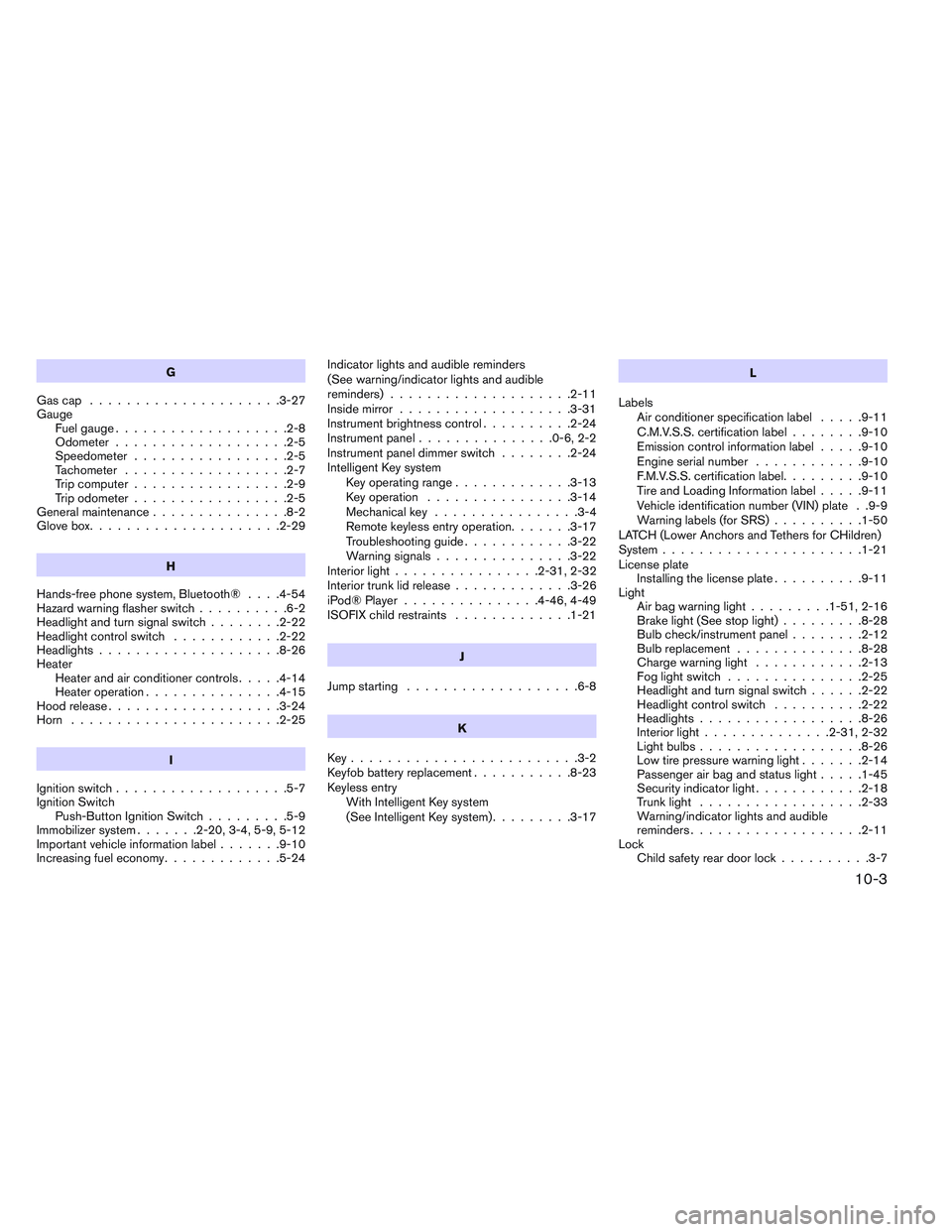
G
Gascap .....................3-27
Gauge Fuel gauge ...................2-8
Odometer ...................2-5
Speedometer .................2-5
Tachometer ..................2-7
Trip computer .................2-9
Trip odometer .................2-5
Generalmaintenance...............8-2
Glovebox.....................2-29
H
Hands-free phone system, Bluetooth® ....4-54
Hazard warning flasher switch ..........6-2
Headlightandturnsignalswitch........2-22
Headlightcontrolswitch ............2-22
Headlights....................8-26
Heater Heater and air conditioner controls .....4-14
Heater operation ...............4-15
Hood release ...................3-24
Horn .......................2-25
I
Ignition switch ...................5-7
Ignition Switch Push-Button Ignition Switch .........5-9
Immobilizer system .......2-20,3-4,5-9,5-12
Importantvehicleinformationlabel.......9-10
Increasing fuel economy .............5-24 Indicator lights and audible reminders
(See warning/indicator lights and audible
reminders)....................2-11
Inside mirror
...................3-31
Instrument brightness control ..........2-24
Instrument panel ...............0-6,2-2
Instrument panel dimmer switch ........2-24
Intelligent Key system Key operating range .............3-13
Key operation ................3-14
Mechanicalkey ................3-4
Remote keyless entry operation .......3-17
Troubleshooting guide ............3-22
Warning signals ...............3-22
Interiorlight................2-31,2-32
Interiortrunklidrelease.............3-26
iPod® Player ...............4-46,4-49
ISOFIX child restraints .............1-21
J
Jump starting ...................6-8
K
Key.........................3-2
Keyfob battery replacement ...........8-23
Keyless entry With Intelligent Key system
(See Intelligent Key system) .........3-17 L
Labels Air conditioner specification label .....9-11
C.M.V.S.S. certification label ........9-10
Emission control information label .....9-10
Engine serial number ............9-10
F.M.V.S.S. certification label .........9-10
Tire and Loading Information label .....9-11
Vehicle identification number (VIN) plate . .9-9
Warning labels (for SRS) ..........1-50
LATCH (Lower Anchors and Tethers for CHildren)
System ......................1-21
License plate Installing the license plate ..........9-11
Light Airbagwarninglight.........1-51, 2-16
Brake light (See stop light) .........8-28
Bulb check/instrument panel ........
2-12
Bulbreplacement..............8-28
Charge warning light ............2-13
Fog light switch ...............2-25
Headlightandturnsignalswitch......2-22
Headlight control switch ..........2-22
Headlights..................8-26
Interiorlight..............2-31,2-32
Lightbulbs..................8-26
Low tire pressure warning light .......2-14
Passenger air bag and status light .....1-45
Security indicator light ............2-18
Trunklight ..................2-33
Warning/indicator lights and audible
reminders...................2-11
Lock Child safety rear door lock ..........3-7
10-3
Page 327 of 331
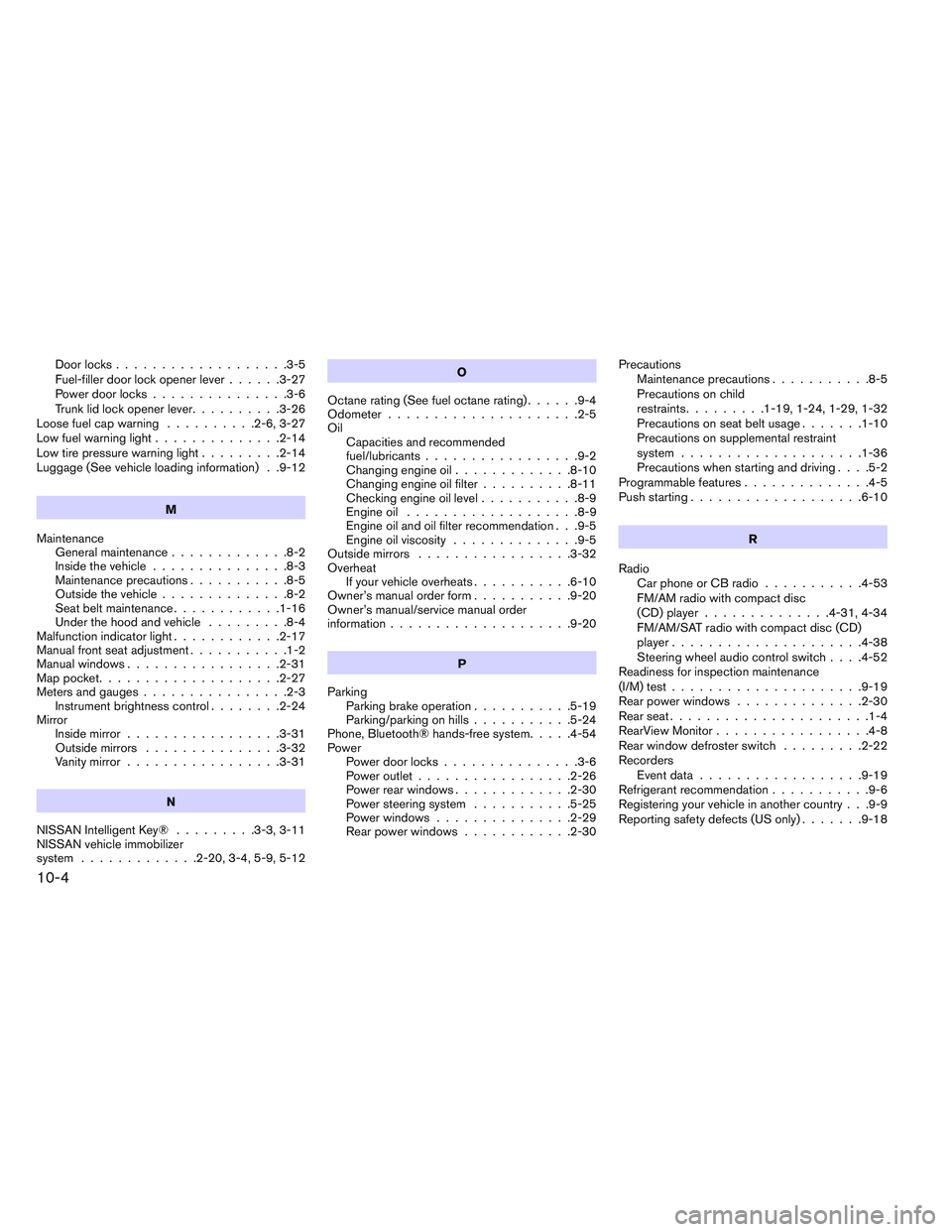
Door locks...................3-5
Fuel-filler door lock opener lever ......3-27
Power door locks ...............3-6
Trunk lid lock opener lever ..........3-26
Loose fuel cap warning ..........2-6,3-27
Lowfuelwarninglight..............2-14
Low tire pressure warning light .........2-14
Luggage (See vehicle loading information) . .9-12
M
Maintenance Generalmaintenance.............8-2
Insidethevehicle...............8-3
Maintenanceprecautions...........8-5
Outsidethevehicle..............8-2
Seat belt maintenance ............1-16
Under the hood and vehicle .........8-4
Malfunction indicator light ............2-17
Manual front seat adjustment ...........1-2
Manual windows .................2-31
Map pocket ....................2-27
Meters and gauges ................2-3
Instrument brightness control ........2-24
Mirror Inside mirror .................3-31
Outside mirrors ...............3-32
Vanity mirror .................3-31
N
NISSAN Intelligent Key® .........3-3,3-11
NISSAN vehicle immobilizer
system .............2-20,3-4,5-9,5-12 O
Octane rating (See fuel octane rating) ......9-4
Odometer .....................2-5
Oil Capacities and recommended
fuel/lubricants .................9-2
Changing engine oil .............8-10
Changing engine oil filter ..........8-11
Checking engine oil level ...........8-9
Engineoil ...................8-9
Engine oil and oil filter recommendation . . .9-5
Engine oil viscosity ..............9-5
Outside mirrors .................3-32
Overheat If your vehicle overheats ...........6-10
Owner’s manual order form ...........9-20
Owner’s manual/service manual order
information ....................9-20
P
Parking Parking brake operation ...........5-19
Parking/parking on hills ...........5-24
Phone, Bluetooth® hands-free system .....4-54
Power Power door locks ...............3-6
Power outlet .................2-26
Power rear windows .............2-30
Power steering system ...........5-25
Power windows ...............2-29
Rear power windows ............2-30 Precautions
Maintenanceprecautions...........8-5
Precautions on child
restraints .........1-19,1-24,1-29,1-32
Precautions on seat belt usage .......1-10
Precautions on supplemental restraint
system ....................1-36
Precautions when starting and driving ....5-2
Programmablefeatures..............4-5
Push starting ...................6-10
R
Radio CarphoneorCBradio...........4-53
FM/AM
radio with compact disc
(CD) player ..............4-31,4-34
FM/AM/SAT radio with compact disc (CD)
player .....................4-38
Steering wheel audio control switch ....4-52
Readiness for inspection maintenance
(I/M) test .....................9-19
Rear power windows ..............2-30
Rear seat ......................1-4
RearViewMonitor.................4-8
Rear window defroster switch .........2-22
Recorders Eventdata..................9-19
Refrigerant recommendation ...........9-6
Registering your vehicle in another country . . .9-9
Reporting safety defects (US only) .......9-18
10-4