cruise control NISSAN VERSA 2018 Owners Manual
[x] Cancel search | Manufacturer: NISSAN, Model Year: 2018, Model line: VERSA, Model: NISSAN VERSA 2018Pages: 354, PDF Size: 4.84 MB
Page 16 of 354
18. Cruise control switches (if so
equipped) (P. 5-19)
19. Tilt steering (P. 3-15)
20. Audio control switches (P. 4-48)
Bluetooth® Hands-Free Phone
System switches (P. 4-50)
21. Vehicle Dynamic Control (VDC) OFF
switch (P. 2-25)
21. Fuel-filler door release lever (P. 3-13)
Hood release lever (P. 3-10)
23. Electronic outside rearview mirror
control switch (P. 3-17)
Refer to the page number indicated in
parentheses for operating details.
Illustrated table of contents0-7
Page 84 of 354
18. Cruise control switches
(if so equipped) (P. 5-19)
19. Tilt steering (P. 3-15)
20. Audio control switches (P. 4-48)
Bluetooth® Hands-Free Phone
System switches (P. 4-50)
21. Vehicle Dynamic Control (VDC) OFF
switch (P. 2-25)
21. Fuel-filler door release lever (P. 3-13)
Hood release lever (P. 3-10)
23. Electronic outside rearview mirror
control switch (P. 3-17)
Refer to the page number indicated in
parentheses for operating details.
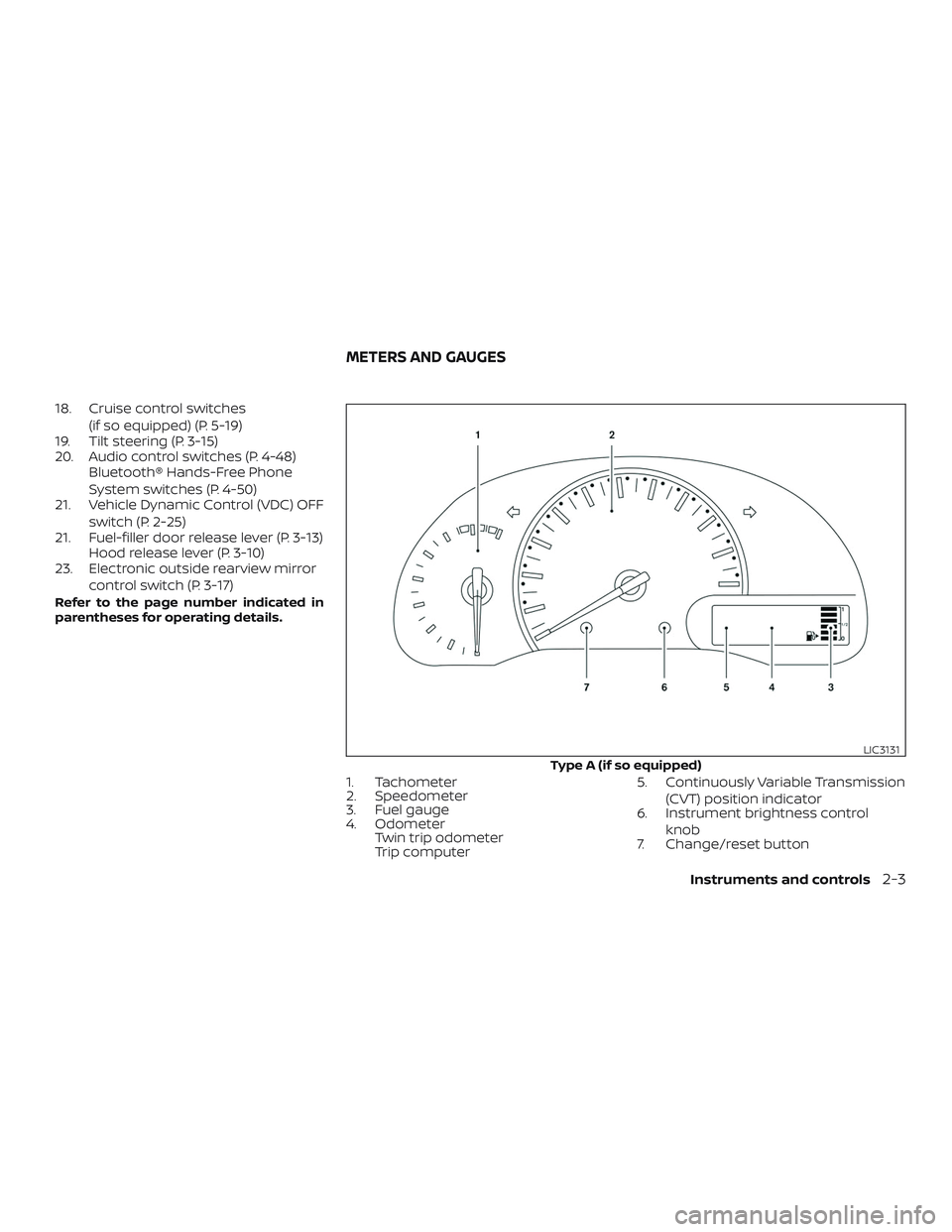
1. Tachometer
2. Speedometer
3. Fuel gauge
4. Odometer
Twin trip odometer
Trip computer5. Continuously Variable Transmission
(CVT) position indicator
6. Instrument brightness control
knob
7. Change/reset button
Type A (if so equipped)
LIC3131
METERS AND GAUGES
Instruments and controls2-3
Page 93 of 354
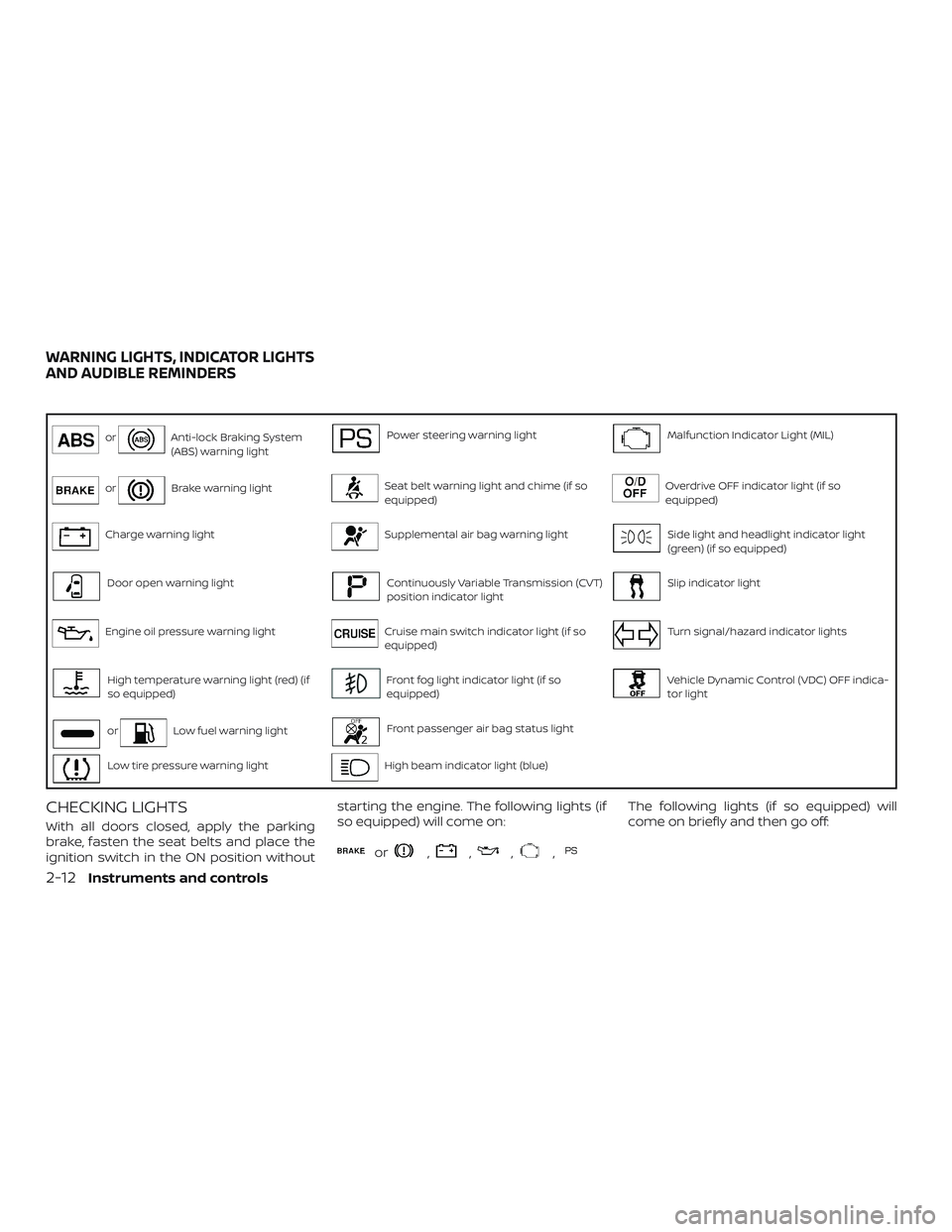
orAnti-lock Braking System
(ABS) warning lightPower steering warning lightMalfunction Indicator Light (MIL)
orBrake warning lightSeat belt warning light and chime (if so
equipped)Overdrive OFF indicator light (if so
equipped)
Charge warning lightSupplemental air bag warning lightSide light and headlight indicator light
(green) (if so equipped)
Door open warning lightContinuously Variable Transmission (CVT)
position indicator lightSlip indicator light
Engine oil pressure warning lightCruise main switch indicator light (if so
equipped)Turn signal/hazard indicator lights
High temperature warning light (red) (if
so equipped)Front fog light indicator light (if so
equipped)Vehicle Dynamic Control (VDC) OFF indica-
tor light
orLow fuel warning lightFront passenger air bag status light
Low tire pressure warning lightHigh beam indicator light (blue)
CHECKING LIGHTS
With all doors closed, apply the parking
brake, fasten the seat belts and place the
ignition switch in the ON position withoutstarting the engine. The following lights (if
so equipped) will come on:
or,,,,
The following lights (if so equipped) will
come on briefly and then go off:
WARNING LIGHTS, INDICATOR LIGHTS
AND AUDIBLE REMINDERS
2-12Instruments and controls
Page 99 of 354
tion properly. For additional information, re-
fer to “Supplemental Restraint System
(SRS)” in the “Safety—Seats, seat belts and
supplemental restraint system” section of
this manual.
WARNING
If the supplemental air bag warning
light is on, it could mean that the front
air bag, side air bag, curtain air bag
and/or pretensioner systems will not
operate in an accident. To help avoid
injury to yourself or others, have your
vehicle checked as soon as possible. It is
recommended that you visit a NISSAN
dealer for this service.
INDICATOR LIGHTS
This vehicle has various indicator lights
that may illuminate to indicate a system
status. For additional information, refer to
the specific light in this section.
Continuously Variable
Transmission (CVT)
position indicator light
When the ignition switch is placed in the ON
position, this indicator light shows the shif t
lever position. For additional information,refer to “Driving the vehicle” in the “Starting
and driving” section of this manual.
Cruise main switch
indicator light (if so
equipped)
The light comes on when the cruise control
main switch is pushed. The light goes out
when the main switch is pushed again.
When the cruise main switch indicator light
comes on, the cruise control system is op-
erational. For additional information, refer
to “Cruise control” in the “Starting and driv-
ing” section of this manual.
Front fog light indicator
light (if so equipped)
The front fog light indicator light illumi-
nates when the front fog lights are on. For
additional information, refer to “Fog light
switch” in this section.
Front passenger air bag
status light
The front passenger air bag status light will
be lit and the passenger front air bag will be
off depending on how the front passenger
seat is being used.For additional information, refer to “Front
passenger air bag and status light” in the
“Safety — Seats, seat belts and supplemen-
tal restraint system” section of this manual.
High beam indicator light
(blue)
This blue light comes on when the head-
light high beams are on and goes out when
the low beams are selected.
The high beam indicator light also comes
on when the passing signal is activated.
Malfunction Indicator Light
(MIL)
If this indicator light comes on steady or
blinks while the engine is running, it may
indicate a potential emission control mal-
function.
The MIL may also come on steady if the
fuel-filler cap is loose or missing, or if the
vehicle runs out of fuel. Check to make sure
the fuel-filler cap is installed and closed
tightly, and that the vehicle has at least
3 gallons (11.4 liters) of fuel in the fuel tank.
Af ter a few driving trips, the
light
should turn off if no other potential emis-
sion control system malfunction exists.
2-18Instruments and controls
Page 212 of 354
5 Starting and driving
Precautions when starting and driving..........5-2
Exhaust gas (carbon monoxide)..............5-2
Three-way catalyst...........................5-2
Tire Pressure Monitoring System
(TPMS)........................................5-3
Avoiding collision and rollover................5-6
Off-roadrecovery ............................5-6
Rapid air pressure loss.......................5-7
Drinking alcohol/drugs and driving...........5-8
Ignition switch...................................5-8
Continuously Variable Transmission
(if so equipped)...............................5-8
Manual transmission (if so equipped).........5-9
Ignition switch positions......................5-9
Before starting the engine......................5-10
Starting the engine.............................5-10
Driving the vehicle...............................5-11
Continuously Variable Transmission
(CVT) (if so equipped).........................5-11
Manual transmission (if so equipped)........5-16
Parking brake..................................5-18
Cruise control (if so equipped)..................5-19Precautions on cruise control................5-19
Cruise control operations....................5-19
Break-in schedule..............................5-20
Fuel efficient driving tips........................5-21
Increasing fuel economy.......................5-22
Parking/parking on hills........................5-23
Power steering.................................5-24
Brake system...................................5-25
Brake precautions...........................5-25
Anti-lock Braking System (ABS)..............5-25
Brake assist.................................5-26
Vehicle Dynamic Control (VDC) system.........5-27
Brake force distribution......................5-28
Cold weather driving...........................5-29
Freeing a frozen door lock...................5-29
Antifreeze...................................5-29
Battery......................................5-29
Draining of coolant water....................5-30
Tire equipment..............................
5-30
Special winter equipment...................5-30
Driving on snow or ice.......................5-30
Engine block heater (if so equipped).........5-31
Page 230 of 354
PRECAUTIONS ON CRUISE
CONTROL
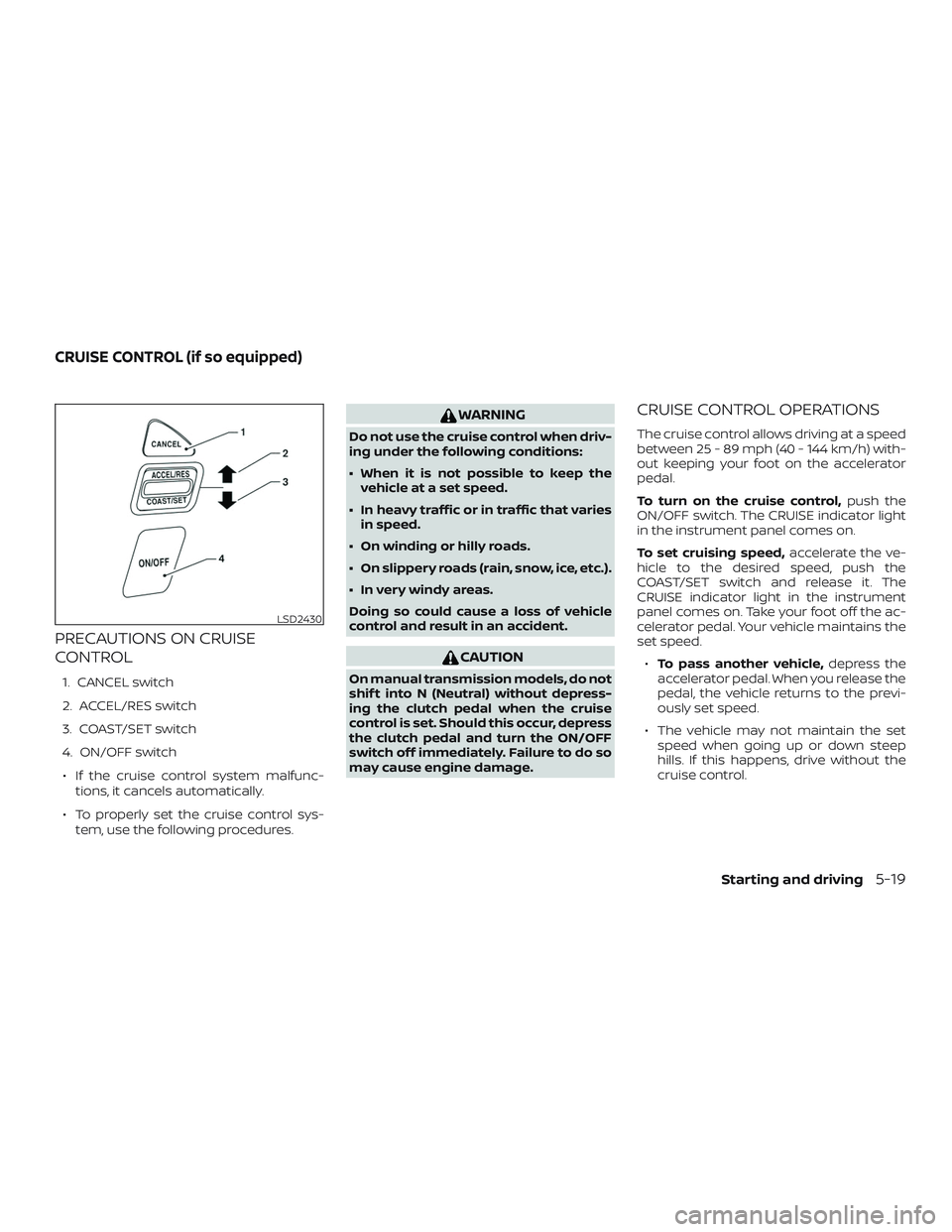
1. CANCEL switch
2. ACCEL/RES switch
3. COAST/SET switch
4. ON/OFF switch
∙ If the cruise control system malfunc-
tions, it cancels automatically.
∙ To properly set the cruise control sys-
tem, use the following procedures.
WARNING
Do not use the cruise control when driv-
ing under the following conditions:
∙ When it is not possible to keep the
vehicle at a set speed.
∙ In heavy traffic or in traffic that varies
in speed.
∙ On winding or hilly roads.
∙ On slippery roads (rain, snow, ice, etc.).
∙ In very windy areas.
Doing so could cause a loss of vehicle
control and result in an accident.
CAUTION
On manual transmission models, do not
shif t into N (Neutral) without depress-
ing the clutch pedal when the cruise
control is set. Should this occur, depress
the clutch pedal and turn the ON/OFF
switch off immediately. Failure to do so
may cause engine damage.
CRUISE CONTROL OPERATIONS
The cruise control allows driving at a speed
between 25 - 89 mph (40 - 144 km/h) with-
out keeping your foot on the accelerator
pedal.
To turn on the cruise control,push the
ON/OFF switch. The CRUISE indicator light
in the instrument panel comes on.
To set cruising speed,accelerate the ve-
hicle to the desired speed, push the
COAST/SET switch and release it. The
CRUISE indicator light in the instrument
panel comes on. Take your foot off the ac-
celerator pedal. Your vehicle maintains the
set speed.
∙To pass another vehicle,depress the
accelerator pedal. When you release the
pedal, the vehicle returns to the previ-
ously set speed.
∙ The vehicle may not maintain the set
speed when going up or down steep
hills. If this happens, drive without the
cruise control.
LSD2430
CRUISE CONTROL (if so equipped)
Starting and driving5-19
Page 231 of 354
To cancel the preset speed,use one of the
following three methods:
∙ Push the CANCEL switch; the CRUISE
indicator light in the instrument panel
goes out.
∙ Tap the brake pedal; the CRUISE indica-
tor light goes out.
∙ Push the ON/OFF switch off. The CRUISE
indicator light in the instrument panel
goes out.
The cruise control is automatically can-
celed and the CRUISE indicator light in the
instrument panel goes out if:
∙ You depress the brake or clutch pedal
while pushing the ACCEL/RES or
SET/COAST switch. The preset speed is
deleted from memory.
∙ The vehicle slows down more than
8 mph (13 km/h) below the set speed.
∙ You depress the clutch pedal (manual
transmission), or move the shif t lever
into N (Neutral) (Continuously Variable
Transmission).
To reset at a faster cruising speed,use
one of the following three methods:
∙
Depress the accelerator pedal. When the
vehicle attains the desired speed, push
and release the COAST/SET switch.
∙ Push and hold the ACCEL/RES switch.
When the vehicle attains the speed you
desire, release the switch.
∙ Push and release the ACCEL/RES
switch. Each time you do this, the set
speed increases by about 1 mph
(1.6 km/h).
To reset at a slower cruising speed,use
one of the following three methods:
∙ Lightly tap the brake pedal. When the
vehicle attains the desired speed, push
the COAST/SET switch and release it.
∙ Push and hold the COAST/SET switch.
Release the switch when the vehicle
slows to the desired speed.
∙ Push and release the COAST/SET
switch. Each time you do this, the set
speed decreases by about 1 mph
(1.6 km/h).
To resume the preset speed,push and
release the ACCEL/RES switch. The vehicle
returns to the last set cruising speed when
the vehicle speed is over 25 mph (40 km/h).CAUTION
During the first 1,200 miles (2,000 km),
follow these recommendations to ob-
tain maximum engine performance
and ensure the future reliability and
economy of your new vehicle. Failure to
follow these recommendations may re-
sult in shortened engine life and re-
duced engine performance.
∙ Avoid driving for long periods at con-
stant speed, either fast or slow, and do
not run the engine over 4,000 rpm.
∙ Do not accelerate at full throttle in any
gear.
∙ Avoid quick starts.
∙ Avoid hard braking as much as pos-
sible.
BREAK-IN SCHEDULE
5-20Starting and driving
Page 232 of 354
Follow these easy-to-use Fuel Efficient
Driving Tips to help you achieve the most
fuel economy from your vehicle.
1.Use Smooth Accelerator and Brake
Pedal Application
∙ Avoid rapid starts and stops.
∙ Use smooth, gentle accelerator and
brake application whenever possible.
∙ Maintain constant speed while com-
muting and coast whenever pos-
sible.
2.Maintain Constant Speed
∙ Look ahead to try and anticipate and
minimize stops.
∙ Synchronizing your speed with traffic
lights allows you to reduce your num-
ber of stops.
∙ Maintaining a steady speed can mini-
mize red light stops and improve fuel
efficiency.
3.Use Air Conditioning (A/C) at Higher
Vehicle Speeds
∙ Below 40 mph (64 km/h), it is more
efficient to open windows to cool the
vehicle due to reduced engine load.∙ Above 40 mph (64 km/h), it is more
efficient to use A/C to cool the vehicle
due to increased aerodynamic drag.
∙ Recirculating the cool air in the cabin
when the A/C is on reduces cooling
load.
4.Drive at Economical Speeds and Dis-
tances
∙ Observing the speed limit and not
exceeding 60 mph (97 km/h) (where
legally allowed) can improve fuel effi-
ciency due to reduced aerodynamic
drag.
∙ Maintaining a safe following distance
behind other vehicles reduces un-
necessary braking.
∙ Safely monitoring traffic to anticipate
changes in speed permits reduced
braking and smooth acceleration
changes.
∙ Select a gear range suitable to road
conditions.
5.Use Cruise Control
∙ Using cruise control during highway
driving helps maintain a steady
speed.∙ Cruise control is particularly effective
in providing fuel savings when driving
on flat terrains.
6.Plan for the Shortest Route
∙ Utilize a map or navigation system to
determine the best route to save
time.
7.Avoid Idling
∙ Shutting off your engine when safe
for stops exceeding 30–60 seconds
saves fuel and reduces emissions.
8.
Buy an Automated Pass for Toll Roads
∙ Automated passes permit drivers to
use special lanes to maintain cruis-
ing speed through the toll and avoid
stopping and starting.
9.Winter Warm Up
∙ Limit idling time to minimize impact
to fuel economy.
∙ Vehicles typically need no more than
30 seconds of idling at start-up to
effectively circulate the engine oil be-
fore driving.
∙ Your vehicle will reach its ideal oper-
ating temperature more quickly
while driving versus idling.
FUEL EFFICIENT DRIVING TIPS
Starting and driving5-21
Page 242 of 354
∙ Watch for slippery spots (glare ice).
These may appear on an otherwise
clear road in shaded areas. If a patch
of ice is seen ahead, brake before
reaching it. Try not to brake while on
the ice, and avoid any sudden steering
maneuvers.
∙ Do not use the cruise control (if so
equipped) on slippery roads.
∙ Snow can trap dangerous exhaust
gases under your vehicle. Keep snow
clear of the exhaust pipe and from
around your vehicle.
ENGINE BLOCK HEATER (if so
equipped)
Engine block heaters are used to assist
with cold temperature starting.
The engine block heater should be used
when the outside temperature is 20°F (-7°C)
or lower.
WARNING
∙ Do not use your engine block heater
with an ungrounded electrical system
or a 2-pronged adapter. You can be
seriously injured by an electrical
shock if you use an ungrounded
connection.
∙ Disconnect and properly store the en-
gine block heater cord before starting
the engine. Damage to the cord could
result in an electrical shock and can
cause serious injury.
∙ Use a heavy-duty 3-wire, 3-pronged
extension cord rated for at least 10 A.
Plug the extension cord into a Ground
Fault Interrupt (GFI) protected,
grounded 110-VAC outlet. Failure to
use the proper extension cord or a
grounded outlet can result in a fire or
electrical shock and cause serious
personal injury.To use the engine block heater:
1. Turn the engine off.
2. Open the hood and unwrap the engine
block heater cord.
3. Plug the engine block heater cord into
a grounded 3-wire, 3-pronged exten-
sion cord.
4. Plug the extension cord into a Ground
Fault Interrupt (GFI) protected,
grounded 110-volt AC (VAC) outlet.
5. The engine block heater must be
plugged in for at least 2 to 4 hours,
depending on outside temperatures,
to properly warm the engine coolant.
Use an appropriate timer to turn the
engine block heater on.
6. Before starting the engine, unplug and
properly store the cord to keep it away
from moving parts.
Starting and driving5-31
Page 347 of 354
CD player
(See audio system).......4-29,4-35,4-40
Childrestraints........1-18, 1-19, 1-20, 1-23
LATCH (Lower Anchors and Tethers for
CHildren)System..............1-23
Precautions on child
restraints .........1-20, 1-27, 1-33, 1-38
Top tether strap anchor point
locations...................1-25
Child safety rear door lock..........3-5
Chimes, audible reminders.........2-20
Cleaningexteriorandinterior......7-2,7-4
Clock set/adjustment . .4-28, 4-33, 4-34, 4-37
Clock setting (models without Navigation
System)..................4-28,4-39
Clutch
Clutchfluid.................8-10
Coldweatherdriving.............5-29
Compact disc (CD) player . . .4-29, 4-35, 4-40
Continuously Variable Transmission
(CVT).....................5-8,5-11
Continuously Variable Transmission
(CVT) fluid...................8-9
Driving with Continuously Variable
Transmission (CVT)..........5-8,5-11
Controls
Audio controls (steering wheel)....4-48
Heater and air conditioner controls . . .4-9
Coolant
Capacities and recommended
fuel/lubricants...............10-2
Changing engine coolant.........8-5
Checking engine coolant level......8-5
Engine coolant temperature gauge . .2-8
Corrosionprotection..............7-7
Cruisecontrol..................5-19Cupholders...................2-29
Curtain side-impact and rollover air
bag........................1-57
D
Defroster switch
Rearwindowdefrosterswitch.....2-22
Dimensions and weights...........10-9
Dimmer switch for instrument panel . . .2-23
Door locks..................3-3,3-4
Door open warning light...........2-14
Drivebelt ....................8-14
Driving
Cold weather driving...........5-29
Driving with Continuously Variable
Transmission (CVT)..........5-8,5-11
Driving with manual
transmission..............5-9,5-16
Precautions when starting and
driving.....................5-2
Drivingthevehicle...............5-11
E
Economy - fuel.................5-22
Emission control information label. . . .10-11
Emission control system warranty . . . .10-19
Engine
Before starting the engine........5-10
Blockheater ................5-31
Capacities and recommended
fuel/lubricants...............10-2
Changing engine coolant.........8-5Changing engine oil............8-7
Changing engine oil filter.........8-8
Checking engine coolant level......8-5
Checking engine oil level.........8-6
Engine compartment check
locations...................8-3
Engine coolant temperature gauge . .2-8
Engine cooling system..........8-4
Engine oil...................8-6
Engine oil and oil filter
recommendation.............10-6
Engine oil pressure warning light....2-14
Engine oil viscosity.............10-7
Engine serial number...........10-11
Engine specifications...........10-8
Starting the engine............5-10
Engine coolant temperature gauge....2-8
EventDatarecorders ............10-21
Exhaust gas (Carbon monoxide).......5-2
Explanation of maintenance items.....9-2
Explanation of scheduled maintenance
items .......................9-5
Extended storage switch..........8-20
F
Flashers
(Seehazardwarningflasherswitch)....6-2
Flattire....................6-2,6-3
Floormatpositioningaid...........7-6
Fluid
Brakefluid..................8-9
Capacities and recommended
fuel/lubricants...............10-2
Clutchfluid.................8-10
11-2