weight NISSAN VERSA NOTE 2014 2.G User Guide
[x] Cancel search | Manufacturer: NISSAN, Model Year: 2014, Model line: VERSA NOTE, Model: NISSAN VERSA NOTE 2014 2.GPages: 372, PDF Size: 3.94 MB
Page 342 of 372
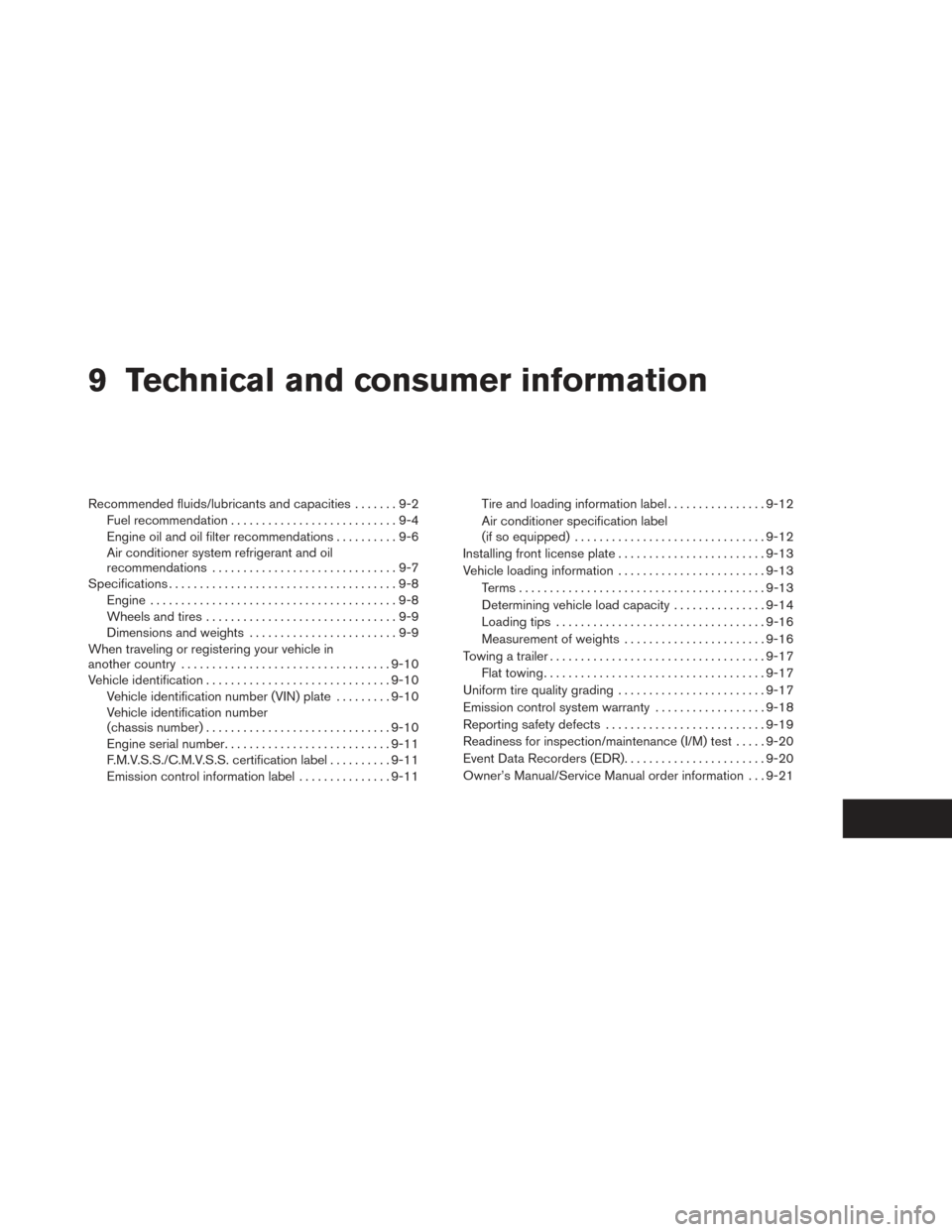
9 Technical and consumer information
Recommended fluids/lubricants and capacities . ......9-2
Fuel recommendation ...........................9-4
Engine oil and oil filter recommendations ..........9-6
Air conditioner system refrigerant and oil
recommendations ..............................9-7
Specifications .....................................9-8
Engine ........................................9-8
Wheels and tires ...............................9-9
Dimensions and weights ........................9-9
When traveling or registering your vehicle in
another country .................................. 9-10
Vehicle identification .............................. 9-10
Vehicle identification number (VIN) plate .........9-10
Vehicle identification number
(chassis number) .............................. 9-10
Engine serial number ........................... 9-11
F.M.V.S.S./C.M.V.S.S. certification label ..........9-11
Emission control information label ...............9-11Tire and loading information label
................9-12
Air conditioner specification label
(if so equipped) ............................... 9-12
Installing front license plate ........................9-13
Vehicle loading information ........................9-13
Terms ........................................ 9-13
Determining vehicle load capacity ...............9-14
Loading tips . . . ............................... 9-16
Measurement of weights .......................9-16
Towing a trailer ................................... 9-17
Flat towing .................................... 9-17
Uniform tire quality grading ........................9-17
Emission control system warranty ..................9-18
Reporting safety defects .......................... 9-19
Readiness for inspection/maintenance (I/M) test .....9-20
Event Data Recorders (EDR) .......................9-20
Owner’s Manual/Service Manual order information . . . 9-21
Page 350 of 372
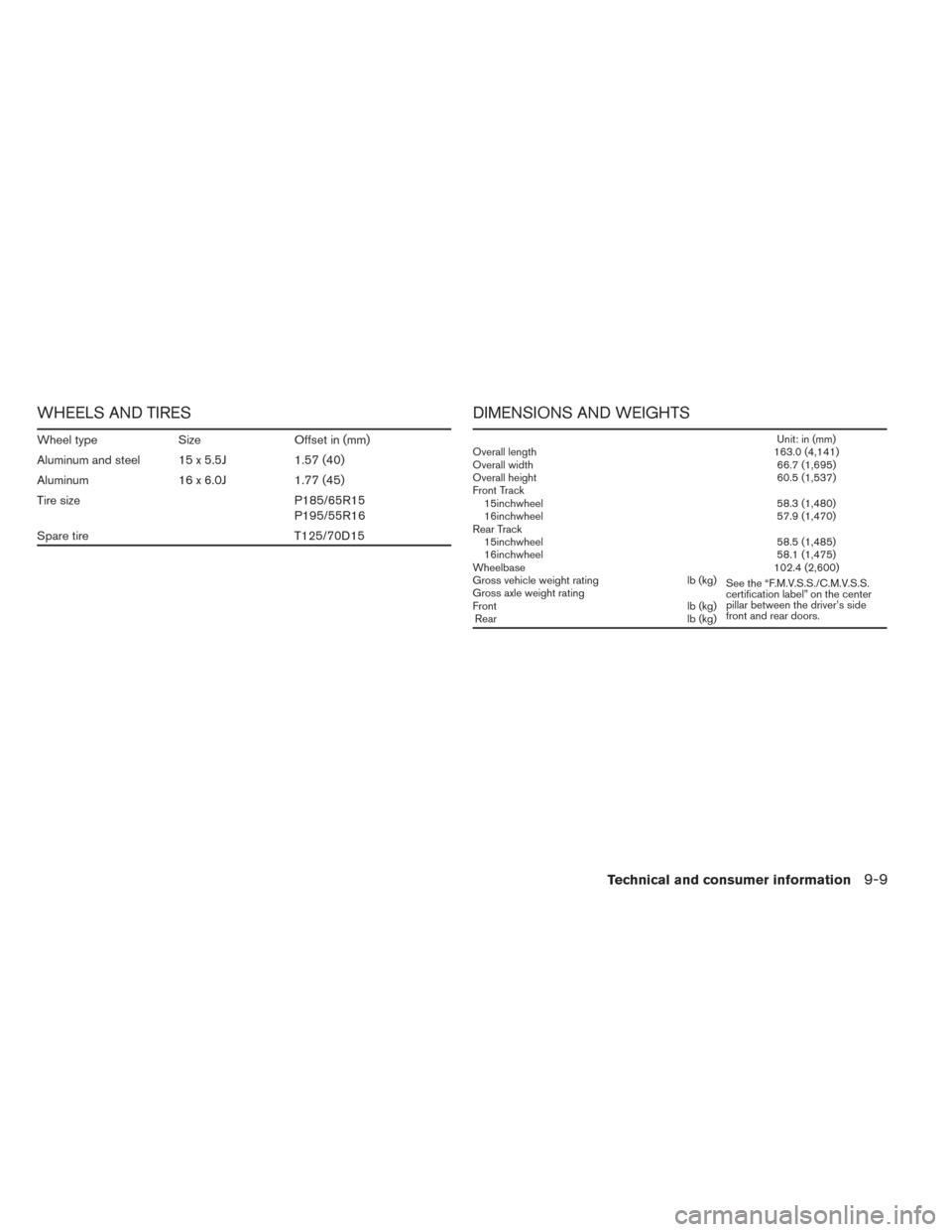
WHEELS AND TIRES
Wheel typeSizeOffset in (mm)
Aluminum and steel 15 x 5.5J 1.57 (40)
Aluminum 16 x 6.0J1.77 (45)
Tire size P185/65R15
P195/55R16
Spare tire T125/70D15
DIMENSIONS AND WEIGHTS
Unit: in (mm)
Overall length 163.0 (4,141)
Overall width 66.7 (1,695)
Overall height 60.5 (1,537)
Front Track 15inchwheel 58.3 (1,480)
16inchwheel 57.9 (1,470)
Rear Track 15inchwheel 58.5 (1,485)
16inchwheel 58.1 (1,475)
Wheelbase 102.4 (2,600)
Gross vehicle weight rating lb (kg) See the “F.M.V.S.S./C.M.V.S.S.
certification label” on the center
pillar between the driver’s side
front and rear doors.
Gross axle weight rating
Front lb (kg)
Rear lb (kg)
Technical and consumer information9-9
Page 352 of 372
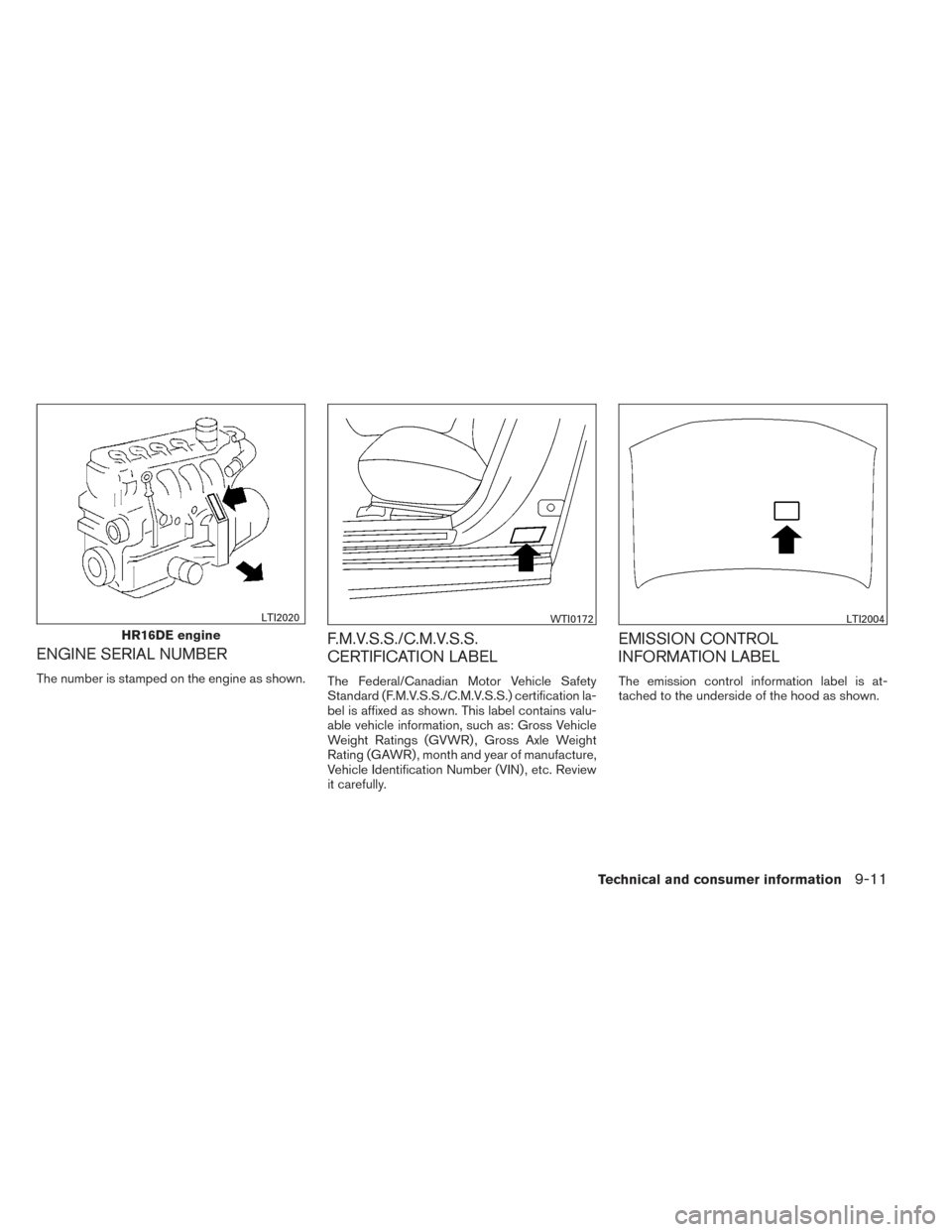
ENGINE SERIAL NUMBER
The number is stamped on the engine as shown.
F.M.V.S.S./C.M.V.S.S.
CERTIFICATION LABEL
The Federal/Canadian Motor Vehicle Safety
Standard (F.M.V.S.S./C.M.V.S.S.) certification la-
bel is affixed as shown. This label contains valu-
able vehicle information, such as: Gross Vehicle
Weight Ratings (GVWR) , Gross Axle Weight
Rating (GAWR) , month and year of manufacture,
Vehicle Identification Number (VIN) , etc. Review
it carefully.
EMISSION CONTROL
INFORMATION LABEL
The emission control information label is at-
tached to the underside of the hood as shown.
HR16DE engine
LTI2020WTI0172LTI2004
Technical and consumer information9-11
Page 354 of 372
Before mounting the license plate, confirm the
following parts are enclosed in the plastic bag:
– License plate bracket
– License plate bracket screws x2
Use the following steps to mount the front license
plate:1. Hold the license plate bracket and mount the license plate bracket using the two screws
to the facia.
WARNING
● It is extremely dangerous to ride
in a cargo area inside a vehicle. In
a collision, people riding in these
areas are more likely to be seri-
ously injured or killed.
● Do not allow people to ride in any
area of your vehicle that is not
equipped with seats and seat
belts.
● Be sure everyone in your vehicle
is in a seat and using a seat belt
properly.
TERMS
It is important to familiarize yourself with
the following terms before loading your
vehicle:
● Curb Weight (actual weight of your
vehicle) - vehicle weight including:
standard and optional equipment, flu-
ids, emergency tools, and spare tire
assembly. This weight does notin-
clude passengers and cargo.
LTI2069
INSTALLING FRONT LICENSE PLATE VEHICLE LOADING INFORMATION
Technical and consumer information9-13
Page 355 of 372
●GVW (Gross Vehicle Weight) - curb
weight plus the combined weight of
passengers and cargo.
● GVWR (Gross Vehicle Weight Rat-
ing) - maximum total combined
weight of the unloaded vehicle, pas-
sengers, luggage, hitch, trailer
tongue load and any other optional
equipment. This information is lo-
cated on the F.M.V.S.S./C.M.V.S.S.
certification label.
● GAWR (Gross Axle Weight Rating) -
maximum weight (load) limit specified
for the front or rear axle. This informa-
tion is located on the
F.M.V.S.S./C.M.V.S.S. certification
label.
● GCWR (Gross Combined Weight
rating) - The maximum total weight
rating of the vehicle, passengers,
cargo, and trailer. ●
Vehicle Capacity Weight, Load limit,
Total load capacity - maximum total
weight limit specified of the load
(passengers and cargo) for the ve-
hicle. This is the maximum combined
weight of occupants and cargo that
can be loaded into the vehicle. If the
vehicle is used to tow a trailer, the
trailer tongue weight must be in-
cluded as part of the cargo load. This
information is located on the Tire and
Loading Information label.
● Cargo capacity - permissible weight
of cargo, the subtracted weight of
occupants from the load limit.
DETERMINING VEHICLE LOAD
CAPACITY
The load capacity of this vehicle is deter-
mined by weight, not by available cargo
space. For example, a luggage rack, bike
carrier, cartop carrier or similar equipment
does not increase load carrying capacity
of your vehicle. To determine vehicle load capacity:
Vehicle weight can be determined by us-
ing a commercial-grade scale, found at
places such as a truck stop, gravel quarry,
grain elevator, or a scrap metal recycling
facility.
1. Determine the curb weight of your vehicle.
2. Compare the curb weight amount to the GVWR specified for your vehicle
to determine how much more weight
your vehicle can carry.
3. After loading (cargo and passen- gers) , re-weigh your vehicle to deter-
mine if either GVWR or GAWR for
your vehicle is exceeded. If GVWR is
exceeded, remove cargo as neces-
sary. If either the front or rear GAWR
is exceeded, shift the load or remove
cargo as necessary.
9-14
Technical and consumer information
Page 356 of 372
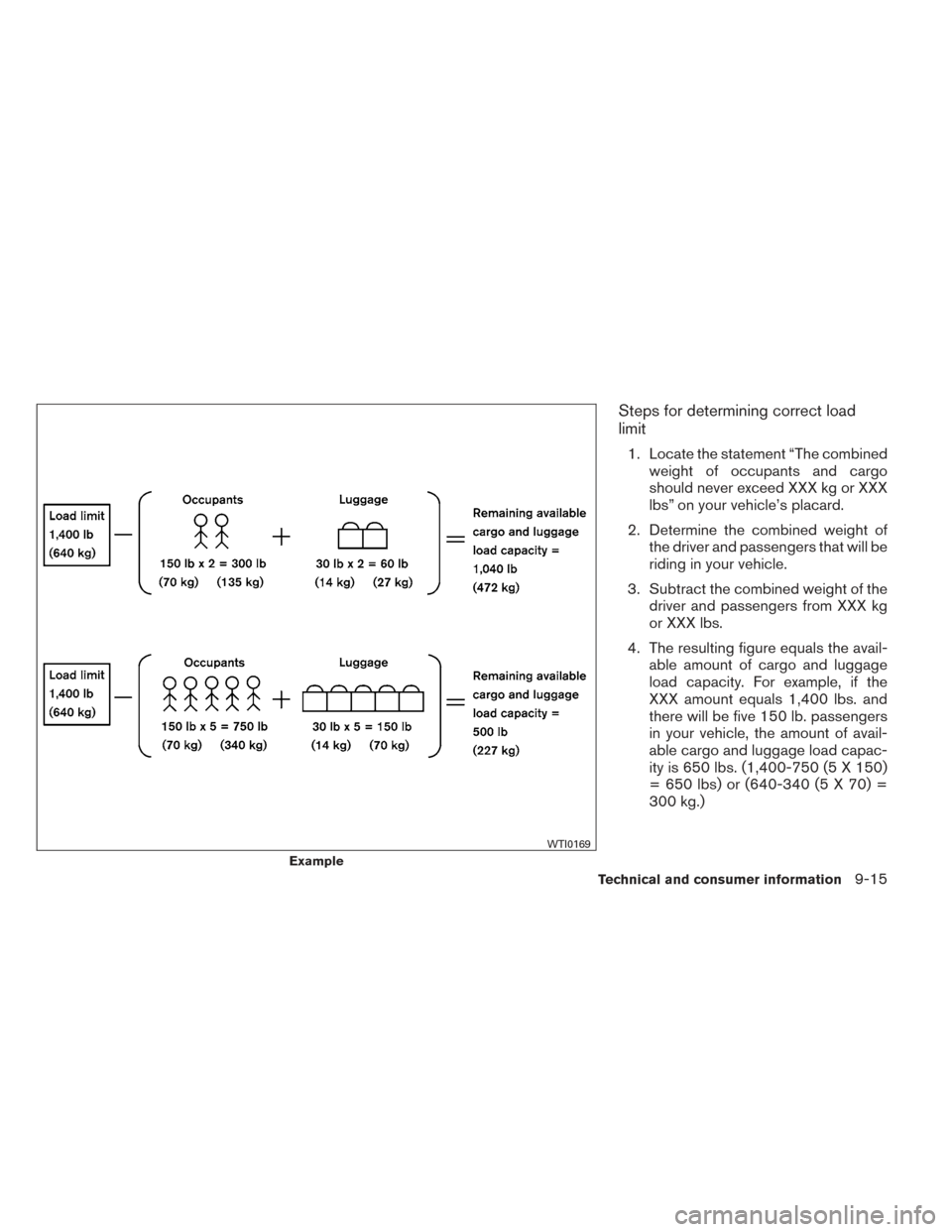
Steps for determining correct load
limit
1. Locate the statement “The combinedweight of occupants and cargo
should never exceed XXX kg or XXX
lbs” on your vehicle’s placard.
2. Determine the combined weight of the driver and passengers that will be
riding in your vehicle.
3. Subtract the combined weight of the driver and passengers from XXX kg
or XXX lbs.
4. The resulting figure equals the avail- able amount of cargo and luggage
load capacity. For example, if the
XXX amount equals 1,400 lbs. and
there will be five 150 lb. passengers
in your vehicle, the amount of avail-
able cargo and luggage load capac-
ity is 650 lbs. (1,400-750 (5 X 150)
= 650 lbs) or (640-340 (5 X 70) =
300 kg.)
Example
WTI0169
Technical and consumer information9-15
Page 357 of 372
5. Determine the combined weight ofluggage and cargo being loaded on
the vehicle. That weight may not
safely exceed the available cargo and
luggage load capacity calculated in
Step 4.
Before driving a loaded vehicle, confirm
that you do not exceed the Gross Vehicle
Weight Rating (GVWR) or the Gross Axle
Weight Rating (GAWR) for your vehicle.
See “Measurement of weights” in this
section.
Also check tires for proper inflation pres-
sures. See the Tire and Loading Informa-
tion label.
LOADING TIPS
● The GVW must not exceed GVWR
or GAWR as specified on the
F.M.V.S.S./C.M.V.S.S. certification
label.
● Do not load the front and rear axle to
the GAWR. Doing so will exceed the
GVWR.
WARNING
● Properly secure all cargo with
ropes or straps to help prevent it
from sliding or shifting. Do not
place cargo higher than the seat-
backs. In a sudden stop or colli-
sion, unsecured cargo could
cause personal injury.
● Do not load your vehicle any
heavier than the GVWR or the
maximum front and rear GAWRs.
If you do, parts of your vehicle can
break, tire damage could occur,
or it can change the way your
vehicle handles. This could result
in loss of control and cause per-
sonal injury.
● Overloading not only can shorten
the life of your vehicle and the
tire, but can also cause unsafe
vehicle handling and longer brak-
ing distances. This may cause a
premature tire failure which
could result in a serious accident
and personal injury. Failures
caused by overloading are not
covered by the vehicle’s warranty.MEASUREMENT OF WEIGHTS
Secure loose items to prevent weight
shifts that could affect the balance of your
vehicle. When the vehicle is loaded, drive
to a scale and weigh the front and the rear
wheels separately to determine axle
loads. Individual axle loads should not ex-
ceed either of the gross axle weight rat-
ings (GAWR) . The total of the axle loads
should not exceed the gross vehicle
weight rating (GVWR) . These ratings are
given on the vehicle certification label. If
weight ratings are exceeded, move or re-
move items to bring all weights below the
ratings.
9-16
Technical and consumer information
Page 365 of 372
Clock.......................4-38(models without navigation system) ....4-38
Clockset.....................4-38
C.M.V.S.S. certification label ..........9-11
Cold weather driving ...............5-30
Compact disc (CD) player ....4-39,4-44,4-50
Continuously Variable Transmission (CVT) . . .5-15 Continuously Variable Transmission
(CVT) fluid ..................8-11
Driving with Continuously Variable
Transmission (CVT) .............5-15
Control panel buttons ...............4-2
Brightness/contrast button ..........4-9
Enterbutton..................4-2
Setting button .................4-5
Controls Audiocontrols(steeringwheel).......4-67
Heater and air conditioner controls .....4-21
Coolant Capacities and recommended
fuel/lubricants .................9-2
Changing engine coolant ...........8-8
Checking engine coolant level ........8-8
Engine coolant temperature gauge .....2-6
Corrosionprotection ...............7-5
Cruisecontrol..................5-21
Cupholders...................2-28
Curtain side-impact air bag system
(See supplemental side air bag and curtain
side-impact air bag system) ...........1-51
D
Daytime running light system (Canada only) . .2-22 Defroster switch
Rear window defroster switch .......2-20
Dimensionsandweights.............9-9
Dimmer switch for instrument panel ......2-22
Display controls (see control panel buttons) . .4-2
Door locks .....................3-5
Door open warning light .............2-11
Drive belt .....................8-15
Driving Cold weather driving .............5-30
Driving with Continuously Variable
Transmission (CVT) .............5-15
Driving with manual transmission ......5-18
Precautions when starting and driving ....5-2
E
Economy - fuel ..................5-24
Emission control information label .......9-11
Emission control system warranty .......9-18
Engine Before starting the engine ..........5-13
Block heater .................5-31
Capacities and recommended
fuel/lubricants .................9-2
Changingenginecoolant...........8-8
Changingengineoil..............8-9
Changing engine oil filter ..........8-10
Checking engine coolant level ........8-8
Checking engine oil level ...........8-8
Engine compartment check locations ....8-6
Engine coolant temperature gauge .....2-6
Engine cooling system ............8-7
Engineoil ...................8-8
Engine oil and oil filter recommendation . . .9-6 Engine oil pressure warning light
......2-11
Engine oil viscosity ..............9-6
Engine serial number ............9-11
Engine specifications .............9-8
Starting the engine .............5-14
Enterbutton....................4-2
Eventdatarecorders ..............9-20
Exhaustgas(Carbonmonoxide).........5-2
Extended storage switch ............8-21
F
Flashers (See hazard warning flasher switch) . .6-2
Flat tire .......................6-3
Floor mat positioning aid .............7-5
Fluid Brake
fluid..................8-11
Capacities and recommended
fuel/lubricants .................9-2
Continuously Variable Transmission
(CVT) fluid ..................8-11
Engine coolant .................8-7
Engine oil ...................8-8
F.M.V.S.S. certification label ...........9-11
Foglightswitch .................2-23
Front air bag system
(See supplemental restraint system) ......1-46
Front seats .....................1-2
Fuel Capacities and recommended
fuel/lubricants .................9-2
Fuel economy ................5-24
Fuel-filler door and cap ...........3-26
Fuel-filler door lock opener lever ......3-26
Fuelgauge...................2-6
10-2
Page 369 of 372
T
Tachometer ....................2-5
Temperature gauge Engine coolant temperature gauge .....2-6
Theft (NISSAN vehicle immobilizer system) ,
engine start ..........2-17,3-4,5-10,5-13
Three-way catalyst ................5-2
Tilting steering wheel ..............3-29
Tire Flat tire .....................6-3
Spare tire ................6-4,8-39
Tire and Loading Information label .....9-12
Tire chains ..................8-36
Tireplacard..................9-12
Tirepressure.................8-29
Tire rotation..................8-36
Types of tires .................8-35
Uniform tire quality grading .........9-17
Wheels and tires ...............8-29
Wheel/tire size .................9-9
Tire pressure Low tire pressure warning light .......2-11
Tire Pressure Monitoring System (TPMS) ....5-3
Top tether strap child restraint .........1-24
Towing Flattowing..................9-17
Towtrucktowing...............6-15
Trailertowing.................9-17
Transmission Continuously Variable Transmission
(CVT) fluid ..................8-11
Driving with Continuously Variable
Transmission (CVT) .............5-15 Driving with manual transmission
......5-18
Travel (See registering your vehicle in another
country) ......................9-10
Trip computer ...................2-7
Trip odometer ...................2-4
Turn signal switch ................2-23
U
Uniform tire quality grading ...........9-17
USB interface Audio file operation ..........4-54,4-56
V
Vanity mirror ...................3-30
Variable voltage control system .........8-15
Vehicle dimensions and weights .........9-9
Vehicle dynamic control (VDC) off switch . . .2-25
Vehicle dynamic control (VDC) system .....5-28
Vehicle identification ...............9-10
Vehicle identification number (VIN)
(Chassis number) ................9-10
Vehicle identification number (VIN) plate ....9-10
Vehicle loading information ...........9-13
Vehicle recovery .................6-17
Vehicle security system (NISSAN vehicle immobi-
lizer system) , engine start . .2-17, 3-4, 5-10, 5-13
Ventilators ....................4-20
Visors.......................3-29
Voice Prompt Interrupt ..........4-73,4-86
Voice recognition system ............4-94 W
Warning Airbagwarninglight.........1-54, 2-14
Anti-lock brake warning light ........2-10
Battery charge warning light ........2-11
Brake warning light .............2-10
Door open warning light ...........2-11
Engine oil pressure warning light ......2-11
Hazard warning flasher switch ........6-2
Low
fuel warning light ............2-11
Low tire pressure warning light .......2-11
Low windshield-washer fluid warning
light......................2-13
Passenger air bag and status light .....1-48
Seatbeltwarninglight............2-14
Warning/indicator lights and audible
reminders ...................2-9
Warning labels (for SRS) ..........1-53
Warninglights...................2-9
Washer switch Rear window wiper and washer
switches...................2-20
Windshield wiper and washer switch . . .2-19
Weights (See dimensions and weights) .....9-9
Wheels and tires .................8-29
Wheel/tire size ...................9-9
When traveling or registering your vehicle in
anothercountry .................9-10
Windows Locking passengers’ windows .......2-34
Manual windows ...............2-35
Power rear windows .............2-34
10-6