octane NISSAN VERSA NOTE 2018 Owner´s Manual
[x] Cancel search | Manufacturer: NISSAN, Model Year: 2018, Model line: VERSA NOTE, Model: NISSAN VERSA NOTE 2018Pages: 878, PDF Size: 9.62 MB
Page 855 of 878
When planning to drive your NISSAN ve-
hicle in another country,you should first
find out if the fuel available is suitable for
your vehicle's engine.
Using fuel with an octane rating that is too
low may cause engine damage. All gaso-
line vehicles must be operated with un-
leaded gasoline. Therefore, avoid taking
your vehicle to areas where appropriate
fuel is not available.
When transferring the registration of
your vehicle to another country, state,
province or district, it may be necessary
to modif y the vehicle to meet local laws
and regulations.
The laws and regulations for motor vehicle
emission control and safety standards
vary according to the country, state, prov-
ince or district; therefore, vehicle specifica-
tions may differ.
When any vehicle is to be taken into an-
other country, state, province or district
and registered, its modifications, trans-
portation and registration are the re-
sponsibility of the user. NISSAN is not re-
sponsible for any inconvenience that
may result.
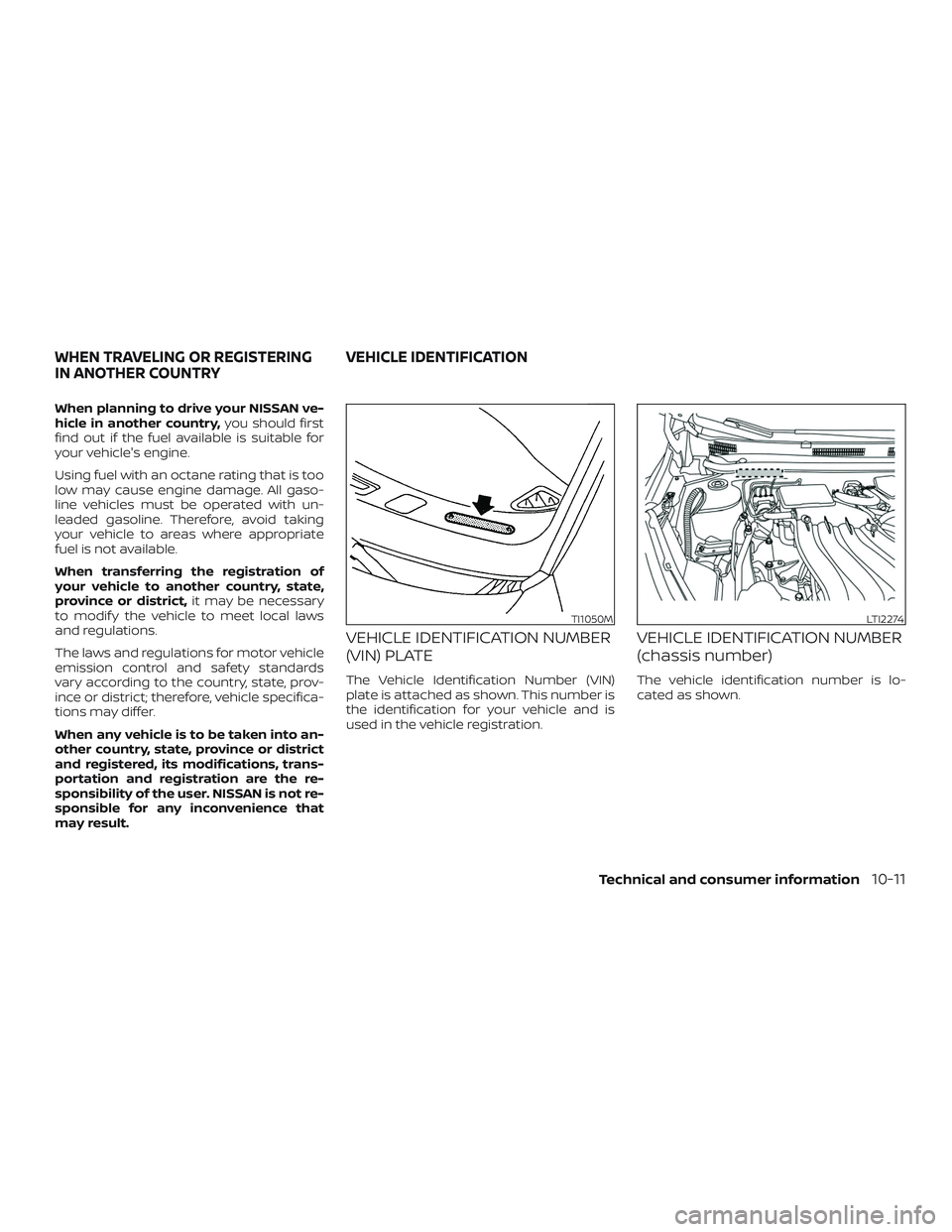
VEHICLE IDENTIFICATION NUMBER
(VIN) PLATE
The Vehicle Identification Number (VIN)
plate is attached as shown. This number is
the identification for your vehicle and is
used in the vehicle registration.
VEHICLE IDENTIFICATION NUMBER
(chassis number)
The vehicle identification number is lo-
cated as shown.
TI1050MLTI2274
WHEN TRAVELING OR REGISTERING
IN ANOTHER COUNTRY VEHICLE IDENTIFICATION
Technical and consumer information10-11
Page 869 of 878
Starting the engine............5-15
Engine Block Heater .............5-36
Engine coolant temperature gauge ....2-9
Enterbutton...................4-4
EventDatarecorders............10-22
Exhaust gas (Carbon monoxide) .......5-2
Explanation of maintenance items .....9-2
Explanation of scheduled maintenance
items .......................9-5
Extended storage switch ..........8-19
F
Flashers
(See hazard warning flasher switch) ....6-2
Flattire....................6-3,6-3
Floormatpositioningaid...........7-6
Fluid Brakefluid..................8-9
Capacities and recommended
fuel/lubricants...............10-2
Clutchfluid.................8-10
Continuously Variable Transmission (CVT)
fluid......................8-9
Engine coolant ...............8-4
Engine oil ...................8-6
F.M.V.S.S. certification label .........10-12
Foglightswitch ................2-31
Front air bag system
(See supplemental restraint system) . . .1-55
Front-door pocket ...............2-35
Frontseats................... .1-2
Fuel Capacities and recommended
fuel/lubricants...............10-2 Fuel economy
...............5-27
Fuel-filler door lock opener lever ....3-28
Fuel gauge .................2-10
Fueloctanerating.............10-6
Fuel recommendation ..........10-4
Loose fuel cap warning .......2-7,3-29
Fuel efficient driving tips ...........5-26
Fuel-filler door .................3-28
Fuel gauge ...................2-10
Fuses .......................8-17
Fusiblelinks...................8-18
G
Gauge Engine coolant temperature gauge . .2-9
Fuel gauge .................2-10
Odometer ..................2-6
Speedometer ................2-5
Tachometer .................2-8
Trip computer ................2-11
Trip odometer ................2-6
General maintenance .............9-2
Glovebox....................2-36
H
Hands-free phone system,
Bluetooth®...............4-90,4-109
Hazard warning flasher switch ........6-2
Headlight and turn signal switch ......2-28
Headlightcontrolswitch...........2-28
Headlights ...................8-23
Headrestraints .................1-6 Heatedseats..................2-32
Heated seat switches
............2-32
Heater Heater and air conditioner controls . .4-35
Heater operation .............4-37
Hood release ..................3-26
Horn .......................2-31
I
Ignition switch ..................5-9
Push-button ignition switch .......5-11
Immobilizer system ........2-24,5-11, 5-14
Important vehicle information label . . .10-12
Increasing fuel economy ...........5-27
Indicator NISSAN Intelligent Key® battery discharge
indicator...................5-14
Indicator lights and audible reminders
(See warning/indicator lights and audible
reminders) ................2-14, 2-21
Instrument brightness control .......2-30
Instrument panel .............0-6,2-2
Instrument panel dimmer switch .....
2-30
Intelligent Key system Key operating range ............3-14
Key operation ................3-15
Mechanical key ...............3-4
Remote keyless entry operation . .3-9, 3-18
Troubleshooting guide .......3-24,3-25
Warning signals ...........3-24,3-25
Interiorlight...............2-43, 2-44
iPod®Player...............4-69,4-72
ISOFIX child restraints .............1-25
11-3
Page 871 of 878
O
Octane rating (See fuel octane rating) . .10-6
Odometer ....................2-6
Oil Capacities and recommended
fuel/lubricants...............10-2
Changing engine oil ............8-7
Changing engine oil filter .........8-8
Checking engine oil level .........8-6
Engine oil ...................8-6
Engine oil and oil filter
recommendation .............10-7
Engine oil viscosity .............10-7
One shot call ..................4 -112
Outsidemirrors................3-33
Overheat Ifyourvehicleoverheats.........6-14
Owner's manual order form ........10-22
Owner's manual/service manual order
information..................10-22
P
Parking Parking brake operation .........5-22
Parking/parkingonhills.........5-28
Parkingbrake..................5-22
Phone, Bluetooth® hands-free
system ..................4-90,4-109
Power Power door locks ..............3-7
Poweroutlet................2-34
Power steering system ..........5-29
Powerwindows..............2-40 Rearpowerwindows...........2-42
Poweroutlet..................2-34
Powersteering.................5-29
Precautions Maintenance precautions .........8-2
Precautions on booster
seats............1-23, 1-30, 1-36, 1-41
Precautions on child
restraints .........1-23, 1-30, 1-36, 1-41
Precautions on seat belt usage .....1-10
Precautions on supplemental restraint
system ................... .1-45
Precautions when starting and
driving.....................5-2
Programmable features .........4-7,4-13
Push starting ..................6-14
R
Radio Car phone or CB radio ..........4-90
FM/AM/SAT radio with compact disc (CD)
player.................4-52,4-57
Steering wheel audio control switch. .4-81
Readiness for inspection maintenance
(I/M) test ....................10-21
Rearcenterseatbelt .............1-16
Rearpowerwindows.............2-42
Rearseat.................... .1-4
Rearviewmirror................3-32
RearViewMonitor...............4-16
Rearwindowdefrosterswitch.......2-28
Rear window wiper and washer
switches .....................2-27
Recommended Fluids ............10-2 Recorders
EventData.................10-22
Refrigerant recommendation ........10-8
Registering a vehicle in another
country .....................10-11
Reporting safety defects (US only) . . . .10-20
S
Safety Child safety rear door lock ........3-8
Childseatbelts......1-23, 1-30, 1-36, 1-41
Reporting safety defects (US only) . .10-20
Seat adjustment Front manual seat adjustment ......1-3
Rear seat adjustment ...........1-4
Seatback pockets ...............2-35
Seat belt Childsafety................ .1-20
Infants and small children ........1-21
I
njuredPerson............... .1-13
Largerchildren.............. .1-22
Precautionsonseatbeltusage.....1-10
Pregnant women ..............1-13
Rearcenterseatbelt ...........1-16
Seat belt extenders ............1-19
Seat belt maintenance ..........1-20
Seatbelts................1-10, 7-6
Shoulder belt height adjustment . . . .1-19
Three-pointtypewithretractor.....1-13
Seat belt extenders ..............1-19
Seatbeltwarninglight.........1-13, 2-20
Seats Adjustment ..................1-2
Armrests ...................1-5
11-5
Page 876 of 878
FUEL RECOMMENDATION:
Use unleaded regular gasoline with an oc-
tane rating of at least 87 AKI (Anti-Knock In-
dex) number (Research octane number 91).
CAUTION
∙ Only vehicles with the E-85 filler doorlabel can operate on E-85. Fuel system
or other damage can occur if E-85 is
used in vehicles that are not designed
to run on E-85.
∙ Using a fuel other than that specified could adversely affect the emission
control system, and may also affect
the warranty coverage.
∙ Under no circumstances should a leaded gasoline be used, because this
will damage the three-way catalyst.
∙ Do not use a fuel containing more than 15% ethanol in your vehicle. Your
vehicle is not designed to run on a fuel
containing more than 15% ethanol.
Using a fuel containing more than 15%
ethanol in a vehicle not specifically
designed for a fuel containing more
than 15% ethanol can adversely affect
the emission control devices and sys-
tems of the vehicle. Damage caused
by such fuel is not covered by the
NISSAN New Vehicle Limited Warranty. ∙
Do not use fuel that contains the oc-
tane booster methylcyclopentadienyl
manganese tricarbonyl (MMT). Using
fuel containing MMT may adversely af-
fect vehicle performance and vehicle
emissions. Not all fuel dispensers are
labeled to indicate MMT content, so you
may have to consult your gasoline re-
tailer for more details. Note that Fed-
eral and California laws prohibit the use
of MMT in reformulated gasoline.
∙ U.S. government regulations require ethanol dispensing pumps to be iden-
tified by a small, square, orange and
black label with the common abbre-
viation or the appropriate percentage
for that region.
For additional information, refer to “Recom-
mended fluids/lubricants and capacities”
in the “Technical and consumer informa-
tion” section of this manual.
ENGINE OIL RECOMMENDATION:
• Genuine “Nissan Motor Oil 0W-20 SN” is
recommended. •
If the above motor is not available, use an
equivalent motor oil that matches the above
grade and viscosity. For additional informa-
tion, refer to “Engine oil and oil filter recom-
mendations” in the “Technical and consumer
information” section of this manual.
COLD TIRE PRESSURE:
For additional information, refer to “Tire and
Loading Information label” in the “Technical
and consumer information” section of this
manual.
The label is typically located on the driver
side center pillar or on the driver’s door. For
additional information, refer to “Wheels and
tires” in the “Do-it-yourself ” section of this
manual.
RECOMMENDED NEW VEHICLE
BREAK-IN PROCEDURE:
During the first 1,200 miles (2,000 km) of
vehicle use, follow the break-in procedure
recommendations for the future reliability
and economy of your new vehicle. For ad-
ditional information, refer to “Break-in
schedule” in the “Starting and driving” sec-
tion of this manual. Failure to follow these
recommendations may result in vehicle
damage or shortened engine life.
GAS STATION INFORMATION