trailer NISSAN VERSA NOTE 2018 Owner´s Manual
[x] Cancel search | Manufacturer: NISSAN, Model Year: 2018, Model line: VERSA NOTE, Model: NISSAN VERSA NOTE 2018Pages: 878, PDF Size: 9.62 MB
Page 834 of 878
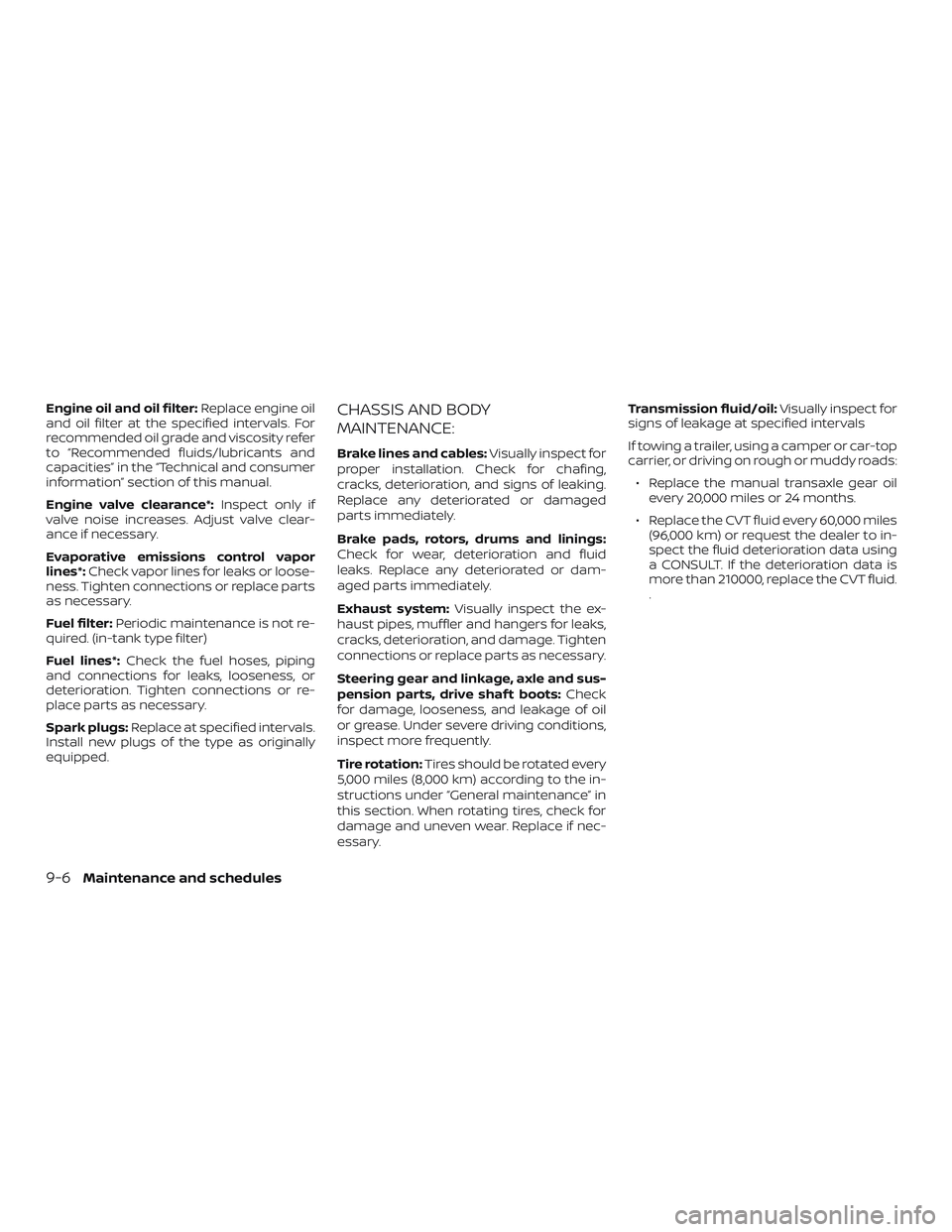
Engine oil and oil filter:Replace engine oil
and oil filter at the specified intervals. For
recommended oil grade and viscosity refer
to “Recommended fluids/lubricants and
capacities” in the “Technical and consumer
information” section of this manual.
Engine valve clearance*: Inspect only if
valve noise increases. Adjust valve clear-
ance if necessary.
Evaporative emissions control vapor
lines*: Check vapor lines for leaks or loose-
ness. Tighten connections or replace parts
as necessary.
Fuel filter: Periodic maintenance is not re-
quired. (in-tank type filter)
Fuel lines*: Check the fuel hoses, piping
and connections for leaks, looseness, or
deterioration. Tighten connections or re-
place parts as necessary.
Spark plugs: Replace at specified intervals.
Install new plugs of the type as originally
equipped.CHASSIS AND BODY
MAINTENANCE:
Brake lines and cables: Visually inspect for
proper installation. Check for chafing,
cracks, deterioration, and signs of leaking.
Replace any deteriorated or damaged
parts immediately.
Brake pads, rotors, drums and linings:
Check for wear, deterioration and fluid
leaks. Replace any deteriorated or dam-
aged parts immediately.
Exhaust system: Visually inspect the ex-
haust pipes, muffler and hangers for leaks,
cracks, deterioration, and damage. Tighten
connections or replace parts as necessary.
Steering gear and linkage, axle and sus-
pension parts, drive shaf t boots: Check
for damage, looseness, and leakage of oil
or grease. Under severe driving conditions,
inspect more frequently.
Tire rotation: Tires should be rotated every
5,000 miles (8,000 km) according to the in-
structions under “General maintenance” in
this section. When rotating tires, check for
damage and uneven wear. Replace if nec-
essary. Transmission fluid/oil:
Visually inspect for
signs of leakage at specified intervals
If towing a trailer, using a camper or car-top
carrier, or driving on rough or muddy roads:
∙ Replace the manual transaxle gear oil every 20,000 miles or 24 months.
∙ Replace the CVT fluid every 60,000 miles (96,000 km) or request the dealer to in-
spect the fluid deterioration data using
a CONSULT. If the deterioration data is
more than 210000, replace the CVT fluid.
.
9-6Maintenance and schedules
Page 845 of 878
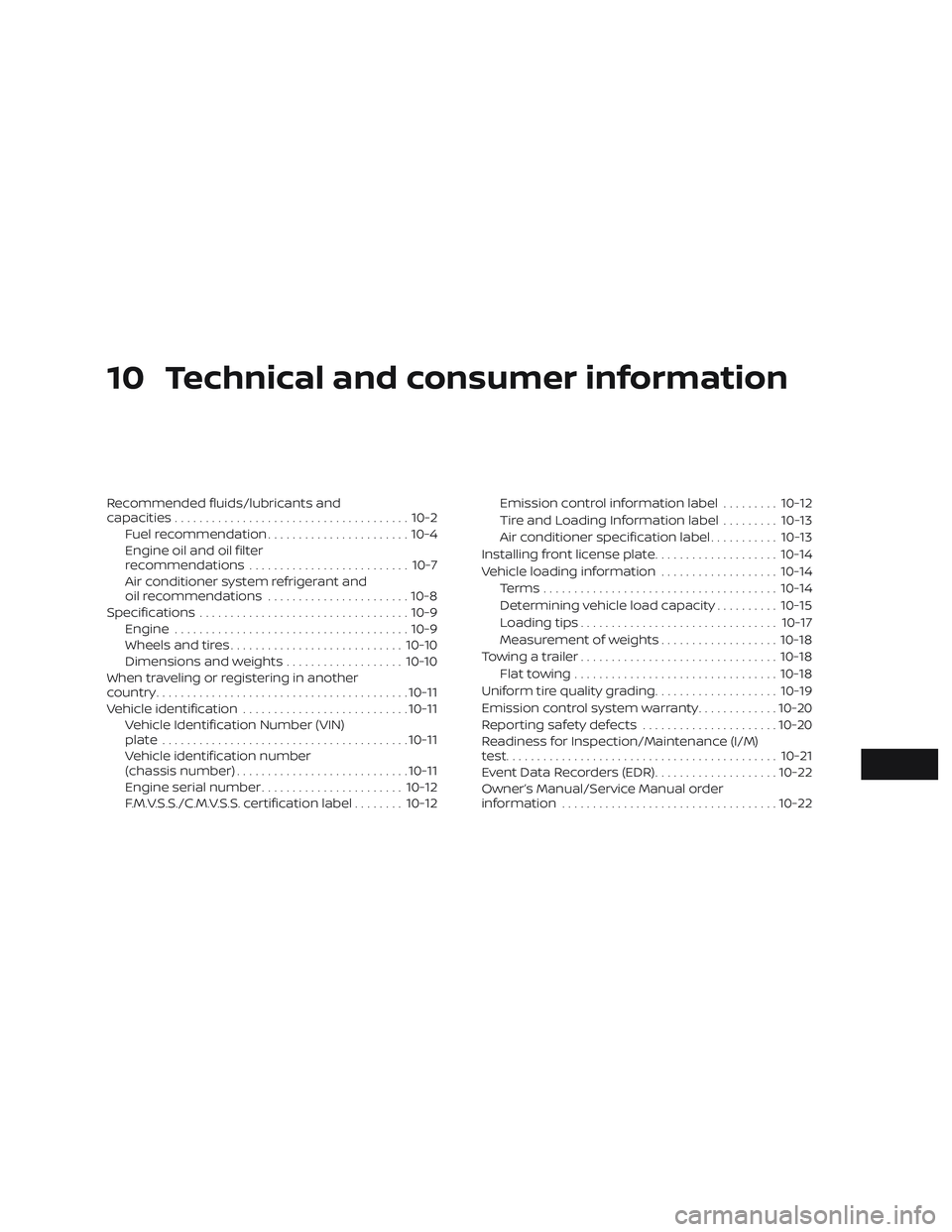
10 Technical and consumer information
Recommended fluids/lubricants and
capacities...................................... 10-2
Fuel recommendation ....................... 10-4
Engine oil and oil filter
recommendations .......................... 10-7
Air conditioner system refrigerant and
oil recommendations .......................10-8
Specifications .................................. 10-9
Engine ...................................... 10-9
Wheels and tires ............................ 10-10
Dimensions and weights ...................10-10
When traveling or registering in another
country ......................................... 10-11
Vehicle identification ........................... 10-11
Vehicle Identification Number (VIN)
plate ........................................ 10-11
Vehicle identification number
(chassis number) ............................ 10-11
Engine serial number ....................... 10-12
F.M.V.S.S./C.M.V.S.S. certification label ........10-12 Emission control information label
.........10-12
Tire and Loading Information label .........10-13
Air conditioner specification label ...........10-13
Installing front license plate ....................10-14
Vehicle loading information ...................10-14
Terms ...................................... 10-14
Determining vehicle load capacity ..........10-15
Loading tips ................................ 10-17
Measurement of weights ...................10-18
Towing a trailer ................................ 10-18
Flat towing ................................. 10-18
Uniform tire quality grading ....................10-19
Emission control system warranty .............10-20
Reporting safety defects ......................10-20
Readiness for Inspection/Maintenance (I/M)
test ............................................ 10-21
Event Data Recorders (EDR) ....................10-22
Owner’s Manual/Service Manual order
information ................................... 10-22
Page 859 of 878
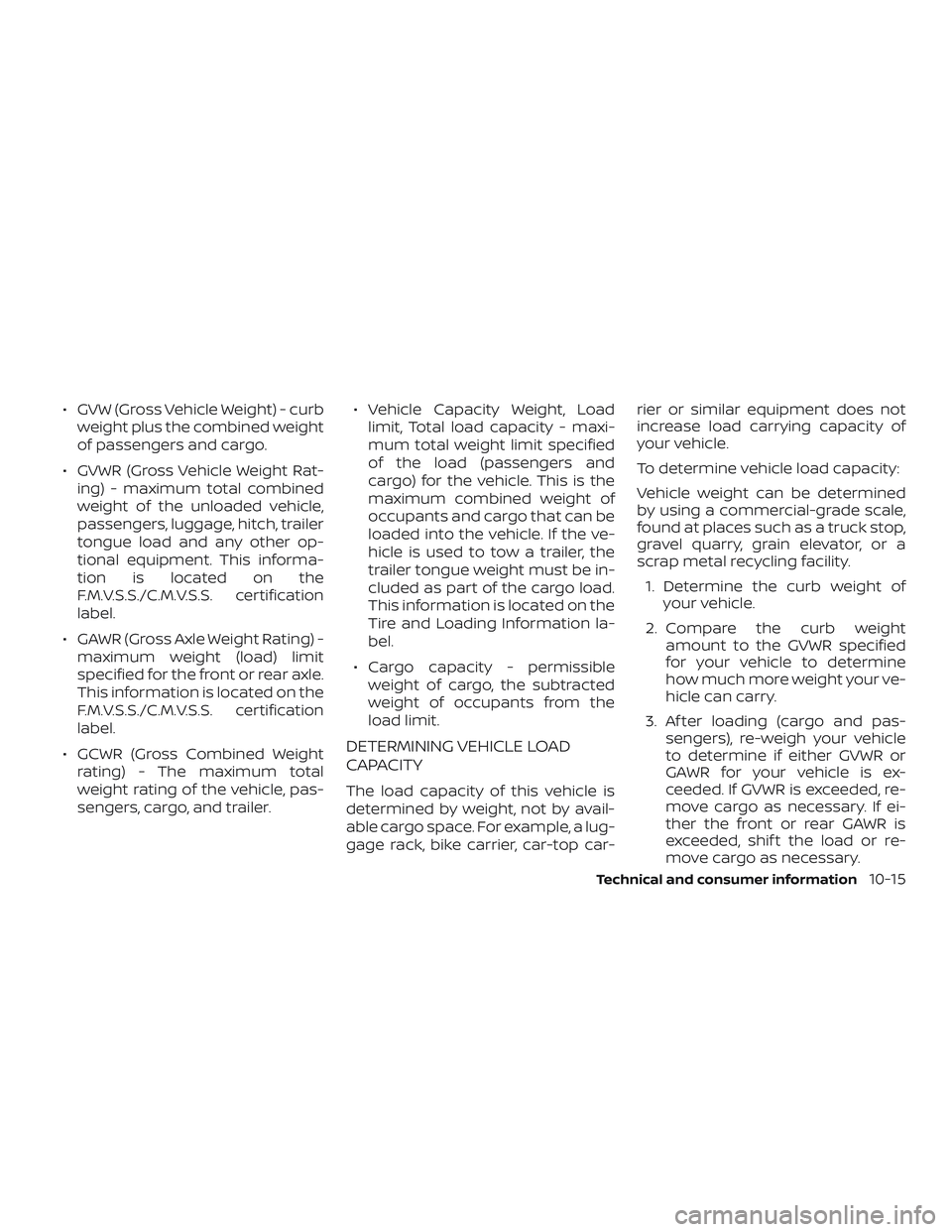
∙ GVW (Gross Vehicle Weight) - curbweight plus the combined weight
of passengers and cargo.
∙ GVWR (Gross Vehicle Weight Rat- ing) - maximum total combined
weight of the unloaded vehicle,
passengers, luggage, hitch, trailer
tongue load and any other op-
tional equipment. This informa-
tion is located on the
F.M.V.S.S./C.M.V.S.S. certification
label.
∙ GAWR (Gross Axle Weight Rating) - maximum weight (load) limit
specified for the front or rear axle.
This information is located on the
F.M.V.S.S./C.M.V.S.S. certification
label.
∙ GCWR (Gross Combined Weight rating) - The maximum total
weight rating of the vehicle, pas-
sengers, cargo, and trailer. ∙ Vehicle Capacity Weight, Load
limit, Total load capacity - maxi-
mum total weight limit specified
of the load (passengers and
cargo) for the vehicle. This is the
maximum combined weight of
occupants and cargo that can be
loaded into the vehicle. If the ve-
hicle is used to tow a trailer, the
trailer tongue weight must be in-
cluded as part of the cargo load.
This information is located on the
Tire and Loading Information la-
bel.
∙ Cargo capacity - permissible weight of cargo, the subtracted
weight of occupants from the
load limit.
DETERMINING VEHICLE LOAD
CAPACITY
The load capacity of this vehicle is
determined by weight, not by avail-
able cargo space. For example, a lug-
gage rack, bike carrier, car-top car- rier or similar equipment does not
increase load carrying capacity of
your vehicle.
To determine vehicle load capacity:
Vehicle weight can be determined
by using a commercial-grade scale,
found at places such as a truck stop,
gravel quarry, grain elevator, or a
scrap metal recycling facility.
1. Determine the curb weight of your vehicle.
2. Compare the curb weight amount to the GVWR specified
for your vehicle to determine
how much more weight your ve-
hicle can carry.
3. Af ter loading (cargo and pas- sengers), re-weigh your vehicle
to determine if either GVWR or
GAWR for your vehicle is ex-
ceeded. If GVWR is exceeded, re-
move cargo as necessary. If ei-
ther the front or rear GAWR is
exceeded, shif t the load or re-
move cargo as necessary.
Technical and consumer information10-15
Page 862 of 878
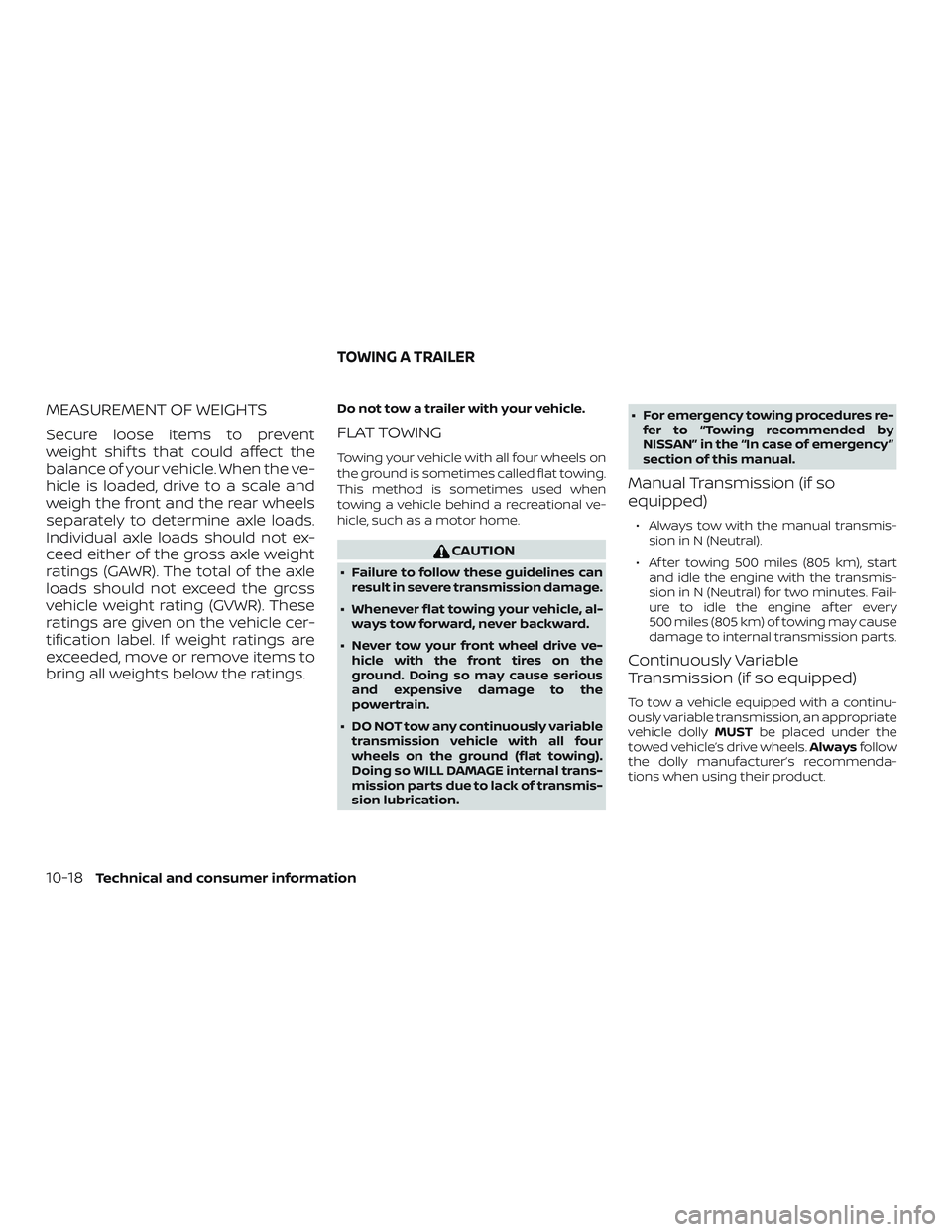
MEASUREMENT OF WEIGHTS
Secure loose items to prevent
weight shif ts that could affect the
balance of your vehicle. When the ve-
hicle is loaded, drive to a scale and
weigh the front and the rear wheels
separately to determine axle loads.
Individual axle loads should not ex-
ceed either of the gross axle weight
ratings (GAWR). The total of the axle
loads should not exceed the gross
vehicle weight rating (GVWR). These
ratings are given on the vehicle cer-
tification label. If weight ratings are
exceeded, move or remove items to
bring all weights below the ratings.
Do not tow a trailer with your vehicle.
FLAT TOWING
Towing your vehicle with all four wheels on
the ground is sometimes called flat towing.
This method is sometimes used when
towing a vehicle behind a recreational ve-
hicle, such as a motor home.
CAUTION
∙ Failure to follow these guidelines canresult in severe transmission damage.
∙ Whenever flat towing your vehicle, al- ways tow forward, never backward.
∙ Never tow your front wheel drive ve- hicle with the front tires on the
ground. Doing so may cause serious
and expensive damage to the
powertrain.
∙ DO NOT tow any continuously variable transmission vehicle with all four
wheels on the ground (flat towing).
Doing so WILL DAMAGE internal trans-
mission parts due to lack of transmis-
sion lubrication. ∙ For emergency towing procedures re-
fer to “Towing recommended by
NISSAN” in the “In case of emergency ”
section of this manual.
Manual Transmission (if so
equipped)
∙ Always tow with the manual transmis- sion in N (Neutral).
∙ Af ter towing 500 miles (805 km), start and idle the engine with the transmis-
sion in N (Neutral) for two minutes. Fail-
ure to idle the engine af ter every
500 miles (805 km) of towing may cause
damage to internal transmission parts.
Continuously Variable
Transmission (if so equipped)
To tow a vehicle equipped with a continu-
ously variable transmission, an appropriate
vehicle dolly MUSTbe placed under the
towed vehicle’s drive wheels. Alwaysfollow
the dolly manufacturer’s recommenda-
tions when using their product.
TOWING A TRAILER
10-18Technical and consumer information
Page 872 of 878
Frontseats..................1-2
Heatedseats................2-32
Manual front seat adjustment......1-3
Rearseat.................. .1-4
Security indicator light ............2-23
Security system (NISSAN Vehicle Immobilizer
System), engine start .......2-24,5-11, 5-14
Self-adjustingbrakes.............8-17
Service manual order form .........10-22
Servicing air conditioner ...........4-43
Settingbutton...............4-7,4-13
Shif ting Continuously Variable Transmission
(CVT) .....................5-18
Manual transmission ...........5-21
Shiftleverlockrelease............5-19
Shoulder belt height adjustment ......1-19
Side air bag system (See supplemental
side air bag, curtain and rollover air bag
systems) .................... .1-60
Siri® Eyes-Free ..............4-84,4-87
Smartphone connectivity ..........4-83
Spark plug replacement ...........8-14
Spark plugs ...................8-14
Specifications ..................10-9
Speedometer ..................2-5
SRS warning label ...............1-63
Stability control ................5-32
Standard maintenance ............9-8
Starting Before starting the engine ........5-15
Jumpstarting ............6-12,8-12
Precautions when starting and
driving .....................5-2
Push starting ................6-14
Starting the engine ............5-15 Starting the engine
..............5-15
Steering Powersteeringsystem..........5-29
Tilting steering wheel ...........3-31
Steering wheel .................3-31
Steering wheel audio control switch ....4-81
Stoplight....................8-25
Storage.....................2-35
Storagetray ..................2-36
Sunvisors....................3-31
Supplemental air bag warning labels . . .1-63
Supplemental air bag warning
light ................... .1-63, 2-20
Supplemental front impact air bag
system ..................... .1-55
Supplemental restraint system Information and warning labels . . . .1-63
Precautions on supplemental restraint
system ................... .1-45
Supplemental restraint system
(Supplemental air bag system) .......1-45
Switch Automatic power window switch . . .2-42
Foglightswitch ..............2-31
Hazard warning flasher switch ......6-2
Headlight and turn signal switch ....2-28
Headlightcontrolswitch.........2-28
Ignition switch ................5-9
Instrument brightness control .....2-30
Power door lock switch ..........3-7
Rearwindowdefrosterswitch.....2-28
Rear window wiper and washer
switches ...................2-27
Turn signal switch .............2-30 T
Tachometer ...................2-8
Temperature gauge Engine coolant temperature gauge . .2-9
Thef t (NISSAN Vehicle Immobilizer System),
engine
start............2-24,5 -11, 5-14
Three-waycatalyst...............5-2
Tilting steering wheel .............3-31
Tire Flattire..................6-3,6-3
Spare tire ...............6-4,8-39
Tire and Loading Information label . .10-13
Tire chains .................8-35
Tire pressure ................8-28
Tirerotation ................8-36
Types of tires ................8-34
Uniform tire quality grading ......10-19
Wheels and tires ..........8-28,10-10
Wheel/tire size ...............10-10
Tire pressure Low tire pressure warning light .....2-17
Tire Pressure Monitoring System (TPMS) . .5-3
Toptetherstrapchildrestraint.......1-27
Towing 2-wheel drive models ........6-16,6-17
Flattowing.................10-18
Towtrucktowing .............6-15
Trailertowing...............10-18
Towingatrailer................10-18
Transmission Continuously Variable Transmission
(CVT) fluid ...................8-9
Driving with Continuously Variable
Transmission (CVT) ..........5-9,5-16
11-6