engine coolant NISSAN VERSA NOTE 2018 Owner´s Manual
[x] Cancel search | Manufacturer: NISSAN, Model Year: 2018, Model line: VERSA NOTE, Model: NISSAN VERSA NOTE 2018Pages: 878, PDF Size: 9.62 MB
Page 395 of 878
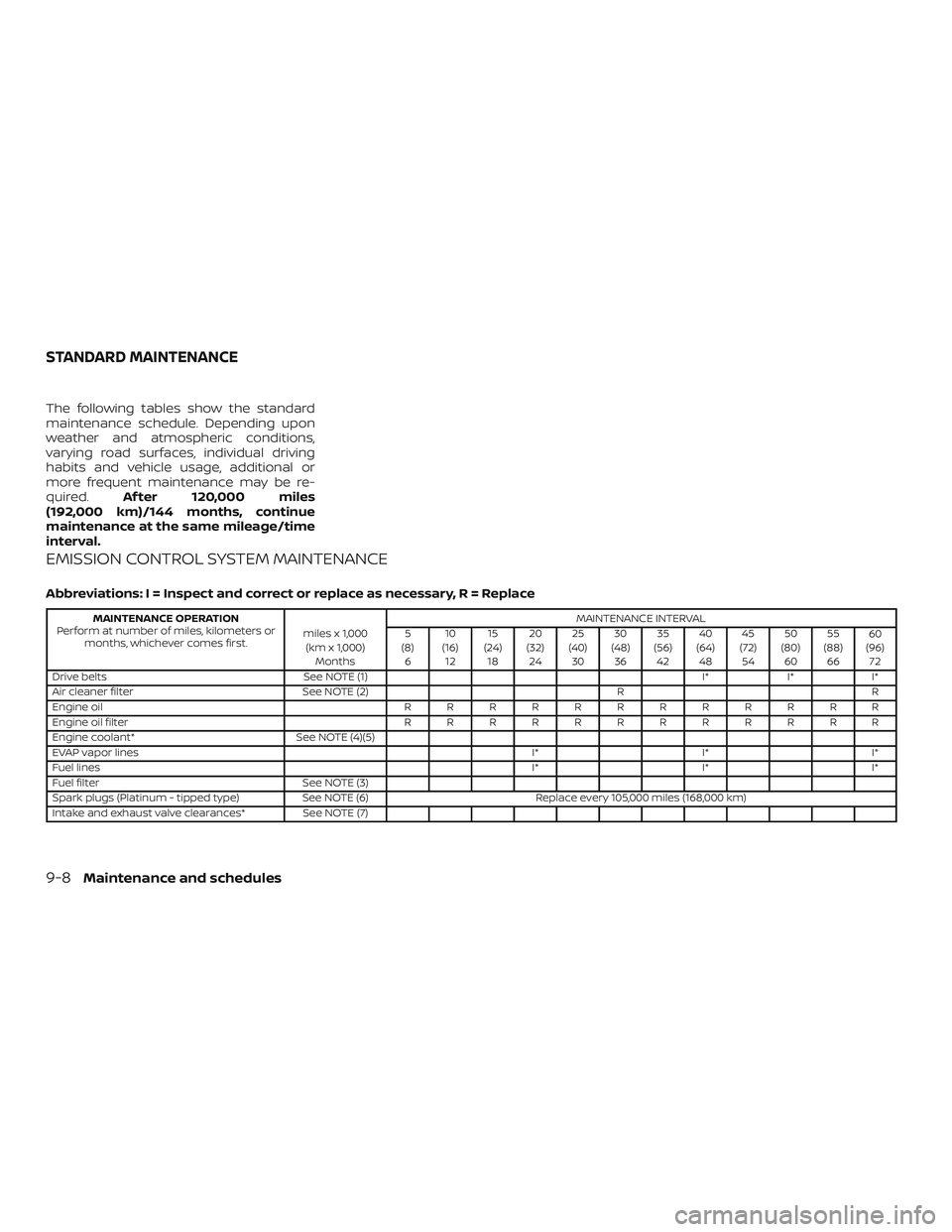
The following tables show the standard
maintenance schedule. Depending upon
weather and atmospheric conditions,
varying road surfaces, individual driving
habits and vehicle usage, additional or
more frequent maintenance may be re-
quired.Af ter 120,000 miles
(192,000 km)/144 months, continue
maintenance at the same mileage/time
interval.
EMISSION CONTROL SYSTEM MAINTENANCE
Abbreviations: I = Inspect and correct or replace as necessary, R = Replace
MAINTENANCE OPERATION
Perform at number of miles, kilometers or months, whichever comes first. miles x 1,000
(km x 1,000) Months MAINTENANCE INTERVAL
5
(8) 6 10
(16) 12 15
(24) 18 20
(32) 24 25
(40) 30 30
(48) 36 35
(56) 42 40
(64) 48 45
(72) 54 50
(80) 60 55
(88) 66 60
(96) 72
Drive belts See NOTE (1) I*I*I*
Air cleaner filter See NOTE (2) RR
Engine oil RRRRRRRRRRRR
Engine oil filter RRRRRRRRRRRR
Engine coolant* See NOTE (4)(5)
EVAP vapor lines I*I*I*
Fuel lines I*I*I*
Fuel filter See NOTE (3)
Spark plugs (Platinum - tipped type) See NOTE (6)Replace every 105,000 miles (168,000 km)
Intake and exhaust valve clearances* See NOTE (7)
STANDARD MAINTENANCE
9-8Maintenance and schedules
Page 396 of 878
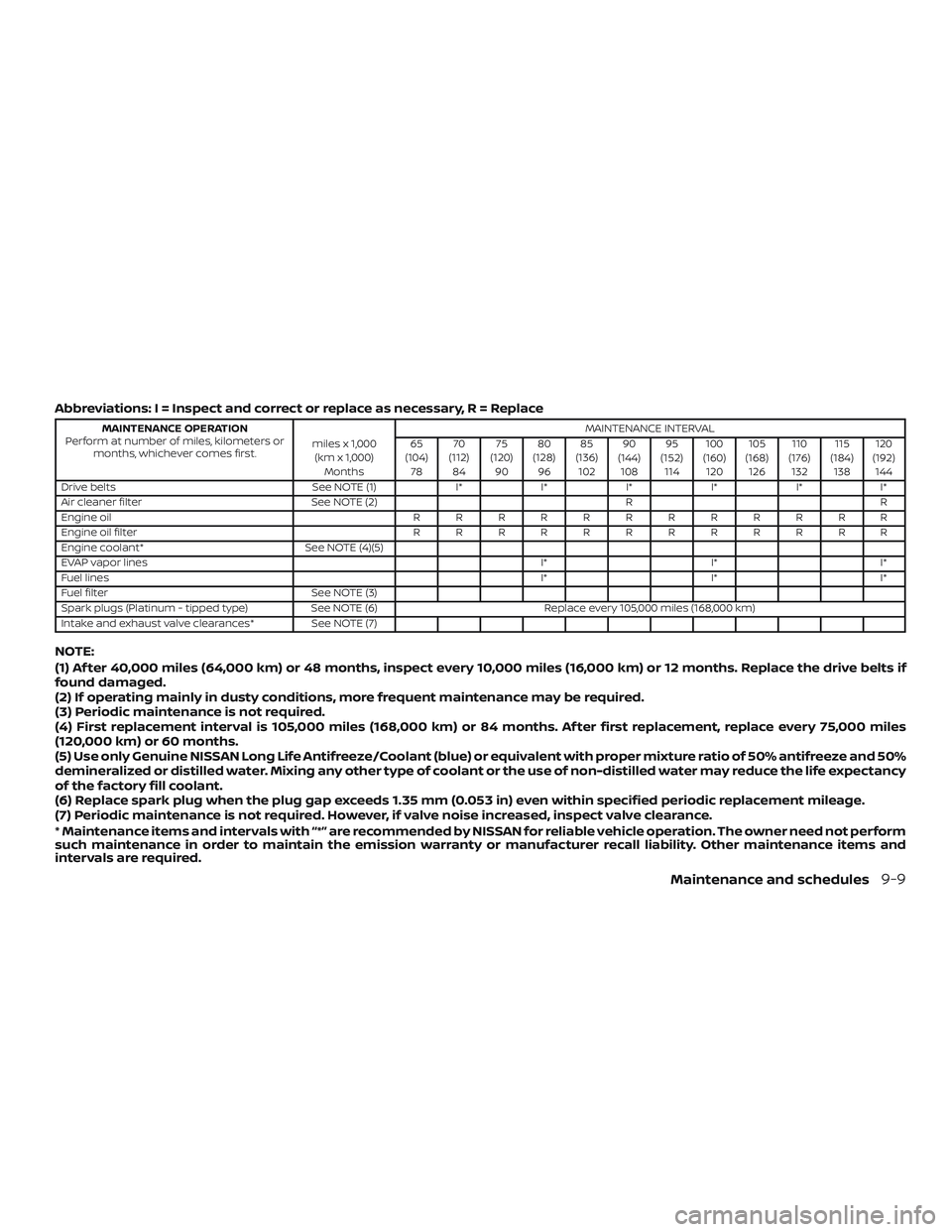
Abbreviations: I = Inspect and correct or replace as necessary, R = Replace
MAINTENANCE OPERATION
Perform at number of miles, kilometers or months, whichever comes first. miles x 1,000
(km x 1,000) Months MAINTENANCE INTERVAL
65
(104) 78 70
(112) 84 75
(120) 90 80
(128) 96 85
(136) 102 90
(144) 108 95
(152) 114 100
(160) 120 105
(168) 126 110
(176) 132 115
(184) 138 120
(192) 144
Drive belts See NOTE (1)I*I*I*I*I*I*
Air cleaner filter See NOTE (2) RR
Engine oil RRRRRRRRRRRR
Engine oil filter RRRRRRRRRRRR
Engine coolant* See NOTE (4)(5)
EVAP vapor lines I*I*I*
Fuel lines I*I*I*
Fuel filter See NOTE (3)
Spark plugs (Platinum - tipped type) See NOTE (6)Replace every 105,000 miles (168,000 km)
Intake and exhaust valve clearances* See NOTE (7)
NOTE:
(1) Af ter 40,000 miles (64,000 km) or 48 months, inspect every 10,000 miles (16,000 km) or 12 months. Replace the drive belts if
found damaged.
(2) If operating mainly in dusty conditions, more frequent maintenance may be required.
(3) Periodic maintenance is not required.
(4) First replacement interval is 105,000 miles (168,000 km) or 84 months. Af ter first replacement, replace every 75,000 miles
(120,000 km) or 60 months.
(5) Use only Genuine NISSAN Long Life Antifreeze/Coolant (blue) or equivalent with proper mixture ratio of 50% antifreeze and 50%
demineralized or distilled water. Mixing any other type of coolant or the use of non-distilled water may reduce the life expectancy
of the factory fill coolant.
(6) Replace spark plug when the plug gap exceeds 1.35 mm (0.053 in) even within specified periodic replacement mileage.
(7) Periodic maintenance is not required. However, if valve noise increased, inspect valve clearance.
* Maintenance items and intervals with “*” are recommended by NISSAN for reliable vehicle operation. The owner need not perform
such maintenance in order to maintain the emission warranty or manufacturer recall liability. Other maintenance items and
intervals are required.
Maintenance and schedules9-9
Page 405 of 878
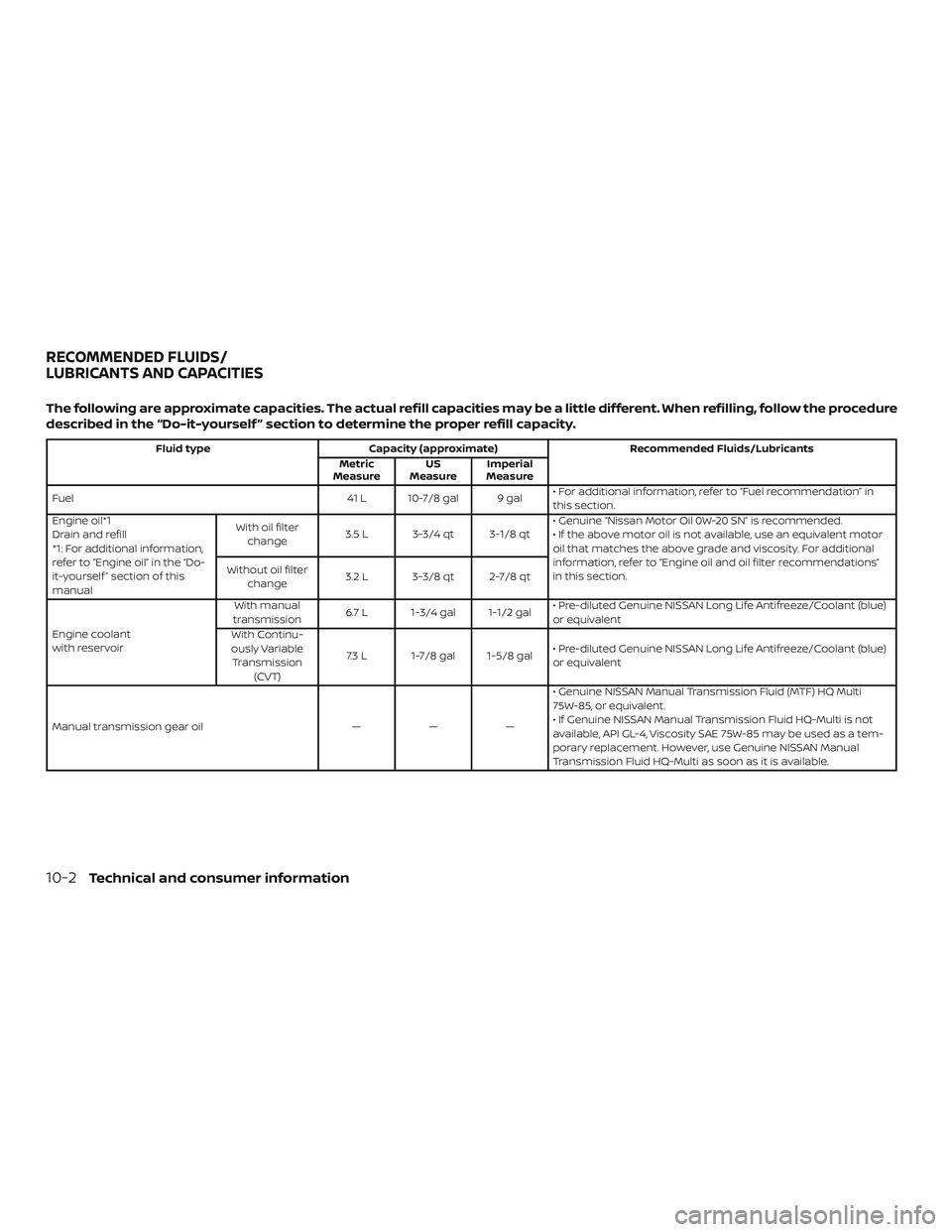
The following are approximate capacities. The actual refill capacities may be a little different. When refilling, follow the procedure
described in the “Do-it-yourself ” section to determine the proper refill capacity.
Fluid typeCapacity (approximate) Recommended Fluids/Lubricants
Metric
Measure US
Measure Imperial
Measure
Fuel 41 L 10-7/8 gal 9 gal• For additional information, refer to “Fuel recommendation” in
this section.
Engine oil*1
Drain and refill
*1: For additional information,
refer to “Engine oil” in the “Do-
it-yourself ” section of this
manual With oil filter
change 3.5 L 3-3/4 qt 3-1/8 qt • Genuine “Nissan Motor Oil 0W-20 SN” is recommended.
• If the above motor oil is not available, use an equivalent motor
oil that matches the above grade and viscosity. For additional
information, refer to “Engine oil and oil filter recommendations”
in this section.
Without oil filter
change 3.2 L 3-3/8 qt 2-7/8 qt
Engine coolant
with reservoir With manual
transmission 6.7 L 1-3/4 gal 1-1/2 gal • Pre-diluted Genuine NISSAN Long Life Antifreeze/Coolant (blue)
or equivalent
With Continu-
ously Variable Transmission (CVT) 7.3 L 1-7/8 gal 1-5/8 gal
• Pre-diluted Genuine NISSAN Long Life Antifreeze/Coolant (blue)
or equivalent
Manual transmission gear oil ———• Genuine NISSAN Manual Transmission Fluid (MTF) HQ Multi
75W-85, or equivalent.
• If Genuine NISSAN Manual Transmission Fluid HQ-Multi is not
available, API GL-4, Viscosity SAE 75W-85 may be used as a tem-
porary replacement. However, use Genuine NISSAN Manual
Transmission Fluid HQ-Multi as soon as it is available.
RECOMMENDED FLUIDS/
LUBRICANTS AND CAPACITIES
10-2Technical and consumer information
Page 427 of 878
C
Capacities and recommended fuel/
lubricants....................10-2
Cargocover...................2-39
Cargo (See vehicle loading information). .10-13
Car phone or CB radio ............4-81
CDcareandcleaning.............4-73
CD player (See audio system). .4-47, 4-52, 4-60
Checking bulbs .................2-15
Childrestraints........1-20, 1-21, 1-23, 1-25 LATCH (Lower Anchors and Tethers for
CHildren)System..............1-25
Precautions on child
restraints .........1-23, 1-30, 1-36, 1-41
Top tether strap anchor point
locations.................. .1-27
Child restraint with top tether strap . . . .1-27
Child safety rear door lock ..........3-8
Chimes, audible reminders .........2-23
Cleaningexteriorandinterior......7-2,7-4
Clock setting (models with Navigation
System) ...................4-7,4-9
Clock setting (models without Navigation
System) ...........4-46,4-50,4-51,4-51
Clutch Clutchfluid.................8-10
C.M.V.S.S. certification label .........10-11
Coldweatherdriving.............5-34
Compact disc (CD) player ....4-47,4-52,4-60
Connect phone ................4-76
Continuously Variable
Transmission (CVT) ............5-9,5-15
Continuously Variable Transmission (CVT)
fluid......................8-9 Driving with Continuously Variable
Transmission (CVT)
..........5-9,5-15
Control panel buttons .............4-4
Brightness/contrast button .......4-9
Settingbutton................4-7
Controls Audio controls (steering wheel) .....4-74
Heater and air conditioner controls . .4-28
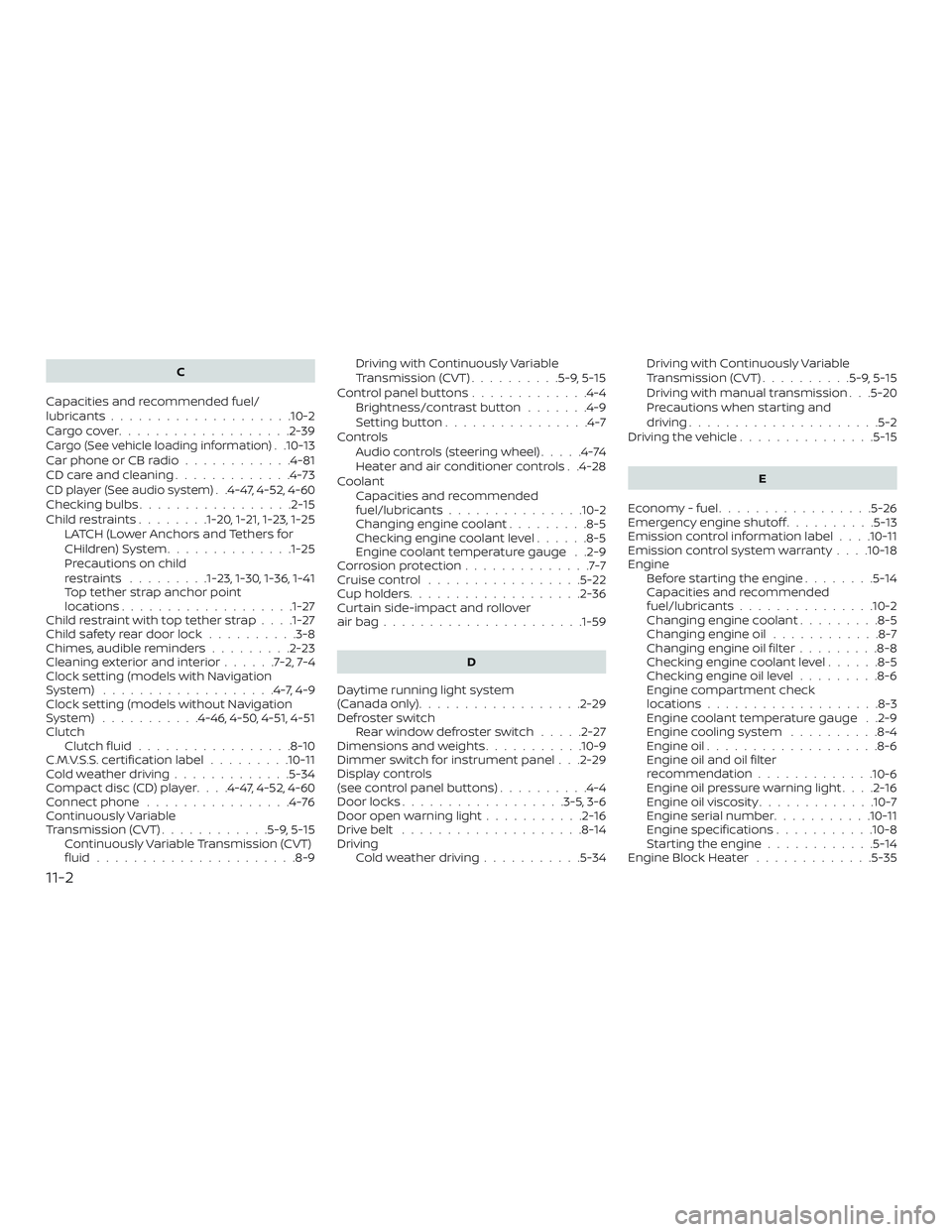
Coolant Capacities and recommended
fuel/lubricants...............10-2
Changing engine coolant .........8-5
Checking engine coolant level ......8-5
Engine coolant temperature gauge . .2-9
Corrosionprotection..............7-7
Cruisecontrol .................5-22
Cupholders...................2-36
Curtain side-impact and rollover
airbag..................... .1-59
D
Daytime running light system
(Canada only) ..................2-29
Defroster switch Rearwindowdefrosterswitch.....2-27
Dimensions and weights ...........10-9
Dimmer switch for instrument panel . . .2-29
Display controls
(see control panel buttons) ..........4-4
Door locks ..................3-5,3-6
Door open warning light ...........2-16
Drivebelt ....................8-14
Driving Cold weather driving ...........5-34 Driving with Continuously Variable
Transmission (CVT)
..........5-9,5-15
Driving with manual transmission . . .5-20
Precautions when starting and
driving .....................5-2
Driving the vehicle ...............5-15
E
Economy - fuel .................5-26
Emergency engine shutoff ..........5-13
Emission control information label . . . .10-11
Emission control system warranty . . . .10-18
Engine Before starting the engine ........5-14
Capacities and recommended
fuel/lubricants...............10-2
Changing engine coolant .........8-5
Changing engine oil ............8-7
Changing engine oil filter .........8-8
Checking engine coolant level ......8-5
Checking engine oil level .........8-6
Engine compartment check
locations...................8-3
Engine coolant temperature gauge . .2-9
Engine cooling system ..........8-4
Engine oil ...................8-6
Engine oil and oil filter
recommendation .............
10-6
Engine oil pressure warning light . . . .2-16
Engine oil viscosity .............10-7
Engine serial number ...........10-11
Engine specifications ...........10-8
Starting the engine ............5-14
Engine Block Heater .............5-35
11-2
Page 428 of 878
Engine coolant temperature gauge....2-9
EventDatarecorders............10-20
Exhaust gas (Carbon monoxide) .......5-2
Explanation of maintenance items .....9-2
Explanation of scheduled maintenance
items .......................9-5
Extended storage switch ..........8-20
F
Flashers
(See hazard warning flasher switch) ....6-2
Flattire....................6-3,6-3
Floormatpositioningaid...........7-6
Fluid Brakefluid..................8-9
Capacities and recommended
fuel/lubricants...............10-2
Clutchfluid.................8-10
Continuously Variable Transmission (CVT)
fluid......................8-9
Engine coolant ...............8-4
Engine oil ...................8-6
F.M.V.S.S. certification label ..........10-11
Foglightswitch ................2-31
Front air bag system
(See supplemental restraint system) . . .1-54
Front-door pocket ...............2-34
Frontseats................... .1-2
Fuel Capacities and recommended
fuel/lubricants...............10-2
Fuel economy ...............5-26
Fuel-filler door lock opener lever ....3-28
Fuel gauge .................2-10 Fueloctanerating.............10-5
Fuel recommendation
..........10-4
Loose fuel cap warning .......2-7,3-29
Fuel efficient driving tips ...........5-25
Fuel-filler door .................3-28
Fuel gauge ...................2-10
Fuses .......................8-18
Fusiblelinks...................8-19
G
Gauge Engine coolant temperature gauge . .2-9
Fuel gauge .................2-10
Odometer ..................2-6
Speedometer ................2-5
Tachometer .................2-8
Trip computer ................2-11
Trip odometer ................2-6
General maintenance .............9-2
Glovebox....................2-36
H
Hands-free phone system,
Bluetooth®............4-81,4-96,4-108
Hazard warning flasher switch ........6-2
Headlight and turn signal switch ......2-28
Headlightcontrolswitch...........2-28
Headlights ...................8-24
Headrestraints .................1-6
Heatedseats..................2-32
Heated seat switches ............2-32 Heater
Heater and air conditioner controls . .4-28
Heater operation .............4-30
Hood release ..................3-26
Horn .......................2-31
I
Ignition switch ..................5-8
Push-button ignition switch .......5-10
Immobilizer system .......2-24,5-10,5-14
Important vehicle information label . . . .10-11
Increasing fuel economy ...........5-26
Indicator NISSAN Intelligent Key® battery discharge
indicator...................5-13
Indicator lights and audible reminders
(See warning/indicator lights and audible
reminders) ................2-14,2-20
Instrument brightness control .......2-29
Instrument panel .............0-6,2-2
Instrument panel dimmer switch .....2-29
Intelligent Key system Key operating range ............
3-14
Key operation ................3-15
Mechanical key ...............3-4
Remote keyless entry operation . .3-9, 3-18
Troubleshooting guide .......3-24,3-25
Warning signals ...........3-24,3-25
Interiorlight...............2-42,2-43
iPod®Player...............4-65,4-68
ISOFIX child restraints .............1-25
11-3
Page 431 of 878
Seatbeltwarninglight.........1-13, 2-20
SeatsAdjustment ..................1-2
Armrests ...................1-5
Frontseats..................1-2
Heatedseats................2-32
Manual front seat adjustment ......1-3
Rearseat.................. .1-4
Security indicator light ............2-22
Security system (NISSAN Vehicle Immobilizer
System), engine start .......2-24,5-10,5-14
Self-adjustingbrakes.............8-18
Service manual order form .........10-21
Servicing air conditioner ...........4-36
Settingbutton..................4-7
Shif ting Continuously Variable Transmission
(CVT) .....................5-17
Manual transmission ...........5-20
Shiftleverlockrelease............5-18
Shoulder belt height adjustment ......1-19
Side air bag system (See supplemental
side air bag, curtain and rollover air bag
systems) .................... .1-59
Siri® Eyes-Free .................4-77
Smartphone connectivity ..........4-76
Spark plug replacement ...........8-15
Spark plugs ...................8-15
Specifications .................10-8
Speedometer ..................2-5
SRS warning label ...............1-62
Stability control .................5-31
Standard maintenance ............9-8
Starting Before starting the engine ........5-14
Jumpstarting ............6-12,8-13 Precautions when starting and
driving.....................5-2
Push starting
................6-14
Starting the engine ............5-14
Starting the engine ..............5-14
Steering Powersteeringsystem .........5-28
Tilting steering wheel ...........3-31
Steering wheel .................3-31
Steering wheel audio control switch . . .4-74
Stoplight....................8-26
Storage.....................2-34
Storagetray ..................2-35
Sunvisors....................3-31
Supplemental air bag warning labels . . .1-62
Supplemental air bag warning
light ....................1-62, 2-20
Supplemental front impact air bag
system ..................... .1-54
Supplemental restraint system Information and warning labels . . . .1-62
Precautions on supplemental restraint
system ................... .1-44
Supplemental restraint system
(Supplemental air bag system) .......1-44
Switch Automatic power window switch . . .2-42
Foglightswitch ..............2-31
Hazard warning flasher switch ......6-2
Headlight and turn signal switch ....2-28
Headlightcontrolswitch.........2-28
Ignition switch ................5-8
Instrument brightness control .....2-29
Power door lock switch ..........3-7
Rearwindowdefrosterswitch.....2-27 Rear window wiper and washer
switches
...................2-26
Turn signal switch .............2-30
V
ehicle dynamic control (VDC) off
switch....................2-33
T
Tachometer ...................2-8
Temperature gauge Engine coolant temperature gauge . .2-9
Thef t (NISSAN Vehicle Immobilizer System),
engine start ............2-24,5-10,5-14
Three-waycatalyst...............5-2
Tilting steering wheel .............3-31
Tire Flattire..................6-3,6-3
Spare tire ...............6-4,8-39
Tire and Loading Information label . .10-12
Tire chains .................8-36
Tire pressure ................8-29
Tirerotation.................8-37
Types of tires ................8-35
Uniform tire quality grading .......10-17
Wheels and tires ...........8-29,10-9
Wheel/tire size ...............10-9
Tire pressure Low tire pressure warning light .....2-17
Tire Pressure Monitoring System (TPMS) . .5-3
Toptetherstrapchildrestraint.......1-27
Towing 2-wheel drive models ........6-16,6-17
Flattowing.................10-17
Towtrucktowing .............6-15
Trailertowing ...............10-17
11-6
Page 452 of 878
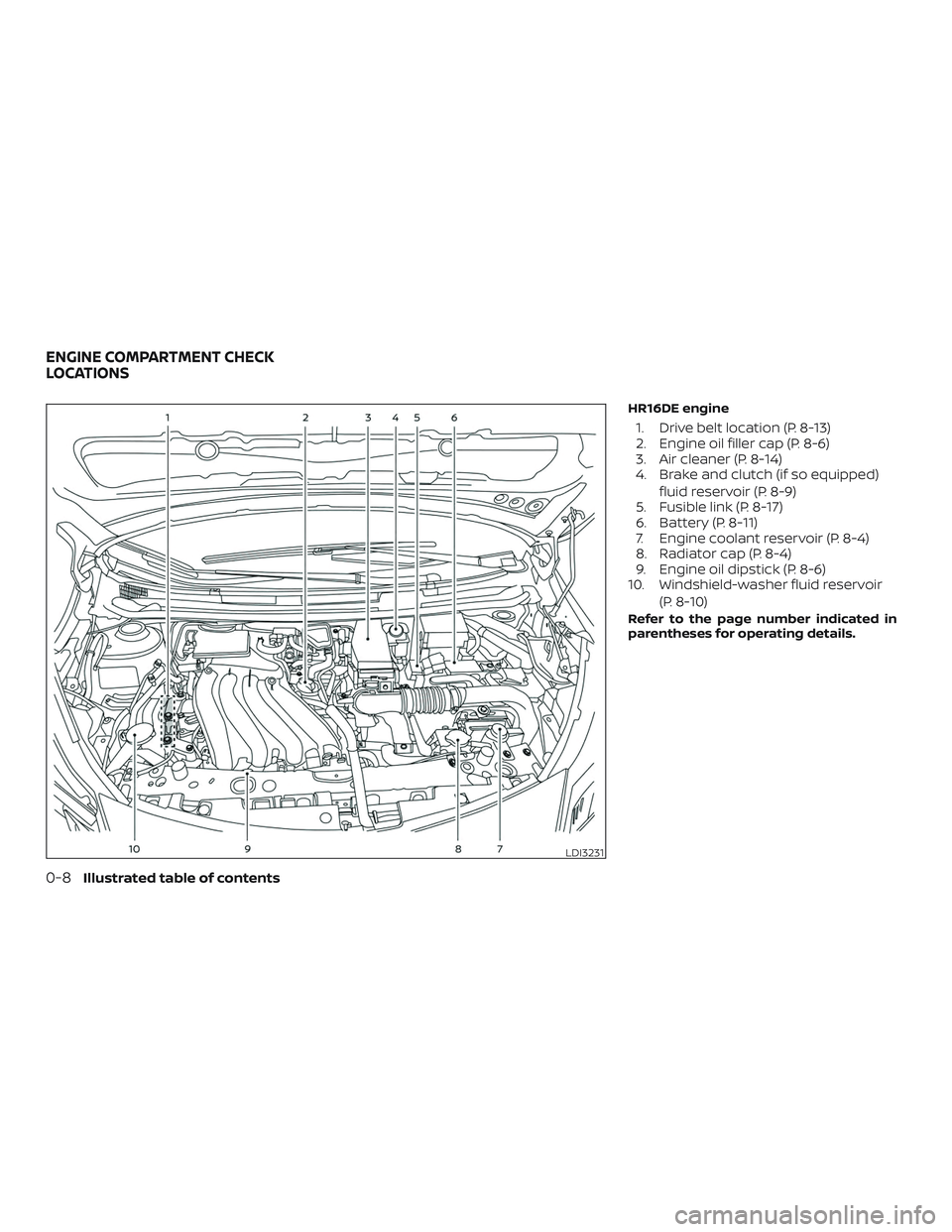
HR16DE engine
1. Drive belt location (P. 8-13)
2. Engine oil filler cap (P. 8-6)
3. Air cleaner (P. 8-14)
4. Brake and clutch (if so equipped)fluid reservoir (P. 8-9)
5. Fusible link (P. 8-17)
6. Battery (P. 8-11)
7. Engine coolant reservoir (P. 8-4)
8. Radiator cap (P. 8-4)
9. Engine oil dipstick (P. 8-6)
10. Windshield-washer fluid reservoir
(P. 8-10)
Refer to the page number indicated in
parentheses for operating details.
LDI3231
ENGINE COMPARTMENT CHECK
LOCATIONS
0-8Illustrated table of contents
Page 520 of 878
2 Instruments and controls
Instrument panel................................2-2
Meters and gauges ..............................2-3
Speedometer and odometer .................2-5
Tachometer ..................................2-8
Engine coolant temperature gauge ..........2-9
Fuel gauge .................................. 2-10
Trip computer ................................ 2-11
Service interval reminder
(if so equipped) .............................. 2-12
Warning lights, indicator lights and audible
reminders ...................................... 2-14
Checking lights .............................. 2-15
Warning lights ............................... 2-15
Indicator lights .............................. 2-21
Audible reminders ........................... 2-23
Security systems ............................... 2-24
NISSAN Vehicle Immobilizer System
(if so equipped) .............................. 2-24
Wiper and washer switch .......................2-26
Switch operation ............................ 2-26
Rear switch operation .......................2-27
Rear window and outside mirror
(if so equipped) defroster switch ................2-28Headlight and turn signal switch
...............2-28
Headlight control switch .....................2-28
Daytime running lights (DRL) system
(Canada only) ................................ 2-29
Instrument brightness control ...............2-30
Turn signal switch ........................... 2-30
Fog light switch (if so equipped) .............2-31
Horn ........................................... 2-31
Heated seat switches (if so equipped) ..........2-32
Vehicle Dynamic Control (VDC) OFF switch ......2-33
Power outlets .................................. 2-34
Storage ........................................ 2-35
Front-door pockets .......................... 2-35
Seatback pocket ............................ 2-35
Storagetray................................. 2-36
Glovebox.................................... 2-36
Upper glove box ............................. 2-36
Cup
holders ................................. 2-37
Divide-n-hide® adjustable floor
(if so equipped) .............................. 2-38
Cargo cover (if so equipped) .................2-39
Windows ....................................... 2-40
Power windows (if so equipped) .............2-40
Manual windows (if so equipped) ............2-42
Page 529 of 878
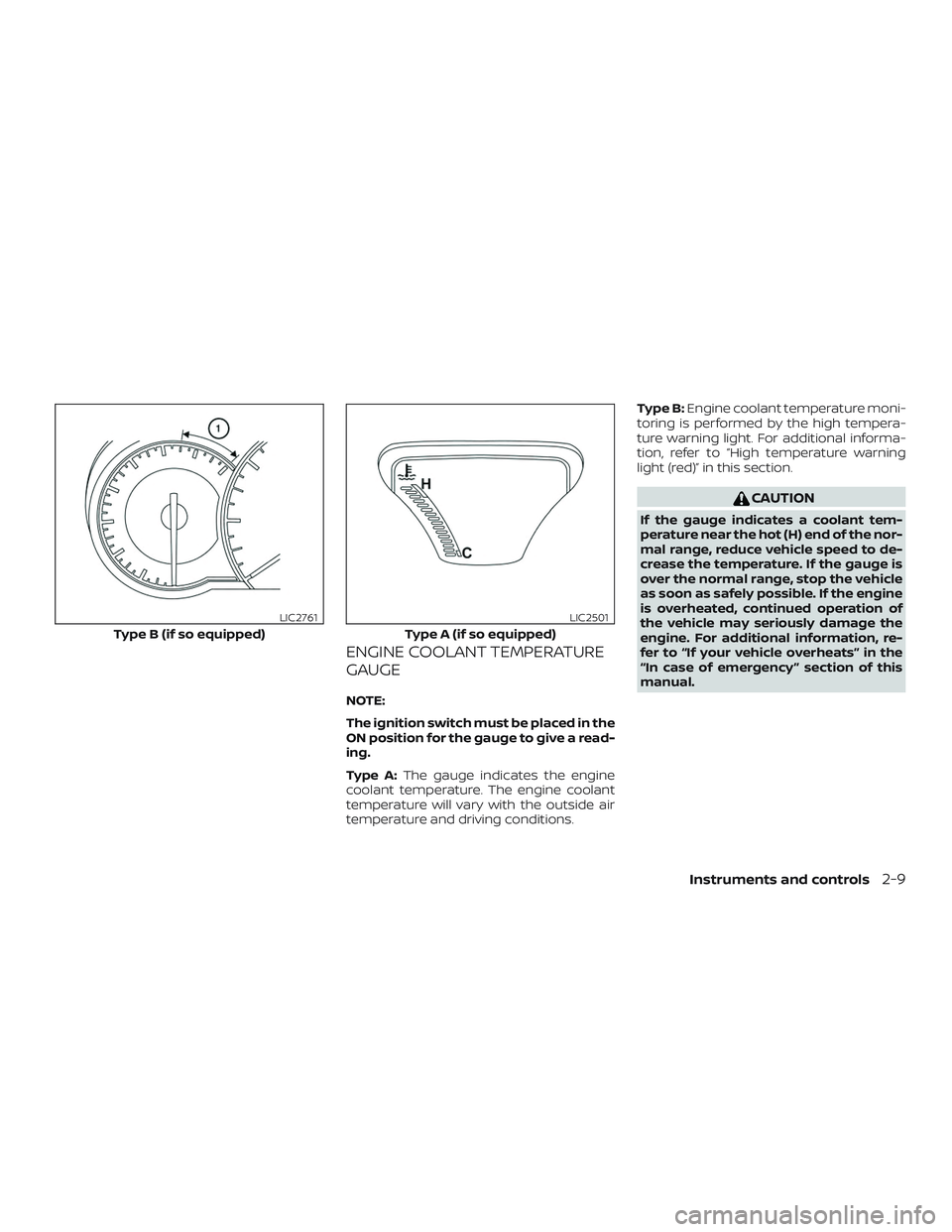
ENGINE COOLANT TEMPERATURE
GAUGE
NOTE:
The ignition switch must be placed in the
ON position for the gauge to give a read-
ing.
Type A:The gauge indicates the engine
coolant temperature. The engine coolant
temperature will vary with the outside air
temperature and driving conditions. Type B:
Engine coolant temperature moni-
toring is performed by the high tempera-
ture warning light. For additional informa-
tion, refer to “High temperature warning
light (red)” in this section.
CAUTION
If the gauge indicates a coolant tem-
perature near the hot (H) end of the nor-
mal range, reduce vehicle speed to de-
crease the temperature. If the gauge is
over the normal range, stop the vehicle
as soon as safely possible. If the engine
is overheated, continued operation of
the vehicle may seriously damage the
engine. For additional information, re-
fer to “If your vehicle overheats” in the
“In case of emergency ” section of this
manual.
Type B (if so equipped)
LIC2761
Type A (if so equipped)
LIC2501
Instruments and controls2-9
Page 537 of 878
dicates that the high temperature sensor
in the engine coolant system is opera-
tional.
When driving, the high temperature warn-
ing light may turn off. This indicates that the
engine coolant temperature is within the
normal range.
CAUTION
If the high temperature warning light
illuminates while the engine is running,
it may indicate the engine temperature
is extremely high. Stop the vehicle
safely as soon as possible. If the vehicle
is overheated, continuing vehicle op-
eration may seriously damage the en-
gine. For additional information, refer
to “If your vehicle overheats” in the “In
case of emergency ” section of this
manual.
Low fuel warning light
This light comes on when the fuel level in
the fuel tank is getting low. Refuel as soon
as it is convenient, preferably before the
fuel gauge reaches 0 (Empty).There will be
a small reserve of fuel in the tank when
the fuel gauge reaches 0 (Empty), show-
ing no more fuel bars.
Low tire pressure warning
light (if so equipped)
Your vehicle is equipped with a Tire Pres-
sure Monitoring System (TPMS) that moni-
tors the tire pressure of all tires except the
spare.
The low tire pressure warning light warns
of low tire pressure or indicates that the
TPMS is not functioning properly.
Af ter the ignition switch is placed in the ON
position, this light illuminates for about
1 second and turns off.
Low tire pressure warning
If the vehicle is being driven with low tire
pressure, the warning light will illumi-
nate.
A CHECK TIRE PRES (pressure) warning
message is also displayed in the odom-
eter.
When the low tire pressure warning light
illuminates, you should stop and adjust
the tire pressure of all four tires to the
recommended COLD tire pressure shown
on the Tire and Loading Information la-
bel located in the driver’s door opening.
The low tire pressure warning light does
not automatically turn off when the tire pressure is adjusted. Af ter the tire is in-
flated to the recommended pressure,
the vehicle must be driven at speeds
above 16 mph (25 km/h) to activate the
TPMS and turn off the low tire pressure
warning light. Use a tire pressure gauge
to check the tire pressure.
The low tire pressure warning light remains
illuminated until the tires are inflated to the
recommended COLD tire pressure. The
CHECK TIRE PRES warning message is dis-
played each time the ignition switch is
placed in the ON position as long as the low
tire pressure warning light remains illumi-
nated.
Instruments and controls2-17