weight NISSAN VERSA NOTE 2018 Owner´s Manual
[x] Cancel search | Manufacturer: NISSAN, Model Year: 2018, Model line: VERSA NOTE, Model: NISSAN VERSA NOTE 2018Pages: 878, PDF Size: 9.62 MB
Page 416 of 878
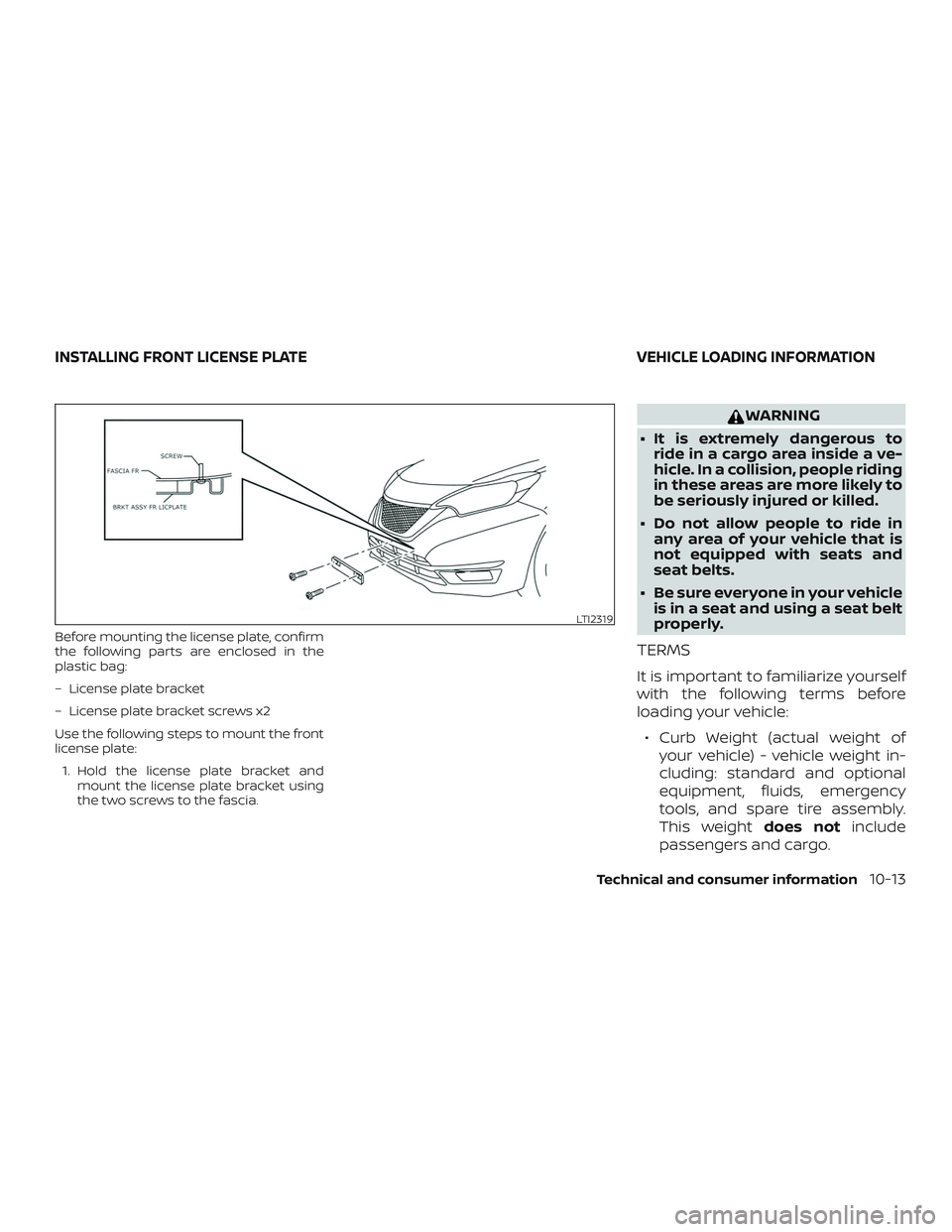
Before mounting the license plate, confirm
the following parts are enclosed in the
plastic bag:
– License plate bracket
– License plate bracket screws x2
Use the following steps to mount the front
license plate:1. Hold the license plate bracket and mount the license plate bracket using
the two screws to the fascia.
WARNING
∙ It is extremely dangerous to ride in a cargo area inside a ve-
hicle. In a collision, people riding
in these areas are more likely to
be seriously injured or killed.
∙ Do not allow people to ride in any area of your vehicle that is
not equipped with seats and
seat belts.
∙ Be sure everyone in your vehicle is in a seat and using a seat belt
properly.
TERMS
It is important to familiarize yourself
with the following terms before
loading your vehicle:
∙ Curb Weight (actual weight of your vehicle) - vehicle weight in-
cluding: standard and optional
equipment, fluids, emergency
tools, and spare tire assembly.
This weight does notinclude
passengers and cargo.
LTI2319
INSTALLING FRONT LICENSE PLATE VEHICLE LOADING INFORMATION
Technical and consumer information10-13
Page 417 of 878
∙ GVW (Gross Vehicle Weight) - curbweight plus the combined weight
of passengers and cargo.
∙ GVWR (Gross Vehicle Weight Rat- ing) - maximum total combined
weight of the unloaded vehicle,
passengers, luggage, hitch, trailer
tongue load and any other op-
tional equipment. This informa-
tion is located on the
F.M.V.S.S./C.M.V.S.S. certification
label.
∙ GAWR (Gross Axle Weight Rating) - maximum weight (load) limit
specified for the front or rear axle.
This information is located on the
F.M.V.S.S./C.M.V.S.S. certification
label.
∙ GCWR (Gross Combined Weight rating) - The maximum total
weight rating of the vehicle, pas-
sengers, cargo, and trailer. ∙ Vehicle Capacity Weight, Load
limit, Total load capacity - maxi-
mum total weight limit specified
of the load (passengers and
cargo) for the vehicle. This is the
maximum combined weight of
occupants and cargo that can be
loaded into the vehicle. If the ve-
hicle is used to tow a trailer, the
trailer tongue weight must be in-
cluded as part of the cargo load.
This information is located on the
Tire and Loading Information la-
bel.
∙ Cargo capacity - permissible weight of cargo, the subtracted
weight of occupants from the
load limit.
DETERMINING VEHICLE LOAD
CAPACITY
The load capacity of this vehicle is
determined by weight, not by avail-
able cargo space. For example, a lug-
gage rack, bike carrier, car-top car- rier or similar equipment does not
increase load carrying capacity of
your vehicle.
To determine vehicle load capacity:
Vehicle weight can be determined
by using a commercial-grade scale,
found at places such as a truck stop,
gravel quarry, grain elevator, or a
scrap metal recycling facility.
1. Determine the curb weight of your vehicle.
2. Compare the curb weight amount to the GVWR specified
for your vehicle to determine
how much more weight your ve-
hicle can carry.
3. Af ter loading (cargo and pas- sengers), re-weigh your vehicle
to determine if either GVWR or
GAWR for your vehicle is ex-
ceeded. If GVWR is exceeded, re-
move cargo as necessary. If ei-
ther the front or rear GAWR is
exceeded, shif t the load or re-
move cargo as necessary.
10-14
Technical and consumer information
Page 418 of 878
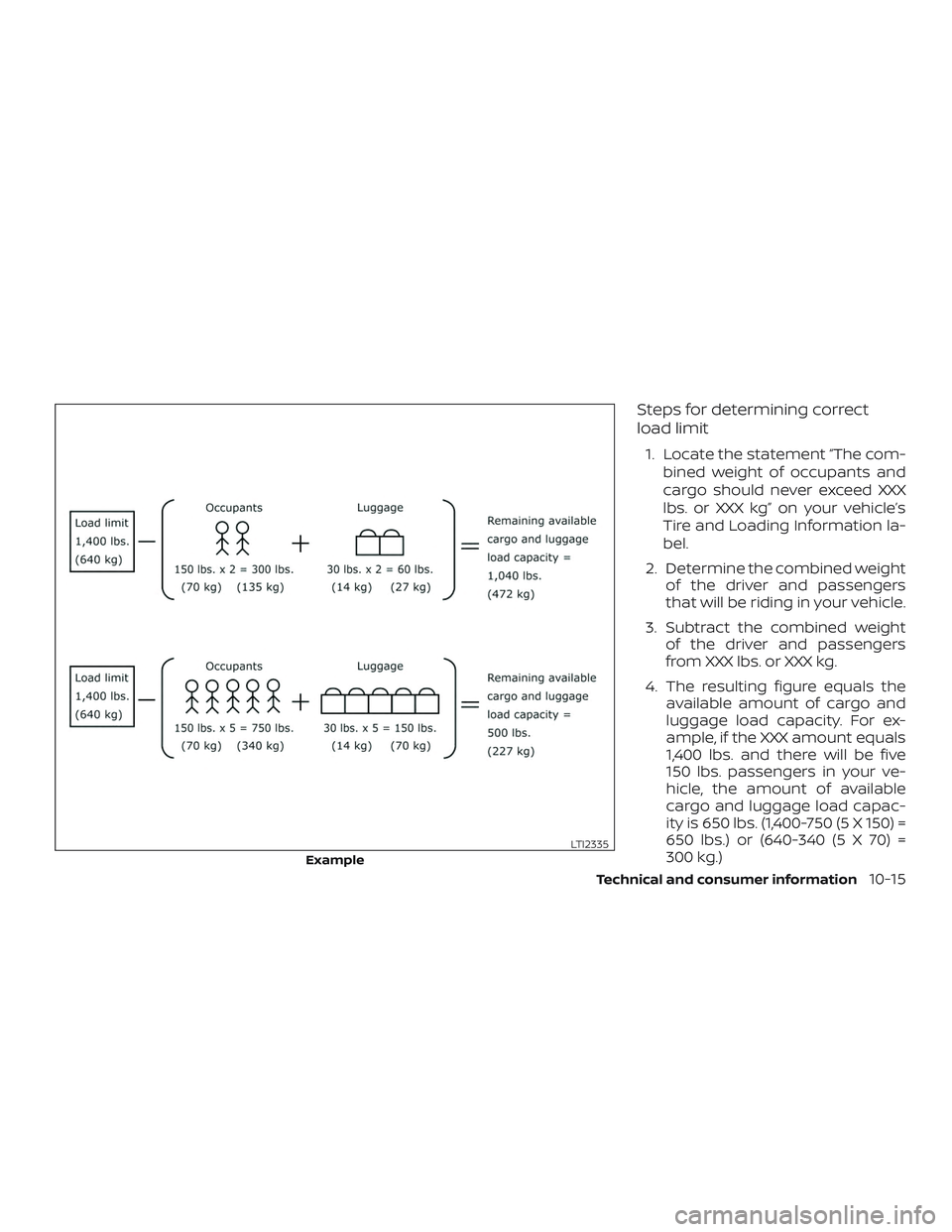
Steps for determining correct
load limit
1. Locate the statement “The com-bined weight of occupants and
cargo should never exceed XXX
lbs. or XXX kg” on your vehicle’s
Tire and Loading Information la-
bel.
2. Determine the combined weight of the driver and passengers
that will be riding in your vehicle.
3. Subtract the combined weight of the driver and passengers
from XXX lbs. or XXX kg.
4. The resulting figure equals the available amount of cargo and
luggage load capacity. For ex-
ample, if the XXX amount equals
1,400 lbs. and there will be five
150 lbs. passengers in your ve-
hicle, the amount of available
cargo and luggage load capac-
ity is 650 lbs. (1,400-750 (5 X 150) =
650 lbs.) or (640-340 (5 X 70) =
300 kg.)
Example
LTI2335
Technical and consumer information10-15
Page 419 of 878
5.Determine the combined weight
of luggage and cargo being
loaded on the vehicle. That
weight may not safely exceed the
available cargo and luggage load
capacity calculated in step 4.
Before driving a loaded vehicle, con-
firm that you do not exceed the
Gross Vehicle Weight Rating (GVWR)
or the Gross Axle Weight Rating
(GAWR) for your vehicle. For addi-
tional information, refer to “Measure-
ment of weights” in this section.
Also check tires for proper inflation
pressures. For additional informa-
tion, refer to “Tire and Loading Infor-
mation label” in this section.
LOADING TIPS
∙The GVW must not exceed GVWR or
GAWR as specified on the
F.M.V.S.S./C.M.V.S.S. certification label.
∙ Do not load the front and rear axle to the GAWR. Doing so will
exceed the GVWR.
WARNING
∙ Properly secure all cargo with ropes or straps to help prevent
it from sliding or shif ting. Do not
place cargo higher than the
seatbacks. In a sudden stop or
collision, unsecured cargo could
cause personal injury.
∙ Do not load your vehicle any heavier than the GVWR or the
maximum front and rear
GAWRs. If you do, parts of your
vehicle can break, tire damage
could occur, or it can change the
way your vehicle handles. This
could result in loss of control
and cause personal injury.
∙ Overloading not only can shorten the life of your vehicle
and the tire, but can also cause
unsafe vehicle handling and
longer braking distances. This
may cause a premature tire fail-
ure which could result in a seri-
ous accident and personal in-
jury. Failures caused by
overloading are not covered by
the vehicle’s warranty.MEASUREMENT OF WEIGHTS
Secure loose items to prevent
weight shif ts that could affect the
balance of your vehicle. When the ve-
hicle is loaded, drive to a scale and
weigh the front and the rear wheels
separately to determine axle loads.
Individual axle loads should not ex-
ceed either of the gross axle weight
ratings (GAWR). The total of the axle
loads should not exceed the gross
vehicle weight rating (GVWR). These
ratings are given on the vehicle cer-
tification label. If weight ratings are
exceeded, move or remove items to
bring all weights below the ratings.
10-16
Technical and consumer information
Page 427 of 878
C
Capacities and recommended fuel/
lubricants....................10-2
Cargocover...................2-39
Cargo (See vehicle loading information). .10-13
Car phone or CB radio ............4-81
CDcareandcleaning.............4-73
CD player (See audio system). .4-47, 4-52, 4-60
Checking bulbs .................2-15
Childrestraints........1-20, 1-21, 1-23, 1-25 LATCH (Lower Anchors and Tethers for
CHildren)System..............1-25
Precautions on child
restraints .........1-23, 1-30, 1-36, 1-41
Top tether strap anchor point
locations.................. .1-27
Child restraint with top tether strap . . . .1-27
Child safety rear door lock ..........3-8
Chimes, audible reminders .........2-23
Cleaningexteriorandinterior......7-2,7-4
Clock setting (models with Navigation
System) ...................4-7,4-9
Clock setting (models without Navigation
System) ...........4-46,4-50,4-51,4-51
Clutch Clutchfluid.................8-10
C.M.V.S.S. certification label .........10-11
Coldweatherdriving.............5-34
Compact disc (CD) player ....4-47,4-52,4-60
Connect phone ................4-76
Continuously Variable
Transmission (CVT) ............5-9,5-15
Continuously Variable Transmission (CVT)
fluid......................8-9 Driving with Continuously Variable
Transmission (CVT)
..........5-9,5-15
Control panel buttons .............4-4
Brightness/contrast button .......4-9
Settingbutton................4-7
Controls Audio controls (steering wheel) .....4-74
Heater and air conditioner controls . .4-28
Coolant Capacities and recommended
fuel/lubricants...............10-2
Changing engine coolant .........8-5
Checking engine coolant level ......8-5
Engine coolant temperature gauge . .2-9
Corrosionprotection..............7-7
Cruisecontrol .................5-22
Cupholders...................2-36
Curtain side-impact and rollover
airbag..................... .1-59
D
Daytime running light system
(Canada only) ..................2-29
Defroster switch Rearwindowdefrosterswitch.....2-27
Dimensions and weights ...........10-9
Dimmer switch for instrument panel . . .2-29
Display controls
(see control panel buttons) ..........4-4
Door locks ..................3-5,3-6
Door open warning light ...........2-16
Drivebelt ....................8-14
Driving Cold weather driving ...........5-34 Driving with Continuously Variable
Transmission (CVT)
..........5-9,5-15
Driving with manual transmission . . .5-20
Precautions when starting and
driving .....................5-2
Driving the vehicle ...............5-15
E
Economy - fuel .................5-26
Emergency engine shutoff ..........5-13
Emission control information label . . . .10-11
Emission control system warranty . . . .10-18
Engine Before starting the engine ........5-14
Capacities and recommended
fuel/lubricants...............10-2
Changing engine coolant .........8-5
Changing engine oil ............8-7
Changing engine oil filter .........8-8
Checking engine coolant level ......8-5
Checking engine oil level .........8-6
Engine compartment check
locations...................8-3
Engine coolant temperature gauge . .2-9
Engine cooling system ..........8-4
Engine oil ...................8-6
Engine oil and oil filter
recommendation .............
10-6
Engine oil pressure warning light . . . .2-16
Engine oil viscosity .............10-7
Engine serial number ...........10-11
Engine specifications ...........10-8
Starting the engine ............5-14
Engine Block Heater .............5-35
11-2
Page 432 of 878
Towingatrailer................10-17
TransmissionContinuously Variable Transmission (CVT)
fluid......................8-9
Driving with Continuously Variable
Transmission (CVT) ..........5-9,5-15
Driving with manual transmission . . .5-20
Transmission shif t lever lock release . . .5-18
Travel (See registering a vehicle in another
country) .....................10-10
Trip computer ..................2-11
Trip odometer ..................2-6
Troubleshooting guide (NISSAN voice
recognition system) .............4-122
Turn signal switch ...............2-30
U
Uniform tire quality grading .........10-17
USBinterface ..............4-61,4-63 Audio file operation ........4-62,4-64
V
Vanitymirror..................3-32
Variable voltage control system ......8-14
Vehicle dimensions and weights ......10-9
Vehicle dynamic control (VDC) off
switch......................2-33
Vehicle dynamic control (VDC) system . .5-31
Vehicle Dynamic Control (VDC) system . .5-31
Vehicle identification .............10-10
Vehicle identification number (VIN) . . . .10-10Vehicle identification number (VIN)
(Chassis number)
...............10-10
Vehicle identification number (VIN)
plate.......................10-10
Vehicle immobilizer system . .2-24, 5-10, 5-14
Vehicle loading information .....10-13,10-14
Vehiclerecovery................6-17
Vehicle security system (NISSAN Vehicle
Immobilizer System), engine
start.................2-24,5-10,5-14
Ventilators ...................4-28
Visors.......................3-31
Voice Prompt Interrupt. .4-85, 4-98, 4-99, 4-111
Voice recognition system ..........4-118
W
Warning Airbagwarninglight........1-62, 2-20
Anti-lock brake warning light ......2-15
Battery charge warning light ......2-16
Brakewarninglight............2-15
Door open warning light .........2-16
Engine oil pressure warning light ....2-16
Hazard warning flasher switch ......6-2
Loose fuel cap warning .......2-7,3-29
Lowfuelwarninglight...........2-17
Lowtirepressurewarninglight.....2-17
Low windshield-washer fluid warning
light......................2-19
Passenger air bag and status light. . .1-54
Seatbeltwarninglight.......1-13, 2-20
Supplemental air bag warning
light ..................1-62, 2-20 Warning/indicator lights and audible
reminders
...............2-14,2-20
Warning labels (for SRS) ..........1-62
Warning/indicator lights and audible
reminders .................2-14, 2-20
Audible reminders .........2-14,2-20
Checking bulbs ...............2-15
Indicatorlights............2-14, 2-20
Warninglights............2-14,2-20
Warninglights..............2-14,2-20
Warning lights, indicator lights and audible
reminders ....................2-14
Washer switch Rear window wiper and washer
switches ...................2-26
Weights (See dimensions and weights) . .10-9
Wheels and tires .............8-29,10-9
Wheel/tire size .................10-9
When traveling or registering in another
country .....................10-10
Windows ....................2-40 Locking passengers' windows .....2-41
Manual windows ..............2-42
Powerrearwindows ...........2-41
Powerwindows..............2-40
Rearpowerwindows...........2-41
Windshield-washer fluid ...........8-10
Windshield wiper blades ...........8-16
Wiper Rear window wiper and washer
switches ...................2-26
Wiper blades ................8-16
Wiper and washer switch ..........2-25
11-7
Page 446 of 878
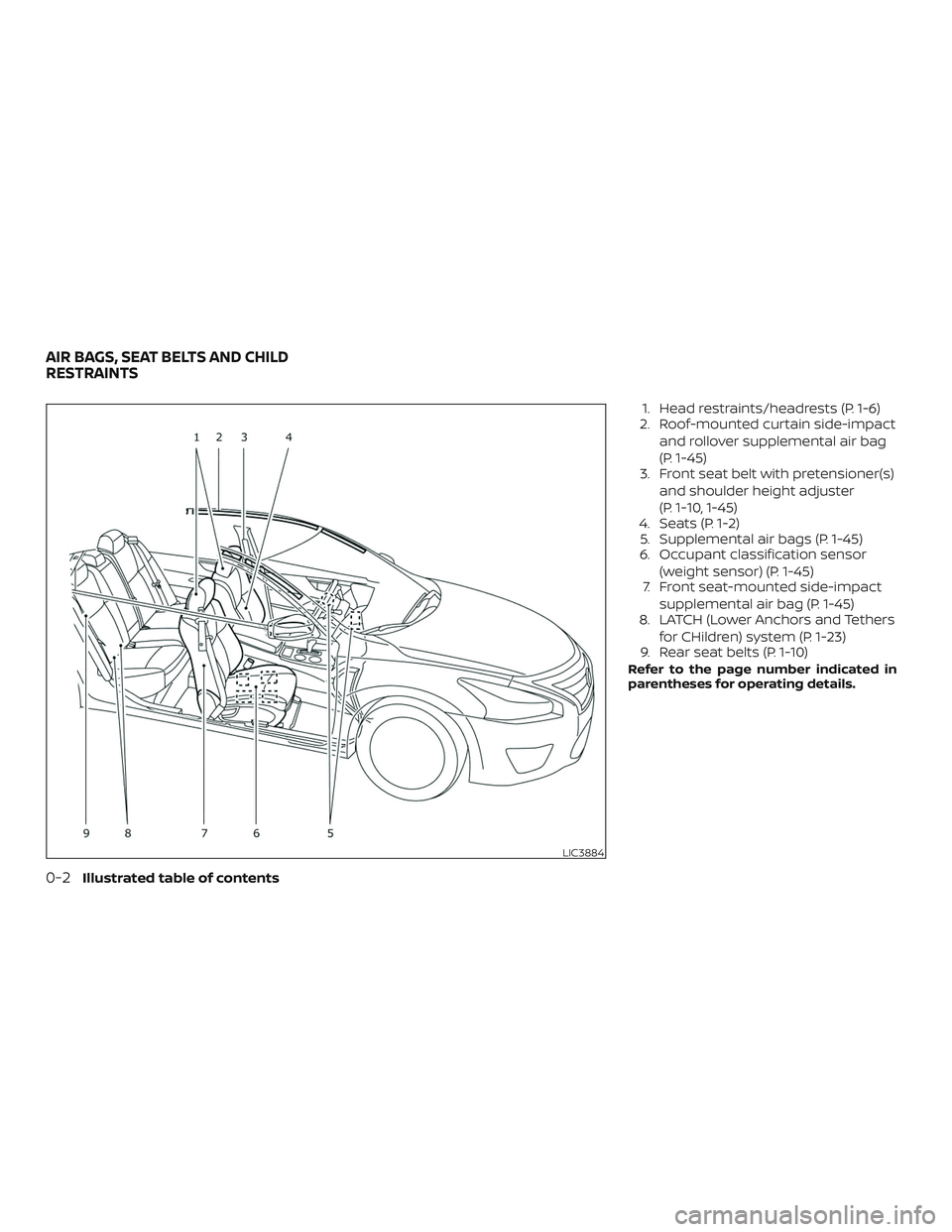
1. Head restraints/headrests (P. 1-6)
2. Roof-mounted curtain side-impact
and rollover supplemental air bag
(P. 1-45)
3. Front seat belt with pretensioner(s)
and shoulder height adjuster
(P. 1-10, 1-45)
4. Seats (P. 1-2) 5. Supplemental air bags (P. 1-45)
6. Occupant classification sensor
(weight sensor) (P. 1-45)
7. Front seat-mounted side-impact
supplemental air bag (P. 1-45)
8. LATCH (Lower Anchors and Tethers
for CHildren) system (P. 1-23)
9. Rear seat belts (P. 1-10)
Refer to the page number indicated in
parentheses for operating details.
LIC3884
AIR BAGS, SEAT BELTS AND CHILD
RESTRAINTS
0-2Illustrated table of contents
Page 475 of 878
There are three basic types of child re-
straint systems:∙ Rear-facing child restraints
∙ Forward-facing child restraints
∙ Booster seats
The proper restraint depends on the child’s
size. Generally, infants up to about 1 year
and less than 20 lbs. (9 kg) should be placed
in rear-facing child restraints. Forward-
facing child restraints are available for chil-
dren who outgrow rear-facing child re-
straints and are at least 1 year old. Booster
seats are used to help position a vehicle
lap/shoulder belt on a child who can no
longer use a forward-facing child restraint.
WARNING
Infants and children need special pro-
tection. The vehicle’s seat belts may not
fit them properly. The shoulder belt may
come too close to the face or neck. The
lap belt may not fit over their small hip
bones. In an accident, an improperly fit-
ting seat belt could cause serious or fa-
tal injury. Always use appropriate child
restraints. All U.S. states and Canadian provinces or
territories require the use of approved child
restraints for infants and small children. For
additional information, refer to “Child re-
straints” in this section.
A child restraint may be secured in the ve-
hicle by using either the LATCH (Lower An-
chors and Tethers for CHildren) system or
with the vehicle seat belt. For additional
information, refer to “Child restraints” in this
section.
NISSAN recommends that all pre-teens
and children be restrained in the rear
seat. Studies show that children are
safer when properly restrained in the
rear seat than in the front seat.
This is especially important because
your vehicle has a supplemental re-
straint system (air bag system) for the
front passenger. For additional informa-
tion, refer to “Supplemental Restraint
System (SRS)” in this section.
INFANTS
Infants up to at least 1 year old should be
placed in a rear-facing child restraint.
NISSAN recommends that infants be
placed in child restraints that comply with
Federal Motor Vehicle Safety Standards or Canadian Motor Vehicle Safety Standards.
You should choose a child restraint that fits
your vehicle and always follow the manu-
facturer’s instructions for installation and
use.
SMALL CHILDREN
Children that are over 1 year old and weigh
at least 20 lbs. (9 kg) should remain in a
rear-facing child restraint as long as pos-
sible up to the height or weight limit of the
child restraint. Children who outgrow the
height or weight limit of the rear-facing
child restraint and are at least 1 year old
should be secured in a forward-facing child
restraint with a harness. Refer to the manu-
facturer’s instructions for minimum and
maximum weight and height recommen-
dations. NISSAN recommends that small
children be placed in child restraints that
comply with Federal Motor Vehicle Safety
Standards or Canadian Motor Vehicle
Safety Standards. You should choose a
child restraint that fits your vehicle and al-
ways follow the manufacturer’s instruc-
tions for installation and use.
Safety—Seats, seat belts and supplemental restraint system1-21
Page 476 of 878
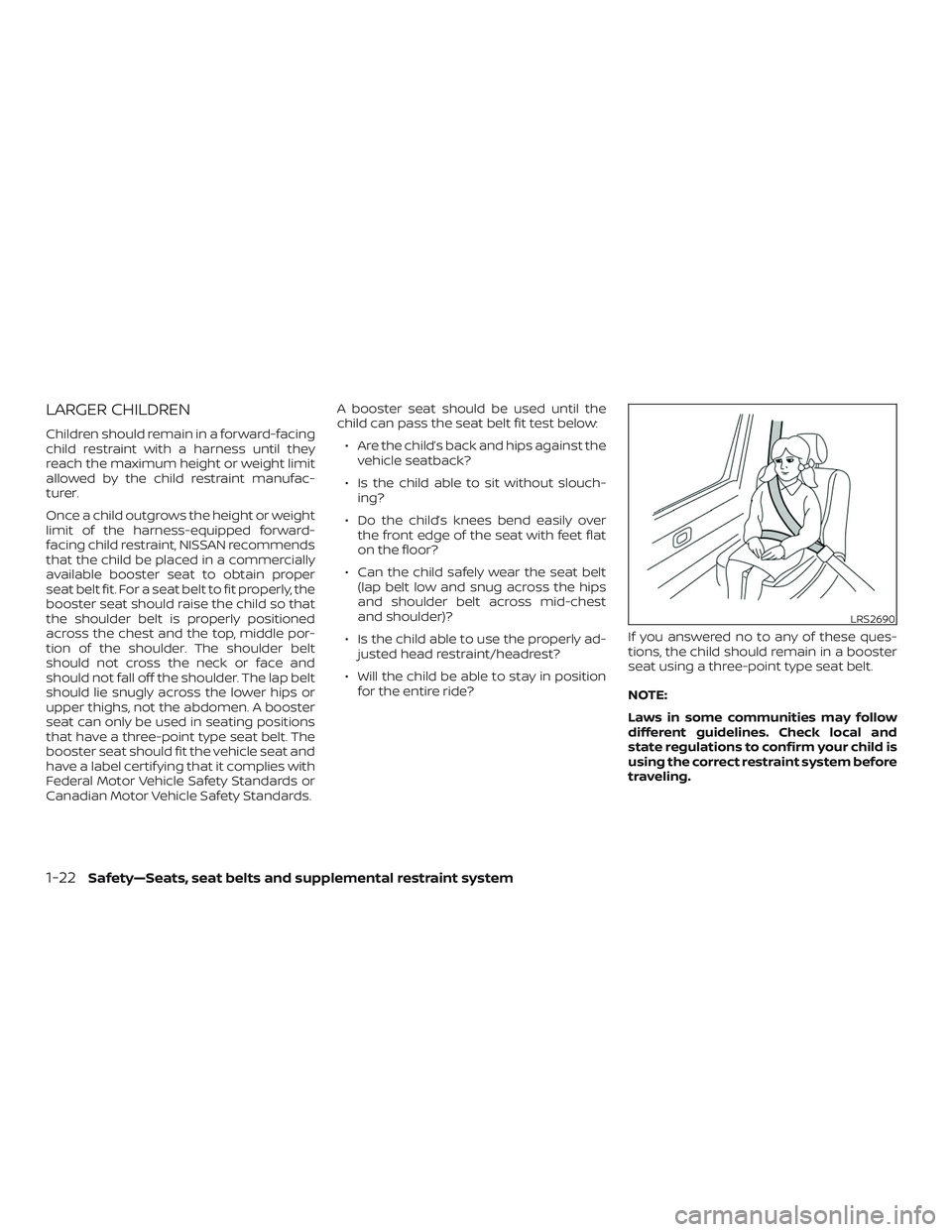
LARGER CHILDREN
Children should remain in a forward-facing
child restraint with a harness until they
reach the maximum height or weight limit
allowed by the child restraint manufac-
turer.
Once a child outgrows the height or weight
limit of the harness-equipped forward-
facing child restraint, NISSAN recommends
that the child be placed in a commercially
available booster seat to obtain proper
seat belt fit. For a seat belt to fit properly, the
booster seat should raise the child so that
the shoulder belt is properly positioned
across the chest and the top, middle por-
tion of the shoulder. The shoulder belt
should not cross the neck or face and
should not fall off the shoulder. The lap belt
should lie snugly across the lower hips or
upper thighs, not the abdomen. A booster
seat can only be used in seating positions
that have a three-point type seat belt. The
booster seat should fit the vehicle seat and
have a label certif ying that it complies with
Federal Motor Vehicle Safety Standards or
Canadian Motor Vehicle Safety Standards.A booster seat should be used until the
child can pass the seat belt fit test below:
∙ Are the child’s back and hips against the vehicle seatback?
∙ Is the child able to sit without slouch- ing?
∙ Do the child’s knees bend easily over the front edge of the seat with feet flat
on the floor?
∙ Can the child safely wear the seat belt (lap belt low and snug across the hips
and shoulder belt across mid-chest
and shoulder)?
∙ Is the child able to use the properly ad- justed head restraint/headrest?
∙ Will the child be able to stay in position for the entire ride? If you answered no to any of these ques-
tions, the child should remain in a booster
seat using a three-point type seat belt.
NOTE:
Laws in some communities may follow
different guidelines. Check local and
state regulations to confirm your child is
using the correct restraint system before
traveling.
LRS2690
1-22Safety—Seats, seat belts and supplemental restraint system
Page 479 of 878
Several manufacturers offer child re-
straints for infants and children of various
sizes. When selecting any child restraint,
keep the following points in mind:∙ Choose only a restraint with a label cer- tif ying that it complies with Federal Mo-
tor Vehicle Safety Standard 213 or Cana-
dian Motor Vehicle Safety Standard 213.
∙ Check the child restraint in your vehicle to be sure it is compatible with the vehi-
cle’s seat and seat belt system.
∙ If the child restraint is compatible with your vehicle, place your child in the child
restraint and check the various adjust-
ments to be sure the child restraint is
compatible with your child. Choose a
child restraint that is designed for your
child’s height and weight. Always follow
all recommended procedures.
∙ If the combined weight of the child and child restraint is less than 65 lbs.
(29.5 kg), you may use the LATCH an-
chors to install the child restraint (not
both at the same time). ∙ If the combined weight of the child and
child restraint is greater than 65 lbs.
(29.5 kg), use the vehicle’s seat belt (not
the lower anchors) to install the child
restraint.
∙ Be sure to follow the child restraint manufacturer’s instructions for installa-
tion.
All U.S. states and Canadian provinces or
territories require that infants and small
children be restrained in an approved
child restraint at all times while the ve-
hicle is being operated. Canadian law re-
quires the top tether strap on forward-
facing child restraints be secured to the
designated anchor point on the vehicle.
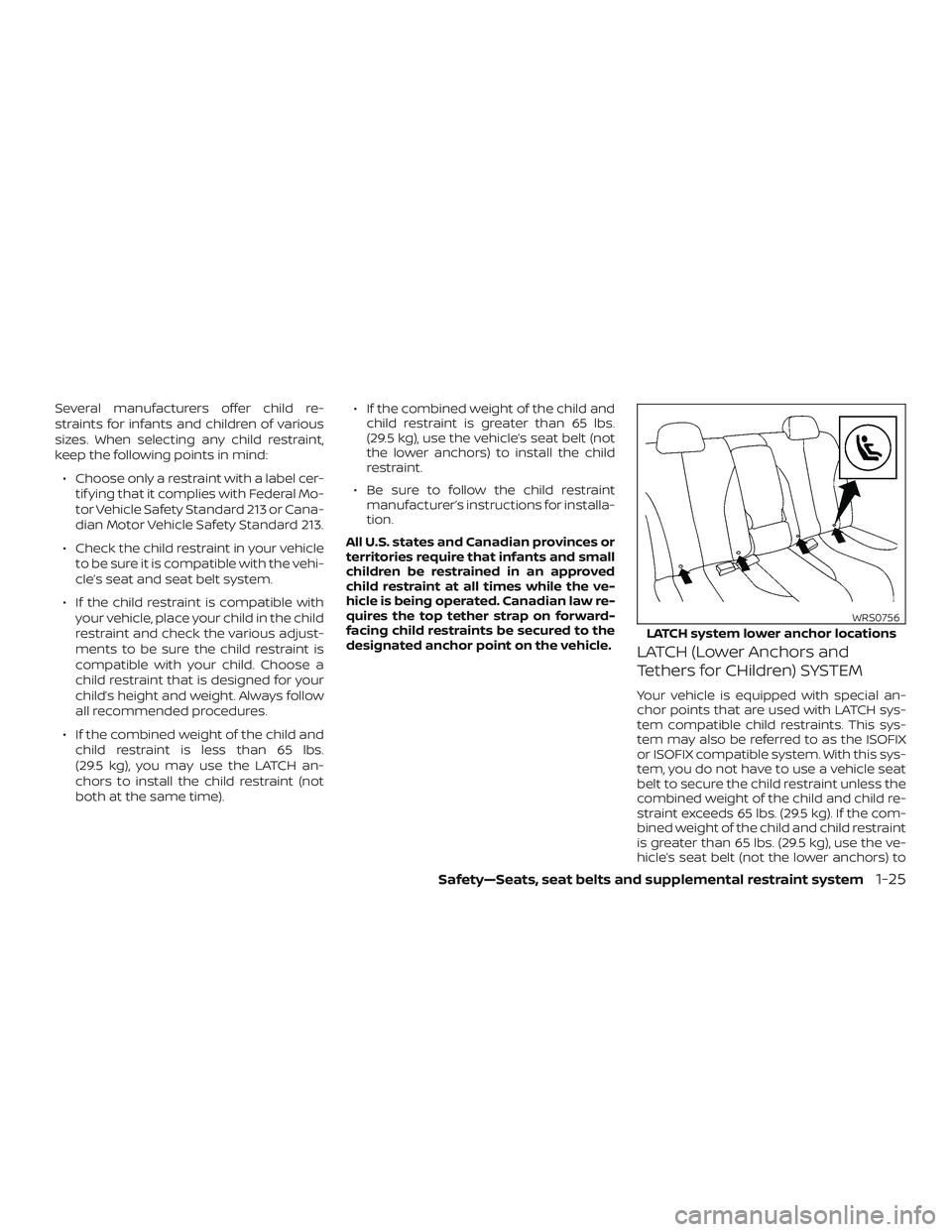
LATCH (Lower Anchors and
Tethers for CHildren) SYSTEM
Your vehicle is equipped with special an-
chor points that are used with LATCH sys-
tem compatible child restraints. This sys-
tem may also be referred to as the ISOFIX
or ISOFIX compatible system. With this sys-
tem, you do not have to use a vehicle seat
belt to secure the child restraint unless the
combined weight of the child and child re-
straint exceeds 65 lbs. (29.5 kg). If the com-
bined weight of the child and child restraint
is greater than 65 lbs. (29.5 kg), use the ve-
hicle’s seat belt (not the lower anchors) to
LATCH system lower anchor locations
WRS0756
Safety—Seats, seat belts and supplemental restraint system1-25