child restraint NISSAN VERSA NOTE 2018 Owner´s Manual
[x] Cancel search | Manufacturer: NISSAN, Model Year: 2018, Model line: VERSA NOTE, Model: NISSAN VERSA NOTE 2018Pages: 878, PDF Size: 9.62 MB
Page 74 of 878
The occupant classification sensor in this
vehicle is a weight sensor. It is designed to
detect an occupant and objects on the
seat by weight. For example, if a child is in
the front passenger seat, the NISSAN Ad-
vanced Air Bag System is designed to turn
the front passenger air bag OFF in accor-
dance with the regulations. Also, if a child
restraint of the type specified in the regula-
tions is on the seat, its weight and the
child’s weight can be detected and cause
the air bag to turn OFF.
Front passenger seat adult occupants who
are properly seated and using the seat belt
as outlined in this manual should not
cause the front passenger air bag to be
automatically turned OFF. For small adults
it may be turned OFF, however if the occu-
pant takes his/her weight off the seat
cushion (for example, by not sitting upright,
by sitting on an edge of the seat, or by
otherwise being out of position), this could
cause the sensor to turn the air bag OFF.
Always be sure to be seated and wearing
the seat belt properly for the most effective
protection by the seat belt and supple-
mental air bag.
NISSAN recommends that pre-teens and
children be properly restrained in a rear
seat. NISSAN also recommends that ap-propriate child restraints and booster
seats be properly installed in a rear seat. If
this is not possible, the occupant classifica-
tion sensor is designed to operate as de-
scribed above to turn the front passenger
air bag OFF for specified child restraints as
required by the regulations. Failing to prop-
erly secure child restraints and to use the
ALR mode may allow the restraint to tip or
move in a collision or sudden stop. This can
also result in the passenger air bag inflat-
ing in a crash instead of being OFF. For
additional information, refer to “Child re-
straints” in this section.
If the front passenger seat is not occupied,
the front passenger air bag is designed not
to inflate in a crash. However, heavy objects
placed on the seat could result in air bag
inflation, because of the object’s weight de-
tected by the occupant classification sen-
sor. Other conditions could also result in air
bag inflation, such as if a child is standing
on the seat, or if two children are on the
seat, contrary to the instructions in this
manual. Always be sure that you and all
vehicle occupants are seated and re-
strained properly.
Using the front passenger air bag status
light, you can monitor when the front pas-
senger air bag is automatically turned OFFwith the seat occupied. The light will not
illuminate when the front passenger seat is
unoccupied.
If an adult occupant is in the seat but the
front passenger air bag status light is illu-
minated (indicating that the air bag is OFF),
it could be that the person is a small adult,
or is not sitting on the seat properly or not
using the seat belt properly.
If a child restraint must be used in the front
seat, the front passenger air bag status light
may or may not be illuminated, depending
on the size of the child and the type of child
restraint being used. If the air bag status light
is not illuminated (indicating that the air bag
might inflate in a crash), it could be that the
child restraint or seat belt is not being used
properly. Make sure that the child restraint is
installed properly, the seat belt is used prop-
erly and the occupant is positioned properly.
If the air bag status light is still not illumi-
nated, reposition the occupant or child re-
straint in a rear seat.
If the front passenger air bag status light
will not illuminate even though you believe
that the child restraint, the seat belts and
the occupant are properly positioned, the
system may be sensing an unoccupied
seat (in which case the air bag is OFF). A
Safety—Seats, seat belts and supplemental restraint system1-55
Page 75 of 878
NISSAN dealer can check that the system is
OFF by using a special tool. However, until
you have confirmed with a dealer that your
air bag is working properly, reposition the
occupant or child restraint in a rear seat.
The NISSAN Advanced Air Bag System and
front passenger air bag status light will
take a few seconds to register a change in
the front passenger seat status. This is nor-
mal system operation and does not indi-
cate a malfunction.
If a malfunction occurs in the front passen-
ger air bag system, the supplemental air
bag warning light
, located in the me-
ter and gauges area of the instrument
panel, will blink. Have the system checked. It
is recommended that you visit a NISSAN
dealer for this service.
Normal operation
In order for the occupant classification
sensor system to classif y the front passen-
ger based on weight, please follow the pre-
cautions and steps outlined below:
Precautions
∙ Make sure that there are no objects weighing over 9.1 lbs. (4 kg) hanging on
the seat or placed in the seatback
pocket. ∙ Make sure that a child restraint or other
object is not pressing against the rear
of the seatback.
∙ Make sure that a rear passenger is not pushing or pulling on the back of the
front passenger seat.
∙ Make sure that the front passenger seat or seatback is not forced back
against an object on the seat or floor
behind it.
∙ Make sure that there is no object placed under the front passenger seat.
Steps 1. Adjust the seat as outlined in the “Seats” section of this manual. Sit upright, lean-
ing against the seatback, and centered
on the seat cushion with your feet com-
fortably extended to the floor.
2. Make sure there are no objects on your lap.
3. Fasten the seat belt as outlined in the “Seat belts” section of this manual.
4. Remain in this position for 30 seconds allowing the system to classif y the
front passenger before the vehicle is
put into motion. 5.
Ensure proper classification by checking
the front passenger air bag status light.
NOTE:
This vehicle’s occupant classification sen-
sor system locks the classification during
driving so it is important that you confirm
that the front passenger is properly clas-
sified prior to driving. Also, the occupant
classification sensor system may recalcu-
late the weight of the occupant when the
vehicle comes to a stop (i.e. stop light, stop
sign, etc.), so front passenger seat occu-
pants should continue to remain seated
as outlined above.
Troubleshooting
If you think the front passenger air bag
status light is incorrect:
1. If the light is ON with no front passenger and no objects on the front passenger
seat:
This may be due to the following condi-
tions that may be interfering with the
weight sensors: ∙ An object weighing over 9.1 lbs. (4 kg) hanging on the seat or placed in the
seatback pocket.
1-56Safety—Seats, seat belts and supplemental restraint system
Page 76 of 878
∙ A child restraint or other object pressingagainst the rear of the seatback.
∙ A rear passenger pushing or pulling on the back of the front passenger seat.
∙ Forcing the front seat or seatback against an object on the seat or floor
behind it.
∙ An object placed under the front pas- senger seat.
∙ An object placed between the seat cushion and center console or between
the seat cushion and the door.
If the vehicle is moving, please come to a
stop when it is safe to do so. Check and
correct any of the above conditions. Re-
start the vehicle and wait 1 minute.
NOTE:
A system check will be performed during
which the front passenger air bag status
light will remain lit for about 7 seconds
initially.
If the light is still ON af ter this, the vehicle
should be checked as soon as possible. It is
recommended that you visit a NISSAN
dealer for this service. 2. If the light is ON with an adult occupy-
ing the front passenger seat:
∙ Occupant is a small adult — the air bag light is functioning as intended. The
front passenger air bag is suppressed.
However, if the occupant is not a small
adult, then this may be due to the following
conditions that may be interfering with the
weight sensors: ∙ Occupant is not sitting upright, leaning against the seatback, and centered on
the seat cushion with his/her feet com-
fortably extended to the floor.
∙ A child restraint or other object pressing against the rear of the seatback.
∙ A rear passenger pushing or pulling on the back of the front passenger seat.
∙ Forcing the front seat or seatback against an object on the seat or floor
behind it.
∙ An object placed under the front pas- senger seat.
∙ An object placed between the seat cushion and center console or between
the seat cushion and the door. If the vehicle is moving, please come to a
stop when it is safe to do so. Check and
correct any of the above conditions. Re-
start the vehicle and wait 1 minute.
NOTE:
A system check will be performed during
which the front passenger air bag status
light will remain lit for about 7 seconds
initially.
If the light is still ON af ter this, the person
should be advised not to ride in the front
passenger seat and the vehicle should be
checked as soon as possible. It is recom-
mended that you visit a NISSAN dealer for
this service.
3. If the light is OFF with a small adult, child or child restraint occupying the
front passenger seat.
This may be due to the following con-
ditions that may be interfering with the
weight sensors:
∙ Small adult or child is not sitting upright, leaning against the seatback, and cen-
tered on the seat cushion with his/her
feet comfortably extended to the floor.
Safety—Seats, seat belts and supplemental restraint system1-57
Page 77 of 878
∙ The child restraint is not properly in-stalled, as outlined in the “Child re-
straints” section of this manual.
∙ An object weighing over 9.1 lbs. (4 kg) hanging on the seat or placed in the
seatback pocket.
∙ A child restraint or other object pressing against the rear of the seatback.
∙ A rear passenger pushing or pulling on the back of the front passenger seat.
∙ Forcing the front seat or seatback against an object on the seat or floor
behind it.
∙ An object placed under the front pas- senger seat.
∙ An object placed between the seat cushion and center console.
If the vehicle is moving, please come to a
stop when it is safe to do so. Check and
correct any of the above conditions. Re-
start the vehicle and wait 1 minute. NOTE:
A system check will be performed during
which the front passenger air bag status
light will remain lit for about 7 seconds
initially.
If the light is still OFF af ter this, the small
adult, child or child restraint should be re-
positioned in the rear seat and the vehicle
should be checked as soon as possible. It is
recommended that you visit a NISSAN
dealer for this service.
Other supplemental front-impact air
bag precautions
WARNING
∙ Do not place any objects on the steer-
ing wheel pad or on the instrument
panel. Also, do not place any objects
between any occupant and the steer-
ing wheel or instrument panel. Such
objects may become dangerous pro-
jectiles and cause injury if the front air
bags inflate.
∙ Immediately af ter inflation, several front air bag system components will
be hot. Do not touch them; you may
severely burn yourself. ∙ No unauthorized changes should be
made to any components or wiring of
the supplemental air bag system. This
is to prevent accidental inflation of
the supplemental air bag or damage
to the supplemental air bag system.
∙ Do not make unauthorized changes to your vehicle’s electrical system,
suspension system or front end struc-
ture. This could affect proper opera-
tion of the front air bag system.
∙ Tampering with the front air bag sys- tem may result in serious personal in-
jury. Tampering includes changes to
the steering wheel and the instru-
ment panel assembly by placing ma-
terial over the steering wheel pad and
above the instrument panel or by in-
stalling additional trim material
around the air bag system.
∙ Removing or modif ying the front pas- senger seat may affect the function of
the air bag system and result in seri-
ous personal injury.
1-58Safety—Seats, seat belts and supplemental restraint system
Page 81 of 878
When pretensioner(s) activate, smoke is re-
leased and a loud noise may be heard. This
smoke is not harmful and does not indi-
cate a fire. Care should be taken not to
inhale it, as it may cause irritation and
choking. Those with a history of a breath-
ing condition should get fresh air promptly.
Af ter the pretensioner(s’) activation, load
limiters allow the seat belt to release web-
bing (if necessary) to reduce forces against
the chest.
The supplemental air bag warning
light
is used to indicate malfunctions
in the pretensioner(s) system. For addi-
tional information, refer to “Supplemental
air bag warning light” in this section. If the
operation of the supplemental air bag
warning light indicates there is a malfunc-
tion, have the system checked. It is recom-
mended that you visit a NISSAN dealer for
this service.
When selling your vehicle, we request that
you inform the buyer about the preten-
sioner system and guide the buyer to the
appropriate sections in this Owner’s
Manual.
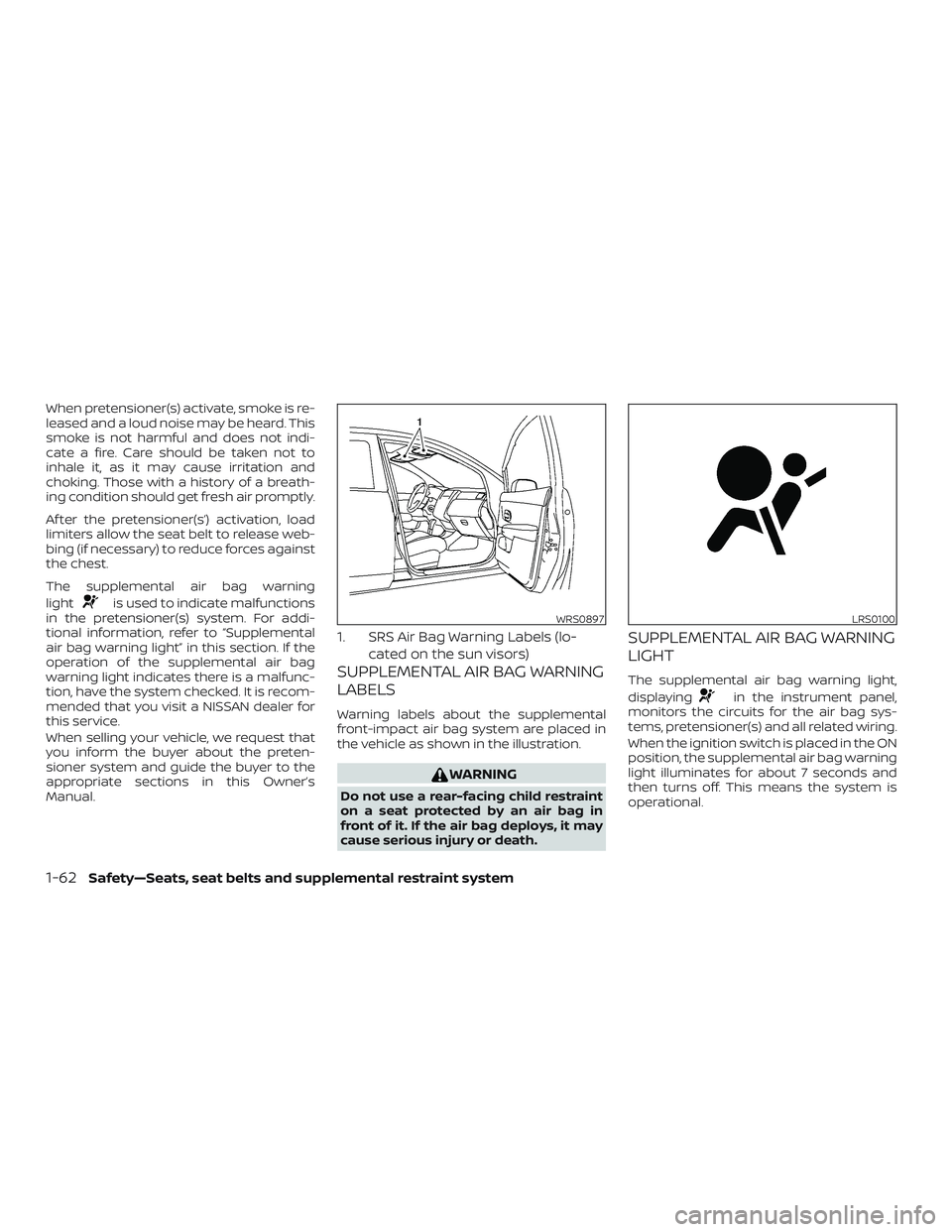
1. SRS Air Bag Warning Labels (lo-
cated on the sun visors)
SUPPLEMENTAL AIR BAG WARNING
LABELS
Warning labels about the supplemental
front-impact air bag system are placed in
the vehicle as shown in the illustration.
WARNING
Do not use a rear-facing child restraint
on a seat protected by an air bag in
front of it. If the air bag deploys, it may
cause serious injury or death.
SUPPLEMENTAL AIR BAG WARNING
LIGHT
The supplemental air bag warning light,
displaying
in the instrument panel,
monitors the circuits for the air bag sys-
tems, pretensioner(s) and all related wiring.
When the ignition switch is placed in the ON
position, the supplemental air bag warning
light illuminates for about 7 seconds and
then turns off. This means the system is
operational.
WRS0897LRS0100
1-62Safety—Seats, seat belts and supplemental restraint system
Page 122 of 878
CARGO COVER (if so equipped)
WARNING
∙ Never put anything on the cargocover, no matter how small. Any ob-
ject on it could cause an injury in an
accident or sudden stop.
∙ Do not put objects heavier than 44 lbs. (20 kg) on the cargo cover for long
periods of time.
∙ Do not leave the cargo cover in the vehicle with it disengaged from the
holder.
∙ Properly secure all cargo with ropes or straps to help prevent it from sliding
or shif ting. Do not place cargo higher
than the seatbacks. In a sudden stop
or collision, unsecured cargo could
cause personal injury.
∙ Your child could be seriously injured or killed in a collision if the child re-
straint top tether strap is damaged. ∙ Properly secure cargo and do not al-
low it to contact the top tether strap
when it is attached to the top tether
anchor. Cargo that is not properly se-
cured or cargo that contacts the top
tether strap may damage the top
tether strap during a collision. If the
cargo cover contacts the top tether
strap when it is attached to the top
tether anchor, remove the cargo cover
from the vehicle or secure it on the
cargo floor below its attachment lo-
cation. If the cargo cover is not re-
moved, it may damage the top tether
strap during a collision. Your child
could be seriously injured or killed in a
collision if the child restraint top
tether strap is damaged.
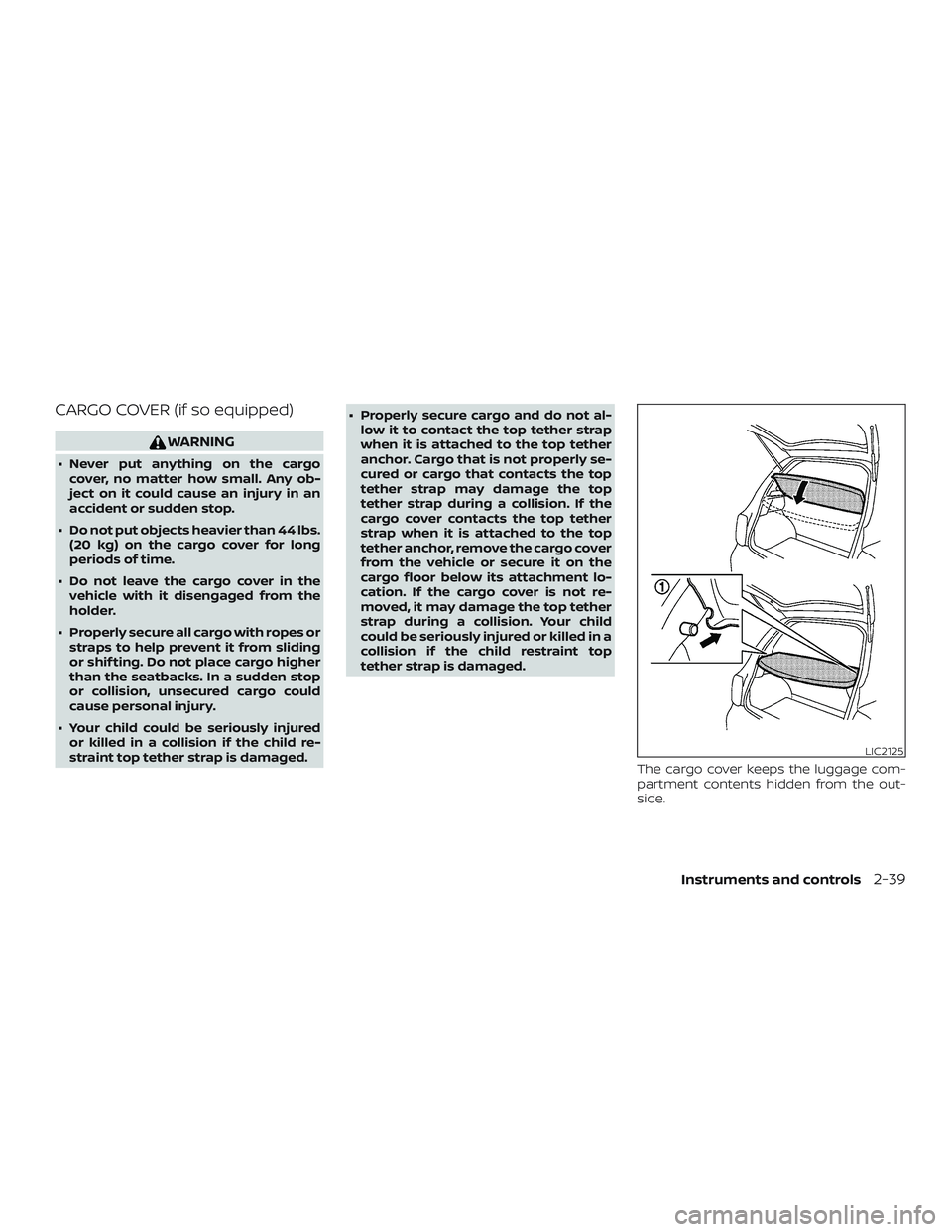
The cargo cover keeps the luggage com-
partment contents hidden from the out-
side.
LIC2125
Instruments and controls2-39
Page 427 of 878
C
Capacities and recommended fuel/
lubricants....................10-2
Cargocover...................2-39
Cargo (See vehicle loading information). .10-13
Car phone or CB radio ............4-81
CDcareandcleaning.............4-73
CD player (See audio system). .4-47, 4-52, 4-60
Checking bulbs .................2-15
Childrestraints........1-20, 1-21, 1-23, 1-25 LATCH (Lower Anchors and Tethers for
CHildren)System..............1-25
Precautions on child
restraints .........1-23, 1-30, 1-36, 1-41
Top tether strap anchor point
locations.................. .1-27
Child restraint with top tether strap . . . .1-27
Child safety rear door lock ..........3-8
Chimes, audible reminders .........2-23
Cleaningexteriorandinterior......7-2,7-4
Clock setting (models with Navigation
System) ...................4-7,4-9
Clock setting (models without Navigation
System) ...........4-46,4-50,4-51,4-51
Clutch Clutchfluid.................8-10
C.M.V.S.S. certification label .........10-11
Coldweatherdriving.............5-34
Compact disc (CD) player ....4-47,4-52,4-60
Connect phone ................4-76
Continuously Variable
Transmission (CVT) ............5-9,5-15
Continuously Variable Transmission (CVT)
fluid......................8-9 Driving with Continuously Variable
Transmission (CVT)
..........5-9,5-15
Control panel buttons .............4-4
Brightness/contrast button .......4-9
Settingbutton................4-7
Controls Audio controls (steering wheel) .....4-74
Heater and air conditioner controls . .4-28
Coolant Capacities and recommended
fuel/lubricants...............10-2
Changing engine coolant .........8-5
Checking engine coolant level ......8-5
Engine coolant temperature gauge . .2-9
Corrosionprotection..............7-7
Cruisecontrol .................5-22
Cupholders...................2-36
Curtain side-impact and rollover
airbag..................... .1-59
D
Daytime running light system
(Canada only) ..................2-29
Defroster switch Rearwindowdefrosterswitch.....2-27
Dimensions and weights ...........10-9
Dimmer switch for instrument panel . . .2-29
Display controls
(see control panel buttons) ..........4-4
Door locks ..................3-5,3-6
Door open warning light ...........2-16
Drivebelt ....................8-14
Driving Cold weather driving ...........5-34 Driving with Continuously Variable
Transmission (CVT)
..........5-9,5-15
Driving with manual transmission . . .5-20
Precautions when starting and
driving .....................5-2
Driving the vehicle ...............5-15
E
Economy - fuel .................5-26
Emergency engine shutoff ..........5-13
Emission control information label . . . .10-11
Emission control system warranty . . . .10-18
Engine Before starting the engine ........5-14
Capacities and recommended
fuel/lubricants...............10-2
Changing engine coolant .........8-5
Changing engine oil ............8-7
Changing engine oil filter .........8-8
Checking engine coolant level ......8-5
Checking engine oil level .........8-6
Engine compartment check
locations...................8-3
Engine coolant temperature gauge . .2-9
Engine cooling system ..........8-4
Engine oil ...................8-6
Engine oil and oil filter
recommendation .............
10-6
Engine oil pressure warning light . . . .2-16
Engine oil viscosity .............10-7
Engine serial number ...........10-11
Engine specifications ...........10-8
Starting the engine ............5-14
Engine Block Heater .............5-35
11-2
Page 428 of 878
Engine coolant temperature gauge....2-9
EventDatarecorders............10-20
Exhaust gas (Carbon monoxide) .......5-2
Explanation of maintenance items .....9-2
Explanation of scheduled maintenance
items .......................9-5
Extended storage switch ..........8-20
F
Flashers
(See hazard warning flasher switch) ....6-2
Flattire....................6-3,6-3
Floormatpositioningaid...........7-6
Fluid Brakefluid..................8-9
Capacities and recommended
fuel/lubricants...............10-2
Clutchfluid.................8-10
Continuously Variable Transmission (CVT)
fluid......................8-9
Engine coolant ...............8-4
Engine oil ...................8-6
F.M.V.S.S. certification label ..........10-11
Foglightswitch ................2-31
Front air bag system
(See supplemental restraint system) . . .1-54
Front-door pocket ...............2-34
Frontseats................... .1-2
Fuel Capacities and recommended
fuel/lubricants...............10-2
Fuel economy ...............5-26
Fuel-filler door lock opener lever ....3-28
Fuel gauge .................2-10 Fueloctanerating.............10-5
Fuel recommendation
..........10-4
Loose fuel cap warning .......2-7,3-29
Fuel efficient driving tips ...........5-25
Fuel-filler door .................3-28
Fuel gauge ...................2-10
Fuses .......................8-18
Fusiblelinks...................8-19
G
Gauge Engine coolant temperature gauge . .2-9
Fuel gauge .................2-10
Odometer ..................2-6
Speedometer ................2-5
Tachometer .................2-8
Trip computer ................2-11
Trip odometer ................2-6
General maintenance .............9-2
Glovebox....................2-36
H
Hands-free phone system,
Bluetooth®............4-81,4-96,4-108
Hazard warning flasher switch ........6-2
Headlight and turn signal switch ......2-28
Headlightcontrolswitch...........2-28
Headlights ...................8-24
Headrestraints .................1-6
Heatedseats..................2-32
Heated seat switches ............2-32 Heater
Heater and air conditioner controls . .4-28
Heater operation .............4-30
Hood release ..................3-26
Horn .......................2-31
I
Ignition switch ..................5-8
Push-button ignition switch .......5-10
Immobilizer system .......2-24,5-10,5-14
Important vehicle information label . . . .10-11
Increasing fuel economy ...........5-26
Indicator NISSAN Intelligent Key® battery discharge
indicator...................5-13
Indicator lights and audible reminders
(See warning/indicator lights and audible
reminders) ................2-14,2-20
Instrument brightness control .......2-29
Instrument panel .............0-6,2-2
Instrument panel dimmer switch .....2-29
Intelligent Key system Key operating range ............
3-14
Key operation ................3-15
Mechanical key ...............3-4
Remote keyless entry operation . .3-9, 3-18
Troubleshooting guide .......3-24,3-25
Warning signals ...........3-24,3-25
Interiorlight...............2-42,2-43
iPod®Player...............4-65,4-68
ISOFIX child restraints .............1-25
11-3
Page 430 of 878
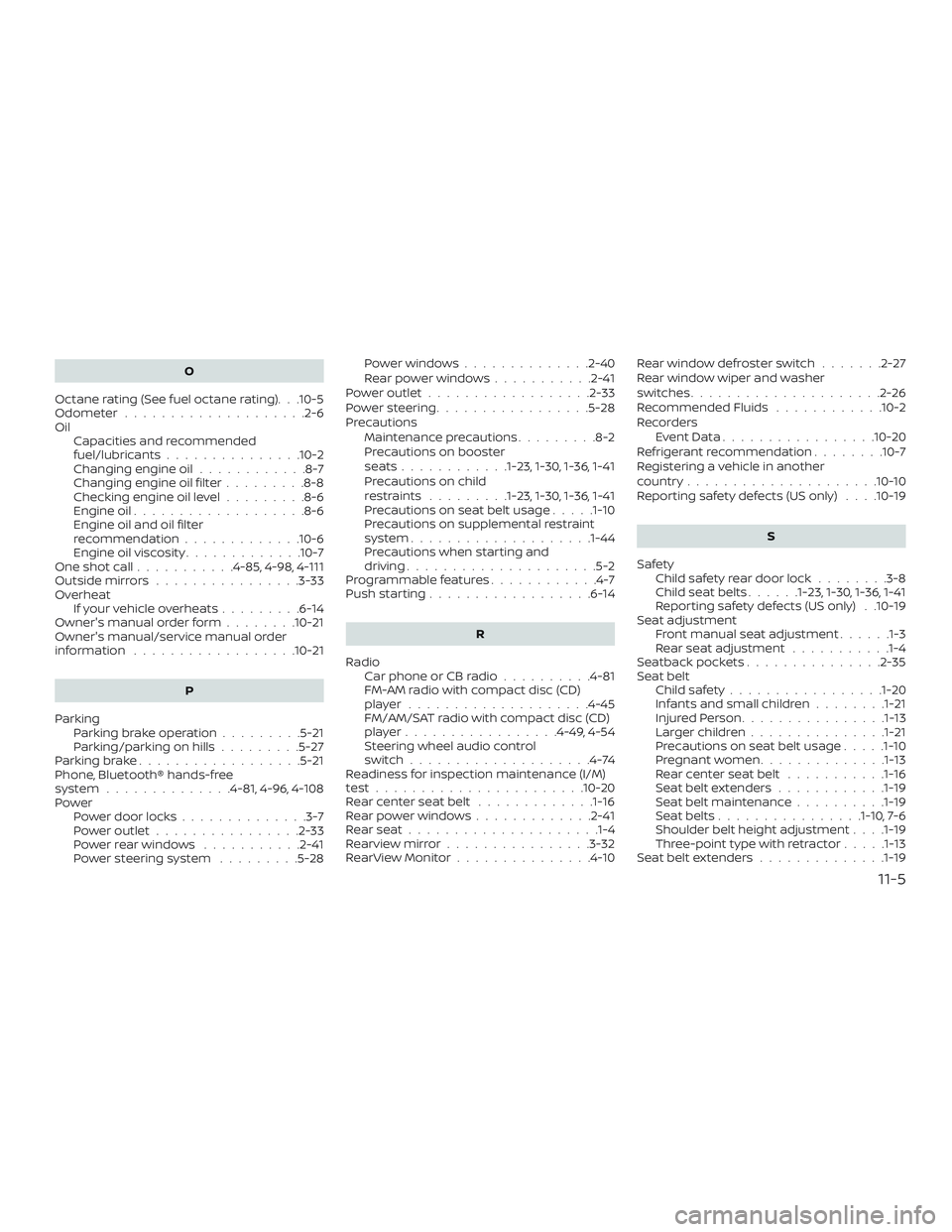
O
Octane rating (See fuel octane rating). . .10-5
Odometer ....................2-6
Oil Capacities and recommended
fuel/lubricants...............10-2
Changing engine oil ............8-7
Changing engine oil filter .........8-8
Checking engine oil level .........8-6
Engine oil ...................8-6
Engine oil and oil filter
recommendation .............10-6
Engine oil viscosity .............10-7
One shot call ...........4-85,4-98,4 -111
Outsidemirrors................3-33
Overheat Ifyourvehicleoverheats.........6-14
Owner's manual order form ........10-21
Owner's manual/service manual order
information ..................10-21
P
Parking Parking brake operation .........5-21
Parking/parkingonhills.........5-27
Parkingbrake..................5-21
Phone, Bluetooth® hands-free
system ..............4-81,4-96,4-108
Power Power door locks ..............3-7
Poweroutlet................2-33
Powerrearwindows ...........2-41
Power steering system .........5-28Powerwindows..............2-40
Rearpowerwindows...........2-41
Poweroutlet..................2-33
Powersteering.................5-28
Precautions Maintenance precautions .........8-2
Precautions on booster
seats............1-23, 1-30, 1-36, 1-41
Precautions on child
restraints .........1-23, 1-30, 1-36, 1-41
Precautions on seat belt usage .....1-10
Precautions on supplemental restraint
system ................... .1-44
Precautions when starting and
driving.....................5-2
Programmable features ............4-7
Push starting ..................6-14
R
Radio Car phone or CB radio ..........4-81
FM-AM radio with compact disc (CD)
player....................4-45
FM/AM/SAT radio with compact disc (CD)
player.................4-49,4-54
Steering wheel audio control
switch....................4-74
Readiness for inspection maintenance (I/M)
test.......................10-20
Rearcenterseatbelt .............1-16
Rearpowerwindows.............2-41
Rearseat.................... .1-4
Rearviewmirror................3-32
RearViewMonitor...............4-10 Rearwindowdefrosterswitch.......2-27
Rear window wiper and washer
switches
.....................2-26
Recommended Fluids ............10-2
Recorders EventData................ .10-20
Refrigerant recommendation ........10-7
Registering a vehicle in another
country .....................10-10
Reporting safety defects (US only) . . . .10-19
S
Safety Child safety rear door lock ........3-8
Childseatbelts......1-23, 1-30, 1-36, 1-41
Reporting safety defects (US only) . .10-19
Seat adjustment Front manual seat adjustment ......1-3
Rear seat adjustment ...........1-4
Seatback pockets ...............2-35
Seat belt Childsafety................ .1-20
Infants and small children ........1-21
I
njuredPerson............... .1-13
Largerchildren.............. .1-21
Precautionsonseatbeltusage.....1-10
Pregnant women ..............1-13
Rearcenterseatbelt ...........1-16
Seat belt extenders ............1-19
Seat belt maintenance ..........1-19
Seatbelts................1-10, 7-6
Shoulder belt height adjustment . . . .1-19
Three-pointtypewithretractor.....1-13
Seat belt extenders ..............1-19
11-5
Page 431 of 878
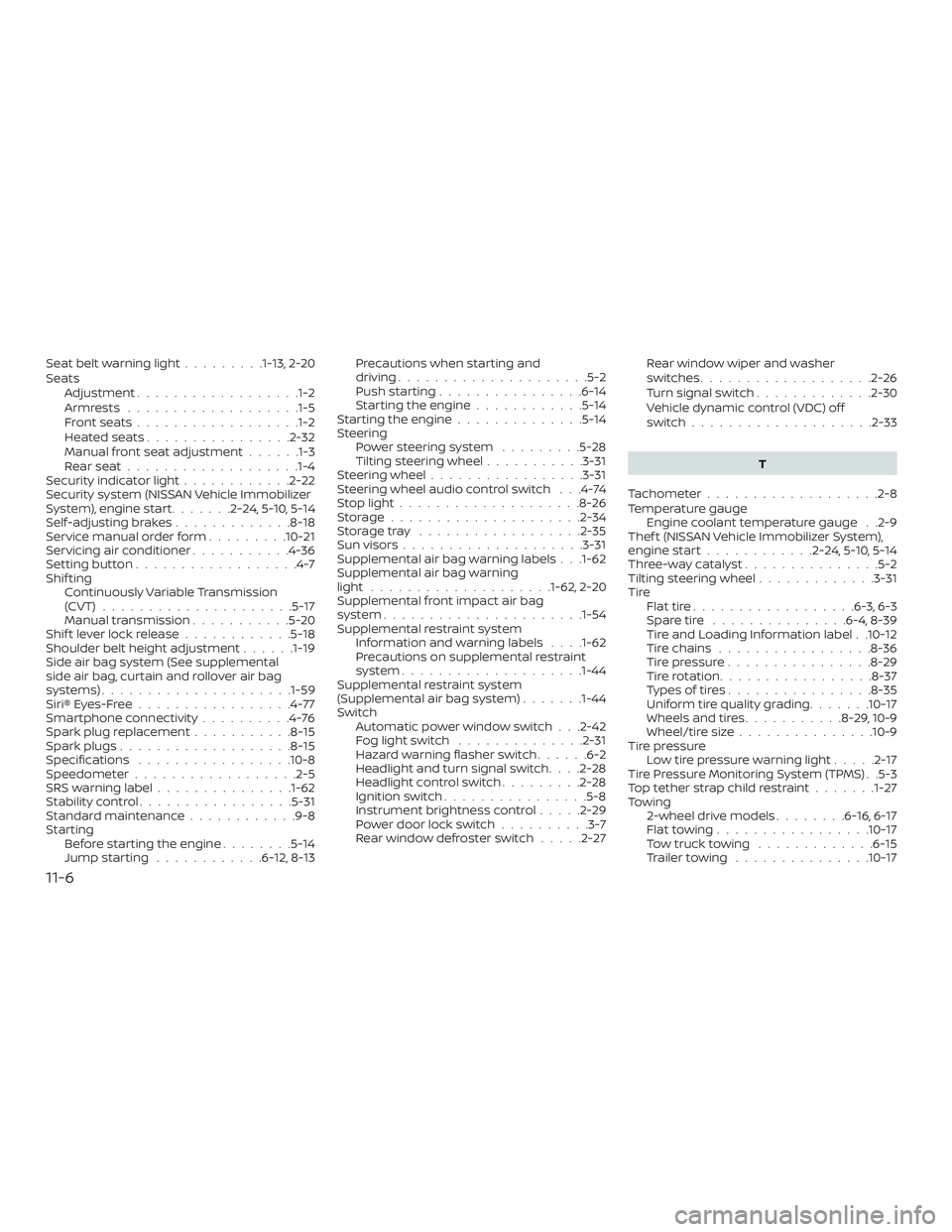
Seatbeltwarninglight.........1-13, 2-20
SeatsAdjustment ..................1-2
Armrests ...................1-5
Frontseats..................1-2
Heatedseats................2-32
Manual front seat adjustment ......1-3
Rearseat.................. .1-4
Security indicator light ............2-22
Security system (NISSAN Vehicle Immobilizer
System), engine start .......2-24,5-10,5-14
Self-adjustingbrakes.............8-18
Service manual order form .........10-21
Servicing air conditioner ...........4-36
Settingbutton..................4-7
Shif ting Continuously Variable Transmission
(CVT) .....................5-17
Manual transmission ...........5-20
Shiftleverlockrelease............5-18
Shoulder belt height adjustment ......1-19
Side air bag system (See supplemental
side air bag, curtain and rollover air bag
systems) .................... .1-59
Siri® Eyes-Free .................4-77
Smartphone connectivity ..........4-76
Spark plug replacement ...........8-15
Spark plugs ...................8-15
Specifications .................10-8
Speedometer ..................2-5
SRS warning label ...............1-62
Stability control .................5-31
Standard maintenance ............9-8
Starting Before starting the engine ........5-14
Jumpstarting ............6-12,8-13 Precautions when starting and
driving.....................5-2
Push starting
................6-14
Starting the engine ............5-14
Starting the engine ..............5-14
Steering Powersteeringsystem .........5-28
Tilting steering wheel ...........3-31
Steering wheel .................3-31
Steering wheel audio control switch . . .4-74
Stoplight....................8-26
Storage.....................2-34
Storagetray ..................2-35
Sunvisors....................3-31
Supplemental air bag warning labels . . .1-62
Supplemental air bag warning
light ....................1-62, 2-20
Supplemental front impact air bag
system ..................... .1-54
Supplemental restraint system Information and warning labels . . . .1-62
Precautions on supplemental restraint
system ................... .1-44
Supplemental restraint system
(Supplemental air bag system) .......1-44
Switch Automatic power window switch . . .2-42
Foglightswitch ..............2-31
Hazard warning flasher switch ......6-2
Headlight and turn signal switch ....2-28
Headlightcontrolswitch.........2-28
Ignition switch ................5-8
Instrument brightness control .....2-29
Power door lock switch ..........3-7
Rearwindowdefrosterswitch.....2-27 Rear window wiper and washer
switches
...................2-26
Turn signal switch .............2-30
V
ehicle dynamic control (VDC) off
switch....................2-33
T
Tachometer ...................2-8
Temperature gauge Engine coolant temperature gauge . .2-9
Thef t (NISSAN Vehicle Immobilizer System),
engine start ............2-24,5-10,5-14
Three-waycatalyst...............5-2
Tilting steering wheel .............3-31
Tire Flattire..................6-3,6-3
Spare tire ...............6-4,8-39
Tire and Loading Information label . .10-12
Tire chains .................8-36
Tire pressure ................8-29
Tirerotation.................8-37
Types of tires ................8-35
Uniform tire quality grading .......10-17
Wheels and tires ...........8-29,10-9
Wheel/tire size ...............10-9
Tire pressure Low tire pressure warning light .....2-17
Tire Pressure Monitoring System (TPMS) . .5-3
Toptetherstrapchildrestraint.......1-27
Towing 2-wheel drive models ........6-16,6-17
Flattowing.................10-17
Towtrucktowing .............6-15
Trailertowing ...............10-17
11-6