turn signal NISSAN VERSA NOTE 2018 Owner´s Manual
[x] Cancel search | Manufacturer: NISSAN, Model Year: 2018, Model line: VERSA NOTE, Model: NISSAN VERSA NOTE 2018Pages: 878, PDF Size: 9.62 MB
Page 764 of 878
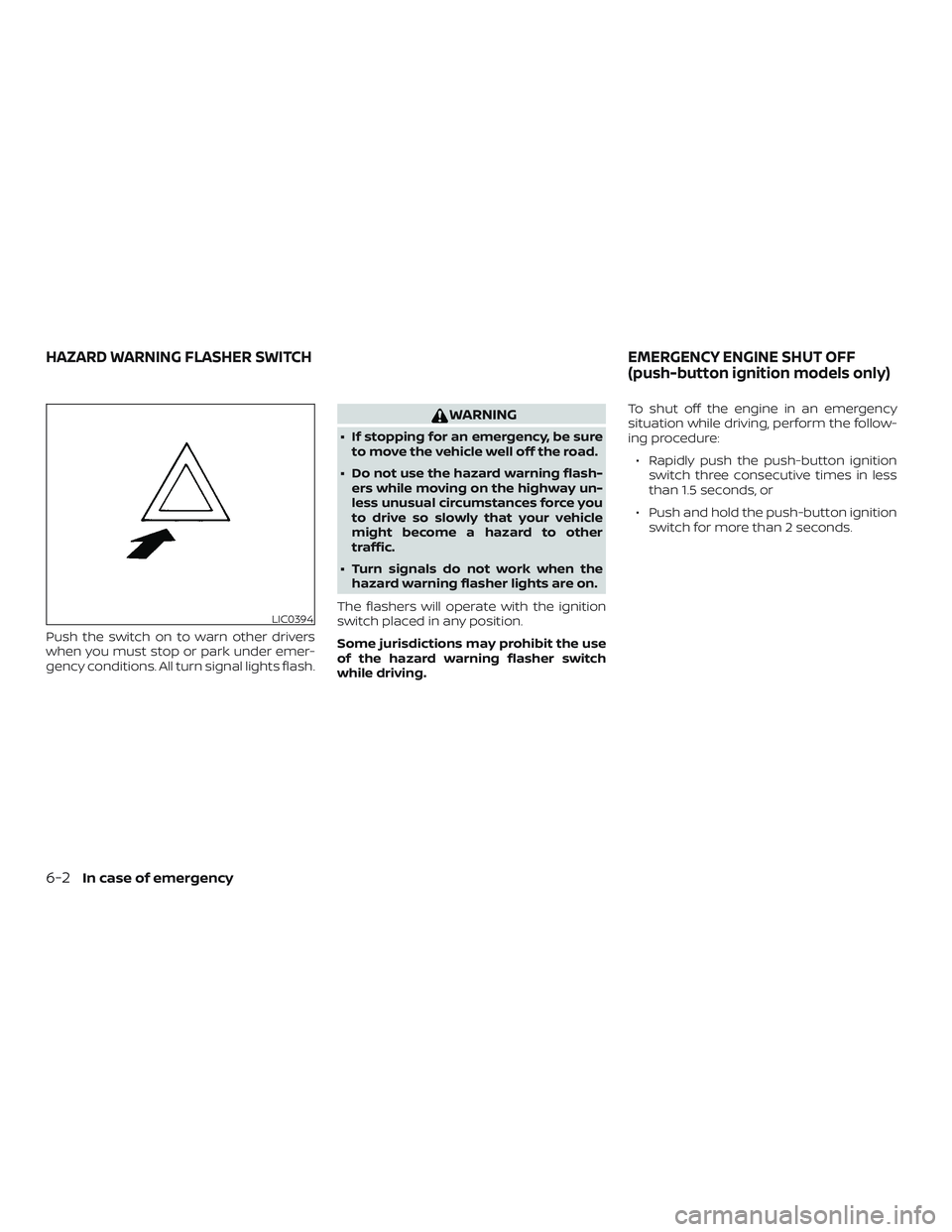
Push the switch on to warn other drivers
when you must stop or park under emer-
gency conditions. All turn signal lights flash.
WARNING
∙ If stopping for an emergency, be sureto move the vehicle well off the road.
∙ Do not use the hazard warning flash- ers while moving on the highway un-
less unusual circumstances force you
to drive so slowly that your vehicle
might become a hazard to other
traffic.
∙ Turn signals do not work when the hazard warning flasher lights are on.
The flashers will operate with the ignition
switch placed in any position.
Some jurisdictions may prohibit the use
of the hazard warning flasher switch
while driving. To shut off the engine in an emergency
situation while driving, perform the follow-
ing procedure:
∙ Rapidly push the push-button ignition switch three consecutive times in less
than 1.5 seconds, or
∙ Push and hold the push-button ignition switch for more than 2 seconds.
LIC0394
HAZARD WARNING FLASHER SWITCH EMERGENCY ENGINE SHUT OFF
(push-button ignition models only)
6-2In case of emergency
Page 765 of 878
TIRE PRESSURE MONITORING
SYSTEM (TPMS) (if so equipped)
This vehicle is equipped with the Tire Pres-
sure Monitoring System (TPMS). It monitors
tire pressure of all tires except the spare.
When the low tire pressure warning light is
lit, and the CHECK TIRE PRES (pressure)
warning message is displayed in the
odometer, one or more of your tires is sig-
nificantly under-inflated. If the vehicle is be-
ing driven with low tire pressure, the TPMS
will activate and warn you of it by the low
tire pressure warning light. This system will
activate only when the vehicle is driven at
speeds above 16 mph (25 km/h). For addi-
tional information, refer to “Warning lights,
indicator lights and audible reminders” in
the “Instruments and controls” section, and
“Tire Pressure Monitoring System (TPMS)” in
the “Starting and driving” section of this
manual.
WARNING
∙ Radio waves could adversely affectelectric medical equipment. Those
who use a pacemaker should contact
the electric medical equipment
manufacturer for the possible influ-
ences before use. ∙ If the low tire pressure warning light
illuminates while driving, avoid sud-
den steering maneuvers or abrupt
braking, reduce vehicle speed, pull off
the road to a safe location and stop
the vehicle as soon as possible. Driv-
ing with under-inflated tires may per-
manently damage the tires and in-
crease the likelihood of tire failure.
Serious vehicle damage could occur
and may lead to an accident and could
result in serious personal injury.
Check the tire pressure for all four
tires. Adjust the tire pressure to the
recommended COLD tire pressure
shown on the Tire and Loading Infor-
mation label to turn the low tire pres-
sure warning light OFF. If you have a
flat tire, replace it with a spare tire as
soon as possible.
∙ When replacing a wheel without TPMS such as the spare tire, TPMS will not
function and the low tire pressure
warning light will flash for approxi-
mately 1 minute. The light will remain
on af ter 1 minute. Have your tires re-
placed and/or TPMS system reset as
soon as possible. It is recommended
that you visit a NISSAN dealer for
these services. ∙ Do not inject any tire liquid or aerosol
tire sealant into the tires, as this may
cause a malfunction of the tire pres-
sure sensors.
∙ Replacing tires with those not origi- nally specified by NISSAN could affect
the proper operation of the TPMS.
CHANGING A FLAT TIRE
If you have a flat tire, follow the instructions
below:
Stopping the vehicle
1. Safely move the vehicle off the road and
away from traffic.
2. Turn on the hazard warning flashers.
3. Park on a level surface and apply the parking brake. Shif t the manual trans-
mission into R (Reverse) or the Continu-
ously Variable Transmission (CVT) into
P (Park).
4. Turn off the engine.
5. Raise the hood to warn other traffic and to signal professional road assis-
tance personnel that you need assis-
tance.
FLAT TIRE
In case of emergency6-3
Page 813 of 878
CAUTION
∙ High pressure halogen gas is sealedinside the halogen bulb. The bulb may
break if the glass envelope is
scratched or the bulb is dropped.
∙ When handling the bulb, do not touch the glass envelope.
∙ Use the same number and wattage as originally installed as shown in the
chart.
∙ Do not leave the bulb out of the fog light for a long period of time as dust,
moisture and smoke may enter the
fog light body and affect the perfor-
mance of the fog light.
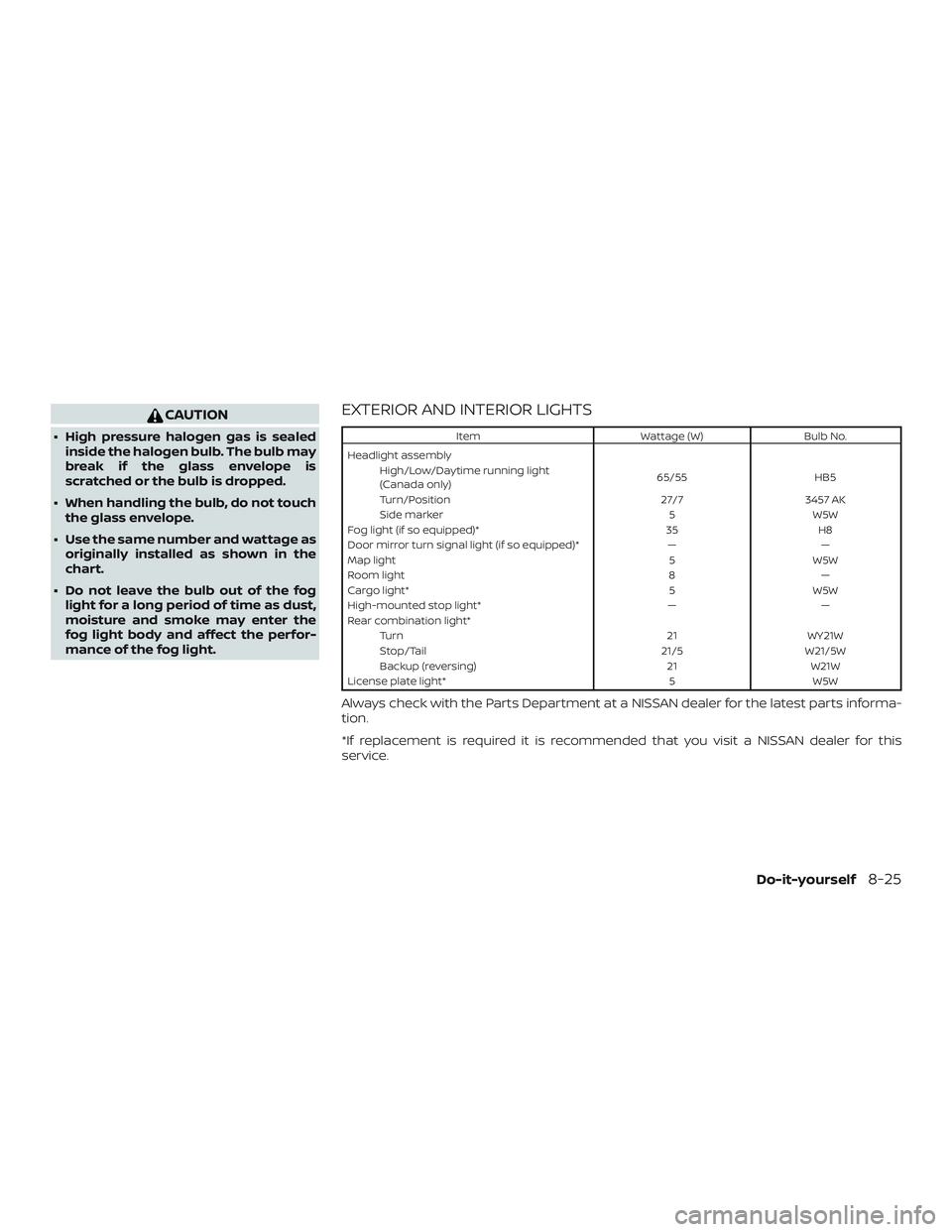
EXTERIOR AND INTERIOR LIGHTS
Item Wattage (W)Bulb No.
Headlight assembly High/Low/Daytime running light
(Canada only) 65/55
HB5
Turn/Position 27/73457 AK
Side marker 5W5W
Fog light (if so equipped)* 35H8
Door mirror turn signal light (if so equipped)* ——
Map light 5W5W
Room light 8—
Cargo light* 5W5W
High-mounted stop light* ——
Rear combination light* Turn 21WY21W
Stop/Tail 21/5W21/5W
Backup (reversing) 21W21W
License plate light* 5W5W
Always check with the Parts Department at a NISSAN dealer for the latest parts informa-
tion.
*If replacement is required it is recommended that you visit a NISSAN dealer for this
service.
Do-it-yourself8-25
Page 814 of 878
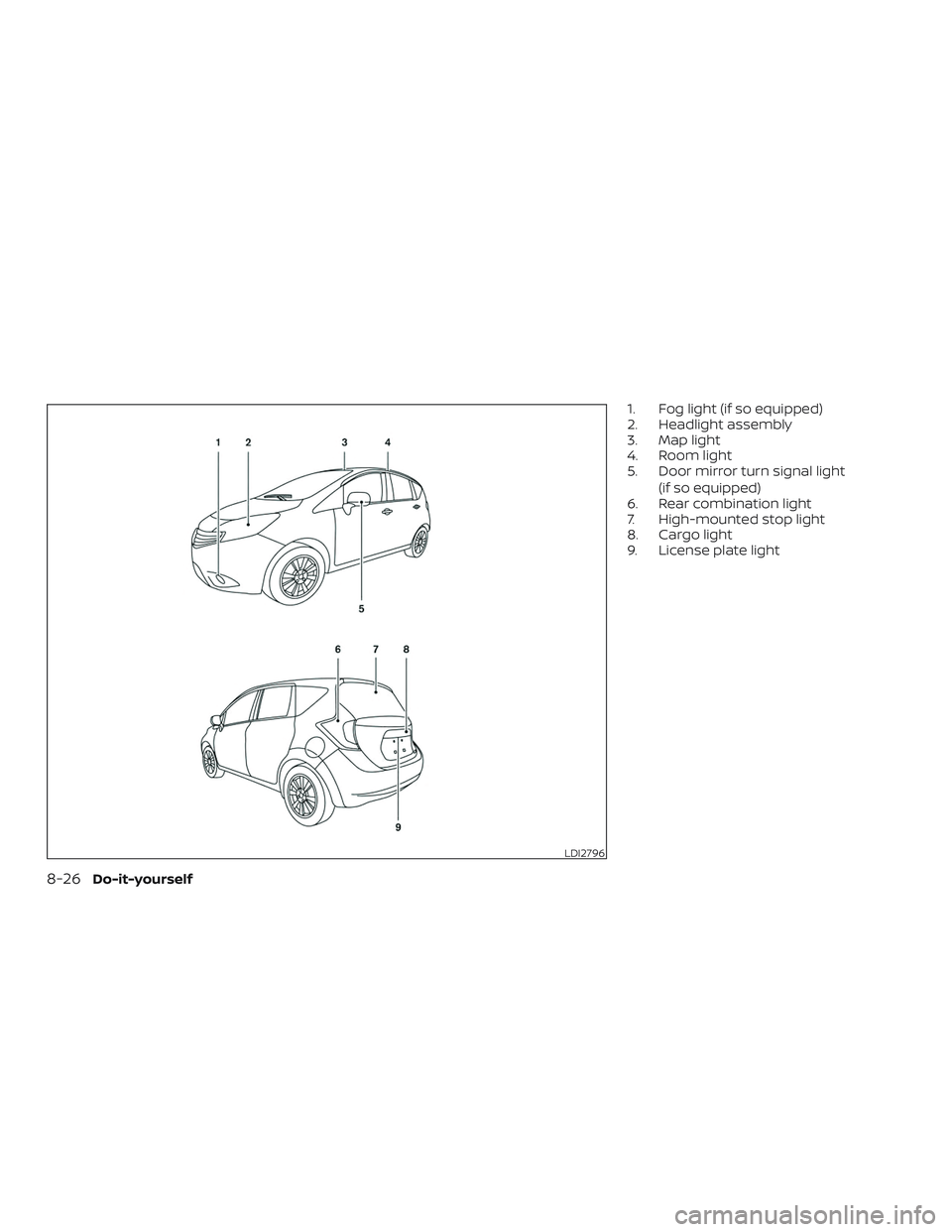
1. Fog light (if so equipped)
2. Headlight assembly
3. Map light
4. Room light
5. Door mirror turn signal light(if so equipped)
6. Rear combination light
7. High-mounted stop light
8. Cargo light
9. License plate light
LDI2796
8-26Do-it-yourself
Page 831 of 878
Doors and engine hood:Check that the
doors and engine hood operate properly.
Also ensure that all latches lock securely.
Lubricate hinges, latches, latch pins, rollers
and links if necessary. Make sure that the
secondary latch keeps the hood from
opening when the primary latch is re-
leased.
When driving in areas using road salt or
other corrosive materials, check lubrica-
tion frequently.
Lights*: Clean the headlights on a regular
basis. Make sure that the headlights, stop
lights, tail lights, turn signal lights, and other
lights are all operating properly and in-
stalled securely. Also check headlight aim.
Road wheel nuts (lug nuts)*: When check-
ing the tires, make sure no wheel nuts are
missing, and check for any loose wheel
nuts. Tighten if necessary.
Tire rotation*: Tires should be rotated ev-
ery 5,000 miles (8,000 km).
Tires*: Check the pressure with a gauge
of ten and always prior to long distance
trips. If necessary, adjust the pressure in all
tires, including the spare, to the pressure
specified. Check carefully for damage, cuts
or excessive wear. Tire Pressure Monitoring System (TPMS)
transmitter components (if so
equipped):
Replace the TPMS transmitter
grommet seal, valve core and cap when
the tires are replaced due to wear or age.
Wheel alignment and balance: If the vehicle
should pull to either side while driving on a
straight and level road, or if you detect un-
even or abnormal tire wear, there may be a
need for wheel alignment. If the steering
wheel or seat vibrates at normal highway
speeds, wheel balancing may be needed.
For additional information regarding tires,
refer to “Important Tire Safety Information”
(US) or “Tire Safety Information” (Canada) in
the Warranty Information Booklet.
Windshield: Clean the windshield on a
regular basis. Check the windshield at least
every six months for cracks or other dam-
age. Have a damaged windshield repaired
by a qualified repair facility.
Windshield wiper blades*: Check for
cracks or wear if they do not wipe properly.
Inside the vehicle
The maintenance items listed here should
be checked on a regular basis, such as
when performing scheduled maintenance,
cleaning the vehicle, etc. Accelerator pedal:
Check the pedal for
smooth operation and make sure the
pedal does not catch or require uneven
effort. Keep the floor mat away from the
pedal.
Brake pedal: Check the pedal for smooth
operation. If the brake pedal suddenly goes
down further than normal, the pedal feels
spongy or the vehicle seems to take longer
to stop, have your vehicle checked imme-
diately. It is recommended that you visit a
NISSAN dealer for this service. Keep the
floor mat away from the pedal.
Brakes: Check that the brakes do not pull
the vehicle to one side when applied.
Continuously Variable Transmission
(CVT) P (Park) position mechanism (if so
equipped): On a fairly steep hill check that
the vehicle is held securely with the shif t
lever in the P (Park) position without apply-
ing any brakes.
Parking brake: Check the parking brake
operation regularly. The vehicle should be
securely held on a fairly steep hill with only
the parking brake applied. If the parking
brake needs adjustment, it is recom-
mended that you visit a NISSAN dealer for
this service.
Maintenance and schedules9-3
Page 869 of 878
Starting the engine............5-15
Engine Block Heater .............5-36
Engine coolant temperature gauge ....2-9
Enterbutton...................4-4
EventDatarecorders............10-22
Exhaust gas (Carbon monoxide) .......5-2
Explanation of maintenance items .....9-2
Explanation of scheduled maintenance
items .......................9-5
Extended storage switch ..........8-19
F
Flashers
(See hazard warning flasher switch) ....6-2
Flattire....................6-3,6-3
Floormatpositioningaid...........7-6
Fluid Brakefluid..................8-9
Capacities and recommended
fuel/lubricants...............10-2
Clutchfluid.................8-10
Continuously Variable Transmission (CVT)
fluid......................8-9
Engine coolant ...............8-4
Engine oil ...................8-6
F.M.V.S.S. certification label .........10-12
Foglightswitch ................2-31
Front air bag system
(See supplemental restraint system) . . .1-55
Front-door pocket ...............2-35
Frontseats................... .1-2
Fuel Capacities and recommended
fuel/lubricants...............10-2 Fuel economy
...............5-27
Fuel-filler door lock opener lever ....3-28
Fuel gauge .................2-10
Fueloctanerating.............10-6
Fuel recommendation ..........10-4
Loose fuel cap warning .......2-7,3-29
Fuel efficient driving tips ...........5-26
Fuel-filler door .................3-28
Fuel gauge ...................2-10
Fuses .......................8-17
Fusiblelinks...................8-18
G
Gauge Engine coolant temperature gauge . .2-9
Fuel gauge .................2-10
Odometer ..................2-6
Speedometer ................2-5
Tachometer .................2-8
Trip computer ................2-11
Trip odometer ................2-6
General maintenance .............9-2
Glovebox....................2-36
H
Hands-free phone system,
Bluetooth®...............4-90,4-109
Hazard warning flasher switch ........6-2
Headlight and turn signal switch ......2-28
Headlightcontrolswitch...........2-28
Headlights ...................8-23
Headrestraints .................1-6 Heatedseats..................2-32
Heated seat switches
............2-32
Heater Heater and air conditioner controls . .4-35
Heater operation .............4-37
Hood release ..................3-26
Horn .......................2-31
I
Ignition switch ..................5-9
Push-button ignition switch .......5-11
Immobilizer system ........2-24,5-11, 5-14
Important vehicle information label . . .10-12
Increasing fuel economy ...........5-27
Indicator NISSAN Intelligent Key® battery discharge
indicator...................5-14
Indicator lights and audible reminders
(See warning/indicator lights and audible
reminders) ................2-14, 2-21
Instrument brightness control .......2-30
Instrument panel .............0-6,2-2
Instrument panel dimmer switch .....
2-30
Intelligent Key system Key operating range ............3-14
Key operation ................3-15
Mechanical key ...............3-4
Remote keyless entry operation . .3-9, 3-18
Troubleshooting guide .......3-24,3-25
Warning signals ...........3-24,3-25
Interiorlight...............2-43, 2-44
iPod®Player...............4-69,4-72
ISOFIX child restraints .............1-25
11-3
Page 870 of 878
J
Jumpstarting ..............6-12,8-12
K
Key.........................3-2
Key fob battery replacement .....8-20,8-20
Keyless entry With Intelligent Key system
(See Intelligent Key system) .....3-9,3-18
Keys NISSAN Intelligent Key® .......3-3,3-12
NISSAN Vehicle Immobilizer System
keys......................3-5
L
Label Tire and Loading Information label . .10-13
Labels Air conditioner specification label . . .10-13
C.M.V.S.S. certification label .......10-12
Emission control information label . .10-12
Engine serial number ..........10-12
F.M.V.S.S. certification label .......10-12
Tire and Loading Information label . .10-13
Vehicle identification number (VIN) . .10-11
Vehicle identification number (VIN)
plate.....................10-11
Warning labels (for SRS) ..........1-63
LATCH (Lower Anchors and Tethers for
CHildren)System................1-25
Launch bar menu ................4-9 License plate
Installing the license plate .......10-14
Light Airbagwarninglight........1-63, 2-20
Brakelight(Seestoplight)........8-25
Bulb check/instrument panel ......2-15
Bulb replacement .............8-25
Charge warning light ...........2-16
ExteriorandInteriorlights........8-25
Foglights..................8-24
Foglightswitch ..............2-31
Headlight and turn signal switch ....2-28
Headlightcontrolswitch.........2-28
Headlights .................8-23
Interiorlight.............2-43,2-44
Lightbulbs.................8-23
Low tire pressure warning light .....2-17
Low windshield-washer fluid warning
light......................2-19
Passenger air bag and status light. . .1-55
Security indicator light ..........2-23
Warning/indicator lights and audible
reminders ...............2-14,2-21
Lights ......................8-23
Lock Child safety rear door lock ........3-8
Door locks ................3-5,3-6
Fuel-filler door lock opener lever . . . .3-28
Power door locks ..............3-7
Loose fuel cap warning .........2-7,3-29
Lowfuelwarninglight.............2-17
Low tire pressure warning light .......2-17
Low windshield-washer fluid warning
light........................2-19
Luggage
(See vehicle loading information) .....10-14 M
Maintenance General maintenance ...........9-2
Insidethevehicle..............9-3
Maintenance precautions .........8-2
Outsidethevehicle.............9-2
Seat belt maintenance ..........1-20
Under the hood and vehicle .......9-4
Maintenance log ................9-13
Maintenance requirements ..........9-2
Maintenance schedules ............9-7
Maintenance under severe operation
conditions....................9-12
Malfunctionindicatorlight..........2-22
Manual front seat adjustment ........1-3
Manual windows ................2-42
Meters and gauges ...............2-3
Instrument brightness control .....2-30
Mirror Outsidemirrors..............3-33
Rearview...................3-32
Vanitymirror................3-32
Mirrors......................3-32
Mobile apps ..................4-83
N
NissanConnect® ................4-83
NISSAN Intelligent Key® .........3-3,3-12
NISS
AN Intelligent Key® battery discharge
indicator.....................5-14
NISSAN Vehicle Immobilizer
System ...............2-24,5 -11, 5-14
NISSAN voice recognition system .....4-120
11-4
Page 872 of 878
Frontseats..................1-2
Heatedseats................2-32
Manual front seat adjustment......1-3
Rearseat.................. .1-4
Security indicator light ............2-23
Security system (NISSAN Vehicle Immobilizer
System), engine start .......2-24,5-11, 5-14
Self-adjustingbrakes.............8-17
Service manual order form .........10-22
Servicing air conditioner ...........4-43
Settingbutton...............4-7,4-13
Shif ting Continuously Variable Transmission
(CVT) .....................5-18
Manual transmission ...........5-21
Shiftleverlockrelease............5-19
Shoulder belt height adjustment ......1-19
Side air bag system (See supplemental
side air bag, curtain and rollover air bag
systems) .................... .1-60
Siri® Eyes-Free ..............4-84,4-87
Smartphone connectivity ..........4-83
Spark plug replacement ...........8-14
Spark plugs ...................8-14
Specifications ..................10-9
Speedometer ..................2-5
SRS warning label ...............1-63
Stability control ................5-32
Standard maintenance ............9-8
Starting Before starting the engine ........5-15
Jumpstarting ............6-12,8-12
Precautions when starting and
driving .....................5-2
Push starting ................6-14
Starting the engine ............5-15 Starting the engine
..............5-15
Steering Powersteeringsystem..........5-29
Tilting steering wheel ...........3-31
Steering wheel .................3-31
Steering wheel audio control switch ....4-81
Stoplight....................8-25
Storage.....................2-35
Storagetray ..................2-36
Sunvisors....................3-31
Supplemental air bag warning labels . . .1-63
Supplemental air bag warning
light ................... .1-63, 2-20
Supplemental front impact air bag
system ..................... .1-55
Supplemental restraint system Information and warning labels . . . .1-63
Precautions on supplemental restraint
system ................... .1-45
Supplemental restraint system
(Supplemental air bag system) .......1-45
Switch Automatic power window switch . . .2-42
Foglightswitch ..............2-31
Hazard warning flasher switch ......6-2
Headlight and turn signal switch ....2-28
Headlightcontrolswitch.........2-28
Ignition switch ................5-9
Instrument brightness control .....2-30
Power door lock switch ..........3-7
Rearwindowdefrosterswitch.....2-28
Rear window wiper and washer
switches ...................2-27
Turn signal switch .............2-30 T
Tachometer ...................2-8
Temperature gauge Engine coolant temperature gauge . .2-9
Thef t (NISSAN Vehicle Immobilizer System),
engine
start............2-24,5 -11, 5-14
Three-waycatalyst...............5-2
Tilting steering wheel .............3-31
Tire Flattire..................6-3,6-3
Spare tire ...............6-4,8-39
Tire and Loading Information label . .10-13
Tire chains .................8-35
Tire pressure ................8-28
Tirerotation ................8-36
Types of tires ................8-34
Uniform tire quality grading ......10-19
Wheels and tires ..........8-28,10-10
Wheel/tire size ...............10-10
Tire pressure Low tire pressure warning light .....2-17
Tire Pressure Monitoring System (TPMS) . .5-3
Toptetherstrapchildrestraint.......1-27
Towing 2-wheel drive models ........6-16,6-17
Flattowing.................10-18
Towtrucktowing .............6-15
Trailertowing...............10-18
Towingatrailer................10-18
Transmission Continuously Variable Transmission
(CVT) fluid ...................8-9
Driving with Continuously Variable
Transmission (CVT) ..........5-9,5-16
11-6
Page 873 of 878
Driving with manual transmission . . .5-21
Transmission shif t lever lock release . . .5-19
Travel (See registering a vehicle in another
country) .....................10-11
Trip computer ..................2-11
Trip odometer ..................2-6
Troubleshooting guide (NISSAN voice
recognition system) .............4-125
Turn signal switch ...............2-30
U
Uniform tire quality grading ........10-19
USBinterface..............4-65,4-68 Audio file operation ............4-68
V
Vanitymirror..................3-32
Variable voltage control system ......8-13
Vehicle dimensions and weights .....10-10
Vehicle Dynamic Control (VDC) OFF
switch......................2-33
Vehicle Dynamic Control (VDC) system . .5-32
Vehicle identification .............10-11
Vehicle identification number (VIN) . . . .10-11
Vehicle identification number (VIN)
(Chassis number) ...............10-11
Vehicle identification number (VIN)
plate.......................10-11
Vehicle immobilizer system . . .2-24, 5-11, 5-14
Vehicle loading information .....10-14,10-15
Vehiclerecovery................6-17 Vehicle security system (NISSAN Vehicle
Immobilizer System), engine
start.................2-24,5
-11, 5-14
Ventilators ...................4-35
Visors.......................3-31
Voice Prompt Interrupt ........4-93,4-112
Voice recognition system ..........4-120
W
Warning Airbagwarninglight........1-63, 2-20
Anti-lock brake warning light ......2-15
Battery charge warning light ......2-16
Brakewarninglight............2-15
Door open warning light .........2-16
Engine oil pressure warning light ....2-16
Hazard warning flasher switch ......6-2
Loose fuel cap warning .......2-7,3-29
Lowfuelwarninglight...........2-17
Lowtirepressurewarninglight.....2-17
Low windshield-washer fluid warning
light......................2-19
Passenger air bag and status light. . .1-55
Seatbeltwarninglight.......1-13, 2-20
Supplemental air bag warning
light ..................1-63, 2-20
Warning/indicator lights and audible
reminders ...............2-14,2-21
Warning labels (for SRS) ..........1-63
Warning/indicator lights and audible
reminders .................2-14,2-21
Audible reminders ..........2-14,2-21
Checking bulbs ...............2-15
Indicatorlights............2-14,2-21 Warninglights............2-14,2-21
Warninglights..............2-14,2-21
Warning lights, indicator lights and audible
reminders ....................2-14
Washer switch Rear window wiper and washer
switches ...................2-27
Weights
(See dimensions and weights) .......10-10
Wheels and tires ............8-28,10-10
Wheel/tire size .................10-10
When traveling or registering in another
country .....................10-11
Windows ....................2-40 Locking passengers' windows .....2-42
Manual windows ..............2-42
Powerwindows..............2-40
Rearpowerwindows...........2-42
Windshield-washer fluid ...........8-10
Windshield wiper blades ...........8-15
Wiper Rear window wiper and washer
switches ...................2-27
Wiper
blades ................8-15
Wiper and washer switch ..........2-26
11-7