tire pressure NISSAN VERSA NOTE 2018 Owner´s Manual
[x] Cancel search | Manufacturer: NISSAN, Model Year: 2018, Model line: VERSA NOTE, Model: NISSAN VERSA NOTE 2018Pages: 878, PDF Size: 9.62 MB
Page 826 of 878
∙ When replacing a wheel without theTPMS, such as the spare tire, the TPMS
will not function and the low tire pres-
sure warning light will flash for ap-
proximately 1 minute. The light will re-
main on af ter 1 minute. Have your
tires replaced and/or TPMS system
reset as soon as possible. It is recom-
mended that you visit a NISSAN dealer
for this service.
∙ Replacing tires with those not origi- nally specified by NISSAN could affect
the proper operation of the TPMS (if so
equipped).
∙ The TPMS sensor may be damaged if it is not handled correctly. Be careful
when handling the TPMS sensor.
∙ When replacing the TPMS sensor, the ID registration may be required. Con-
tact a NISSAN dealer for ID
registration.
∙ Do not use a valve stem cap that is not specified by NISSAN. The valve stem
cap may become stuck. ∙ Be sure that the valve stem caps are
correctly fitted. Otherwise the valve
may be clogged up with dirt and
cause a malfunction or loss of
pressure.
∙ Do not install a damaged or deformed wheel or tire even if it has been re-
paired. Such wheels or tires could
have structural damage and could fail
without warning.
∙ The use of retread tires is not recommended.
∙ For additional information regarding tires, refer to “Important Tire Safety
Information” (US) or “Tire Safety Infor-
mation” (Canada) in the Warranty In-
formation Booklet.
Wheel balance
Unbalanced wheels may affect vehicle
handling and tire life. Even with regular use,
wheels can get out of balance. Therefore,
they should be balanced as required.
Wheel balance service should be per-
formed with the wheels off the vehicle.
Spin balancing the wheels on the vehicle
could lead to mechanical damage. ∙
For additional information regarding
tires, refer to “Important Tire Safety
Information” (US) or “Tire Safety In-
formation” (Canada) in the Warranty
Information Booklet.
Care of wheels
∙ Wash the wheels when washing the ve- hicle to maintain their appearance.
∙ Clean the inner side of the wheels when the wheel is changed or the underside
of the vehicle is washed.
∙ Do not use abrasive cleaners when washing the wheels.
∙ Inspect wheel rims regularly for dents or corrosion. Such damage may cause
loss of pressure or poor seal at the tire
bead.
∙ NISSAN recommends waxing the road wheels to protect against road salt in
areas where it is used during winter.
8-38Do-it-yourself
Page 827 of 878
Spare tire (TEMPORARY USE ONLY
spare tire)
When replacing a wheel without the TPMS
such as the spare tire, the TPMS will not
function.
Observe the following precautions if the
TEMPORARY USE ONLY spare tire must be
used. Otherwise, your vehicle could be
damaged or involved in an accident:
WARNING
∙ The spare tire should be used foremergency use only. It should be re-
placed with the standard tire at the
first opportunity to avoid possible tire
or differential damage.
∙ Drive carefully while the TEMPORARY USE ONLY spare tire is installed. Avoid
sharp turns and abrupt braking while
driving.
∙ Periodically check spare tire inflation pressure. Always keep the pressure of
the TEMPORARY USE ONLY spare tire
at 420 kPa, 4.2 bar (60 psi). ∙ With the TEMPORARY USE ONLY spare
tire installed do not drive the vehicle
at speeds faster than 50 mph
(80 km/h).
∙ When driving on roads covered with snow or ice, the TEMPORARY USE
ONLY spare tire should be used on the
rear wheels and the original tire used
on the front wheels (drive wheels).
∙ Tire tread of the TEMPORARY USE ONLY spare tire will wear at a faster
rate than the standard tire. Replace
the spare tire as soon as the tread
wear indicators appear.
∙ Do not use the spare tire on other vehicles.
∙ Do not use more than one spare tire at the same time.
∙ Do not tow a trailer when the TEMPO- RARY USE ONLY spare tire is installed.
CAUTION
∙ Do not use tire chains on a TEMPO-RARY USE ONLY spare tire. Tire chains
will not fit properly and may cause
damage to the vehicle.
∙ Because the TEMPORARY USE ONLY spare tire is smaller than the original
tire, ground clearance is reduced. To
avoid damage to the vehicle, do not
drive over obstacles. Also, do not drive
the vehicle through an automatic car
wash since it may get caught.
Do-it-yourself8-39
Page 831 of 878
Doors and engine hood:Check that the
doors and engine hood operate properly.
Also ensure that all latches lock securely.
Lubricate hinges, latches, latch pins, rollers
and links if necessary. Make sure that the
secondary latch keeps the hood from
opening when the primary latch is re-
leased.
When driving in areas using road salt or
other corrosive materials, check lubrica-
tion frequently.
Lights*: Clean the headlights on a regular
basis. Make sure that the headlights, stop
lights, tail lights, turn signal lights, and other
lights are all operating properly and in-
stalled securely. Also check headlight aim.
Road wheel nuts (lug nuts)*: When check-
ing the tires, make sure no wheel nuts are
missing, and check for any loose wheel
nuts. Tighten if necessary.
Tire rotation*: Tires should be rotated ev-
ery 5,000 miles (8,000 km).
Tires*: Check the pressure with a gauge
of ten and always prior to long distance
trips. If necessary, adjust the pressure in all
tires, including the spare, to the pressure
specified. Check carefully for damage, cuts
or excessive wear. Tire Pressure Monitoring System (TPMS)
transmitter components (if so
equipped):
Replace the TPMS transmitter
grommet seal, valve core and cap when
the tires are replaced due to wear or age.
Wheel alignment and balance: If the vehicle
should pull to either side while driving on a
straight and level road, or if you detect un-
even or abnormal tire wear, there may be a
need for wheel alignment. If the steering
wheel or seat vibrates at normal highway
speeds, wheel balancing may be needed.
For additional information regarding tires,
refer to “Important Tire Safety Information”
(US) or “Tire Safety Information” (Canada) in
the Warranty Information Booklet.
Windshield: Clean the windshield on a
regular basis. Check the windshield at least
every six months for cracks or other dam-
age. Have a damaged windshield repaired
by a qualified repair facility.
Windshield wiper blades*: Check for
cracks or wear if they do not wipe properly.
Inside the vehicle
The maintenance items listed here should
be checked on a regular basis, such as
when performing scheduled maintenance,
cleaning the vehicle, etc. Accelerator pedal:
Check the pedal for
smooth operation and make sure the
pedal does not catch or require uneven
effort. Keep the floor mat away from the
pedal.
Brake pedal: Check the pedal for smooth
operation. If the brake pedal suddenly goes
down further than normal, the pedal feels
spongy or the vehicle seems to take longer
to stop, have your vehicle checked imme-
diately. It is recommended that you visit a
NISSAN dealer for this service. Keep the
floor mat away from the pedal.
Brakes: Check that the brakes do not pull
the vehicle to one side when applied.
Continuously Variable Transmission
(CVT) P (Park) position mechanism (if so
equipped): On a fairly steep hill check that
the vehicle is held securely with the shif t
lever in the P (Park) position without apply-
ing any brakes.
Parking brake: Check the parking brake
operation regularly. The vehicle should be
securely held on a fairly steep hill with only
the parking brake applied. If the parking
brake needs adjustment, it is recom-
mended that you visit a NISSAN dealer for
this service.
Maintenance and schedules9-3
Page 857 of 878
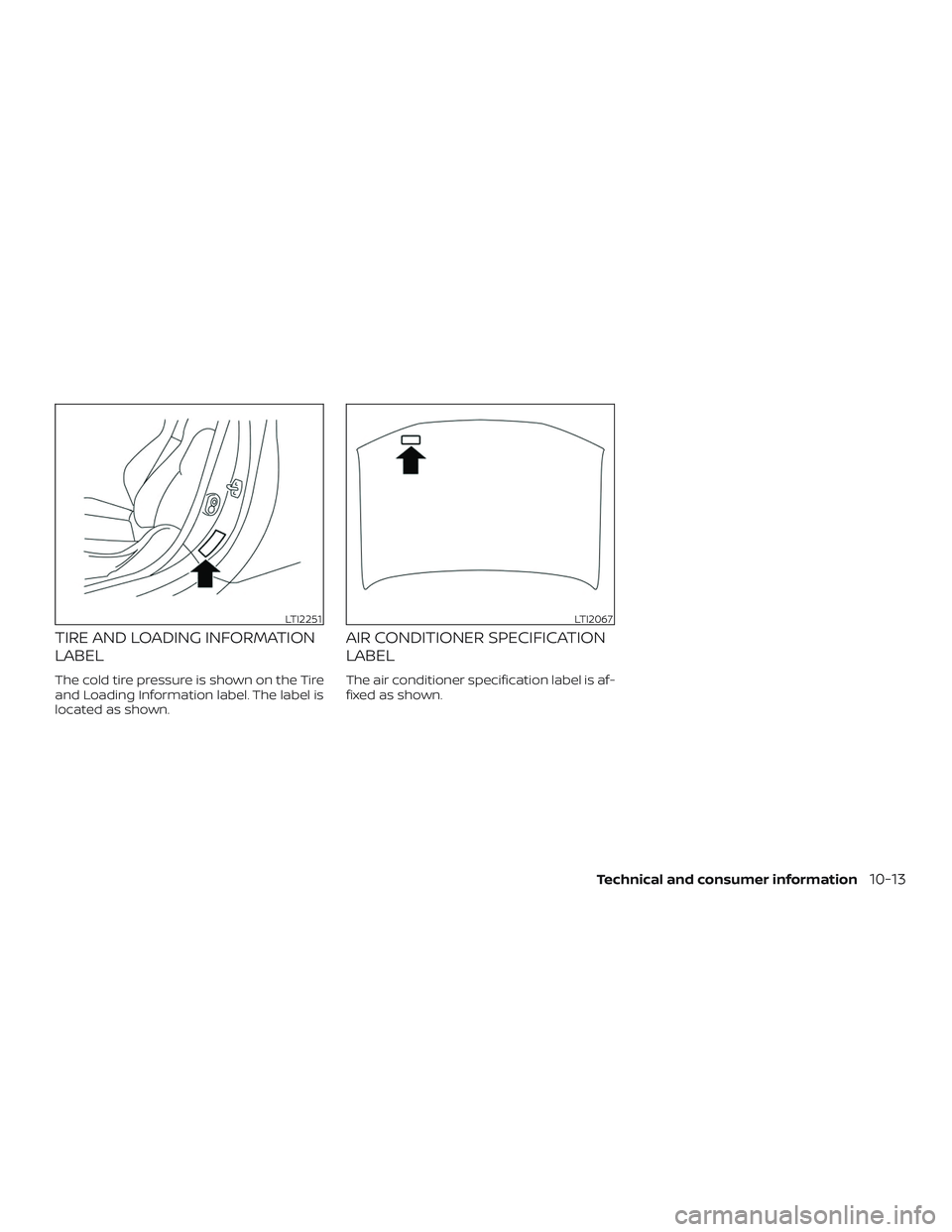
TIRE AND LOADING INFORMATION
LABEL
The cold tire pressure is shown on the Tire
and Loading Information label. The label is
located as shown.
AIR CONDITIONER SPECIFICATION
LABEL
The air conditioner specification label is af-
fixed as shown.
LTI2251LTI2067
Technical and consumer information10-13
Page 861 of 878
5. Determine the combined weightof luggage and cargo being
loaded on the vehicle. That
weight may not safely exceed
the available cargo and luggage
load capacity calculated in
step 4.
Before driving a loaded vehicle, con-
firm that you do not exceed the
Gross Vehicle Weight Rating (GVWR)
or the Gross Axle Weight Rating
(GAWR) for your vehicle. For addi-
tional information, refer to “Measure-
ment of weights” in this section.
Also check tires for proper inflation
pressures. For additional informa-
tion, refer to “Tire and Loading Infor-
mation label” in this section.LOADING TIPS
∙ The GVW must not exceed GVWR or GAWR as specified on the
F.M.V.S.S./C.M.V.S.S. certification
label.
∙ Do not load the front and rear axle to the GAWR. Doing so will
exceed the GVWR.
WARNING
∙ Properly secure all cargo with ropes or straps to help prevent
it from sliding or shif ting. Do not
place cargo higher than the
seatbacks. In a sudden stop or
collision, unsecured cargo could
cause personal injury. ∙ Do not load your vehicle any
heavier than the GVWR or the
maximum front and rear
GAWRs. If you do, parts of your
vehicle can break, tire damage
could occur, or it can change the
way your vehicle handles. This
could result in loss of control
and cause personal injury.
∙ Overloading not only can shorten the life of your vehicle
and the tire, but can also cause
unsafe vehicle handling and
longer braking distances. This
may cause a premature tire fail-
ure which could result in a seri-
ous accident and personal in-
jury. Failures caused by
overloading are not covered by
the vehicle’s warranty.
Technical and consumer information10-17
Page 870 of 878
J
Jumpstarting ..............6-12,8-12
K
Key.........................3-2
Key fob battery replacement .....8-20,8-20
Keyless entry With Intelligent Key system
(See Intelligent Key system) .....3-9,3-18
Keys NISSAN Intelligent Key® .......3-3,3-12
NISSAN Vehicle Immobilizer System
keys......................3-5
L
Label Tire and Loading Information label . .10-13
Labels Air conditioner specification label . . .10-13
C.M.V.S.S. certification label .......10-12
Emission control information label . .10-12
Engine serial number ..........10-12
F.M.V.S.S. certification label .......10-12
Tire and Loading Information label . .10-13
Vehicle identification number (VIN) . .10-11
Vehicle identification number (VIN)
plate.....................10-11
Warning labels (for SRS) ..........1-63
LATCH (Lower Anchors and Tethers for
CHildren)System................1-25
Launch bar menu ................4-9 License plate
Installing the license plate .......10-14
Light Airbagwarninglight........1-63, 2-20
Brakelight(Seestoplight)........8-25
Bulb check/instrument panel ......2-15
Bulb replacement .............8-25
Charge warning light ...........2-16
ExteriorandInteriorlights........8-25
Foglights..................8-24
Foglightswitch ..............2-31
Headlight and turn signal switch ....2-28
Headlightcontrolswitch.........2-28
Headlights .................8-23
Interiorlight.............2-43,2-44
Lightbulbs.................8-23
Low tire pressure warning light .....2-17
Low windshield-washer fluid warning
light......................2-19
Passenger air bag and status light. . .1-55
Security indicator light ..........2-23
Warning/indicator lights and audible
reminders ...............2-14,2-21
Lights ......................8-23
Lock Child safety rear door lock ........3-8
Door locks ................3-5,3-6
Fuel-filler door lock opener lever . . . .3-28
Power door locks ..............3-7
Loose fuel cap warning .........2-7,3-29
Lowfuelwarninglight.............2-17
Low tire pressure warning light .......2-17
Low windshield-washer fluid warning
light........................2-19
Luggage
(See vehicle loading information) .....10-14 M
Maintenance General maintenance ...........9-2
Insidethevehicle..............9-3
Maintenance precautions .........8-2
Outsidethevehicle.............9-2
Seat belt maintenance ..........1-20
Under the hood and vehicle .......9-4
Maintenance log ................9-13
Maintenance requirements ..........9-2
Maintenance schedules ............9-7
Maintenance under severe operation
conditions....................9-12
Malfunctionindicatorlight..........2-22
Manual front seat adjustment ........1-3
Manual windows ................2-42
Meters and gauges ...............2-3
Instrument brightness control .....2-30
Mirror Outsidemirrors..............3-33
Rearview...................3-32
Vanitymirror................3-32
Mirrors......................3-32
Mobile apps ..................4-83
N
NissanConnect® ................4-83
NISSAN Intelligent Key® .........3-3,3-12
NISS
AN Intelligent Key® battery discharge
indicator.....................5-14
NISSAN Vehicle Immobilizer
System ...............2-24,5 -11, 5-14
NISSAN voice recognition system .....4-120
11-4
Page 872 of 878
Frontseats..................1-2
Heatedseats................2-32
Manual front seat adjustment......1-3
Rearseat.................. .1-4
Security indicator light ............2-23
Security system (NISSAN Vehicle Immobilizer
System), engine start .......2-24,5-11, 5-14
Self-adjustingbrakes.............8-17
Service manual order form .........10-22
Servicing air conditioner ...........4-43
Settingbutton...............4-7,4-13
Shif ting Continuously Variable Transmission
(CVT) .....................5-18
Manual transmission ...........5-21
Shiftleverlockrelease............5-19
Shoulder belt height adjustment ......1-19
Side air bag system (See supplemental
side air bag, curtain and rollover air bag
systems) .................... .1-60
Siri® Eyes-Free ..............4-84,4-87
Smartphone connectivity ..........4-83
Spark plug replacement ...........8-14
Spark plugs ...................8-14
Specifications ..................10-9
Speedometer ..................2-5
SRS warning label ...............1-63
Stability control ................5-32
Standard maintenance ............9-8
Starting Before starting the engine ........5-15
Jumpstarting ............6-12,8-12
Precautions when starting and
driving .....................5-2
Push starting ................6-14
Starting the engine ............5-15 Starting the engine
..............5-15
Steering Powersteeringsystem..........5-29
Tilting steering wheel ...........3-31
Steering wheel .................3-31
Steering wheel audio control switch ....4-81
Stoplight....................8-25
Storage.....................2-35
Storagetray ..................2-36
Sunvisors....................3-31
Supplemental air bag warning labels . . .1-63
Supplemental air bag warning
light ................... .1-63, 2-20
Supplemental front impact air bag
system ..................... .1-55
Supplemental restraint system Information and warning labels . . . .1-63
Precautions on supplemental restraint
system ................... .1-45
Supplemental restraint system
(Supplemental air bag system) .......1-45
Switch Automatic power window switch . . .2-42
Foglightswitch ..............2-31
Hazard warning flasher switch ......6-2
Headlight and turn signal switch ....2-28
Headlightcontrolswitch.........2-28
Ignition switch ................5-9
Instrument brightness control .....2-30
Power door lock switch ..........3-7
Rearwindowdefrosterswitch.....2-28
Rear window wiper and washer
switches ...................2-27
Turn signal switch .............2-30 T
Tachometer ...................2-8
Temperature gauge Engine coolant temperature gauge . .2-9
Thef t (NISSAN Vehicle Immobilizer System),
engine
start............2-24,5 -11, 5-14
Three-waycatalyst...............5-2
Tilting steering wheel .............3-31
Tire Flattire..................6-3,6-3
Spare tire ...............6-4,8-39
Tire and Loading Information label . .10-13
Tire chains .................8-35
Tire pressure ................8-28
Tirerotation ................8-36
Types of tires ................8-34
Uniform tire quality grading ......10-19
Wheels and tires ..........8-28,10-10
Wheel/tire size ...............10-10
Tire pressure Low tire pressure warning light .....2-17
Tire Pressure Monitoring System (TPMS) . .5-3
Toptetherstrapchildrestraint.......1-27
Towing 2-wheel drive models ........6-16,6-17
Flattowing.................10-18
Towtrucktowing .............6-15
Trailertowing...............10-18
Towingatrailer................10-18
Transmission Continuously Variable Transmission
(CVT) fluid ...................8-9
Driving with Continuously Variable
Transmission (CVT) ..........5-9,5-16
11-6
Page 873 of 878
Driving with manual transmission . . .5-21
Transmission shif t lever lock release . . .5-19
Travel (See registering a vehicle in another
country) .....................10-11
Trip computer ..................2-11
Trip odometer ..................2-6
Troubleshooting guide (NISSAN voice
recognition system) .............4-125
Turn signal switch ...............2-30
U
Uniform tire quality grading ........10-19
USBinterface..............4-65,4-68 Audio file operation ............4-68
V
Vanitymirror..................3-32
Variable voltage control system ......8-13
Vehicle dimensions and weights .....10-10
Vehicle Dynamic Control (VDC) OFF
switch......................2-33
Vehicle Dynamic Control (VDC) system . .5-32
Vehicle identification .............10-11
Vehicle identification number (VIN) . . . .10-11
Vehicle identification number (VIN)
(Chassis number) ...............10-11
Vehicle identification number (VIN)
plate.......................10-11
Vehicle immobilizer system . . .2-24, 5-11, 5-14
Vehicle loading information .....10-14,10-15
Vehiclerecovery................6-17 Vehicle security system (NISSAN Vehicle
Immobilizer System), engine
start.................2-24,5
-11, 5-14
Ventilators ...................4-35
Visors.......................3-31
Voice Prompt Interrupt ........4-93,4-112
Voice recognition system ..........4-120
W
Warning Airbagwarninglight........1-63, 2-20
Anti-lock brake warning light ......2-15
Battery charge warning light ......2-16
Brakewarninglight............2-15
Door open warning light .........2-16
Engine oil pressure warning light ....2-16
Hazard warning flasher switch ......6-2
Loose fuel cap warning .......2-7,3-29
Lowfuelwarninglight...........2-17
Lowtirepressurewarninglight.....2-17
Low windshield-washer fluid warning
light......................2-19
Passenger air bag and status light. . .1-55
Seatbeltwarninglight.......1-13, 2-20
Supplemental air bag warning
light ..................1-63, 2-20
Warning/indicator lights and audible
reminders ...............2-14,2-21
Warning labels (for SRS) ..........1-63
Warning/indicator lights and audible
reminders .................2-14,2-21
Audible reminders ..........2-14,2-21
Checking bulbs ...............2-15
Indicatorlights............2-14,2-21 Warninglights............2-14,2-21
Warninglights..............2-14,2-21
Warning lights, indicator lights and audible
reminders ....................2-14
Washer switch Rear window wiper and washer
switches ...................2-27
Weights
(See dimensions and weights) .......10-10
Wheels and tires ............8-28,10-10
Wheel/tire size .................10-10
When traveling or registering in another
country .....................10-11
Windows ....................2-40 Locking passengers' windows .....2-42
Manual windows ..............2-42
Powerwindows..............2-40
Rearpowerwindows...........2-42
Windshield-washer fluid ...........8-10
Windshield wiper blades ...........8-15
Wiper Rear window wiper and washer
switches ...................2-27
Wiper
blades ................8-15
Wiper and washer switch ..........2-26
11-7
Page 876 of 878
FUEL RECOMMENDATION:
Use unleaded regular gasoline with an oc-
tane rating of at least 87 AKI (Anti-Knock In-
dex) number (Research octane number 91).
CAUTION
∙ Only vehicles with the E-85 filler doorlabel can operate on E-85. Fuel system
or other damage can occur if E-85 is
used in vehicles that are not designed
to run on E-85.
∙ Using a fuel other than that specified could adversely affect the emission
control system, and may also affect
the warranty coverage.
∙ Under no circumstances should a leaded gasoline be used, because this
will damage the three-way catalyst.
∙ Do not use a fuel containing more than 15% ethanol in your vehicle. Your
vehicle is not designed to run on a fuel
containing more than 15% ethanol.
Using a fuel containing more than 15%
ethanol in a vehicle not specifically
designed for a fuel containing more
than 15% ethanol can adversely affect
the emission control devices and sys-
tems of the vehicle. Damage caused
by such fuel is not covered by the
NISSAN New Vehicle Limited Warranty. ∙
Do not use fuel that contains the oc-
tane booster methylcyclopentadienyl
manganese tricarbonyl (MMT). Using
fuel containing MMT may adversely af-
fect vehicle performance and vehicle
emissions. Not all fuel dispensers are
labeled to indicate MMT content, so you
may have to consult your gasoline re-
tailer for more details. Note that Fed-
eral and California laws prohibit the use
of MMT in reformulated gasoline.
∙ U.S. government regulations require ethanol dispensing pumps to be iden-
tified by a small, square, orange and
black label with the common abbre-
viation or the appropriate percentage
for that region.
For additional information, refer to “Recom-
mended fluids/lubricants and capacities”
in the “Technical and consumer informa-
tion” section of this manual.
ENGINE OIL RECOMMENDATION:
• Genuine “Nissan Motor Oil 0W-20 SN” is
recommended. •
If the above motor is not available, use an
equivalent motor oil that matches the above
grade and viscosity. For additional informa-
tion, refer to “Engine oil and oil filter recom-
mendations” in the “Technical and consumer
information” section of this manual.
COLD TIRE PRESSURE:
For additional information, refer to “Tire and
Loading Information label” in the “Technical
and consumer information” section of this
manual.
The label is typically located on the driver
side center pillar or on the driver’s door. For
additional information, refer to “Wheels and
tires” in the “Do-it-yourself ” section of this
manual.
RECOMMENDED NEW VEHICLE
BREAK-IN PROCEDURE:
During the first 1,200 miles (2,000 km) of
vehicle use, follow the break-in procedure
recommendations for the future reliability
and economy of your new vehicle. For ad-
ditional information, refer to “Break-in
schedule” in the “Starting and driving” sec-
tion of this manual. Failure to follow these
recommendations may result in vehicle
damage or shortened engine life.
GAS STATION INFORMATION