do it yourself NISSAN VERSA NOTE 2019 Owner´s Manual
[x] Cancel search | Manufacturer: NISSAN, Model Year: 2019, Model line: VERSA NOTE, Model: NISSAN VERSA NOTE 2019Pages: 388, PDF Size: 4.46 MB
Page 331 of 388
Summer tires
NISSAN specifies summer tires on some
models to provide superior performance
on dry roads. Summer tire performance is
substantially reduced in snow and ice.
Summer tires do not have the tire traction
rating “M&S” on the tire sidewall.
If you plan to operate your vehicle in snowy
or icy conditions, NISSAN recommends the
use of SNOW tires or ALL SEASON tires on all
four wheels.
Snow tires
If snow tires are needed, it is necessary to
select tires equivalent in size and load rat-
ing to the original equipment tires. If you do
not, it can adversely affect the safety and
handling of your vehicle.
Generally, snow tires have lower speed rat-
ings than factory equipped tires and may
not match the potential maximum vehicle
speed. Never exceed the maximum speed
rating of the tire.
If you install snow tires, they must be the
same size, brand, construction and tread
pattern on all four wheels.For additional traction on icy roads, stud-
ded tires may be used. However, some U.S.
states and Canadian provinces prohibit
their use. Check local, state and provincial
laws before installing studded tires. Skid
and traction capabilities of studded snow
tires on wet or dry surfaces may be poorer
than that of non-studded snow tires.
TIRE CHAINS
Use of tire chains may be prohibited ac-
cording to location. Check the local laws
before installing tire chains. When installing
tire chains, make sure they are the proper
size for the tires on your vehicle and are
installed according to the chain manufac-
turer’s suggestions.
Use only SAE class “S”
chains. Class “S” chains are used on ve-
hicles with restricted tire to vehicle clear-
ance. Vehicles that can use Class “S” chains
are designed to meet the minimum clear-
ances between the tire and the closest ve-
hicle suspension or body component re-
quired to accommodate the use of a
winter traction device (tire chains or
cables). The minimum clearances are de-
termined using the factory equipped tires.
Other types may damage your vehicle. Use
chain tensioners when recommended by
the tire chain manufacturer to ensure a
tight fit. Loose end links of the tire chain must be secured or removed to prevent
the possibility of whipping action damage
to the fenders or underbody. If possible,
avoid fully loading your vehicle when using
tire chains. In addition, drive at a reduced
speed. Otherwise, your vehicle may be
damaged and/or vehicle handling and
performance may be adversely affected.
Tire chains must be installed only on the
front wheels and not on the rear wheels.
Never install tire chains on a TEMPORARY
USE ONLY spare tire.
Do not use tire chains on dry roads. Driving
with chains in such conditions can cause
damage to the various mechanisms of the
vehicle due to some overstress.
Do-it-yourself8-37
Page 332 of 388
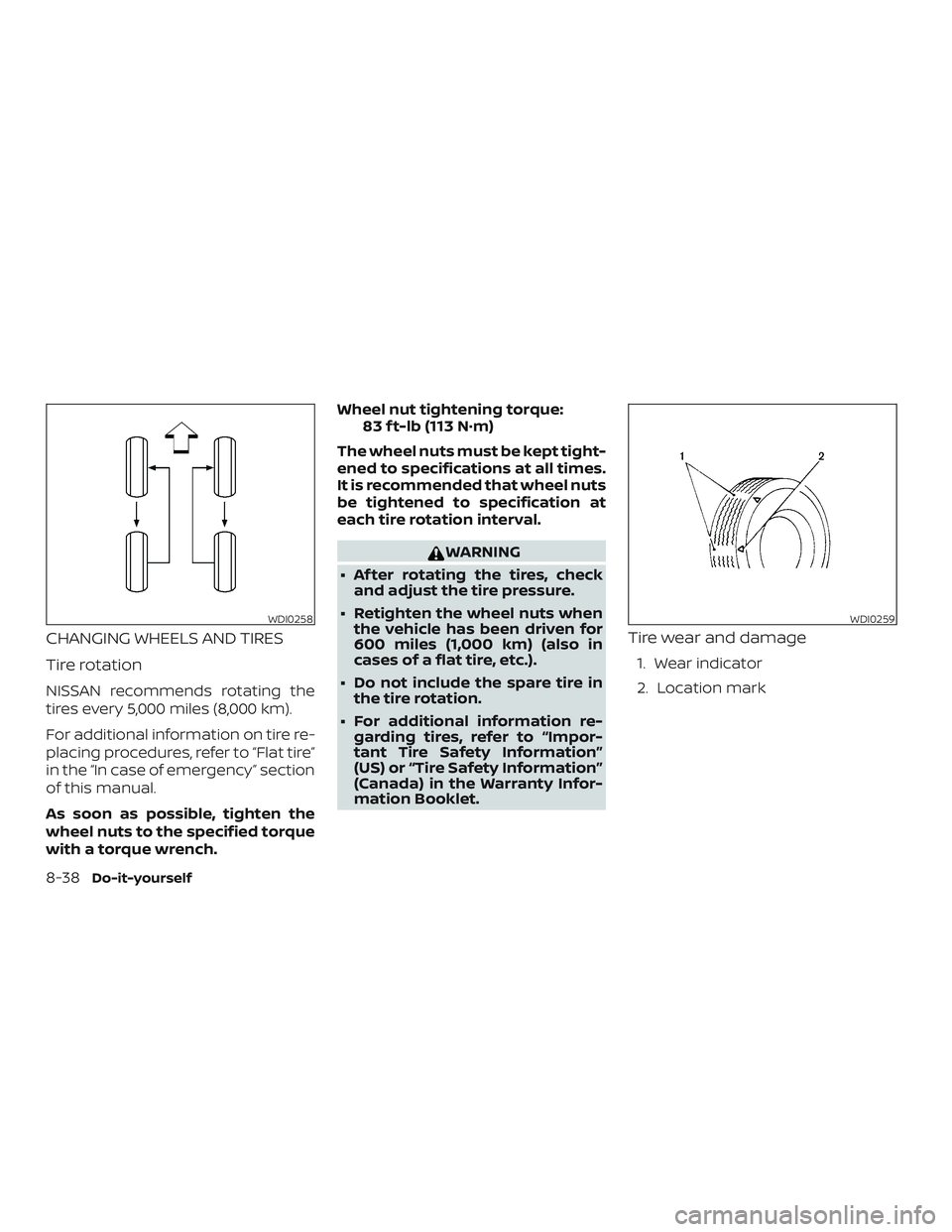
CHANGING WHEELS AND TIRES
Tire rotation
NISSAN recommends rotating the
tires every 5,000 miles (8,000 km).
For additional information on tire re-
placing procedures, refer to “Flat tire”
in the “In case of emergency” section
of this manual.
As soon as possible, tighten the
wheel nuts to the specified torque
with a torque wrench.Wheel nut tightening torque:
83 f t-lb (113 N·m)
The wheel nuts must be kept tight-
ened to specifications at all times.
It is recommended that wheel nuts
be tightened to specification at
each tire rotation interval.
WARNING
∙ Af ter rotating the tires, check and adjust the tire pressure.
∙ Retighten the wheel nuts when the vehicle has been driven for
600 miles (1,000 km) (also in
cases of a flat tire, etc.).
∙ Do not include the spare tire in the tire rotation.
∙ For additional information re- garding tires, refer to “Impor-
tant Tire Safety Information”
(US) or “Tire Safety Information”
(Canada) in the Warranty Infor-
mation Booklet.
Tire wear and damage
1. Wear indicator
2. Location mark
WDI0258WDI0259
8-38Do-it-yourself
Page 333 of 388
WARNING
∙ Tires should be periodically in- spected for wear, cracking,
bulging or objects caught in the
tread. If excessive wear, cracks,
bulging or deep cuts are found,
the tire(s) should be replaced.
∙ The original tires have built-in tread wear indicators. When the
wear indicators are visible, the
tire(s) should be replaced.
∙ Tires degrade with age and use. Have tires, including the spare,
over 6 years old checked by a
qualified technician because
some tire damage may not be
obvious. Replace the tires as
necessary to prevent tire failure
and possible personal injury.
∙ Improper service of the spare tire may result in serious per-
sonal injury. If it is necessary to
repair the spare tire, it is recom-
mended that you visit a NISSAN
dealer for this service. ∙ For additional information re-
garding tires, refer to “Impor-
tant Tire Safety Information”
(US) or “Tire Safety Information”
(Canada) in the Warranty Infor-
mation Booklet.
Replacing wheels and tires
When replacing a tire, use the same size,
tread design, speed rating and load carry-
ing capacity as originally equipped. For ad-
ditional information, refer to “Wheels and
tires” in the “Technical and consumer infor-
mation” section of this manual.
WARNING
∙ The use of tires other than those rec-
ommended or the mixed use of tires
of different brands, construction
(bias, bias-belted or radial), or tread
patterns can adversely affect the ride,
braking, handling, Vehicle Dynamic
Control (VDC) system, ground clear-
ance, body-to-tire clearance, tire
chain clearance, speedometer cali-
bration, headlight aim and bumper
height. Some of these effects may
lead to accidents and could result in
serious personal injury. ∙ If your vehicle was originally
equipped with four tires that were the
same size and you are only replacing
two of the four tires, install the new
tires on the rear axle. Placing new tires
on the front axle may cause loss of
vehicle control in some driving condi-
tions and cause an accident and per-
sonal injury.
∙ If the wheels are changed for any rea- son, always replace with wheels
which have the same off-set dimen-
sion. Wheels of a different off-set
could cause premature tire wear, de-
grade vehicle handling characteris-
tics, affect the VDC system and/or in-
terference with the brake
discs/drums. Such interference can
lead to decreased braking efficiency
and/or early brake pad wear. For ad-
ditional information on wheel off-set
dimensions, refer to “Wheels and
tires” in the “Technical and consumer
information” section of this manual.
Do-it-yourself8-39
Page 334 of 388
∙ When replacing a wheel without theTPMS, such as the spare tire, the TPMS
will not function and the low tire pres-
sure warning light will flash for ap-
proximately 1 minute. The light will re-
main on af ter 1 minute. Have your
tires replaced and/or TPMS system
reset as soon as possible. It is recom-
mended that you visit a NISSAN dealer
for this service.
∙ Replacing tires with those not origi- nally specified by NISSAN could affect
the proper operation of the TPMS (if so
equipped).
∙ The TPMS sensor may be damaged if it is not handled correctly. Be careful
when handling the TPMS sensor.
∙ When replacing the TPMS sensor, the ID registration may be required. Con-
tact a NISSAN dealer for ID
registration.
∙ Do not use a valve stem cap that is not specified by NISSAN. The valve stem
cap may become stuck. ∙ Be sure that the valve stem caps are
correctly fitted. Otherwise the valve
may be clogged up with dirt and
cause a malfunction or loss of
pressure.
∙ Do not install a damaged or deformed wheel or tire even if it has been re-
paired. Such wheels or tires could
have structural damage and could fail
without warning.
∙ The use of retread tires is not recommended.
∙ For additional information regarding tires, refer to “Important Tire Safety
Information” (US) or “Tire Safety Infor-
mation” (Canada) in the Warranty In-
formation Booklet.
Wheel balance
Unbalanced wheels may affect vehicle
handling and tire life. Even with regular use,
wheels can get out of balance. Therefore,
they should be balanced as required. Wheel balance service should be per-
formed with the wheels off the vehicle.
Spin balancing the wheels on the vehicle
could lead to mechanical damage.
∙ For additional information regarding
tires, refer to “Important Tire Safety
Information” (US) or “Tire Safety In-
formation” (Canada) in the Warranty
Information Booklet.
Care of wheels
∙ Wash the wheels when washing the ve- hicle to maintain their appearance.
∙ Clean the inner side of the wheels when the wheel is changed or the underside
of the vehicle is washed.
∙ Do not use abrasive cleaners when washing the wheels.
∙ Inspect wheel rims regularly for dents or corrosion. Such damage may cause
loss of pressure or poor seal at the tire
bead.
∙ NISSAN recommends waxing the road wheels to protect against road salt in
areas where it is used during winter.
8-40Do-it-yourself
Page 335 of 388
Spare tire (TEMPORARY USE ONLY
spare tire)
When replacing a wheel without the TPMS
such as the spare tire, the TPMS will not
function.
Observe the following precautions if the
TEMPORARY USE ONLY spare tire must be
used. Otherwise, your vehicle could be
damaged or involved in an accident:
WARNING
∙ The spare tire should be used foremergency use only. It should be re-
placed with the standard tire at the
first opportunity to avoid possible tire
or differential damage.
∙ Drive carefully while the TEMPORARY USE ONLY spare tire is installed. Avoid
sharp turns and abrupt braking while
driving.
∙ Periodically check spare tire inflation pressure. Always keep the pressure of
the TEMPORARY USE ONLY spare tire
at 420 kPa, 4.2 bar (60 psi). ∙ With the TEMPORARY USE ONLY spare
tire installed do not drive the vehicle
at speeds faster than 50 mph
(80 km/h).
∙ When driving on roads covered with snow or ice, the TEMPORARY USE
ONLY spare tire should be used on the
rear wheels and the original tire used
on the front wheels (drive wheels).
∙ Tire tread of the TEMPORARY USE ONLY spare tire will wear at a faster
rate than the standard tire. Replace
the spare tire as soon as the tread
wear indicators appear.
∙ Do not use the spare tire on other vehicles.
∙ Do not use more than one spare tire at the same time.
∙ Do not tow a trailer when the TEMPO- RARY USE ONLY spare tire is installed.
CAUTION
∙ Do not use tire chains on a TEMPO-RARY USE ONLY spare tire. Tire chains
will not fit properly and may cause
damage to the vehicle.
∙ Because the TEMPORARY USE ONLY spare tire is smaller than the original
tire, ground clearance is reduced. To
avoid damage to the vehicle, do not
drive over obstacles. Also, do not drive
the vehicle through an automatic car
wash since it may get caught.
Do-it-yourself8-41
Page 336 of 388
MEMO
8-42Do-it-yourself
Page 338 of 388
Some day-to-day and regular mainte-
nance is essential to maintain your vehi-
cle’s good mechanical condition, as well as
its emissions and engine performance.
It is the owner’s responsibility to make sure
that the scheduled maintenance, as well as
general maintenance, is performed.
As the vehicle owner, you are the only one
who can ensure that your vehicle receives
proper maintenance. You are a vital link in
the maintenance chain.
GENERAL MAINTENANCE
General maintenance includes those items
which should be checked during normal
day-to-day operation. They are essential
for proper vehicle operation. It is your re-
sponsibility to perform these procedures
regularly as prescribed.
Performing general maintenance checks
requires minimal mechanical skill and only
a few general automotive tools.
These checks or inspections can be done
by yourself, a qualified technician or, if you
prefer, a NISSAN dealer.
SCHEDULED MAINTENANCE
The maintenance items listed in this sec-
tion are required to be serviced at regular
intervals. However under severe driving
conditions, additional or more frequent
maintenance will be required.
WHERE TO GO FOR SERVICE
If maintenance service is required or your
vehicle appears to malfunction, have the
systems checked and corrected. It is rec-
ommended that you visit a NISSAN dealer
for this service.
NISSAN technicians are well-trained spe-
cialists who are kept up-to-date with the
latest service information through techni-
cal bulletins, service tips and in-dealership
training programs. They are completely
qualified to work on NISSAN vehiclesbe-
fore they work on your vehicle rather than
af ter they have worked on it.
You can be confident that a NISSAN deal-
er’s service department performs excellent
service to meet the maintenance require-
ments on your vehicle — in a reliable and
economical way. During the normal day-to-day operation of
the vehicle, general maintenance should
be performed regularly as prescribed in
this section. If you detect any unusual
sounds, vibrations or smells, be sure to
check for the cause or have it checked
promptly. In addition, it is recommended
that you visit a NISSAN dealer if you think
that repairs are required.
When performing any checks or mainte-
nance work, closely observe the “Mainte-
nance precautions” in the “Do-it-yourself ”
section of this manual.
EXPLANATION OF GENERAL
MAINTENANCE ITEMS
Additional information on the following
items with“*”isf
ound in the “Do-it-
yourself ” section of this manual.
Outside the vehicle
The maintenance items listed here should
be performed from time to time, unless
otherwise specified.
MAINTENANCE REQUIREMENTS GENERAL MAINTENANCE
9-2Maintenance and schedules
Page 341 of 388
Fluid leaks:Check under the vehicle for
fuel, oil, water or other fluid leaks af ter the
vehicle has been parked for a while. Water
dripping from the air conditioner af ter use
is normal. If you should notice any leaks or if
fuel fumes are evident, check for the cause
and have it corrected immediately.
Radiator and hoses: Check the front of the
radiator and clean off any dirt, insects,
leaves, etc., that may have accumulated.
Make sure the hoses have no cracks, defor-
mation, rot or loose connections.
Underbody: The underbody is frequently
exposed to corrosive substances such as
those used on icy roads or to control dust. It
is very important to remove these sub-
stances from the underbody, otherwise
rust may form on the floor pan, frame, fuel
lines and exhaust system. At the end of
winter, the underbody should be thor-
oughly flushed with plain water, in those
areas where mud and dirt may have accu-
mulated. For additional information, refer
to the “Appearance and care” section of this
manual.
Windshield-washer fluid*: Check that
there is adequate fluid in the reservoir. The following descriptions are provided to
give you a better understanding of the
scheduled maintenance items that should
be regularly checked or replaced. The
maintenance schedule indicates at which
mileage/time intervals each item requires
service.
Items marked with
“*”are recommended
by NISSAN for reliable vehicle operation.
You are not required to perform mainte-
nance on these items in order to maintain
the warranties which come with your
NISSAN. Other maintenance items and in-
tervals are required.
When applicable, additional information
can be found in the “Do-it-yourself ” section
of this manual.
NOTE:
NISSAN does not advocate the use of
non-OEM approved af termarket flush-
ing systems and strongly advises
against performing these services on a
NISSAN product. Many of the af termar-
ket flushing systems use non-OEM ap-
proved chemicals or solvents, the use of
which has not been validated by NISSAN. For recommended fuel, lubricants, fluids,
grease, and refrigerant, refer to “Recom-
mended fluids/lubricants and capaci-
ties” in the “Technical and consumer in-
formation” section of this manual.
EMISSION CONTROL SYSTEM
MAINTENANCE:
Drive belt*:
Check engine drive belt for
wear, fraying or cracking and for proper
tension. Replace any damaged drive belts.
Engine air filter: Replace at specified inter-
vals. When driving for prolonged periods in
dusty conditions, check/replace the filter
more frequently.
Engine coolant*: Replace coolant at the
specified interval. When adding or replac-
ing coolant, be sure to use only Genuine
NISSAN Long Life Antifreeze/Coolant (blue)
or equivalent with the proper mixture. (For
additional information on the proper mix-
ture for your area, refer to “Engine cooling
system” in the “Do-it-yourself ” section of
this manual.
NOTE: Mixing any other type of coolant
or the use of non-distilled water may re-
duce the recommended service interval
of the coolant.
EXPLANATION OF SCHEDULED
MAINTENANCE ITEMS
Maintenance and schedules9-5
Page 354 of 388
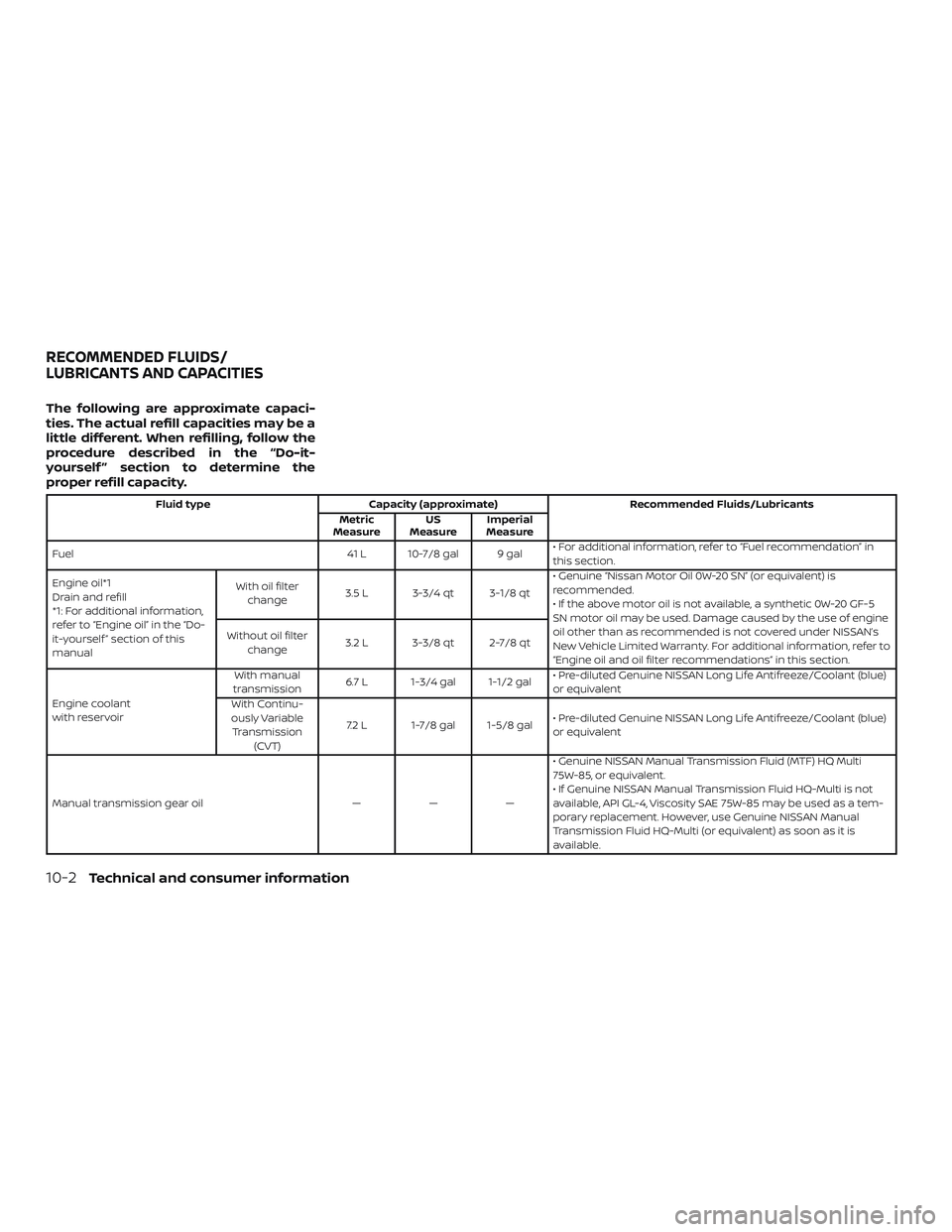
The following are approximate capaci-
ties. The actual refill capacities may be a
little different. When refilling, follow the
procedure described in the “Do-it-
yourself ” section to determine the
proper refill capacity.
Fluid typeCapacity (approximate) Recommended Fluids/Lubricants
Metric
Measure US
Measure Imperial
Measure
Fuel 41 L 10-7/8 gal 9 gal• For additional information, refer to “Fuel recommendation” in
this section.
Engine oil*1
Drain and refill
*1: For additional information,
refer to “Engine oil” in the “Do-
it-yourself ” section of this
manual With oil filter
change 3.5 L 3-3/4 qt 3-1/8 qt • Genuine “Nissan Motor Oil 0W-20 SN” (or equivalent) is
recommended.
• If the above motor oil is not available, a synthetic 0W-20 GF-5
SN motor oil may be used. Damage caused by the use of engine
oil other than as recommended is not covered under NISSAN’s
New Vehicle Limited Warranty. For additional information, refer to
“Engine oil and oil filter recommendations” in this section.
Without oil filter
change 3.2 L 3-3/8 qt 2-7/8 qt
Engine coolant
with reservoir With manual
transmission 6.7 L 1-3/4 gal 1-1/2 gal • Pre-diluted Genuine NISSAN Long Life Antifreeze/Coolant (blue)
or equivalent
With Continu-
ously Variable Transmission (CVT) 7.2 L 1-7/8 gal 1-5/8 gal
• Pre-diluted Genuine NISSAN Long Life Antifreeze/Coolant (blue)
or equivalent
Manual transmission gear oil ———• Genuine NISSAN Manual Transmission Fluid (MTF) HQ Multi
75W-85, or equivalent.
• If Genuine NISSAN Manual Transmission Fluid HQ-Multi is not
available, API GL-4, Viscosity SAE 75W-85 may be used as a tem-
porary replacement. However, use Genuine NISSAN Manual
Transmission Fluid HQ-Multi (or equivalent) as soon as it is
available.
RECOMMENDED FLUIDS/
LUBRICANTS AND CAPACITIES
10-2Technical and consumer information
Page 365 of 388
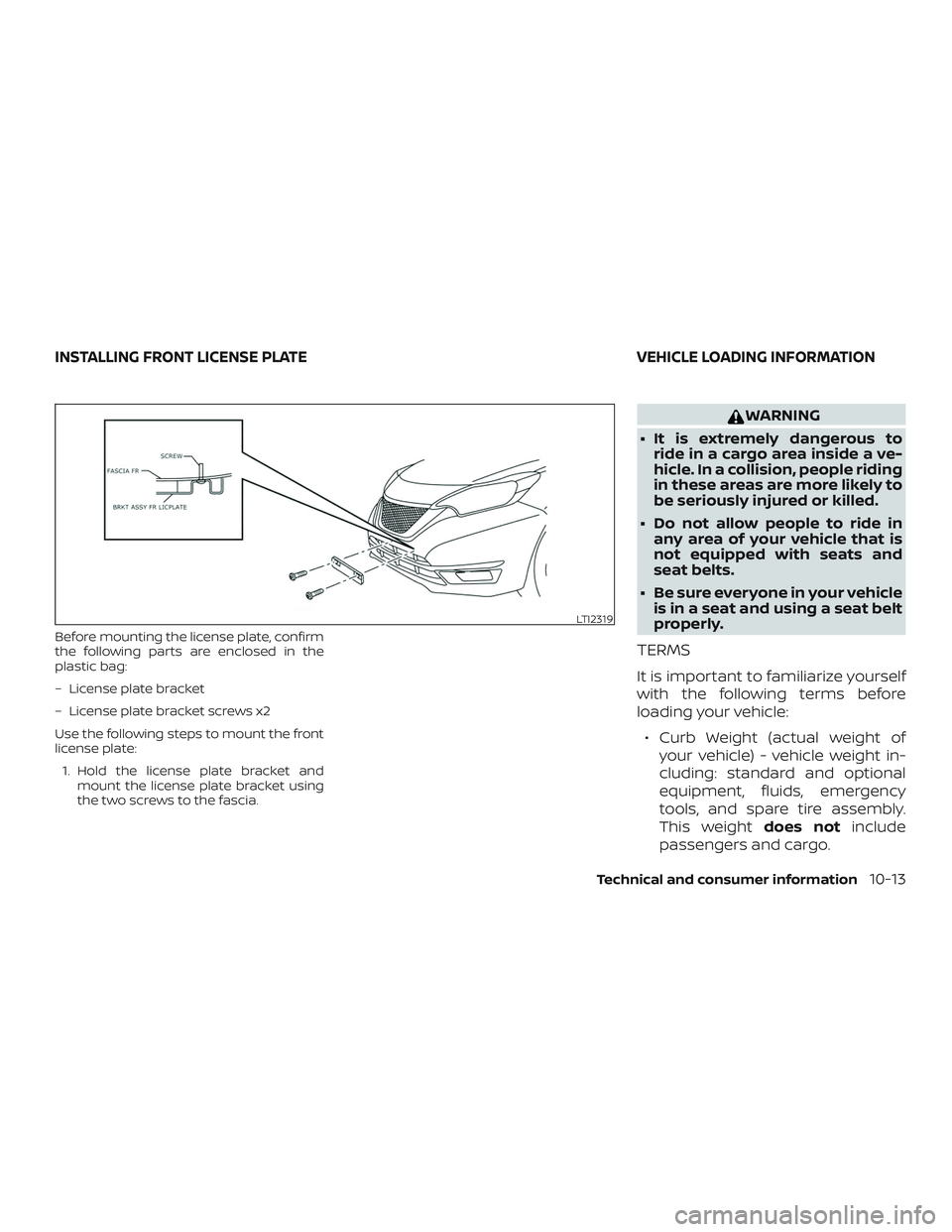
Before mounting the license plate, confirm
the following parts are enclosed in the
plastic bag:
– License plate bracket
– License plate bracket screws x2
Use the following steps to mount the front
license plate:1. Hold the license plate bracket and mount the license plate bracket using
the two screws to the fascia.
WARNING
∙ It is extremely dangerous to ride in a cargo area inside a ve-
hicle. In a collision, people riding
in these areas are more likely to
be seriously injured or killed.
∙ Do not allow people to ride in any area of your vehicle that is
not equipped with seats and
seat belts.
∙ Be sure everyone in your vehicle is in a seat and using a seat belt
properly.
TERMS
It is important to familiarize yourself
with the following terms before
loading your vehicle:
∙ Curb Weight (actual weight of your vehicle) - vehicle weight in-
cluding: standard and optional
equipment, fluids, emergency
tools, and spare tire assembly.
This weight does notinclude
passengers and cargo.
LTI2319
INSTALLING FRONT LICENSE PLATE VEHICLE LOADING INFORMATION
Technical and consumer information10-13